




Abstract


Delays in oral language development in early childhood can be an indicator for later reading disabilities and affect students’ overall school success through high school. Fortunately, there are research-based approaches to help young students at risk for reading disabilities make long-term improvements in their vocabulary development skills. This article is intended to translate the large body of research on shared reading into a five-step planning process for developing explicit vocabulary intervention in 1-week sequences. Descriptions are provided to assist teachers in designing shared reading instruction that includes guided play activities and an evaluation tool for determining students’ developing knowledge of the taught words.
Research findings have indicated that delays in oral language development appear at a young age and can be an indicator of slower growth in reading achievement over time compared to peers with typical language skills (Catts et al., 2008). In particular, evidence suggests vocabulary development, the cognitive process of giving meaning to a word, is predictive of academic success through the elementary and high school years (Beck & McKeown, 2007; Dickinson et al., 2010). This can be of particular concern for children of different language and cultural backgrounds who may have less experience with the kinds of language privileged in schools (Gatlin & Wanzek, 2017; Oller et al., 2007). Fortunately, meaningful experiences and multiple exposures to vocabulary in preschool and kindergarten classrooms may enrich language opportunities for children during their early years and improve outcomes for preschool children with the greatest need (Hindman et al., 2016; Phillips et al., 2016; Pollard-Durodola et al., 2016). Thus, this article presents the integration of two instructional methods for supporting young children’s language development: shared reading and guided play.
Shared Reading
Across research studies, findings suggest the likelihood of young children learning new vocabulary words can be increased by: (a) providing repeated exposures to new words (Biemiller & Boote, 2006), (b) offering explicit definitions of new words (Biemiller & Boote, 2006), (c) presenting new words in a meaningful text or theme rather than in isolation (Beck et al., 2013), and (d) having adults encourage children to use words in conversation in whole groups, small groups, or one-on-one (Justice et al., 2018). In classroom settings, adult–child dialogues about new vocabulary words during storybook read-alouds has been associated with improved outcomes for children with or at risk for reading difficulties (Wasik et al., 2016).
Shared reading encompasses a variety of interactive experiences in which an adult reads a book to children, models proficient skills, and guides the children in discussing aspects of the book (What Works Clearinghouse, 2006). Because few prekindergarten and kindergarten students can read independently, shared reading and subsequent discussions facilitated by the teacher are the primary methods for granting young children access to text (De Temple & Snow, 2001).
Guided Play
Another instructional approach that offers rich opportunities to use new vocabulary words with support of an adult is guided play. Guided play is defined as an adult playing with children while scaffolding and modeling specific literacy and language skills (Roskos & Christie, 2011a). For example, guided play can support story retelling skills by using props to represent characters and objects from a storybook (Roskos & Christie, 2011b). Teachers can select toys, like stuffed animals, that depict characters in the storybook. Children use the stuffed animals to reenact the story or dialogue about the characters and events in the story (Roskos & Christie, 2011b). Guided play also might be used to reinforce new vocabulary words that are introduced during shared reading lessons (Bond & Wasik, 2009). The teacher’s role in this application of guided play is to facilitate additional exposures to target vocabulary words by providing a high degree of student–teacher interactions, such as by initiating conversations about the target vocabulary words.
Hadley and Dickinson (2019) report several language-support strategies that teachers should consider when implementing guided play for oral language development. Teachers can model how to use new words during a conversation and expand on student responses by restating the target word and providing an accurate definition of the word. Additionally, teachers can ask open-ended questions to help students build an understanding of the vocabulary words.
Drawing on the available literature, the present article provides classroom teachers with a five-step guide for planning an explicit vocabulary intervention incorporating shared reading and guided play. The approach described here is intended for lessons that will be developed in small-group or one-on-one settings and with homogenous or heterogeneous groups of students. Individual and small-group instruction allow for a high degree of student–teacher engagement, which may increase students’ opportunities to respond and teachers’ ability to provide immediate feedback (Gunn et al., 2011).
Preparing for Shared Reading and Guided Play Intervention
Although shared reading and guided play can be implemented at home, the focus of this five-step process is on a school-based shared reading and guided play vocabulary intervention for students at risk of language delays. This article discusses five steps for planning intervention lessons in a classroom setting:
Select the storybooks
Identify the target vocabulary words
Script the vocabulary introduction and reinforcement
Prepare multiple exposures
Assess student learning
“Meaningful experiences and multiple exposures to vocabulary in preschool and kindergarten classrooms may enrich language opportunities for children during their early years.
Ms. Rodriguez is a kindergarten general education teacher. She is working with small groups of kindergarten students who are at risk for reading difficulties. Recent evaluations show that her students scored at or below the 25th percentile on standardized language measures. Additionally, all students receive free or reduced-price lunch, indicating their families are economically disadvantaged. Ms. Rodriguez knows that she needs to support her students’ vocabulary development, so she consults with a colleague in special education, Mr. Ngyuen, about implementing a vocabulary intervention for 30 minutes of the daily literacy block over the next 5 weeks. Together Ms. Rodriguez and Mr. Ngyuen plan the vocabulary intervention in five steps.
The thoroughness of the planning for the shared reading and guided play is intended to ensure students will have meaningful and successful experiences in building their oral language vocabulary.
Step 1: Select the Storybooks
The first step of preparing for the intervention is to identify the right kinds of books to use. Researchers have offered several insights into ensuring the books read to children will make the experience engaging and provide meaningful opportunities for vocabulary development (Hargrave & Sénéchal, 2000; Justice et al., 2005). First, teachers should look for books with appealing illustrations that help tell the story. This can support students’ interest and understanding of the context for the vocabulary (Martinez & Harmon, 2012). Second, the books should include words that are not familiar to students so that there are opportunities to expand their vocabularies (Beck et al., 2013).
Because the teacher will be stopping throughout the shared reading portion of the lesson to discuss the words, the third recommendation is that the book be a reasonable length (Hargrave & Sénéchal, 2000; Justice et al., 2005). That is, the book needs to be long enough to present a quality story but short enough to allow for conversation without losing students’ attention in a lengthy activity. The books can be fictional or informational, but they should present age-appropriate content and ideas. To these recommendations, other researchers have added that teachers should implement culturally responsive instruction that honors students’ races, ethnicities, and personal experiences (Yenika-Agbaw & Napoli 2011). Moreover, teachers should select literature that resonates with students’ identities as members of a specific cultural group and promotes the use of students’ background knowledge to assist vocabulary development and reading comprehension (Conrad et al., 2003; Méndez et al., 2015).
“Teachers should select literature that resonates with students’ identities as members of a specific cultural group and promotes the use of students’ background knowledge to assist vocabulary development and reading comprehension.
In previous studies, the number of books selected for a vocabulary intervention has varied (Wasik et al., 2016). Based on the types of activities planned for the five-step instructional process presented here, two new books related by theme will be introduced during 1 week of the vocabulary intervention lessons (Pollard-Durodola et al., 2011). As shown in Figure 1, the teacher will introduce one of the new books on Day 1 and the other new book on Day 3 of the week. The day after a book is introduced (Days 2 and 4, respectively), the teacher will read the book again to offer additional exposures to vocabulary.
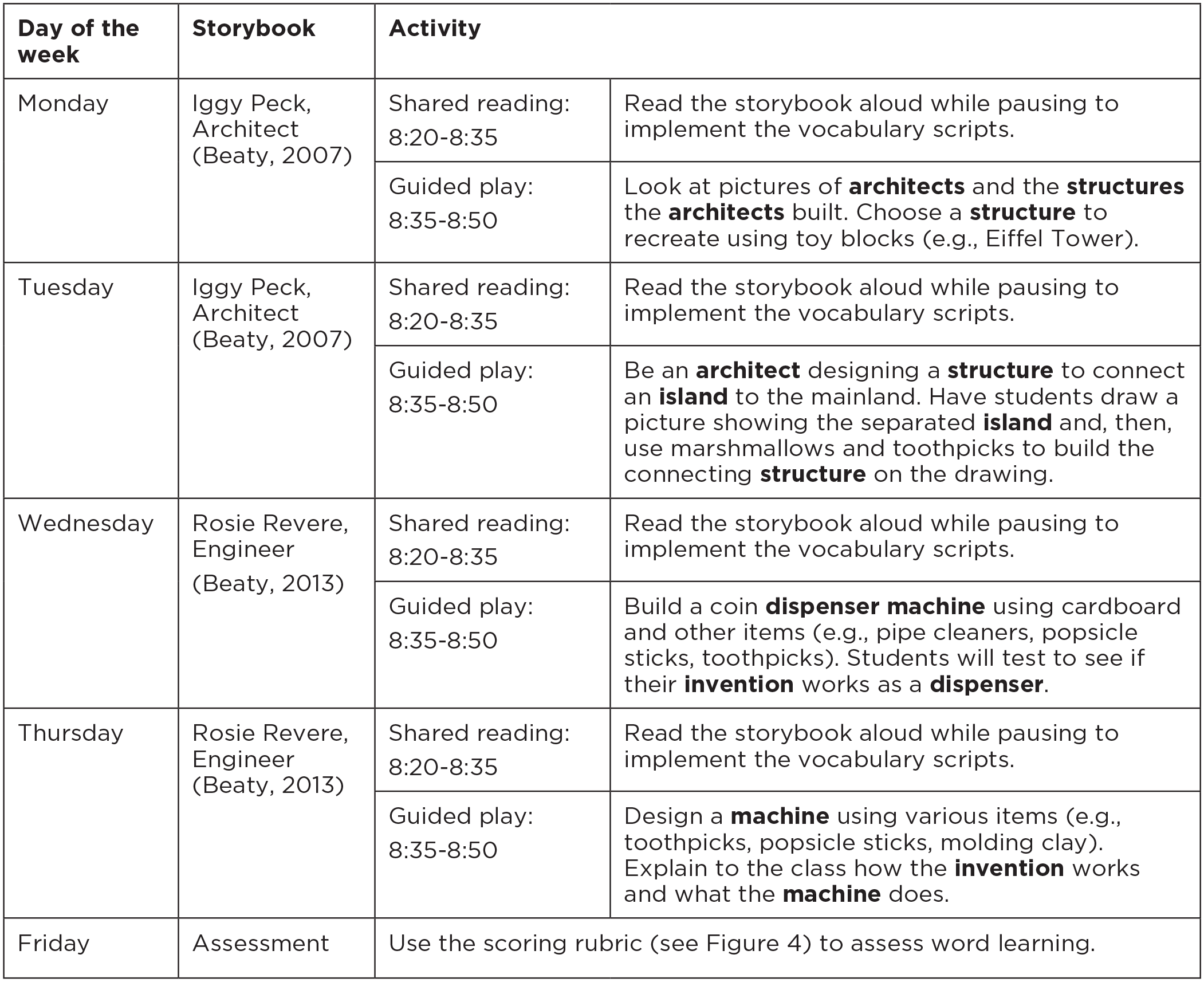
Sample 1-week instructional sequence
Ms. Rodriguez works with Mr. Ngyuen to select books for her vocabulary intervention that have supportive illustrations and words that would be new to students’ oral language. The pair also want the books to contain not only age-appropriate content but also culturally relevant ideas. Ms. Rodriguez and Mr. Ngyuen use information from a questionnaire the school district had asked students’ families to complete for instructional planning purposes. The survey queried families’ language backgrounds, cultural identities, and home educational practices. Ms. Rodriguez and Mr. Ngyuen select books that reflect her students’ particular cultural groups and daily lives.
Ms. Rodriguez and Mr. Ngyuen review a few books and vocabulary words during their planning period. The first book is Brown Bear, Brown Bear, What Do You See? (Martin & Carle, 1967), which includes age-appropriate content and supportive illustrations. However, the book uses high-frequency words (e.g., “purple,” “bird,” “see”) that are likely familiar to kindergarten students. Consequently, Ms. Rodriguez and Mr. Ngyuen agree to exclude this book from the intervention.
The second book is The Book With No Pictures (Novak, 2014). This book contains familiar words (e.g., “rule,” “boring,” “voice”) and age-appropriate content for kindergarten students, but it lacks illustrations to support the context of the story. Thus, Ms. Rodriguez and Mr. Ngyuen exclude this book from the intervention.
The third book is Iggy Peck, Architect (Beaty, 2007). It contains a variety of academic words (e.g., “structure,” “architect,” “island”), supportive illustrations, and culturally relevant ideas. Ms. Rodriguez and Mr. Ngyuen select this book for the intervention because it satisfies all of the book selection criteria. A similar process is repeated until 10 books are selected for the intervention.
Step 2: Identify Target Vocabulary Words
After the books for shared reading have been identified, the next step is to select the vocabulary for the instructional conversations that will occur during the intervention. Target words may include nouns, verbs, and adjectives—all of which are considered important types of words for students in kindergarten to learn (Robbins & Ehri, 1994). More important than the part of speech of the words, the vocabulary chosen should reflect general academic language or high-frequency words that are likely unfamiliar to students but commonly encountered in other materials and resources (Beck et al., 2013). There is no definitive guidance on the number of new words that is optimal for a week of shared reading instruction, so the decision can be based on what is developmentally appropriate (i.e., part of speech known to students, grade-appropriate academic or high-frequency word.) for students as well as the amount of time planned for instruction and the length and content of the books (Beck et al., 2013). For example, two or three new words per book might be reasonable when delivering vocabulary instruction to young children in an intervention setting.
After identifying the vocabulary to feature during the shared reading and guided play, teachers should consult children’s dictionaries so that definitions reflect age-appropriate language. In addition to defining each word, teachers will provide examples of how to use the word in different contexts. Figure 2 provides an example of the target word embedded in the sentence from the storybook and an example of the target word applied in an everyday or familiar context to which students can relate (Beck et al., 2013). The same two or three words, definitions, and example sentences are used each day the associated storybook is read, as shown in Figure 1.
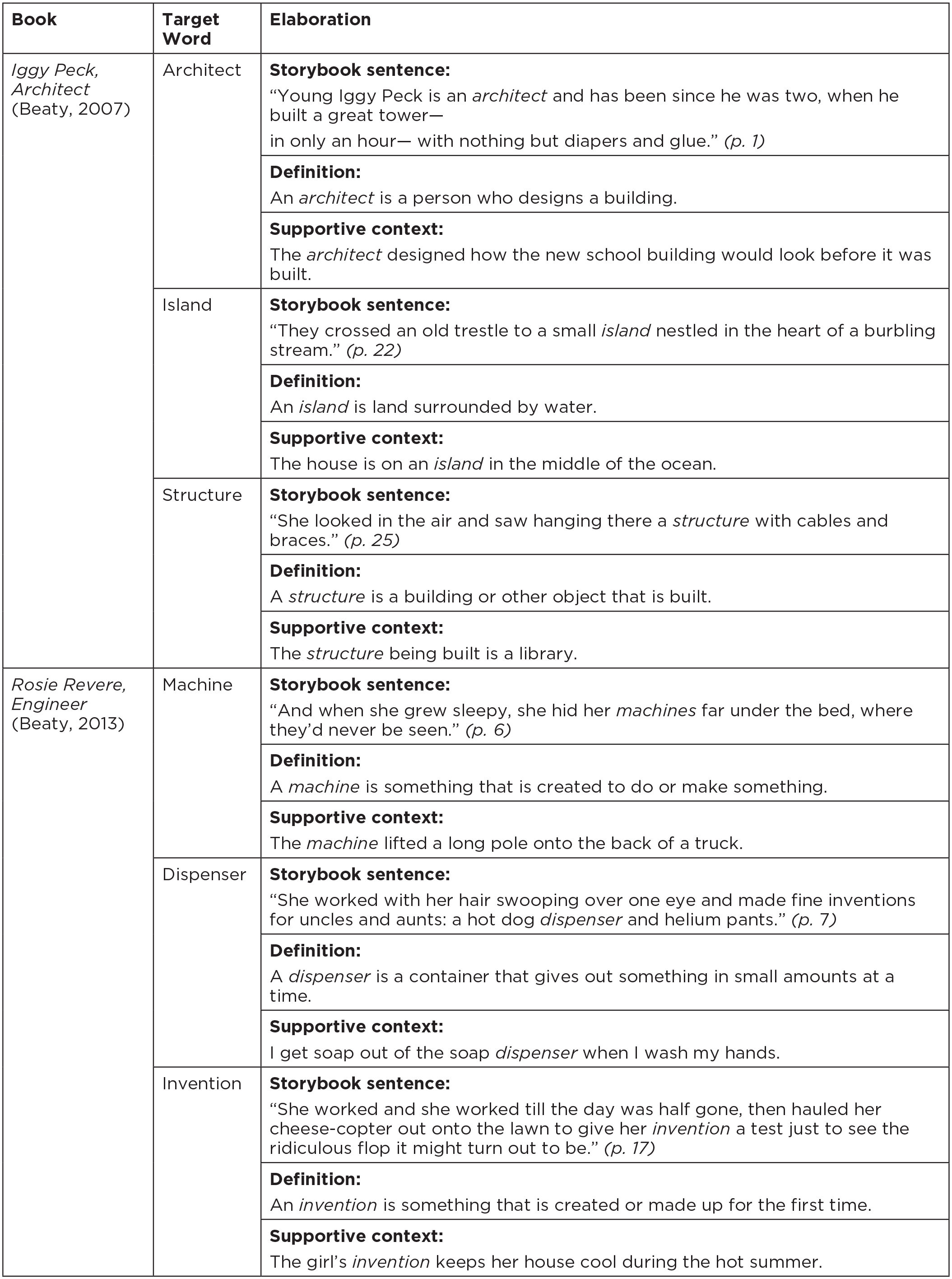
Example preparation for elaborating on the target vocabulary words during shared reading of Iggy Peck, Architect (Beaty, 2007) and Rosie Revere, Engineer (Beaty, 2013)
Ms. Rodriguez and Mr. Ngyuen identify a total of 30 target vocabulary words from 10 books, which include nouns, verbs, and adjectives that are likely unfamiliar to kindergarten students. The first book they analyze is Iggy Peck, Architect (Beaty, 2007). Ms. Rodriguez highlights the word “architect.” Kindergarten students are not likely to use “architect” in everyday conversations, but it could appear in academic materials. Thus, Ms. Rodriguez and Mr. Ngyuen select “architect” as a target vocabulary word.
They also consider the words “group,” “island,” “structure,” and “building.” Both “group” and “building” are excluded because they are high-frequency words and likely familiar to the students. However, Ms. Rodriguez and Mr. Ngyuen think “island” and “structure” are unfamiliar academic words that would be useful in different contexts. Therefore, “structure” and “island” are added to “architect” as the target vocabulary words for the first book.
Following these selection procedures, Ms. Rodriguez and Mr. Ngyuen identify three words from each of the other nine intervention books.
Step 3: Script the Vocabulary Introduction and Reinforcement
The next step in preparing for the intervention is to develop a script for introducing the vocabulary during shared reading and reinforcing the new word meanings during guided play. The script for shared reading includes the definitions of the identified vocabulary words and the example sentences of how to use the vocabulary words in the book and an everyday context (see example in Figure 2). Before shared reading, it is common for teachers to print the procedures on labels or sticky notes and attach them to the storybook pages where the words first appear. Labels serve as a reference tool for the teacher when delivering instruction and keep the transitions between reading and talking about words efficient.
The script for guided play includes an example of how the teacher can encourage the use of the new words, expand on student’s responses, and ask open-ended questions while carrying out the role-play or other guided play activity (see example in Figure 3). Preparing the scripts in advance may minimize teacher errors and other challenges that arise unexpectedly in a lesson, thus allowing teachers to concentrate on providing more meaningful exposures to the words during instruction (Justice et al., 2005).
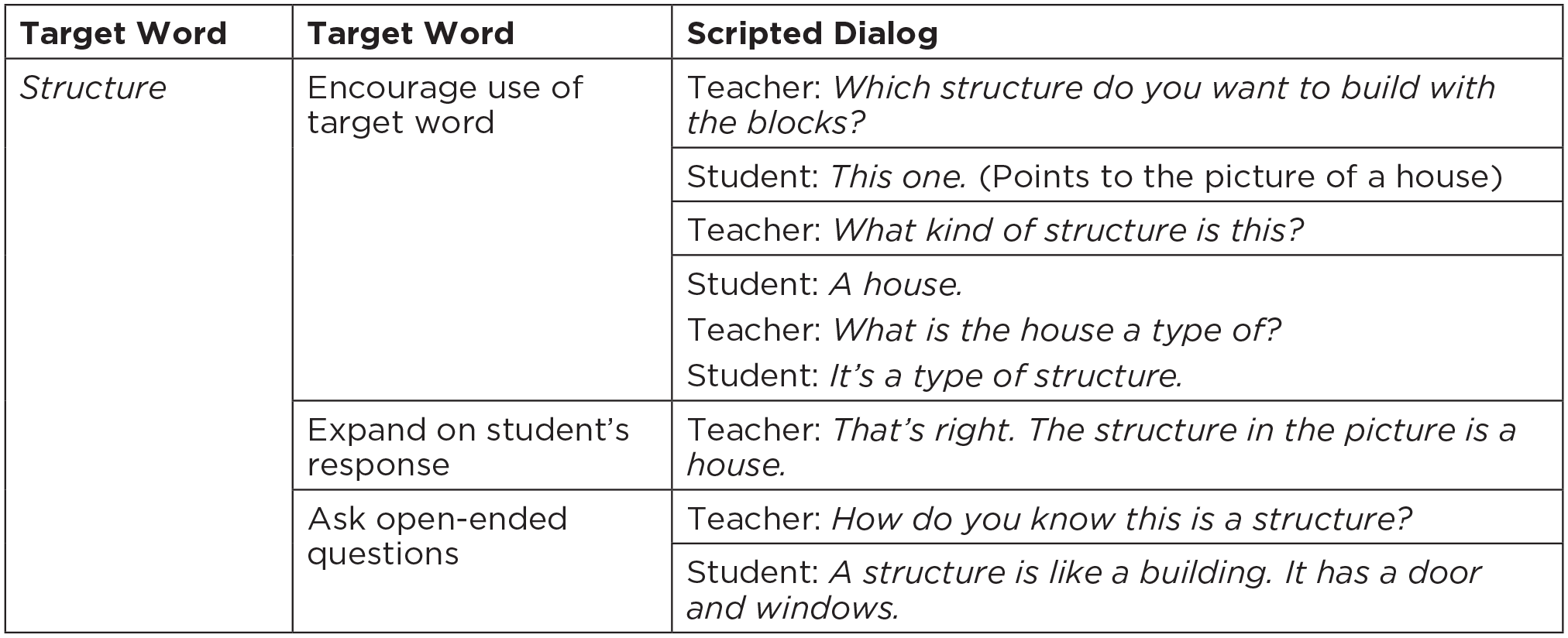
Example scripted dialog of teacher implementing the language support strategies during guided play following the shared reading of Iggy Peck, Architect (Beaty, 2007)
Ms. Rodriguez and Mr. Ngyuen develop a script for introducing new vocabulary words during shared reading. They create a master list of the storybook sentences, child-friendly definitions, and supportive contexts of all 30 vocabulary words. Then, Ms. Rodriguez and Mr. Ngyuen transfer this information for each word to a sticky note. For example, three labels are made for the words in Iggy Peck, Architect (2007): “structure,” “architect,” and “island.” Ms. Rodriguez creates the first label for the word, “structure.”
Storybook sentence: “She looked in the air and saw hanging there a structure with cables and braces.”
Definition: A structure is a building or other object that is built.
Supportive context: The structure being built is a library.
Ms. Rodriguez places the label in a discrete place on the page in which the word occurs in the book. Then, she and Mr. Ngyuen repeat these procedures until all 30 labels are made and placed in their corresponding book.
Step 4: Prepare for Multiple Exposures
Researchers agree that frequent, multiple, and varied exposures to target vocabulary words increase students’ ability to independently recall word meanings (Beck et al., 2013; Hadley & Dickinson, 2019; Justice et al., 2005). Thus, the third step of preparing for this vocabulary intervention is to plan guided play activities that provide students repeated exposures to target vocabulary words (Hadley & Dickinson, 2019). The purpose of guided play is to reinforce words that were introduced during the shared reading portion of the lesson. For example, during guided play, students can act out the role of an important character from the story, such as an architect (one of the vocabulary words), by using blocks or other manipulatives to build structures (another vocabulary word), like buildings, bridges, and towers. Other guided play examples can be seen in the instructional sequence outlined in Figure 1.
Ms. Rodriguez and Mr. Ngyuen prepare guided play activities that reinforce the new words—“architect,” “island,” and “structure”—from Iggy Peck, Architect (Beaty, 2007). All three words would be covered across 2 days of guided play sessions. The 1st day focuses on the words “structure” and “architect,” and the 2nd day incorporates the third vocabulary word, “island.”
“The purpose of guided play is to reinforce words that were introduced during the shared reading portion of the lesson.
Ms. Rodriguez and Mr. Ngyuen work together to design an activity for the 1st day of guided play. Ms. Rodriguez suggests that students build structures out of blocks while pretending to be architects. Mr. Ngyuen adds to her idea by recommending that students look at pictures of architects and the structures they built and recreate the structures using toy blocks. For example, they might show students the pictures of Stephen Sauvestre, Maurice Koechlin, and Émile Nouguier—the architects of the Eiffel Tower—and have students use their blocks to be the architects replicating the lattice tower.
Then, Ms. Rodriguez and Mr. Ngyuen develop a scripted dialogue that will encourage students to use the target word “structure” and ensure the teachers expand on students’ responses as well as ask open-ended questions during the guided play activity. First, Ms. Rodriguez plans to initiate the activity by presenting the pictures and asking students, “Which structure do you want to build with the blocks?” Mr. Ngyuen is concerned that students with language difficulties may respond to her question by pointing to the picture, so he suggests she ask a follow-up question, “What kind of structure is this?” Next, Ms. Rodriguez plans to expand on students’ responses by modeling how to use the vocabulary word in a complete sentence. For example, Ms. Rodriguez may respond by saying, “The structure in the picture is a house.” Last, they think about an open-ended question that will demonstrate students’ understanding of the word’s meaning. Mr. Ngyuen proposes, “How do you know this is a structure?” Ms. Rodriguez and Mr. Ngyuen follow similar procedures for developing a scripted dialogue for the word “architect.”
Step 5: Assess Student Learning
As is common in language and literacy interventions, it is important to monitor students’ progress in developing targeted knowledge and skills (Filderman et al., 2018). Therefore, to prepare for the last day of the instructional sequence (see sample in Figure 1), teachers will develop a scoring rubric for evaluating students’ understanding of the taught vocabulary (Justice et al., 2005; McGregor et al., 2013). Teachers will prompt students to verbally define the target vocabulary word by asking, “What is a [target word]?” If there is no response or partial response, teachers can ask a follow-up question, like “Can you show me or tell me anything else about [target word]?” (Hadley & Dickinson, 2019). The prepared rubric includes criteria for determining the accuracy of a student’s response (see sample in Figure 4). Points range from a low of 0 to a maximum of 2 per word. To earn 2 points, students must verbally provide an accurate definition of the target word or accurately use the target word in a sentence. To earn 1 point, students must verbally provide an easier or more frequently used word that is similar in meaning to the target word or that is an example of the word. No points are earned if students do not respond, incorrectly use the target word in a sentence, or offer an incorrect example of the target word. Rubrics are made specific to each vocabulary word to ensure teachers consider the ways their students might express developing knowledge about the words.
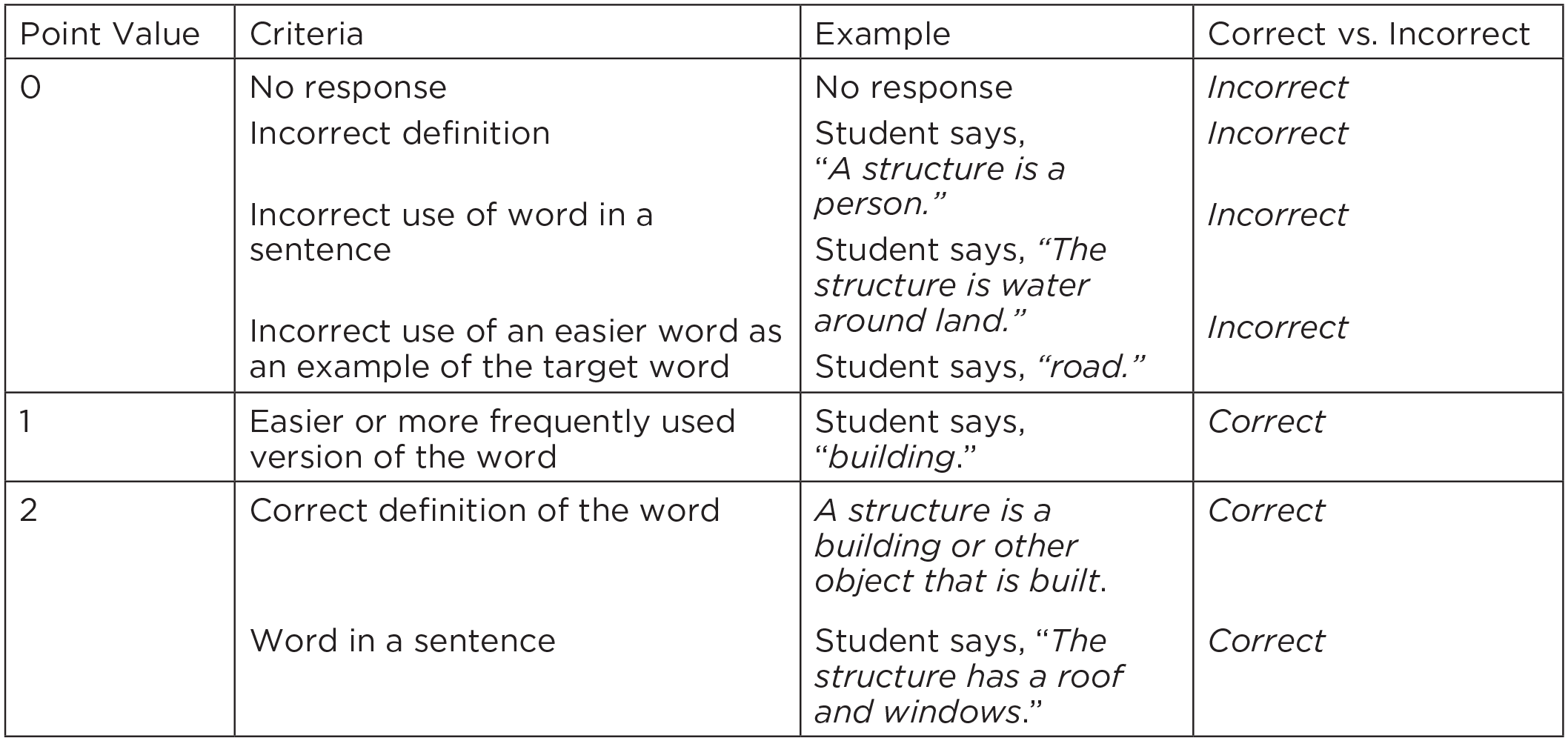
Scoring rubric criteria for the target word “structure”
Ms. Rodriguez wants to develop an objective and systematic scoring rubric for evaluating students’ word learning, so she drafts a rubric that consists of criteria and point values. She asks for Mr. Ngyuen’s help with anticipating student responses. She explains that students will verbally define each word during the assessment, and anticipating student responses will improve the fairness and accuracy of her evaluation. The pair discusses possible student responses for all 30 words.
The first word deliberated is “structure,” from Iggy Peck, Architect (Beaty, 2007). Ms. Rodriguez and Mr. Ngyuen start with the responses that would earn 2 points, the highest point value. To receive this score, students would have to provide the definition of the word or use the word in a sentence. Mr. Ngyuen refers to the child-friendly definition and thinks about how students might use “structure” in a sentence. He anticipates that student responses will be related to the way “structure” is used in the story and guided play, such as “The structure has a roof and windows.” Ms. Rodriguez adds that an incorrect use of the word in a sentence would be “The structure is water around land.”
“Explicit vocabulary interventions that incorporate shared reading and guided play have been a successful approach to helping students at risk for reading difficulties make gains in vocabulary development.
Students would receive 1 point for providing an easier or less sophisticated version of the word. Ms. Rodriguez suggests that any type of building, such as “house” or “library,” would be considered correct. Then, Mr. Ngyuen proposes that an incorrect example would be “road.” Ms. Rodriguez and Mr. Ngyuen follow this pattern of deliberation for the remaining target vocabulary words.
Conclusion
Many students enter school exhibiting a risk for reading difficulties because they lack the oral language development of peers who have had more exposure to rich vocabulary (Nelson et al., 2011). Fortunately, explicit vocabulary interventions that incorporate shared reading and guided play have been a successful approach to helping students at risk for reading difficulties make gains in vocabulary development (Hadley & Dickinson, 2019; Justice et al., 2005). To assist teachers with approach, this article discussed five steps for designing intervention lessons:
Step 1: Select the storybooks
Step 2: Identify target vocabulary words
Step 3: Script the vocabulary introduction and reinforcement
Step 4: Prepare for multiple exposures
Step 5: Assess student learning
Although this article focuses on students with or at risk for reading difficulties, the vocabulary intervention can be adapted to benefit English language learners (ELs) and students with more severe disabilities or with limited verbal speaking skills. To adapt intervention lessons for students with different needs, teachers can provide a preview of the target words prior to shared reading and guided play sessions. Working with either a small group or with individual students who need extra support, teachers can introduce students to the word, practice pronouncing it, and provide a concrete example of the word (e.g., a picture, familiar application, short video of the concept the word represents). Another type of adaptation teachers might make for ELs and students with limited verbal skills is to allow them to point to picture options during the vocabulary assessment so the students can demonstrate word knowledge nonverbally.
Explicit vocabulary instruction through shared reading and guided play provides students with meaningful exposures to new words (Roth, 2002) and can make a long-lasting difference in students’ reading achievement (Pollard-Durodola et al., 2016).
Footnotes
Declaration of Conflicting Interests
The author(s) declared no potential conflicts of interest with respect to the research, authorship, and/or publication of this article.
Funding
The author(s) received no financial support for the research, authorship, and/or publication of this article.
