




Abstract


Ms. Chris (preschool team leader and teacher) and Ms. Ashley (paraprofessional) have been working together in an early childhood special education classroom for the past 10 years. The children in their classroom have a variety of identified disabilities, and all currently have a language or literacy goal on their individualized education program. Ms. Ashley has expressed an interest in taking a more active role within the classroom in supporting children’s language and literacy development and wonders where to begin. Ms. Chris and Ms. Ashley identify shared book reading (SBR) as one instructional routine where language and literacy instruction is the focus and could be a good starting place for Ms. Ashley to assume responsibility in supporting children’s language and literacy skills and goals. Ms. Ashley has watched Ms. Chris as she reads to the children but is unsure how to go about planning for and then implementing strategies during SBR sessions. Team leaders at each grade level recently attended a workshop on coaching, and Ms. Chris believes this would be a great approach to support Ms. Ashley in developing the necessary skills.
High-quality early childhood (EC) education has emerged as a national priority alongside the need for ensuring practitioners have the knowledge and skills to support the learning of all children, including those with disabilities and delays (Snyder et al., 2012). To create high-quality learning environments that meet the needs of children requiring more intensive intervention due to learning or behavioral challenges (Sutherland et al., 2015), EC practitioners need more intensive professional development (PD) activities targeting implementation of evidence-based practices (EBPs; Becker & Domitrovich, 2011), such as shared book reading (SBR). Traditional forms of training (e.g., workshops) are effective at increasing practitioners’ awareness of intervention practices, but research suggests additional forms of PD are needed if the goal is to influence fidelity (i.e., the intervention is implemented as intended) and practitioners’ sustained use of the practice (Artman-Meeker et al., 2015).
A number of studies have reported on the impact of PD that includes both training and coaching on EC practitioners’ implementation of EBPs, with a focus on the following recommendations outlined by Snyder and colleagues (2015). First, the content of the PD should focus on explicit curricula, interventions, or sets of practices rather than general teaching methods, such as lesson planning or instructional grouping methods. Second, PD instructional strategies should include explicit explanations and illustrations of the content or practices to be learned. Finally, job-embedded support (i.e., coaching) is crucial for implementation fidelity, as learners are supported in using practices in context while also having the opportunity to reflect and receive performance feedback. Studies including these recommendations were generally associated with improved fidelity of implementation across the following areas: (a) social-emotional (Artman-Meeker et al., 2015), (b) positive behavior supports (Conroy et al., 2014), and (c) literacy (McCollum et al., 2013). In some, they resulted in positive learning outcomes for both children at risk for learning challenges and those with identified disabilities. Although this evidence is promising in terms of utilizing a specific form of PD (i.e., coaching) to support practitioners, Snyder and colleagues (2015) propose a coaching framework called practice-based coaching (PBC) with a specific focus on implementing evidence-based teaching practices with fidelity.
“Establishing a collaborative partnership that creates a context for shared decision making is essential to the success of PBC.
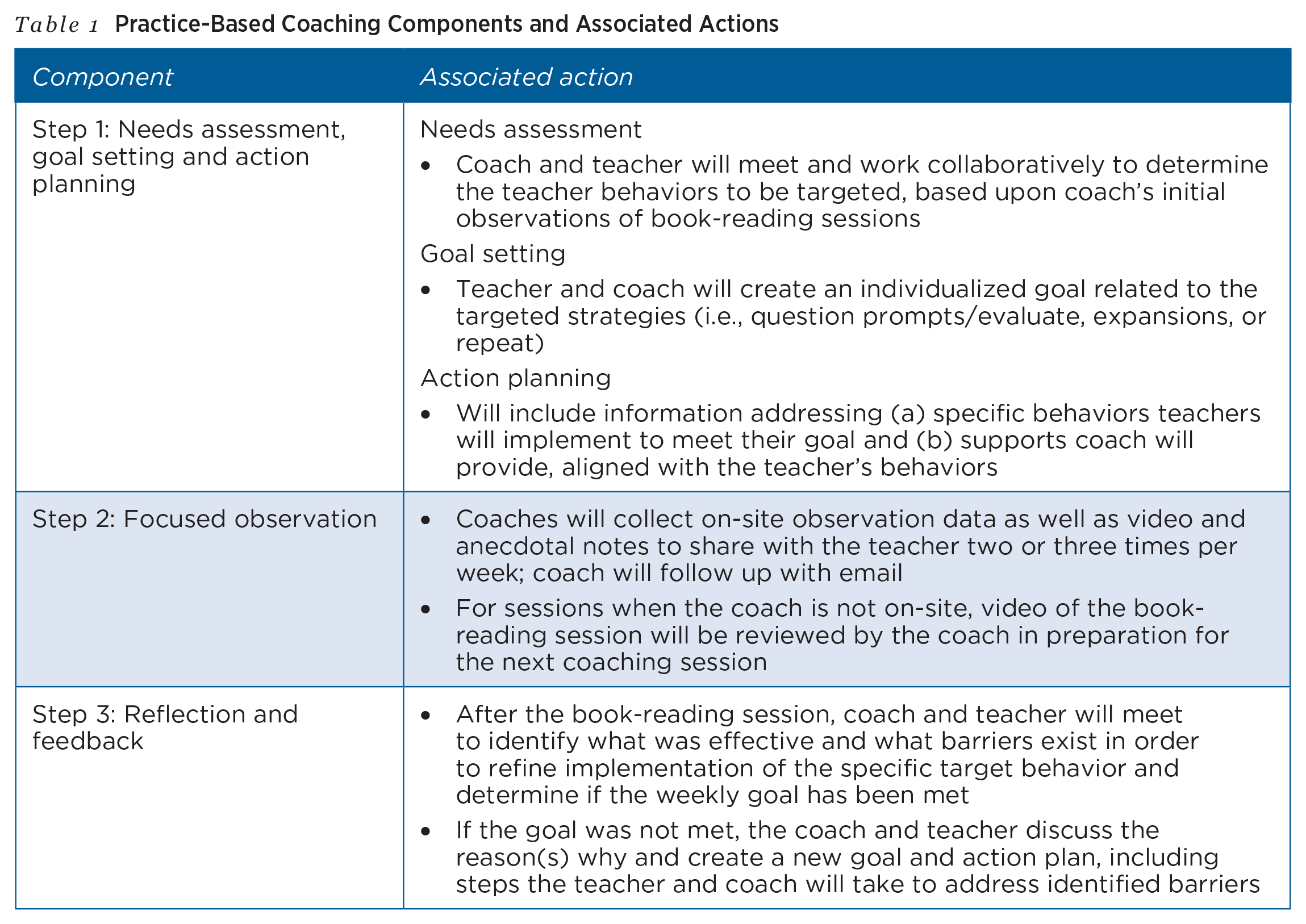
PBC is an individualized coaching model comprising three components: (a) shared goals and action planning, (b) focused observation, and (c) reflection and feedback. See Table 1 for components and associated actions. Establishing a collaborative partnership that creates a context for shared decision making is essential to the success of PBC. In PBC, teaching practices are derived from EBPs or recommended practices that, when implemented with fidelity, have been shown through research to be positively associated with child engagement and learning (Snyder et al., 2015).
Practice-Based Coaching Components and Associated Actions
Teachers and other related service personnel (e.g., speech-language pathologists) are the primary service providers to address the language and early literacy deficits present in preschool children with developmental disabilities (Towson et al., 2016). Paraprofessionals spend a significant amount of time interacting with children yet often feel undervalued in their ability to contribute within the classroom setting (Chopra et al., 2004). Research suggests paraprofessionals can successfully learn to incorporate strategies or therapeutic practices into early learning environments (Ledford et al., 2018) but may require support to implement these strategies correctly (Hall et al., 2010). A recent study by Towson and colleagues (2020) suggests paraprofessionals may be a viable source of expanding the direct instruction of evidence-based teaching practices for young children with language impairments in preschool settings if more consistent coaching and in-book supports are provided.
The purpose of this article is to describe Stages 1 to 3 of the PBC process in an EC education setting. Vignettes are used to portray a teacher as the coach (i.e., Ms. Chris) and a paraprofessional as the coachee (i.e., Ms. Ashley) as they work together to implement evidence-based teaching strategies during SBR sessions to improve early language and literacy outcomes for preschool children ages 3 to 5.
Step 1: Needs Assessment, Shared Goals and Action Planning
Ms. Chris and Ms. Ashley decide to use the PBC model as Ms. Ashley learns how to support children’s language and literacy during SBR. Ms. Chris conducts a needs assessment in which she observes two sessions of Ms. Ashley reading a storybook to the children and takes notes regarding the behaviors she believes Ms. Ashley can improve upon. The primary need identified is specific instructional strategies to encourage and develop language. During the initial coaching session, Ms. Chris and Ms. Ashley set a goal related to asking questions during SBR sessions that include preselected vocabulary targeting children’s language and literacy needs. As coach, Ms. Chris leads the session while ensuring Ms. Ashley contributes her ideas to the goal and action plan for the week. They collaborate to identify specific supports Ms. Ashley will need from Ms. Chris to be successful in meeting her goal. See Figure 1 for a sample action plan.
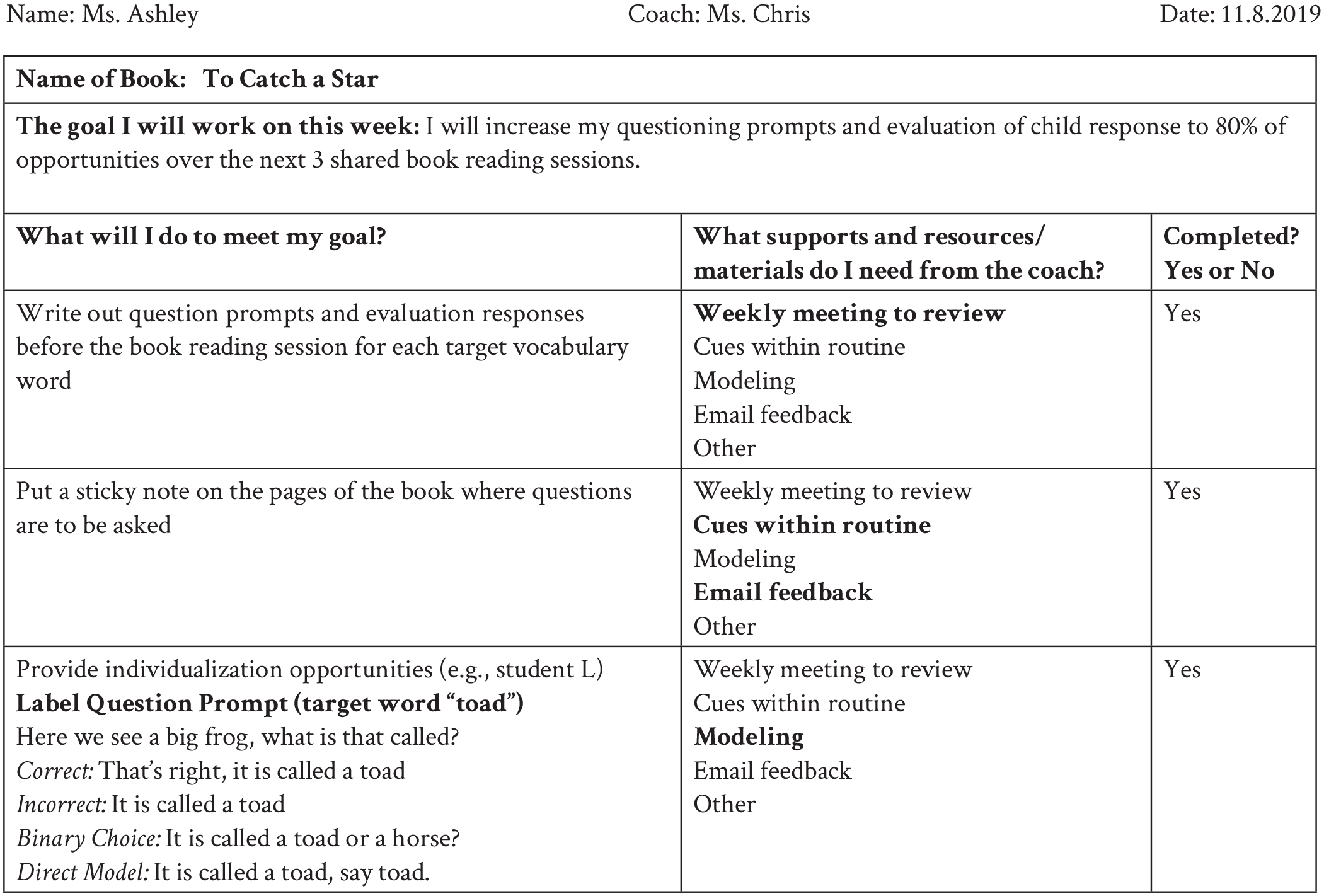
Sample action plan
During the shared-goals-and-action-planning component of the PBC process, the coach and coachee work together to create goals, actionable steps toward meeting those goals, and anticipated supports needed by the coachee (Snyder et al., 2015). When creating goals, a needs assessment may be done in which the coach observes the target behaviors of the coachee in order to gauge a starting point for a reasonable goal and performance criteria. Goals should be measurable, observable, and explicit (Snyder et al., 2015) while also considering the coachee’s strengths, needs, and preferences. As new goals are written or existing goals modified, support may also need to be adjusted.
Initial training may need to occur when a new skill or process is being learned by the coachee. For example, the coach may provide direct instruction on the behaviors to be implemented, model the procedures while the coachee observes, and role-play with the coachee while providing feedback for both correct and incorrect implementation examples (Lerman et al., 2019).
After completing the action plan, Ms. Chris shares specific strategies and techniques for teaching vocabulary that will help Ms. Ashley support children’s language and literacy needs during SBR. First, she shares three preselected target vocabulary words that are likely unknown to the children and are written in text or depicted in an illustration of the book as well as corresponding child-friendly definitions. Then, using a sample storybook, Ms. Chris models the first part of the instructional sequence. She states the target word and definition that will be found on the page, reads the page, then asks the preplanned question about the target vocabulary word. Ms. Ashley plays the role of the child to respond to the question, and then Ms. Chris evaluates her answer. Together, they read through the sample storybook and take turns role-playing while labeling and defining the vocabulary word on each page, asking the question prompts, and evaluating responses. Once Ms. Ashley is confident in the strategies, she selects a book she would like to read, and together they complete a teacher resource table following the same instructional sequence. Ms. Chris refers Ms. Ashley back to her action plan to review her goal. To end the coaching session, they schedule three focused observations of Ms. Ashley reading to the children.
Step 2: Focused Observation
As outlined by Snyder and colleagues (2015), the term observation refers to processes associated with gathering information about fidelity of practice implementation and is guided by the action plan and associated goals. Information gathered during the focused observation should be specific to the goal outlined in the action plan rather than a general observation. During the focused observation, the coach takes notes (both quantitative and qualitative) about the teacher’s action plan goal related to implementation of targeted strategies. Figure 2 provides a sample data collection form to be used alongside the teacher resource table. This will allow the coach to collect data in real time or via video recording as it serves as an easy reference for the strategies being implemented.
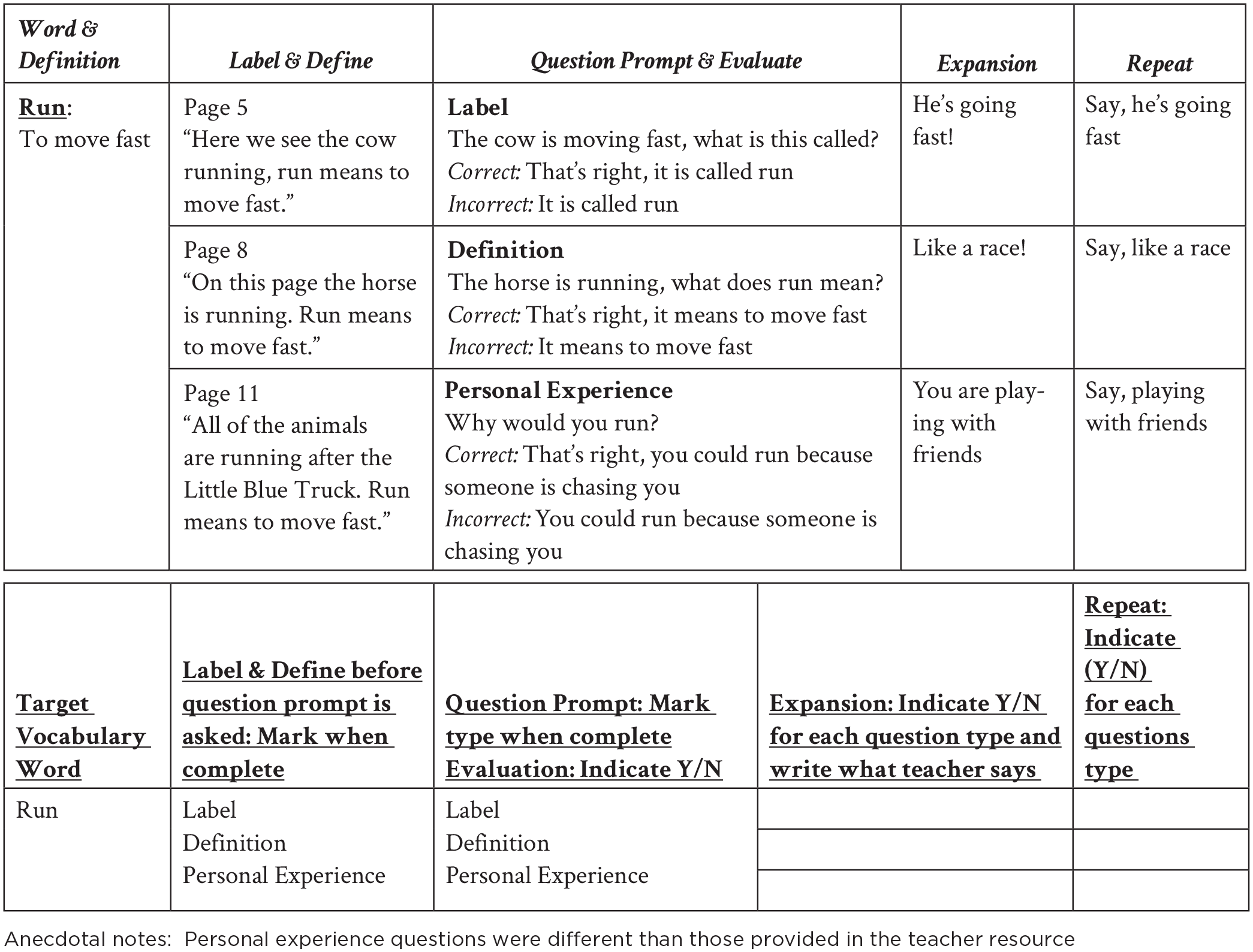
Sample teacher resource table and data collection form
Ms. Chris observes and records data during three of Ms. Ashley’s SBR sessions over the course of the week. Data recorded include anecdotal notes (i.e., qualitative data) as well as a frequency count (i.e., quantitative data) for each opportunity to ask a question (i.e., label, definition, and personal connection) and provide the corresponding evaluation for correct or incorrect response. Ms. Ashley has six to nine opportunities (depending on number of words selected) to ask a question and evaluate the response. Both must occur for the opportunity to be scored as correct. Ms. Chris creates a simple line graph to visually depict Ms. Ashley’s behavior. Ms. Chris inserts the graph, summary of the data, and anecdotal notes into the performance feedback form she created (see Figure 3). She will collaborate with Ms. Ashley during the next coaching session to evaluate progress toward her goal.
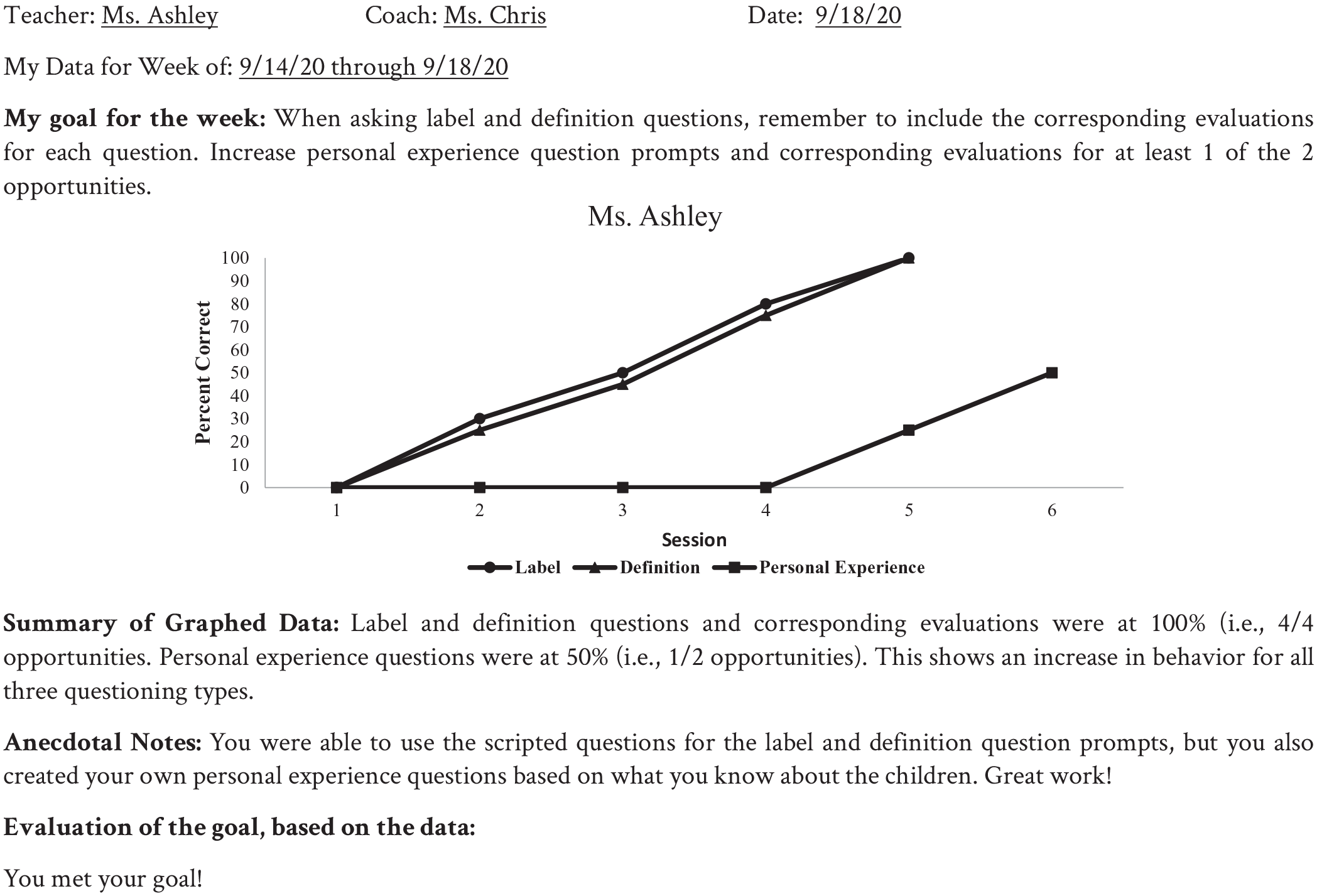
Performance feedback sheet
Step 3: Reflection and Feedback
The reflection component involves coach and coachee reviewing the action plan as well as data gathered about practice implementation to identify successes, challenges, motivators, or next steps needed to improve or refine the teaching practice (Snyder et al., 2015). Within the PBC coaching model, feedback provided is performance based, or specific to the individual’s behavior. Supportive feedback is used to identify and provide positive aspects of the teaching practice and connects information from the observation with the goals and associated action plan to help illustrate progress. Constructive feedback is used to help identify opportunities to improve or refine teaching practices, are specific, and outline steps for strengthening fidelity of practice implementation. Instructional statements can be used to inform or teach about how to enhance future implementation of the targeted teaching practices. Clarifying and probing questions can be used to, respectively, confirm understanding or actions and encourage the coachee to share personal opinions, perspectives, or feelings related to the target practices (Shannon et al., 2020). Finally, reflection and feedback strategies can include review of data, role-play, problem-solving conversations, and modeling of practices (Snyder et al., 2015).
The extent to which coaching has a measurable and replicable effect on teachers’ use of evidence-based teaching practices is contingent upon coaches implementing an evidence-based coaching framework, like PBC, with fidelity (Shannon et al., 2020). Figure 4 provides a protocol to assist the coach in facilitating each coaching session, leading to increased fidelity to the coaching framework while still allowing for individualization within the process (Shannon et al., 2020). Following each session, the coach sends an email to summarize feedback and discuss next steps.
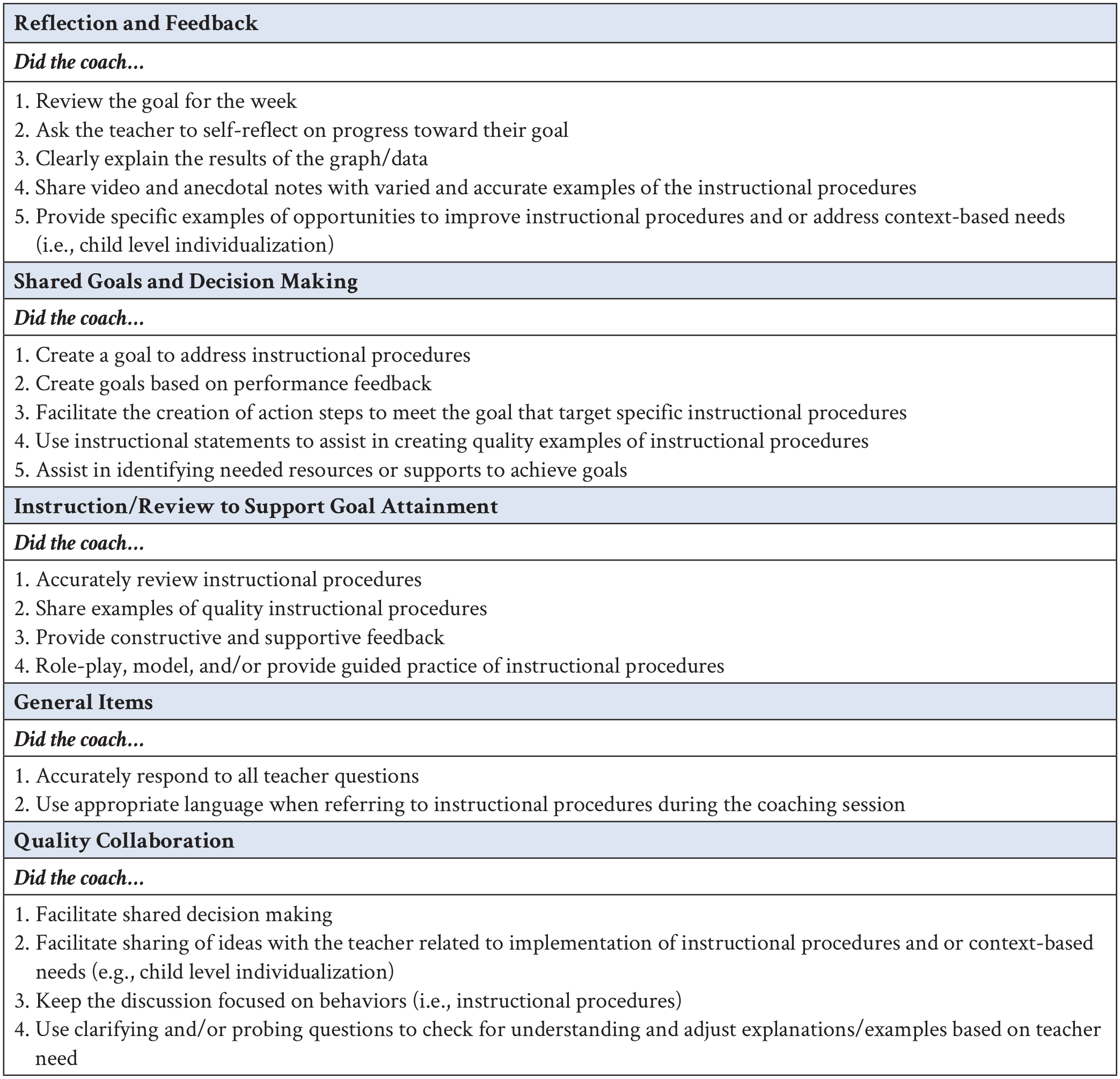
Coaching checklist
During the next coaching session, Ms. Chris and Ms. Ashley review the performance feedback sheet while Ms. Chris provides both supportive and constructive feedback. Ms. Ashley shares how difficult it was to remember everything during SBR despite writing down question prompts and evaluations and adding sticky notes to book pages. Ms. Chris shares her anecdotal notes and data collected, explaining Ms. Ashley did a nice job asking label and definition questions followed by evaluating the child’s response but struggled to incorporate the questions related to personal experience. Upon closer examination of the data, they determined label and definition questions and corresponding evaluations were at 100% (4/4 opportunities), but personal experience questions were at 0% (0/2 opportunities). Together they revise Ms. Ashley’s goal to increase personal-experience question prompts and corresponding evaluations to 100%. In determining how to best approach the new goal, Ms. Chris and Ms. Ashley problem solve and decide having the teacher resource sheet as a reference during the SBR sessions would be helpful. The action plan is updated to reflect this additional support. To end the coaching session, Ms. Chris checks for understanding by asking Ms. Ashley to share her questions, concerns, and feelings. A couple of days later, Ms. Chris emails Ms. Ashley with specifics regarding their conversation.
Given the cyclical process of PBC, additional coaching sessions will likely be necessary for the coachee to master each behavior. Mastery will be determined by the goal and associated action plan developed by the coach and coachee. The coach and coachee can determine a reasonable time frame for fading weekly coaching sessions based on progress toward goals and coachee need for support. Once the coachee consistently reaches performance criterion (e.g., at least three consecutive sessions), more time between coaching sessions or increased autonomy for the coachee may be appropriate. Ultimately, coaching sessions would cease when the coachee is comfortable and confident in their abilities to independently implement the targeted behaviors.
Snyder and colleagues (2015) identified additional factors influencing the need for coaching. These factors include the number of practices implemented, presence of other supports (e.g., administrative and programwide commitment), and learner characteristics (e.g., knowledge or experience, motivation, self-efficacy). Each factor is discussed and decided upon in the collaborative PBC process between coach and coachee.
Ms. Ashley reaches criterion (i.e., at least 80%) for question prompts and evaluations after two to three coaching sessions (i.e., approximately 2–3 weeks). Together Ms. Ashley and Ms. Chris decide to move to the next behavior, expansions. They write a new goal and update the action plan. Ms. Chris continues to conduct two or three observations of SBR sessions per week, monitors implementation fidelity for question prompts and evaluations, collects data for expansions, and shares progress with Ms. Ashley. Ms. Ashley requires additional time to master this behavior; therefore, Ms. Chris and Ms. Ashley continue with weekly coaching sessions until she is able to reach criterion. The final behavior, asking the child to repeat the expansion, is targeted, and Ms. Ashley quickly acquires this behavior. Ms. Ashley feels confident in her abilities, and Ms. Chris begins to fade coaching. Ms. Ashley continues to complete the teacher resource sheet for subsequent SBR sessions. Given their close working relationship, Ms. Chris and Ms. Ashley are able to collaborate and discuss concerns or issues with implementation as needed.
“To ensure an adequate level of success for children who have limited language, begin with simpler questions and build to questions requiring lengthier or more complex language.
Individualization
The PBC coaching process supports adults with implementation of targeted behaviors with the ultimate goal of positive impact on child-level outcomes. However, some children may require additional individualization in order to successfully participate in the routines and activities throughout their day, for example, during SBR sessions. In this case, coach and coachee could incorporate these additional strategies into the action plan (see Figure 1). These strategies would be considered supplemental to the targeted goal and implemented for children requiring these additional supports.
Teachers can meet children’s individual needs in other ways. For example, teachers can repeat question prompts and requests. Definitions of target vocabulary can be shortened or reworded. Preferential seating during book-reading sessions to redirect attention can also be utilized. To ensure an adequate level of success for children who have limited language, begin with simpler questions and build to questions requiring lengthier or more complex language (i.e., labeling to defining to connecting to personal experience).
Ms. Ashley and Ms. Chris notice Logan, a student with a significant language delay, is not participating during SBR sessions. During one of their coaching sessions, they decide to implement additional supports to ensure he is able to meaningfully contribute. They ask Logan to sit closer to Ms. Ashley and indicate on the teacher resource sheet which questions will be targeted specifically to Logan. They also prepare binary choices and direct models for those questions.
Conclusion
The PBC framework offers EC special educators (e.g., teachers and paraprofessionals) the opportunity to collaborate in order to improve the language and literacy outcomes for children with language delays. The PBC framework also successfully supports implementation of evidence-based strategies during SBR sessions. Additional considerations for individualizing strategies will help to ensure all children can meaningfully participate in SBR sessions and can be easily incorporated into the PBC framework
Footnotes
Declaration of Conflicting Interests
The author(s) declared no potential conflicts of interest with respect to the research, authorship, and/or publication of this article.
Funding
The author(s) received no financial support for the research, authorship, and/or publication of this article.
