




Abstract


For years, Ms. Kiernan wanted her school to become more inclusive. As a self-contained special educator, she believed her students would benefit from being educated alongside their grade-level peers. Her principal once mentioned encouragement from the district level to become more inclusive, but no specific actions had been taken. Ms. Kiernan was torn between doing something to help her students be included and keeping to the schedule and situation with which she felt comfortable. Did she want to rock the boat? And, even if she were willing, what would she do to start the process?
As more schools move to adopt inclusive practices, special educators are expected to provide services to students in new settings, collaborate with their general education colleagues, and navigate various difficult situations. These new settings, models, and collaborative efforts can be stressful for the special educator because of the conflicts and challenges involved. To successfully negotiate these various stressors, special educators need to be able to self-advocate. This article provides steps, strategies, and resources specific to self-advocating for and in inclusive settings. These steps include stepping out of your comfort zone (from segregation to inclusion), stepping up (to highlight your own strengths), stepping off (moving from conflict toward productive assertiveness), stepping away (from “rescuing” kids), and stepping back (to help yourself physically and emotionally). Ultimately, each of these changes can be taken step-by-step to avoid burnout.
Students with disabilities (SWDs) have increasingly been moved out of segregated settings with help from the advocacy of others—parents, teachers, community members, and politicians (J. Rodriguez & Murawski, 2020). According to the National Center for Education Statistics out of the U.S. Department of Education (2019), the number of SWDs receiving their education in the general education classroom almost doubled, from 33% in 1990 to more than 62% in 2015. Research has found that support services with a natural fit, such as peer tutoring and cooperative learning, are most effective when there is both administrative support and teacher buy-in (McLeskey et al., 2014). Despite the social-justice aspect of providing similar opportunities for all students through an inclusive philosophy, there remain logistical, philosophical, and educational hurdles that keep many SWDs in segregated classrooms or settings.
Step Out
Much research has been conducted on the benefits and barriers of inclusive education (e.g., Cole et al., 2018; Oh-Young & Filler, 2015). Consistently, researchers find that positive teacher attitudes are important and impact the success of inclusive practices (e.g., Baguisa & Ang-Manaig, 2019). It can be difficult to “step out” of the special education setting; certainly having one’s own room and a comfort level around how to provide services for small groups of SWDs is understandable. However, we know that the more experience teachers have in inclusive settings, the more positive they feel about it (Avramidis et al., 2000). The same holds true for training: The more professional development that educators have on strategies to successfully include SWDs in general education settings, the more comfortable and self-confident they are (Royster et al., 2014). Knowing that they have administrative backing and resources to support their efforts is a third key component to improving the feelings of self-confidence and self-efficacy of educators moving to more inclusive settings (I. Rodriguez et al., 2012). Taking that first step outside of one’s own comfort zone and into a general education classroom can be intimidating; it is so much easier to do if you are taking that step knowing you have the support and resources to make this a successful excursion!
“Taking that first step outside of one’s own comfort zone and into a general education classroom can be intimidating.
Ms. Kiernan had the desire to work in a more inclusive setting. However, like many special educators in her position, she was reluctant to make change and nervous about what her role might be in a new situation. Given the major variables that impact teacher attitudes toward inclusion, Ms. Kiernan should self-advocate for experiences in inclusive settings, for additional training, and for resources and supports.
Clarifying Concepts
Least Restrictive Environment (LRE) is a legal term defined in IDEA. Children with disabilities should be educated with their nondisabled grade level peers to the maximum extent appropriate. A student’s LRE might be in the general education class, but it might also be in a special education school - it all depends on what is least restrictive for that student.
The following are concrete actions that Ms. Kiernan, and other special educators who want to increase inclusive practices, can take.
Stepping Out in Action
Talk to administrators. Tell them about the benefits SWDs get from receiving their special education services in inclusive settings. Although school administrators may want to implement more inclusive practices, many do not have the experience to know what to do or how to get started (Voltz & Collins, 2010). One way to self-advocate is to educate those around you. Bring other stakeholders into the conversation and consider creating an Inclusion Task Force!
Find opportunities. Identify specific ways that the students on your caseload can be more actively engaged, integrated, and included with their classmates without disabilities. This might include social inclusion at various events and activities but must also involve academic inclusion (Ruijs & Peetsma, 2009). Wolfe and Hall (2003) wrote years ago, “Let’s end the debate about whether to include students with severe disabilities in the general education classroom. Let’s focus on how and when and where” (p. 56). Ms. Kiernan can self-advocate by talking to colleagues about ways to include students in activities, projects, and classes. She can share supports they might need to feel more comfortable and prepared (e.g., a paraprofessional, adapted materials, a specific schedule, copy of individualized education program [IEP] goals and objectives, her support through co-teaching; see Murawski & Scott, 2017).
Schedule it. Once Ms. Kiernan has some concrete possibilities, she could provide a schedule to her principal that demonstrates specifically how, where, when, and with whom her students could be included as she, too, enters general education classes. Figure 1 provides resources that Ms. Kiernan could provide her administrator so they can research next steps toward more inclusive practices together.
“One way to self-advocate is to educate those around you. Bring other stakeholders into the conversation and consider creating an Inclusion Task Force!
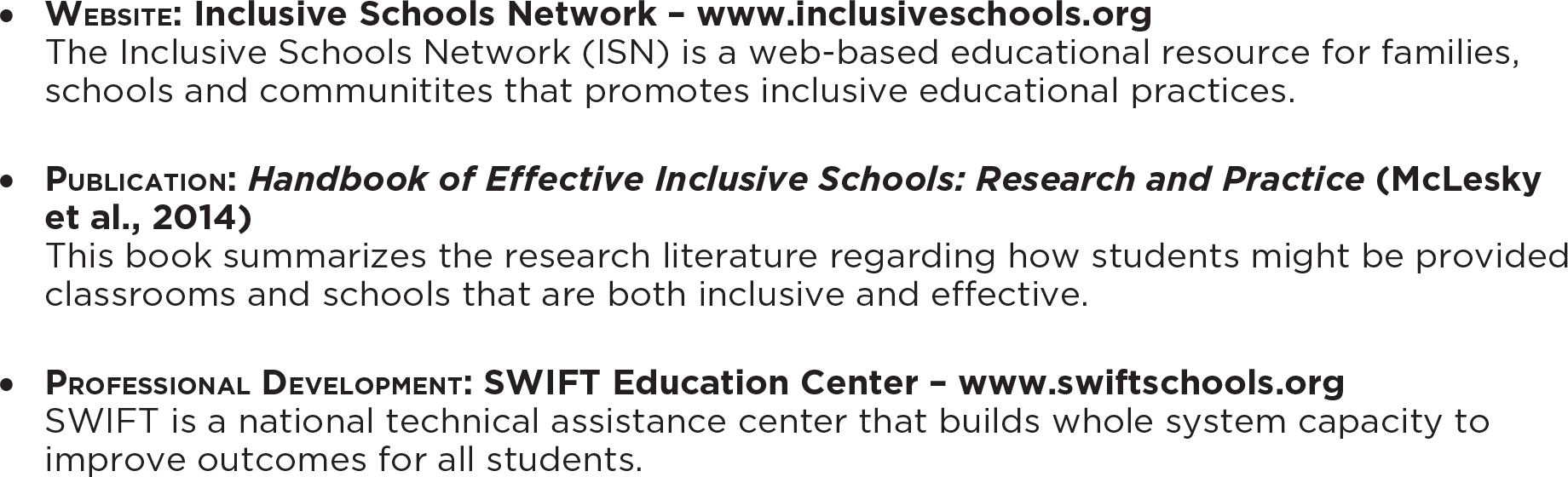
Resources to become more inclusive
After hearing Ms. Kiernan’s suggestions, her principal announced that she wanted to implement more inclusive practices, including some co-teaching. Ms. Kiernan learned she would now be co-teaching 1 hour a day with Mr. Nickolas. Although somewhat exciting, it was also frightening. What was her role? What did Mr. Nickolas know about co-teaching, and what was his attitude about the inclusion of students with disabilities? What had she gotten herself into? As she stood in the mailroom contemplating these questions, Mr. Nickolas walked in. “Heard we are co-teaching math together, Ms. Kiernan,” he stated. “I know,” she replied, “and that petrifies me. I’m so bad at math! I use a calculator for everything.” Mr. Nickolas paused, looked down at the floor a moment, and then slowly said, “Well, OK. That’s too bad. Um, then I guess I’ll just see you at 11 for math?”
Step Up
When faced with general education content, special educators all too often question their own expertise. Karten and Murawski (2020) write, “Don’t apologize for your lack of content knowledge; instead, emphasize the skills you do bring” (p. 54). Why would Mr. Nickolas, or any general educator for that matter, want to work with someone who starts the relationship off by stating they have nothing to offer? Whether co-teaching or providing any type of in-class support in a general education setting, the role of the special educator involves a variety of skills specific to their training. These include a knowledge of SWDs and the ways their needs may manifest and be addressed. Special educators need to bring their abilities to create and administer specially designed instruction (SDI) as well as their strengths in collaboration, differentiation, Universal Design for Learning (UDL), behavior support, and the “high-leverage practices” identified by the Council for Exceptional Children (CEC; 2018), among other skills. Rather than being modest, special educators need to “step up” and self-advocate when beginning relationships with their general education colleagues by emphasizing what they bring to the classroom as opposed to minimizing their expertise. We need to avoid situations that involve feeling like a “glorified aide” or taking a passive role in the shared classroom (Johnson et al., 2020). Step up to show that you have skills and are ready to share responsibilities for planning, teaching, and assessing.
“Karten and Murawski (2020) write, “Don’t apologize for your lack of content knowledge; instead, emphasize the skills you do bring. “Rather than being modest, special educators need to “step up” and self-advocate.
General educators may not know the expertise that a special educator offers the class dynamic. Keep in mind that although all of us have participated in a general education class and have a good idea of the role of the general educator, not everyone has experienced special education or knows what a special educator’s day might entail. Ms. Kiernan might self-advocate by inviting Mr. Nickolas to look over her schedule, visit one of her classes to see how she teaches or collaborates in a general education setting, jointly view some videos of inclusive support delivery with her, or even discuss her caseload of students over a cup of coffee. The goal of these interactions is to build professional trust in one another, a key element in effective collaboration (Stefanidis et al., 2019). When general educators have a better sense of the role of the special educator and what they can do in the inclusive classroom, they are more apt to respect, trust, and share the stage (Karten & Murawski, 2020). Ms. Kiernan can consider taking the following actions to step up.
Stepping Up in Action
Make a good impression. Think about how you are introduced or how you introduce yourself. Avoid apologizing for what you do not know, and instead focus on your strengths. Special educators have been taught to have a “strengths-based” approach and a growth mindset for our students (Dweck, 2016); we need to do the same for ourselves. Ms. Kiernan might have said to Mr. Nickolas, “Math isn’t currently a strength of mine, so I look forward to improving this year as we work together. Luckily, I am very organized, a quick learner, strong at developing strategies and mnemonics, and I’m able to come up with ways to teach content to students who struggle. So, I’ll emphasize those strengths as we collaborate and as I learn more of the math content.” Mr. Nickolas would surely be eager to work with her then!
Be specific about the roles you feel comfortable with and those you do not. If you are not yet comfortable with the content, suggest that you have more face time with the students for the warm-up, agenda, directions, homework, or strategy instruction. If you are not yet comfortable with teaching a large class, suggest the use of smaller groups, such as station, parallel, or alternative teaching. These regrouping approaches not only help with student–teacher ratio, but they are also helpful for UDL, differentiation, relationship building, and SDI (Karten & Murawski, 2020). In fact, studies show that smaller instructional groups promote student cognitive engagement (Lochner et al, 2019), enriched curricula, positive interactions between teachers and students, increased time on instruction over class management, and improved morale (Deutsch, 2003). These are excellent reasons for Ms. Kiernan and Mr. Nickolas to get students into small groups!
Be confident. Relax. Many general educators feel they lack sufficient training to work with SWDs (Shin et al., 2016), so right away, you have an advantage. Teacher preparation in special education typically includes far more information on high-leverage practices (CEC, 2018), SDI, and strategies than that in general education. In addition, special educators can continue to build their skills by attending face-to-face or virtual professional development, reading books and research, networking with colleagues, and joining organizations (e.g., CEC, TASH, National Association for Gifted Children, Council for Learning Disabilities; see Figure 2 for more information on these organizations). Use the resources in Figure 2 to support your learning.
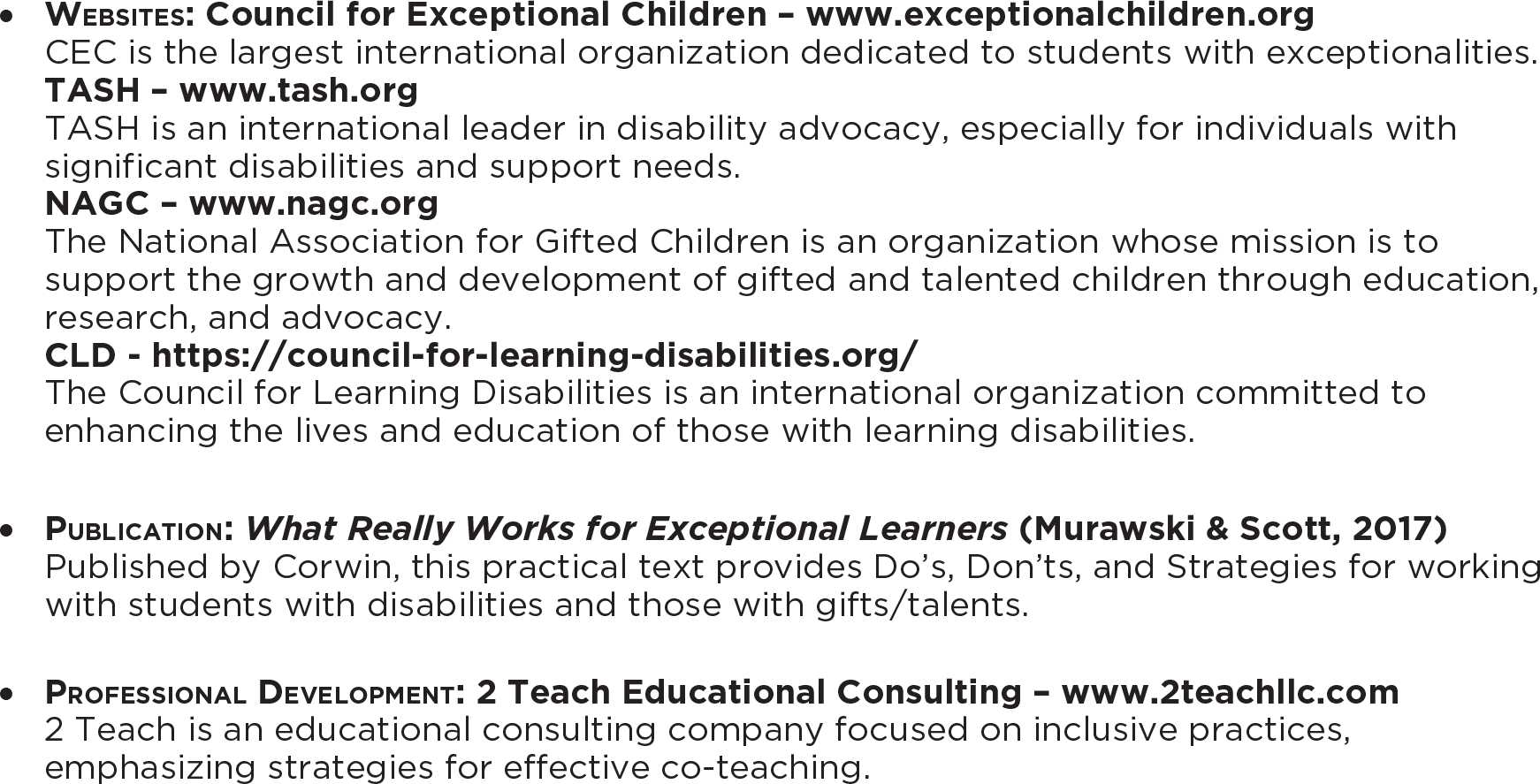
Resources to build special education skills
Once Ms. Kiernan and Mr. Nickolas had established their areas of strength, Ms. Kiernan felt much more comfortable working in an inclusive environment. Mr. Nickolas recognized that she was an expert in working with SWDs. As the days passed, however, she felt that they both tended to step on one another’s toes and struggled to know their respective roles. Mr. Nickolas seemed to expect her to simply focus on “her kids” and take care of them discreetly and individually. He rarely sent lesson plans to her in advance. One day, Ms. Kiernan snapped at Mr. Nickolas and said, “Look. We need to talk. I’m tired of not feeling like an equal in here.” Mr. Nickolas looked surprised. “Huh?” he said. “I thought I was being respectful of you by letting you do what you needed to do with your kids. Where’s this attitude coming from?”
Step Off
Whether providing in-class support, co-teaching, or just monitoring and consultation, no level of collaboration can be successful without strong communication. The relationship between educators in an inclusive class has frequently been likened to a marriage (Murawski & Scott, 2017), and just as in a marriage, communication is key. Instead of getting angry at your partner when communication is not working, it may help to take a moment to “step off” and reassess what is happening. Parity, or a feeling of equality, is an important component in a shared class and not one that is easily achieved; research has shown that teachers are simply used to working in a silo and having one “leader” in a room, and in fact, general educators tend to be more instructionally active in co-taught classes than their special education partners (Johnson et al., 2020). Although teachers do not need to be doing the same activities, and it is crucial that special educators do not forget their roles in ensuring SDI (Karten & Murawski, 2020), they do need to share the stage at times. Building a team dynamic and sharing roles, when one is not used to that, can result in conflict.
“Instead of getting angry at your partner when communication is not working, it may help to take a moment to “step off” and reassess what is happening.
Conflict is difficult and most adults would prefer to avoid it. When it comes to advocating for SWDs and for yourself, there is too much at stake to simply avoid conflict. General and special educators have different frames of reference (Friend & Cook, 2016), which is why the collaboration between the two is so powerful—but is also why it can be so frustrating. However, as Stefanidis et al. (2019) found, there must be a shared desire for the students to succeed, even when the definition of “success” may appear to differ between colleagues. Try to communicate with straightforward, non-emotional, nonjudgmental statements that are descriptive rather than evaluative (Friend & Cook, 2016), such as “I feel like we are on a different page; can we talk about that?” or, in Ms. Kiernan’s case, “Parity to me doesn’t mean sitting in the back and answering questions. I’d like to talk about my role in this class and ways I think I would be more supportive, as well as fulfilled.”
Stepping Off in Action
Communicate, communicate, communicate! Talk to one another to determine how you communicate best, your communication preferences, and pet peeves. Some may prefer to email or send frequent, short texts, whereas others may need a direct, face-to-face interaction. Yet others may desire a more passive approach, such as a weekly check-in or questionnaire with standard questions. Ms. Kiernan and Mr. Nickolas need to share their goals with one another as well as determine not only how they will communicate but when, where, and regarding what. They may even want to come up with verbal and nonverbal signals to use during co-planning and co-instructing. One tool that helps co-teachers share their expectations, hopes, responsibilities, preferences, and even pet peeves is the SHARE worksheet (Murawski & Dieker, 2012). It can be found at www.2TeachLLC.com/resources.
Provide respect and expect respect. When two teachers work collaboratively, each should respect the other. That does not mean that permission has to be asked constantly or that one should always defer to the other. Teachers are equals. Be kind and diplomatic, but do not allow yourself to be bullied or to feel you have no say in the class. It is essential to create a strong element of trust and respect to be able to work together effectively (Stefanidis et al., 2019).
Establish parity. Take overt steps that make both of you feel like equals in the classroom. For example, administrators can make sure both teachers have their names on the class door, on the report card, and on any materials to students and parents (Murawski & Dieker, 2012). Most importantly, teachers should determine roles and responsibilities with which they are both comfortable. Use the resources available in Figure 3 to build your own communication and conflict management skills.
“When two teachers work collaboratively, each should respect the other.
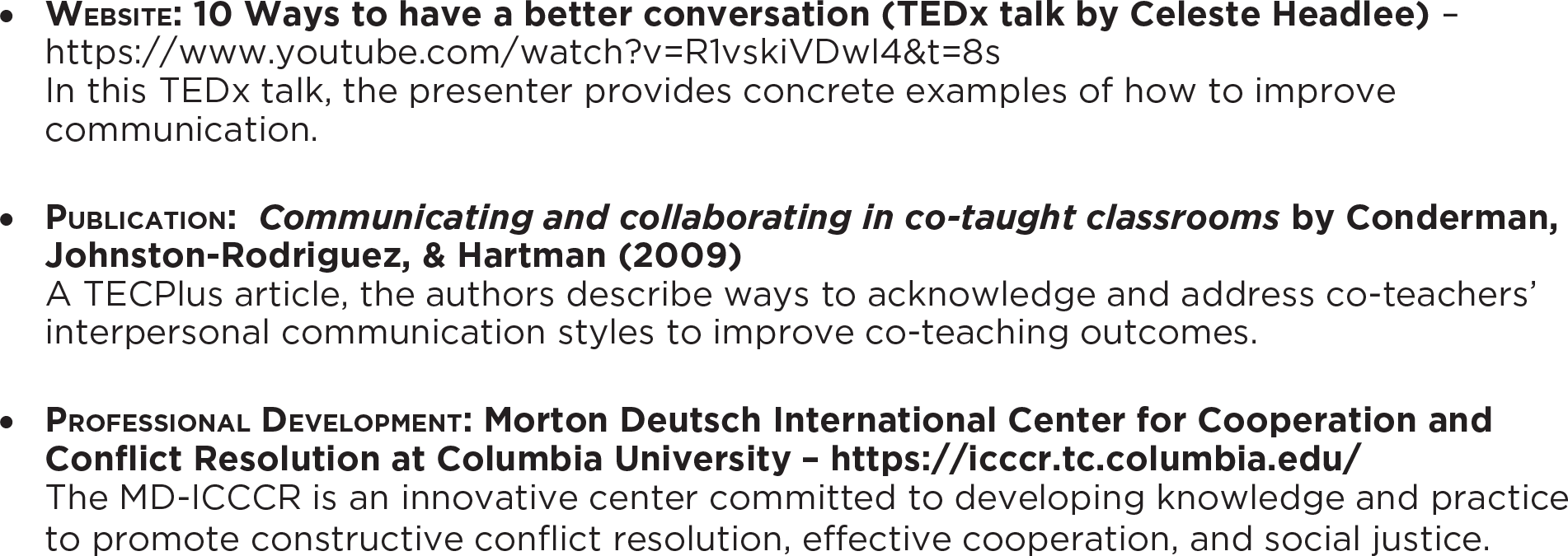
Resources to build skills in communication and conflict management
Once Ms. Kiernan and Mr. Nickolas had established their areas of strength and some strategies for better communication, Ms. Kiernan felt much more comfortable in the co-taught classroom. However, she started to notice that, despite—or perhaps because of—Mr. Nickolas’ respect for her expertise, he frequently referred all students with questions to her. In fact, she was noticing more and more that students were raising their hands and then just waiting for her to get to them to help. She was also working late into the night trying to create adaptations to all the math work to support the students with more significant learning needs in addition to those with mild needs! She simply wasn’t going to be able to keep up with all this work.
Step Away
Special educators should not feel that they are the only one who can help the general educator, the students, or parents. It is important to be able to “step away” by establishing those learning and behavior strategies that develop self-regulation, self-monitoring, and self-guidance. Teachers sometimes contribute to the problem when they provide too much support to students (McCarter, 2013). True teaching is not “rescuing” a child; it is building their autonomy to rescue themselves. There are numerous strategies available to develop students’ self-efficacy and reduce learned helplessness, including the use of UDL (Fritzgerald, 2020) as well as high-leverage practices to support students’ social, emotional, and metacognitive strategies for self-regulation as well as their behavioral and academic success (Riccomini et al., 2017).
One of the most significant issues that needs to be addressed is in the area of learned helplessness. Learned helplessness is a phenomenon wherein individuals feel powerless and wait for external support. Recent research has found that academic achievement is positively predicted by an orientation on mastery, whereas it is negatively predicted by learned helplessness (Filippello et al., 2019). The hallmark of learned helplessness behavior is attributing success to an outside factor or person. It is important that students not perceive the special educator as the primary source of support, waiting for help rather than attempting the work independently. Ms. Kiernan cannot be the only one to provide behavioral supports, differentiated approaches, choices in learning options, and emotional support.
Special educators are legally tasked with making sure that a student’s IEP goals and objectives are followed, assessed, and reported and that accommodations are being provided (J. Rodriguez & Murawski, 2020). However, it is important to know that not all “special” education has to be provided by the special educator. In an inclusive setting, general and special educators can share this provision of appropriate education as long as both teachers collaboratively develop plans using strategies and routines that allow SWDs to have their needs met. Although the need for direct services may be written into the IEP, there are many ways that the special educator can step away from hovering over students or pulling them aside for small-group lessons. Having a special educator present to manage basic instruction could allow a content specialist to provide more intensive instruction for SWDs who need extra content support.
Developing strategies, setting goals, and building and maintaining relationships are all techniques that can help reduce students’ learned helplessness in inclusive classrooms and allow the special educator to step away from carrying the burden alone. When students are provided these flexible instructional approaches, encouraged to make choices in their learning process, and instructional barriers are removed, achievement and behavioral attitudes have been found to improve (Katz & Sokal, 2016). In addition, research has found positive effects of using UDL for teachers, too. If Ms. Kiernan and Mr. Nickolas are able to proactively and collaboratively create lessons that provide a wide range of choice to students, while also encouraging student input and voice in how they are learning and demonstrating their understanding of the content, Ms. Kiernan will have less adaptation to do for specific learners and both teachers may feel more efficacious (Katz & Sokol, 2016).
Stepping Away in Action
Provide needed professional development. Using principles from UDL, teachers with different areas of expertise can work together to create brain-based routines and instructional approaches that provide multiple means of engagement, representation, and action or expression (Fritzgerald, 2020). How can Ms. Kiernan do that? She could ask for time at a faculty meeting to review the principles of UDL with her general education colleagues. She could describe how using multiple methods of engaging students, options for providing instruction, and varied assessment strategies allows students options and choices throughout the instructional process, which, when implemented appropriately (Edyburn, 2010), can address common learning issues, such as motivation, memory, attention, and fine-motor writing difficulties. She might show the 3-minute YouTube video “Transforming Inclusive Education” featuring Shelley Moore (Social Sciences and Humanities Research Council, 2016) to help explain the concept behind UDL. She and her colleagues could ask their principal for more professional development on UDL and differentiation strategies. If the whole school implements universal design principles, there will be less need for individualized adaptations for specific learners.
Be thoughtful in the selection of instructional strategies. In a universally designed class, most students will be engaged at their appropriate levels. Thus, fewer differentiation strategies specific to individual students will be necessary. Thus, by self-advocating for more UDL in the classroom, Ms. Kiernan is not only helping students but also helping herself. However, UDL alone will not “solve” all students’ learning needs. Teachers are not “rescuers” of students who are struggling but are facilitators as students learn to be resilient learners. Techniques that special educators need to engage in that emphasize a connection between actions and outcomes for students include the use of explicit teaching, high-leverage practices, SDI, and intensive interventions (Riccomini et al., 2017). Ms. Kiernan may also implement data-based individualization (DBI). DBI is an empirically supported methodology for teaching students with intensive learning needs (Jung et al., 2018). In doing so, Ms. Kiernan may find she needs to occasionally step away from the general education setting to provide more intensive intervention for those who need it. Figure 4 provides the URL for the Iris Center (which offers a helpful module on DBI) as well as additional resources geared to build UDL and student engagement.
“Thus, by self-advocating for more UDL in the classroom, Ms. Kiernan is not only helping students but also helping herself.
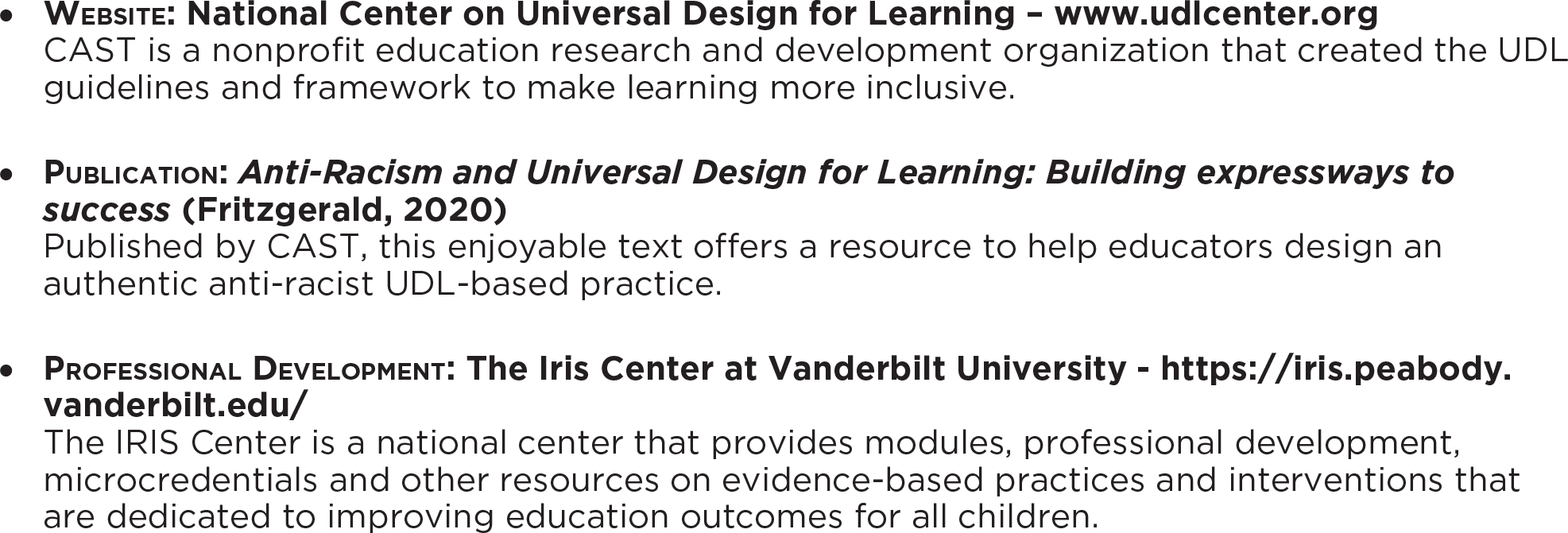
Resources to build Universal Design for Learning and student engagement
The UDL strategies were an enormous help! Being able to offer multiple choices to students for their introduction to material, their engagement and retention of it, and even their demonstration of competencies meant Ms. Kiernan had much less to do in terms of differentiating materials. Having set up more ways for the students to self-regulate, self-monitor, and self-reinforce allowed Ms. Kiernan to focus on providing SDI for those students who needed it. Not everything was perfect, though. It was a stressful job! Her paperwork was behind, three IEP meetings were scheduled in 1 week, a student had a meltdown in class, and parents were clamoring for regular daily updates. Only 4 years into teaching, Ms. Kiernan loved most of what she was doing—but she was starting to understand how so many special educators burned out early from the profession.
Step Back
Teacher burnout is a significant issue among special educators. Intense needs of the student, coupled with limited support from colleagues and administrators, can create a situation where special educators have feelings of stress, physical issues, and negative student outcomes (Brunstig et al., 2015). The list of stressors includes, among others, lack of appreciation, parental support, public support, and paperwork. Ms. Kiernan is experiencing stress in time management, getting caught up in student behavioral issues, and lack of boundaries with parents; she may need to “step back” a bit and take a breath.
Although the ultimate solution to teacher burnout might rest with school systems that create public support, ensure positive and trained colleagues, and provide resources and time to do the job, (Mieliwocki, 2019), there are a number of things that teachers can do to help themselves by stepping back and setting boundaries. It is natural to want to support students and parents at all times; however, that is simply unsustainable. Self-care activities are integral skills to cultivate. Mindfulness—or stepping back emotionally from a situation and observing it dispassionately, allowing it to be without placing judgment upon it—has helped counselors and teachers cope with stressful situations. Although mindfulness can be helpful for students and reduce suspensions and behavioral issues, it can also be an invaluable skill in allowing a teacher mental space to step back from conflict and stress (Jennings et al., 2017).
“There are a number of things that teachers can do to help themselves by stepping back and setting boundaries.
Stepping Back in Action
Determine your comfort levels. If she is feeling overwhelmed, Ms. Kiernan can establish clear communication procedures and boundaries, such as “I will respond to all emails between 4 and 6 p.m.” and “You can check on Classroom Dojo to see how your child did today.” These procedures can help parents and teachers feel connected (Venet, 2019). Ms. Kiernan does not need to feel guilty telling Mr. Nickolas that she will not respond to email on Sundays, that she prefers he not text after 7 p.m., or that she has a standing appointment on Wednesdays after school and cannot meet then. Ms. Kiernan can also identify her preferred communication channels. Although some teachers give their cell numbers out, there are other technological means to staying in communication, such as the Remind app, online grade books, and behavior management programs, such as Classroom Dojo.
Care for yourself. Ms. Kiernan needs to make sure she is getting enough sleep. “Sleep hygiene” is especially important because special educators are at particular risk for “compassion fatigue” or “secondary trauma.” Sleep hygiene is more than the pursuit of enough sleep; it’s turning off the news hours before bedtime and limiting the amount of work you bring home. Want an excellent read chockful of research on sleep that might change your outlook? Try Dr. Matthew Walker’s (2017) Why We Sleep: Unlocking the Power of Sleep and Dreams. In addition, Ms. Kiernan needs to allocate time to exercise and eat right. Although this may seem obvious, yet possibly unreasonable due to stress and time constraints, remember that your physical body needs to be strong enough to support the strain you go through every day. Whether it’s yoga, Zumba, gardening, or a short run, Ms. Kiernan should keep herself active and engaged in something that is not related to school as an important aspect of her mental health.
Be aware of your own stress levels. Strategies such as a “body scan,” where you become quiet and find out where stress is located in your body, and “breath awareness,” where you become aware of the breath coming in and going out of your own body, can help teachers find a place of calm and restraint (Jennings et al., 2020). Other mindfulness exercises include living in the moment, being aware of your senses, and engaging in self-compassion. The resources in Figure 5 can help Ms. Kiernan learn some of these mindfulness techniques.
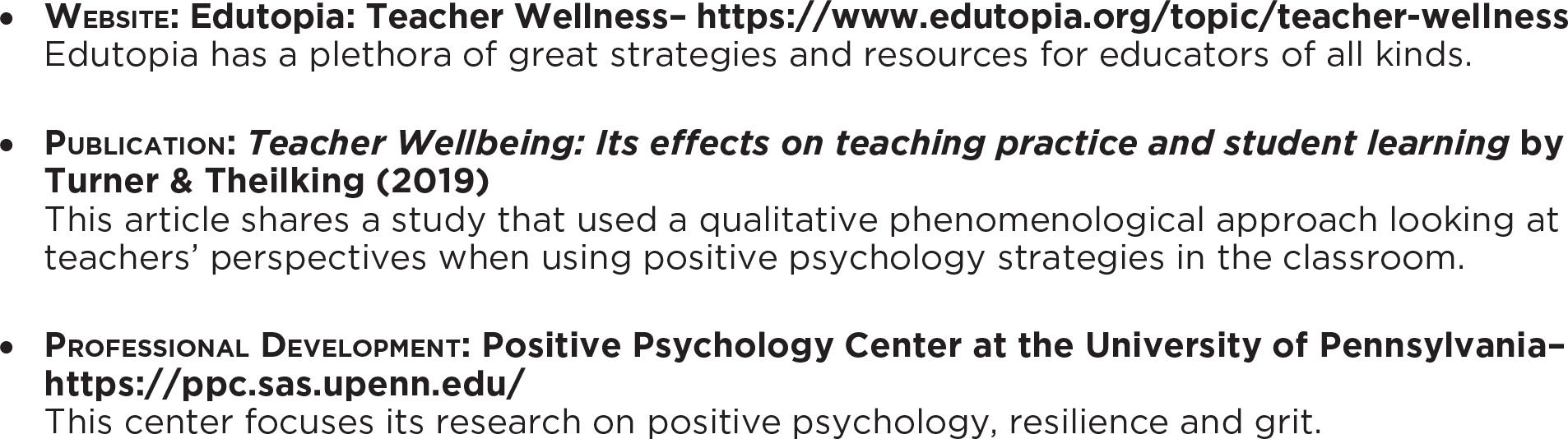
Resources to build mental health skills
Ms. Kiernan realized that she needed to take care of her own mental and physical health. Knowing that by doing so she was also better able to meet the needs of the children in her classes made her feel less guilty about taking a yoga class, watching a TV show, or even just reading a book on the weekends. She recognized that inclusive education wasn’t a “quick fix” and that there would continue to be barriers and bumps in the way, but she now felt empowered to take them on one by one. Having the confidence to self-advocate for what her students needed—as well as what she personally needed—made all the difference!
Step-by-Step
Rebecca Mieliwocki (2019), 2012 National Teacher of the Year, wrote, “I’m all about self-care. I try to stay as balanced as I can in a profession that will extract every ounce of energy we have and blur the boundaries between work and personal time if we’re not careful.” In addition to the typical stressors of teaching mentioned by Mieliwocki, special educators have added stressors of compliance issues, paperwork, and the complexities involved in working with SWDs and their families (Brunstig et al., 2015). For Ms. Kiernan to remain energized and have the capacity to self-advocate, she needs to take baby steps.
Because of the population we serve, there is an urgency to the work of special education. Issues of social justice, equity, and self-determination are powerful forces and drive most special educators. When there is so much to do and students’ lives and futures are involved, it can be difficult to take a break or dare to rock the boat. Ultimately, though, to do the work that is still very much needed in order to create a more inclusive class, school, and world, special educators, like Ms. Kiernan, must feel emboldened enough to take the steps that will support them in that work. This will require them to step out, step up, step off, step away, and step back. Not right away and not all at once, but with baby steps. Step-by-step, the situation will improve for Ms. Kiernan and other special education professionals and, more importantly, for the students and families they serve. Figure 6 provides additional resources for those educators ready to begin taking steps toward improvement and self-advocacy.
“Ultimately, though, to do the work that is still very much needed in order to create a more inclusive world, special educators, must feel emboldened enough to take the steps that will support them in that work.
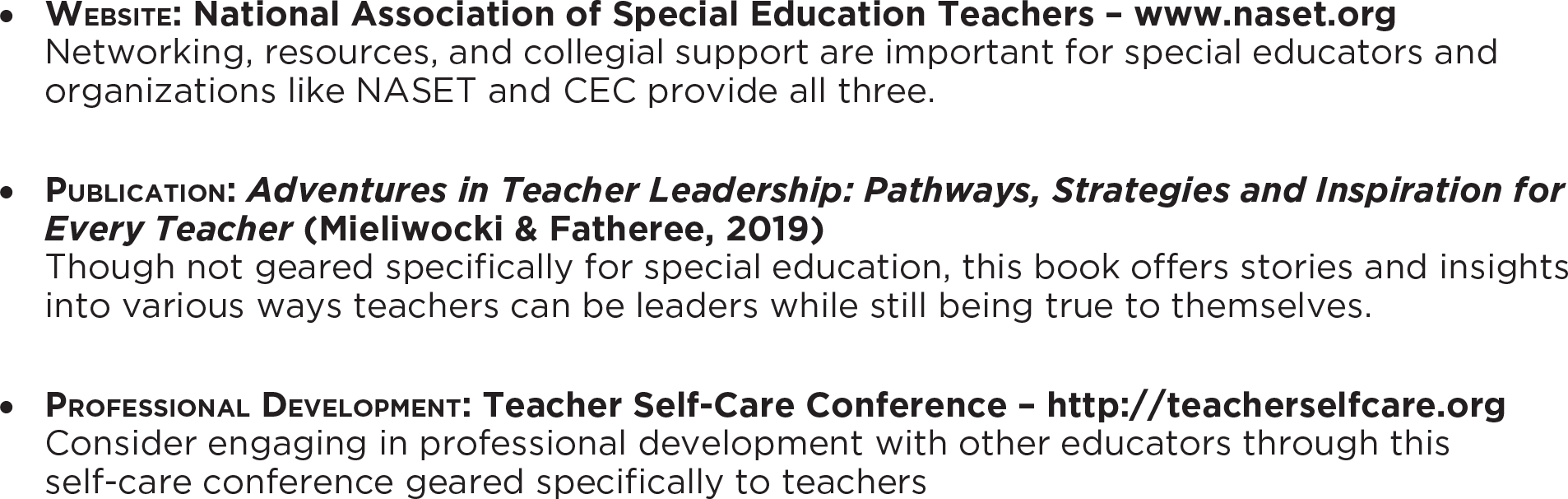
More resources to promote teacher self-advocacy
Advocate for Self-Care
Self-advocating can also support self-care. Do colleagues’ behaviors (e.g., changing lesson plans last minute, not showing up for planning) cause you stress? Don’t let it build. Use positive communication strategies to share those stressors with your colleagues so they have the opportunity to make changes that reduce your stress. It is possible they don’t know how much their actions are affecting you.
Footnotes
Declaration of Conflicting Interests
The author(s) declared no potential conflicts of interest with respect to the research, authorship, and/or publication of this article.
Funding
The author(s) received no financial support for the research, authorship, and/or publication of this article.
