



Abstract

This View From the Field column is the third in a series describing the important contributions of the field of implementation science in supporting educators in implementing evidence-based practices (EBPs; Kittelman et al., 2020, 2021). In the previous columns, we highlighted the importance of selecting EBPs and establishing school implementation teams to provide support to students, and support to educators, in implementing EBPs. For this column, we focus on another component of the Active Implementation Frameworks (Metz & Bartley, 2012) by describing the actions and activities needed to move EBPs through different stages of implementation. In doing this, we highlight the important work of researchers and practitioners from the National Technical Assistance Center on the State Implementation and Scaling-Up of Evidence-Based Practices ([SISEP]; https://sisep.fpg.unc.edu) within the National Implementation Research Network (NIRN; https://nirn.fpg.unc.edu).
Principal Perkins and the Freedom Elementary school improvement team (known as the school implementation team) recently set goals for the upcoming school year. Upon reflection, they noted their literacy goal has been the same goal set for the past three years, but the school has struggled to improve literacy outcomes to 80% proficient, despite providing teachers professional development in literacy in the previous two years. They have also encountered disruptions and barriers as they have moved back and forth between in-person and virtual learning due to the COVID-19 pandemic and with fewer than half of the teachers reporting using the practices as intended or with fidelity. Several staff on the team are proposing they abandon their selected core instructional practices and materials and try something new.
Implementation Stages
There is consensus in the study of implementation that all efforts should proceed from (a) identification of need and assets and exploration of potential solutions to (b) adoption and sustainability (Aarons et al., 2011; Metz, 2015; Meyers et al., 2012). Implementation is a multiyear process toward a goal with a clear theory of action that involves stakeholders making decisions, taking action, and identifying improvements needed to support successful use of selected effective practices in schools (Fixsen et al., 2001; Saldana, 2014). Implementation starts when a school begins to consider change, and full implementation is reached when the change is fully in place and producing intended outcomes in all classrooms. Although there are different models in the field of implementation science used to organize implementation processes and activities (e.g., Aarons et al., 2011; Fixsen et al., 2013), there is consensus that practices move through discrete implementation stages that can lead to the long-term survival (sustainability) and continued effectiveness of any effective practice in a context of constant change. According to Fixsen et al. (2013) and Metz and Bartley (2012), these stages include exploration, installation, initial implementation, and full implementation (Figure 1). The stages serve as a road map for schools by outlining the necessary activities and intended outcomes of implementation work (e.g., acceptability, adoption, fidelity; Proctor et al., 2011).
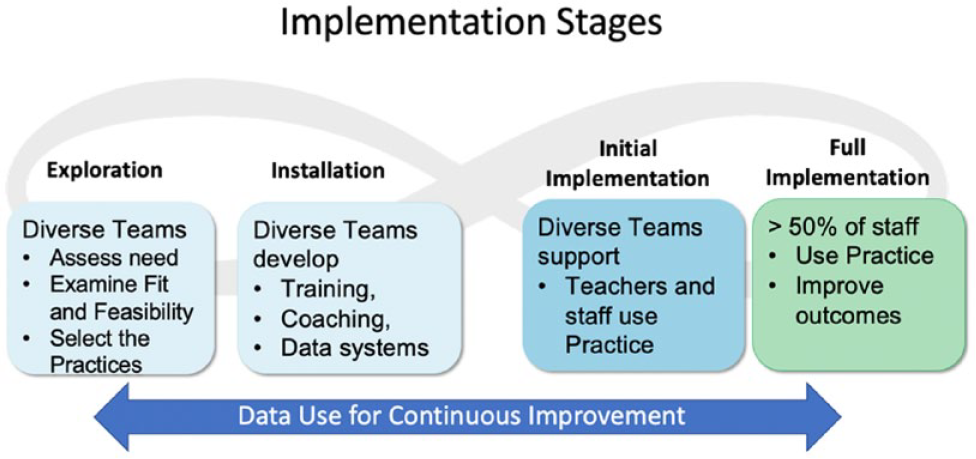
Four implementation stages needed for sustainability of evidence-based practices
Exploration
The first stage of implementation, exploration, is a time when schools make decisions about fit, feasibility, capacity, and commitment to use selected effective practices (Kittelman et al., 2020). During this stage, school implementation teams are established, with diverse representation from school and district leaders (e.g., general and special education staff, administrators, other school staff, community members, families, students). These teams are designed to engage in activities related to identifying current needs, assets, and potential root causes of poor student outcomes to determine needed changes (Kittelman et al., 2021). With support from the district, the school implementation team considers possible options of effective practices to address the needed changes, examines the fit and feasibility of the identified practices to decide if they will move forward with implementation, and communicates with stakeholders throughout the process. Intentional and purposeful use of exploration activities results in the establishment of readiness and collective commitment of all staff to the selected practices.
Installation
Following the decision to implement selected practices, school implementation teams develop or refine the necessary infrastructure to support staff and organizational competency during the installation stage. School implementation teams work closely with the district implementation teams to ensure the practices are clearly defined and usable for the staff who will be implementing them. The school implementation team also develops an implementation plan that outlines (a) protocols for selecting staff needed for implementation; (b) training and coaching supports; (c) data systems, including what data will be collected (i.e., outcome, fidelity, and process data) and how and when data will be collected, analyzed, and shared; and (d) decision-making criteria for determining success. In addition, it is during the installation stage that school implementation teams identify teachers who will participate, provide initial training, ensure access to materials and equipment necessary to support use of the effective practices, and develop and use feedback loops among staff, leadership, community partners, and stakeholders to ensure effective communication (Saldana et al., 2012).
Initial Implementation
During initial implementation, the selected EBPs are implemented in the school and classrooms, and teachers begin receiving coaching supports. During this time, it is crucial for the school implementation team to meet regularly to use data to examine the effectiveness of the supports being provided and make improvements to the implementation infrastructure (e.g., professional development systems) to meet the needs of teachers and maximize success for students (Figure 2). The team also uses data and decision-making criteria for expanding use of the EBP by additional school staff. It is imperative that strong communication protocols (e.g., feedback loops) are in place between teachers and the team to ensure teachers have the support they require. In addition, having strong communication protocols between the school implementation teams and district leadership is key for ensuring the school implementation teams have the resources, professional development, and support (e.g., policies) needed to ensure these practices are implemented and sustained.
Full Implementation
When a school has at least 50% of its teachers using the effective practices with integrity, and the desired student outcomes are being achieved, it is in the full-implementation stage. It is key during this time that teams do not get complacent and remove supports or stop meeting, assuming smooth sailing is ahead. To ensure continued success and prevent drifting back to previous practice, teams should maintain (a) provision of needed training and coaching supports, (b) use of feedback loops, and (c) regular use of data for continuous improvement. For example, conducting at least annual evaluations of both the implementation of the organizational systems and practices and improvements in school and student outcomes helps to inform future improvement efforts. Teams continue to return to previous stage-based activities as they (a) bring on new staff (e.g., establish new relationships and create readiness with incoming staff members), (b) apply their implementation infrastructure to other schoolwide practices, and (c) continuously develop the capacity of school staff, their community, and local school boards. By school implementation teams engaging in these implementation activities, practice can inform policy, and policy can enable effective practice, where school funding formulas and finance policies are equitable and lead to closing long-standing disparities in student outcomes.
A tool that can help implementation teams critically examine their implementation efforts to date and make decisions is the Implementation Stages Planning Tool (NIRN, 2020). The Implementation Stages Planning Tool may be used to guide a team in identifying its current stage of implementation and provides a checklist of activities and outcomes needed to establish or strengthen staff readiness and needed implementation supports. School implementation teams can use the data to assess, monitor, and communicate their current implementation efforts to key stakeholders.
Let’s return back to Principal Perkins and the Freedom Elementary school improvement team. They are at a juncture where they need to critically examine their implementation efforts and make decisions. In using the Implementation Stages Planning Tool, the Freedom Elementary school improvement team identified it was in the initial implementation stage given it had literacy instruction practices in use but fewer than 50% of teachers were using the practices as intended. The team, in reviewing the different stage-based activities, identified it needed to go back and revisit some activities in the exploration and installation stages to support staff readiness and competent use of the literacy practices. Specifically, at the exploration stage, the team decided to further examine the fit and feasibility of the selected literacy practices by using the Hexagon Tool (Metz & Louison, 2018) and establish a communication plan for staff on why these practices were selected and the need to improve literacy outcomes. In the installation stage, the team used the information learned from fit and feasibility to develop a coaching plan and processes to strengthen use of the instructional practices.

Initial implementation
Summary and Recommendations
Practices move through discrete stages of implementation necessary to ensure they are sustained and continue to be effective in improving school and student outcomes; however, stages are not linear. Ending one stage to begin another is seldom the case; rather, the stages may overlap, and stage-based activities may be applied across multiple stages. For example, a school in full implementation and producing good outcomes in 50% of its classrooms may revisit exploration as it scales to additional classrooms.
Second, the activities of the stages repeat at each level of the system. That is, a school implementation team will need to go through stage-based activities in addition to the district or central office members going through the activities. Third, a school can be in different stages at the same time for different practices. For example, a school may be in initial implementation for its selected literacy practice but also in exploration as it identifies needs for a practice to address social-emotional skills. Fourth, sustainability is attended to throughout the stages, beginning with exploration. At each stage, school implementation teams are working toward developing a sustainable infrastructure to implement practices with high implementation fidelity. Finally, implementation work is never done.
The time required to move through the stages of implementation will vary depending upon the complexity of the practices being implemented, the availability of the implementation supports and resources, and other contextual factors (Metz & Bartley, 2012). It is key that school implementation teams complete the necessary stage-based activities at each stage to move the practices through the different implementation stages. One tool that is helpful in guiding teams through this process is the Implementation Stages Planning Tool.