




Abstract
Secondary educators implement an array of work-based learning activities that expose transition-age students to the demands of post-secondary employment. One such strategy, internships, provides students with a formal opportunity to acquire transferable employment skills that lead to meaningful post-secondary employment outcomes. Facilitating internships for transition-aged students with disabilities, however, presents challenges for educators because internships often involve complicated and sometimes ambiguous labor laws, regulations, and provisions. This article provides secondary educators with information about how to facilitate unpaid and paid internships for students with disabilities that align with requirements established by the Fair Labor Standards Act. The article provides a case study to illustrate how schools can develop both unpaid and paid internships and concludes with recommendations for best practices.

Taylor Lee is a special education transition coordinator who works with students with disabilities to develop and implement individual transition plans and services. She regularly teaches a course in business information management in the Career and Technical Education (CTE) program at her high school. She works with her general education colleagues to make sure the class includes students with and without disabilities who have a range of employment experience; some students have limited employment experience and some students have identified career goals based on prior paid work experiences. Her vision is to develop and expand the school’s internship programming. She is committed to supporting internship experiences for students like J.P., who uses an augmentative communication device and has yet to identify vocational interests and explore his strengths in an actual employment setting. Ms. Lee is also committed to promoting career development for more experienced students like V.S., who has worked at his family’s dry-cleaning service making deliveries but now wants to explore employment in the sales force. Ms. Lee knows that providing students with disabilities, including those with extensive support needs, opportunities to develop soft employment skills and paid work experiences will require collaboration with local businesses and other related service professionals, such as vocational rehabilitation and Workforce Innovation and Opportunity Act (WIOA) Youth Program personnel, who can help navigate the complexities of internship experiences and help recruit employers.
Ms. Lee has an established relationship with many local business partners, including Alejandra Cariño, the owner of Business Solutions. Business Solutions is a copy and shipping business with employees who engage in physical and clerical labor. Both women realized that they share a common goal: supporting and introducing students with disabilities to meaningful career opportunities closer to home. Ms. Cariño is enthusiastic about meeting with Ms. Lee to plan an internship program that is mutually beneficial for local students and small businesses. She sees this partnership and her contribution as a way to help transition-age students find meaningful employment. Ms. Cariño and Ms. Lee schedule a meeting to discuss and organize internship experiences that are aligned with the strengths, interests, and needs of students.
“This article focuses on internships because they formally connect students to the demands of work while maintaining a direct connection between an individualized intern experience and school-based learning.
High school graduates are an important source of skilled workers in the United States. Unfortunately, secondary students with disabilities may be overlooked by employers because of stereotypes about work capacity, disability biases, and perceived barriers to youth employment. As a result, students with disabilities often have diminished opportunities to participate in meaningful secondary work experiences and are not obtaining valued postschool outcomes—such as competitive, integrated employment—at the same rate as students without disabilities. For example, the U.S Department of Labor (2021) reported that 17.3% of youth with disabilities between 16 and 19 years old are employed, compared with 28.9% of same-age peers without disabilities. The employment gap increases with age, with only 34.9% of young adults with disabilities between 20 and 24 years old employed, compared with 60.9% of their peers without disabilities. These outcomes are discouraging because competitive integrated employment is correlated to higher quality-of-life status for people with disabilities (Ra & Kim, 2016). Research also indicates that when people with disabilities are employed, local economies see positive economic impacts, such as increased tax revenues and reductions in use of public benefits (Wilhelm & Robinson, 2012).
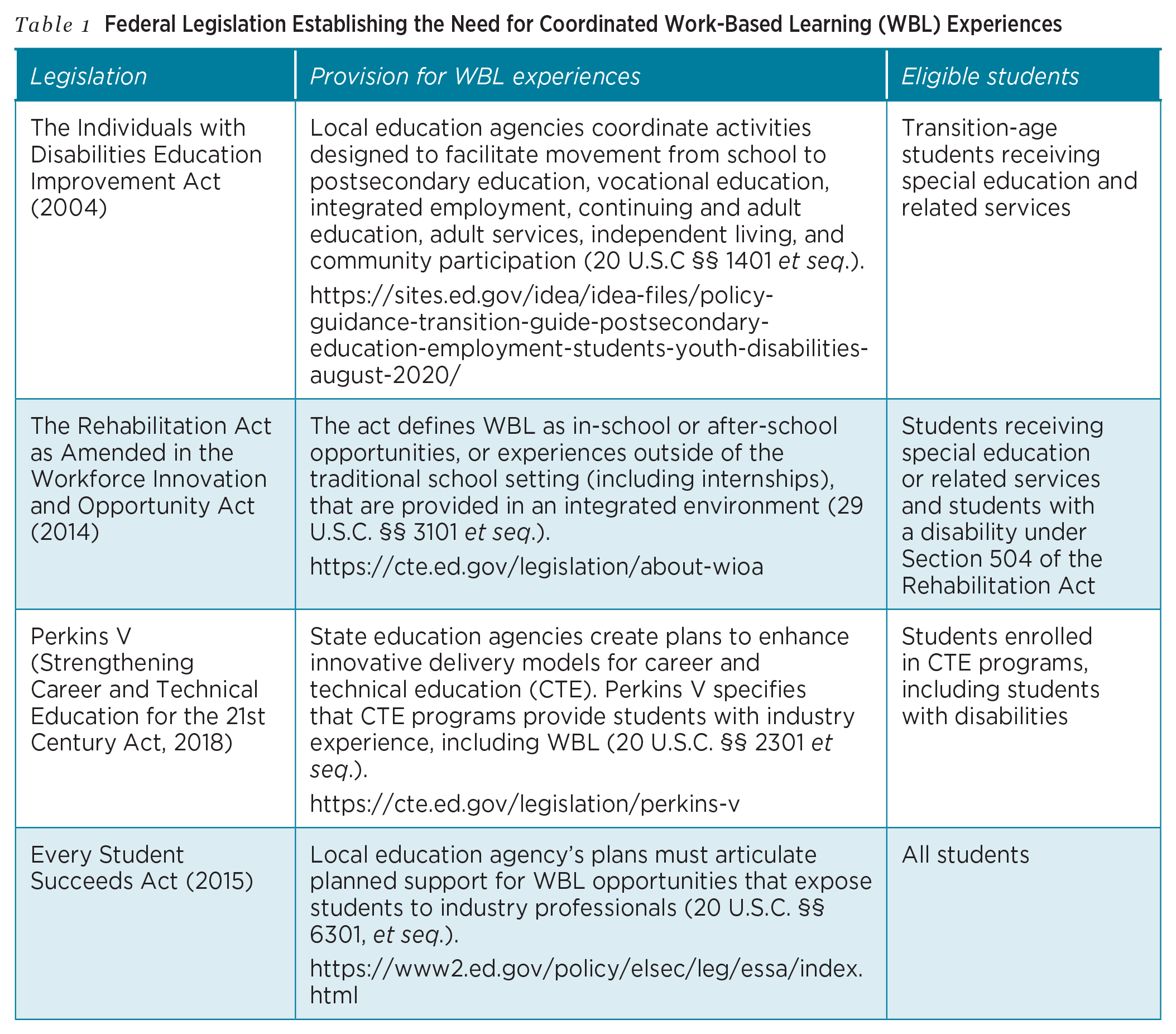
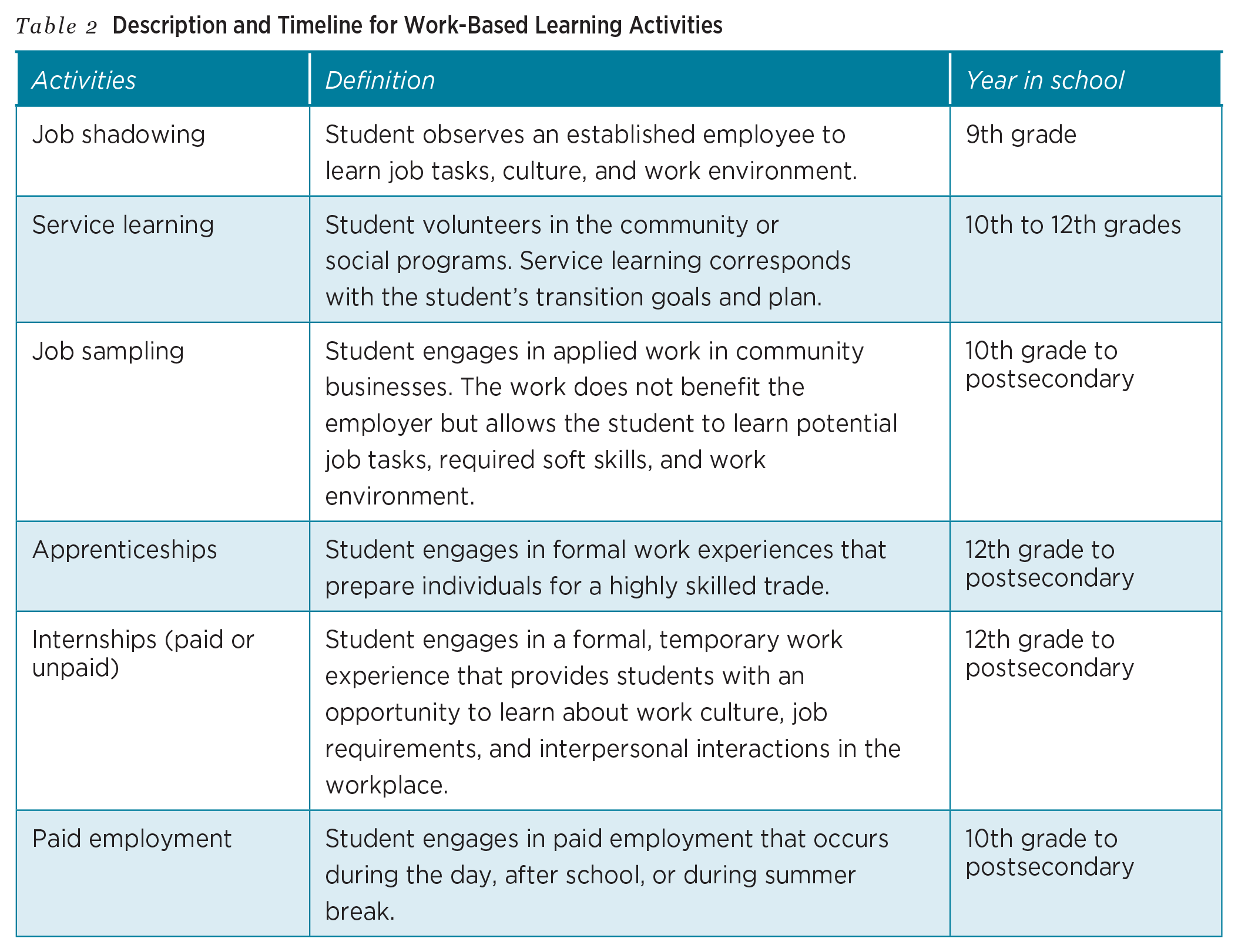
Recent legislation that pointedly addresses these obstacles and poor outcomes and supports career readiness for all students with and without disabilities includes (a) the Individuals with Disabilities Education Improvement Act (IDEA; 2004), (b) WIOA (2014), (c) the Perkins V (Strengthening Career and Technical Education for the 21st Century Act, 2018), and (d) the Every Student Succeeds Act (ESSA; 2015). These statutes reinforce the notion that preparing students to be career ready is an essential component of secondary education. Each statute, outlined in Table 1, recognizes that work-based learning (WBL) is an effective strategy to prepare students, with and without disabilities, for the demands of postschool employment. Research also suggests that students with disabilities who engage in WBL experiences prior to exiting school have improved postschool employment outcomes (Mazzotti et al., 2016; Wehman et al., 2015). WBL experiences, outlined in Table 2, may include job shadowing, service learning, job sampling, apprenticeships, unpaid and paid internships, and paid employment (Cease-Cook et al., 2015). This article focuses on internships because they formally connect students to the demands of work while maintaining a direct connection between an individualized intern experience and school-based learning. At the same time, internships can be difficult for educators to organize and facilitate because of complicated and sometimes ambiguous statutory requirements about what constitutes an employee–employer relationship and U.S. Department of Labor (DOL) requirements about the types of work in which individuals under 18 can engage.
Federal Legislation Establishing the Need for Coordinated Work-Based Learning (WBL) Experiences
Description and Timeline for Work-Based Learning Activities
“Internships can be part of a formal career and technical education (CTE) course, a WBL program, or a workrelated goal as part of the transition services outlined on a student’s individualized education program (IEP).
Internships
An internship is a formal, temporary work experience that provides students with an opportunity to learn about work culture, job requirements, and interpersonal interactions in the workplace (Gross et al., 2018). Internships can be part of a formal career and technical education (CTE) course, a WBL program, or a work-related goal as part of the transition services outlined on a student’s individualized education program (IEP). There are several models at the national level that illustrate how to successfully implement internships with transition-age students with disabilities. One such example, Project SEARCH, is a business-led internship program for students with disabilities (Rutkowski et al., 2006). Project SEARCH uses businesses, secondary schools, and adult service agencies (i.e., vocational rehabilitation, intellectual and developmental disability agencies) to create intern partnerships to prepare students with disabilities for competitive integrated employment. Student interns participate in three 10-to-12-week internships during their senior year in high school. The internships consist of 1 hour of instruction of work-related skills followed by 4 hours at the internship site (Wehman et al., 2012). Project SEARCH maintains a website (www.projectsearch.us) that provides a detailed overview of the core model fidelity. The website also provides information about both finding local Project SEARCH sites and starting such a program from scratch.
Implementing Internships
Educators, school administrators, related service providers, and employers should understand certain provisions of the Fair Labor Standards Act (FLSA; 2011) because they may impact internship activities for student interns. Provisions of the FLSA are triggered any time an employee–employer relationship exists. An employer–employee relationship, defined broadly in the statute, is a situation where there is an employer, an employee, and an act or condition of employment (DOL, 2016c). Educators need to understand that there are implications for internships when specific conditions that define an employer–employee relationship are met. In other words, when an employer–employee relationship is established through work, an employer is obligated to pay an employee at least the federal minimum wage, and the employee is guaranteed certain protections outlined by FLSA. This can be confusing because the term “internship” is not explicitly defined in FLSA (Tepper & Holt, 2015), and internships have been historically seen as a way for young, developing employees to gain valuable, yet unpaid, work experiences (Svacina, 2012). Because of the ambiguity in the statute, educators must understand that the type of employment and school-related activities a student engages will determine whether there is an employee–employer relationship and whether the intern activities will be unpaid or paid.
Unpaid Internships
Although paid internships are the most preferable pathway to competitive, integrated employment for students with disabilities, there may be situations where educators elect to develop unpaid internships for students with no prior work experiences or underdeveloped career interests. Unpaid internships may have utility for introducing less experienced students to a range of occupations, social integration experiences, and hands-on work practices (Riesen & Oertle, 2019). To clarify when an internship can be unpaid under FLSA, the DOL created a seven-point primary beneficiary test for unpaid internships at “for-profit” businesses (DOL, 2018). Figure 1 outlines each item on the seven-point test. It is important to note that the DOL indicates that no single factor on this test is determinative of whether an employee–employer relationship is triggered and that determining whether the intern is an employee under FLSA depends on the unique circumstances of each situation. Because most student internship experiences are indeed unique, educators and business partners should use the seven-point test to carefully assess each student internship and related school experience to determine if a student is entitled to commensurate wages and benefits as outlined by the DOL. In the case of unpaid internships, employers may also have concerns about workplace liability. When an internship is unpaid, no employee–employer relationship exists, so worksite liability is the responsibility of the school district rather than the employer. Educators should work collaboratively with their local education agency (LEA) to understand their specific districts’ workers compensation policies.
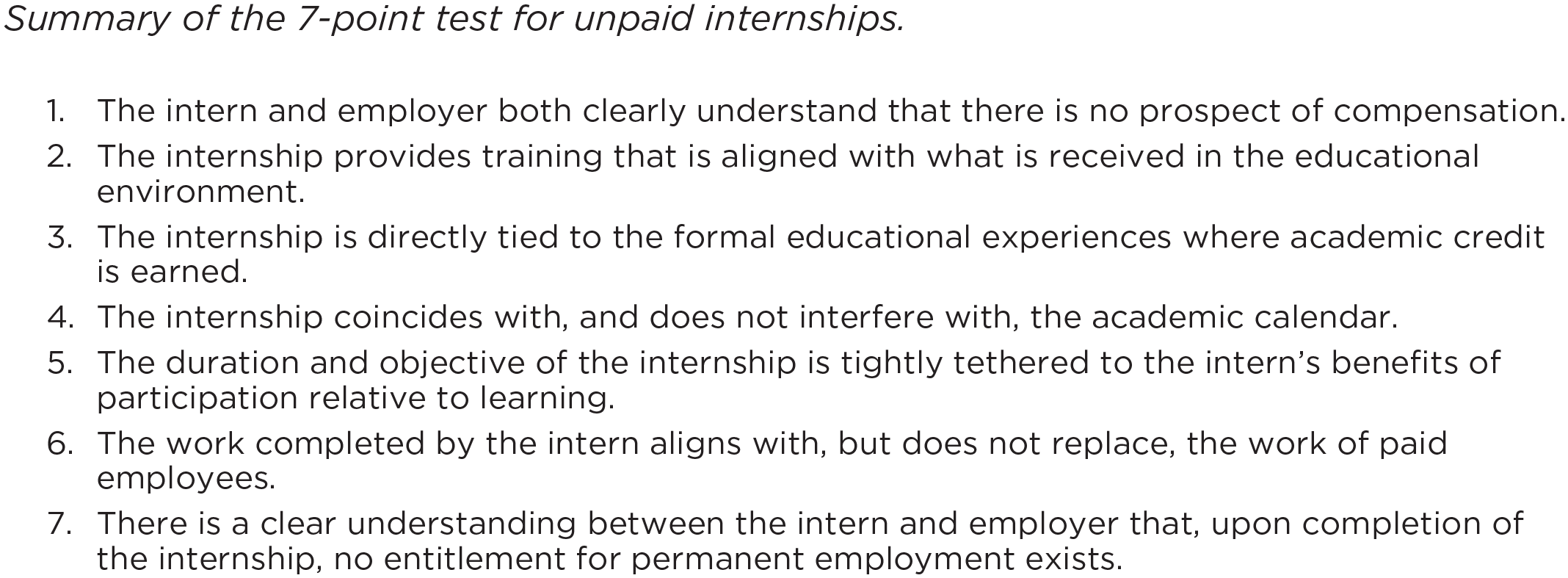
Test for unpaid internships
Paid Internships
Paid internships are formal, time-limited, WBL experiences designed to introduce students to a specific industry or job and to provide the student with relevant and applied work experience. Educators must consider how related policy impacts the implementation of paid internships. Most importantly, when an intern is paid wages from an employer, that intern enters into an employee–employer relationship (Tepper & Holt, 2015). At that point, specific provisions of FLSA are triggered, such as minimum wage and overtime protections and child labor protections in cases where the student intern is under age 18. In regard to child labor protections, students under age 18 may not work in any of the 17 occupations that are deemed hazardous by FLSA (DOL, 2016b). The DOL also prohibits individuals under 18 from performing tasks deemed too hazardous in certain occupations. For example, if a student under age 18 is interested in an internship at a bakery, the DOL, Hazardous Order No. 11, prohibits that student from setting up, operating, assisting others to operate, cleaning, oiling, adjusting, or repairing power-driven bakery machines, including horizontal and vertical dough mixers; batter mixers; bread dividing, rounding, or molding machines; dough breaks; dough sheeters; cookie and cracker machines; and cake-cutting band saws. The order, however, permits 16- and 17-year-olds to operate certain lightweight, small, portable, countertop mixers and certain pizza dough rollers under certain conditions (DOL, 2016b). More information about FLSA child labor provision can be found in DOL (2016a).
“To maintain the integrity of the internship experience, Ms. Lee and Ms. Cariño develop an internship agreement that will be signed by the intern (i.e., student with a disability), the teacher (i.e., Ms. Lee), and the business partner (i.e., Ms. Cariño).
As Ms. Lee and Ms. Cariño continue their discussions about possible collaborations, Ms. Lee explains that many of her students with IEPs are enrolled in the Business Information and Management (BIM) class, a course that supports learning specific job skills, résumé development, and technical and computer skills for students with and without disabilities. This course is offered each semester, and students enrolled in the course engage in part-time work or internships to practice the skills they learn in class. Ms. Lee and Ms. Cariño meet to discuss the BIM curriculum and how internships at Business Solutions would provide opportunities for students to gain valuable hands-on experiences. These internships would provide Ms. Cariño and other businesses with a steady stream of prepared, entry-level employees who live in the local community. Both Ms. Lee and Ms. Cariño are eager to collaboratively develop internship opportunities in their community during current economically challenging times.
Ms. Lee knows certain aspects of this process are complicated, so she and Ms. Cariño meet to review the DOL’s seven-point test for unpaid internships. The two start the meeting by defining the goal of the unpaid internship and then apply each of the seven criteria on the DOL fact sheet to the internship experience for a student with little or no prior work history. Figure 2 outlines the notes from their meeting. Next, Ms. Lee and Ms. Cariño use a similar process to ensure they are meeting specific requirements for a student who will engage in a paid internship opportunity. See Figure 3 for these additional meeting notes.
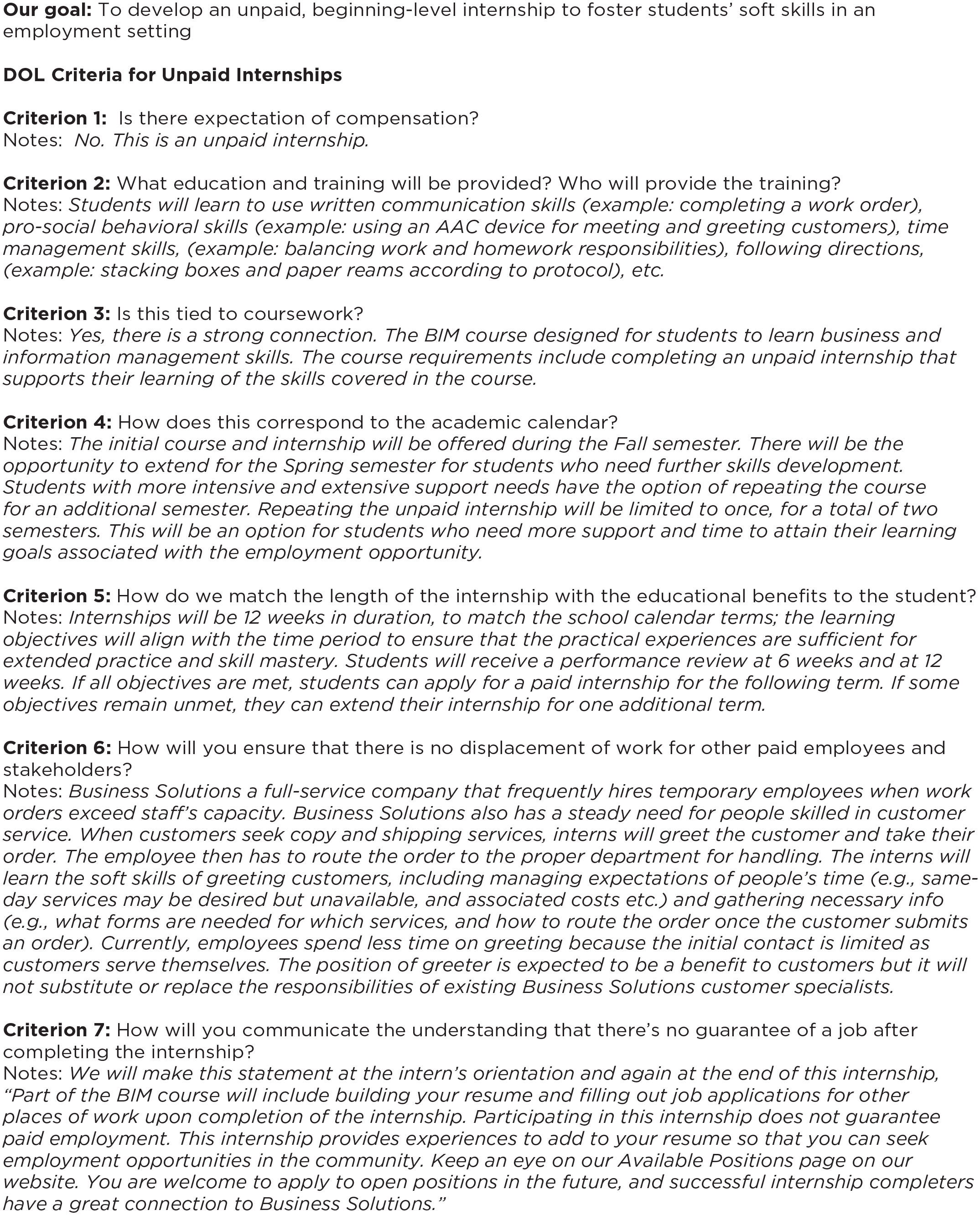
Ms. Lee and Ms. Cariño’s notes on unpaid internships
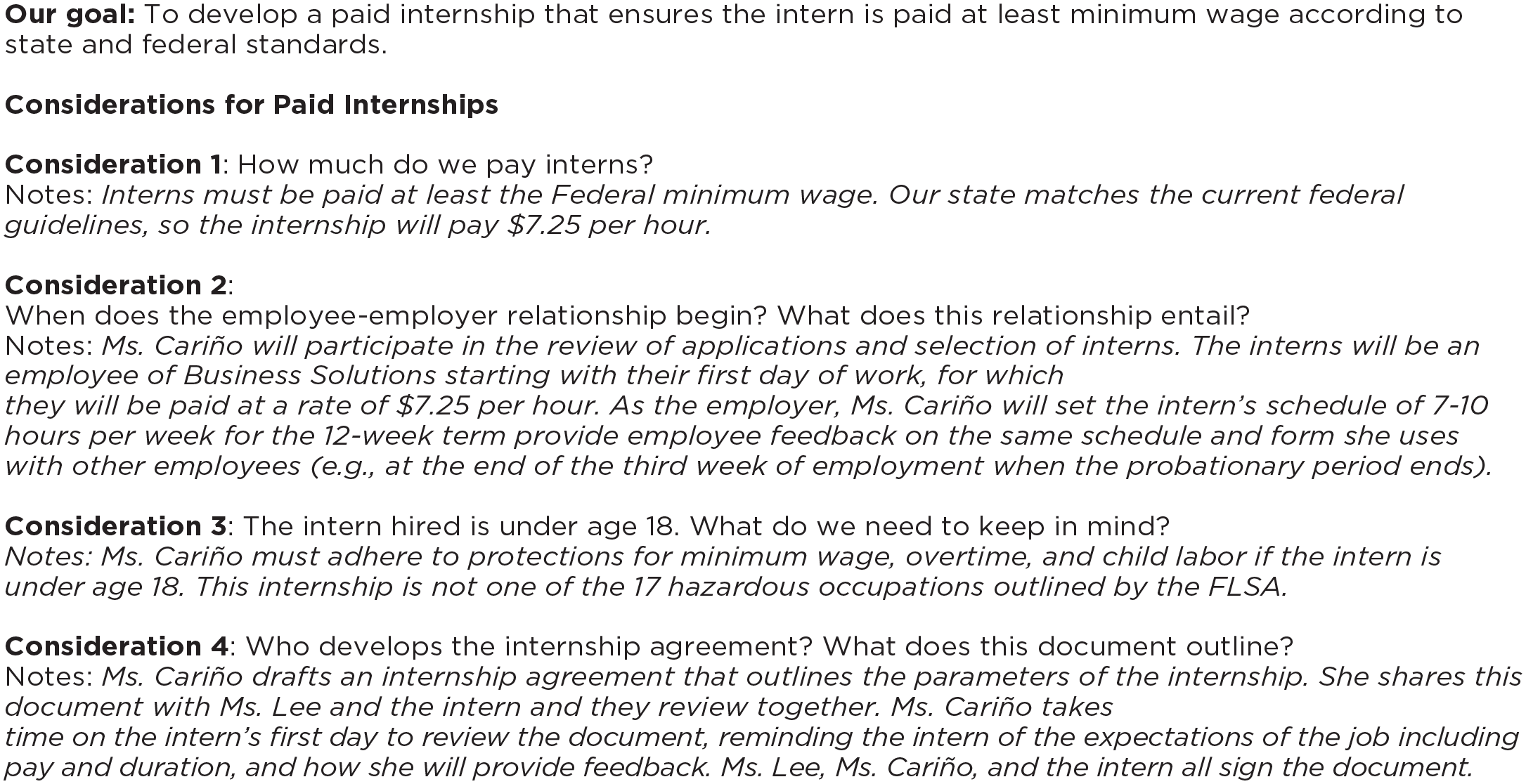
Considerations for paid internships
Once Ms. Lee and Ms. Cariño are satisfied their draft responses accurately adhere to relevant provisions of FLSA, they set up a meeting with school administrators to share their notes and to determine the next steps in outlining the details of the internship by applying Luecking and Gramlich’s (2003) WBL quality indicator checklist. These quality WBL indicators include the articulation of (a) clear goals and objectives; (b) clear roles and responsibilities for supervisors, mentors, and partners; (c) plans that specify learning goals that align with student outcomes; (d) clear expectations and feedback; and (e) assessment to identify skills and supports needed. This checklist serves as an internship framework for the school administrators and a guiding document that will be used in the BIM course.
To maintain the integrity of the internship experience, Ms. Lee and Ms. Cariño develop an internship agreement that will be signed by the intern (i.e., student with a disability), the teacher (i.e., Ms. Lee), and the business partner (i.e., Ms. Cariño). The agreement (a) outlines the duration of the internship and the number of hours per week the intern will work, (b) provides contact information for a school internship coordinator, (c) provides contact information about the employer supervisor who will oversee the intern, (d) provides wage information and ensures at least minimum wage according to federal and state standards, (e) provides information about employment duties that intern will complete, and (f) indicates that the intern is not guaranteed employment at the conclusion of the internship.
Finally, Ms. Lee and Ms. Cariño will use a collaborative framework to work with related service and other community partners who can help navigate, understand, and implement a student internship. For example, Ms. Lee will use her connections with vocational rehabilitation to invite counselors who provide transition services and preemployment transition services to student planning meetings. She will work with these counselors to gather information about how vocational rehabilitation can assist with internships and other work-related experiences. Ms. Lee is also aware of the WIOA Youth Programs. She will collaborate with the WIOA Youth Program coordinator to learn about the array of services and supports to available to students seeking employment—these services can be used to help a student learn crucial employment soft skills. Finally, to maintain community connections, Ms. Cariño plans to visit Ms. Lee’s school and the BIM course as a guest speaker. In turn, Ms. Cariño invites Ms. Lee to attend an upcoming Zoom meeting and networking session with the local chamber of commerce to discuss her work in developing internship activities for students with and without disabilities.
Thinking Inclusively From Multiple Perspectives
As members of the school’s neighborhood, Ms. Lee and Ms. Cariño are both aware that members of their larger community may face barriers to employment. Some of the barriers associated with historical marginalization, such as racial discrimination in the form of hiring practices and wage discrepancies, may impact families’ views of unpaid internships. Other barriers associated with recent events, such as the pandemic-related economic downturn, may also influence families’ enthusiasm and participation. At the same time, Ms. Lee and Ms. Cariño both recognize the myriad strengths and assets of this larger community that coexist with their barriers to employment. While outlining next steps, Ms. Lee and Ms. Cariño also make plans to visit with key members across their diverse local community to consider the needs of the various community stakeholders. Together they decide it would be helpful to hold a community conversation open to all community members. Using Ms. Lee’s knowledge of her students and their combined insight about the local community, they brainstorm questions to facilitate conversation with the larger community about how to ensure their work is community conscious, mindful of disability, and responsive to the needs of multiple stakeholders. See Figure 4 for a guide to this strategy.

Maximizing community buy-in and inclusion
By developing internships collaboratively from inception to implementation, educators, related service providers, and business partners can support one another’s efforts to be inclusive and to use a strengths-based mindset to career development. The approaches and strategies presented here through the case of Ms. Cariño and Ms. Lee aim to align with this framework, where partners from diverse fields (i.e., education and business) bring an understanding of the strengths, preferences, and needs of the student with a disability and the business community. In addition to disability-related accessibility, partners collaboratively address, for example, tailoring internships to meet the needs of families living in poverty, communities with limited transportation resources, schools and businesses with changing linguistic demands, and circumventing barriers associated with marginalization. In summary, internships provide valuable WBL experiences to students with disabilities. These experiences not only help prepare students to meet the demands of competitive integrated employment but also expose employers to a diverse and qualified workforce.
Footnotes
Declaration of Conflicting Interests
The author(s) declared no potential conflicts of interest with respect to the research, authorship, and/or publication of this article.
Funding
The author(s) received no financial support for the research, authorship, and/or publication of this article.
