




Abstract


The COVID-19 pandemic of 2020 forced many schools to deliver remote and/or online instruction, at least intermittently, to all students, including those with learning disabilities (LD; Grant, 2020). The move to remote (i.e., education provided not in the physical classroom or school) or virtual (i.e., learning facilitated by digital tools) instruction started in Spring 2020 and continued throughout the 2020–2021 school year for some schools (Microsoft & New Pedagogies for Deep Learning, 2020). Regardless of the emergency or sustained nature of delivering online instruction to students with LD throughout the pandemic, secondary special education teachers were and still are left with limited research, guidance, or practices on how to implement effective online mathematics instruction (Basham et al., 2016).
Although schools resumed more typical face-to-face operations for the 2021–2022 academic school year, many schools will likely need to continue to offer virtual learning for secondary students with LD. For one, the potential for outbreaks or students needing to quarantine, even with vaccines, necessitates preparation and planning to deliver and support secondary students with LD relative to online mathematics instruction (Welby, 2021). Second, some schools announced the discontinuation of snow days and are opting to use virtual learning on those days to eliminate travel in inclement weather (Lieberman, 2020). Third, some schools view online learning as an additional medium to serve secondary students, including those with medical needs or those living in rural settings (Johnston & Barbour, 2013), especially in mathematics (Cavanagh & Mitchelmore, 2011). Finally, online learning remains a potential untapped niche to support secondary students with LD with critical academic (e.g., math) supports, such as tutoring, credit recovery, and interventions, including during the summer (Basham et al., 2015). Secondary students, including those with LD, may be more appropriate to target for continued use of online or hybrid mathematics learning given the likelihood of functioning more independently than elementary students with both the technology and in the home environment (Stahl et al., 2017).
“Online instruction” is a broad term often erroneously interchanged with other terms. For our discussion, “online” and “virtual” are synonyms, referring to students learning within a virtual environment, which is different from “hybrid” (i.e., receiving some instruction face-to-face and some virtual) or even “remote” (i.e., learning when students are not physically within a classroom with or without technology; Mcelrath, 2020; Microsoft & New Pedagogies for Deep Learning, 2020). Online learning can occur synchronously or asynchronously. Asynchronous instruction is when instruction is not live, such that a teacher and student may not be online at the same time. Synchronous instruction is the converse—the instruction online is live and in real time between the teacher and students (Vasquez & Straub, 2012).
Online Learning and Students With LD
Although little is known about online teaching and learning in mathematics for secondary students with LD, we can leverage research regarding teaching and supporting students with disabilities in mathematics—such as the evidence-based practice of explicit instruction (Gersten et al., 2009; National Center on Intensive Interventions, 2016; Riccomini et al., 2017)—and consider how explicit instruction can be modified for online delivery. One means to implement online teaching to ensure accessibility is through the lens of the Universal Design for Learning (UDL) framework, which typically includes three core considerations: multiple means of engagement, representation, and expression (CAST, 2018; Flanagan & Morgan, 2021; Rao & Tanners, 2011). For multiple means of engagement, Flanagan and Morgan (2021) suggested educators consider student preference of technology and technology that provides consistency. Multiple means of representation within online teaching can involve using different digital visualizations to increase student access to instruction. Finally, multiple means of expression encourages students to select modes for demonstrating their learning (Flanagan & Morgan, 2021). By implementing online explicit instruction in mathematics for students with LD within a UDL framework, teachers can focus less on individual student accommodations and create accessibility for a broader range of students (Root et al., 2022). In this article, we present concrete suggestions for providing online explicit instruction in secondary mathematics to students with LD aligned with as UDL framework (see Figure 1).
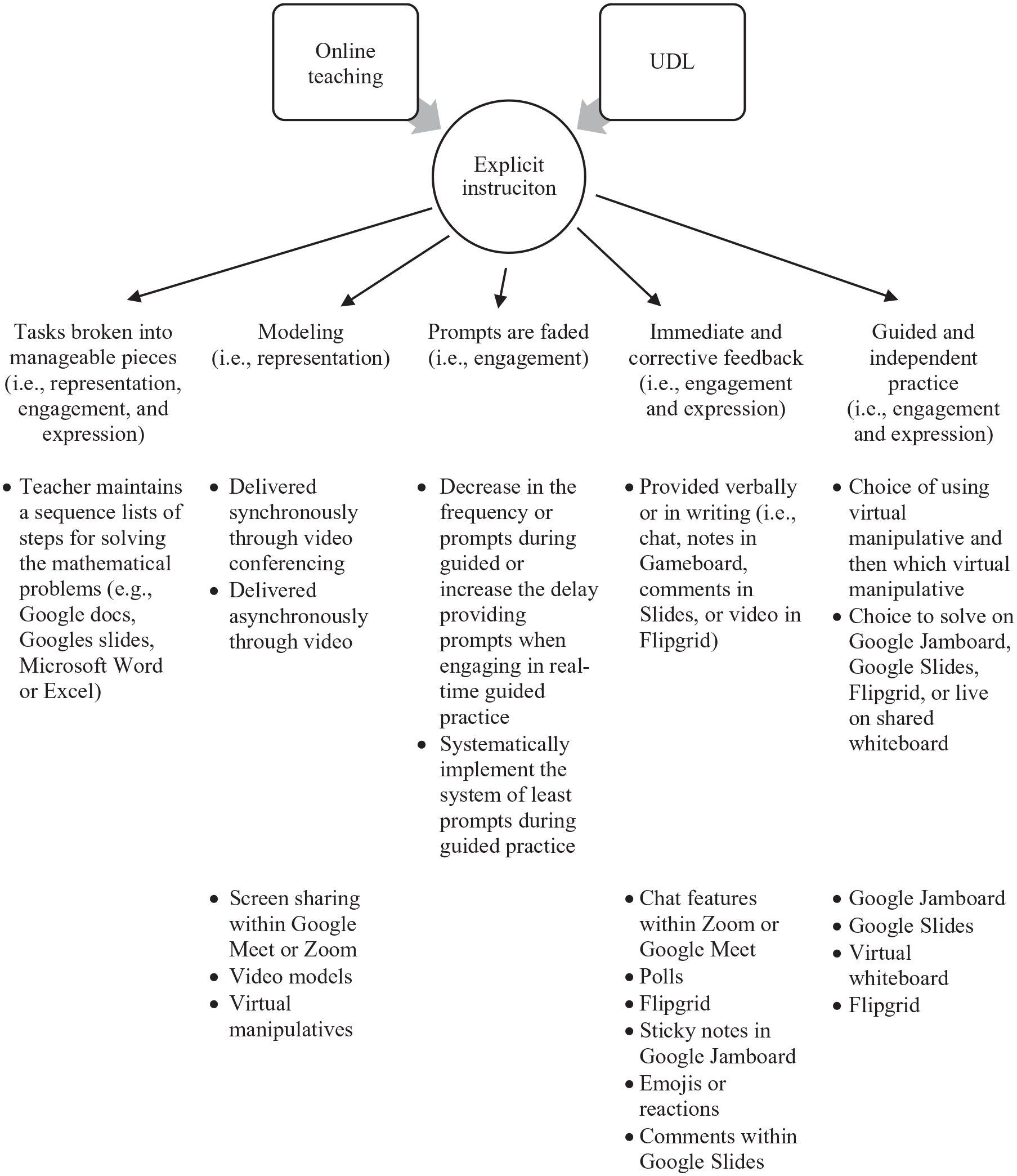
Implementing explicit instruction for secondary mathematics online within a Universal Design for Learning framework
Mrs. Ball is supporting her eighth graders in their co-taught mathematics class and in her resource room class in learning systems of equations by substitution, such as −2x + 3y = 8 and −x + y = 2. Teaching this mathematical idea to students face-to-face is difficult, so she is worried about how to help her students succeed when learning in a virtual setting. Yet a virtual teaching and learning environment is a reality because her students with LD within her resource room are learning this unit in mathematics entirely online due to issues beyond her control (e.g., quarantining for a positive COVID-19 test or exposure and weather). In preparation for this school year, with the potential for moving instruction online or converting snow days to virtual instruction days, the district provided each student their own device and Internet access to create a one-to-one district. In middle school, each student was given a Chromebook for school and home learning use, and teachers were expected to actively integrate the use of the technology into their face-to-face teaching and learning and consider it an option for students for effective online instruction. As Mrs. Ball contemplates providing online instruction to her secondary students with LD in algebra, she knows she wants to implement her approaches following the UDL framework so that she can reduce barriers for her students and hopefully keep them engaged (see Figure 2 to follow Mrs. Ball’s instructional decision-making and explanation).
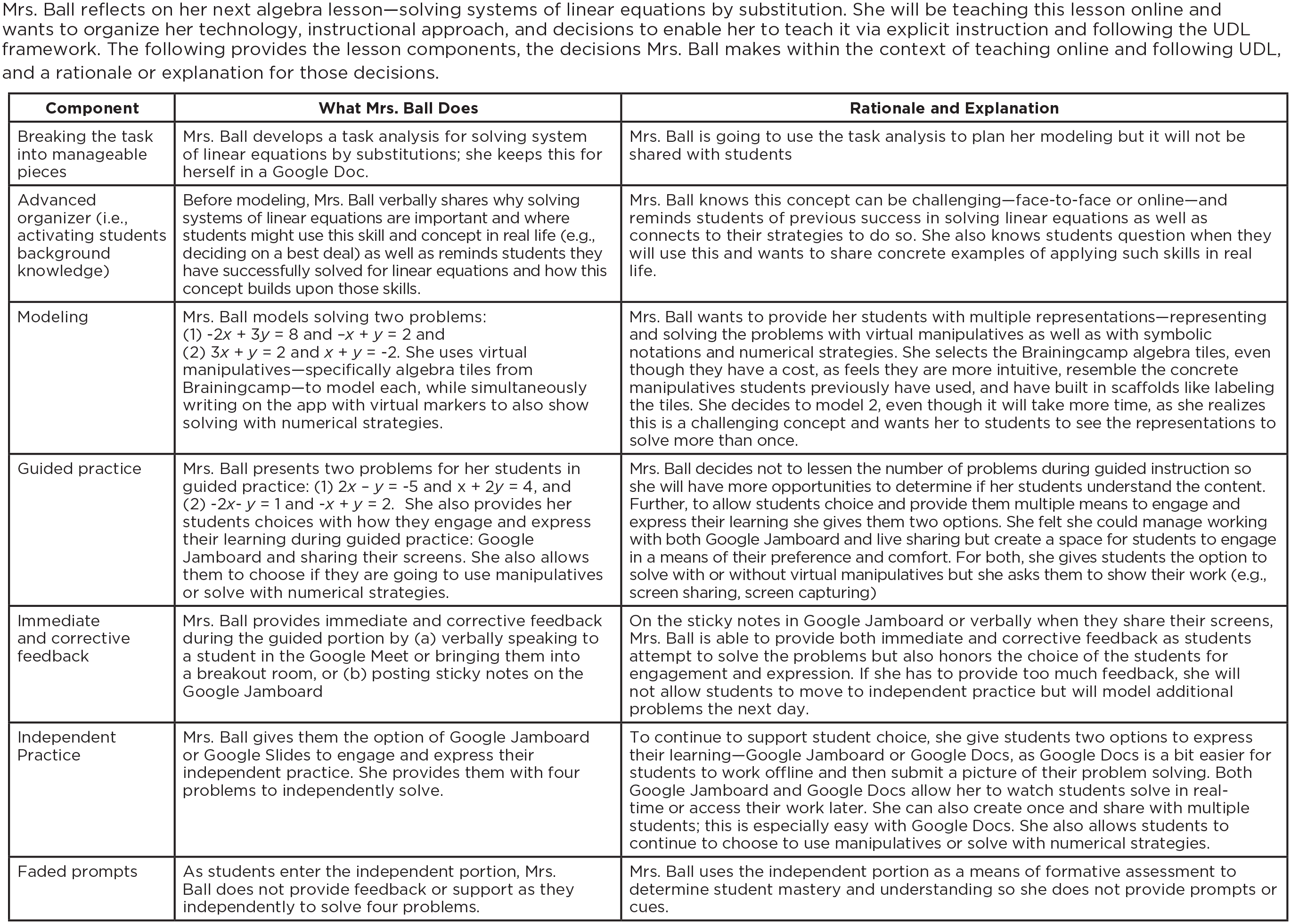
Implementation of explicit instruction in mathematics online
Explicit Instruction
Explicit instruction is an evidence-based practice for students with LD in mathematics (Gersten et al., 2009; National Center on Intensive Interventions, 2016; Riccomini et al., 2017) and a high-leverage practice (McLeskey et al., 2017). Generally, explicit instruction involves five components: a task broken into manageable pieces, instructional modeling, fading of prompts, immediate feedback, and practice opportunities (Hughes et al., 2017; see Figure 3 for a checklist for implementing explicit instruction for mathematics online). Specific to mathematics, explicit instruction often includes an advanced organizer (i.e., the purpose of the mathematics is briefly provided), a modeling phase in which think-alouds are provided, a guided phase with prompts and feedback, and then an independent phase in which students solve problems without feedback, prompts, or teacher support (Gersten et al., 2009; Hudson et al., 2006; Long et al., 2021). Explicit instruction in mathematics is both an instructional strategy and a pedagogical approach for teaching students other instructional strategies (e.g., manipulative-based sequences, problem-solving approaches; Agrawal & Morin, 2016).
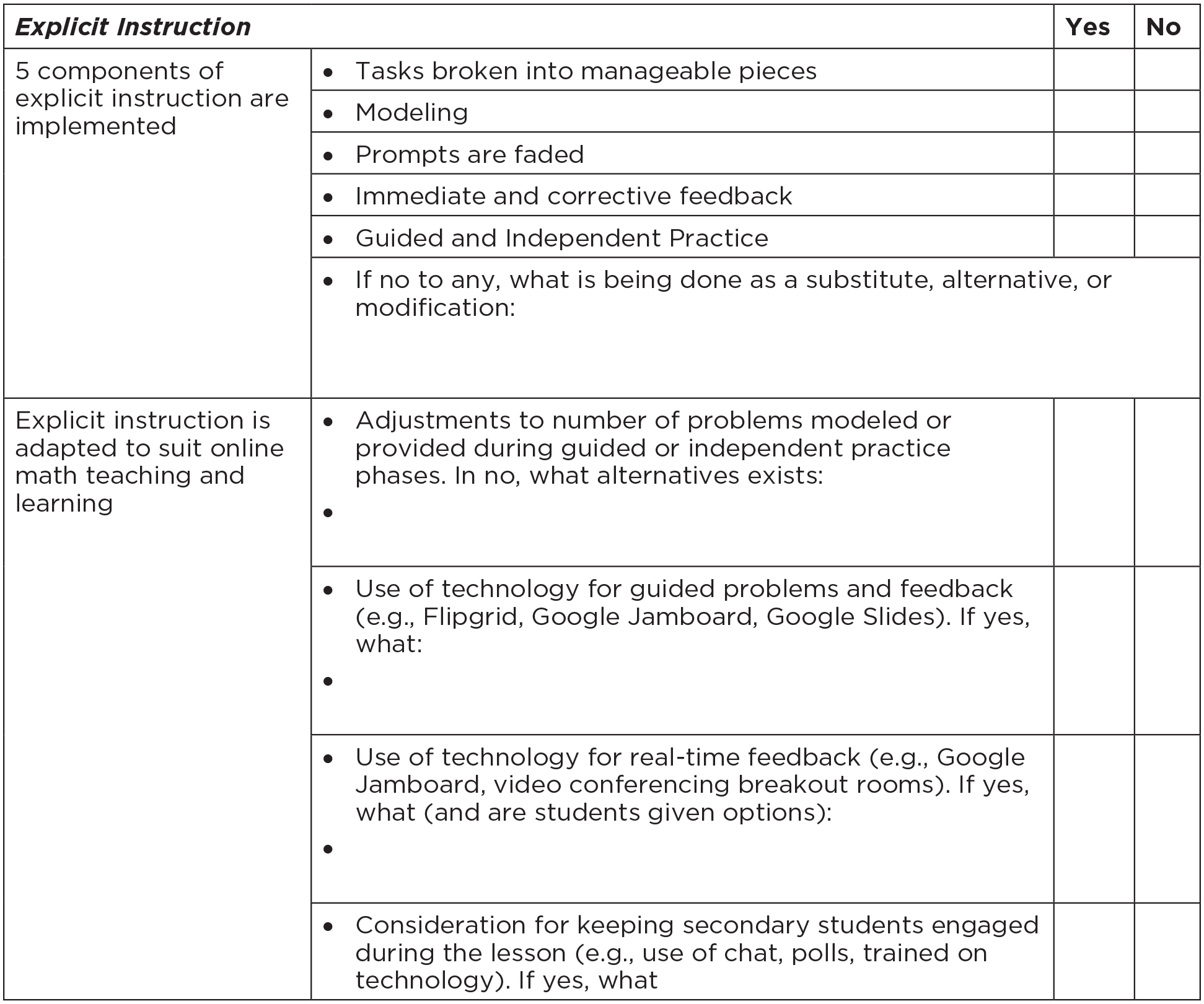
Checklist for providing explicit instruction to secondary students with learning disabilities learning mathematics online
Online Implementation of Explicit Instruction
In preparing to teach her lesson on systems of equations by substitution online to her students in her resource room support class, Mrs. Ball considers the elements of explicit instruction. She is very aware of the need to keep the task broken into manageable pieces in accordance with explicit instruction and to provide an advanced organizer that helps students connect the purpose of the mathematics to their lives and future mathematics learning. She also knows her students lose motivation and attention and become fatigued easier during online instruction. Mrs. Ball begins to plan how to model the algorithm. She decides to model two problems—consistent with most implementations of explicit instruction—and she feels it will support students to see more than one problem and process for finding a solution. However, she notes that in later lessons, she may model just one based on timing and students’ prior knowledge and understanding. In creating the lesson, Mrs. Ball decides to incorporate manipulatives into her first day of instruction and selects the algebra tiles from Brainingcamp to support her students by providing both the symbolic notion and a pictorial representation of the mathematics, in accordance with UDL. To model, Mrs. Ball shares her screen during her Zoom session. She has the virtual tiles app on display and provides a verbal think-aloud while she solves two problems in which she makes her approach to solving the problems mathematically explicit to students. Through using the virtual manipulatives, solving with mathematical notation simultaneously, and orally presenting her strategies to solve, Mrs. Ball feels confident that she is providing her students multiple means of representation within the online teaching environment.
“Explicit instruction is an evidence-based practice for students with LD in mathematics.
Although Mrs. Ball uses virtual manipulatives in the modeling phase of explicit instruction, virtual manipulatives—available in such free sites as Didax (https://www.didax.com/math/virtual-manipulatives.html) and Math Learning Center (https://www.mathlearningcenter.org/apps) and purchase sites as Brainingcamp (https://app.brainingcamp.com/)—are not required. Yet they do provide another form of representation, which is aligned with UDL. Manipulatives, in general, are an evidence-based practice and support students in developing both conceptual and procedural mathematical knowledge (Carbonneau et al., 2013; Peltier et al., 2020; see Figure 4 for an example of explicit instruction modeling with verbal think-aloud using a virtual manipulative). A teacher can also model solving the mathematics without manipulatives, through screen sharing a virtual whiteboard (i.e., within video conferencing programs like Zoom or Google Meet) or as a separate site (e.g., Math Learning Center). It should be further noted that virtual manipulatives, like concrete manipulatives, lend themselves mathematically to more elementary content and that fewer options exist to support advanced mathematics, particularly beyond algebra.
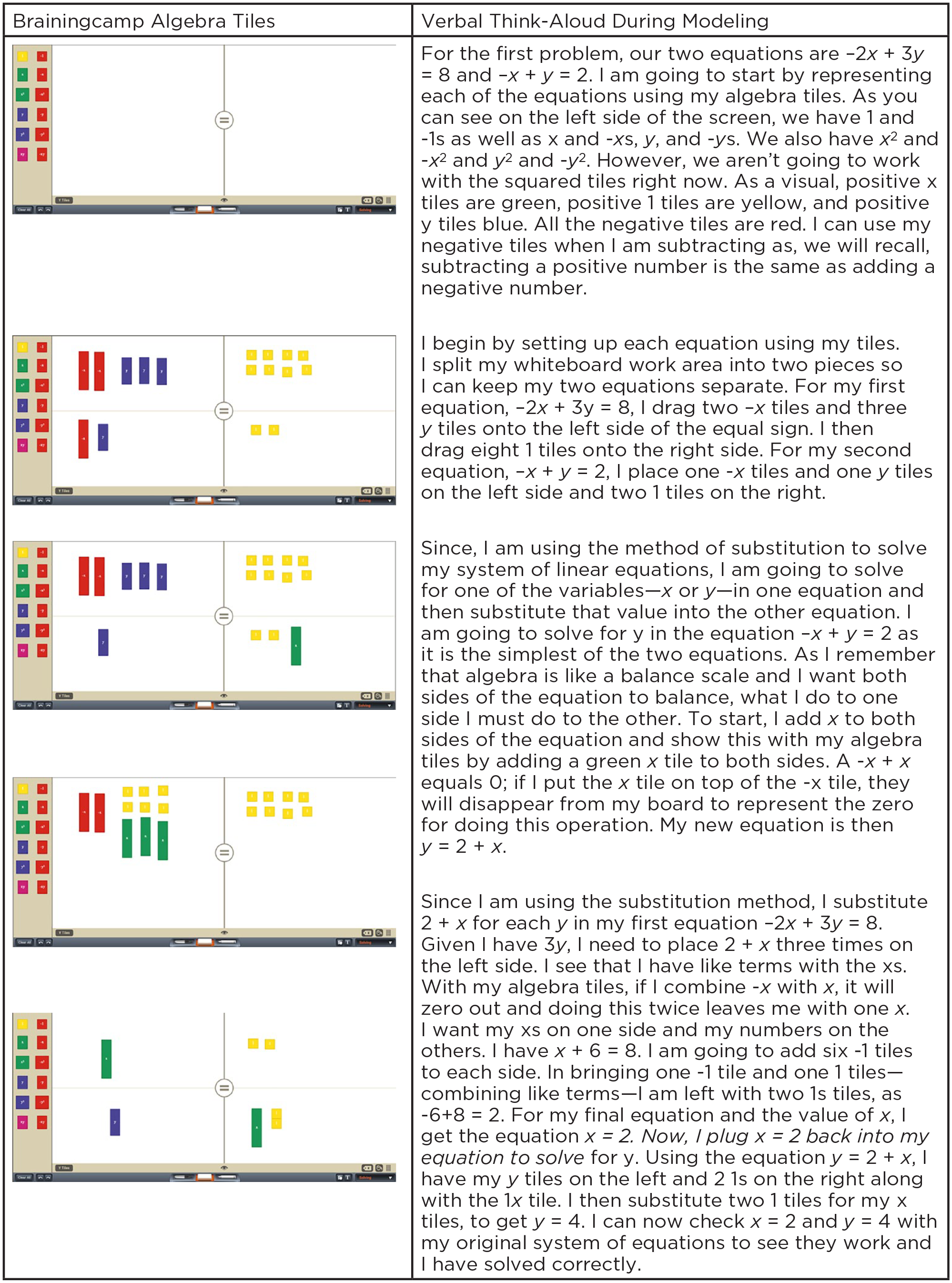
Examples of implementing explicit instruction online—modeling
Although the aforementioned examples provide modeling opportunities for synchronous online modeling, options exist for modeling within an asynchronous environment (i.e., students and teachers are not online at the same time). One means of modeling when providing asynchronous online teaching is video modeling, which is increasingly used to support secondary students with LD (e.g., Satsangi et al., 2018, 2021). Although creating video models is very time-consuming, one benefit is their use beyond online teaching—during or beyond a pandemic—to support for students and families at home. Educators can make video models in multiple ways, including sharing their screen and recording their think-aloud and demonstration via manipulatives, whiteboards, and other tools. Free options for creating videos or screen recordings include Screencastify, Loom, Flipgrip, and options within video conferencing programs such as Zoom or Google Meet; for-purchase choices include Camtasia.
When Mrs. Ball is engaged in modeling—whether with manipulatives or a virtual whiteboard—within her video conferencing program, she hits record. By recording her modeling phase of explicit instruction, she can post the videos to her Google Classroom, class website, or learning management system. Her students can access the videos at home or later for additional assistance; by recording when she is doing her live explicit instruction modeling, no additional resources or time are required to create these supports. Mrs. Ball realizes sharing these videos establishes another opportunity for students to engage with the teaching and learning.
After modeling, explicit instruction involves a guided phase in which cues and prompts are provided to students as they try to solve the mathematical problems (Doabler & Fien, 2013). This phase allows for both guided practice amd immediate and corrective feedback (Hughes et al., 2017). The guided phase is challenging within an online learning environment because the teacher needs to prompt and cue individual students and ensure they are ready for independent practice. Although explicit instruction online can be provided within small groups—through the original size of one’s online class or breakout rooms within a video conferencing system—guiding students online takes advanced planning. A teacher must decide how to observe students during guided practice online, including students screen sharing via a video conferencing breakout room, working on a collaborative digital whiteboard (e.g., the free option Google Jamboard, https://jamboard.google.com/), or students recording their guided work and submitting (e.g., through free options as Flipgrid, https://info.flipgrid.com/; see Figure 5 for an example of online guided instruction). The challenge with students recording videos, which may be necessary within an asynchronous online environment, is the delayed feedback.
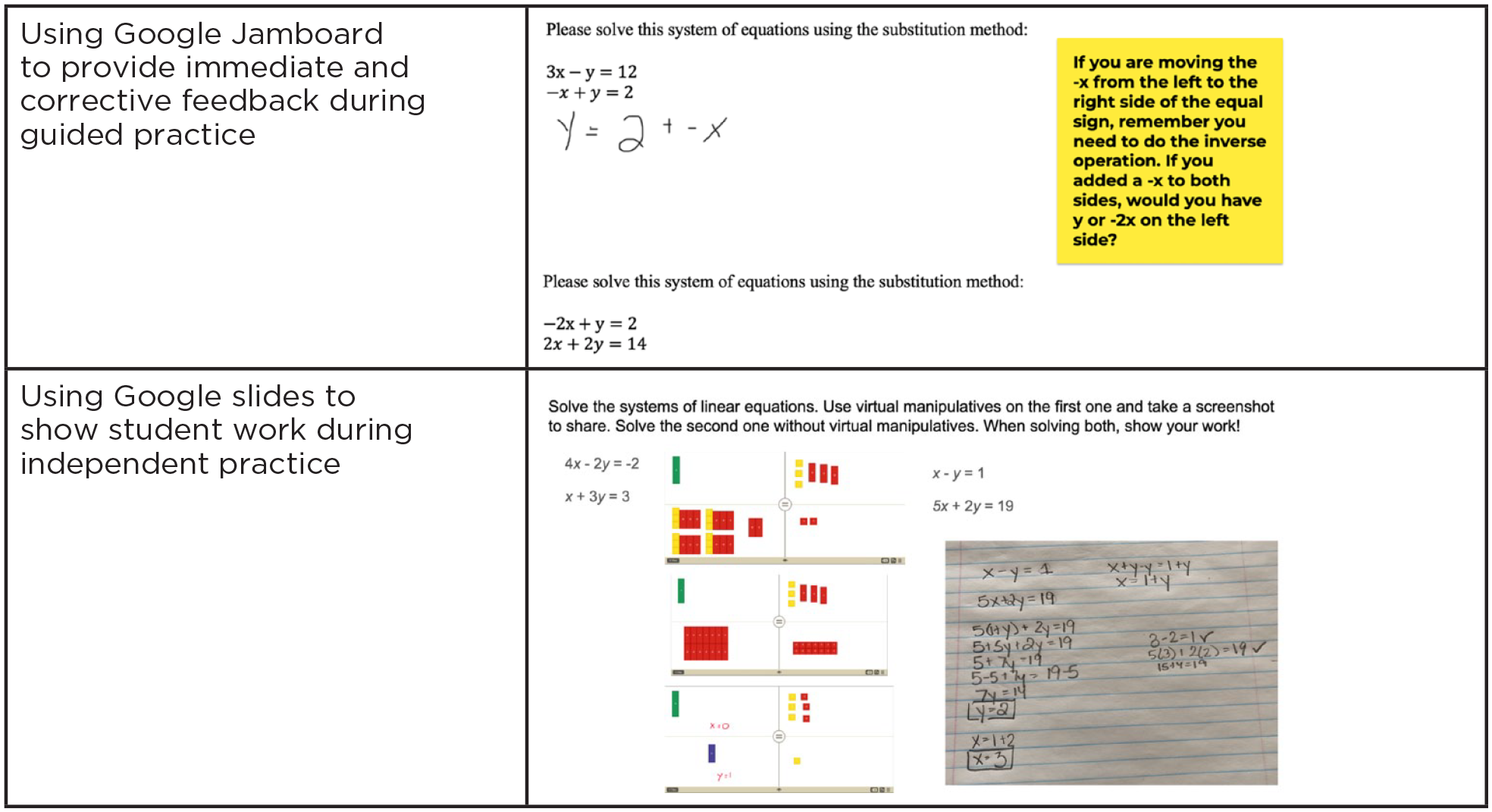
Examples of explicit instruction guided and independent practice phases online
Due to the synchronous nature of Mrs. Ball’s online mathematics teaching with her eighth-grade students with LD, she chose to engage in guided practice in real time. After reviewing technology options for guided practice, Mrs. Ball presented her students with three choices for engaging and expressing their work. However, she also encourages her students to use virtual manipulatives. One option she provided to students was Google Jamboard. She selected this technology because she could prepare the collaborative whiteboard space of Google Jamboard in advance by putting in pictures of problems or typing or writing them in advance. She could also see each student on their own Google Jamboard solving in real time. While she can verbally provide immediate and corrective feedback to each student within the video conferencing program (i.e., Google Meet or Zoom), she can also type or write on the Google Jamboard to provide feedback. The second option presented was for her students to share their screens, such as using a virtual manipulative or whiteboard, and solve while she is live on her video conferencing program. She thought about also providing students the option of Google Slides, where she could also prepare problems in advance, students could take pictures of their work online or on paper and add to the slides, and she could access in real time. She ultimately decided three options would be too cumbersome for her to manage and did not include Google Slides as an option during guided practice.
Once students have demonstrated sufficient independence and accuracy during the guided practice portion of explicit instruction, they are ready to move into independent practice. A teacher needs to remember some students may need to receive additional modeling or guided practice before independent practice if they required too many prompts or cues during the guided phase. The independent portion of explicit instruction can serve as a formative assessment for the teacher to check mastery and understanding; students independently solve the problems and teachers are not providing prompts, cues, or other supports. In this case, the prompts are faded as students move into independent practice (Hughes et al., 2017). Given the greater independence and decreased need for teachers to monitor the independent portion, teachers have more flexibility as to their technology offerings and the choices they provide to students to express their learning. Teachers can continue to use Google Jamboard (i.e., collaborative interactive whiteboard), Google Slides, or Flipgrid (i.e., video or screen recording tool) or provide other asynchronous options. With Google Slides, in which students take a picture and submit their work, the teacher is providing flexibility for students to solve with virtual or with concrete manipulatives, on a digital whiteboard, or even on paper-and-pencil because students can take a screen capture or actual digital photo (see Figure 5).
Additional Considerations for Implementing Explicit Instruction Online
When teaching online, additional considerations for explicit instruction may exist (refer to Figure 3). Explicit instruction can be modified, although limited research has examined the efficacy of modifications to date. One such modification includes adjusting (i.e., decreasing or increasing) the number of problems a teacher models, guides, or has the student engage in independently (Long et al., 2021). Although many examples of explicit instruction in mathematics involve the modeling and guiding of two problems each—as was referenced in the case with Mrs. Ball—it is not a set rule but rather should be based on the student (e.g., strengths and challenges), mathematics content (e.g., how familiar student is with content and how challenging is the content in general), and context (e.g., how much time for intervention or support; Doabler & Fien, 2013). In a recent study during the pandemic, Bouck & Long (2021) found modifying explicit instruction to include one modeled problem, one guided problem, and five independent problems was sufficient to support the acquisition of the targeted mathematics for three upper elementary students with disabilities or deemed at risk. However, little to no research exists on modifications to explicit instruction for secondary students or students learning more advanced mathematics (e.g., algebra, geometry).
“When teaching on line, additional considerations for explict instruction may exist.
Another consideration with providing explicit instruction online to secondary students with LD, following the guidelines of UDL, is providing students with choice. Given the additional challenges to teaching mathematics online, teachers will need to balance student choice in engagement and expression of their mathematics with their own ability to navigate different technology. However, ways to infuse student choice within online explicit instruction implementation includes allowing students to (a) select to use virtual manipulatives and even the type of virtual manipulative (e.g., algebra tiles vs. balance scale for solving linear algebra problems), (b) select from a few technology options for providing their work (e.g., Google Jamboard vs. Google Slides vs. digital whiteboard), (c) select a means in which to receive feedback (e.g., verbally, in the chat, or post-it on Google Jamboard; see Figure 1), and (d) select how many problems should be completed in the guided and independent phases to demonstrate their mathematical understanding, provided they are showing mastery.
A final consideration, especially considering secondary students with LD and online instruction, is keeping students engaged. Engagement is critical to helping secondary students with LD connect to mathematics teaching and increase their mathematics learning (Domina et al., 2021). Engagement is multifaceted, including participating and attending to activities and one’s behavior, sense of belonging, self-regulation, and working to learn (Fredricks et al., 2016). Although student engagement decreased during the emergency remote learning of the COVID-19 pandemic, with resources and increased emphasis, educators can actively engage secondary students with LD during online mathematics teaching and learning (Domina et al., 2021).
Although using digital technology, such as with online teaching and as a central part of the UDL framework, can support engagement, teachers must ensure students have access and adequate training in how to use the technology being employed (e.g., Google Meet, Google Jamboard, Flipgrid, or virtual manipulatives; Domina et al., 2021). Second, teachers should take advantage of the alternative ways of participating not always afforded to students in face-to-face learning, such as allowing students with LD to respond orally, write in a chatbox, or answer a digital poll (Harris et al., 2020). Providing students with choices and allowing them to make decisions supports students’ engagement and aligns with UDL (Basham et al., 2020).
Another way to increase student engagement in online mathematics learning is through involving one-on-one instruction and small group breakout rooms or sessions. If classes meet 60 minutes for math, all 60 minutes should not involve the teacher lecturing, talking, or modeling. Rather, teachers can provide multiple ways for students to engage with the mathematical content through one-on-one meetings with students or connecting with students with LD facing similar struggles during this time by using breakout rooms within digital platforms such as Google Meet or Zoom. When a teacher is meeting one-on-one or in small groups with students in a breakout room, other students may be working independently, such as completing problems in Google Jamboard or Google doc or slide, or working in small groups in other breakout rooms to discuss their strategies and approaches to solving the problems. Finally, teachers can encourage student engagement by having students communicate and collaborate (Basham et al., 2020). While positively supporting UDL and engagement regardless of modality, explicitly planning for and supporting students to communicate and collaborate within online mathematics teaching and learning can be particularly important where secondary students may feel less connected with peers (Ellis et al., 2020.).
“Layered across the UDL framework, teachers can implement explicit instruction online that supports students with LD in learning mathematics.
Conclusion
Online mathematics teaching and learning for secondary students with LD can be used to increase instructional intensity (including supporting student credit recovery) and decrease interruptions in students’ schedules due to future pandemics and snow days. Given the efficacy of explicit instruction in mathematics—and that it is an evidence-based practice for students with LD—special education teachers being knowledgeable and prepared to implement explicit instruction in mathematics in virtual learning environments is essential (Gersten et al., 2009; National Center on Intensive Interventions, 2016; Riccomini et al., 2017). Layered across the UDL framework, teachers can implement explicit instruction online that supports secondary students with LD in learning mathematics by taking advantage of technologies and instructional approaches that privilege options and choice. Throughout this article, we provided a continuous case study focused on a major secondary mathematics focus—algebra. However, the suggestions and ideas can be applied to a range of mathematics content taught to secondary students with LD.
Footnotes
Declaration of Conflicting Interests
The author(s) declared no potential conflicts of interest with respect to the research, authorship, and/or publication of this article.
Funding
The author(s) received no financial support for the research, authorship, and/or publication of this article.
