




Abstract
Many general education teachers have indicated they do not feel well prepared to meet the academic and behavioral needs of students with extensive support needs (ESN). Although teachers cite limited training, preparation, and experience as notable barriers to general education placements for students with ESN, the opportunity and success of the inclusion of students with ESN in general education, should never be dependent on the previous preparation of teachers. To address and reduce some of the identified barriers, this article proposes ways in which many strategies commonly used for instruction with students without disabilities can readily be adapted to allow not only access for students with disabilities but to also promote active engagement and progress towards learning the general education content standards.

Daniel is a third-grade student with autism spectrum disorder and an intellectual disability. Mr. Carter, a third-grade teacher, and Mrs. Saldido, Daniel’s special education teacher, meet with Daniel and his parents, the speech language pathologist, and the principal during an individualized education program (IEP) meeting. The team decides during the meeting that Daniel’s needs can best be met in the third-grade classroom. Mr. Carter has other students with disabilities in his classroom but no one quite like Daniel who requires specially designed instruction. He wants to ensure Daniel is engaged in the class both when learning content and interacting with peers. Although Mr. Carter had one course in his preparation program regarding supporting students with disabilities, he does not feel well prepared to become the teacher of record for Daniel.
Mr. Carter is not alone. Many general education teachers do not feel prepared to actively engage students like Daniel in the learning process (Agran et al., 2020). Daniel can be described as having extensive support needs, or ESN. Students with ESN are representative of a diverse student population who have differing intensive and pervasive support needs that may be present across various domains (e.g., school participation and learning, communication, social and behavioral; Kurth & Zagona, 2018). In the educational setting, students with ESN may receive special education services under the eligibility categories of autism spectrum disorder, intellectual disability, multiple disabilities, or deaf-blindness and are typically eligible to participate in the state alternate assessment (Kurth et al., 2019). General education teachers have expressed apprehension across multiple surveys when asked about including students with ESN in their classrooms, due primarily to the lack of training and instruction they received during their teacher preparation programs (e.g., Gehrke & Cocchiarella, 2013; Kurth & Forber-Pratt, 2017; McHatton & Parker, 2013; Zagona et al., 2017).
“By actively involving students in the learning process, teachers are presenting students with opportunities to apply constructed knowledge and skills while engaging in meaningful learning experiences. “Active engagement strategies increase student participation, academic achievement, and displays of appropriate behavior (Common et al., 2020).
General education teachers are, however, experts in implementing active learning strategies. Active learning strategies require student participation in activities that have been intentionally structured by teachers to facilitate student engagement, improve motivation, and enhance relevance of course content. By actively involving students in the learning process, teachers are presenting students with opportunities to apply constructed knowledge and skills while engaging in meaningful learning experiences. Through these experiences, researchers have shown that active engagement strategies increase student participation, academic achievement, and displays of appropriate behavior (Common et al., 2020). Although these strategies have been shown to be effective for all students, students with ESN often require additional support to adequately participate in these strategies in the general education classroom.
The following sections outline active learning strategies (i.e., opportunities to respond [OTRs], explicit instruction, turn and talk/think-pair-share, think-alouds, graphic organizers, visual supports) that commonly occur in the general education setting. Each section is designed to provide a brief description of the strategy, how it can be adapted or applied for use with students with ESN using principles of Universal Design for Learning (UDL), and an example of how the teachers discussed and planned to use the strategy during a lesson with Daniel, our case study student. UDL ensures instruction is designed with the same goal for all students by removing barriers related to the delivery of content, engagement, or expression of knowledge (CAST, 2018). UDL consists of three guidelines (engagement—the why of learning; representation—the what of learning; and action/expression—the how of learning) with specific considerations to increase access, build knowledge or skills, and empower students to be self-directed. The use of UDL supports a teacher’s ability to explicitly design OTRs for all students to actively participate and respond during lessons. Table 1 includes examples of each support or strategy, goal, embedded content, barriers, and possible solutions specific to Daniel's education.
Examples of Instructional Supports and Strategies With Embedded Content in Grade-Level Lessons.
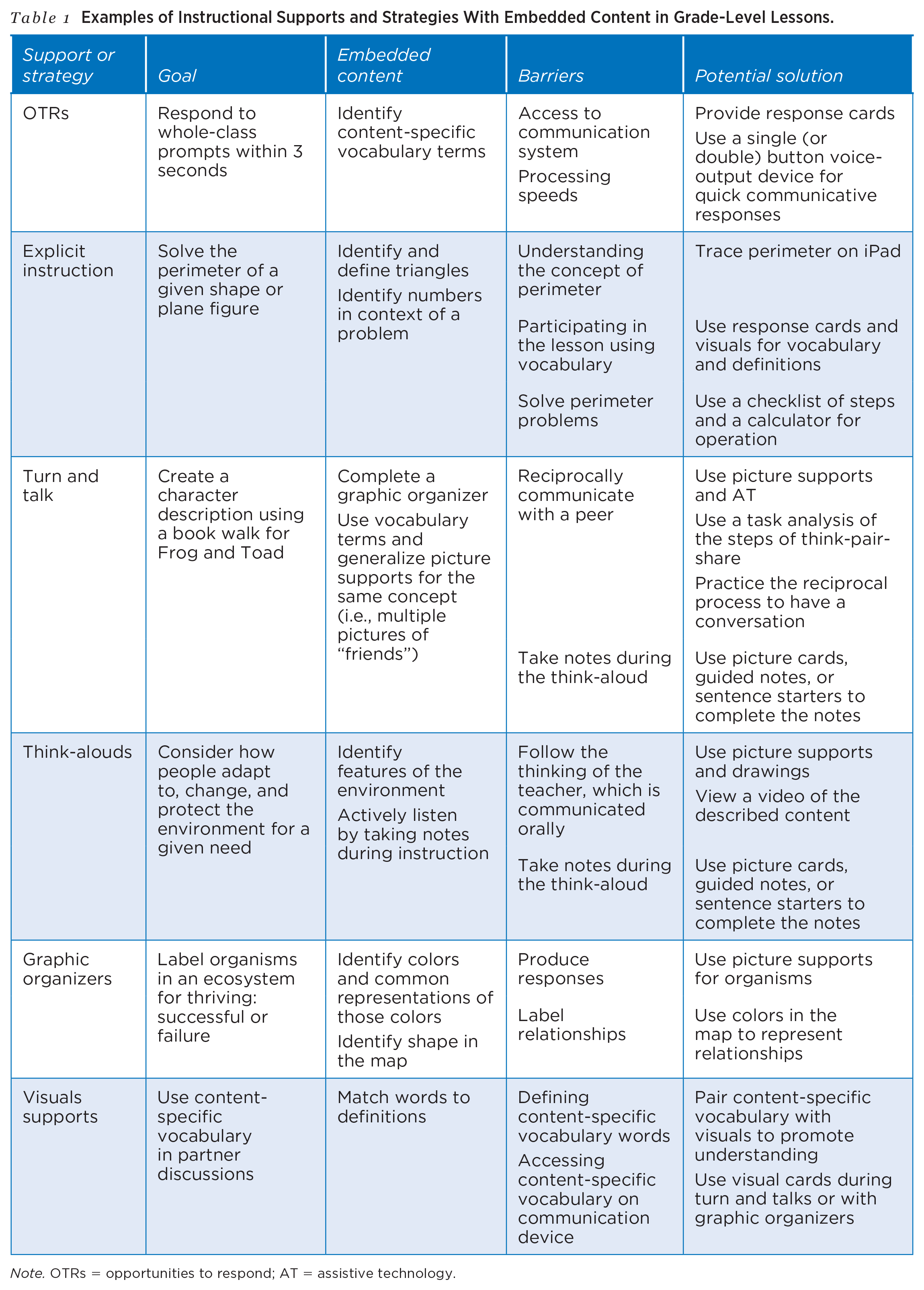
Note. OTRs = opportunities to respond; AT = assistive technology.
OTRs
Although general education teachers may not be familiar with the phrase “OTRs,” it is something they present consistently throughout their instructional day. An OTR is defined as an interaction between a teacher’s academic prompt (i.e., visual, verbal, written, or technological) and a student’s active response (i.e., verbal, written, gestural, or technological; Greenwood et al., 1984). For example, asking all students to point to the section of a metal spring that shows compression is an opportunity for each student to respond. Having numerous OTRs during instruction has proven to be a critical factor in student success (Martin et al., 2018). These opportunities must be purposefully planned, with student needs and abilities in mind, to promote authentic responses by all students that accurately reflect what students know and can do. Allowing students to actively engage and participate during instruction, receive feedback on that performance, and try again using the feedback provided is one of the most effective ways to determine student understanding and learning prior to them independently practicing content related skills.
“Having numerous OTRs during instruction has proven to be a critical factor in student success (Martin et al., 2018).
Reaching All Learners
There are several universally designed ways to increase OTRs for students with ESN in the general education classroom. It is important to ensure each student has multiple means to engage in OTRs (CAST, 2018). One way this can be done is by planning to present content via instructional technology, like an interactive whiteboard, which can aid in increasing engagement, student interest, and represent content in an alternative way while promoting the delivery of multiple OTRs. Other ways to improve access to OTRs are the inclusion of pictures or media to support symbols and vocabulary terms or programming assistive technology for students to express their understanding in OTRs. Teachers who understand the connection between the UDL guidelines and OTRs are better able to provide meaningful access and engagement for all students.
Mr. Carter already presents multiple OTRs throughout his instruction. He knows that OTRs improve student engagement and serve as a way to assess student understanding. However, he does not know how to ensure Daniel has the means to respond to these opportunities. Daniel uses augmentative and alternative communication (AAC), but it often takes Daniel longer than his peers to respond, so it is difficult for Mr. Carter to determine if Daniel actually knows the answer or if he is just echoing his peers. During his lesson on geography, his students respond by writing on whiteboards. To improve access for Daniel, he makes a response card with the key content words and gives him a clothespin to mark his answer (see Figure 1).
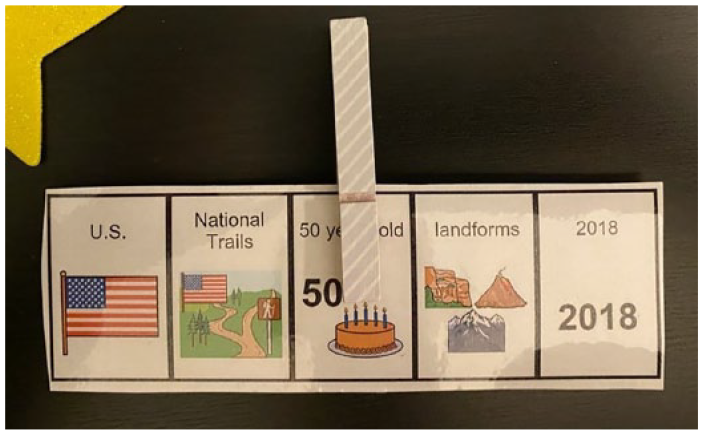
Response card
Explicit Instruction
Many general education teachers organize their lesson plans in an “I do, we do, you do” format. What they may not realize is that this is part of a set of evidence-based practices (EBPs) known as explicit instruction. Explicit instruction refers to “a group of research-supported instructional behaviors used to design and deliver instruction that provides needed supports for successful learning through clarity of language and purpose and reduction of cognitive load” (Riccomini et al., 2017, p. 4). Archer and Hughes (2011) outlined 16 elements of explicit instruction, including breaking skills down into clearly sequenced units that are taught using examples and nonexample models and designing instruction that includes frequent responses from students during guided and supported practice. Using an explicit approach during instructional delivery ensures that not only do students have a model from which to work from, but they also have the opportunity to practice using that model and receive feedback regarding their performance.
Reaching All Learners
Explicit instruction can be made more accessible for students like Daniel through task analytic instruction. Task analytic instruction is a research-based practice for students with ESN in inclusive settings in which complex processes are broken down into manageable steps (Saunders et al., 2020). This instructional practice is used when teaching skills with multiple steps, such as solving math problems, conducting a science lab, or analyzing historical events (McConomy et al., 2021). Teachers provide the description and model the steps during the teacher input and guided practice segments of a direct instruction lesson. The deconstruction of a complex task into understandable chunks allows students to develop an understanding of what to do and then build fluency with the steps in the larger task. This multifaceted instructional practice can be used by both teachers and students. For example, teachers can use task analyses to break down complex academic skills, whereas students can use task analyses as scripts to engage in social interactions and instructional routines (see Figure 2). Task analyses can help to create authentic and meaningful access to academic opportunities in the general education setting for students with ESN because students are provided with natural supports needed to self-monitor and self-prompt (McConomy et al., 2021).
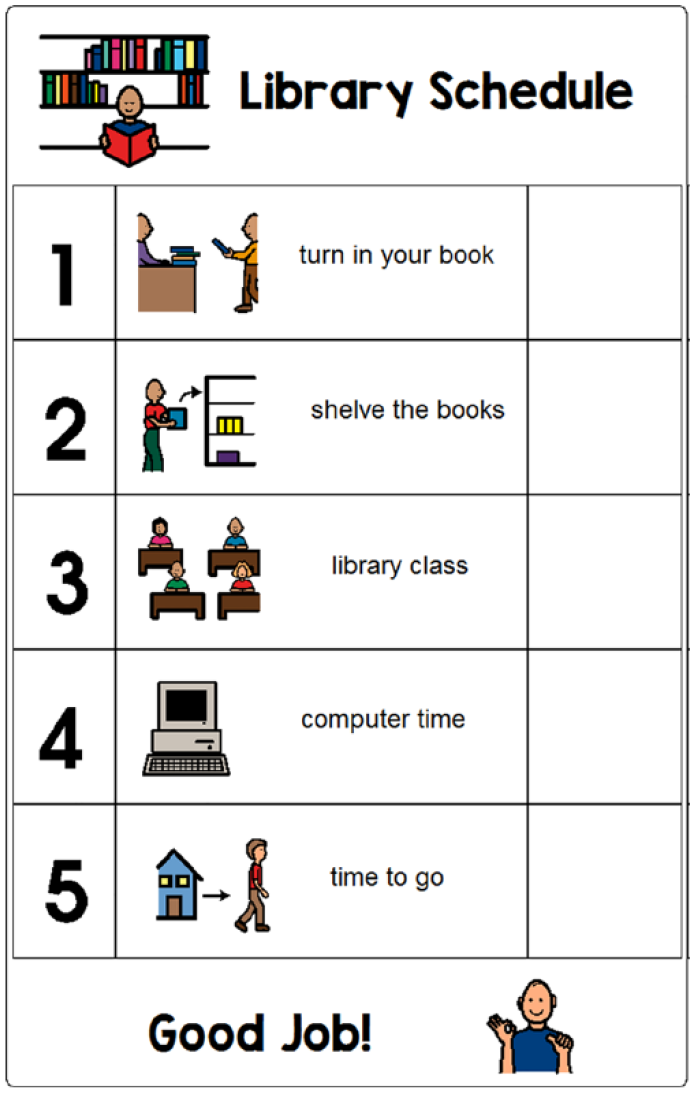
Library routine task analysis
Mrs. Saldido and Mr. Carter discuss the upcoming standard for social studies: Summarize the elements (cultural, demographic, economic, and geographic) that define regions (community, state, nation, and world). Mr. Carter explains that he would like students to work in groups to research at least one region of their state and collect information regarding the geography, population, and economic factors of each region. The teachers discuss how Daniel could conduct research. Mrs. Saldido decides to complete the process herself first, writing down each step so she can build a task analysis. The teachers use this as a guide to consider how Daniel could participate in each step of the research process.
Turn and Talk/Think-Pair-Share
Collaborative learning, including peer support interventions, may be one of the most widely used practices in every grade level and content domain. This active learning strategy goes by many names (e.g., turn and talk, think-pair-share, shoulder partners, numbered heads together) and involves two students discussing a topic, having time to compare ideas or come to a consensus, and then sharing with the class. Research has shown this teaching technique improves student engagement and understanding while also providing students with opportunities to practice academic language, communication, and problem-solving skills (Prahl, 2017). These skills prepare students for life—in school, in work, in the home, and in the community.
Reaching All Learners
Peer supports were identified as an EBP for students with ESN in inclusive general education classrooms, but many students with ESN have had few opportunities to work with peers prior to joining a general education classroom (Saunders et al., 2020). Reyes et al. (2020) described ways to help facilitate the participation of all students in a turn and talk strategy. Students may need explicit instruction and supports for social interactions and practice engaging with familiar peers and content with known outcomes (e.g., “What is your favorite ice cream flavor? [listen] Mine is strawberry. Are our flavors the same or different? [listen] Our flavors are different so we will put our marker on the Different category.”). One way to provide this support is by giving students a list of steps they can use to self-monitor (see Figure 3). Students who communicate nonvocally will require supports such as AAC to talk with their peers. The provision of assistive technology or response options that allow students to express themselves are essential for students to be active participants in collaborative strategies.
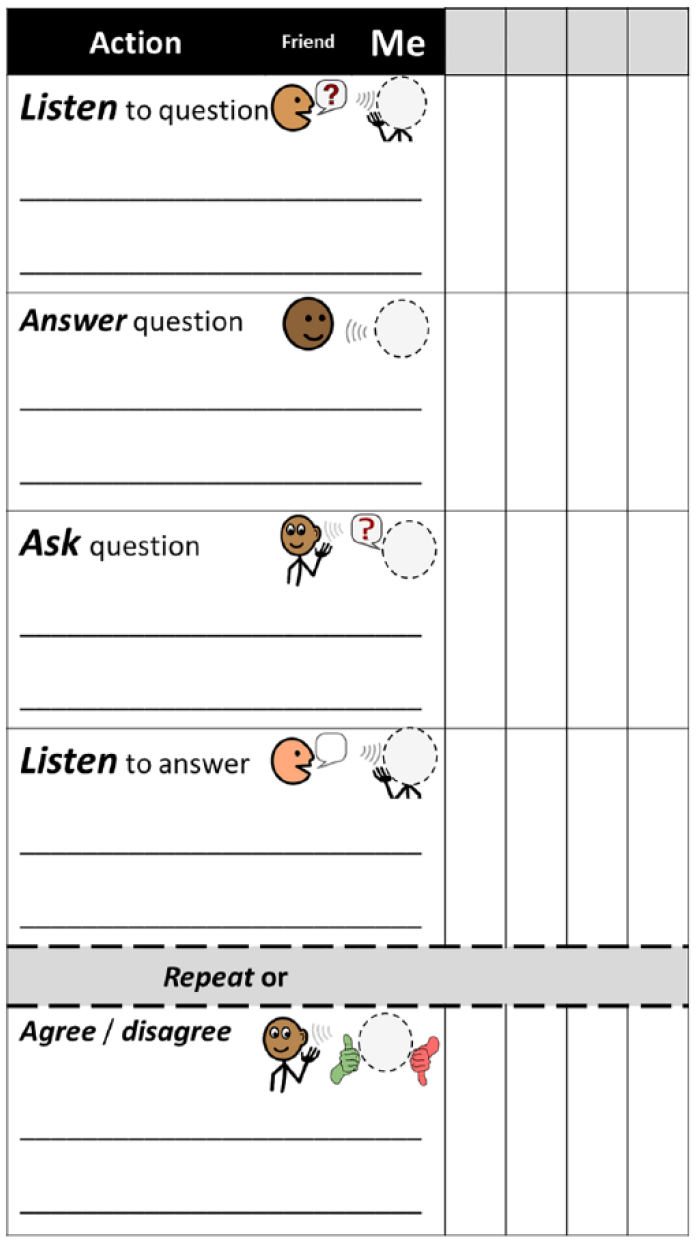
Turn and talk support from Project IMPACT
Mr. Carter is planning to do a character analysis on a familiar book—Frindle, by Andrew Clements. He plans for the students to preview the book in pairs and use a graphic organizer to build a character description for the main character, Nick. Mrs. Saldido shares that Daniel has never participated in this strategy. She considers that Daniel speaks in one-word utterances and knows he will need additional supports to participate. Mr. Carter works with her to add content words and phrases to Daniel’s AAC device. They also plan to provide Daniel a chance to practice this strategy with his friend Sara before morning meeting starts for a few days prior to the lesson using core words in high-interest topics such as which is the best train—a freight train or a passenger train—and come up with a reason to support their thinking. Daniel’s AAC device is ready for this type of conversation, and Mr. Carter develops a task analysis of the steps for the conversation to help the pair visually work through them together.
Think-Alouds
Think-alouds help teachers and students gain insight into how a person explicitly thinks when they address a problem or situation. When thinking aloud, teachers and students verbalize their thoughts as they occur, providing an awareness of teachers’ and students’ interpretation and thought processes during an activity (Deshpande et al., 2021). More specifically, the use of think-alouds by a teacher provides students with a model for thinking, whereas the use by students provides teachers with insight into students’ thinking process, which they may not see on a paper or in a project. As a result, behaviors associated with thinking, processing, and problem solving can be observed while they are being executed (Deshpande et al., 2021), providing formative assessment data that can be used to guide instruction and increase opportunities for students to receive specific praise and explicit feedback.
Reaching All Learners
Think-alouds can be particularly useful for students with ESN when targeting complex concepts, such as making inferences. These students, however, typically have not had exposure to think-alouds and may need additional supports when engaging in this active learning strategy. Johnson et al. (2021) described considerations for teachers to co-plan ways for students with ESN to authentically participate in think-alouds. Teachers can increase accessibility to think-alouds by following a common process across examples, using visual supports, providing physical models, or recording their process as a resource to be experienced multiple times. To increase engagement, students may need sentence starters and visual or written response options and can be encouraged to generate additional options.
One skill in which all of Mr. Carter’s students need help with is making inferences. His students are proficient at citing from the text and recalling key details, but they have not quite mastered “reading between the lines” yet. He tries to choose texts that are culturally relevant and interesting to the students and has used think-alouds in the past to model making connections to background knowledge, but Daniel has never engaged in one. Mr. Carter decides to make some visual representations of his thinking (e.g., a graphic organizer that captures feeling words said or thought by the main character to infer the character’s intention) that he can show to the students as he engages in the think-aloud. He makes a set of sentence-starter visuals for Daniel as well to help him participate in think-alouds during small and whole-group discussions (see Figure 4).
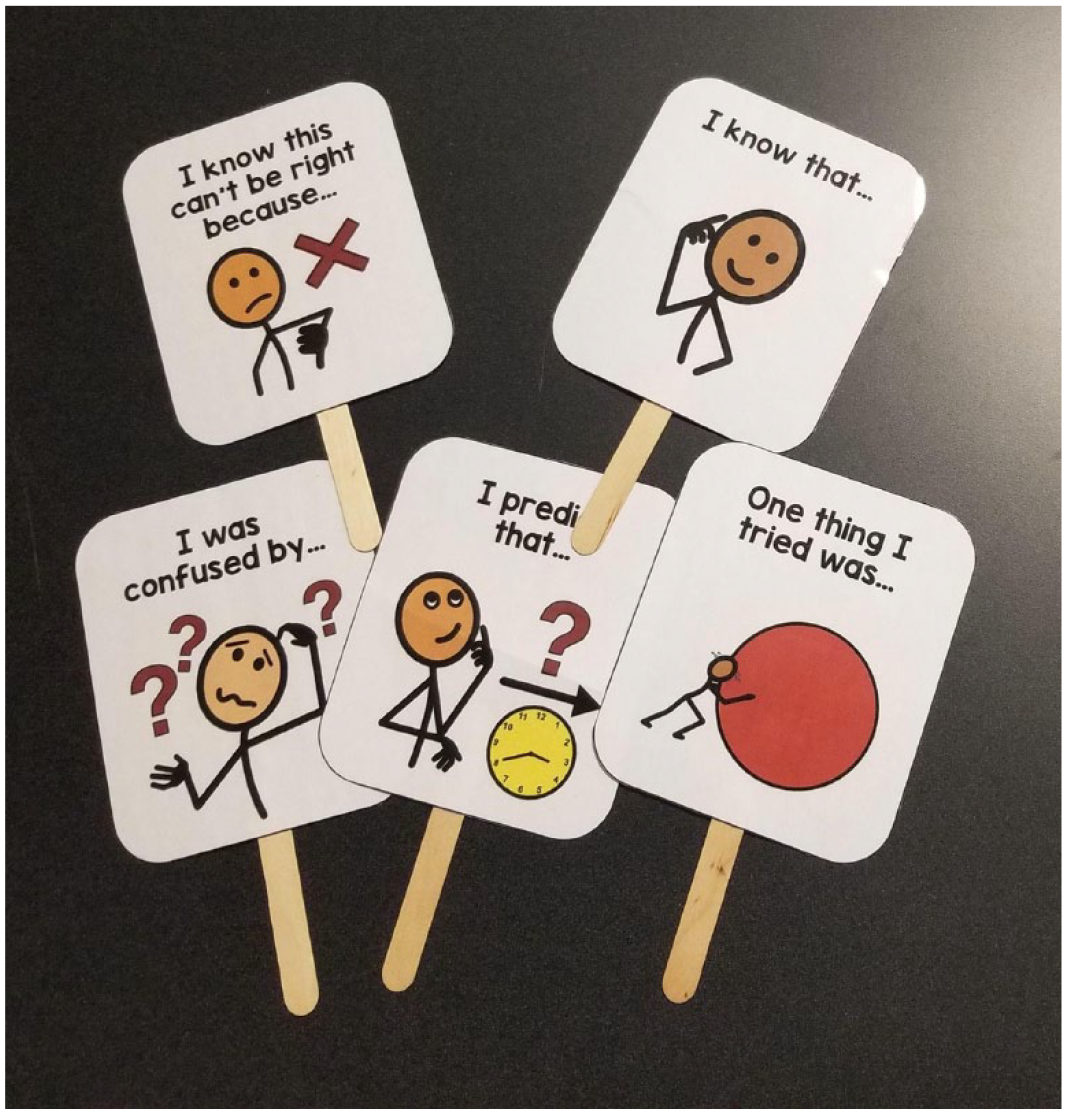
Think-aloud visual supports
Graphic Organizers
General education teachers have used graphic organizers for years to help students gather, organize, and share information (Dexter & Hughes, 2011). Graphic organizers include tools such as T-charts, Venn diagrams, concept maps, or Frayer models. Graphic organizers are appealing because they can be widely used and adapted to address many different topics and subjects while providing visual representations of the relationships within newly or previously learned content.
Reaching All Learners
Graphic organizers have been used to explicitly teach students with ESN reading comprehension skills in multiple subject areas such as social studies (Wood et al., 2015) and science (Jimenez et al., 2012). Because graphic organizers are one of the most common supports used in classrooms, considering how to make them accessible is essential for learning academic content. For students who may require an adaptation to traditional graphic organizers, teachers should consider how students will engage with and respond to the graphic organizer and content (see Figure 5). Students with ESN can more readily engage with an organizer that promotes student interests, choices, and the relevance of the task. Lastly, organizers are most accessible and increase OTRs when they allow variability in student response modes (e.g., select concrete or tactile options, eye gaze to options, generate options with assistive technology; see Figure 6). This is especially important for students with complex communication needs.

Adapted guided notes

Three-dimensional graphic organizer
Mr. Carter plans on working on the interdependence of organisms in an ecosystem with the class. He wonders how he can build on his plan for using a graphic organizer to best represent how organisms and features in an ecosystem interact and their interdependence for Daniel. Mrs. Saldido recommends that Mr. Carter consider Daniel’s strengths and use visuals to represent not only the content but also the relationships in the organizer. She suggests that if the organizer is a bubble map with a feature in the center, with the organisms represented by text and pictures when needed, the organisms can be placed in red bubbles for failure to thrive or green bubbles for successfully thrive around the feature, and Daniel can more independently respond and engage with the content.
Visual Supports
Representing content in multiple ways, including the use of visuals supports, also known as visual aids, improves understanding and engagement for all learners. Examples of visual supports include but are not limited to pictures, charts, maps, checklists, and diagrams. As one of the most effective and commonly used strategies in general education, visual supports have been shown to increase learning structure and predictability and improve student comprehension (Nagro et al., 2019). Incorporating visuals during instruction has also been shown to produce positive outcomes in the areas of communication, behavior, social, and academic skills (Nagro et al., 2019; Wong et al., 2014). By intentionally planning the use of visual supports throughout a lesson plan, teachers can help to increase student understanding and independence, promote efficient transitions, effectively communicate expectations, and encourage self-monitoring (Swanson et al., 2015).
Reaching All Learners
Visual supports are an EBP for students with ESN, particularly those with autism (Steinbrenner et al., 2020). When using visuals, students with ESN may need more concrete visual representations to use as reference material, such as a video example of science concepts like gravity in action or picture cards that support comprehension. They may need a visual to understand when events will occur during the day (an object or picture or written individual schedule), how many problems are necessary to be completed to end the lesson (a work schedule or highlighted paper), or how much time is expected for an activity (a timer on the interactive whiteboard or individual physical timer). One visual support available to enhance the reading and comprehension of text is the use of adapted text (Hudson et al., 2013). The text can include picture supports embedded within to aid in students’ understanding of vocabulary and in the reading of common words. Students with ESN can also use visuals to ask and answer questions, improving engagement (see Figure 7). These visual response options have a significant impact on student engagement and may be one of the most essential supports for teachers to incorporate to reduce barriers to access.

Visual supports for asking “WH” questions.
Students with ESN commonly use visuals to aid in interpreting the text (e.g., when decoding, a picture support can be provided with the text for context such as a picture of a volcano erupting with the word “erupt”; Hart Barnett et al., 2018). The picture can be faded over time as the student becomes more proficient with decoding the word. The visuals can be presented in hard copy or via technology and in the form of a picture, figure, checklist, or chart. Visuals can also be used to support students’ social, communication, and self-help skills (Steinbrenner et al., 2020).
Mrs. Saldido shares Daniel’s visual schedules with Mr. Carter and explains that Daniel is more engaged and productive when he knows the expectations for the day and in a class. She uses two types of schedules—a daily schedule on the whiteboard that is written and erased by Daniel as the day progresses and a lesson schedule on a laminated index card that allows her to write individual expectations such as the time for silent reading or the number of math problems to solve, which can vary across lessons. The teachers also discuss the vocabulary expectations in the math and science unit involving experiments measuring mass and volume. Mr. Carter plans to incorporate video resources that can be revisited to reinforce the concepts and recognizes the need to add pictures for additional support that Daniel could use in his science journal to collect and report information.
“All students need OTRs to actively engage with content during instruction.
Conclusion
All students need OTRs to actively engage with content during instruction. Students with ESN who are included in general education classrooms may require adaptations designed using UDL guidelines to do this effectively. Although the goal for instruction may not need to change, how students are able to show what they know and can do may. It is essential that teachers identify and build on student strengths (what the student can do) rather than focus solely on the student’s needs (what they are unable to do yet). The supports and strategies explained in the article are intended to equip general and special education teachers with ideas for use during planning to consider how all students can more readily participate with high levels of OTRs in general education lessons that target grade-level content. For further information, the TIES Center (n.d.) has resources regarding the use of these supports and strategies in inclusive classrooms (https://z.umn.edu/inclusiontips).
Footnotes
Declaration of Conflicting Interests
The author(s) declared no potential conflicts of interest with respect to the research, authorship, and/or publication of this article.
Funding
The author(s) disclosed receipt of the following financial support for the research, authorship, and/or publication of this article: Funding for this article was provided by the TIES Center. TIES Center is supported primarily through a Cooperative Agreement (No. H326Y170004) with the Research to Practice Division, Office of Special Education Programs, U.S. Department of Education. The TIES Center is affiliated with the National Center on Educational Outcomes in the Institute on Community Integration at the College of Education and Human Development, University of Minnesota.
