




Abstract
This article presents the rationale, evidence base, and strategies for teachers and related service personnel to implement peer-assisted Augmentative & Alternative Communication (AAC) modeling with their students with complex communication needs within inclusive settings across the school day. Specific steps for teaching the student’s same-age peers to use aided AAC modeling are provided, as well as overall recommendations for implementation. Aided AAC modeling examples and strategies for collecting data on student AAC use are also included.
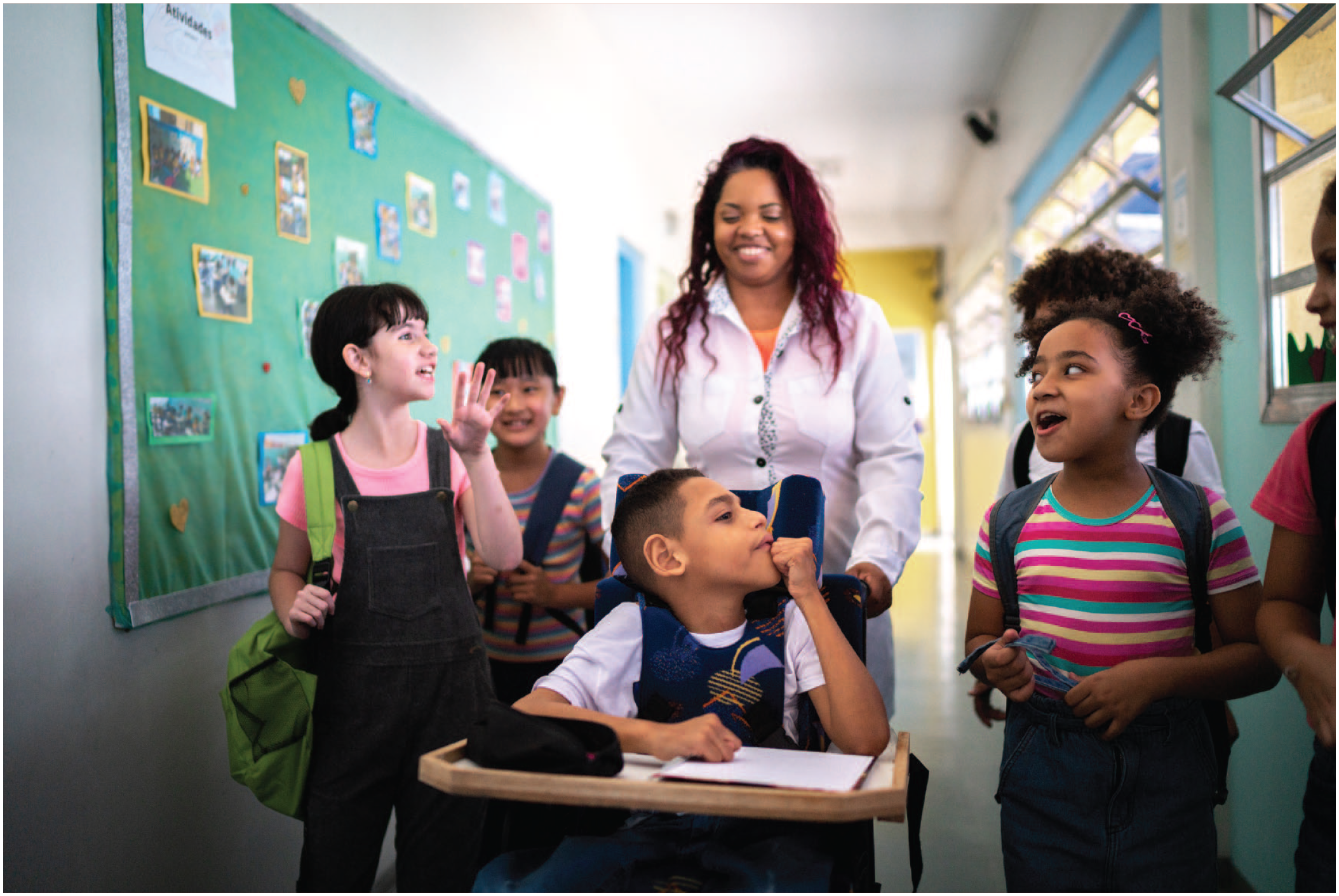
Brian is a 9-year-old fourth grader participating in his state’s alternate assessment on alternative achievement standards (AA-AAS). He is identified as having a significant intellectual disability, has complex communication needs, and is learning to use an augmentative and alternative communication (AAC) device (see Figure 1 for a definition of AAC). Brian uses a tablet with a communication app that serves as a speech-generating device with an adjustable dynamic grid display that he accesses using direct selection (touch). He is currently using a 5 × 9 display with 34 symbols and words representing high-use vocabulary and 11 blank spaces for future growth (see Figure 2). The device has the capacity to link from the home page to content vocabulary as needed for specific classes and activities.

Boxed text
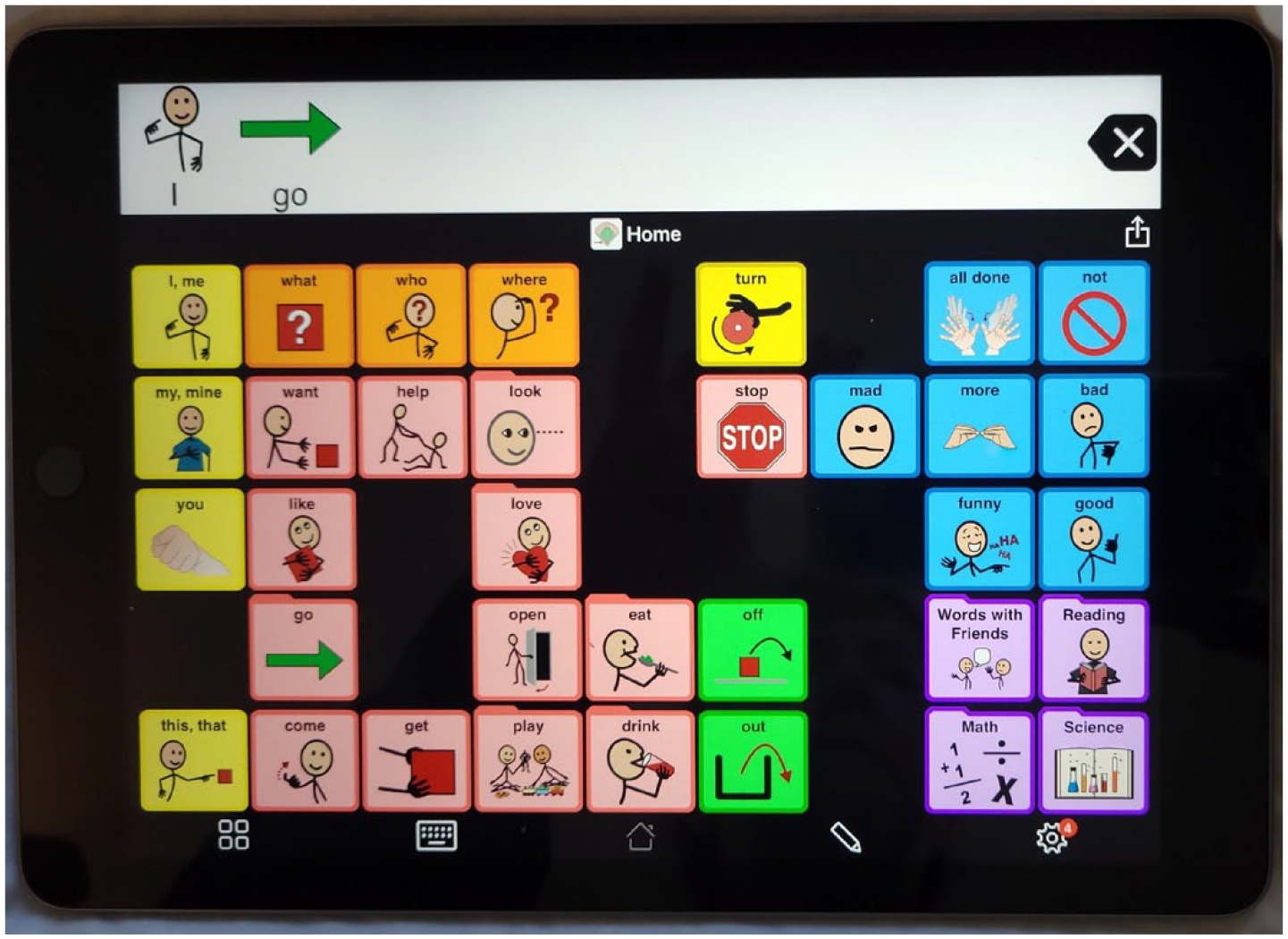
Example of an augmentative and alternative communication home board
Setting the Stage: Why Explicit AAC Interventions Are Essential
Communication is fundamental to all our lives; however, many students experience similar communication challenges as Brian. For students with the most significant cognitive disabilities (i.e., those students participating in state AA-AAS), studies have shown approximately 10% lack a formal means or mode of communication. That is, they communicate at a presymbolic level, relying on nonregularized facial expressions and/or body movements to express their basic intentions. An additional 17% to 18% of students with the most significant cognitive disabilities are classified as only emerging symbolic language users (i.e., using just a few pictures, objects, or regularized or idiosyncratic gestures to communicate; Kearns et al., 2011; Towles-Reeves et al., 2012). Towles et al. (2012) noted for 10% of students identified as presymbolic, less than half (i.e., only 40%) had access to AAC; for the 18% of students identified as emerging symbolic, only 39% had access to AAC. While some students with complex communication challenges do have AAC in place, opportunities for actually using their AAC may often be problematic. For example, Chung et al. (2012) found students who used AAC were in close proximity to their own AAC system approximately only 40% of the time. See Figure 3 for classroom tips on ensuring students have access their AAC.
“Unfortunately, peers seldom receive instruction on how to interact with students with complex communication needs (McCarty & Light, 2022).
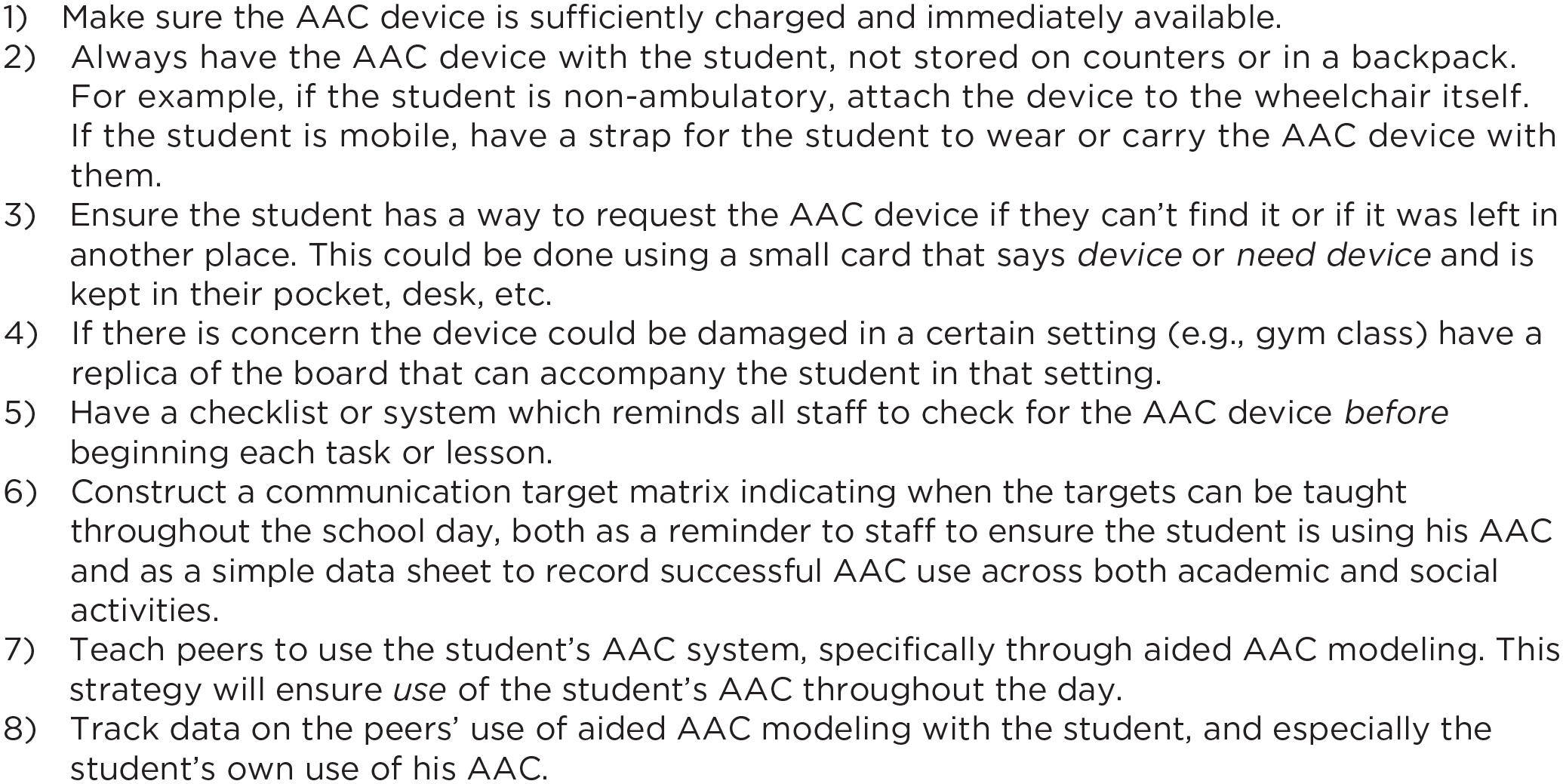
Tips for ensuring student access to augmentative and alternative communication device
Chung et al. (2012) noted the adults may have inadvertently reduced opportunities for peer-to-peer interactions for these students by creating an overreliance on one-to-one adult assistance as the main classroom support and communication partners for the student. In a further study, Chung and Carter (2013) found students with complex communication needs increased both their peer interactions and use of AAC when practitioners ensured access to their AAC throughout the school day and systematically prompted classroom peers to initiate interactions. Biggs et al. (2017) further found the use of peer support arrangements (an evidence-based practice in which a student with a significant disability is matched with two to three peers who are trained to provide academic and social support for the student during ongoing learning activities in that class; see Carter et al., 2015) resulted in students with complex communication needs initiating and responding to peers at higher rates, although not necessarily through their AAC system. In a subsequent study, Biggs, Carter, Mazur, et al. (2018) found the use of peer networks (similar to peer support arrangements, a peer network consists of a group of three to six peers and a focus student with a significant disability who meet regularly around their common interests; Carter et al., 2013), when used specifically with aided AAC modeling, resulted in the target student with complex communication needs increasing actual use of their AAC device to communicate with peers. Unfortunately, peers seldom receive instruction on how to interact with students with complex communication needs (McCarty & Light, 2022).
Brian can respond to simple two-step directions and can use his AAC to produce prompted one- to two-word requests. His AAC device is programmed so Brian can (a) request and talk about adapted, grade-level texts by commenting on favorite characters and answering comprehension questions; (b) plan how to solve math word problems; and (c) describe and predict science experiments. Brian is supported by a paraprofessional who typically sits with him, assists with the daily general education lessons, and adapts the general education materials under the direction of his regular and special education teachers. Brian’s paraprofessional attempts to involve the peers who sit near Brian in working with him, but they typically channel their questions to Brian through the paraprofessional (e.g., “Who is Brian’s favorite character in the story? Does Brian like to play on the computer?”). Brian uses his AAC primarily to respond to questions his paraprofessional or teacher asks him about the daily lessons and to request things he needs (e.g., snack, a break, his book). He does not use his AAC to initiate or to respond to his classmates, although they have expressed an interest in how his communication system operates. Brian’s speech language pathologist (SLP) has recently learned about aided AAC modeling and wonders if it might be helpful for him.
What Is Aided AAC Modeling?
Aided AAC modeling (also described as “communication partner modeling,” “aided language modeling,” “natural aided language,” and “aided AAC modeling”; see Sennott et al., 2016) can serve as one of the most useful ways to introduce the target student to his or her AAC and simultaneously teach use of AAC in a truly functional and interactive manner. This procedure is easily taught to the student’s classmates and promotes increased interactions with peers.
Aided AAC modeling involves others in the student’s environment (peers, school staff, etc.) communicating with the target student by using the student’s AAC system or a duplicate of that system in their interactions with the student (Biggs, Carter, & Gilson, 2018). Aided AAC modeling requires the communication partner to use a similar device or ask to use the AAC user’s device to point to or activate the key words in a message while speaking that message (e.g., describing what either they or the AAC user is doing, expanding an initiation from the AAC user, or commenting on some other thing of interest in a conversation; see Biggs, Carter, Mazur, et al., 2018). Aided AAC modeling expects the communication partner to speak clearly, emphasize key words, and pause frequently, allowing the AAC user time to prepare a response using the device or another communication form. As with all language modeling, AAC modeling is typically done one level above the student’s current skill level (Hartman, 2015). For example, for a student not yet using single words to communicate, modeling should be at the single word level, whereas modeling for a student already using single words should be at the two- to three-word level to promote further language development. It is important to note aided AAC modeling encourages but does not require the student to respond. In addition, the “modeling” in aided AAC does not mean the student is to imitate the communication partner’s utterance but, rather, to experience a partner using AAC.
“Aided AAC modeling involves others in the student’s environment (peers, school staff, etc.) communicating with the target student by using the student’s AAC system.
During AAC modeling, communication partners are not prompting the student to make a specific response but, rather, are modeling for the student how the student’s AAC system is a viable means for communication they can all use. This confirms the student’s AAC as a normalized means of communication in the eyes of both the target student and his peers and thus does not set the student apart from his peers in those acts of communication (TIES Center-a, n.d.). As Sennott et al. (2016) noted, children who use AAC rarely see others using their mode of communication; in that sense, AAC users have been unequal communication partners with their peers.
The impact of aided AAC modeling is well documented. Biggs, Carter, and Gilson (2018) conducted a systematic review of research on AAC use among children or youth and concluded that AAC modeling was generally effective in enhancing expressive communication across students ranging in age from 20 months to 21 years, with 10 (33%) of the studies reviewed involving the use of peers. While Biggs, Carter, and Gilson did not measure the specific impact of involving peers in AAC modeling, in an additional meta-analysis, O’Neill et al. (2018) did find positive effects (i.e., large effect size) of using peers to support aided AAC modeling for participants with complex communication needs. Moreover, peers may at times be the best interventionists. For example, Barker et al. (2013) found for preschoolers with developmental disabilities, students made greater growth in language through peer-augmented use of AAC than through just teacher prompting.
Vocabulary and Aided AAC Modeling
Aided AAC modeling, combined with strategies to systematically identify and display essential symbols for students with complex communication needs, can be a very effective approach in increasing students’ receptive and expressive language as well as their AAC use (Erikson & Geist, 2016; Harris & Reichle, 2004; O’Neill et al., 2018). The importance of systematically identifying and displaying essential vocabulary on the student’s AAC cannot be overestimated in teaching peers and others to use aided AAC modeling. First, the student must have the necessary vocabulary (symbols) on his or her AAC to engage in a conversation about the lessons and activities the students are doing together and to be able to discuss things of common interest (Geist & Erickson, 2022). This involves the use of high-frequency vocabulary personalized to the student (see Figure 2) as well as the use of additional vocabulary needed for specific academic lessons (for a science class example, see Figure 4) or other planned activities during the student’s day (for a social communication/friends page, see Figure 5). Second, the position of the words/symbols should be held constant in the AAC itself. This feature facilitates motor memory, increases the efficiency with which the student can use their AAC, and enables peers to quickly find the symbols they need to communicate with the student when they use the AAC device.
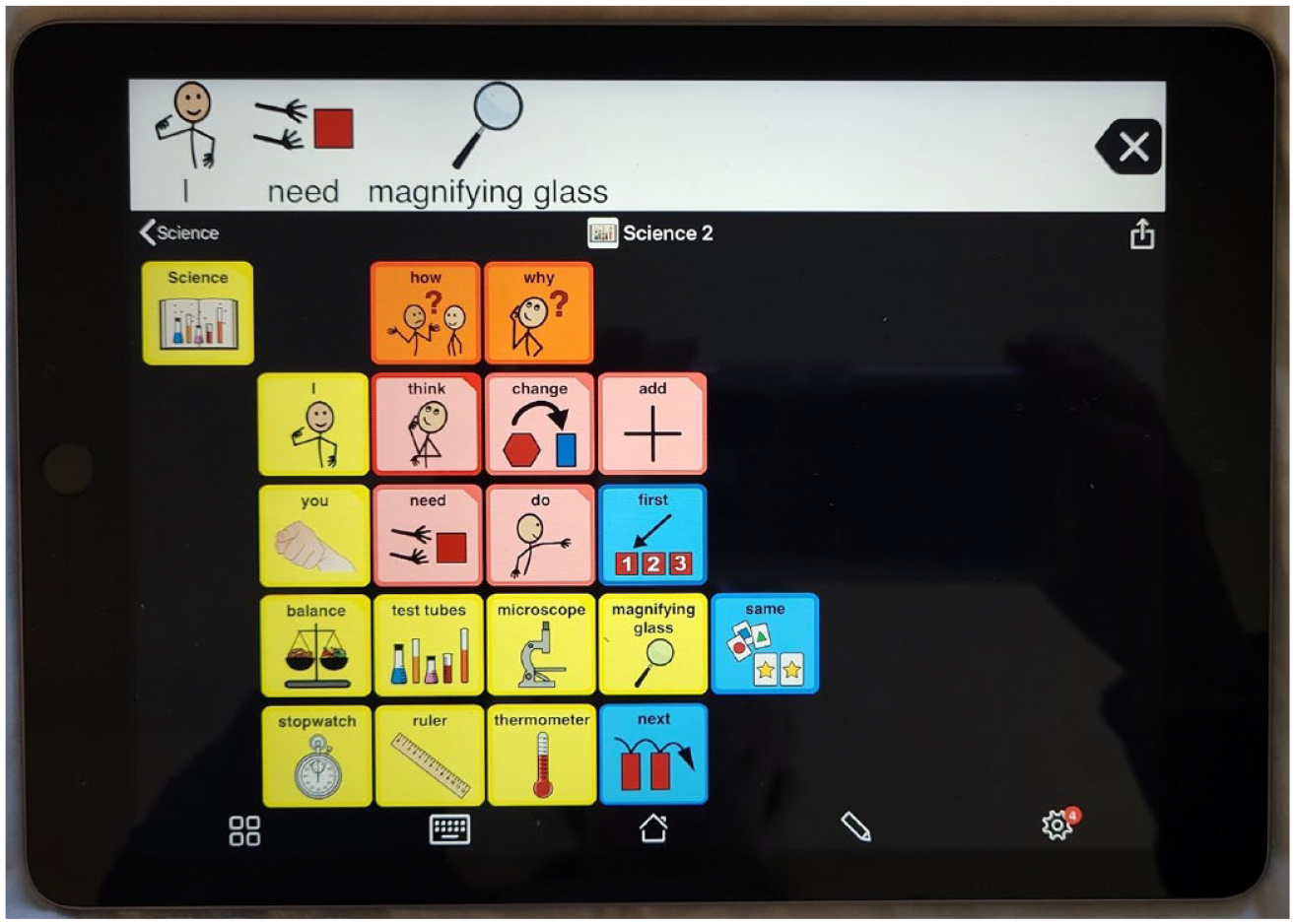
Example of an augmentative and alternative communication display for science class

Example of a social/communication and friends page
Brian’s team worked to create an AAC system that includes robust vocabulary (Geist & Erickson, 2022) and best practices in AAC assessment and development (Beukelman & Light, 2020). Brian’s special education teacher decided to set up a peer support arrangement for Brian to use his AAC to participate more fully in classroom activities and especially in small-group work. The regular education teacher identified three classmates who expressed an interest in working with Brian and asked if they would like to work together with him in class. Each of the peers responded positively. Yet Brian was still not using his AAC to communicate directly with his peers when they asked him questions about the lesson or asked him about other things he likes to do. During a team meeting, Brian’s SLP discussed aided AAC modeling and suggested this might be a good strategy to increase Brian’s use of his AAC in general education class activities, especially with his peers, and throughout the school day.
“Can be a very effective approach in increasing students’ receptive and expressive language as well as their AAC use.
Teaching Peers to Implement Aided AAC Modeling
To facilitate the student’s use of the AAC system with peers, you must start by training the peers how to use the AAC device for effective communication. The following are 12 steps to train peers.
Recruit peers who have shown an interest in the target student (and/or who are interested in learning more about the student’s communication system). If you are already using peer support arrangements (Carter et al., 2015; Kentucky Peer Support Network Project, n.d.) for your target student, then these peers would be an ideal place to start in implementing aided AAC modeling!
Encourage the AAC user to show their peers how the device works, including how to link from the home page to the content pages (e.g., literacy, science, math, friends page). This supports the student by giving them control and ownership of the device.
Consider creating low-tech versions of the student’s AAC for peers themselves to use. If they need to use the student’s device, teach them the importance of asking the student first. In using a version of the student’s vocabulary display themselves, the peers are endorsing the student’s AAC as a valid and normalized means of communication.
Teach peers to tell their own thoughts with their own or the AAC user’s board or system in their conversations with the student. For example, a peer could use the student’s AAC to indicate their favorite character in a story or their favorite thing to do on weekends.
If a peer doesn’t understand the AAC user’s message, teach the peer to say “I don’t understand” and ask for permission, “Can I use your talker (or board) to show you what I thought you said?” The peer can then model what they thought they heard.
Encourage the target student and peers to engage in social interactions with the AAC. For example, practice using the device to tell jokes or a story about a favorite topic (for an example, see Figure 5). Make sure the vocabulary for the stories is available on the device. For example, preprogramming age-appropriate jokes into the student’s AAC is a wonderful way to create conversation starters with peers.
Encourage peers to provide plenty of wait time for the AAC user to formulate their response or comment and execute the response before jumping in to help.
Encourage peers to provide new words for conversation topics, including high-interest activities, favorite shows, sports teams, and so on, that can expand the AAC user’s friends and social conversation page.
Provide plenty of positive reinforcement and ongoing support to peers in using aided AAC modeling through verbal prompts and feedback and by modeling communication with the student’s AAC symbols (see also Biggs, Carter, Mazur, et al., 2018).
Monitor peers’ use of aided AAC modeling with the target student. Figure 6 presents a student checklist that peers should follow in implementing aided AAC modeling.
Remember it does not have to be perfect! If a step is skipped and communication continues, it is still a successful communication! If any of the communication partners become frustrated, consider a brief reorientation session with the peers and target student and continue to provide ongoing support and coaching to the peers. Figure 7 provides examples of peer-assisted modeling in both academic and social contexts.
Ensure all adults in the classroom (general and special education teacher, paraprofessional, therapists) also have an opportunity to receive training in aided AAC modeling so everyone is using this strategy and continue to model it with the student’s peers.

Aided augmentative and alternative communication modeling peer checklist
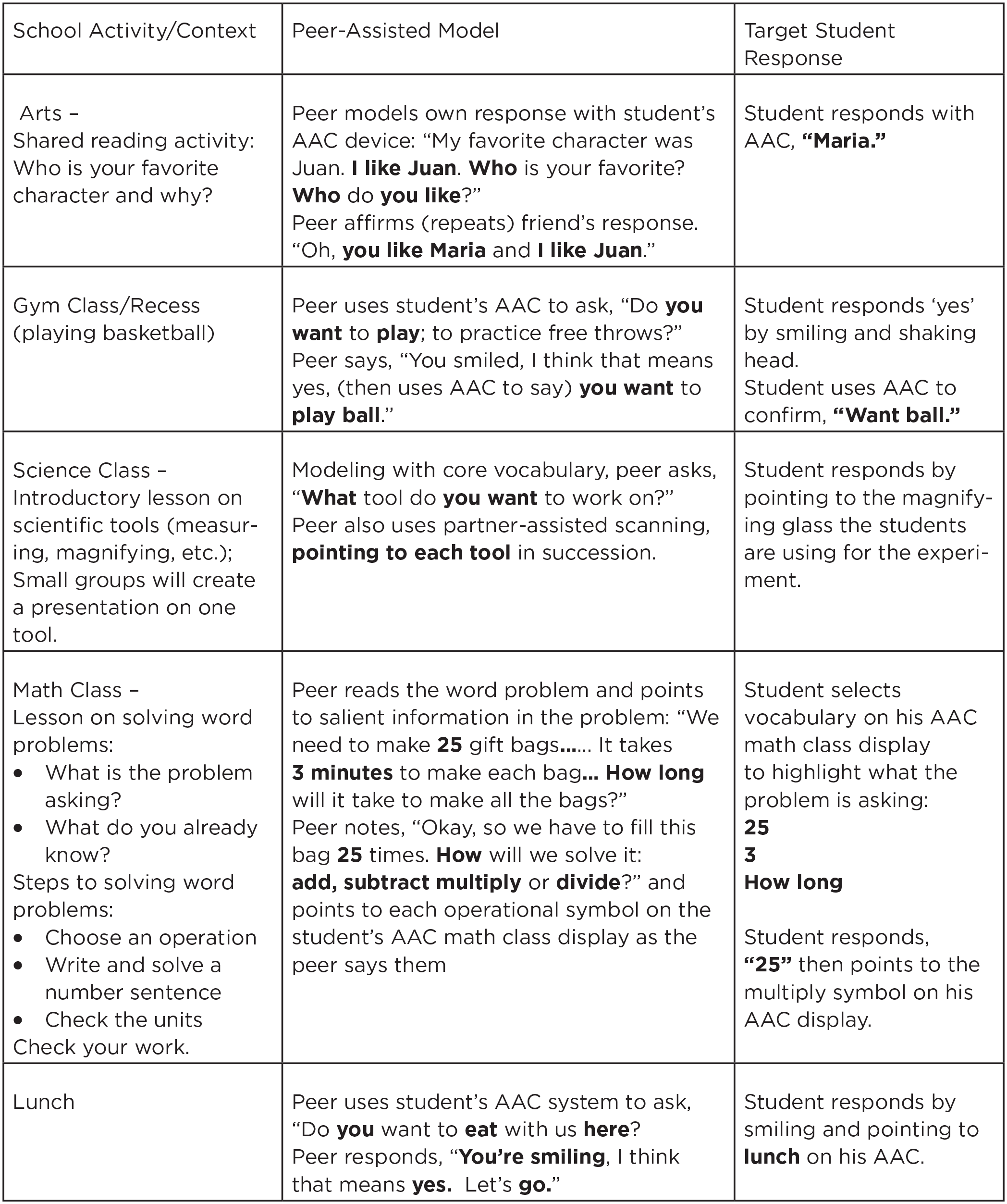
Examples of peer-assisted aided augmentative and alternative communication modeling
Brian’s special education teacher provided a short session for the peers on how they could provide support (clarifying and rephrasing content for Brian, prompting him to attend to the text and lessons, encouraging him to respond in class, etc.) as well as instruction on how Brian’s AAC works and, most importantly for his communication, how they could provide aided AAC modeling. The new peer support arrangement has clearly increased Brian’s active engagement in the language arts lesson, including his attention to the activities, and increased nonverbal communication with his peers (smiling, nodding yes to their questions, following along to the story his peers read, etc.). In addition, for the first time, Brian has used his AAC device directly with his peers!
Critical Factors in Using Aided AAC Modeling and AAC
There are several factors that must be addressed in using peer-assisted aided AAC modeling related to the importance of (a) teaming and (b) ongoing assessment and support.
Teaming
The importance of an interdisciplinary team to provide input into positioning, type and level of symbols or words, mode of selection, and vision support in the design of a student’s AAC cannot be overstated and has shown to be an evidence-based practice (Hunt et al., 2002; Kleinert et al., 2019). Investing in regular team meetings with a structured format such as the TIES Center’s 5-15-45 tool (TIES Center [b], n.d.) ensures the team implements aided AAC modeling with fidelity, shares progress, and problem solves challenges. Regular meetings also provide opportunities to plan the vocabulary and the student’s participation needs so daily routines and student participation across classes and environments go smoothly. In addition, the team can determine how to deliver services in the classroom. Finally, information sharing during team meetings increases the knowledge and understanding of all the team members and results in improved implementation across all activities and school environments. If the student is receiving support from a paraprofessional, be sure to include the paraprofessional in planning, specifically in training and encouraging peers to use aided AAC modeling with the target student. Paraprofessionals can provide excellent support to students with complex communication needs in inclusive settings and to their peers in using AAC modeling (see Biggs, Carter, Mazur, et al., 2018; McCarty & Light, 2022). In addition, Worah et al. (2010) provided specific strategies for paraprofessionals and other team members in fostering AAC communication.
Assessment and Ongoing Support
Finally, be sure to consider each of the following:
Provide ongoing monitoring of peers’ use of aided AAC modeling. Remember that both adults and peers should always request permission from the student to use their AAC system; that “modeling” is communicative—it is not intended as a means for eliciting a simple imitation from the target student; and that aided AAC modeling helps increase meaningful engagement between peers.
Embed opportunities for the student to communicate with their AAC throughout the day and opportunities for peers to use aided AAC modeling with the student. Careful planning ensures the student’s peers are viewed as primary communication partners. Communication matrices are an excellent tool for planning these opportunities. See Figure 8 for an example of a communication matrix.
Collect ongoing data on the student’s communication targets, including the student’s use of their AAC to initiate and respond to peers in the context of general education class and other school activities. The team may also want to measure the peers’ use of aided AAC modeling with the student. For example, when students are working together in a peer support arrangement, how many times did the peers use aided AAC modeling to communicate with the target student during the lesson? A communication matrix that includes the student’s specific AAC communication targets, as illustrated in Figure 8, can also be used as a simple data collection tool on the peers’ provision of aided AAC modeling and the student’s own AAC use.
“Embed opportunities for the student to communicate with their AAC throughout the day.
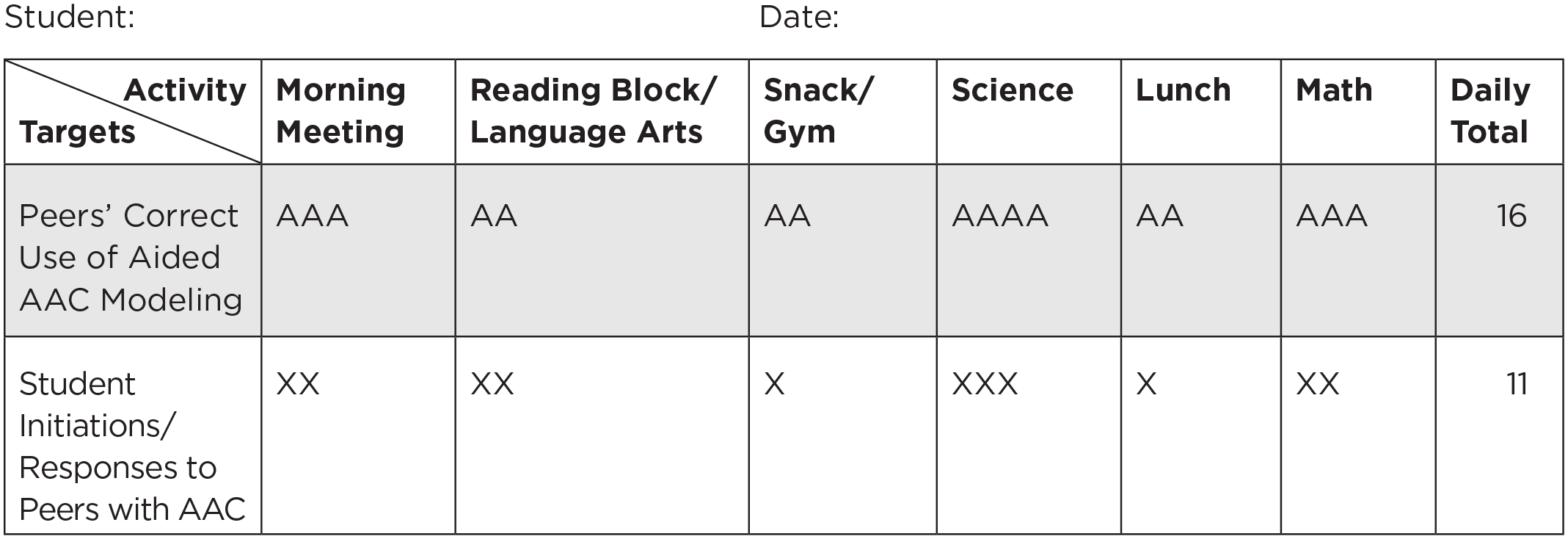
Example of a communication matrix as a data sheet for student augmentative and alternative communication (AAC) use with peers
Conclusion
Brian’s school team furnished each of his classmates in the peer support arrangement with a replica of Brian’s home page and continued to work with the peers in using aided AAC modeling. The peers quickly learned to use aided AAC modeling with Brian in their cooperative class activities (for the checklist that they used, see Figure 6). Moreover, Brian is now using his AAC to communicate directly with his peers. His special education teacher and SLP have continued to monitor Brian’s use of his AAC with his peers and the peers’ fidelity in using this strategy. His team has noted that other classmates have also begun to use aided AAC modeling with Brian. Brian himself is taking a more active role in his classroom and other school activities and finds numerous opportunities to use his AAC with his classmates.
Aided AAC modeling is an evidence-based practice for increasing use of AAC by students with significant disabilities, and peer-assisted aided AAC modeling can enhance students’ ongoing interactions with peers in both general education lessons and in activities throughout the school day. Given the challenges of communicative competence for many students with significant disabilities, peer-assisted AAC modeling is an approach not only to enhancing that competence but also providing meaningful access to peers in general education, to friendships, and to the vital content of general education lessons.
Footnotes
Declaration of Conflicting Interests
The author(s) declared no potential conflicts of interest with respect to the research, authorship, and/or publication of this article.
Funding
The author(s) disclosed receipt of the following financial support for the research, authorship, and/or publication of this article: This manuscript was supported through a subcontract with the TIES Center, University of Minnesota. The TIES Center is a Cooperative Agreement (No. H326Y170004) with the Research to Practice Division, Office of Special Education Programs, U.S. Department of Education. Opinions expressed do not necessarily reflect those of the U.S. Department of Education or Offices within it. Project Officer: Susan Weigert.
