




Abstract
Schools have a finite number of resources each year to allocate towards the implementation of evidence-based practices (EBPs). Therefore, school leadership teams must carefully consider how resources are being allocated and how to maximize those resources when implementing EBPs within the context of multi-tiered systems of support, such as Positive Behavioral Interventions and Supports (PBIS). These considerations are particularly important for ensuring the sustained implementation of EBPs at the advanced tiers for students with or at-risk for disabilities who require more resource-intensive supports. Leadership teams can maximize resources most efficiently by evaluating how data systems, school personnel, materials, and space are being utilized to support implementation of EBPs across Tiers 2 and 3.

The school leadership team at Rio Elementary has a 5-year professional development plan with the goal of implementing all three tiers of positive behavioral interventions and supports (PBIS), a multitiered framework designed to increase social-emotional skills, prevent challenging student behavior, and support students based on their level of need. Over a 2-year period, the leadership team led the development and implementation of a core set of positive, schoolwide behavioral expectations. The combination of Tier 1 practices and systems was implemented with fidelity and was successful at reducing challenging behavior, office referrals, and suspensions. Now, the leadership team is in the middle of their third year of implementing Tier 1 and first year of Tier 2 implementation. This year, in addition to continuing to implement their Tier 1 evidence-based practices (EBPs), the leadership team is also focused on implementing two Tier 2 EBPs, Check-In, Check-Out (CICO; Hawken et al., 2021) and social skills groups to address the needs of a smaller group of students who continue to struggle with behavior expectations. Unfortunately, consistent implementation of both Tier 2 EBPs with fidelity has not been achieved. For example, only a small percentage of the students needing Tier 2 supports are being served, and only some components of CICO are being implemented consistently by school personnel. The team is struggling to provide the time and expertise needed to deliver Tier 2 EBPs. Consequently, because the students are not improving, the leadership team is not fading students from these interventions and are unable to support additional students.
Maximizing Limited Resources for Implementation of EBPs
School leadership teams must regularly determine how to best utilize limited resources as they implement EBPs to address educational challenges (e.g., poor graduation rates, high levels of student suspensions, low literacy proficiency). Ideally, leadership team members (e.g., school administrators, general and special education teachers, behavior specialists, family and community members; Kittelman et al., 2021) collaboratively select EBPs based on both (a) evidence that the EBP is effective at improving student outcomes (Slocum et al., 2014; Spencer et al., 2012) and (b) availability of the resources needed to implement and sustain those practice over time. Due to the increased emphasis placed on implementing EBPs in general and special education contexts (Cook et al., 2014; Spencer et al., 2012), leadership teams can easily access information about the efficacy of EBPs using freely available resources from reputable groups (see Table 1). However, guidance is less accessible to leadership teams seeking to efficiently allocate and maximize their resources toward implementing multiple EBPs (Horner et al., 2019; Pinkelman et al., 2015). Without explicit consideration for the resources needed to implement and sustain multiple EBPs, partial implementation and/or abandonment of EBPs is more likely (Bambara et al., 2012; McGoey et al., 2014).
Available Resources From Reputable Groups

The limited attention to resource allocation may be due in part to the higher emphasis given by EBP developers and the larger educational community for formal documentation that EBPs are effective versus efficient and cost-effective. We suggest that when EBPs are developed, it is reasonable for educators to expect (a) operational descriptions of the practices, (b) research documented the efficacy and effectiveness of the practices, (c) training materials that can be used in typical contexts, and (d) formal specification of the resources needed to implement and sustain the practice.
Selecting EBPs in Multitiered System of Supports Frameworks
Thousands of schools across the United States are implementing multitiered system of supports (MTSS) frameworks to guide the implementation of behavior support (PBIS; Horner et al., 2019), academic interventions (response to intervention; Hughes & Dexter, 2011), and mental health practices (interconnected systems framework; Weist et al., 2018). A hallmark of MTSS frameworks is the concurrent delivery of multiple EBPs that allow for differentiated intensities of support (e.g., more time in instruction, smaller learning groups, additional feedback, mental health supports) matched to student needs. The delivery of these EBPs is made possible through carefully coordinated organizational systems (e.g., teaming, data for decision making, ongoing professional development; Kittelman et al., 2021; McIntosh & Goodman, 2016) designed to support the implementation at each tier. The three-tiered model of MTSS stipulates that at Tier 1, highly efficient, preventive practices are delivered for all students, with the understanding that at Tiers 2 and 3, more resource-intensive practices are added for a smaller number of students who require targeted and individualized supports to be successful (Fuchs et al., 2017). MTSS assumes 10% to 15% of students will need slightly more support intensity at Tier 2 to be successful, while 4% to 8% of students will require intensive, individualized support at Tier 3 (Fuchs et al., 2017).
Horner and colleagues (2017) highlighted that in schools implementing MTSS, it is important that EBPs and initiatives are selected not only because they are identified as “evidence-based” but because they also fit with the needs, culture, and resources available in the educational context. Selecting EBPs for their documented efficacy is insufficient without identifying the resources needed for school personnel to implement the EBPs with sustained fidelity (implementing with adequate fidelity over time). Key considerations for implementing EBPs with fidelity in school settings include (a) how the practice will need to be adapted to fit the social and cultural context (Spencer et al., 2012), (b) school personnel expertise with EBPs, and (c) the resources required to ensure the practice can be seamlessly integrated into the MTSS framework. Planful resource allocation is particularly critical as schools work to implement EBPs at Tiers 2 and 3 while continuing to maintain fidelity of their Tier 1 systems (i.e., Tier 1 EBPs and organizational systems).
Resource Allocation in PBIS
PBIS is one MTSS framework that focuses on the social, emotional, and behavioral needs in schools or other educational settings (Horner et al., 2019). Several studies have identified a lack of necessary resources as a significant barrier to PBIS implementation (e.g., Garbacz et al., 2018; Kittelman et al., 2020; McDaniel et al., 2017). For example, Garbacz et al. (2018) surveyed over 200 PBIS leadership team members across three states to identify barriers and facilitators to implementing core PBIS features of family engagement in schools. The most common barrier identified was schools lacking the resources (e.g., school personnel time, funding) to build strong family-school partnerships. Researchers have also linked a lack of necessary resources (e.g., personnel time, funding for coaches) to the failure to implement and sustain individualized Tier 3 behavior support practices (Strickland-Cohen et al., 2019). These findings suggest that without careful consideration of the resources available and needed for implementation activities, leadership teams can struggle to support the implementation of existing and new EBPs.
Too often, schools attempt to reduce the cost or effort associated with implementing EBPs by selecting and implementing only a portion of the core features necessary for the EBP to be effective (Kittelman et al., 2020). For example, school leadership teams may have students participating in CICO with coordinators but fail to allocate the resources (e.g., personnel time, meeting space) to ensure other components (e.g., classroom feedback, collection and use of data) are in place and being implemented. Without full implementation of all components, it is unknown whether the EBP will be effective because research has tested the delivery of all components.
Resources Needed for PBIS Implementation at Tier 1
Several studies have examined the cost of implementing universal behavior support in schools (Blonigen et al., 2008; Lindstrom Johnson et al., 2020). Because the resources needed to implement Tier 1 core features with fidelity have been well defined and are fairly consistent across schools (Blonigen et al., 2008), resources for implementation of Tier 1 are typically easier to plan for compared to resources for Tiers 2 and 3. For example, it is expected all school personnel participate in the implementation of Tier 1 (i.e., establishing a school leadership team, process for collecting fidelity and outcome data to guide decision making, formal systems for defining, teaching, and acknowledging positive behaviors; Simonsen et al., 2008). Therefore, all school personnel can be efficiently trained during schoolwide professional development opportunities, and resources needed for implementation are less expensive (e.g., reward/reinforcement tickets for acknowledging student appropriate behavior).
Resources Needed for PBIS Implementation at Advanced Tiers
Implementation of Tier 2 and 3 EBPs is often more costly, resource-intensive, and complex (Horner et al., 2012). For example, unlike EBPs practices at Tier 1, behavior support practices at Tier 2 and particularly at Tier 3 often require personnel with specialized knowledge (i.e., functional behavioral assessment, social skills training). In addition, school leaders implementing PBIS must consider the resource intensity when implementing multiple Tier 2 and 3 EBPs. For example, school leadership teams are implementing multiple Tier 2 and Tier 3 EBPs across academic, social, and behavior support domains. The result is that resources available for addressing efforts to simultaneously support Tier 2 and 3 EBPs targeting early literacy, bully prevention, and individualized interventions for noncompliance may be in competition. Horner and colleagues (2019) conceptualized the resources needed for schoolwide PBIS implementation can be consolidated across four categories: (a) data systems, (b) school personnel, (c) intervention materials, and (d) dedicated space for implementation.
“Implementation of Tier 2 and 3 EBPs is often more costly, resource-intensive, and complex.
Previous research examining barriers and facilitators affecting PBIS implementation suggests these four resource-related components are critical to implementation of EBPs at Tiers 2 and 3 (Bambara et al., 2012; McDaniel et al., 2017; Robertson et al., 2020; Strickland-Cohen et al., 2019). For schools implementing Tier 2 and 3 EBPs, school leadership teams may consider mapping the EBPs they are currently implementing across the different resource-related components (e.g., data systems, school personnel, materials, and space; see overview in Table 2). By assessing current needs and available resources, leadership teams can prioritize areas that require the most significant resource investments. In the following section, we describe each of these resource-related components and offer recommendations for how school leadership teams can improve implementation of EBPs across the advanced tiers through considerations for resource allocation.
Positive Behavioral Interventions and Supports Implementation Resources
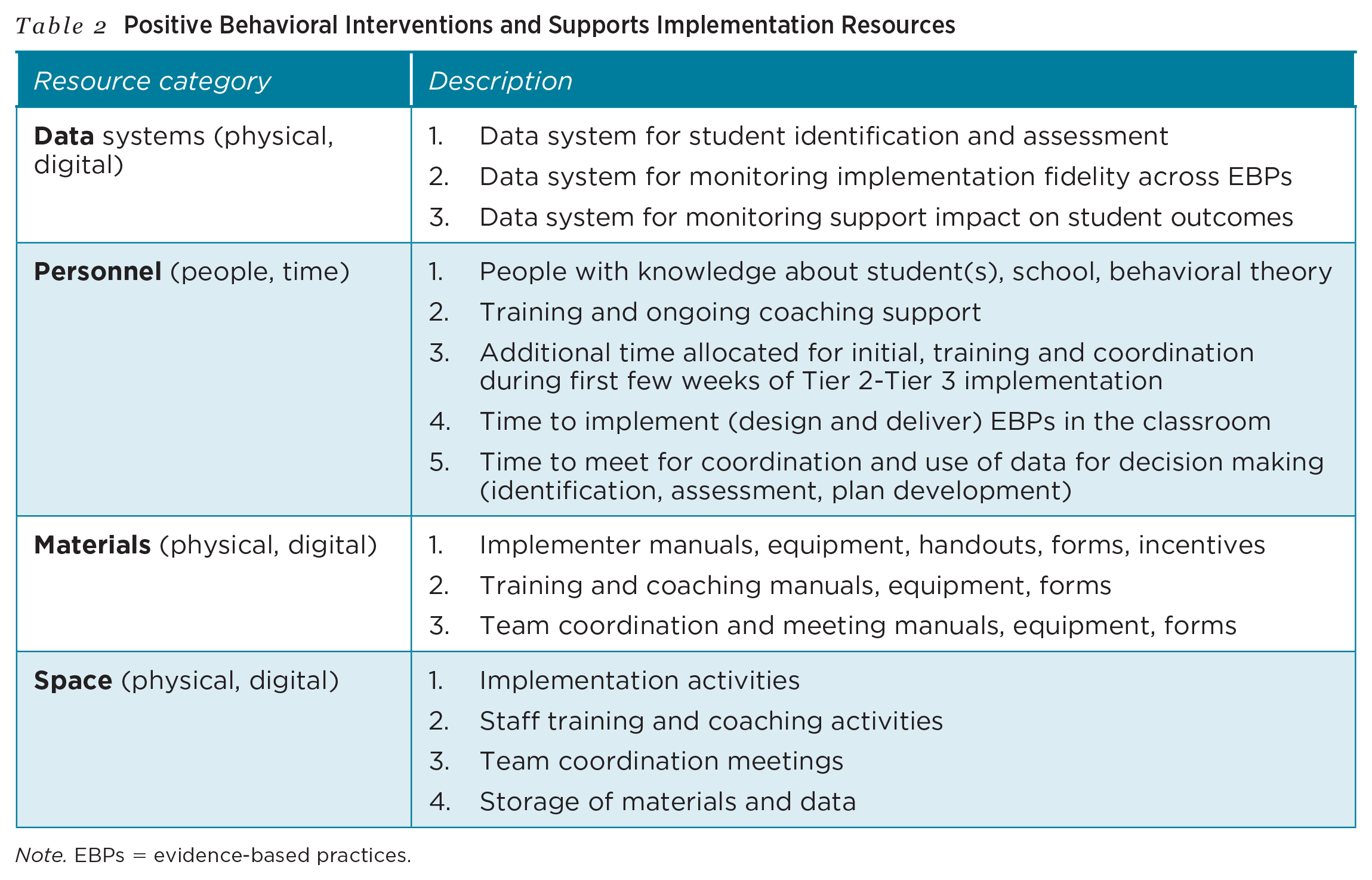
Note. EBPs = evidence-based practices.
Before discussing recommendations for PBIS implementation at Tiers 2 and 3, it is important to highlight the benefits of having core Tier 1 practices and systems in place and to describe how Tier 1 is connected to resource-related components at the advanced tiers. Recent research has shown higher fidelity of Tier 1 core features is related to higher fidelity of implementation at Tiers 2 and 3 (Kittelman et al., 2022). By having Tier 1 core features in place, school leadership teams and school personnel will have many of the skills, systems, and resources needed to implement core PBIS features at the advanced tiers. For example, school leadership teams will have already invested in data systems and have experience meeting regularly (e.g., biweekly or monthly) to conduct data-based decision making (e.g., disaggregating school-level student data, identifying problems, and implementing solutions; Horner et al., 2018; Nese et al., 2021). In addition, school personnel will have received professional development and coaching on Tier 1 practices such as defining, teaching, and acknowledging positive behaviors across school settings. Moreover, because approximately 80% of students will respond to Tier 1 practices (Fuchs et al., 2017), this reduces the number of students requiring more costly and intensive Tier 2 and 3 practices. Before school leadership teams begin building Tier 2 and Tier 3 systems, we recommend they first assess the extent to which Tier 1 core features of Tier 1 are in place using the PBIS Tiered Fidelity Inventory (Algozzine et al., 2014). If Tier 1 core features are not in place, it would be beneficial for leadership teams to focus efforts on getting these features implemented with fidelity. However, this does not mean that leadership teams need to delay Tier 2 and 3 supports for students who need them.
Data Systems
Efficient and reliable data systems are critical for collecting, summarizing, and reporting on the fidelity of EBP implementation and impact on student outcomes (Horner et al., 2017). Effective data systems are particularly crucial for effectively implementing EBPs designed to address the needs of students with Tier 2 and 3 needs. Much like the implementation of practices at Tiers 2 and 3, data collection and data-based decision making at advanced tiers is more complex and resource intensive than at Tier 1. At advanced tiers, individual student data are typically collected daily, and teams meet frequently (e.g., weekly or biweekly) to assess the extent to which supports are being implemented with fidelity and resulting in positive outcomes for students. This intensified level of data-based teaming is necessary at advanced tiers to ensure that targeted and individualized supports are regularly adapted (e.g., intensified or faded) to meet the changing needs of students.
At Tiers 2 and 3 of PBIS, data systems serve three primary functions: (a) identification and assessment of students needing support beyond Tier 1 (e.g., behavior screening tools; National Center on Intensive Intervention, n.d.-b), (b) monitoring staff fidelity of implementation of Tier 2 and 3 systems (e.g., Algozzine et al., 2014) and EBPs for individual students (e.g., National Center on Intensive Intervention, n.d.-c), and (c) monitoring impact of Tier 2 and 3 behavior supports on individual student outcomes (e.g., reductions in challenging behavior, increased academic engagement; National Center on Intensive Intervention, n.d.-a). At Tiers 2 and 3, these data systems are used to assist teams in identifying areas for improvement and developing action plans. Often, this includes reviewing graphs that include implementation fidelity and small group and individual student outcome data. Having the data systems needed to efficiently monitor and adapt student supports as needed helps to improve the effectiveness of targeted and individualized supports and increase the capacity for teams to support more students during the school year.
Recommendations for data systems
Collection and use of student behavioral data has become a standard practice in schools implementing PBIS. However, without efficient procedures in place for data sharing and accurate interpretation, data may not be appropriately influencing decisions (Spencer et al., 2012). To maximize use of data for decision making, leadership teams should consider developing a set of action-focused (e.g., adopt, continue, modify, discontinue) decision guidelines that map sources of data to the specific decisions that the leadership team members are likely to consider during iterative review meetings (Horner et al., 2018). These decision guidelines can then be used to identify data systems that will best inform multiple decisions across tiers of support, interventions, and other layers of decisions. Second, school leadership teams should consider prioritizing natural or existing data systems in the school and make small adaptations to maximize their utility across tiers of support before adopting new data systems. When a new data system is adopted, the new system should be vetted based on the breadth of information provided (to be applicable across many decisions), the depth of information provided (to be easily disaggregated for precision), the format of the information (to allow for visual representation of patterns, trends, peaks, and valleys), and the accessibility of data to decision makers.
“Without efficient procedures in place for data sharing and accurate interpretation, data may not be appropriately influencing decisions.
School Personnel
The amount of school personnel time needed to implement Tier 2 and 3 EBPs will depend on the number of students needing support and the intensity of support provided. In PBIS, Tier 1 EBPs are implemented across all settings, for all students, by all school personnel. By contrast, Tier 2 and 3 EBPs are provided for a much smaller number of students, but the amount of time required per student is often much greater (McDaniel et al., 2017). For example, for students who require Tier 3 support, student support teams made up of individuals with behavioral expertise (e.g., behavior specialist, school psychologist), knowledge of the student (e.g., classroom staff, family members), and knowledge of the school (e.g., administrators, PBIS team members) work together to assess student needs and design an individualized behavior support plan (BSP). A BSP may include multiple strategies requiring increased teacher time, such as teaching replacement skills and providing high rates of positive feedback (e.g., approximately once per minute) to a student when they engage in using newly learned replacement behaviors in classroom (e.g., raising hand instead of getting out of seat and interrupting the teacher). To implement BSPs with fidelity, classroom staff typically require ongoing training and coaching from support staff with behavioral expertise, with extra coaching support being provided during the first few (e.g., 2–3) weeks of implementation. For example, during the initial “launch” of an individualized BSP, classroom staff should have weekly or biweekly meetings with a school- or district-level behavior coach in addition to regularly scheduled progress monitoring meetings with student support team members. Thus, the level of involvement for a classroom teacher to implement a BSP for one student can take significantly more time than providing Tier 1 EBPs for the whole class.
Recommendations for school personnel resources
As previously discussed, EBPs at Tier 2 and Tier 3 are more intensive and, as a result, often require more educator time and skill to implement. There are several steps leadership teams can take to enhance school-based capacity for implementing at the advanced tiers. One essential step to facilitate the successful implementation of EBPs for students who require support beyond Tier 1 is to first ensure all school personnel are trained and use Tier 1 EBPs (e.g., teaching, regularly reviewing, and acknowledging behavioral expectations; implementing high-quality instructional practices). By ensuring schoolwide EBPs are implemented with fidelity, teams can help to (a) reduce the number of students who require more intensive support and (b) free up resources for those students who do need support at advanced tiers.
Furthermore, unlike most universal EBPs at Tier 1, EBPs at advanced tiers can require additional training and coaching for implementers. Yet it is recommended teams respond quickly to school personnel requests for students needing additional supports (e.g., within 48 hours; Lewis et al., 2016). To make this type of efficient support possible, all school personnel (i.e., both general and special education teachers) should receive training on the types of Tier 2 EBPs being provided in their school and how to implement those supports. Along with providing professional development for school personnel, team members can develop written materials (e.g., pamphlets, job aids) detailing Tier 2 organizational systems and EBPs for new and substitute personnel and those school personnel who need a refresher.
In addition to providing training and materials for school personnel related to intervention at Tier 2, school leadership teams can work with district-level behavior support personnel to enhance school-based capacity for providing individualized (i.e., Tier 3) support for students with more intensive needs. At Tier 3, implementing school personnel should be active members of individualized student teams and included in the design of the BSP to enhance contextual fit and help strengthen implementation fidelity (Monzalve & Horner, 2021). To help streamline this process, teams can work with district personnel to provide professional development for all school personnel focused on function-based thinking and the essential features of individualized support plans (Strickland-Cohen et al., 2019). School-based team members should also consult with district- and school-based behavior specialists to define and document coaching structures and supports for implementing school personnel as well as a process personnel can use to access those supports. Finally, to enhance school capacity for providing targeted and individualized support, it is also recommended leadership teams work with school administrators to help define job descriptions for incoming general and special education personnel specifying the need for existing knowledge of PBIS at all three tiers.
Materials
Accessibility of materials can also affect the extent to which EBPs are implemented with fidelity at Tiers 2 and 3. For example, Robertson and colleagues (2020) conducted a statewide survey study of 602 school personnel, the majority of whom were special educators, with experience implementing Tier 3 BSPs. The authors found having inadequate materials (e.g., educators needing to create or purchase their own implementation tools and incentives) was the third most common barrier to implementing BSPs. Along with EBP materials (e.g., tools, equipment, implementation manuals/scripts, lesson plans, student incentives) for implementers, materials such as training manuals and readiness and evaluation checklists are often required for coaches who support school personnel during EBP implementation.
Furthermore, although formal or packaged EBPs for students with Tier 2 and Tier 3 needs are often defined with a higher level of precision (e.g., Check and Connect; Anderson et al., 2004), school teams often need to contextualize how those programs will be implemented to fit the existing materials available in their schools. Research has shown that EBPs can be implemented well under short-term and ideal conditions (e.g., when outside technical assistance is available; Durlak & DuPre, 2008). However, when funding or technical assistance runs out and visibility decreases, schools often struggle with full and sustained implementation. The thoughtful inventory, storage, and allocation of materials can help leadership teams support EBP implementation with sustained fidelity over time.
“When funding or technical assistance runs out and visibility decreases, schools often struggle with full and sustained implementation.
Recommendations for material costs
Leaderships teams can aid in the successful implementation of EBPs across tiers by minimizing or coordinating material costs across the building. Incentives are a common feature of many Tier 2 and Tier 3 EBPs but are also a major component of Tier 1 systems. A rich menu of natural low-cost and no-cost rewards that align to different behavioral functions (e.g., accessing peer attention, avoiding tasks or unpleasant sensory stimuli) may be expanded beyond schoolwide systems to allow for use across tiers. Examples of no-cost incentives at the elementary and middle school levels might include a specified amount of free time to interact with a preferred adult or peer or read a preferred book, preferential seating at lunch or during circle time, the choice to opt out of one homework assignment, or a free-choice art activity. For high school students, low- and no-cost rewards might include free tickets to prom, a parking pass or preferred parking for a week, or recognition of the student of the week on social media.
Another type of material cost may relate to instructional materials, such as data collection forms. It may be possible to adapt or combine existing forms to allow for efficient collection of multiple dimensions (e.g., rate, latency, duration) of both social and academic behaviors for students receiving multiple EBPs. Material costs will vary greatly across to EBPs. Free or low-cost instructional materials (e.g., lesson plans, data collection tools, student worksheets) may be available digitally to reduce the costs of traditional published print materials (e.g., textbooks, manualized curriculum) for some EBPs. Double-sided printing and lamination may further reduce material costs. Nonreproducible materials required by some EBPs may be shareable across multiple implementers if a reasonable rotation or schedule can be coordinated. As with all four of the resource categories, the cost of materials should be considered alongside data systems, personnel, and space. For example, creating electronic forms for tracking student data and implementation fidelity can eliminate the need to use personnel time to enter data manually from paper forms (Kittelman et al., 2018) but may result in increased personnel time or even the need for new, more expensive materials (e.g., devices, computer program).
Space
Without the physical space needed to coordinate and monitor student progress during intervention, teams will struggle with implementation (Horner et al., 2012). School leadership teams typically meet at least monthly to monitor the implementation of EBPs at Tier 1 (e.g., review data, problem solve, delegate tasks) and resulting student outcomes (e.g., rates of office discipline referrals, universal reading and math scores; Nese et al., 2021). To support students with Tier 2 and 3 needs, teams commonly meet more often (e.g., biweekly or weekly) to review individual student data for progress monitoring and timely decision making (Nese et al., 2021). These teaming meetings take place in a broad range of physical spaces, such as classrooms, conference rooms, or a corner in the hallway, depending on the activity. In addition to space for necessary implementation and coordination activities, there may be space requirements for storage of materials. Ideally, team members will have protected time and space allocated for meetings and ongoing program implementation activities.
Recommendations for space
Considering space requirements for implementing and coordinating multiple PBIS teams, often with overlapping membership, is critical to successfully implement all three tiers simultaneously. Many schools have procedures in place to identify and address physical space needs at the beginning of the school year. Documenting space requirements and assignments prior to implementation can help team members and administrators identify and problem solve conflicts early by negotiating alternative spaces or schedules as needed. Consideration will need to be given based on the frequency and time of each meeting. For example, a Tier 1 team may only meet monthly for 60 minutes, but the Tier 2 team may meet biweekly for 90 minutes. For leadership teams, possible strategies to conserve space may include conducting some team meetings virtually (Nese et al., 2020). For example, it may be beneficial for leadership team members to have monthly meetings in person when reviewing behavior goals for all students receiving Tier 3 supports but also meet more frequently virtually to update key team members on the progress of individual students.
In addition, as more students are identified to receive Tier 2 and 3 EBPs, the needs related to physical space may shift related to the optimal locations in the school to provide direct supports. To efficiently allocate the physical space available in the school, leadership teams should work with personnel and administrators to periodically (e.g., quarterly) review critical features of space needs for those supporting students across the tiers of support, taking into consideration the natural routines and schedules across school personnel and students. This information can be used to intentionally design spaces throughout the school for multiple purposes to allow for flexibility across tasks (e.g., teaming and coaching meetings, storage of assessments and materials, individual intervention delivery). For example, school leadership teams can work with teachers to briefly utilize classroom space (e.g., a cool-down space in the classroom) and time to implement Tier 2 and 3 practices (e.g., restorative circles; Lodi et al., 2022). In addition to utilizing space, it also ensures that students are not pulled out of the classroom to receive Tier 2 or 3 supports. As another example, for students in larger high schools receiving Tier 2 supports (e.g., CICO), school leadership teams may designate multiple locations in the school where students can meet with school personnel to obtain daily feedback during intervention. This ensures students are able to meet during brief transitions from period to period and the number of students needing support are distributed across multiple school personnel (Hawken et al., 2015).
The Rio Elementary leadership team decided they needed to assess and reprioritize their resources allocated for implementation of their two Tier 2 EBPs. They identified their largest barrier to be a lack of consistent implementation of Tier 2 EBPs by classroom staff. Specifically, staff were struggling to understand their roles in implementation of Tier 2 EBPs and how CICO and the brief social skills groups were connected to their school’s Tier 1 implementation efforts. The lack of implementation fidelity had resulted in reduced effectiveness of the Tier 2 interventions, students remaining on Tier 2 interventions longer than anticipated, and a lack of capacity to support the growing number of students being referred for Tier 2. Although a schoolwide training on both Tier 2 EBPs was provided at the beginning of the school year, a large proportion of staff were unable to attend or were new due to teacher turnover and were relying on informal information from peers to implement the EBPs. To address these issues, the leadership team decided to invest additional resources to provide another schoolwide training and worked with administrators to ensure all staff had time allocated to attend the training. The additional training provided more information on (a) how the Tier 2 EBPs aligned with their Tier 1 EBPs (e.g., reteaching schoolwide behavioral expectations, providing behavior-specific praise with higher frequency for meeting behavioral expectations) and (b) how to implement the different components of the two Tier 2 EBPs (e.g., how to model social skills during small groups, how to provide students with behavior-specific feedback after completing the students point card on CICO). The leadership team also conducted brief observations of school personnel implementing the Tier 2 EBPs after the schoolwide training to identify school personnel who would benefit from additional coaching (e.g., providing performance feedback) on how to implement certain components of the Tier 2 EBPs. After the additional training and coaching, implementation fidelity of Tier 2 EBPs by school personnel improved, and the leadership team was able to graduate students from their Tier 2 EBPs as student behavior improved. As a result of this increased capacity, Rio Elementary has been able to more successfully identify and support students at Tier 2. The team is now working on their action planning goals for next year, including identifying the resources to build and sustain implementation of supports at Tier 3.
Conclusion
PBIS leadership teams have a difficult task in selecting and implementing EBPs with fidelity, particularly for students with or at risk for disabilities who require resource-intensive support at advanced tiers. A major contributing factor is the failure to define the resources needed to implement and sustain these EBPs. Too often, limited resources hinder the ability of school teams to implement multiple EBPs (McGoey et al., 2014). By allocating resources efficiently across tiers and EBPs, schools can maximize the effectiveness and efficiency of these EBPs in producing desired student outcomes.
Footnotes
Declaration of Conflicting Interests
The author(s) declared no potential conflicts of interest with respect to the research, authorship, and/or publication of this article.
Funding
The author(s) received no financial support for the research, authorship, and/or publication of this article.
