




Abstract
Inspired by the principle of visual persistence, an innovated design method of preparing polymeric optical fiber jacquard fabric with a dynamic pattern display is put forward. Polymer optical fibers (POFs) as weft threads are interwoven with warp threads on a jacquard loom to produce patterns on the surface of fabric. The application of the figured jacquard computer-aided design system in pattern design and multi-backed construction design makes it possible to create different patterns on the same fabric zone. As a result, designed POF jacquard fabrics are capable of displaying dynamic patterns with high brightness and resolution under circuit control. The fabric not only has a decorative effect just as traditional jacquard fabric, but also has a luminous effect, and can serve as fashionable clothes, portable electronic devices, house decorations, etc.
Polymeric optical fiber fabric is produced by weaving, knitting or embroidering 1 polymer optical fibers (POFs) into fabric. For years the textile industry has been weaving POFs into fabric for illumination and decoration purposes, in which light-emitting diodes (LEDs) are used as a light source.2,3 The first POF woven fabric was described in 1967 by interrupting the total internal reflection characteristics of optical fibers. 4
POF fabrics can be divided into plain effect fabric and figured effect fabric based on illumination effects. Plain effect luminous fabrics show a large area illumination without any patterns. Therefore, large diameter side-glowing POFs can be woven into fabrics to act as a light-illuminating medium. An alternative approach is to treat the surface of end-lighting POF fabrics to impart the side-illuminating effect. Many luminous fabrics are produced in the laboratory, and some applications are entering the market at present. 5 – 7
However, figured effect luminous fabric can show various patterns in a static or dynamic manner. There are two primary methods of producing luminous patterns. In the first method, POFs would be cut off when they are woven into the fabric, and the luminous patterns obtained by the end side of the POF. It provides high brightness patterns, but the shape of patterns is easy to deform subject to external force, as the outer ends of POFs in textile structures can be very easily moved. So it is necessary to adopt approaches to maintain the stability of patterns. 8 In the second method, a basic fabric is made by interlacing POFs and other yarns on a loom. POFs are chemically or mechanically treated to impart the side-illuminating effect. The luminous pattern, which is composed of POFs, is delimited by a stencil key. 9 It can offer quite a high resolution, but does not display dynamic patterns. In order to generate dynamic effects, France Telecom has developed a prototype for a flexible screen with a display of 8 × 8 pixels. Each pixel, which can be controlled respectively, is composed of several POFs. Thus, it can display various illuminated patterns by controlling pixels light on and off.10,11 However, the illuminated patterns formed by lighting different squares have low resolution because of the matrix dimensions.
In conclusion, the majority of polymeric optical fiber products display appearance effects in a static manner. There are few reports about POF fabrics with dynamic pattern display, especially in jacquard fabrics. A major problem is the limitation on pattern and fabric structure design, because the designed structure has to favor the treatments in a subsequent step to receive side-illuminating patterns and effects. 9 In this study, the side-illuminating effect of the dynamic pattern was obtained based on the bending of the POF in different jacquard weaves. The pattern and side-illuminating effect were formed simultaneously during weaving on the jacquard loom rather than by mechanical or chemical treatment. The application of the figured jacquard computer-aided design (CAD) system in pattern design and multi-backed construction design method made it possible to create different patterns on the same fabric zone. According to the principle of visual persistence, circuit and luminous patterns were designed. As a result, these luminous patterns, with high resolution, were capable of displaying animation effects.
Design principles and methods
Design process
Nowadays, the CAD system is changing the method of jacquard fabric design,12,13 which makes it possible to weave dynamic textile patterns by POFs.
POF jacquard fabric is different in appearance from traditional jacquard fabric. It is capable of expressing decorative and luminous effects in the bright and dark areas, respectively. In this paper, patterns were divided into two types: a decorative pattern and a luminous pattern. The decorative pattern was interwoven by traditional weft and warp threads, whereas the luminous pattern was interwoven by POFs and traditional warp threads. To this end, patterns and weaves should be designed using a jacquard fabric CAD system; the sequence of the work flow is shown in Figure 1. Decorative patterns and luminous patterns must be edited and modified independently in the jacquard CAD system, and then one pattern is superimposed onto another in a same pattern grid. Therefore, the combination pattern can be obtained accurately and quickly via this method.
Work flow of polymer optical fiber (POF) jacquard fabric design and production.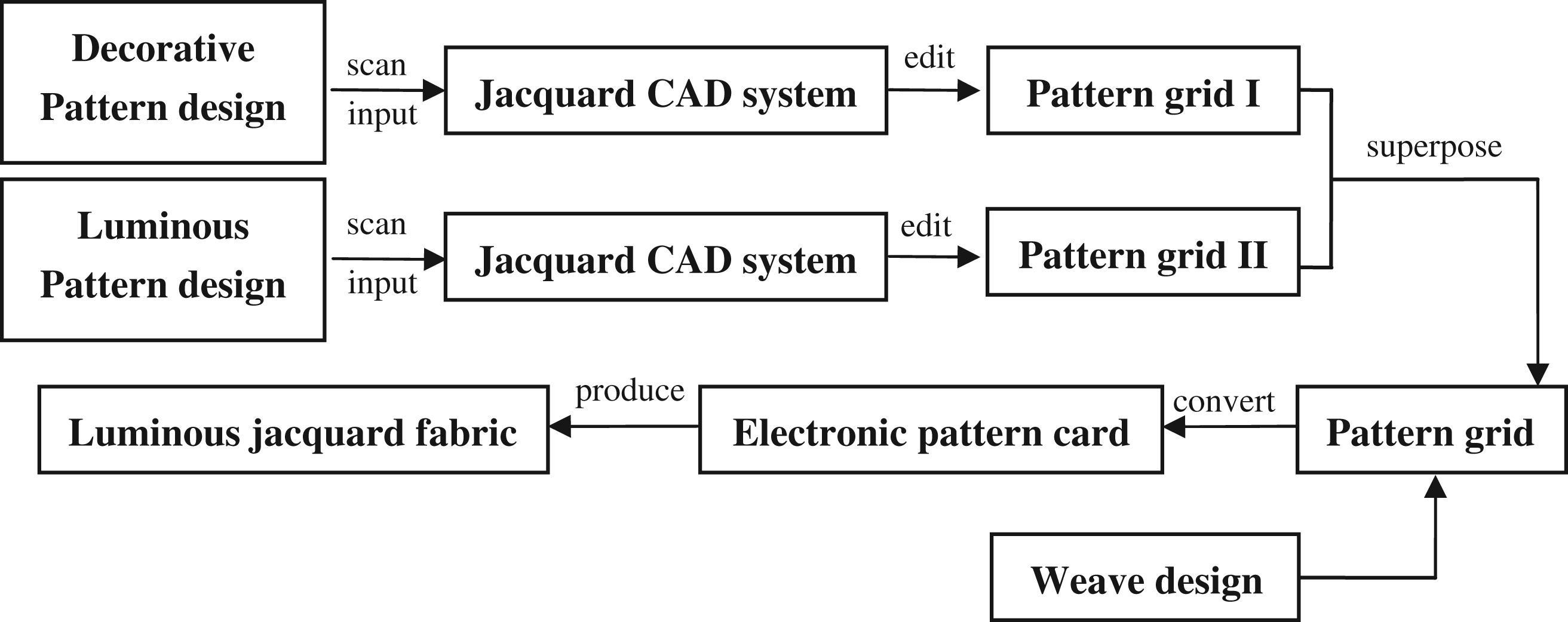
Superposition principle of pattern
For display dynamic patterns on the same fabric zone, patterns must be superposed in the jacquard fabric CAD system. The superposition method of patterns is shown in Figure 2, where (a) is decorative pattern with colors a and d, (b) is luminous pattern I with colors b and e and (c) is luminous pattern II with colors c and f. First of all, the three patterns of (a), (b) and (c) are edited and modified independently in the jacquard CAD system. Next, one of the patterns is taken as the basic pattern, and the second pattern is superposed on it to form a new superposed pattern, which then is superposed by the third pattern. The final superposed pattern with colors a, b, c, ab, ac, bc, abc and def is shown in Figure 2(d).
Diagram of superposition principle of three patterns: (a) decorative pattern; (b) luminous pattern I; (c) luminous pattern II; (d) superposition pattern.
Theoretically, if the decorative pattern has m types of colors, luminous pattern I has n types of colors and luminous pattern II has p types of colors, the superposed pattern will have m × n × p types of colors eventually. The principle is the same for four or more independent patterns.
Design principle of POF jacquard fabric structure
The appearance of fabric changes along with the fabric construction of weaves. There are four main types of traditional jacquard fabric structures: single-layer, backed structure (warp-backed, weft-backed), double-layer and multi-layer.
14
For POF jacquard fabrics, weft-backed weaves were used, as POFs were woven into fabrics as weft yarns. Figure 3 shows a weft-backed weave using 8-thread weft sateen and 3/1 twill as the face and back weaves, respectively. The red line represents the POF and the blue line represents polyester. In terms of theory, polyester is covered by POFs and warp yarns, making it invisible on the face of the fabric. However, the polyester is visible in the area of stitches forming the decorative pattern during lighting off, due to the POF being transparent, as shown by dashed frames in the Figure 3.
Cross-sectional view of a weft-backed woven structure (color online only).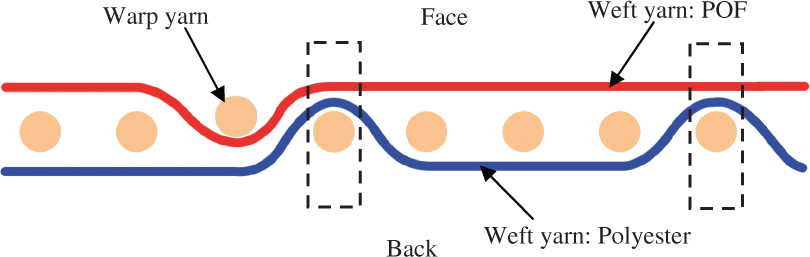
Therefore, a special fabric with two layers of patterns could be produced, as shown in Figure 4. The top layer was a luminous pattern displayed by POFs of the side-illuminating effect during lighting on, while the bottom layer was a decorative pattern displayed by yellow and brown polyester weft yarns. For this fabric, the luminous pattern is static and the shape of the two patterns is the same. Furthermore, the dynamic luminous patterns are carried out by this weft-backed weave design based on the superposition pattern in the jacquard CAD system.
Polymer optical fiber (POF) jacquard fabric with two layers of patterns: (a) decorative pattern effect; (b) luminous pattern effect.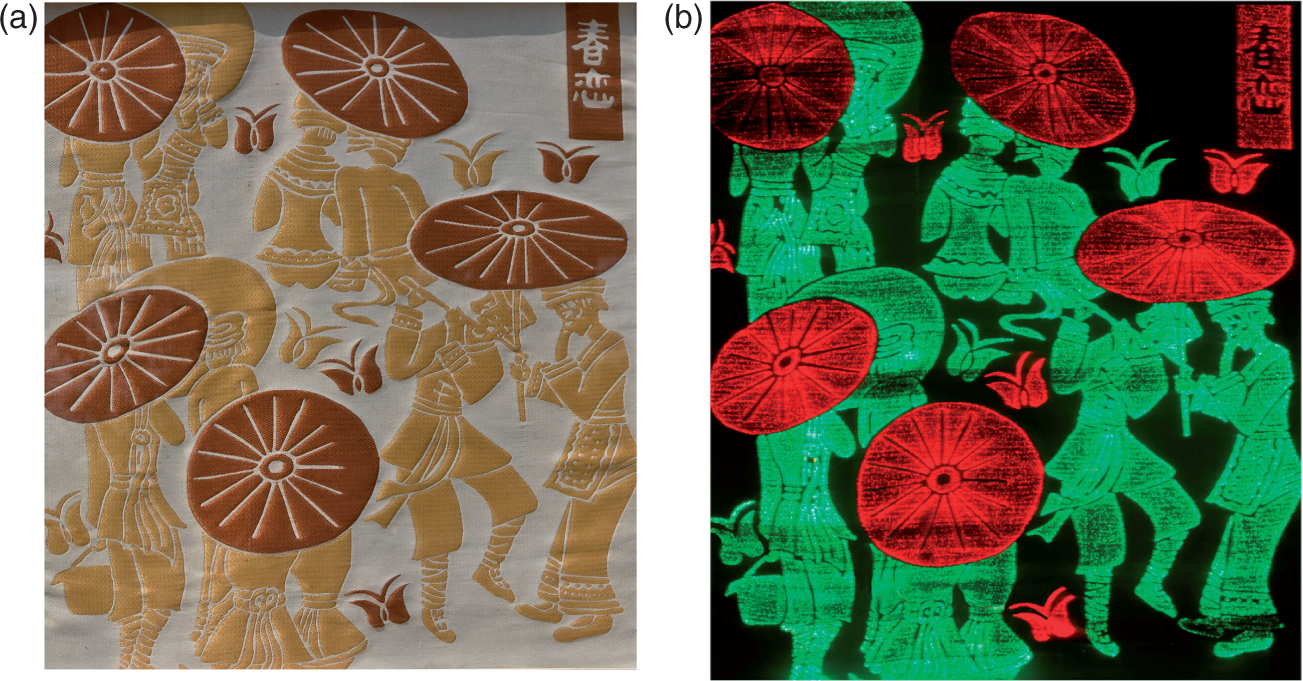
Design illustration
The above-mentioned are fundamental design principles and methods. In order to obtain dynamic luminous patterns, the key design technique lies in pattern and structure designs. The following design illustrations are given to describe the design principles and methods.
Materials and technical parameters
Essential specification of polymer optical fiber (POF) jacquard fabric

Dynamic patterns and weaves design
In this specimen, dynamic patterns were designed based on the principle of vision persistence. Persistence of vision is the phenomenon of the eye by which an afterimage is thought to persist for approximately one twentieth to one fifth of a second on the retina. It is a general application in our daily life, for example, it is a technique in cartoons and movies. A series of static images can display an animation effect when they are shown in rapid succession.
The luminous patterns are two butterflies, while the decorative pattern is a folklore butterfly paper cutting. As mentioned previously, three independent patterns were superimposed on each other in the jacquard textile CAD system. The result shows, in Figure 5, that there are eight different colors on the superposition pattern. Among them, color lump Nos.1, 2, 3, 7 and 8 constituted pattern (a), color lump Nos.1, 3, 4, 5 and 8 constituted pattern (b) and color lump Nos.1, 4, 6, 7 and 8 constituted pattern (c), as shown in Figure 6.
Pattern grid of superposition pattern. Relationship between pattern grid and fabric effect.

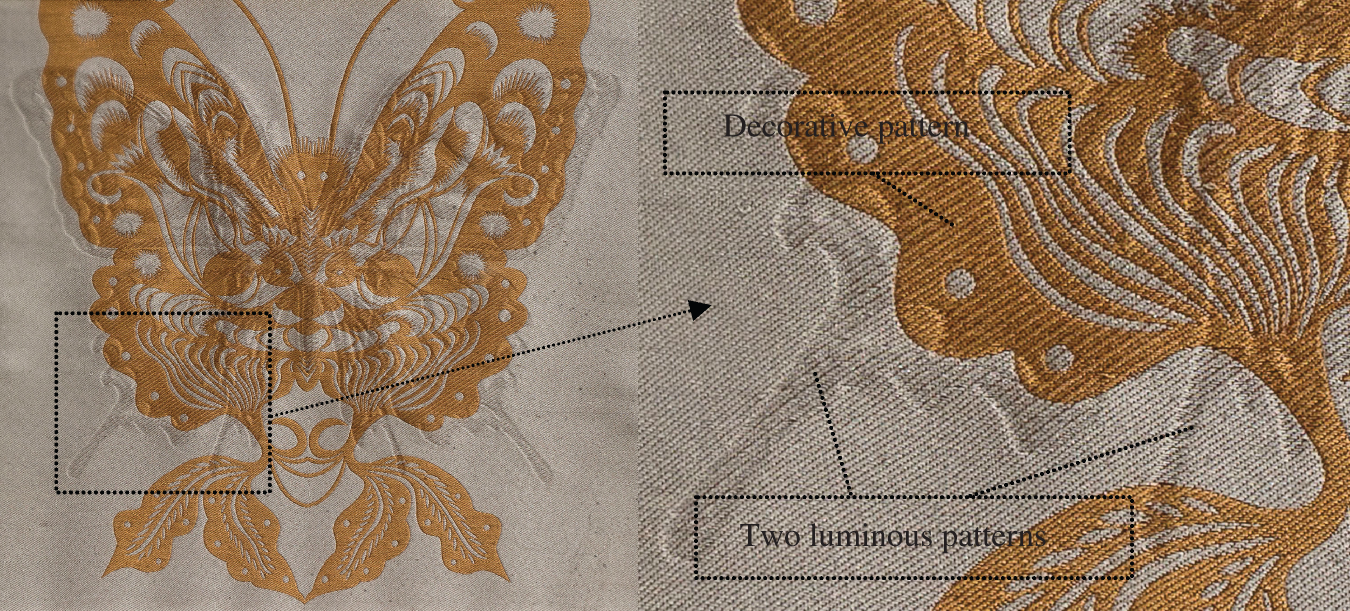
The luminous POF jacquard fabric had weft-backed structures; the primary weaves were 16-thread satin and 32-thread satin, as shown in Figure 7, where (a) is 16-thread weft sateen, (b) is 32-thread weft sateen, (c) is 16-thread warp sateen and (d) is 32-thread warp sateen. Based on the combination method of backed structures, Figures 7(a) and (b) serve as face weaves, while Figures 7(c) and (d) serve as backing weaves. The merit of this type structure is that the up-float of the back weft is always situated under the longer floats of the face weft when the face and back threads are arranged in a certain ratio. In this particular specimen, the luminous jacquard fabric was multi-backed constructed with one brown warp thread and three weft threads of polyester, POF and rayon arranged in the proportion of 2:2:1. Eight multi-backed weaves were designed according to the appearance of the fabric surface. The fabric effect is shown in Figure 8. The patterns on the fabric surface made of POF are transparent during lighting off.
Primary weaves of polymer optical fiber (POF) jacquard fabric: (a) and (b) face weaves; (c) and (d) backing weaves. Polymer optical fiber (POF) jacquard fabric with overall and detailed effects.
Circuit connection and luminous effect
In woven structure, POFs are interwoven with warp threads, which may cause micro bend at the interlacing point. An optical leakage will take place when the reflection angle is greater than the critical angle. 15 It is known that the side-glowing intensity decreases exponentially along the whole length of the POF.16,17 In order to increase the side-glowing intensity and uniformity, both ends of the POFs should be connected with LEDs.
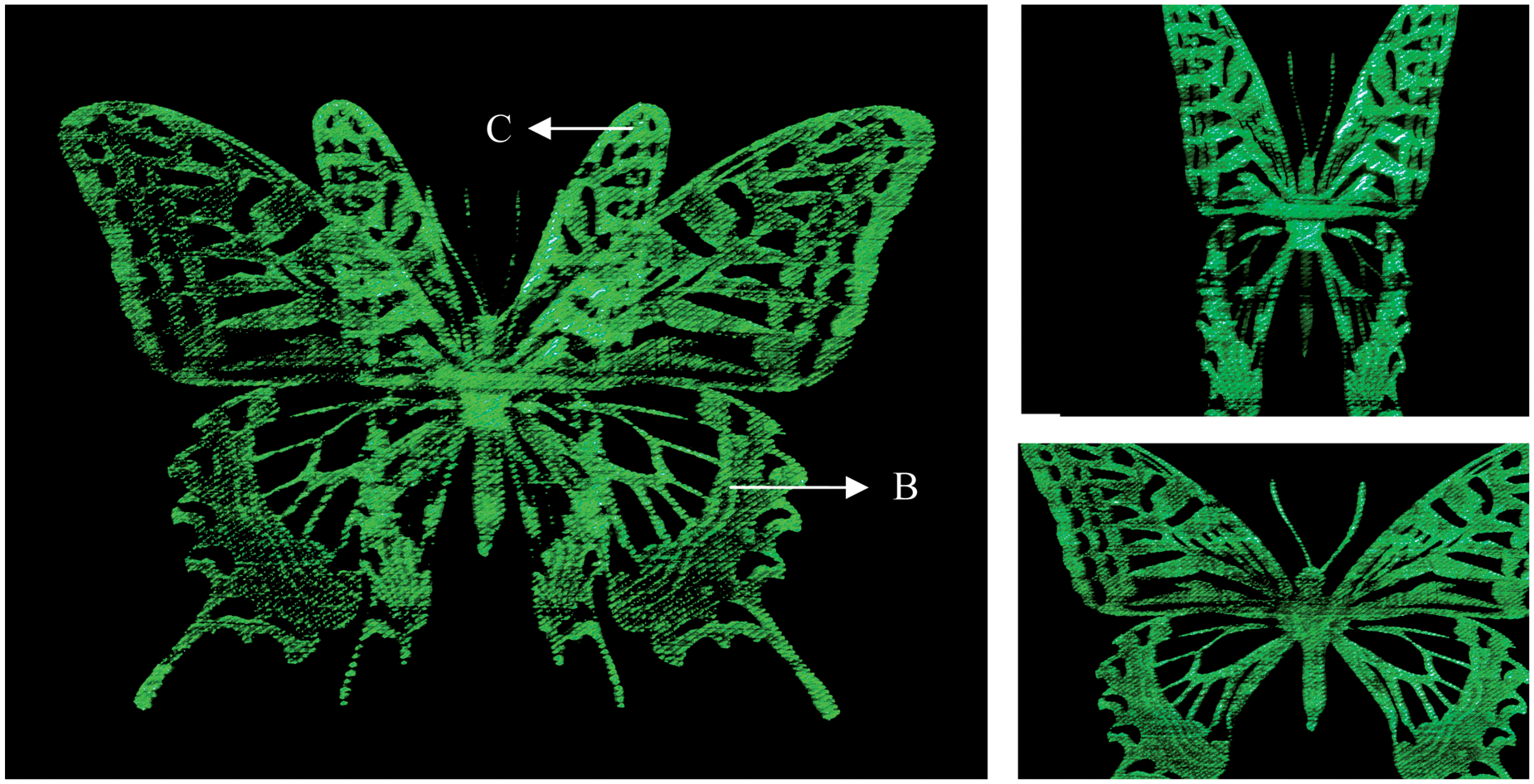
The luminous patterns were controlled by the corresponding LEDs, which connect to an electronic control device, as shown in Figure 9. There are two movement stages, which involve alternating two groups of POFs – one for the blue butterfly and the other for the green butterfly. When the first group of POFs emits light (the second one does not emit light), the green butterfly is displayed. Likewise, when the second group of POFs emits light (the first one does not emit light), the green butterfly disappears and the blue butterfly is displayed. There is a continuous relationship between the shape of the blue butterfly and that of the green one. It seems that a butterfly quivers its wings as long as the two patterns are displayed by turns in rapid succession. The luminous effects are shown in Figure 10.
Circuit connections of polymer optical fiber (POF) jacquard fabric. Dynamic effects of polymer optical fiber (POF) jacquard fabric.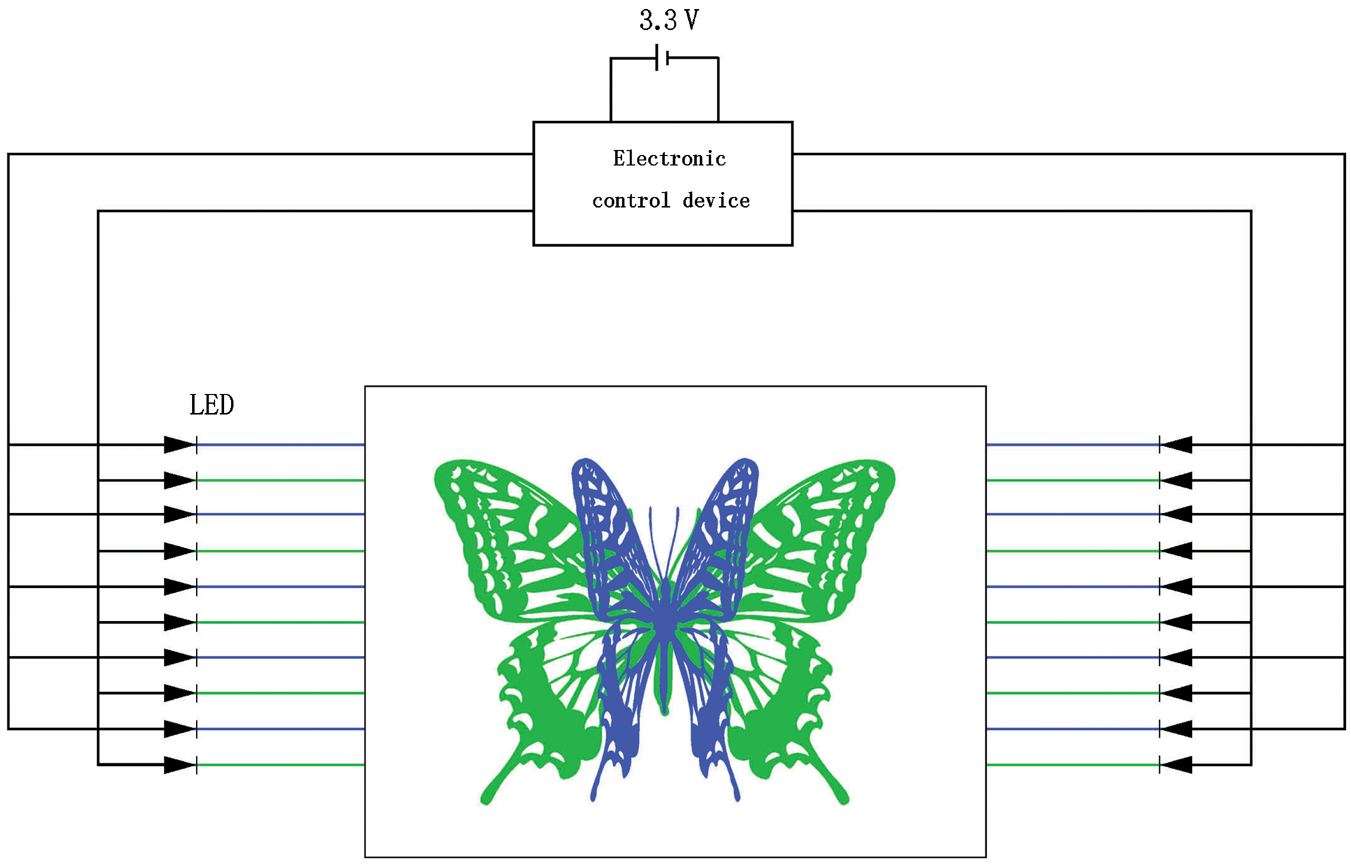
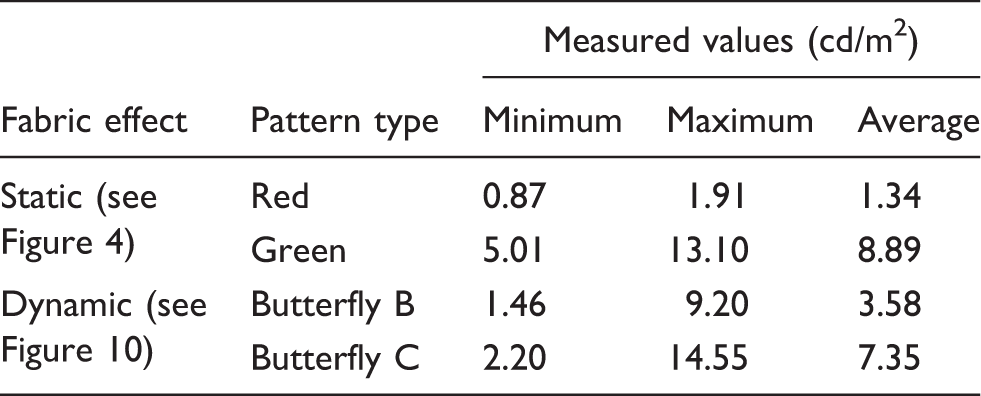
Side-glowing intensity of polymer optical fiber (POF) jacquard fabrics
Conclusions
POF jacquard fabric is a new breed of functional fabric based on textile technology, electronics and materials science. Such fabric both has decorative and luminous effects, and can be produced on a jacquard loom with transparent POFs by using a multi-backed fabric structure. The design method of luminous POF jacquard fabric with a dynamic pattern display was developed by using the technology of pattern superposition. A series of patterns were designed according to the principle of persistence of vision, then were superposed into an assembled pattern in the figured jacquard CAD system. These made it possible to create different patterns on the same fabric zone. Designed luminous patterns displayed an animation effect under the control of a circuit. The results of this study have broadened application prospects of POF fabric, and also added value to the fabric.
Footnotes
Acknowledgements
The authors would like to thank Prof. Hua Zhou for helping to take some photos.
Funding
This work was supported by a program for Changjiang scholars and innovative research teams in university (Grant number IRT0654) and innovation fund program for graduate student of Zhejiang Sci-Tech University (Grant number YCX-S11001).
Conflict of interest statement
None declared.