




Abstract
Garment simulation technology is expected to help reduce consumers’ apparel fit dissatisfaction in online shopping. However, the simulated garments must be accurate representations of real garments for consumers to accept this technology. The purpose of this study was to investigate users’ evaluations of the fidelity and accuracy of three-dimensional (3D) garment simulation technology used in a virtual online shopping scenario. Ferwerda’s Functional Realism Framework was used to examine garment simulation realism. Thirty-seven women participated in the study. Participants were scanned, and 3D virtual models were made from their scans. A set of pants (misses 2–20) was developed. These pants patterns were digitally input to the computer to develop virtual pants that were fit to the participants’ virtual models. Each participant evaluated the virtual pants fit and the real pants fit in a simulated shopping experience. Participants evaluated fit at 13 critical areas using a seven-point scale and then explained their evaluations during an interview. The overall accuracy and fidelity of the virtual simulation technology was moderately good, but not to the extent that the participants could perform all important aspects of the online fit evaluation. The overall physical appearances of the virtual pants were similar to the real pants. The pants length and the waistband position were accurately represented; however, fabric wrinkles were not accurately represented in the virtual simulation. Garment and body shape relationships were not accurately represented due to technological limitations. This study revealed aspects of garment simulation technology that warrant further research and development.
Garment simulation technology was introduced in the late 1980s. 1 The underlying techniques of garment simulation technology were inspired by traditional apparel pattern and garment making procedures. 2,3 Two-dimensional (2D) apparel patterns are created, imported into a three-dimensional (3D) simulation program and converted to a polygonal mesh that can be positioned around a 3D form representative of a human body. The “virtual body” may be a scan of the shopper or the shopper’s measurements input to a standard body form. 3 The “virtual fit” of the patterns formed to the body can be evaluated and modified to improve the fit of the simulated garment and the simulation can be changed accordingly for re-evaluation. 4 5 Garment simulation technology is expected to help reduce consumers’ dissatisfaction with apparel fit, especially when online shopping. 6–8 Consumers can view a realistic 3D simulated image of a garment on their 3D virtual model (VM) before making a purchase decision. Examples of apparel technology developers providing 3D garment simulation include the e-fit Simulator™ by TukaTech, V-Stitcher™ by Browzwear, 3D Runaway Designer by OptiTex™, and Modaris® by Lectra. Another similar application is that developed by Bodimetrics, which is a 3D body-mapping system using Microsoft Kinect technology that enables people to scan themselves to have a virtual fitting room experience even at home on their television. 9 10 Examples of apparel online retailers implementing this technology include a Canadian company, My Virtual Model (see http://www.mvm.com), and a Korean company, i-Fashion Mall (see http://www.ifashionmall.co.kr). Even with such growing interests in 3D simulation technology, unless the fit of simulated garments is accurate and a realistic representation of real garments, consumers are unlikely to accept this technology.
Computer graphics researchers generally have the goal of developing accurate and realistic models of real objects. Early virtual garment simulation research mainly focused on simulating fabric drape for accurate representation of a garment. 11 However, fabric drape simulation methods alone are not sufficient to represent apparel fit in a virtual “try-on” situation. Apparel fit is the result of complex interactions of many factors, including garment grain, set, line, balance, and ease. 12 Because researchers in computer graphics have little background or knowledge of apparel construction and fit, questions remain whether garment simulation technology realistically represents garments for online shopping fit evaluation.
The purpose of this study was to investigate the users’ evaluation of fidelity and accuracy of 3D garment simulation technology used in a virtual online shopping scenario. Ferwerda’s
13
Functional Realism Framework provided criteria to evaluate accuracy and fidelity. For this purpose, we asked women to compare virtual garments as “fitted” on their 3D virtual bodies to actual garments they tried on. A classic style pant was selected as the virtual and real garment, because achieving good pants fit is an especially challenging task.
14,15
The research purpose was accomplished with the following specific questions.
How do women evaluate the fit of virtual pants on their VM as represented on a computer screen? How do women evaluate the fit of real pants as viewed on their bodies? What are the similarities and differences of virtual pants fit on the VM and real pants fit on the real body (RB)?
The results of the study provide understanding of how the users of 3D garment simulation evaluate accuracy and fidelity of the technology for online shopping use. The information will help software developers in improving 3D garment simulation technologies with the ultimate goal of improving online shopping experiences.
Framework of the study
Psychophysics is the study of perceptual processes by systematically varying the properties of stimulus images and subjects’ responsive behaviors from the stimulus. 16 With major developments of creating 3D images in computer graphics and their applications being extended to many products, such as aircraft, automobiles, and garments, studies on the impacts of its use on viewers’ perceptions are recommended. 17 Ferwerda, 13 a computer graphic researcher, presented a psychophysical conceptual framework explaining functional realism for computer graphics. The framework provides standard criteria for evaluating the realism of computer graphics images. Using functional realism as the conceptual framework, we proposed to examine garment simulation realism. The functional realism framework was selected for this study to provide relevant structural guidelines for identifying critical visual information that is useful in developing realistic garment simulations. In functional realism, images provide the same reliable “visual information” as the represented objects. Examples of visual information that help observers to perform tasks effectively include shapes, sizes, positions, motions, and materials of the objects. Functionally realistic images do not require complex computation processes, but achieve image displays accurate enough for communicating function and purpose for viewers to make reliable visual judgments and perform expected tasks. Rendering styles can vary from rather abstract rendering to more complicated rendering like photo-realistic images. Irrelevant details that are computationally complex to produce can be eliminated, but the images still provide functionally relevant visual information like that provided by the real objects.
Two criteria are used for measuring functional realism: (a) accuracy and (b) fidelity. When the computer graphic image is accurate, it means that the physically measurable property of the image is correct. When the image has fidelity, the image is true to the reality that the image is representing. Fidelity is described as the properties of the computer graphic image that “allow the observer to perceive important properties of the scene with the same certainty that they could in the real world” (Ferwerda: 294)13. Fidelity can be measured by checking if images allow viewers to perform tasks with the same certainty as they do in the real world. When the viewers are able to perform similar tasks, the image has fidelity and retains accurate visual information. 18
Ferwerda’s framework raises the following question. In garment simulation, what constitutes a functionally realistic image? To measure accuracy, it is necessary to identify and examine the accuracy of physically measurable properties of the garment simulation images. In order to measure fidelity, it is necessary to identify important real world tasks, in this case online shopping tasks, and compare a person’s activities when viewing simulated garment fit and when viewing real garment fit.
Challenges in garment simulation technology and user-centered evaluation
Although garment simulation in the computer graphics field has advanced from basic shape modeling to more realistic garment simulation,
1,2
challenges still remain. Magnenat-Thalmann and Volino
1
listed the following diverse challenges:
the size of garments, which can be one meter long and yet need to be simulated at millimeter accuracy; the intricate and highly variable shape of garments, which interact through complex contact patterns with the body (which is itself a complex deformable entity), as well as with other garments; the highly deformable nature of cloth, which translates very subtle mechanical variations into large draping and motion variations that modify completely the visual appearance of garment models; the highly intricate anisotropic and non-linear mechanical behavior of garments, requiring accurate measurement, modeling, and complex numerical methods for their resolution (p.507).
In summary, the researchers have categorized garment simulation challenges into three categories: (a) size of garment; (b) shape of garment, which is formed by body and garment interaction; and (c) fabric behavior, which describes the basic mechanical behaviors of a fabric determined by the inherent nature of fabric. Computer scientists have made the following efforts to improve each category.
Firstly, the purpose of mechanical simulation is to accurately reproduce the mechanical behavior of a fabric by considering its inherent nature, such as fiber structures, yarn constructions, and fabric structures. 2 Mechanical simulation has to be successful prior to garment simulation to produce realistically behaving fabric simulations. Fabric behaviors will determine the drape of the garment on the body and the interaction of the garment with the environment.
The second factor is accurate interpretation of garment interaction with objects. The interaction between the garment and the body and between one garment and another is computed by collision detection. The computation results decide the size and shape of the final garment in relation to the body form. 19 Collision detection has been studied extensively, 20–22 and Baciu and Wong 23 confirmed it to be one of the most computationally demanding tasks due to the flexible nature of fabric.
After producing realistic garment simulations, the next step is testing the technology. Fiore, 24 an apparel researcher, stated that for successful apparel digital technology, it is important to examine the human–computer interface experience, such as consumer interactivity and reactions to VMs. Computer scientists assert that more efforts must be made in user-centered design and the evaluation of virtual technology. 25 Kosara et al., 26 computer graphic researchers, emphasized the importance of usability testing of virtual visualization techniques in an application setting, in which users have freedom to experiment, rather than in an artificially simple environment. Therefore, for the research project reported here, we evaluated garment simulation in a practical user setting following real-life online shopping steps.
Apparel fit analysis
In order to measure fidelity and accuracy of garment simulation, it is necessary to examine how apparel researchers evaluate apparel fit, which is defined as the relationship between apparel and the body.
27
Fit analysis is a process of judging how well the clothing conforms to the body based on a set of requirements.
28
Ashdown et al.
28
stated that: A well-fitted garment is a garment that hangs smoothly and evenly on the body, with no pulls or distortion of the fabric, straight seams, pleasing proportions, no gaping, no constriction of the body, and adequate ease for movement. Hems are parallel to the floor unless otherwise intended, and the garment armscye and crotch do not constrict the body. (p.3)
Erwin and Kinchen 12 identified five elements of fit: (a) grain; (b) set; (c) line; (d) balance; and (e) ease. Grain is how well the fabric vertical yarns and intersecting horizontal yarns hang in relation to a wearer’s body. Set is how smoothly a garment follows the body contour without wrinkles. Line is evaluating the structural lines of a garment, such as side seams; the structural lines should follow the body line appropriately. Balance describes how well a garment is distributed on the body from left to right, as well as front to back. A well-balanced garment hangs on the body evenly and symmetrically. Ease gives an appropriate amount of room between body and garment so that wearers can move comfortably. Proper ease value changes depend on the fabric types; 29 garments made with stretchy fabrics require less ease amount for movement than garments with less stretchy fabrics. Heavyweight fabrics need more ease than lightweight fabrics to make a comfortable garment.
Apparel fit studies have been approached from different perspectives. Perception of fit has been evaluated based on either expert judge opinions or wearers’ opinions. Rating scales for a number of critical fit locations are often used to measure both wearer and expert evaluations of garment fit. 27–31 In this study, participants’ (wearers’) evaluations and rating scales were used to analyze fit.
Method
This study replicated a real-life online shopping experience where the consumer has the opportunity of viewing virtual pants on a VM developed from the consumer’s body scan. The consumer can view virtual pants in different sizes on her body scan to determine best size before purchase. She can select the pants she likes and place an order. When the garment is delivered to her house, she tries the garment on to evaluate appearance and fit. She can compare the real pants to the image on the computer screen and determine if the item she ordered is what she expected.
The study was conducted using quantitative and qualitative methods. Two questionnaires were developed: the VM fit evaluation questionnaire and the RB fit evaluation questionnaire, to assess participants’ evaluations of the virtual and real pants. Rating scales assessing the fit of critical locations were adopted and modified from previous apparel fit evaluation studies. 27–31 Interviews were conducted to further understand participants’ comparisons of the virtual and real pants.
The VM questionnaire asked participants about the fit of 13 critical areas (fit factors), including overall fit, front waistband, back waistband, abdomen, hip, front thigh, back thigh, front crotch, back crotch, left side, right side, inseams, and hem, using a seven-point Likert-type scale with endpoints of extremely poor fit (1) and excellent fit (7). Participants were then asked to explain their number choice in an interview.
The RB fit evaluation questionnaire consisted of two parts: (a) participants evaluated the fit of 13 critical areas of the real pants on their body using the same seven-point Likert-type scale with endpoints of extremely poor fit (1) and excellent fit (7); and (b) they were provided with the 3D virtual image that they previously evaluated, to determine similarities and differences of the VM and RB pants. They were asked to rate how strongly they agree or disagree that the pants fit on the virtual body and on their RB were the same using the seven-point Likert-type scale with endpoints of strongly disagree (1) and strongly agree (7).
Participants were not instructed about any specific fit elements that they needed to consider during fit evaluations. Instead, they were asked to use their own fit evaluation criteria that they would normally use when purchasing a garment, because the goal of this user study setting was to reflect a real-life experience.
Participants
Participants were students and employees at a large US Midwestern university. Institutional Review Board approval was acquired before proceeding with the study. Participants were recruited through flyers posted on campus and in-class announcements. The participants were paid a small amount of compensation upon completion of the study. Thirty-seven participants, ages 19–35 years, met criteria that they must wear misses sizes between 2 and 20 of the ASTM D 5585-95 standard. 32 The majority of the participants were 19–22 years old (n = 24, 64.86%). Most of the participants were undergraduate students (75.68%) with some graduate students (18.92%) and some categorized as “other” (5.40%).
Study procedures
Data were collected in two sessions. During the first session participants were scanned wearing their own bra and panties. In preparation for the participants’ second session, participants’ scans were made into VMs, a set of graded pants patterns were developed, pants patterns were cut and sewn into real garments, and virtual pants in 10 different sizes were developed. Within two weeks, participants returned to the lab. In the second session, participants first selected one pair of best size virtual pants after viewing several different size virtual pants on their VM. Participants viewed and evaluated the virtual pants on their VM using the VM fit evaluation questionnaire. After the virtual pants evaluation, they tried on and evaluated the real pants (same size as the virtual pants) as viewed in a mirror using the RB fit evaluation questionnaire. The steps are explained in more detail in the following sections.
Body scanning and virtual garment simulation
A VITUS/smart 3D Body Scanner, a laser sensor-type scanner produced by Human Solutions, was used to scan participants. ScanWorX™ software extracted the point cloud data of the scan, which was then imported into InnovMetric Polyworks™ software to make a polygonal VM. As a solid VM was necessary to accomplish accurate virtual draping, missing data in the crotch area were patched by following the crotch contours of the model using Polyworks™ software hole-patching functions. The polygonal model was saved as a Virtual Reality Modeling Language (VRML) file with *.wrl file format and was imported into the 3D virtual garment simulation software that was selected to produce the “virtual” garment. The software was developed by a leading apparel industry 2D/3D computer-aided design (CAD) software company.
“Real” pants and “virtual” pants development
Size 8 sloper patterns from a patternmaking book 33 were digitized into the software and modified to a classic style pants pattern. The size 8 pattern was used as the sample size and was graded to 10 sizes, misses 2–20, with grade rules based on the ASTM D 5585-95 standard 32 using the 2D patternmaking functions of the software. Virtual pants and real pants were developed using these patterns. The “virtual” pants in 10 sizes were prepared by 3D simulation functions of the software to “drape” pants on participants’ VMs.
The “real” pants were made from full-size plotted patterns. Ten pants, sizes 2–20, were cut and sewn so that participants could select and try on a pair of pants of their size choice. A 60% cotton/40% polyester blend gabardine twill weave fabric, medium gray, was selected for the real pants. The detailed fabric description includes the following: staple length, single ply yarn with S twist, left-handed 3/1 twill weave with a shaft of 4, yarn count 128 × 60. Developing the “virtual” pants required accurate reproduction of fabric mechanical behavior. This type of description is critical for successful garment simulation. The garment simulation software required fabric physical parameters, including fabric type (name), stretch, bend, shear, thickness, and weight. The fabric was tested by a professional textile testing lab using the FAST (Fabric Assurance by Simple Testing) testing method using SIROFAST/International Wool Textile Organization (IWTO) guidelines. The results of testing were as follows: extensibility 1.0% (warp) and 3.4% (filling); bending rigidity 14.1 µN.m (warp) and 9.0 µN.m (filling); shear rigidity 119.1 N/m; surface thickness 0.107 mm; and weight 225 g/m2. Results were input into the software’s fabric editor. A jpeg image with similar texture and appearance characteristics of the real fabric was selected from the software’s fabric image library and the jpeg image was applied to the surface image of the pants.
Data analysis
The quantitative data were analyzed in two steps: (a) differences between participants’ fit evaluations on the VM and on the RB were analyzed using paired t-tests; and (b) participants’ comparison ratings between the VM fit and the RB fit were analyzed using descriptive statistics. Interview data were analyzed using content analysis techniques classifying and analyzing text data and indentifying the meaning of the text. 34,35 Counting the frequencies of coded text is the simplest kind of content analysis study using a quantitative approach. 34 In the qualitative approach, the underlying meaning of the text is identified after categorizing the text data. 35 Therefore, interviews were transcribed from digital recordings and logged into Excel spreadsheets. The primary researcher first read each participant’s entire transcript several times to understand the scope of the text and then constructed a coding frame for the fit factors. Next, the researcher read the transcripts to identify emerging categories for each factor and coded the data. The repeatedly occurring categories in each fit factor were identified, and their underlying meanings were formed into themes. To validate theme identification, the content analysis process was cross-checked with a co-researcher and two other researchers with fit evaluation expertise.
Results and discussion
Paired t-tests and descriptive statistics
The analysis of participants’ rating scales revealed answers to the research questions. Based on “accuracy” and “fidelity”, the two criteria of the Functional Realism Framework, it is important to verify that the visual information from the garment simulation allows participants to perform the same useful tasks as they can do with real garment. For this reason, participants’ fit evaluation of virtual pants and fit evaluation of real pants were compared using a paired t-test. Descriptive statistics supported t-test results.
Paired t-test for ratings of virtual model (VM) and real body (RB) fit evaluations

Note. P Value refers to a two-tailed paired t-test.
(1 = extremely poor fit, 2 = poor fit, 3 = below average fit, 4 = average fit, 5 = above average fit, 6 = good fit, 7 = excellent fit).
Participant comparison between virtual model (VM) and real body (RB) fit
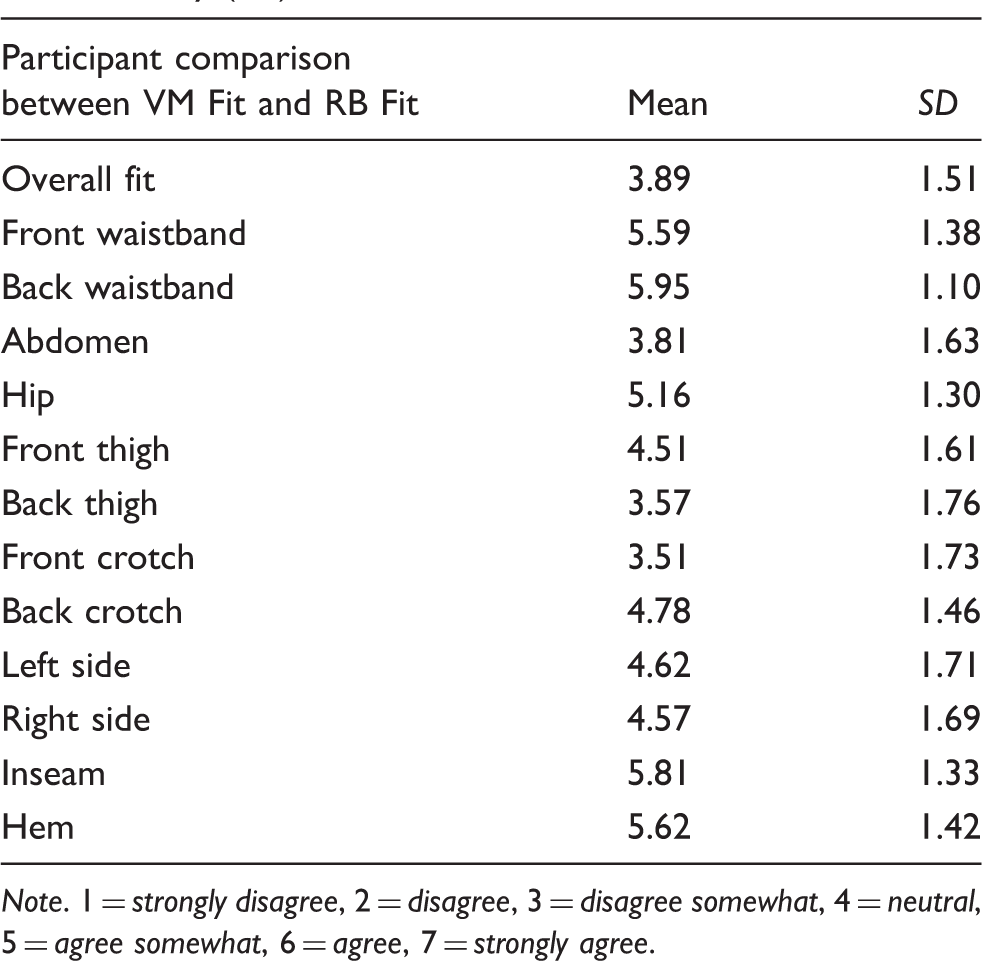
Note. 1 = strongly disagree, 2 = disagree, 3 = disagree somewhat, 4 = neutral, 5 = agree somewhat, 6 = agree, 7 = strongly agree.
In summary, the results from t-tests and descriptive statistics showed that the VM fit appearance scored higher than the RB fit at the abdomen, back thigh, and front crotch; therefore, the virtual fit representations at those fit factors were inaccurate. On the other hand, the VM fit representations at the waistband, hip, inseam, and hem were accurate. In addition, VM fit representations at the front thigh, back crotch, and left and right side were moderately accurate.
It is especially important to note that the mean for the overall fit from descriptive statistics was lower than all the means, except for the abdomen; this may indicate that unless most of the critical areas show an accurate representation of the real pants, overall accuracy of garment simulation may not be good enough to replace trying on real pants. Accuracy of the simulation images will determine the fidelity of the image. Accuracy in waistband, hip, inseam, and hem fit factors would allow virtual online shopping users to select a correct length pants that fits the waistband and hip area, which increases fidelity. Inaccuracy in the abdomen and front crotch areas would probably disappoint the users when they try on the garment, because they were not able to realistically evaluate that area.
Interview themes
Participants’ interview responses provided detailed information on participants’ evaluations. Participants’ responses revealed four themes that relate to measureable physical properties of the VM pants: (a) fabric; (b) size; (c) shape; and (d) critical locations. The themes served as the basis to evaluate accuracy of the garment simulation technology. The meaningful visual tasks that the participants performed to measure fidelity were the fit evaluations and the correct size decision resulting in a good purchase decision. Results are discussed using the four themes of fabric, size, shape, and critical location.
Fabric
Example of virtual model (VM) and real body (RB) abdomen, hip, and waistband fit evaluation
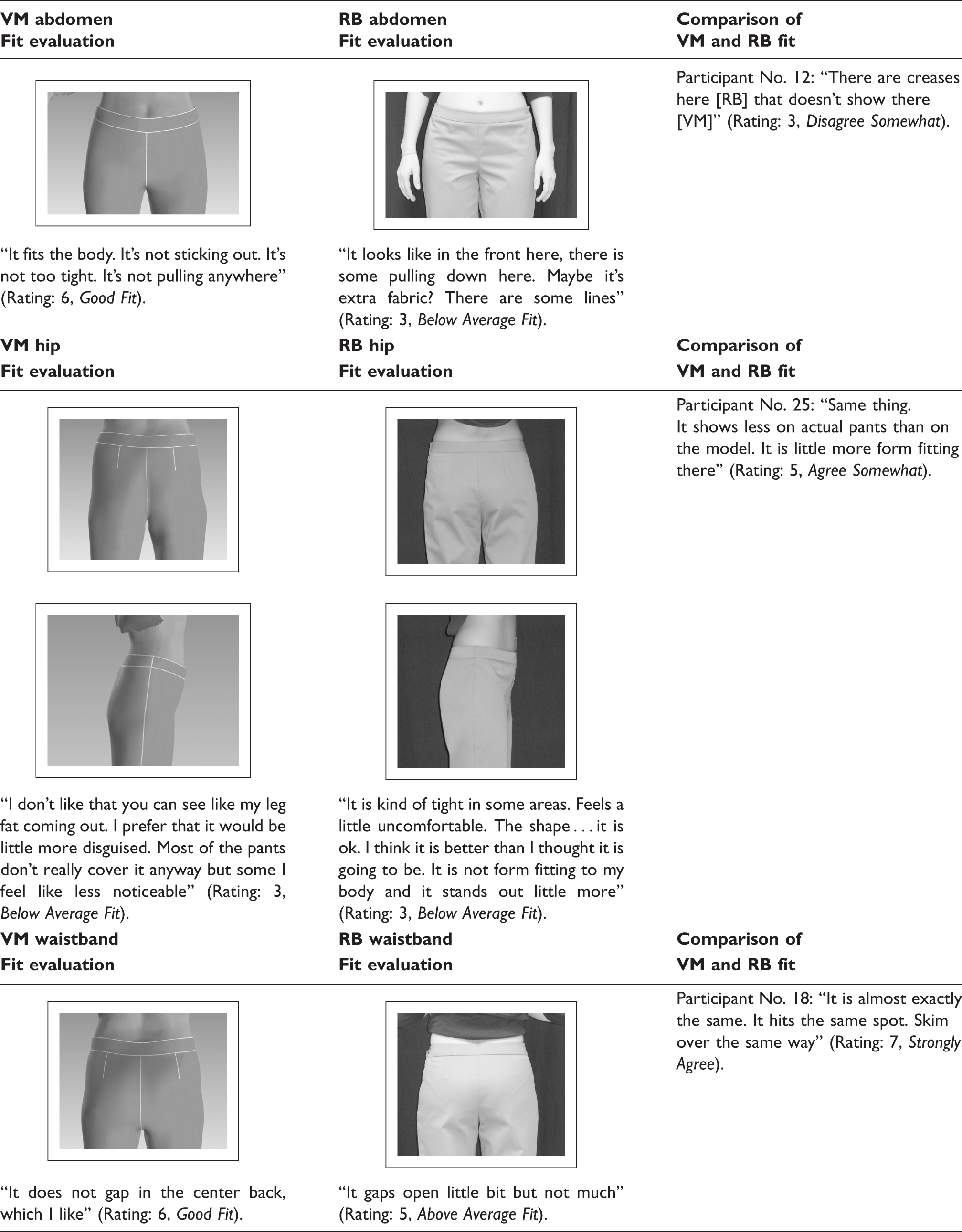
Virtual garments are made of polygonal meshes and, in order to decrease computation time, the polygon sizes need to be fairly large; however, larger polygons cannot simulate small wrinkles that are smaller than the size of the polygons. 37 This suggests that the polygon sizes composing the virtual pants in this study might not have been small enough to represent all the critical wrinkles. Selle et al. 20 recognized the limitations of low-resolution cloth simulation in producing realistic folds and wrinkles, and thus presented a method of simulating high-resolution clothing with up to two million triangles to achieve detailed folds and wrinkles.
Findings suggest that additional fabric tests are necessary to improve the accuracy of fabric simulation. A variety of standard fabric tests are available to assist in modeling fabric simulations, including the FAST method. FAST is the method required by the software used in this study; it is described as a simpler method compared to other methods, but only determines linear parameters of fabrics. 38 Despite use of the fabric parameters from standard fabric tests, fabric deformation, such as wrinkles, creases, and bunching, cannot be modeled easily. Simulating accurate fabric deformation requires more complex calculations of parameters, as well as “other subtle behaviors of fabrics that cannot be characterized and measured directly” (p.36).38
The second problem identified by participants was that fabric texture was inaccurately represented. The fabric on the VM appeared to be a knit or a fabric with spandex as a component of the fiber content, which resulted in the virtual pants looking like “work-out” pants. Rendering and bump mapping techniques are used to create realistic fabric textures 38 with the problem that fabric appearance varies depending on viewing distance. 39 In this study, the zoom-in view showed the proper fabric textures and weave, but the distance view showed a very smooth and somewhat shiny surface. The study findings indicated that improved rendering techniques are necessary.
Size
Inaccurate size representation decreased fidelity of the garment simulation technology. Participants evaluated overall virtual pants size as tighter than the RB fit, which was most apparent at the abdomen, hip, crotch, and front and back thigh. Size misrepresentation is related to the shape theme, because tighter virtual pants exhibited a more contoured shape. For example, when participants observed an obvious body curve on the VM, such as side hip indentation and thigh curve, but a less noticeable curve on the RB, they then evaluated the VM as tighter than the RB fit (see Table 3, Hip Evaluation). Generally, participants said that the VM waistband size was similar to the RB fit. Many participants were especially pleased that there was no gapping at the center back of the VM and RB waistband (see Table 3, Waistband Evaluation).
Ashdown 29 studied the smallest physically detectable differences of ease values that could be perceived by people trying on pants. People were sensitive to ease variations of as little as 5–15 mm at different locations on pants. Findings suggest that consumers have the ability to differentiate sizes. In order to achieve good fidelity, garment simulation technology should provide information to assist consumers in differentiating garment size differences with similar sensitivity.
Shape
The overall pants silhouette in relation to the individual’s body shape was determined to be very accurate on the VM, thus increasing fidelity of the technology. Participants reported that their ability to select the correct size garment would increase if they could view the garment on their VM rather than viewing a professional model wearing the garment on a website.
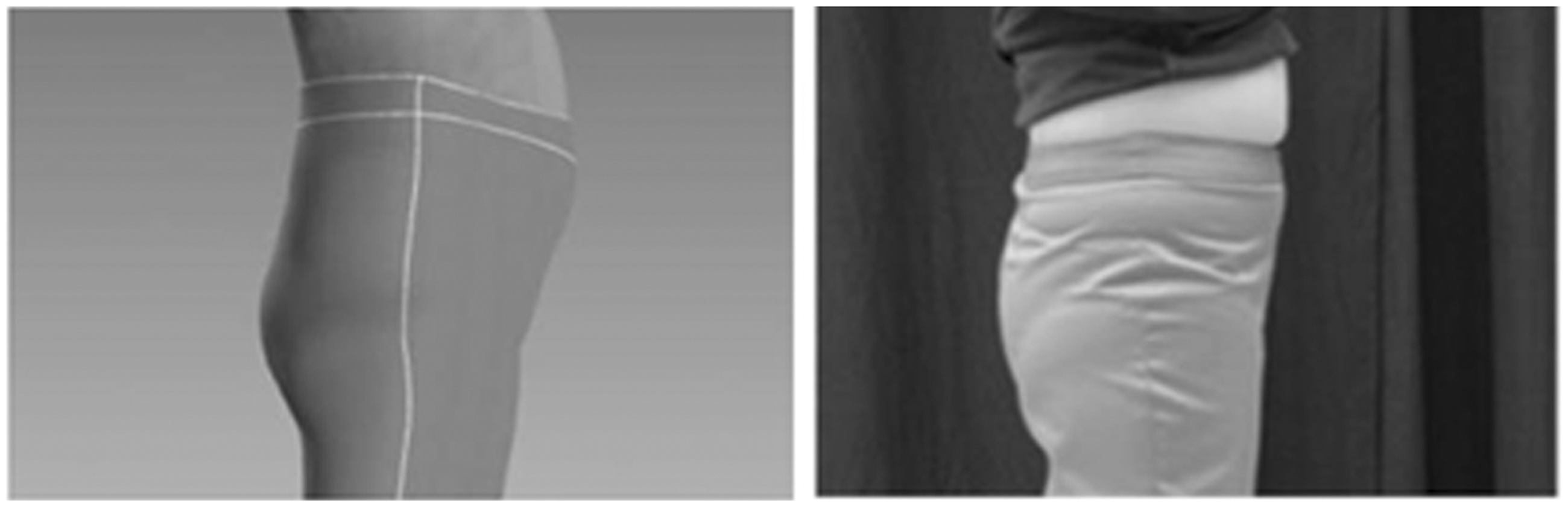
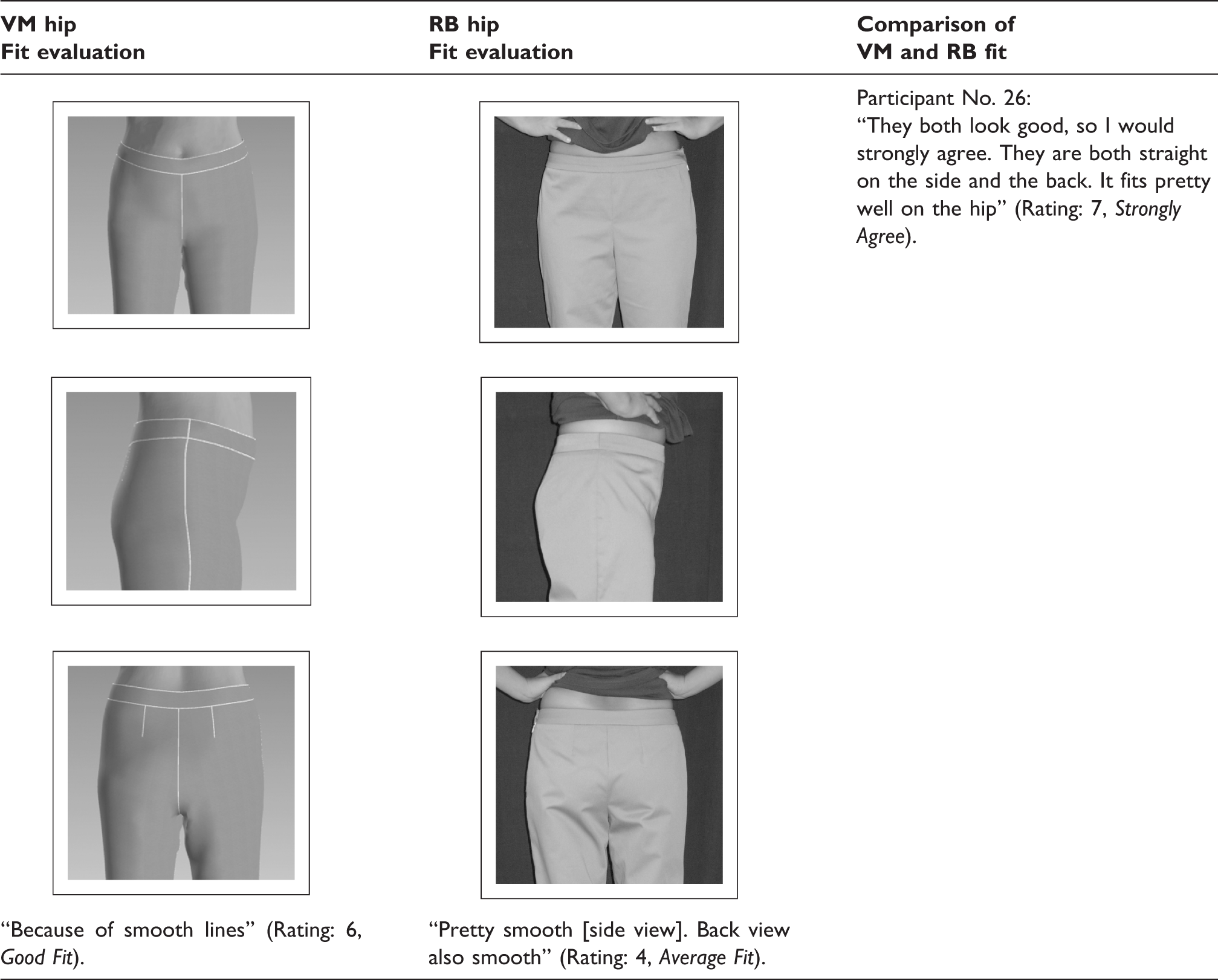
Both accurate and inaccurate aspects were found in virtual simulation in terms of shape. The overall hip silhouettes on the VM and RB were reported to be alike (see Table 4). However, the VM waistband shape had both accurate and inaccurate properties in representing RB waistband shape. VM and RB fit exhibited smooth and even waistband shapes. In many cases, however, the VM waistband “dipped down” at the center front, while the RB waistband was parallel to the floor. Similarly, pant leg hems were different to the RB hem, which was parallel to the floor all around the leg. The VM pant leg hems were not parallel to the floor, with the inseams longer than the side seams. It is likely that the VM “dipping” waistband and the non-parallel to floor hems are related to differences in VM solid models compared to RB compressible bodies (see Figure 1). In addition, the participants with more flesh around the waist and abdomen said the RB pants were tighter than they expected because they could see their ‘belly sticking out’ on their body while the virtual pants conformed to their VM (see Figure 2). Because the scanned model is a solid model that does not have compressible flesh, the virtual pants conform to the shape of the VM and do not displace flesh, which can result in bulging flesh around the waist area. Modifying the shape of the body scan images in accordance to the garment tension is not possible with current technology. In addition, the solid scan could cause the center front and back waistband to “dip down”, while the real soft body allows a more conforming fit at the crotch seam, allowing the waistband to lie smoothly around the waist (see Figure 1). Likewise, the solid scan causes the side seams to pull up in relation to the “anchored” or solid crotch seam area of the VM. This current limitation of the technology means that apparel designs intended to re-shape the body, such as corsets and bras, cannot be evaluated for fit accuracy using garment simulation technology.
Comparison between VM and RB waistband and hem shapes. Examples of uncompressible body scan image and compressible real body (RB). Examples of virtual model (VM) and real body (RB) hip fit evaluation
Critical location
Example of virtual model (VM) and real body (RB) waistband, side, and hem fit evaluation
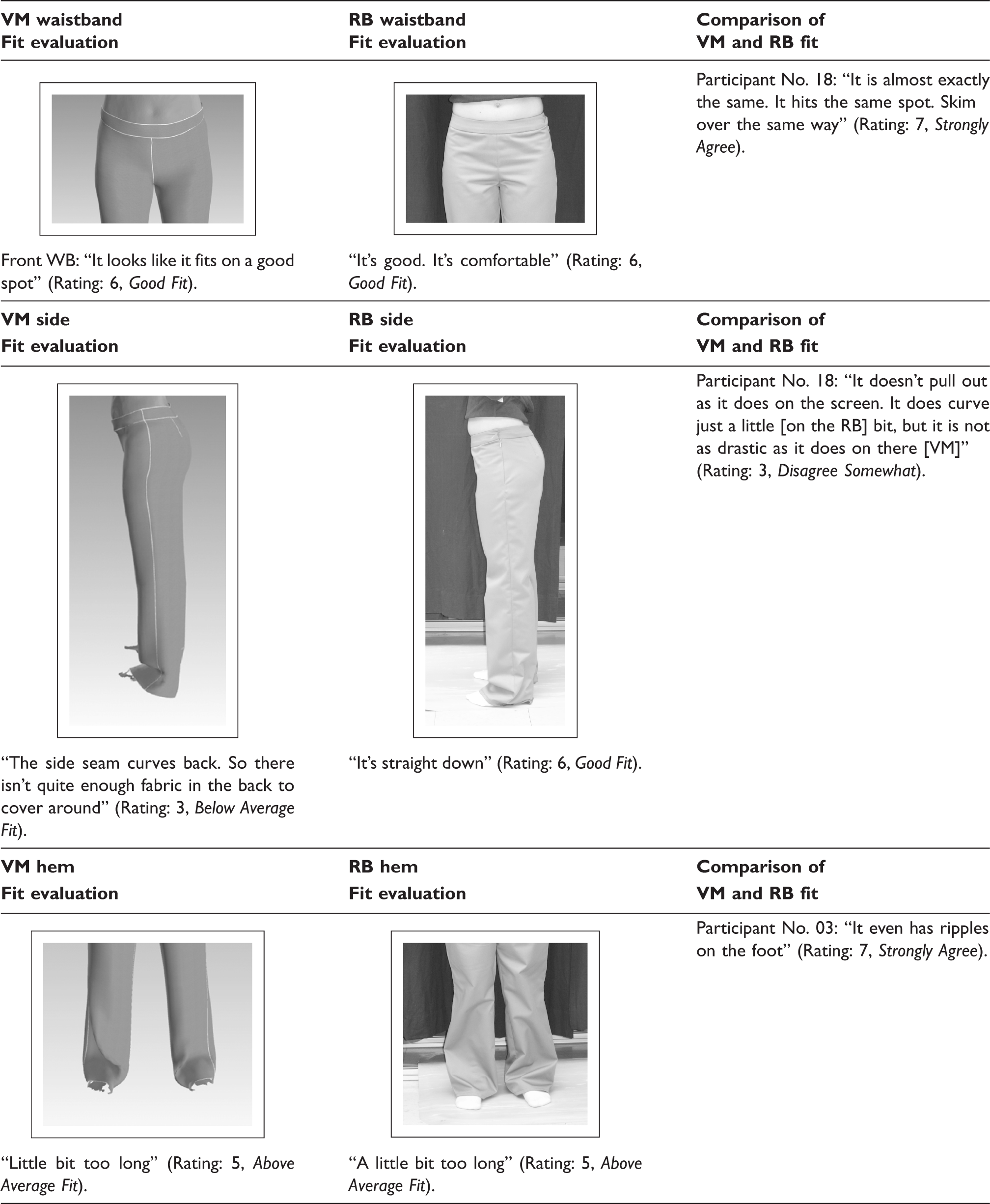
Ferwerda 13 discussed the advantages of using drawings over photographs, arguing that a well-illustrated drawing can provide more useful visual information that might be difficult to view in a photograph. In this study, the side seam on the virtual pants was an excellent example supporting this argument. One participant commented that the ability to view the side seam was helpful for the fit evaluation because the side seam is difficult to observe in photographs on an online shopping website. Ferwerda’s argument and participants’ opinions suggest that the capability of viewing the seam location would increase garment simulation fidelity.
Conclusions
This study revealed aspects of 3D virtual garment simulation technology that warrant further research and development. The “accuracy” and “fidelity” from Ferwerda’s Functional Realism Framework provided structural guidelines for evaluating the realism of garment simulation technology. The Virtual Garment Functional Realism Model, based on Ferwerda’s
13
Functional Realism Framework, was developed based on the results from this study (see Figure 3), which revealed four important measureable physical properties of virtual garments that served as guidelines to evaluate the accuracy of the technology: fabric; size; shape; and critical locations. The accuracy level determined if the users were able to accomplish important online shopping tasks, including size decision, fit evaluation, and correct purchase decisions, which were the bases to measure fidelity.
Virtual Garment Functional Realism Model (Adapted from Ferwerda's Functional Realism Framework).
The most critical findings from quantitative analysis were that although some areas of virtual pants, such as hip shape, waistband position, and pants length, were evaluated to be accurate, participants evaluated the accuracy of overall virtual pants fit different from the real pants fit. Virtual pants were particularly evaluated to be inaccurate at the abdomen, back thigh, and front crotch, which probably caused the participants’ final quantitative decision on the overall virtual pants fit to be different from the real pant fit. Analysis of interviews revealed that from the participants’ perspective the overall physical appearances of the VM pants were somewhat similar to the RB pants; however, the virtual simulation did not provide completely accurate descriptions of the physical characteristics of the RB pants. The major reason causing differences between the fit on the VM and the fit on the RB was inaccurate fabric representations, particularly at the abdomen, front crotch, and back thigh. The VM fabric simulation was smooth, but many wrinkles were visible on the RB. Also, the overall fabric texture was inaccurately represented because the simulated fabric was described as resembling a knit fabric, but the test fabric was a woven fabric. In terms of size, although the rating score proved that virtual pants size accurately represented the waistband size in particular, the overall size of the virtual pants was often commented to be slightly tighter than the real pants. In terms of location, some aspects, such as waistband and inseam position and hem length, were evaluated to be accurate, but the side seam position was inaccurate. In terms of shape, the overall pants silhouette in relation to the individual’s body shape was evaluated to be the most accurate aspect of the simulation and this could make the tool effective for online shopping experiences. However, even with accurate overall shape representation, technological limitations were found in representing garment to body shape relationships. Because 3D body scan images are solid and uncompressible, the shape of the body scan images could not be modified in accordance to garment tension. Therefore, the fidelity of the technology was sufficient for participants to perform the early steps of a fit evaluation – selecting the size range – but was not always successful in aiding selection of the correct size. Participants were often misled to choose a slightly larger size when viewing virtual pants than they would normally choose when trying on real pants. In conclusion, from the users’ perspective, the overall accuracy of the virtual simulation technology is moderately good, but not to the extent that they can perform all important aspects of online fit evaluation. Fidelity of the virtual simulation tool is moderate as well. Consumers will be dissatisfied if they must return garments because fit of the real garment is different from their online shopping expectations. Technological improvement in garment simulation is necessary to improve online shopping experiences.
Implications for future research
The results from the current study are particularly meaningful to researchers and professionals in the textiles and apparel field, because the evaluation was completed from apparel users’ perspectives instead of software developers’ perspectives. Online apparel companies should be able to make full use of the benefits of the technology while taking its limitations into consideration. Companies can consider limitations while advocating for, and perhaps financing, technology improvements. This study highlights the importance of continued efforts to improve accuracy and fidelity of fabric and garment simulations and virtual human body realism, including compressibility of body forms.
This study tested one garment type with one fabric type using a single garment simulation software program. Although the software program was from a leading company, findings from this study cannot be generalized to other 3D simulation software packages. Future studies must consider comparing several programs using different garment and fabric combinations for complete testing of 3D virtual garment simulation fidelity and accuracy. For instance, testing knit garments will verify if the accuracy and fidelity can be improved for knitwear. In addition, since the current study only tested pants, a full range of garment types must be tested. The Virtual Garment Functional Realism Evaluation Model developed from this study will be beneficial in evaluating all virtual garment types and fabrics and other virtual garment simulation software.
Footnotes
Acknowledgments
The authors acknowledge the National Science Foundation (Grant No. 0321172.) for providing 3D technologies available in the University of Minnesota Human Dimensioning© Laboratory.
Funding
This work was supported in part by Thesis Research Grants from the University of Minnesota Graduate School and College of Design.