



Abstract
Silk fiber surfaces were modified using oxygen and argon plasma treatments. Adsorption kinetics of lac dyeing on silk fibers was investigated. The treated silk surfaces were notably roughened and the surface roughness was increased with increasing plasma treatment time. The adsorption of lac dye on the untreated silks and treated silks was found to follow the pseudo-first-order kinetic model. The adsorption reached the equilibrium at a dyeing time of about 60 min. As seen from the amount of dye adsorbed at equilibrium, the adsorption capacity for the pretreated silks was much improved when compared with that of the untreated sample. The best improvement of adsorption capacity was found in the argon-treated silk-containing system.
Natural dyes are known for their beautiful, soft and multi-hued shades. There is considerable current interest in the dyeing of textile fibers with natural dyes on account of their compatibility with the environment and because of their generally lower toxicity and allergic reaction. Lac dye is one of the well-known natural reddish dyestuffs extracted from a secretion of the insect Coccus laccae (Laccifer Lacca Kerr).
1
The insect C. laccae is often found in South and Southeast Asia, especially in Thailand and India. Lac dye is widely used for coloring food, as a cosmetics ingredient, oil painting and dyeing textiles such as silk, cotton and wool. Lac dye is composed mainly of two major groups of substance: four closely related laccaic acids, A, B, C and E, all of which are water-soluble pigments producing a red color, and erythrolaccin, which dissolves in alcohol producing a pale-yellow color.2–4 The chemical structures of laccaic acids A, B, C and E are shown in Figure 1(I).
Chemical structures of laccaic acids (I) and silk fibroin (II).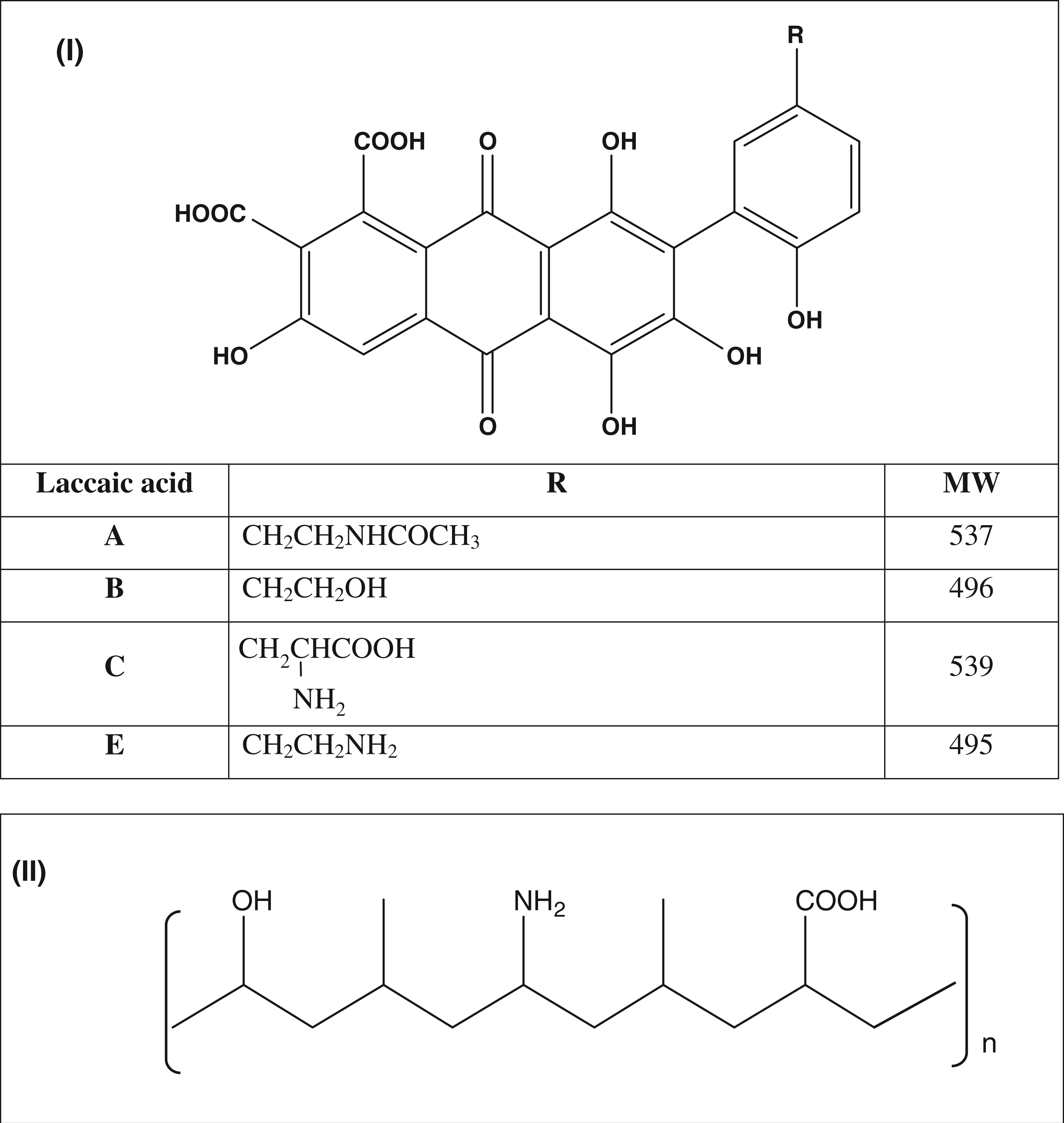
In the north and northeast of Thailand, lac dye is widely used as a red dyestuff for cotton and silk dyeing, despite it having a limited usefulness in cotton or silk dyeing as it is not readily adsorbed by cotton or silk. Therefore, the fastness properties and reproducibility to give consistency in production are still problems to be circumvented. In general, the routes to solve these problems consist of fundamental physical studies on the dyeing process5,6 and chemical modifications to improve the lac dye adsorption on the fibers.7,8 For the latter route, various types of mordants were used as surface modifiers to promote the binding of dyes to fabric by forming a chemical bridge from dye to fiber, enhancing the staining ability of a dye along with increasing its fastness properties. However, most of the mordants used are toxic and have serious detrimental effects on the environment. Therefore, an environmentally friendly method of surface modification is required.
Low-temperature plasma treatment is a technique for modifying the fiber’s surface to improve surface wettability, 9 shrink resistance, 10 interfacial adhesion, 11 hydrophilicity, 12 hydrophobicity13,14 and dyeing properties.15,16 The advantages of this technique are that the plasma modification is only confined to the surface of the materials without interfering with their bulk properties, and the plasma process itself is environmentally friendly, involving no chemicals. There are a few limitations for commercially utilizing this plasma process, including technical problems during system scale-up for industrial use. Moreover, the life times of treated samples still cannot meet the requirements of the textile industry on permanence against washing, light, perspiration and so on. Recently, the atmospheric-pressure plasma treatment has been developed and widely applied to textiles to reduce the drawbacks of the low-pressure plasma system.17,18 However, although many advantages are gained from the atmospheric-pressure plasma, the low-pressure plasma is still useful and convenient for surface treatment on the laboratory scale.
In the present work, we attempted to modify the silk surfaces using low-pressure plasma treatments on the laboratory scale for improving the adsorption capacity of lac dye on silk. The effect of silk surface modification by oxygen and Ar plasma treatments on adsorption kinetics of lac dyeing on silk is investigated. The kinetics of the adsorption process are comparatively examined for untreated and the pretreated silks containing dyeing systems.
Experimental details
Materials
The silk yarn used in the present study was provided by local villagers living in Chonabot district, Khon Kaen province, Thailand. To remove the sericin gum, the degumming process of silk was carried out as described elsewhere. 5 The degummed silk was finally treated with 0.1% NaOH (w/v) for 20 min and then removed and washed with deionized water until the rinsed water was natural. The degummed silk was dried in a vacuum oven at room temperature and kept in a desiccator. The chemical structure of silk fibroin is shown in Figure 1(II).
Stic lac (500 g) was finely ground and heated in distilled water (2 l) at 60°C for 1 h. The aqueous dye solution was filtered and the filtrate was concentrated using a rotary evaporator. The crude lac obtained was then used without further purification.
Instruments and characterization
The silk surface was modified using oxygen and Ar plasma techniques (Basic Plasma KIT, model BP-1, Samco International Inc.). The treatment was conducted in an inductively couple radio frequency (13.56 MHz) plasma generator. The gas flow rate, operation pressure and plasma power were set at 5 ml/min–1, 1.5 × 10⁻³ torr and 20 W, respectively. The treatment times were varied from 0 to 300 seconds. A Jasco V-500 (PC) ultraviolet–visible (UV-Vis) spectrophotometer (Jasco Corp.) was employed for absorbance measurement. A quartz cell with a 1 cm path length was used. A CONSORT C-830 pH meter was used to measure the pH values of the lac dye solution. In this study, the average value of absorbance from three measurements was determined. To study the surface properties of silk before and after treatments, the functional groups of silk was characterized by Attenuated Total Reflection–Fourier Transform Infrared (ATR-FTIR) spectroscopy (Spectrum GX-1, Perkin Elmer), and Scanning Electron Microscopy (SEM) (OL JSM-6460 LV) was employed for morphological characterization of the silk surface.
Methods
Effect of ph on the adsorption of lac dye onto silk
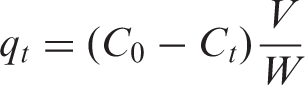
Lac dye (500 mg) was dissolved in deionized water (1 l). The pH of 50 ml of lac dye solution in each conical flask was adjusted as 2.0, 3.0, 4.0 and 5.0 with glacial acetic acid. All solutions were then shaken in a thermostatted shaker at 50 rpm for 30 min. The untreated silk yarn (0.50 mg) was then immersed in the dye solution for 60 min. After 60 min, the silk was rapidly withdrawn. The dye concentrations were determined using a calibration curve based on absorbance at λmax 490 nm versus dye concentration in standard lac dye solution. The amount of dye adsorbed per gram of silk (qt) (mg/g silk) for the dye solution with various pH values was calculated using the following equation:5,6
Effect of plasma treatment time of silk surface on lac dyeability
The silk yarn (0.50 mg) pretreated at each plasma treatment time was immersed in 50 ml of 500 mg/l dye solution with optimum pH. After 60 min, the silk was withdrawn and the measurements of dye concentration were carried out following the same method as that of the effect of pH studies. Similarly, the amount of lac dye absorbed per gram of silk (mg/g silk) at each plasma treatment time (qt) was calculated using Equation (1). The amount of lac dye absorbed per gram of silk (mg/g silk) at equilibrium (qe) was further examined as the adsorption capacity in order to select the optimum plasma treatment time.
Batch kinetic experiments
Lac dye solution (500 mg/l, 50 ml) with optimum pH was prepared. The untreated or pretreated silks (0.5 g) at the optimum treatment time were immersed in the pre-warmed dye solution at the required dyeing temperatures (30, 60 and 90°C) in each conical flask and continuously shaken in a thermostatted shaker bath at 50 rpm. The silk sample was then rapidly withdrawn after different dyeing times. The dye concentration at dyeing time zero and subsequent dyeing times were determined using the same UV-Vis spectroscopic method as mentioned in the previous sections. Subsequently, the amount of lac dye absorbed per gram of silk (mg/g silk) at each dyeing time (qt) was calculated.
Results and discussion
ATR-FTIR characterization
ATR-FTIR spectroscopy is a convenient, quick and non-destructive testing method that is often used for the surface analysis of textile materials. The effects of oxygen and Ar plasma treatment time on the structure of silks, revealed by ATR-FTIR spectra, are shown in Figures 2 and 3, respectively. It was seen that the various amide bands appeared in the range of 1700−600 cm−1, which are typical of polypeptides and proteins.
19
As seen from Figures 2 and 3, for oxygen or Ar plasma-treated samples at each treatment time, the peak at 1540 cm−1 corresponding to the amide-II random coil band mostly disappeared. The change indicates a structural transition of the random coil conformation after plasma treatment of silk surfaces. At the same time, the amide-I β-sheet band (1628 cm−1) of silk seems to change with the plasma treatments. These findings are similar to those of silks pretreated with oxygen plasma reported by Chen et al.
20
They reported that the conformation change from the amide-II random coil to the amide-I β-sheet structure of silk under oxygen plasma treatment arises from the oxidation and deoxidation reactions during and after treatment, respectively. Moreover, they also suggest that the macromolecular group partly decomposed and reorganized, resulting in the increase in the β-sheet structure. Interestingly, the pretreatment of silk surfaces using Ar plasma, investigated in the present study (Figure 3), is found to mainly affect the conformation change from random coil to a β-sheet structure similar to that using oxygen plasma.
Infrared spectra of untreated silk (a) and oxygen plasma-treated silks with plasma treatment times for (b) 30, (c) 60 and (d) 120 s. Infrared spectra of untreated silk (a) and Ar plasma-treated silks with plasma treatment times for (b) 30, (c) 60 and (d) 120 s.

Surface morphology of silk
The effect of oxygen and Ar plasma treatments at each plasma treatment time on the surface morphology of silk investigated by SEM is illustrated in Figure 4. For the untreated sample (Figure 4(a)) the smooth surface of the silk fiber is clearly observed, whereas the silk fibers were notably roughened by the oxygen and Ar plasma treatments, as seen from Figures 4(b)–(e). Although the surface roughness of the silk fiber increases with increasing plasma treatment time, the surface morphology of silks, exposed to the plasma treatment greater than 60 s, are not shown here. Note that, at the same plasma treatment time, the Ar plasma-treated silk shows relatively lower surface roughness than the oxygen plasma-treated one. Typically, oxygen plasma modifies the surface by grafting hydroxyl, carbonyl and carboxylate groups.
19
However, it is known that argon plasma is more efficient in introducing oxygen-containing groups with relatively low surface roughness than oxygen plasma, due to the chemical etching nature of oxygen.
21
Scanning electron micrographs of (a) untreated silk, (b) O2 plasma-treated silk for 30 s, (c) O2 plasma-treated silk for 60 s, (d) Ar plasma-treated silk for 30 s and (e) Ar plasma-treated silk for 60 s.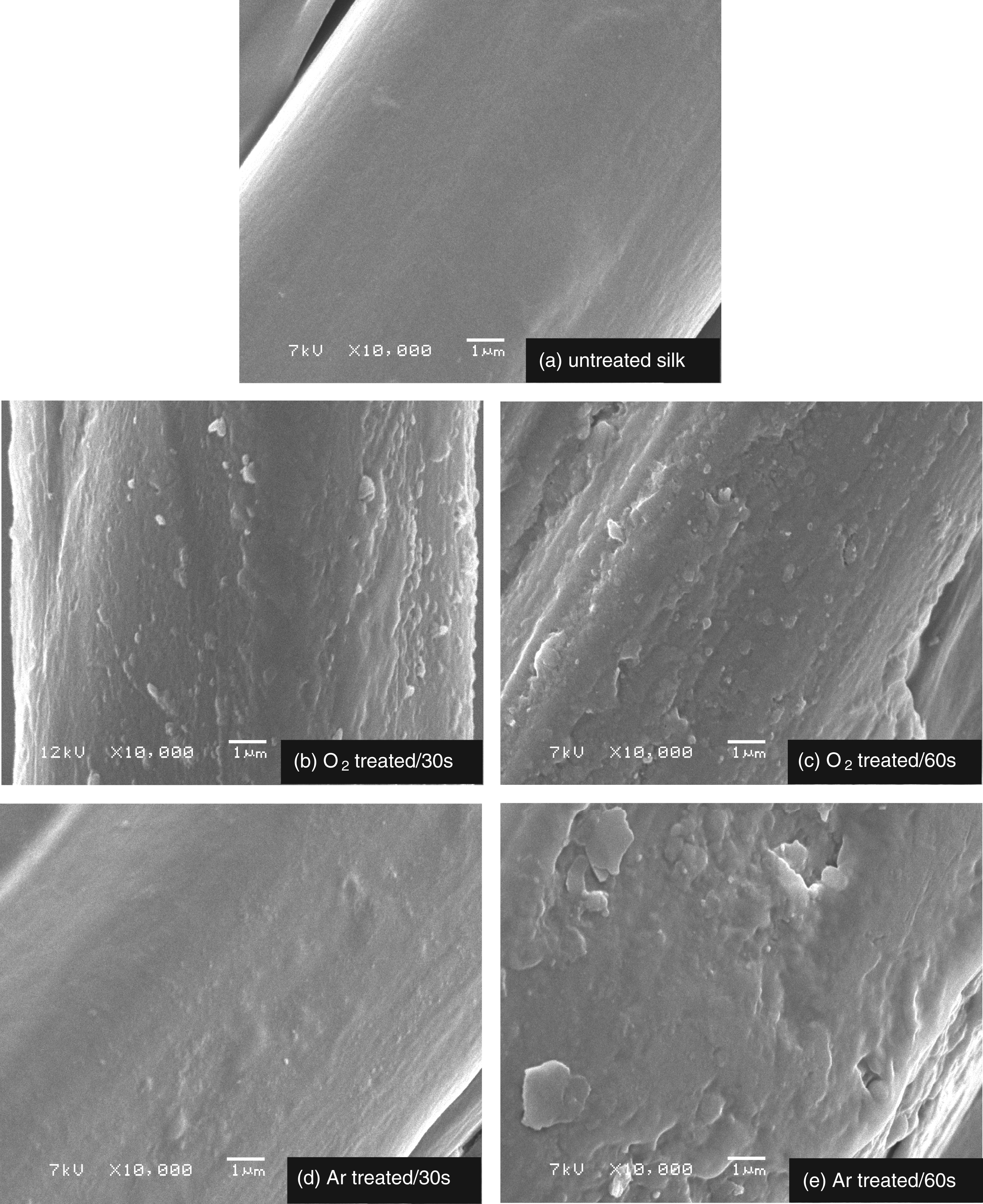
Effect of pH on lac dyeability
The pH of the dye solution is one of the important factors influencing the adsorption of lac dye onto silk. NH2 groups of laccaic acids C and E and –NH– group of laccaic acid A interact with –OH groups of the silk surface, and –OH groups of all laccaic acids can interact with NH2 groups of the silk surface. The effect of pH on the dyeability of lac dye onto silk is shown in Figure 5. The pH of the dye solution was varied in the pH range of 2.0–5.0 by adjustment with glacial acetic acid. It is seen that, based on the amount of dye adsorbed per gram silk at equilibrium (qe), the highest adsorption capacity was observed at pH = 3.0. The highest dyeability of lac dye in such pH arises from an increase in the protonation of the amino group (NH2) of amino acid in silk protein, whereas the carboxylic groups in the side chain are unionized at lower pH.5 Also, in pH = 3, –NH– or NH2 groups of lac are protonated. This observation indicates that under acidic conditions, there is electrostatic interaction between Effect of pH on the adsorption capacity of lac dyeing on silk (dyeing conditions: C0 = 500 mg/l, materials-to-liquor ratio = 1:100, dyeing temperature = 30°C).
Effects of plasma treatment time on the silk surface and dyeing temperature on lac dyeability
Effect of plasma treatment time
Generally, the conditions of the plasma technique have an important role to control the reaction at the surface and, hence, result in the desirable modified surface. The optimum treatment time is one of the plasma-treatment parameters affecting the dyeability. The adsorption capacity of lac dye onto the silk modified using oxygen and Ar plasma treatments at different plasma treatment times was investigated. The plots of qe versus plasma treatment time for the surface modification of silks using the plasma treatments are shown in Figures 6(a) and (b), respectively. The dyeing temperatures were set at 30, 60 and 90°C. It is obviously seen that the dyeability of the lac dye onto silk depends on the types of plasma gas, plasma treatment time and dyeing temperature. By comparing the qe value with that of the untreated silks, the qe value of the oxygen- and Ar-treated silks containing dyeing systems sharply increases with plasma treatment for 10 and 30 s. Particularly at dyeing temperatures of 60 and 90°C, the qe values of the treated silk systems under plasma treatment for 10 and 30 s are higher by about two times than that of the untreated silk. After being exposed to plasma treatments for longer times, the qe values of the plasma-treated silks gradually drop. At the same treatment time and dyeing temperature, the qe values of the Ar plasma-treated silk are mostly somewhat higher than those of the oxygen plasma-treated sample. From the results, the conclusion could be drawn that lac dyeing onto silk would be favorable for the pretreated silk surfaces using plasma treatment time for 30 s. Therefore, the pretreated silk samples used for adsorption kinetic studies in the present work were modified using plasma treatments for 30 s.
Effects of O2 plasma treatment times (a) and Ar plasma treatment time (b) on the adsorption capacity of lac dyeing on silk at 30, 60 and 90°C (dyeing conditions: C0 = 500 mg/l, materials-to-liquor ratio = 1:100, pH = 3.0).
Effect of dyeing temperature
To study the lac dyeability dependence on dyeing temperature, the control of driving force arising from the concentration gradient is necessary. In this work, the concentration of lac dye solution was fixed at 500 mg/l with the materials-to-liquor ratio (MLR) of 1:100 and pH = 3.0. The effects of dyeing temperature on the adsorption of lac dye on silks with and without surface treatments are shown in Figure 7. It is seen that, for all samples, the amount of dye absorbed per gram of silk at any dyeing time (qt) increases sharply first, gradually increases and then roughly keeps constant after dyeing for 60 min. Before approaching the dyeing equilibrium, dyeing using a higher temperature results in a higher initial adsorption rate, as seen from the higher initial slope of the curves. These findings indicate that the increase in dyeing temperature results in the mobility of large dye ions and, subsequently, the rates of adsorption would be enhanced. These results are in accordance with those observed for lac dyeing on untreated silk
5
and cotton.
6
However, the qt for all samples decreases with increasing temperature at equilibrium state, suggesting an exothermic adsorption process.
Effects of dyeing (contact) time on the adsorption of lac dye on untreated silk (a), O2 plasma-treated silk (b) and Ar plasma-treated silk (c) at 30, 60 and 90°C (dyeing conditions: C0 = 500 mg/l, materials-to-liquor ratio = 1:100, pH = 3.0). The silk fibers were plasma-treated for 30 s.
By comparing the effect of plasma treatments on the silk surface, on the lac dye ability, the qe values of all dyeing systems were examined. The respective qe values for the dyeing systems containing the untreated, oxygen and Ar plasma-treated silks were found to be 26.5, 42.5 and 46.8 mg/g silk at 30°C; 20.3, 37.1 and 43.0 mg/g silk at 60°C; and 18.4, 34.9 and 40.6 mg/g silk at 90°C. It is obviously seen that, at the same dyeing temperature, the qe values of the plasma-treated silks are much higher than those of the untreated sample. The obtained results indicate that the adsorption capacity of silk is much improved with pretreatment of the silk surface using plasma techniques. It is known that oxygen plasma typically modifies the surface by grafting hydroxyl, carbonyl and carboxylate groups 19 and argon plasma treatment has a high efficiency in introducing oxygen-containing groups in the treated samples. 21 Therefore, increase in oxygen-containing groups of the silk-treated surface increases electrostatic interaction between the lac and the treated silk surface; along with a change in the conformation of the silk structure, this enhances lac adsorption on the surface of the treated silk compared with that of the untreated silk. Note that the qe value progressively increases for the pretreated silks using oxygen and Ar plasma treatments, indicating that the highest adsorption capacity is achieved for the Ar plasma-treated silk sample.
Kinetic studies of adsorption
To examine the adsorption kinetics of lac dye on silks, pseudo-first- and second-order- kinetic models were used for analysis of the experimental data. For the analysis of pseudo- first-order kinetics of adsorption, the Lagergren equation was employed as follows:22–24
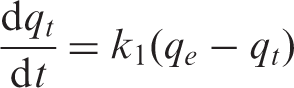

The slope of
For pseudo-second-order kinetic investigation, the pseudo-second-order kinetic model5,6,23,24 is expressed as
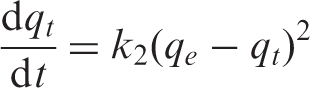
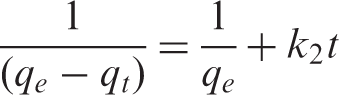
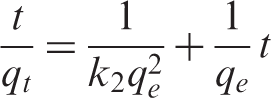
Kinetic parameters for pseudo-first-order adsorption of lac dyeing on silk calculated from the dyeing time region of 0–10 min at 30, 60 and 90°C (dyeing conditions: C0 = 500 mg/l, materials-to-liquor ratio = 1:100, pH = 3.0)

Conclusion
In the present work, the influence of plasma-treated silk surfaces on the adsorption kinetics and thermodynamics of lac dyeing on silk was investigated. The treatment of silk surfaces using oxygen and Ar plasma mainly affected the conformation change from the amide-II random coil to the amide-I β-sheet structure. The silk surfaces were notably roughened by the oxygen and Ar plasma treatments and surface roughness was found to increase with increasing plasma treatment time. Under the controlled initial dye concentration and the MLR, the optimum pH of dye solution was found to be 3.0. For the initial stage of adsorption (t = 0–10 min), the kinetic mechanism of adsorption obeys the pseudo-first-order equation. Based on the amount of dye adsorbed at equilibrium, the adsorption capacity was much improved for the plasma-pretreated samples, and the best improvement of adsorption capacity for lac dyeing on silk was found using the Ar-treated silk sample.
Footnotes
Acknowledgements
We would like to thank Associate Professor Dr Taweechai Amornsakchai, Department of Chemistry, Faculty of Science, Mahidol University, for encouragement and valuable guidance on gas plasma treatment and Mrs Warunthip Chatjutamanee, Chemistry Division, Rajamangala University of Technology Khon Kaen, for encouragement of ATR-FTIR characterization.
Funding
This work was supported by the Center of Excellence for Innovation in Chemistry (PERCH-CIC), Commission on Higher Education, Ministry of Education. Partial financial support from Mahasarakham University (Grant no. 5503004, fiscal year 2012) is also acknowledged.