




Abstract
Hot liquid hazards present in work environments are well known to be a considerable risk in workplace safety for numerous industries. In this work, the effects of different liquids and temperatures on penetration performance of fabrics were investigated, and the influence of impingement angle on protective performance of liquid penetration was also studied. Several kinds of fabrics for protective clothing were used to characterize the penetration behaviors of protective materials. The results showed the liquid temperature had a significant impact on the stored and penetrated amount of liquids. Different liquids can lead to distinct damage to fabrics. The impingement angle affects liquid transfer (storage and penetration) through the fabric. The addition of a thermal liner or moisture barrier can sharply decrease the penetration. The results provide new insights into the development of functional garments/materials and better methods for evaluating the performance of these materials under hazardous work environments.
Keywords
Industrial workers may be frequently exposed to multiple hazards, including various thermal, chemical and physiological hazards. 1 Functional protective textile materials have been used to prevent excessive heat and mass transfer from the work environment (hazards) to the human body. During recent decades, many studies have been conducted on heat and flame protection.2–7 Workers in the oil and gas industry are at risk of exposure to steam, hot water and drilling fluid, which can cause scald burn injuries. 8 The required protection of protective clothing against hot liquid hazards is much different than the threats of flash fires or flames. When hot liquid is splashed on protective clothing, liquid absorption and penetration may occur. Due to the high heat capacity of hazardous liquids, the energy transmitted by penetrated liquid splash is high, which increases the potential for a scald injury. Work wear with protection against these hazards is necessary to ensure industrial workers' safety and health. It was found that fabric permeability is the most important factor influencing protective performance. 9
To understand how protective clothing performs, it is essential to investigate and quantify the contributions of potential factors. 10 It was reported that liquid type had a significant effect on liquid barrier testing, but the liquid temperature was not considered as a factor. 11 In a previous study, the effect of lamination on the barrier performance was evaluated, using two pesticide mixtures with a wide range of surface tension and viscosity values. 12 The effect of fiber and liquid characteristic on dynamic capillary height in yarn was investigated. 13 A comprehensive statistical model of pesticide penetration through woven work clothing fabric was developed, considering fabric structure features and liquid properties. 14 Generally, the temperature of exposure fluid varies in actual wear conditions. Cao and Cloud explored the effect of ambient, fabric and liquid temperature on penetration performance of surgical gown fabrics and analyzed the impact of liquid type. 10 It was indicated that the change in ambient temperature significantly increased liquid penetration of at least one type of disposable surgical gown fabric. The warmer fabric was penetrated by liquids more easily than fabric that was conditioned and tested at standard laboratory conditions. The penetration of distilled water was much lower than that of synthetic blood. 10 Recently, the hot water repellent characteristics of super-hydrophobic surfaces were investigated by contact angle measurement and water uptake. 15 These super-hydrophobic surfaces could provide high repellency to cool water (around 25℃), but showed remarkably decreased resistance to hot water (higher than 50℃).
Liquid penetration of fabric can be evaluated by the hydrostatic pressure test (AATCC 127-2008 16 ), the rain test (AATCC 35-2006 17 ) and the impact penetration test (AATCC 42-2000 18 , ISO 18695-2007 19 ). The hydrostatic pressure test measures the resistance of a fabric to the penetration of water under hydrostatic pressure. It is applicable to all types of fabrics, including those treated with a water-resistant or water repellent finish. One surface of the test specimen is subjected to hydrostatic pressure, increasing at a constant rate, until three points of leakage appear on its other surface. The rain test is used to characterize water repellency. It measures the resistance to the penetration of water by impact and is especially suitable for measuring the penetration resistance of garment fabric. A test specimen, backed by a blotter paper, is sprayed with water for 5 minutes under controlled conditions. The blotter is weighed before and after the water spray, to determine the amount of water that penetrated through the specimen during the test. The direction of the water spray is horizontal and the specimen is placed vertically. The purpose and principle of the impact penetration test are similar to the rain test, but the configuration is different. The spout is 0.6 m above the specimen center and the specimen is located on a board at 45o to horizontal. These standards are developed to characterize the water repellent property of tested fabrics, not to simulate the hazards and exposure conditions. The water used in all tests is only at 27℃, while the temperature of potential liquid splash in work scenarios can be 90℃ or higher. The test conditions suggested in the standard are quite different from actual wear conditions, in terms of exposure liquid (category, applied temperature and pressure, etc.) and impingement angle. In addition, the liquid properties, such as surface tension and viscosity, change with temperature. Different liquids have individual physical properties that affect liquid penetration through fabric. Therefore, the interaction between liquid and fabric (fiber, yarn and surface property) varies with the liquid type and temperature.
Although there are few studies on the effect of a specific liquid and its temperature on penetration of protective clothing, the understanding of how liquid, liquid temperature and pouring angle affect the overall performance of protective clothing still remains limited. The objective of this study was to investigate the effect of liquid temperature and type on the impact penetration of protective materials. It also aimed to analyze the influence of impingement angle on the penetration performance. The intention of this research was to study the effect of fabric combinations on overall penetration performance. To achieve the goals of the study, a new modified apparatus was developed and applied to investigate the effect of several factors affecting the penetration performance of fabrics for protective clothing. Different liquids (distilled water, canola oil and drilling fluid) were used to simulate hazards encountered in the oil and gas industry. Elevated liquid temperatures were applied to capture the liquid repellency provided by the fabrics. Interacting angles were compared to analyze the influence of impingement direction of hot liquid on protective clothing. The research findings provide new insights into the development of novel protective materials and a new approach to evaluate the liquid penetration performance of fabrics under conditions of work scenarios.
Materials and experimental methods
Materials
Specification of the testing fabrics
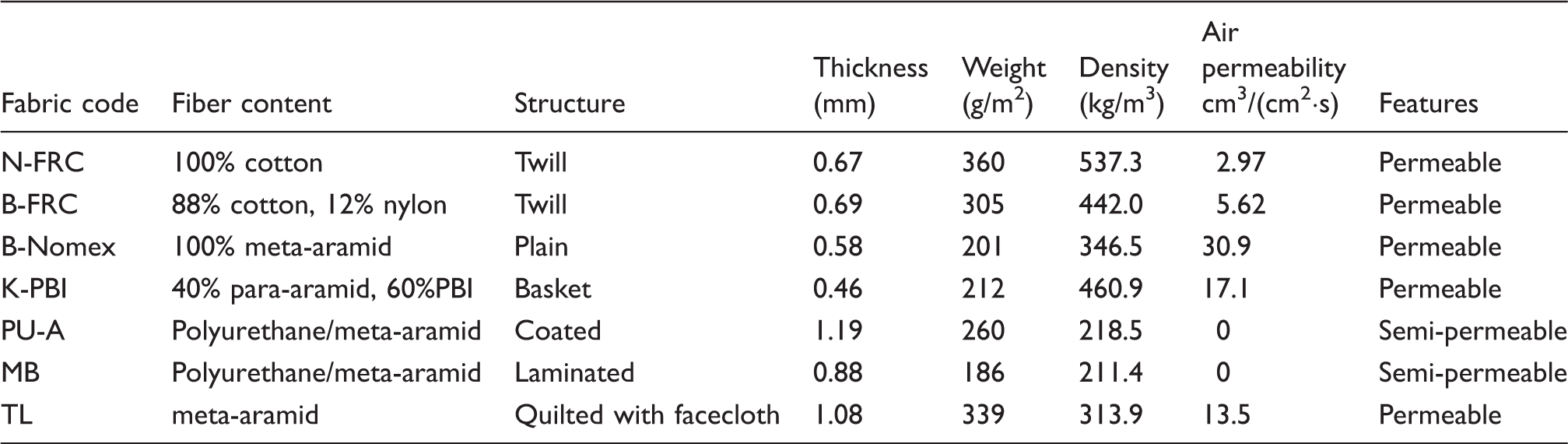
Challenge liquids
Three liquids were used in the modified impact penetration test. Distilled water is the standard liquid used in the impact penetration test of AATCC 42-2000. 18 Canola oil and drilling fluid are commonly encountered in working scenarios. The canola oil was purchased in the market. The drilling fluid (SAGDRIL-water based) was provided by M-I SWACO.
To characterize physical properties of the three liquids, the surface tension of the liquids was measured by using the pendant drop method. Dynamic viscosity of the exposure liquids was measured by a rheometer using a concentric cylinder with vane rotor geometry. To study the effect of temperature on liquid surface properties, the test liquids were heated to different temperatures: 27℃ (temperature described in the standard penetration test), 55℃ and 85℃ (temperature in the hot liquid splash test
22
). The density of liquid was also measured at different temperatures. The physical properties of different liquids with elevated temperatures are described in Table 2. The results show that surface tension and dynamic viscosity decrease with the increasing of liquid temperature. The water and canola oil are Newtonian fluids, but the drilling fluid is a non-Newtonian fluid. The dynamic viscosity of drilling fluid is shown in Figure 1. The viscosity of drilling fluid sharply decreases with the shear rate. The viscosity is lower at higher temperatures over the range tested, showing similar trends with other liquids.
Dynamic viscosity of drilling fluid at different temperatures. Physical properties of exposure liquids at different temperatures Note: For ‘*’, values are shown in Figure 1.

Contact angle or spreading time of test fabrics
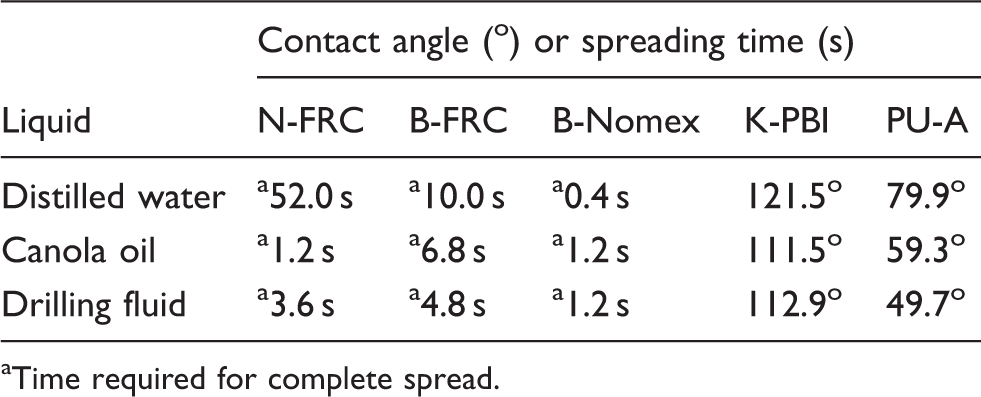
Time required for complete spread.
Test apparatus and method
To understand the performance of protective materials associated with liquid penetration while exposed to hot liquid splashes, a modified hot liquid splash tester was developed.
22
Figure 2 shows the schematic of the liquid penetration test apparatus. The liquid temperature could be heated to a specified temperature between ambient and 150℃ by a heater and the process was monitored by a temperature control device. The volume of the liquid reservoir is 8 l. The flow control device was used to regulate the flow rate of hot liquid in the range of 0–200 ml/s. In addition, the fabric holder board is capable of being rotated to simulate various interacting angles between the hazardous liquid and the protective clothing (0 ≤ β < 90o). The blotter paper recommended in Standard AATCC 42-2000
18
was used to capture the penetrated liquid. The weight of the blotter paper before and after test was measured, and the increase of blotter paper weight was defined as the impact penetration of liquid. The weight increase of testing fabric was also calculated, which was considered as the stored amount of liquid.
Schematic of impact penetration tester of hot liquid splash.
Test conditions
The test specimens were preconditioned for at least 24 hours at 20 ± 2℃ and 65 ± 5% relative humidity (RH). The conditioned test specimens were placed in a sealed container, and testing was conducted within 2 minutes after removing each specimen from the sealed container. The liquid was heated to the pre-set temperature (27, 55, 85℃ respectively), the flow rate was regulated to 40 ml/s and the exposure time was 20 seconds. Angles of 20o and 45o (angle recommended in hot liquid splash test-ASTM F2701-08 22 ) to horizontal were used in this study. The angle of the specimen holder was rotated to the required position, and the blotter paper was placed behind the test specimen. Both the weights of the test specimen and blotter paper were measured before and after the exposure.
Results and discussion
Effect of fabric properties on penetration performance
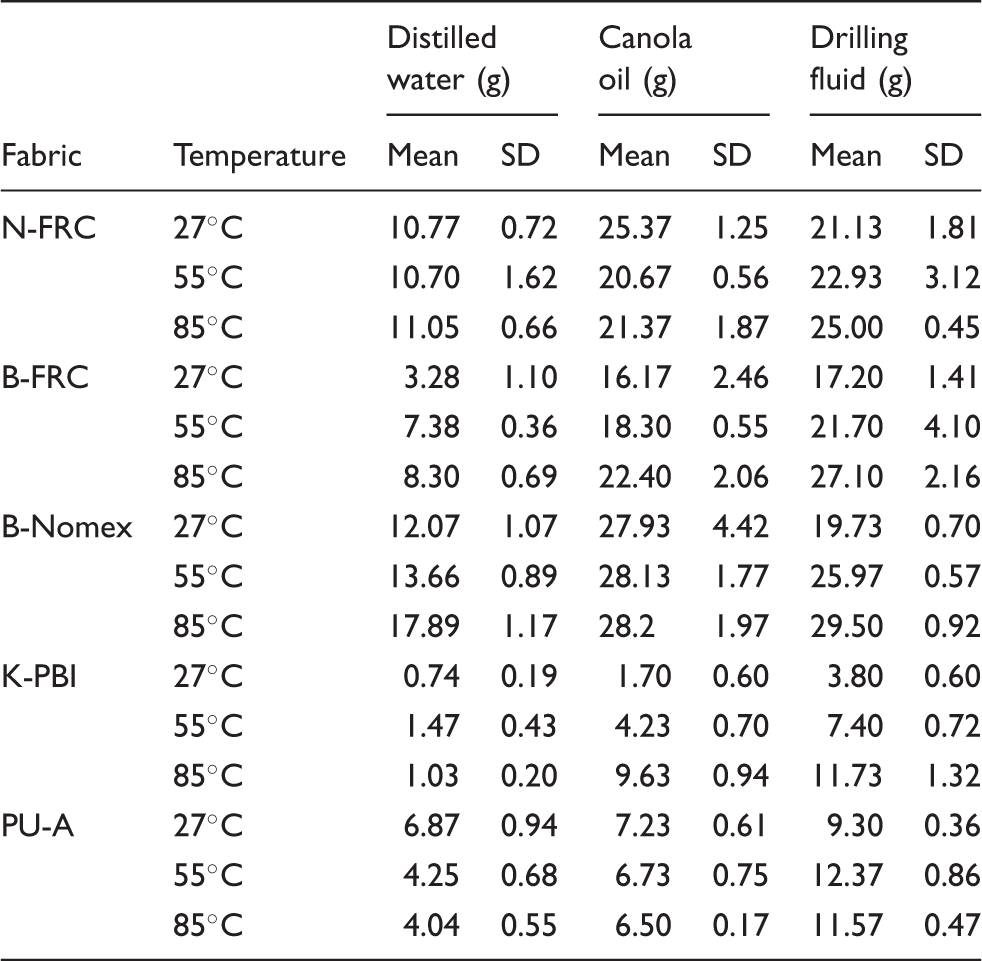
Stored amounts of liquid in single-layer fabrics at 45o to horizontal
Impact penetration of liquids in single-layer fabrics at 45o to horizontal
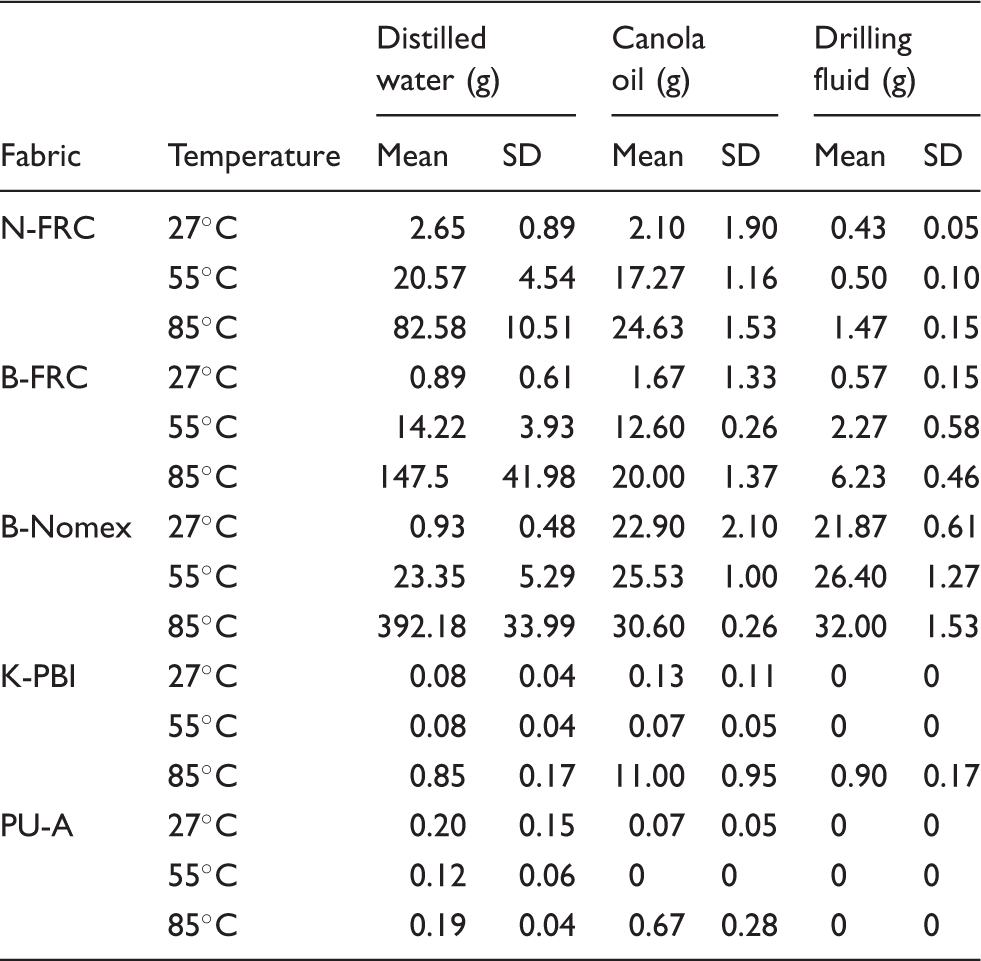
Due to the polyurethane coating on the meta-aramid fabric (PU-A), very little liquid penetrates through the pores of the fabric, even when exposed to the liquid at high temperature. However, a small weight gain from the blotter paper was observed. This increase of weight in the blotter paper is caused by the condensation of the vapor, which transfers through the fabric and contacts the blotter paper. The performance of fabric MB exposed to water of 85℃ at 45o position was also measured and only 0.23 g water was observed. This is also believed to be associated with vapor condensation. For K-PBI, at temperatures of 27 and 55℃, little liquid penetration through the fabric is observed. However, when the temperature is at 85℃, liquid penetration occurs. These results show that the overall stored liquid in K-PBI fabric is the least. With comparison among the selected fabrics, the largest amount of both liquid stored and penetrated occurs in B-Nomex under all conditions. These data indicate the B-Nomex fabric provides the worst performance against liquid penetration. The flow patterns of B-Nomex and K-PBI under exposure to 85℃ drilling fluid with plate position at 45o position are compared in Figure 3. It demonstrates that liquid wets B-Nomex and spreads quickly on the surface, but for K-PBI, it shows resistance in wetting and spreading. The two edges of the profile for K-PBI intersect at the end of the flow. The wetted area of K-PBI is smaller than that of B-Nomex, resulting in less liquid stored in the fabric. As shown from the data, the penetration performance provided by N-FRC and B-FRC is between B-Nomex and K-PBI.
Flow patterns of (a) K-PBI and (b) B-Nomex during and after exposure (85℃ drilling fluid at 45o position).
The different flow pattern developed is caused by fiber–liquid molecular attraction at the surface of the fiber materials, which is mainly determined by the surface tension and the effective capillary pore distribution and pathways. 23 A liquid that does not wet the fibers cannot wick into the fabric. 24 The contact angle is a direct characterization of the fabric wettability. Referring to Table 3, a large contact angle between K-PBI and liquid is obtained. Furthermore, at low temperature, the contact angle is higher than 90o, indicating the fabric surface is not wetted by the liquid, and thus there is little liquid penetrated. It might be associated with fabric surface properties and structure. The weave structure is basket, which is quite different from other selected fabrics. It should be noted that the small amount of penetrated liquid occurs directly under the liquid jet.
The capillary pressure is the primary driving force to manage the moisture transfer in the fabric. The capillary pressure is determined by the Young and Laplace equation
25
as follows:

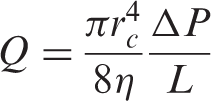
The flow through the pores depends on pore size and liquid viscosity. Poiseuille's equation is used to describe the fluid-transmitting abilities of cylindrical pores:
26
Olderman
27
combined two classical formulas (Young and Laplace equation and Poiseuille's equation) and proposed the word equation to characterize the relationship between liquid penetration resistance and the properties of both the barrier materials and the liquids, as shown in Equation (3):

The overall penetration performance exposed to a specific liquid presented for different fabrics depends on the pore size, thickness of fabric and contact angle. According to Table 1, the thickness of B-Nomex is less than that of N-FRC and B-FRC, and the air permeability of B-Nomex is higher than that of N-FRC and B-FRC. Assuming the pore size is evenly distributed, the pore size of B-Nomex is larger. Additionally, the liquid spreads fastest in B-Nomex (refer to Table 3). Consequently, the liquid penetration resistance of B-Nomex is lower and results in higher liquid penetration. The penetration resistance is inversely proportional to liquid pressure. Liquid may penetrate through the area of hydrophobic fabric under the spout, even if there is no penetration at other areas (e.g., K-PBI under exposure to distilled water and drilling fluid at 85℃).
Effect of liquid temperature on penetration performance
The statistical analysis shows a significant effect of liquid temperature on the penetration performance under all test conditions (F = 8.344, p = 0.000). The effect of temperature on liquid penetration of canola oil is compared in Figure 4. The penetration performance enhances with the increase of liquid temperature. As the liquid temperature is 27℃, only a small amount of penetrated liquid is observed, except in B-Nomex. When the temperature rises to 55℃, a sharp increase in penetration is observed, especially in N-FRC and B-FRC. However, there is still no penetration in K-PBI. Furthermore, the penetration continues to become higher with the temperature up to 85℃. There is 11 g of canola oil passing through the K-PBI when the liquid is at 85℃. Under exposure to distilled water and drilling fluid, a similar trend is observed. Further analyzing the increment of liquid penetration when the temperature of canola oil rises from 27 to 85℃, it is found that the change rate in B-Nomex is the least. However, the penetration through B-Nomex is the highest.
Penetration performance of fabrics exposed to canola oil at different temperatures (at 45o angle).
The higher liquid temperature causes larger amount of penetrated liquid through fabric, which is consistent with Cao and Cloud's study. 10 Unsal et al. 26 demonstrated that lower surface tension could increase the wettability of the material. Following the Olderman expression, 27 the penetration resistance of fabrics decreases with increasing liquid temperature associated with decreasing surface tension (shown in Table 2), which means the penetration of fabric increases, assuming that all other properties are held constant. Actually, the decrease in surface tension due to temperature change is minimal. However, the dynamic viscosity of the liquid sharply decreases with increasing temperature (refer to Table 2), resulting in an increase in flow rate (according to Equation (2)). A larger amount of penetration is found at high temperatures, demonstrating that the viscosity change mainly contributes to the large penetration. The considerable amount of canola oil was observed to penetrate through K-PBI when the liquid temperature was 85℃, which can be explained by wetting property change. At 27℃, the contact angle is much higher than 90o. The liquid shows no wetting on the fabric, and very little liquid penetration occurs. As the temperature reaches 85℃, the wetting occurs, leading to the appearance of wicking. Conforming to Equation (3), the penetration resistance is low due to the small thickness of material and sharp decrease of liquid viscosity (five times), so a considerable amount of canola oil is transported. In a previous study on the water repellency test of super-hydrophobic fabric to hot water, the contact angle sharply decreased to around 60o when the water droplet was at 85℃. 15 Although the contact angle of K-PBI at high temperature was not measured in this study, it is speculated that the contact angle dropped to less than 90o based on the observation of the liquid penetration. It confirms the significant effect of temperature on liquid penetration through protective materials.
Fabric PU-A is polyurethane coated meta-aramid, and there is very little liquid penetration found. From Table 4, it is observed that the amount of liquid remaining on the surface of PU-A decreases with the temperature increase when the fabric is exposed to distilled water and canola oil. This might be associated with the lower viscosity of liquid at higher temperature (refer to Table 2). Contrary to PU-A, permeable fabric absorption significantly increases with increasing temperature (refer to Table 4). The stored amount of liquid in fabrics consists of the liquid remaining on the surface and absorbed into the fabric. The amount of liquid remaining on the surface depends on the liquid viscosity. The absorption relies on the wetting property and fiber–liquid molecular bond. At higher temperature, the surface tension of liquid decreases. The wetting resistance decreases and more liquid is absorbed. Therefore, the effect of temperature on the stored amount of liquid depends on the balance between the amount staying on the surface and that absorbed into the fabric. Based on this study, the change of absorption due to temperature rise dominates.
Effect of liquid properties on penetration performance
Under all the test configurations, the penetration of different liquids through the fabrics is significant (F = 5.761, p = 0.004). Figure 5 shows the penetration performance of fabrics exposed to different liquids at a temperature of 55℃ with the plate angle at 20o. It is observed that the distilled water shows the most penetration, and the drilling fluid shows the least penetration. If the plate angle rotates to 45o, a similar trend occurs in other fabrics, except B-Nomex, where there is no significant difference among liquids (according to Table 5). When the liquid temperature is 85℃, a similar change trend is also observed, with exception of K-PBI. A large amount of canola oil passes through K-PBI, which has not been observed under other conditions. When the temperature is 27℃, the fabric of B-Nomex shows good water resistance, but more than 20 g canola oil and drilling fluid penetrate through the fabric. The water-resistant finish on the B-Nomex contributes to lessen the water penetration, but it shows less resistance to canola oil and drilling fluid. Generally, the penetration of liquids through fabric exhibits the following order: distilled water > canola oil > drilling fluid.
Penetration of fabrics exposed to different liquids at 55℃ with 20o to horizontal. DW: distilled water; CO: canola oil; DM: drilling fluid.
According to Equation (3), for a specific fabric, the penetration resistance depends on surface tension and dynamic viscosity. The surface tension of distilled water is 2–2.5 times higher than that of canola oil. This indicates the wetting resistance of distilled water is higher, and that canola oil can wet the fabric surface more easily than distilled water. This may contribute to the phenomenon that the fabric showing repellence to water penetration does not mean it can retard canola oil penetration, for example, the fabric of B-Nomex (at 27℃) and K-PBI (at 85℃). From Table 2, the dynamic viscosity of distilled water is much lower than that of canola oil and drilling fluid. Following Equation (2), the flow rate of water through capillaries is higher than other liquids if the wetting process occurs. Consequently, a higher amount of penetrated liquid is observed when the fabric is exposed to distilled water. Based on the result of a higher amount of penetrated water, it is inferred that liquid viscosity determines the penetration resistance. Although drilling fluid is a non-Newtonian fluid, it is clear that the viscosity of drilling fluid is much higher than that of canola oil (comparing Figure 1 with Table 2). According to this deduction, the penetration of canola oil is apparently more than that of drilling fluid. Consequently, the liquid penetration shows the sequence presented in Figure 5.
In addition, the stored amount of liquid in the fabrics (shown in Table 4) shows the order as follows: drilling fluid > canola oil > distilled water. The absorption and adsorption of liquid in the fabric depends on the liquid viscosity (shown in Table 2 and Figure 1); therefore, the highest viscosity of drilling fluid results in the largest amount of liquid stored in the fabric. In addition, it should be noted that the drilling fluid is a mixture. While spraying on the fabric, some polymer materials with large diameters may stay on the fabric surface, and thus the weight increase in fabric exposed to drilling fluid is relatively larger. Figure 6 presents the flow profile of N-FRC exposed to canola oil and drilling fluid during and after the exposure. While exposed to canola oil, the liquid can wet the fabric easily and spread on the surface. After exposure, the thickness of canola oil, which remains on the surface of the fabric, is smaller than that of the drilling fluid. Consequently, a higher stored amount of drilling fluid is observed.
Flow profile of N-FRC during and after exposure to (a) drilling fluid and (b) canola oil, at 55℃ and 20o to horizontal.
Effect of impingement angle on penetration performance
While wearing protective clothing, hot liquid splash can spray onto a garment from various directions. The impact of impingement angle on the performance of fabrics was investigated and is shown in Figure 7. It is apparent that both the stored quantity and penetration are less when the specimen holder is positioned at 45o to horizontal. The paired t-test shows that the impingement angle has a significant effect on the stored amount (t = 9.656, p = 0.000) and penetrated amount of liquid (t = 2.734, p = 0.009).
Impact of impingement angle on performance of fabric exposed to drilling fluid at 55℃. Pen-45o: penetration at 45o to horizontal; abs-45o: absorption at 45o to horizontal.
According to the theory of mechanics, friction and pressure depend on the cosine value of the tilt angle. A larger inclined angle leads to smaller friction and pressure. Thereby, less liquid is stored on the fabric surface and in the fabric. Speculating from Equation (3), the penetration resistance is inversely proportional to pressure. Thus, a small tilt angle results in lower penetration resistance, namely higher penetration of liquid, as shown in Figure 7.
Performance of double-layer fabric
Figure 8 presents the impact of the TL on the overall performance of fabrics, in terms of stored amount, penetrated amount and total amount of liquid transferred. The total amount of liquid transferred comprises the stored amount and the penetrated amount. At all temperatures, the double-layer fabric shows a higher stored amount, less penetrated amount and roughly the same total amount. In a higher temperature condition, a larger amount of liquid penetrated through the single-layer fabric, but still little canola oil (around 0.3 g) penetrated through the double-layer fabric without significant change at all temperatures. A similar change trend occurs in drilling fluid. However, while exposed to water at 85℃, 31.7 g water penetrated through the double-layer system, which is different from that observed in canola oil and drilling fluid. At 27℃, very little penetrated amount of all three liquids in the fabric system is observed. Based on this study, a TL can enhance the performance of fabric against liquid penetration to some extent. The stored amount of liquid in a double-layer system and total transferred amount of liquid increase with increasing liquid temperature.
Performance of fabric N-FRC with or without TL exposed to Canola oil (45o to horizontal). TL: thermal liner.
With the addition of a TL, better penetration resistance is obtained. The thickness of the whole system increases remarkably; therefore, the penetration resistance increases according to Olderman's formula. 27 This results in more liquid stored in the fabric system. The liquid penetrated through the shell fabric with TL is calculated as 10.00, 13.03 and 30.1 g at 27℃, 55℃ and 85℃, respectively. The increase in the stored amount accounts for more penetration through the shell fabric with the increase of liquid temperature, which is demonstrated previously (shown in Figure 4).
A MB is considered waterproof, but allows vapor to transfer. There is no penetration measured with the addition of the MB. Absorption in the shell fabric and the stored amount in the fabric system with the inclusion of a MB or TL are compared in Figure 9. The stored amount of liquid consists of the absorption in shell fabric and the liquid that stays on the surface of the MB or is absorbed in the TL. Little liquid stays on the surface of the MB, but a significant amount of liquid is absorbed by the TL. In addition, the absorption in the shell fabric with the MB is much more than that with the TL. There is more liquid stored in the system with the addition of the TL. This demonstrates that the addition of the MB sharply decreases the stored liquid, providing high performance.
Performance of double-layer system exposed to 85℃ distilled water (45o to horizontal). SF: shell fabric; MB: moisture barrier; TL = thermal liner.
Conclusions and recommendations
Several factors affecting the hot liquid penetration performance of fabrics for protective clothing were investigated in this study by using a modified hot liquid splash tester. The fabric structure and properties show effects on the protective performance against hot liquid absorption and penetration. The penetration through fabric increases with the increasing of liquid temperature over the range tested. The liquid penetration performance of fabrics is strongly associated with the viscosity of liquids. For fabrics selected in this study, the liquid with higher viscosity develops less penetration but with a larger amount of stored liquid in the fabric. The liquid impingement angle also shows a significant effect on the liquid penetration performance of fabrics. A smaller inclined angle leads to more liquid both stored in fabric and penetrated through fabric. With the addition of a TL, more liquid can be stored in the fabric system while the amount of penetrated liquid decreases. However, the total amount of liquid (both stored and penetrated) is almost the same. Adding a MB increases penetration resistance, leading to more stored liquid in the shell fabric, but decreasing the stored amount compared with the addition of a TL. The findings provide some new insights into the development of fabrics with high performance. The results also suggest that the existing impact penetration test should consider the effects of liquid temperature, liquid category and impingement angle on the performance of fabrics used in clothing that is protective against hot liquid splashing.
In this study, the fabric temperature was conditioned to room temperature (about 22℃), which is lower than actual wear conditions. The effect of fabric temperature will be explored in a future study. Only limited types of fabrics were used in this work. More fabrics will be investigated in the future to establish the relationship between fabric properties and liquid penetration performance. In addition, other factors related to actual wear conditions should be considered. For example, the fabric surfaces may suffer mechanical deformation and abrasion during wear.
Footnotes
Acknowledgment
The authors appreciate technical support from Stephen Paskaluk at the Protective Clothing and Equipment Research Facility, University of Alberta.
Funding
This research received no specific grant from any funding agency in the public, commercial or not-for-profit sectors.