




Abstract
Helmet security relies on a retention system that is usually manufactured from webbing. In many helmets (e.g. bicycle, climbing) this is polyester or nylon webbing. In UK military helmets, cotton webbing is currently used for the retention system, including the chin-strap. Cotton is the preferred fiber content rather than a synthetic-polymer fiber due to the potential melt hazard of the latter. Whether the retention system of military helmets is strain rate sensitive at quasi-static and dynamic rates and whether the webbing degrades when exposed to ultraviolet radiation (UVR) are of interest with reference to current conflicts. This paper (i) presents data on quasi-static tensile properties at varying strain rates, (ii) describes a method developed to measure the dynamic tensile strain rate sensitivity and (iii) uses that method to determine the effect of simulated UVR exposure on dynamic tensile properties of cotton webbing typical of that used in UK military helmets.
Keywords
Fragments originating from traditional munitions (e.g. artillery shells, mortars, mines) and improvised explosive devices (IEDs) are the major cause of military casualties in general warfare.1–4 Thus, military helmets are primarily designed to provide protection to the brain from fragments, but also provide protection from non-ballistic impacts.5,6 A typical modern military helmet comprises a woven fabric reinforced composite shell, a non-ballistic impact protective liner, suspension and size adjustment systems, comfort pads and a retention system. The retention system usually incorporates a chin-cup and closure system (chin-strap); a size adjustment system; and a mounting system onto the helmet shell. Helmet security, and thus protection to the brain, relies on the strength of the retention system (including chin-strap), which is usually made from webbing.7–10 In the UK, cotton is used rather than a synthetic-polymer fiber to manufacture the webbing due to the melt hazard associated with many man-made fibers. 10 Webbing can be defined as “A woven narrow fabric, the prime function of which is load bearing. It is generally of a coarse weave and often has multiple plies.” 11
Typical methods for determining strength and security (roll off) of helmet retention systems are described in relevant international and national standards. 12 To measure the strength of the retention system, a given mass is hooked onto the retention system of a complete helmet, allowed to fall a given distance and the dynamic extension and residual extension of the retention system is measured. In other standards, the tensile force resulting in retention system failure is also reported. 13 To measure roll off, a mass fixed to the rear of the helmet is allowed to fall over a pulley in such a way that the helmet is pulled forward over a headform to assess whether the retention system ensures helmet security on the headform.
Articles discussing the measurement of dynamic tensile properties to failure of webbing are sparse. Rather the literature is primarily concerned with the behavior of webbing, tapes and associated products under loading regimes other than dynamic tensile or the degradation of products that include webbing, for example parachute components,14,15 seat belts,16–18 crane and hoist components, 19 fall arresters 20 and tow lines. 21 However, there are some exceptions. Haley 22 reported results for nylon and Dacron seat belt webbing (gauge length 20 inches; 508 mm) tested at quasi-static (1 inches/min; 0.42 mm/s; 8.27 × 10⁻⁴ s−1) and dynamic rates (up to 450,000 lb/s; 204.12 tonne/s). At faster loading rates force-at-break was similar for both webbings, while strain-at-break was lower. For polyester and nylon seat belts (gauge length 4.75 inches; 120.65 mm) tested at quasi-static and dynamic rates (10,000 inches/min; 4233 mm/s; 8.33 s−1), a similar response was reported, that is, higher force-at-break and shorter elongation. 23 There are standards that discuss the construction and performance of webbing, and of products using webbing. In BS 7141-7: 1991, 24 breaking strength per cm width of cotton webbing is measured according to BS 2576: 1986 25 (superseded by BS EN ISO 13934-1: 1999), which states a test speed of 100 mm/min. A withdrawn standard, BS 3254-1: 1988, 26 described the measurement of breaking force and reduction of width under load for seat belt webbing also using BS 2576: 1986 25 and hence a test speed of 100 mm/min. Modern seat belts (48 mm wide) are woven on Jacquard looms using polyester, have to resist dynamic loads of up to 14 kN, and performance is usually measured as part of the complete seat belt system using sled tests.27,28 Standards also exist for the testing of various mountaineering products (e.g. ropes, tapes and slings) and for fiber ropes (i.e. non-mountaineering).29–31 However, dynamic tensile properties to failure of the material are not measured; these standards describe the testing to failure of complete products at a test speed of 250 mm/min, or their response (measured in terms of elongation) to a given force applied by a drop-test.
Since typical UK military helmet webbing retention systems are manufactured using cotton, degradation of cellulose by light and ultraviolet radiation (UVR) is of concern.32–35 The effect of UVR on dynamic properties of retention systems does not appear to have previously been discussed. Environmental exposure of UK military products is described in DEF STAN 00-35; Part 4 summarizes natural environments. 36 Of particular interest is climatic condition A2 (hot dry), which includes “ … most of the Middle East and Central Asia … ” Diurnal variation in (total) solar radiation for the A2 condition is given as 0 W/m2 from 20:00 to 05:00, and then varies from 55 W/m2 at 06:00 to 1120 W/m2 at 12:00 and 13:00, decreasing to 55 W/m2 at 19:00. 36 The spectral energy distribution for UVR 280–320 nm is ∼0.5% (for A2: 5 W/m2 between 12:00 and 13:00) and for UVR 320–400 nm is ∼6% (for A2: 63 W/m2 between 12:00 and 13:00) of the spectral energy distribution of solar radiation. 36
The aim of the work described in this paper was to investigate the tensile properties to failure of chin-strap webbing at different strain rates and the effect of exposure to solar radiation on dynamic tensile properties.
Materials and methods
Specimens were cut randomly from a single 100 m roll of olive drab, 19 mm wide, 2-ply plain woven with binders, 100% cotton webbing (74 warp and 20 weft yarns per 10 mm; RTL, Derby, UK).
7
This webbing is fully described in a Ministry of Defence Purchase Description (SCRDE/PD1/86 (1986); pattern number 9511A) and is used in UK military helmets. Four degreased, roughened aluminum tabs (2 mm × 19 mm × 35 mm; two top end, two bottom end; each side of the specimen) were adhered to each webbing specimen to facilitate mounting the specimens in test apparatus grips. Three sets of specimens were prepared as follows.
Uniaxial tensile test specimens (n = 5; gauge lengths 50, 100, 200 and 400 mm). These specimens were tested using an Instron universal test machine (model number 5567 fitted with a 10 kN load cell; test speeds 5, 50 and 500 mm/min). Strain rates varied from 2.08 × 10⁻⁴ to 0.17 s−1. Force-at-break was recorded and strain-at-break calculated from the original gauge length and the extension-at-break. Dynamic tensile test specimens (n = 5; gauge length = 100 mm). (This section on dynamic tensile testing was presented at The Textile Institute Centenary Conference 2010.) These specimens were tested under two regimes: (i) regime A – variable speed with constant impact mass (therefore variable impact energy); and (ii) regime B – constant impact energy at different impact speeds (achieved by varying mass of the impact carriage) (Table 1). Dynamic tensile test specimens that had been exposed to UVR, visible and infra-red radiation (n = 5; gauge length = 140 mm). The longer gauge length used in experiment 3 aimed to reduce the amount of jaw breaks experienced in experiment 2. Specimens were exposed under laboratory conditions using a Xenon lamp with a daylight filter fitted in a Q-Sun Xe-1 s Xenon chamber (Q-Lab Europe Ltd., Bolton, UK) set at 0.6 W/m2 at 340 nm continuous light (considered approximately equivalent to noon summer sunlight) and 65℃. These settings were selected to expose the cotton webbing to short wavelength UVR and with reference to the climatic zones described in DEF STAN 00-35 Part 4.
36
Exposure times were 0 hours, 120 hours (265 KJ/m2 at 340 nm), 240 hours (462 KJ/m2 at 340 nm) and 360 hours (727 KJ/m2 at 340 nm). Twenty-four specimens were placed in the chamber at one time; due to variations in radiation in the chamber, the mounting plate was split into quarters and three specimens randomly selected from each quarter for each exposure period. After exposure, specimens were stored in a light-resistant box until testing; thus specimens exposed for 120 hours were stored for 240 hours before testing commenced. Specimens were tested at 8 m/s (57.14 s−1; 328 J). Experiment 2 – test variables

All specimens were conditioned according to BS EN ISO 139: 2005 37 and transported to the impact laboratory sealed in an air-tight polymeric box. Specimens were typically tested to failure within 3 minutes of removal from the polymeric box. Environmental conditions during testing were monitored using a Tinytag data logger (Gemini Data Loggers (UK) Ltd, Chichester, UK).
Experiments 2 and 3 used an Imatek IM10 impact machine (Imatek Ltd, Old Knebworth, UK) fitted with a 60 kN Kistler quartz load washer (9031A; Kistler Instruments Ltd, Hook, UK). Specimens were tested using a custom made dynamic tensile test apparatus that consisted of a frame with a fixed upper grip, a “tuning fork” impactor fitted to the moving carriage of the impact machine and a lower grip (Figure 1). Grips were tightened to 15 N·m. During testing the tuning fork impacted the lower grip thus extending the specimen to failure. Force versus time data were collected from the load washer, and extension versus time data were collected from a displacement sensor located on the Imatek IM10, which measured movement of the carriage. Specimens were inserted in the grips so that 2 mm of the aluminum tabs were located outside the grip; this reduced the strain field in the immediate area of the grip and protected the specimen from grip damage, thus reducing the number of grip failures that occurred. High-speed video (Phantom V12) was used to ensure grip slippage did not occur. At high impact energies a copper absorption tube was used to prevent damage to the apparatus. Data were collected at between 10,000 and 8,000,000 points per second non-filtered, and force-at-break and energy-at-break calculated for each specimen. Data for specimens that failed within <10 mm of the top of either grips were rejected, and a new specimen prepared and tested; this philosophy is similar to that adopted in the tensile testing of many materials, for example paper, fabrics.
Dynamic impact rig.
Descriptive statistics (mean, standard deviation (SD), coefficient of variation (CV)) were calculated. Significant differences in dynamic tensile properties at failure due to experimental variables were identified by analysis of variance (ANOVA) following confirmation of assumptions of homogeneity of variance and normality of the residuals. Tukey’s multiple comparison test was used to identify significant differences among means using SPSS Statistics 17.0.
Results and discussion
Summary results
Quasi-static experiments
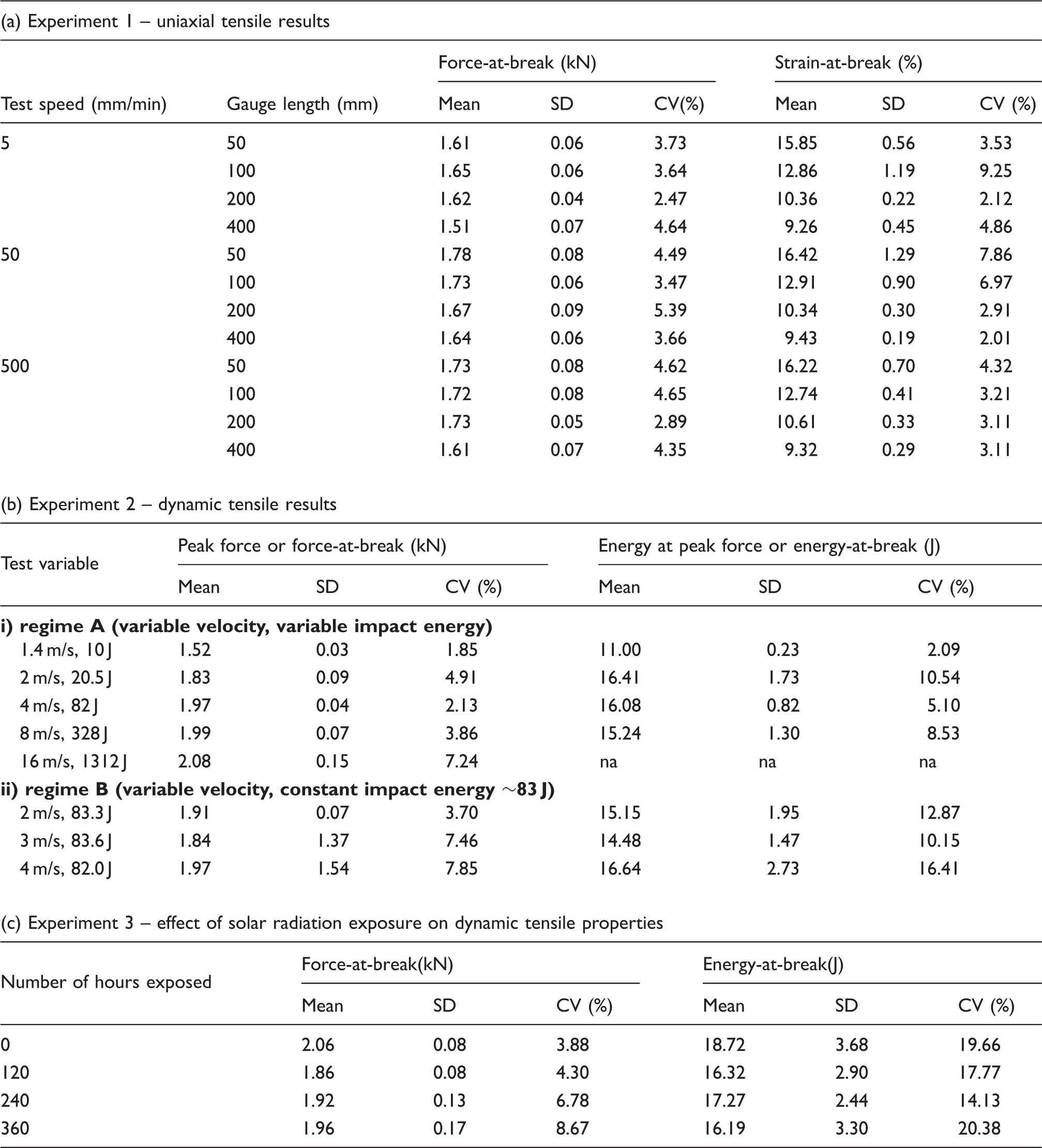
Grip failures occurred for all regimes with no clear pattern (i.e. irrespective of gauge length or test speed; n = 9). Testing continued until five replicates (excluding grip failures) were obtained for each combination of gauge length and test speed. Force-at-break was affected by both test speed and gauge length (F2, 48 = 16.05, p ≤ 0.001; F3, 48 = 10.40, p ≤ 0.001, respectively). Force-at-break was higher when the webbing was tested at 50 and 500 mm/min compared with 5 mm/min (1.73 kN; 1.70 kN; 1.6 kN) (Table 2a). Force-at-break was lower for 400 mm gauge length specimens (1.58 kN) compared to shorter gauge lengths (200 mm 1.67 kN; 100 mm 1.69 kN; 50 mm 1.7 kN) (Table 2a). Strain-at-break was affected by gauge length, but not by test speed (F3, 48 = 303.04, p ≤ 0.001; F2, 48 = 0.45, p = NS). Strain-at-break was higher for shorter gauge lengths (400 mm 9.34%; 200 mm 10.44%; 100 mm 12.84%; 50 mm 16.16%) (Table 2a). That both force-at-break and strain-at-break were higher for shorter gauge lengths was expected with respect to a higher probability of a critical flaw occurring in longer gauge lengths. Higher force-at-break at faster strain rates illustrates the importance of developing a test method for retention systems used in military helmets to consider dynamic test rates. That strain-at-break was not significantly affected by quasi-static strain rate was somewhat surprising; however, this may be a reflection of the webbing structure. The effect of gauge length on tensile properties of webbing does not appear to have been previously reported. Similar data for webbing, but of different fiber content, has been reported with respect to the effect of strain rate.22,23
Dynamic experiments
Specimens tested at 1.4 m/s (n = 5) and at 2 m/s (n = 3) under regime A did not fail, therefore peak force and energy at peak force were recorded. Specimens that failed did so at peak force. Approximately 47% of failed specimens were jaw breaks (i.e. the specimen failed within 5 mm of the end of the aluminum tab) and these tests were repeated until five replicates were obtained for each experimental condition. Energy data were not available for specimens tested at 16 m/s (regime A) because of the need to use an energy absorber to prevent damage to the machine. Good repeatability was observed for valid results across both test regimes, that is, force-at-break CV = 2.13–7.85% and energy-at-break CV = 5.10–15.41%. For regime A, data varied among test speeds and thus impact energies (Table 2b). Force and energy data were affected by test speed (F4, 20 = 38.46, p ≤ 0.001; F3, 16 = 23.21, p ≤ 0.001). Force data were higher at faster test speeds. Force data collected at 1.6 m/s (1.52 kN) were lower than for all other test speeds; data collected at 2 and 4 m/s were similar (1.83, 1.97 kN), while data collected at 4, 8 and 16 m/s were similar (1.97, 1.99, 2.08 kN). Energy to peak force was lower (11.01 J) than the energy-at-break recorded for 2, 4 and 8 m/s, which were similar to each other (F3, 16 = 32.21, p ≤ 0.001; 16.41 J, 16.08 J, 15.24 J). For regime B, data varied little among impact speeds (Table 2b). Dynamic tensile properties were not affected when webbing specimens were tested with an approximate constant impact energy (83 J; variable impact speeds) (force-at-break F2, 12 = 1.34, p = NS; energy-at-break F2, 12 = 1.83, p = NS). Force-at break, but not energy-at-break was affected by the number of days exposed to solar radiation (F3, 46 = 5.89, p ≤ 0.05; F3, 46 = 1.59, p = NS). Aged specimens were weaker than not-aged specimens (120 hours 1.86 kN, 240 hours 1.92 kN, 360 hours 1.95 kN; 0 days 2.06 kN) (Table 2c).
These results for the dynamic testing of webbing demonstrate the successful development of a dynamic test method for retention system webbing; similar data does not appear to have been previously presented. For dynamic testing, failure did not occur at impact energies between 10 and ∼20 J. Varying the impact speed at constant impact energy (∼83 J) did not affect the dynamic tensile response of the webbing. Thus, impact energy rather than impact speed appears more critical during the dynamic loading of retention system webbing. This data is of importance with respect to the security of helmets worn in the military helmet where they might be subjected to a dynamic loading as a result of a blast environment. That UVR is a degradative agent with respect to cotton was expected; what was not expected was that a relatively short period of exposure to UVR would affect the dynamic tensile properties of webbing typical of that used in military helmets.32–35 That the tensile properties of a chin-strap might be compromised during dynamic loading of a helmet that has been used in a high solar environment is of concern and may require the adoption of a regular replacement policy.
Conclusions
A test apparatus and method have been developed for the measurement of the dynamic tensile properties of textile products. Typical military chin-strap webbing has been tested using this apparatus and the effect of exposure to solar radiation assessed. Impact energy (above ∼20 J) rather than impact speed appeared to be the important critical variable when testing this webbing, with increasing impact energy affecting force-at-break and energy-at-break. This may be important in circumstances involving extreme dynamic loading of helmets and associated retention systems. Exposure to solar radiation weakened the webbing at dynamic rates; this may be of concern if helmets are used in high solar environments.
Footnotes
Funding
This work was supported through an EPSRC Summer Vacation Bursary (GS) and a Cranfield Defence and Security Summer Vacation Bursary (TdW). The assistance of Lt. Col (Ret) J Starling is gratefully acknowledged.