



Abstract
The objective of this investigation was to better understand the effects of foot coverings differing in fiber content on the health of the skin on the foot. A longitudinal controlled parallel design wear trial was carried out over 8 weeks: four sock types differing in fiber/yarn closely matched for fiber diameter (100% acrylic, 100% wool (24.5 µm), 100% cotton, 100% wool (20.5 µm)), manufactured such that only fiber type differed, were worn by 16 men. The effects on transepidermal water loss, stratum corneum hydration, pH, skin temperature were examined. Variability in effects among the participants was evident. Each person was his own control, with change expressed as a percentage from baseline. Fabric structural properties and selected performance properties were measured on fabrics of the same fiber/structure as of the socks. Improvement in skin health at the heel, in particular, was evident. Wool socks were associated with more cases of improved skin health (e.g. reduced percentage changes in transepidermal water loss and increased stratum corneum hydration). Results from two indicators of skin health considered together provided stronger evidence of effects than one alone.
Characteristics of the skin of the foot differ from those on other areas of the body, and also across the foot itself. These differences include the thickness of the stratum corneum (SC; 10–20 µm on most of the body surface, including the dorsal surface of the foot but 400–600 µm on the plantar surface 1 ), and the distribution of sweat glands on the dorsal and plantar surfaces of the foot (average 155 per cm2, 294 per cm2, respectively. 1 Despite the higher number and concentration of sweat glands on the plantar than on the dorsal surface of the foot, a lower sweat rate is typical of the plantar region.1–4
In many countries and on most days, the feet of individuals are sheathed in a pair of socks or hosiery item, and placed in some type of footwear often enclosing the entire foot. This sock/shoe combination creates an environment not necessarily conducive to optimal health of the skin of the foot, attributable to changes in sweating, transepidermal water loss (TEWL), SC water content, skin pH, and skin temperature. One indicator of skin health is TEWL.1,5 TEWL of the foot arch (plantar surface) has been estimated as 41–50.2 g/m2/h, and the foot back (dorsal surface) as 18 g/m2/h. 6 An elevated TEWL indicates poorer barrier function while a lowered TEWL indicates recovered function. 6 Elevated levels of TEWL are associated with extended occlusion of the skin, 7 high skin pH, and reduced SC hydration. 8 Another indicator of skin barrier function is water content/hydration of the SC. 9 The sole of the foot (plantar surface) has low SC hydration values compared with other parts of the body 10 with the foot arch reportedly exhibiting mid-range values. 11 Differences in SC hydration among body sites appear attributable to small differences in morphology, thickness, and lipid composition of the SC. 11 Areas rich in sweat glands or that are occluded tend to have higher SC hydration values.10,11 Consequently, wearing socks and enclosed shoes may result in elevated SC hydration, particularly when combined with moderate physical activity such as walking. 12 Occlusion of the skin has also been shown to result in elevated pH,7,11,13 with pH another indicator of skin health, naturally acidic (pH 4–6) and thus acting as a barrier to microbial colonization.14,15
Since the early 21st century, there has been considerable interest in determining whether or not any specific fiber can be linked to reducing blister formation, 16 or to the incidence of foot ulcers and infection of those suffering from diabetes mellitus.2,16–23 Little attention has been directed at skin health per se. Socks have been either off-the-shelf commercially available hosiery (i.e. different fiber content, structure, thickness,17,23–25 or socks specifically constructed for the study (i.e. consistent structure but different fiber content12,16,19,20). Each participant’s own new or current shoes/boots were used in some studies,17,19,20 while in others, new, standardized footwear for a wear trial was issued12,16,25). In some trials participants wore the same sock type on both feet16,20,23,24 while in others, the sock type worn on the left foot differed to that on the right.16,20 Wearing a different sock type on each foot permits a ‘direct within-participant comparison of the different sock types’, 16 but may present challenges in trial management.
Differences in fabric and yarn structure can have a major effect on fabric thickness and mass per unit area. Thinner fabrics trap less air and hence will typically be less insulating than thicker fabrics, all other parameters being identical.26–28 Although thermal resistance is predominantly a function of fabric thickness (and hence structure), fiber properties such as crimp and the presence of scales may increase the volume of air trapped in the fabric. 26 In terms of foot coverings, compressional resilience of the fabric, that is, the extent to which the fabric retains its thickness under the body weight of the wearer, needs to be taken into account. At 20℃ and 65% relative humidity (RH) the moisture regain for acrylic fibers is 1–2%, cotton fibers 7–8% and wool fibers (14–18%). 29 However, moisture regain of different fibers and fabrics can be affected by conditions of measurement, treatments applied to the fabric/fiber prior to measurement, extent of processing, and within-type differences at source such as sheep breed.29,30 In the case of wool, the absorption of acid and acid dyes can neutralize polar groups resulting in reduced water absorbed. 30 (Note the need to distinguish between regain of fibers and that of fabrics.)
Blending of fiber types has been the subject of some consideration. Socks constructed with a blend (50% merino wool/33% polypropylene/17% polyamide) reportedly improved foot skin SC hydration of the posterior surface of the calcaneus (rear of heel) and dorsal surface of third metatarsal (upper side of the center of the foot) compared with effects of wearing 100% polypropylene socks following an outdoor military training session. The difference was attributed to difference in moisture transport of the sock fabric. 16 These findings contrasted with an earlier study by Bogerd et al. 12 (controlled environment simulated walking by military recruits) in which no differences attributable to fiber content of two sock types (100% polypropylene and merino wool blend; similar to the earlier study) were observed for SC hydration and temperature at any of the three foot sites. Higher SC hydration values combined with lower TEWL values are considered features of a healthy, intact skin barrier. Elevated TEWL and reduced SC hydration may be linked to high skin surface pH 8 and with poorer skin health and increasing severity of diseased skin. 31 However, a link between TEWL and SC hydration was not confirmed from measurements at 17 anatomical sites (including the foot) of female participants at ambient conditions of 23–26℃ and 30–40% RH. 5
Effects of foot coverings differing in a range of fibers typical of socks on health of skin on the human foot lack clarity, even though frequently the subject of marketing and benefit claims related to health, safety, and human wellbeing. This investigation was designed to better understand fiber effects on skin health, focusing on the human foot.
Methods
Experimental design
A longitudinal controlled parallel design wear trial was conducted over 8 weeks, to determine the effect on skin health of differences in yarn/fiber types (socks, fabrics) when worn by 16 male participants. Ethical approval to carry out the study was sought and obtained from the Human Ethics Committee, University of Otago (13/217). The Ngai Tahu Research Consultation Committee requested that information on participant ethnicity be collected.
Participants (n = 16) were men aged 25–75 years, employed in work involving a moderate level of walking. To be included required the participant to be a non-smoker, not be on any medication, not engage in activities in which the feet would be exposed to chlorine-based pool water over the 8 weeks of the study, and to agree not to use antibacterial products or soaps. Signed written consent to participate was secured from each person.
Materials
Socks, boots, and sock fabrics
Experimental materials

1 denotes singles yarn; 30 or 36 denote hanks per pound (Ne system); 19.7 or 16.4 Tex, respectively.
All socks and sock fabrics were washed six times prior to use and testing to ensure dimensional stability and removal of any manufacturing surface finishes. 32 The washing and drying method followed ISO 6330:2012 Textiles - Domestic washing and drying procedures for textile testing. 33 An Electrolux Wascator, model FOM71MP LAB, set to hand wash cycle (Type 2A washing machine on 4H procedure of ISO 6330:2012) and detergent A of ISO 6330:2000, a non-phosphate powder detergent without brighteners, was used (James H. Heal, Halifax, England). Socks and sock fabrics were dried flat in a drying cabinet, and consistent dryness achieved using a RH sensor. Socks were laundered and dried after each wearing by the investigator team throughout the trial, ensuring uniformity of cleaning.
Structural and performance properties of sock fabrics were determined after conditioning for a minimum of 24 hours and all measurements determined under standard conditions. 34 Mass per unit area (g/m2) calculated according to BS EN 12127:1998 Textiles – Fabrics – Determination of mass per unit area using small samples, 35 was measured using a Sartorius 1712 balance. Fabric thickness was measured using an SDL Atlas MO34A digital thickness gauge. The number of stitches per 10 mm in both wale and course directions were counted using a fabric pick and an illuminating magnifying glass at three separate locations. Thermal resistance was determined using a sweating guarded hotplate. 36 In order to simulate the way in which the fabric would be used, each specimen (460 mm diameter) was placed with the technical rear against the plate and the technical face exposed to the ambient air. Specimens were oriented so wales were at right angles to the air-flow across the surface. Equilibrium was identified as the time when the rate of energy required to maintain the measuring unit at 35 ± 0.1℃ changed by less than 3% per hour (between two 30-minute time periods). When equilibrium was maintained for 2 hours the average energy consumption over this period was identified, 37 and used to calculate thermal resistance. Calibration of the guarded hotplate was determined using four layers of an NFPA standard reference material of known thermal resistance (0.082 m2K/W ± 10%). 38 Moisture regain was calculated from determination of oven dry mass, according to BS EN 12127:1998 Textiles – Fabrics – Determination of mass per unit area using small samples. 35
Wear trial protocol and determinants of foot skin health
As noted, the wear trial was conducted over 8 weeks. Participants wore the supplied socks and footwear for a minimum of 8 hours per day for 5 days prior to measurement of skin health indicators. Each test period/block was preceded and followed by a 7-day period wearing baseline socks. This wear pattern was repeated for 3 weeks for each sock type.
Indicators of skin health included SC hydration, measured using a Corneometer CM825 (CK electronic, Germany; ±3% accuracy); TEWL measured using the Tewameter TM 300 (CK electronic, Germany; ±1.0 g/m2/h at ≤30% RH accuracy); 39 skin surface acidity (pH) measured using the Skin-pH-Meter® PH 905 (CK electronic, Germany; ±0.1 pH accuracy); 39 skin temperature using a non-contact (laser) thermometer (Raytek, Raynger ST60 ProPlus standard) with an accuracy of ±1% of the target at temperatures above 23℃, i.e. approximately ±0.3℃ for the foot skin surface. Sites for determining skin properties were: heel (the region immediately below the calcaneus); plantar medial (plantar surface region adjacent to the tuberosity of the 5th metatarsal); dorsal lateral toe (skin beyond the web between the 2nd and 3rd toes). Measurements on each participant were taken at a similar time of the day, each time. Participants entered a conditioned room (20℃ ± 2℃, 65 ± 4% RH), 34 removed the boots and socks, and relaxed for a minimum of 20 minutes allowing the bare feet to adapt to the standard conditions, given each participant's activity immediately prior to arrival was not known.
Analysis
Fabric properties
Descriptive statistics (mean, standard deviation (s.d.), coefficient of variation (CV%)) were calculated for thickness, mass per unit area, stitches per 10 mm, moisture regain and thermal resistance, and any significant differences among fabrics determined through univariate analysis of variance (ANOVA). Where significant differences were observed, those differing were identified using Tukey’s test. 40 Thermal and vapor properties were considered both as inherent values and as ratios. Because resistance of fabric to thermal and vapor transfer is affected by fabric thickness and fabric mass, these two transfer properties were standardized as ratios (i.e. warmth:thickness, warmth:mass) thus allowing comparisons among fabrics different in thickness and in mass.
Skin properties
Each participant was considered his own control, taking account of known inter-individual variability in skin properties, highlighting the importance of a baseline measurement. 6 Data on skin properties (TEWL, SC hydration, pH, temperature) of each participant at the relevant position on the foot, along with fiber type of the sock and wear week, were calculated as a percentage change from the participant's baseline. The percentage change, a value derived from data, formed the basis of analysis of each skin property. Descriptive statistics (mean, standard deviation, coefficient of variation) were calculated and any significant differences determined using IBM SPSS Statistics 20 (IBM Corporation, Somers, NY, USA). A linear mixed model analysis was used, repeated measures being factors of position, week and sock, and person as a random-effects factor. A compound symmetry covariance matrix was assumed. Where a significant effect was observed, a Bonferroni adjustment was applied to decide which pairs of means differed. 40 Residuals were checked for normality.
Results
All 16 participants remained in the trial for the 8-week period, although one participant ceased wearing the leather boots after the third week due to a foot injury (with all data relevant to that participant being excluded from analysis). Although three participants were unable to attend one assessment date (‘missing’), no distortionary effects on the analyses were observed. Participant nationality as defined for the New Zealand census was New Zealand European/New Zealander/Pakeha (n = 12), other (English, Irish, Iranian, South African) (n = 4).
Fabric properties
Structural and performance properties of sock fabrics

Notes
Where indicated means that share the same letter within a line (v or w) (x, y or z) do not differ significantly, and when not shared, differ significantly (p > 0.05) based on Bonferroni comparisons.
No superscripts within a line indicates no statistically significant differences for that thermal measure.


No differences among the sock fabrics were evident in their derived ‘dry’ thermal resistance of warmth:mass, or in inherent water vapor resistance and the derived warmth:mass and warmth:thickness.
Effects of fiber type on foot skin health
TEWL, SC hydration, pH, skin temperature for each sock fiber type, foot position and wear week, mean percentage change

Both the position on the foot at which the measurement was determined and the week during which the sock was worn affected TEWL (F2,464 = 11.25, p ≤ 0.001; F2,465 = 4.16, p ≤ 0.05, respectively), and interaction effects were not significant. While effects of fiber type on TEWL were not statistically significant, the strongest indication of improving skin health (i.e. greatest negative percentage change) was evident with the two wool socks. The position on the foot at which TEWL was measured indicated the dorsal position differed to both the heel and plantar positions (p ≤ 0.001, p ≤ 0.01, respectively). These percentage changes for both heel and plantar positions were both negative, and that for the dorsal position was positive (Table 3). Also significant was the difference in TEWL percentage change from baseline between wear weeks 1 and 3 (p ≤ 0.05; mean TEWL change for weeks 1, 2 and 3; Table 3). Interestingly, the mean percentage change in TEWL for both fiber type and wear week were negative when taken at the heel and plantar positions, but positive in the dorsal position (not evident in Table 3).
Improved SC hydration (suggesting improved skin health) is indicated by an increase from the baseline, i.e. a positive SC hydration percentage change. The mean percentage changes are given in Table 3. Effects of fiber type, position on the foot at which the measurement was taken, and wear week were significant (F3,474 = 3.63, p ≤ 0.05; F2,473 = 34.24, p ≤ 0.001; F2,477 = 7.54, p ≤ 0.001, respectively), although some of these values are small. The effects of fiber type on SC hydration differed according to the position at which the measurement was taken (i.e. a significant interaction (F6,473 = 3.99, p ≤ 0.001). Only the wool (B) and cotton differed (p ≤ 0.05). The 100% cotton socks resulted in decreased skin hydration, and potentially lowered skin barrier function. Again, results obtained on the heel differed to those obtained on the plantar and dorsal positions (p ≤ 0.001, p ≤ 0.001, respectively). The mean percentage change in SC hydration (mean over all fiber types) at the heel was +31.71% whereas at the plantar and dorsal sites the change was negative (–28.45%, –14.05%, respectively). A sock type–position interaction was noted (Figure 1). SC hydration percentage change from the baseline sock indicates that at the heel position effects of the wool (B) were significantly different to those of the cotton (p ≤ 0.001) compared with the dorsal and plantar sites.
Stratum corneum hydration: percentage change from baseline sock (shows position–sock interaction) at heel.
The mean percentage changes in SC hydration between weeks 1 and 3 differed (p ≤ 0.001), with week 1 positive (+ 11.36%), compared with week 2 (–3.71%) and week 3 (–18.44%).
Relationships between TEWL and SC hydration are illustrated in Figures 2–4 showing each foot position and fiber type. The greatest number of positive SC hydration points and number of negative TEWL values (upper left quadrant of each graph) appear for the heel position (Figure 2). Results from the heel did tend to be most variable within the quadrant: differences among the participants were evident, notwithstanding that all measures were calculated as a percentage change from baseline.
Percentage change from baseline TEWL and from baseline SC hydration HEEL (R/LP1) all participants: (a) sock A, acrylic; (b) sock B, 24.5 µm wool; (c) sock C, cotton; (d) sock D, 20.5 µm wool. Percentage change from baseline TEWL and from baseline SC hydration PLANTAR (R/LP1) all participants: (a) sock A, acrylic; (b) sock B, 24.5 µm wool; (c) sock C, cotton; (d) sock D, 20.5 µm wool. Percentage change from baseline TEWL and from baseline SC hydration DORSAL (R/LP1) all participants: (a) sock A, acrylic; (b) sock B, 24.5 µm wool; (c) sock C, cotton; (d) sock D, 20.5 µm wool.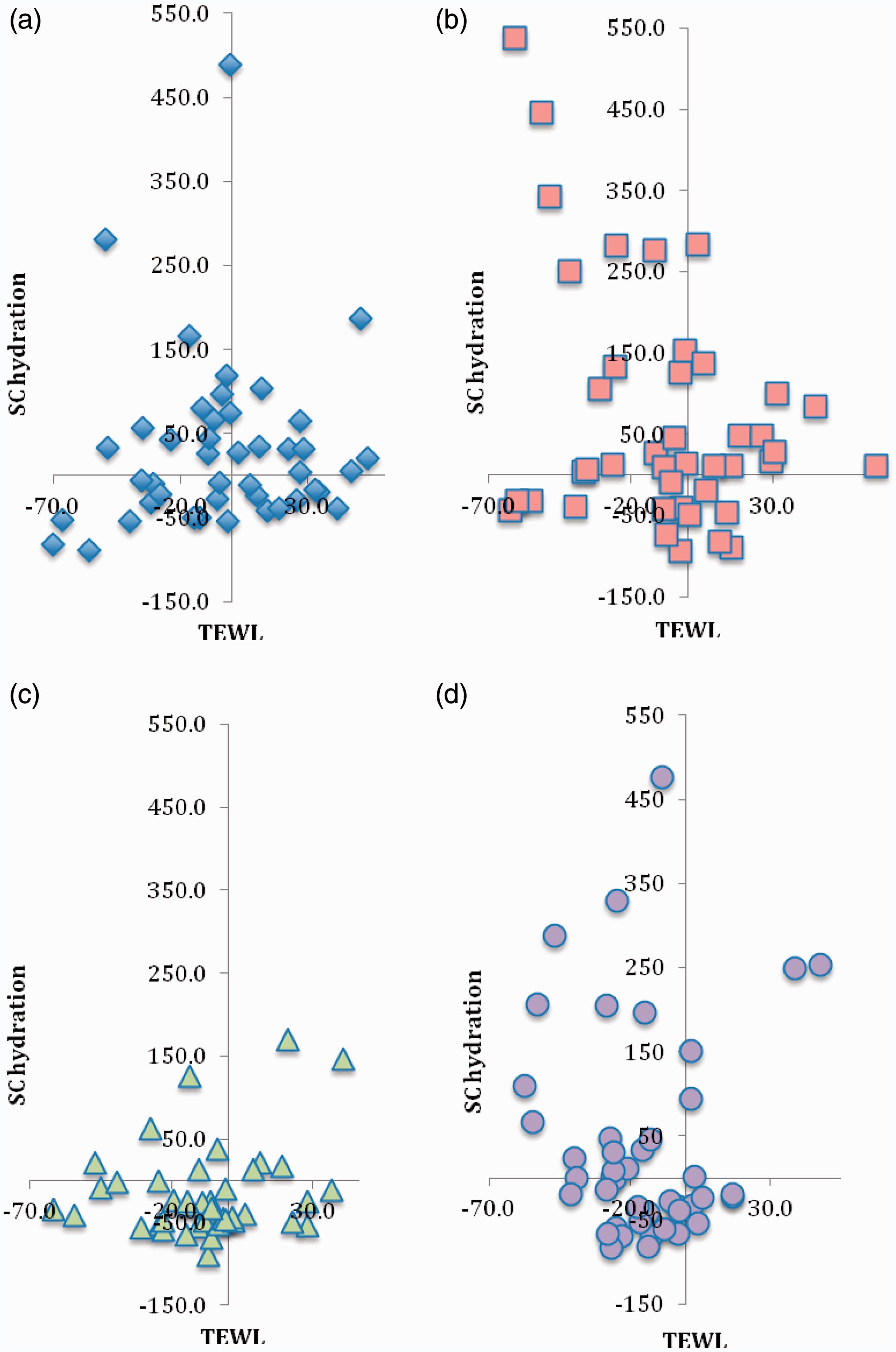


Percentage changes in skin pH (first wear period) are given in Table 3 and these formed the basis of analysis. Effects of both the position on the foot and the wear week were different (F2,284 = 6.94, p ≤ 0.001; F2,289 = 3.85, p ≤ 0.05, respectively). However, no fiber type effects were significant, nor were any interaction effects (sock–position, sock–week, position–week, sock–position–week). Effects on the heel position differed to those from the plantar position (p ≤ 0.001). The mean percentage changes for the heel, dorsal and plantar positions are given in Table 3: they represent small pH values (+0.20 to –0.16), although do exceed the accuracy of the skin pH meter (pH ± 0.1). The significant difference observed in the mean percentage change from baseline between weeks 1 and 3 (+1.07%, −0.90%, respectively, but 0.08–0.06 pH, respectively) was less than the instrument accuracy. pH values on the skin of the foot ranged from 3.14 to 6.41 with CV% typically 10–18%. Irrespective of fiber type, the skin was more alkaline at the heel. The mean pH of the skin which had been covered by the wool socks (B, D: range 4.39–4.94, 3.95–4.83, respectively) was slightly more acidic for each of the three positions than that which had been covered by the other two fiber types (acrylic, cotton: range 4.31–5.12, 4.47–5.17, respectively).
The percentage change in skin temperature from baseline is given in Table 3. There was some evidence that fiber affected this (F3,201 = 2.94, p ≤ 0.05), and some that the week of wear also had an effect (F2,198 = 18.90, p ≤ 0.001). There was no evidence that position or any interactions (sock–position, sock–week, position–week, sock–position–week) had an effect. The mean percentage change in skin temperature did depend on fiber type for both the wool (D) and cotton (C) (p ≤ 0.05) (reduced by< 3.5% with the wool sock (D) and increased by< 1% for the cotton). The mean skin temperatures ranged from 30.1℃ (wool, D) to 30.6℃ (cotton, C) and temperature differences among the fiber types were typically < 2℃ (instrument accuracy of ± 0.3℃). Differences among participants were evident ranging from a low of 21℃ (participant 16) to a high of 34.6℃ (participant 9). A difference in percentage change in skin temperature from baseline was also observed between wear weeks 1 and 2, and between weeks 1 and 3 (p ≤ 0.001, p ≤ 0.001, respectively).
Discussion
There are four issues that warrant discussion: the experimental trial, properties of sock fabrics, indicators of skin health, and the link between fabric/fiber properties and skin health.
Experimental trial
All aspects of the experimental trial were carefully designed and managed to ensure that effects of the fibers from which the socks had been manufactured could be identified. The basis of comparisons was to be fiber, not a mix of effects of fiber/structure, nor an effect of type of footwear. Participants were recruited following clear guidelines of age, health and general physical activity and agreed to meet all requirements of the 8-week period. The number of participants (n = 16), sex (all male), and age range (25–75 years) were similar to those in other sock/skin health studies.12,16,41,42 Although participants met similar criteria regarding health and activity and were predominantly of similar ethnicity, as expected, measurements of all parameters varied among them. Some of this variability seems to have been associated with differences in physical form of the feet (bony, plump). Variability was accounted for by considering each participant as his own control and evaluating percentage change from baseline values for each parameter of interest.
Many aspects of the study were standardized. The four sock types were made on the same machine using yarns differing only in fiber type, and the footwear (boots) was new, of identical style, and fitted for each participant by the manufacturer. The socks were washed prior to wearing and during wear using a standard washing system and detergent,32,33 thus ensuring in-trial consistent treatment. Wearing a different sock/fiber type on each foot provided within-participant comparison, 16 thereby avoiding time-dependent between-participant differences in measures of foot skin health. No mis-assignments were reported to the investigators. All appointments were scheduled between 2 pm and 6 pm, and each participant was measured at approximately the same time each week, thus reducing time-dependent effects that have been observed with TEWL, pH, and temperature.43,44 Measurements on the skin followed an acclimatization period,31,43–45 and were taken in standard environmental conditions. 34
Properties of sock fabrics
That the structural properties of the sock fabrics were very well matched was clear. The difference observed in stitches per 10 mm for the cotton fabric possibly resulted from relaxation shrinkage during the initial six wash ‘pre-cleaning’. 32 The moisture regain of both cotton and wool fabrics was less than values given by Morton and Hearle 29 for fibers and this may reflect differences in processing 30 and within-type fiber variability. 29 Effects of differences in mass and thickness of fabric on thermal resistance are well known. Thinner fabrics trap less air and will be expected to be less insulative than thicker fabrics.26–28 By using ratios (warmth:mass, warmth:thickness), small differences in structural properties can be accommodated. For instance, although the structural properties of the cotton fabric differed a little (i.e. thinner), appropriate comparisons/conclusions could be reached: cotton was still less insulative, even when standardized for thickness.
Indicators of skin health
Indicators of skin health include TEWL, SC hydration, and pH. TEWL is related to fluid homeostasis of the skin and indicates skin barrier function.1,5 An increase in TEWL indicates skin barrier dysfunction, and lowered TEWL with recovery. 6 Consequently, a negative TEWL percentage change from baseline indicates an improvement in skin barrier function and a positive TEWL percentage change from baseline indicates a reduced function. The TEWL related to the baseline sock was not assumed to indicate normal skin barrier function, but merely a point from which changes in TEWL were determined.
For all fiber types the mean percentage change in TEWL were negative, therefore, in this respect, simply covering the skin had a desirable effect on TEWL. The greater mean percentage change was associated with the two wool socks, however, claiming with certainty that one fiber type improved skin barrier function more than another should be treated with caution.
TEWL mean values of the foot arch (plantar surface) were identified by Kottner et al. (2013) to be 41.0 g/m2/h (range 24.5–57.4 g/m2/h) and 50.2 g/m2/h (range 36.9–63.6 g/m2/h) (Kottner et al. reported on several studies). Results of the present study differ. The mean of all participants and sock types was 28.2 g/m2/h:
18% (n = 11 observations) with a maximum value of <24.5 g/m2/h, 77% (n = 46 observations) with a maximum value of <36.9 g/m2/h, 10% (n = 6 observations) with a maximum value of >41 g/m2/h, and 3% (n = 2 observations) with a maximum value of >50.2 g/m2/h.
A similar difference was observed between TEWL values of the dorsal position of the foot the present investigation and published literature. The mean value at this site was noted by Kottner et al.
6
as 18 g/m2/h (range 15.9–20.1 g/m2/h). In the current study a TEWL mean of 13.1 g/m2/h was observed, with
73% (n = 44 observations) having a maximum <15.9 g/m2/h and 10% (n = 6 observations) having a maximum >18 g/m2/h.
These differences among findings of the present study and those in the published literature may well result from differences in measurement site, climate conditions, and instrumentation, none of which was specified by Kottner et al. 6
The site at which the measurements were taken did affect the mean percentage change from baseline TEWL: negative values were typical of the heel and plantar positions, indicative of improved skin barrier function of these sites compared with the dorsal position (although no clear difference was observed for a specific fiber type). Foot health initially deteriorated (first week of wear of the four sock fiber types), as indicated by mean percentage change TEWL (positive percentage change in TEWL), perhaps due to socks differing in fiber type from those normally worn, but did improve in the remaining 2 weeks of the wear period (negative percentage change). Again no discernible difference was observed for specific fiber types.
SC hydration is considered a critical factor in skin barrier function. 9 Well-hydrated areas have higher SC hydration values, and an increase in SC hydration is associated with improved skin barrier function. 31 Accepting this indicator of improvement, the wool sock (B) and the heel position both reflected improvement (positive mean percentage change from baseline) whereas the cotton sock and the plantar and dorsal regions had negative change values. The difference between the wool (B) and cotton, between the heel and plantar and dorsal positions, and the significance of the sock–position interaction at the heel for socks B and C suggests the wool sock (B) increased the skin hydration and barrier function, the cotton sock reduced skin hydration and barrier function, and that this effect was most evident in the heel position. Fiber-related differences in effects at the heel position have been reported in earlier work, the 50% wool blend increased SC hydration compared with the 100% polypropylene. 16 The presence of wool has a strong influence on the moisture and absorption by the fabric, an important factor in skin hydration where the foot is well occluded (boot and sock). 16
SC thickness and morphology influence SC hydration. Areas with low SC thickness generally have a higher SC hydration value. 11 This may be one reason for differences in SC hydration values among individual participants, given some participants were noted to have slim, bony feet (e.g. participant 16; all mean SC hydration values were <30.0) and others had more rounded, plump feet (e.g. participant 10; 79% of mean SC hydration values were >30.0).
For TEWL/SC hydration, a reduction in TEWL (negative change) and an increase in SC hydration (positive change) indicates improved skin barrier health.8,31 This relationship was most evident at the heel position, and in particular related to the wool (B, 24.5 µm) sock. If a relationship between skin health and fibre is to be observed, of the three positions examined, the heel position is where an indication of changes in skin barrier function would be most apparent.
Foot skin pH values observed in the present study (range 3.14–6.41) were dissimilar to published values (those quoted for overall skin, pH of 4–6 14 being more variable in both acidity and alkalinity). The actual pH at the heel position was more alkaline, and at the dorsal position more acidic. The mean percentage change from baseline pH at the heel (2.78) differed to that at the plantar position (–2.23) (p ≤ 0.001). Occlusion of the foot and sweating can result in an increase in skin pH11,13 becoming more alkaline and this may explain the difference in pH between the heel and dorsal regions, given the sock and boot were in closer contact with the skin at the heel than at the dorsal region. An increase in TEWL is associated with elevated pH and occlusion of the skin. 7 Although both the mean percentage change from baseline in pH and in TEWL differed between the heel and dorsal regions, no increases in TEWL and in pH were observed.
For skin temperature, a significant difference in the percentage change from baseline between the cotton and wool (D) was observed: the difference between these two socks at the dorsal position was ±0.51℃. Bogerd et al. 12 (p. 514) reported a difference of 0.3 ± 0.4℃, although sock variables in Bogerd et al.'s work differed from those of the present investigation. Skin temperature reflects environmental factors, extent of occlusion, level of exercise, duration of rest period prior to measurement, site at which the measurement is taken on the body, and inherent differences among individuals. Relevance of average foot skin temperatures is therefore questionable.
The link between fabric/fiber properties and skin health
Wool fabrics had the highest moisture regain and were warmer than the cotton fabric, and of similar warmth to the acrylic fabric. Differences in effects of socks (fiber) were observed for percentage change from baseline in SC hydration and temperature. SC hydration increased as a result of wearing a wool sock (B, 24.5 µm) and decreased as a result of wearing a cotton sock. Curiously, skin foot temperatures were lower for the wool sock (D, 20.5 µm) than for the cotton sock, although thermal resistance measures of the fabric indicated the cotton fabric was the least warm of the four fabrics.
As indicated, a reduction in TEWL indicates an improvement in skin barrier function 6 and when associated with an increase in SC hydration also indicates improved skin barrier function. 8 Although no significant difference was noted between sock types for TEWL alone, both wool socks were associated with the most changes indicating improved skin health. Further, in the heel position these same wool socks exhibited the highest measures associated with both a decrease in TEWL and increase in SC hydration.
The heel position compared with other sites on the foot was of interest. Compared with the plantar and dorsal positions, the heel differed in terms of TEWL (lowest TEWL mean percentage change), SC hydration (highest SC hydration mean percentage change) and pH (increased pH mean percentage change), and where there was the strongest evidence of improved skin barrier function (i.e. lowest TEWL and highest SC hydration mean percentage change). 8 Although the dorsal position was also significantly different to the plantar position for TEWL mean percentage change, the heel was the position where the most significant changes in foot health measures were observed.
Each sock type was worn for 3 weeks during a wear period preceded and followed by wearing baseline socks. There was some evidence that results from the week early in the trial differed from those in later weeks. Differences between weeks 1 and 3 were evident for percentage change in TEWL (increased), SC hydration (decreased), pH (decreased) and temperature (increased). The wear-period effect is separate to the fiber-type effect, and there was no evidence that effects of socks depended on the week during which they had been worn (i.e. no sock–week interaction) in any measure of skin health. No clear pattern of responses in week and changes in TEWL and in SC hydration were identified.
Conclusions
This investigation was designed to focus on effects of different fibers on skin health. Fabrics were very well matched structurally and a number of differences in performance properties of fabrics were determined (regain: wool 10%, cotton 5%, acrylic 2%; inherent warmth: both wool and acrylic fabrics were inherently warmer than the cotton). No differences were evident in vapor transfer. Thus, fabrics well-matched structurally do perform differently in some, but not all, properties. These properties are relevant to skin health when the fabric is a sock worn as part of a human trial. The sock trial of 8 weeks showed variability among participants (e.g. foot shape, temperature), as well as variability dependent on the measurement site (e.g. both heel and plantar surfaces differing from the dorsal surface). Just covering the foot has a desirable effect on skin health: however, improved skin health was associated with wool socks (i.e. both TEWL and SC considered). When covered by a wool sock, the skin became slightly more acidic at each position. Whether this has any effect on resistance to microbial colonization is of potential interest.
Footnotes
Funding
This work was supported by the Wool Industry Research Ltd (grant number OU 2012_16).
Acknowledgements
The authors gratefully acknowledge the willingness of the participants in the study and Dr Rebecca Van Amber and Dr Lei Yao for technical support. The Wool Industry Research Ltd contributed to funding this work: the work and conclusions are those of the authors. No research materials related to the paper are publicly available: any enquiries can be directed to the corresponding author.