




Abstract
‘Wet’ thermal insulation, defined as the thermal insulation when clothing gets partially or fully wet, is an important physical parameter to quantify clothing thermal comfort. As the water/sweat gradually occupies the intra-yarn and inter-yarn air voids of the clothing material, the clothing intrinsic thermal insulation will be diminished and, hence, contribute to the loss of total insulation. In cold conditions, a loss in total thermal insulation caused by sweating may result in an inadequate thermal insulation to keep thermal balance and eventually leads to the development of hypothermia and cold injuries. Therefore, it is imperative to investigate the effect of clothing fit and moisture content on clothing ‘wet’ insulation. In this study, the ‘wet’ thermal insulation of three two-layer clothing ensembles was determined using a Newton thermal manikin. Four levels of moisture content were added to the underwear: 100, 200, 500 and 700 g. The clothing apparent ‘wet’ thermal insulation under different testing scenarios was calculated and compared. A third-degree polynomial relationship between the reduction in ‘wet’ thermal insulation and the moisture content added to underwear was obtained. Further, it was evident that the clothing fit has a minimal effect on the apparent ‘wet’ thermal insulation. The findings may have important applications in designing and engineering functional cold weather clothing and immersion suits.
Keywords
Thermal insulation is one of the most important thermo-physical parameters to characterize clothing thermal comfort. Clothing insulation determines how much body heat can be dissipated to its surrounding environments. It may be divided into two categories based on whether the tested clothing is dry or wet: dry thermal insulation and ‘wet’ thermal insulation. 1 The actual thermal insulation provided when clothing gets either partially or fully wet is called ‘wet’ thermal insulation. It should be noted that clothing ‘wet’ thermal insulation does not refer to clothing water vapor resistance. 2 Water vapor resistance is the second most important clothing parameter to quantify how easy the moisture transfers through a clothing ensemble. Full-scale clothing thermal insulation tests are often performed on a dry-heated thermal manikin.3–5 In thermal insulation tests, the temperature gradient between the manikin surface temperature and the air temperature must be at least 12℃ according to ISO 15831-2004. 6 Also, the observed segmental heat loss should be larger than 20 W/m2. The measurement of dry clothing’s thermal insulation by means of a heated manikin is easy, fast and repeatable. 3 However, a big challenge to determine clothing ‘wet’ thermal insulation is the prevention of evaporation loss. The most common way to do so is using an impermeable layer. Under such testing scenarios, moisture content within the wet clothing/underwear may evaporate and re-condense on the inner side of the impermeable clothing. Condensation will raise the clothing surface temperature and more heat will be lost to the environment through radiation and convection. The ‘wet’ thermal insulation determined in the presence of moisture condensation is often called apparent ‘wet’ thermal insulation. The term ‘apparent’ denotes that the value is determined in a condition where the air movement and/or moisture condensation present.7,8
Previous studies9–11 have shown that thermal insulation will reduce when clothing gets wetted. For physical activities in hot climates, a reduction in thermal insulation is beneficial, as the wearers need to dissipate body heat to the environment in order to keep a thermal balance. On the contrary, for physical activities in cold environments or cold workplaces, clothing thermal insulation loss due to sweat absorption will contribute to increased body heat losses. This may lead to a heat debt inside the body inducing a continuous drop in body core temperature during prolonged exposures. Finally, the continuously dropping body temperature raises the possibility of the development of hypothermia and various local cold injuries.12–14 Similarly, if cold water penetrated the immersion suit and wetted the inner clothing layers during cold-water exposure, fatal hypothermia would be induced due to the loss of thermal insulation and this could threaten the lives of the divers. Therefore, it is imperative to investigate the effect of moisture content on clothing ‘wet’ insulation. To date, the effect of moisture content on clothing apparent ‘wet’ thermal insulation has not been adequately explored. In particular, a regression model to define the relationship between moisture content and the loss of thermal insulation is badly needed. Thus, a main goal of this study is to explore the relationship between the moisture content and the apparent ‘wet’ thermal insulation. Further, clothing fit may play a role in compensating for the apparent ‘wet’ thermal insulation loss because an additional air gap will add extra insulation. Therefore, the second goal of this study is to examine the effect of clothing size on the clothing apparent ‘wet’ thermal insulation.
In this study, full-scale garment tests were performed on a thermal manikin to examine the effects of moisture content and clothing fit on clothing apparent ‘wet’ thermal insulation. A regression model was developed to quantify the relationship between apparent ‘wet’ thermal insulation loss and the amount of moisture content. Finally, the effect of moisture condensation on the clothing outer surface temperature was also examined.
Methods
Clothing ensembles
Detailed clothing size of the polyvinyl chloride-coated polyester coveralls

Tolerance: 0.5 cm.
Thermal manikin
A 34-segment ‘Newton’ type thermal manikin (MTNW, Seattle, WA) was used. This manikin is able to individually control its segmental surface temperature or heating power. Wire sensors were embedded into each segment surface to record segmental temperature. The heat power supplied to the manikin can be recorded using the ThermDAC software. The total surface area of the manikin is 1.697 m2. The constant temperature mode was used and the manikin temperature was set to 34℃.
Calculations
The dry and apparent ‘wet’ thermal insulation can be calculated using Equation (1):

Test protocol and test condition
All thermal insulation tests made on dry clothing ensembles strictly followed the test procedure defined in ISO 15831 (2004). For the apparent ‘wet’ thermal insulation tests, the underwear was wetted in a washing machine for 5 min with 25℃ water and then centrifuged for 1 min to ensure no water dripping. The underwear can hold 700 g (i.e., 170% of its dry weight) moisture with no dripping. Four different amounts of moisture content were selected: 100, 200, 500 and 700 g. The underwear was placed in a sealed plastic bag for thermal balancing at least 5 hours. After the manikin was dressed with the underwear and coverall, the collar, cuff and leg areas of the coverall were closed tightly using Velcro fasteners. The test was concluded after one hour and each test combination was repeated three times. The underwear was weighed before and after each experiment to determine the amount of moisture content remaining in the underwear. An infrared camera (FLIR® T440, FLIR System Inc., OR, USA) was used to detect the outer surface temperature of the coverall. Measurements of the outer surface temperature of the underwear were also carried out immediately after stripping off the coverall. The standoff distance (camera-to-manikin body) was set to 1.0 m and the emissivity was set to 0.97. The detected thermo-images were further analyzed using the FLIR® software (FLIR® ThermaCAM Researcher version 2.10 Pro, FLIR System Inc., OR, USA). An average clothing outer surface temperature was reported. All thermal manikin experiments were performed in a climatic chamber where the air temperature is 21 ± 0.5℃, relative humidity (RH)=55 ± 5% and an air velocity of 0.15 m/s.
Statistical analysis
The clothing dry and apparent ‘wet’ thermal insulation determined under different testing combinations were compared by one-way analysis of variance (ANOVA) using SPSS v.20.0 (IBM Corp., Armonk, NY, USA). Bonferroni post-hoc tests were also performed to determine whether clothing fit and moisture content significantly affect clothing dry thermal insulation and apparent ‘wet’ thermal insulation. The significance level was set at p < 0.05.
Results and discussion
The dry thermal insulation and apparent ‘wet’ thermal insulation of different test combinations

Note:–, not able to measure; ND: nude; UW+COs: the S size coverall was worn on top of the underwear; UW+COm: the M size coverall was worn on top of the underwear; UW+COl: the L size coverall was worn on top of the underwear. For apparent ‘wet’ tests, the combination is expressed as UWα+COβ; the β size coverall (β stands for size S, M or L) was worn on top of the underwear wetted with α g moisture content (α stands for 100, 200, 500 or 700).
The Bonferroni post-hoc test showed that the dry thermal insulation of COm is significantly higher than that of COs (p < 0.001). However, there is no significant difference between the dry thermal insulation of COl and COm (p = 0.213). The dry insulation of clothing combinations UW+CO first increases with the increasing clothing fit/size and then decreases with the still increasing fit/size. The reduction is probably because of the natural convection in clothing microclimate, which normally occurs when the local air gap size is larger than 8–11 mm. This phenomenon has previously been described by many researchers.15,16 Chen et al. 17 studied the garment’s upper body fit on clothing thermal insulation. In their study, five different clothing sizes were used and their thermal insulation values were reported. The thermal insulation differences among different sizes of jackets are similar to our reported data (e.g., ItCOm is about 3% higher than ItCOs). In addition, Chen et al. observed that the rate of increase in thermal insulation gradually decreases as the clothing size becomes larger, that is, the air gap becomes thicker.
The apparent ‘wet’ thermal insulation determined under four different levels of moisture content is also displayed in Table 2. It can be deduced from Table 2 that if the same amount of moisture has been applied to the underwear, an increase of clothing size will cause <7.6% increment in the apparent ‘wet' thermal insulation. The one-way ANOVA reconfirmed the minimal effect of clothing fit on the apparent ‘wet’ insulation. Post-hoc results demonstrated that the apparent ‘wet’ insulation of ensembles UW7+COs and UW5+COs is significantly lower than that of UW7+COl and UW5+COl, respectively (p1 < 0.05; p2 < 0.05). Similarly, there were significant differences in the apparent ‘wet’ insulation between UW2+COs and UW2+COm, UW2+COs and UW2+COl, and UW1+COs and UW1+COm (p > 0.05).
To investigate the effect of moisture content on the apparent ‘wet’ thermal insulation, ‘wet’ insulation data were reorganized and they are illustrated in Figure 1. For testing combinations with COs, there are significant differences in the reported apparent ‘wet’ insulation among UW7+COs, UW5+COs, UW2+COs and UW1+COs. However, no significant difference in the apparent ‘wet’ insulation is found between UW7+COm and UW5+COm (p > 0.05), and between UW7+COl and UW5+COl (p > 0.05). Compared with the UW7 test combinations, the clothing apparent ‘wet’ thermal insulation in UW1 scenarios were 17.8% to 21.7% higher. Thus, we may conclude that the moisture content affects the thermal insulation loss much greater than clothing fit.
Clothing apparent ‘wet’ insulation determined under different test combinations. * p < 0.05; ** p < 0.001(i.e., highly significant).
The relationship between the water content applied to clothing and the ‘wet’ thermal insulation loss is displayed in Figure 2. Based on our observed data points, a third-order polynomial fitting curve was developed and the equation is read as
Effect of moisture contented added to underwear on total thermal insulation loss (open circles are data reported by Hall and Polte;
9
the remaining data points are plotted from our observation).
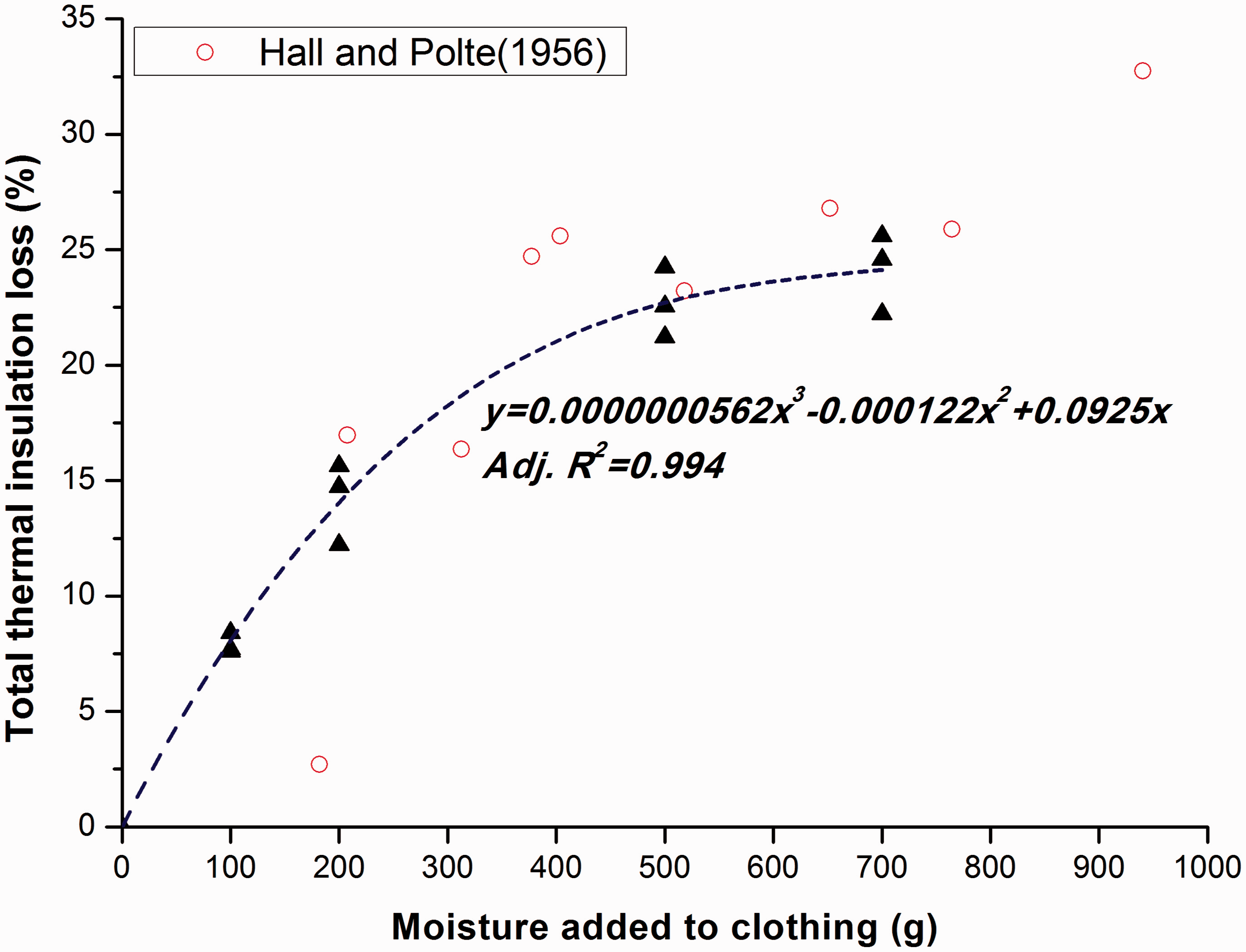
It can be deduced from Figure 2 that the moisture content significantly affects the clothing thermal insulation. If the underwear is fully wetted (i.e., 700 grams moisture), the apparent ‘wet’ thermal insulation loss reached up to 25.6%. Hall and Polte 9 used a copper manikin to determine the dry and wet insulation of a set of clothing assembly consisting of underwear, insulation liner, socks and a water-impermeable anti-exposure suit. Measured quantities of water were added to the clothed truck, arm and leg areas of the copper manikin. A neck closure was used to prevent any significant loss of the water added. Our results are in good agreement with Hall and Polte’s findings, 9 who observed that the assembly had a thermal insulation reduction from 3.36 to 2.49 clo if 764.5 g water content was added to the assembly (i.e., the reduction is about 25.9%). However, the reported percentage of insulation loss by Hall and Polte when 181 g moisture content was added to clothing is much smaller than the estimated value by our equation. A possible reason could be that, in Hall and Polte’s study, 9 the measurement precision and technique for wetting the large area of clothing assembly were not high enough. Further, if the moisture content being applied to the clothing is larger than 800 g, the estimated data by Equation (2) showed a large deviation from the reported data by Hall and Polte. This suggests that the equation developed in our study provides the best predictions in thermal insulation loss for the moisture content range of 100–800 g.
Moisture condensation and clothing surface temperature
The measurement of clothing ‘wet’ insulation must be performed in a condition where the temperature gradient between the manikin temperature and the air temperature is larger than 12℃. Under such testing conditions with impermeable clothing, condensation on the inner surface of the impermeable clothing always occurs. As condensation releases heat and raises the coverall surface temperature, it is meaningful to examine the outer surface temperature of the impermeable coverall under all studied testing combinations. The moisture evaporation rate and clothing outer surface temperature of the coverall and underwear are shown in Figure 3.
The outer surface temperature of the coverall and underwear under four different test combinations. DRY, dry tests; the moisture evaporation rate is 56.7 ± 3.4, 81.7 ± 5.1, 110.0 ± 2.1 and 121.1 ± 2.0 g/h for test combinations WET 100 g (100 g moisture was added), WET 200 g (200 g moisture was added), WET 500 g (500 g moisture was added) and WET 700 g (700 g moisture was added), respectively.
During the garment doffing process, we observed that moisture was re-condensed on the inner surface layer of the impermeable coverall. The total weight of the underwear and coverall after the test is almost equal to the pre-experiment weight. Therefore, we conclude that no moisture or only a minimal amount escaped from the whole clothing ensemble. It is also evident that the moisture re-condensation resulted in an increased outer surface temperature of the coverall. The larger the amount of re-condensed moisture, the higher the observed coverall surface temperature. The coverall’s mean outer surface temperatures under four different wet testing combinations were 0.9–2.1℃ higher than the control scenario (i.e., DRY).
Conclusions
The effects of clothing fit and moisture content on the clothing ‘wet’ thermal insulation were investigated using a thermal manikin. It was found that the moisture content has a tremendous impact on the thermal insulation loss. A third-degree polynomial regression model was developed to quantify the relationship between the total thermal insulation loss and the amount of moisture content. The present study has also demonstrated that the clothing size/fit has a minimal effect on the apparent ‘wet’ thermal insulation.
Moreover, the regression model developed in this study may have an important application in improving the measurement accuracy of clothing evaporative resistance performed in the isothermal condition. 18 During the clothing evaporative resistance measurement, the tested garment is often seen wetted because of the supplied excessive water to the fabric ‘skin’ (i.e., the excessive water will ensure a fully saturated ‘skin’). The ambient heat flows into the ‘fabric skin’ because of the negative temperature difference between the fabric ‘skin’ temperature and the ambient temperature.19,20 By weighing the amount of moisture absorbed by the tested garment before and after the measurement, the amount of energy used for moisture evaporation that was taken from the ambient environment can be determined. Thus, the accuracy of clothing evaporative resistance measurement can be greatly enhanced.
Footnotes
Funding
This work was supported by Killam Trusts and a project from Natural Science Foundation of Jiangsu Province (project number: BK20130312) and a project funded by the Priority Academic Program Development (PAPD) of Jiangsu Higher Education Institutions.