



Abstract
In this paper, anthraquinone was used to improve the properties of ramie fiber in oxidation degumming. The chemical components, structure properties, tensile properties of degummed fiber and the character of oxidation degumming solution were tested and analyzed. With the optimal dosage of anthraquinone (2% (o.w.f.)), the content of hemicellulose, the yield of degumming process, polymerization degree and the work of rupture of the degummed fiber were improved by 17.3%, 7%, 2% and 41%, respectively. The oxidation reduction potential (ORP) value of the degumming solution was also tested, with the addition of anthraquinone, and the ORP value decreased by 250 mV, which is of benefit for the properties of fiber.
Ramie is a perennial herb that originated in China. The production of ramie fiber in China has accounted for more than 90% of the total yields in the world, so ramie fiber is also known as ‘China grass’. 1 In China, ramie is one of the main economic crops, reaching a production of 500,000 t of fibers per year, contributing up to 96–97% of the world’s production. 2 Ramie fiber is the strongest and longest plant fibers, and is lustrous with an almost silky appearance. Ramie fiber has many excellent properties, such as favorable hygroscopicity, coolness, antibacterial, excellent thermal conductivity, ventilation function and so on.3,4
Cellulose is the main component of ramie fibers, the other components in ramie, such as pectin, lignin, water solubles, etc., are defined as gums. Raw ramie is in the form of bundles of many individual ramie cells held together by gums. These bundles should be degummed to separate into single fibers, which is required for the spinning process. 5 Degumming refers to the removal of heavily coated gummy material from the cellulosic part of plant fibers, which is necessary prior to textile industrial utilization of fibers. 6 In addition to high energy consumption, traditional chemical degumming with hot alkaline solution has proved to be heavily polluting to the environment.7,8. Therefore, oxidation degumming with peroxide was considered as an effective alternative to traditional chemical degumming. 9 Compared with tradition degumming, oxidation degumming is effective, eco-friendly and of high fiber yield. The subsequent process of oxidation degumming is the same as with traditional degumming (stamping – acid picking – washing – dehydration – oil finish – drying). Therefore, the change of degumming method did not cause any trouble for industrial production.
However, the highly reactive free radicals generated by hydrogen peroxide not only attack noncellulosic components but also produce significant cellulose damage that can affect subsequent processing of the fiber. 10 The cellulose damage in oxidation degumming is mainly due to two kinds of reaction: one is the fragmentation of the macromolecule chain caused by oxidation and the other is the peeling reaction in the alkali condition. Therefore, the properties of oxidation degummed ramie fiber can be improved by reasonable control of these two kinds of reaction.
In this study, anthraquinone (AQ) was used in oxidation degumming to protect cellulose. Cui and Li 11 added AQ in traditional chemical degumming and found that the yield and fiber properties improved; however, the function of AQ in oxidation degumming of ramie and its acting mechanism has never been studied.
AQ has proved to be a kind of iron chelating agent, 12 thus it can prevent H2O2 from ineffective decompose in the oxidation degumming process and reduce the consumption of H2O2.
AQ can remove free radicals in solutions. 13 Luo et al. 14 found that AQ and its hydroxyl derivatives have the ability of scavenging O–2·using the Electron spin resonance (ESR) method. Cui et al. 15 and Wang et al. 16 found that AQ and its hydroxyl derivatives have the ability of scavenging other kinds of free radicals. Therefore, proper dosage of AQ can remove the excessive free radicals in the degumming solution and prevent cellulose from over-oxidation.
AQ can also protect cellulose by controlling the peeling reaction of cellulose. The peeling reaction of cellulose under alkali condition made the glucose monomers at the end of the cellulose molecular chain fall off the cellulose chain in sequence; this reaction continued until the reducing aldehyde was oxidated to carboxy, which was named the termination reaction. AQ can oxidate the reducing aldehyde at the end of the chain to carboxy quickly, thereby stopping the peeling reaction.17,18
In the past, hemicellulose was considered as a kind of gum, which increased the linear density and thus decreased the tenacity of the degummed fiber. Therefore, in traditional chemical degumming, it is considered that, as much as possible, hemicellulose should be removed. However recently, some reports proved that the more hemicellulose retained in degummed fiber, the higher the yield of degumming, and property of residual hemicellulose in degummed fiber does not do damage to the tenacity of fiber. 19 In this paper, the optimal amount of residual hemicellulose retained in degummed fiber was studied; the tenacity of degummed fiber and the yield of degumming reached their best value simultaneously under this optimal condition.
Experimental details
Materials
Chemical composition of raw ramie

Chemicals
The main chemicals used in this study were H2O2, NaOH, Na5P3O10, NaHSO3 and AQ, which were purchased from Sinopharm Chemical Reagent Co. Ltd (Shanghai, China). All chemicals used in this study were analytical grade reagents.
Process for the degumming of ramie
The degumming solution was composed of 6% (o.w.f.) H2O2, 10% (o.w.f.) NaOH, 4% (o.w.f.) Na5P3O10 and AQ, with a liquor ration of 1:10. Raw ramie was immersed in the degumming solution, then the temperature was raised to 85℃ at a rate of 5℃ per minute, kept this temperature for 60 minutes, then raised to 100℃ at a rate of 5℃ per minute, and kept at 100 ℃ for another 60 minutes. Then ramie fiber was immersed in a solution of 4% (o.w.f.) NaHSO3 at the temperature of 90℃ for 60 min for the reducing reaction, which can increase the tensile properties and softness of fiber caused by over-oxidation 20 (the reducing reaction did not have the function of degumming). Finally, the degummed ramie fiber was washed thoroughly with deionized water.
Constituent content test
The constituent contents were tested according to Chinese standard GB 5889-86.
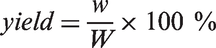
Yield of degumming
The yield of degumming was calculated using Equation (1):
Degree of polymerization test
The polymerization degree of ramie fiber was tested according to Chinese standard GB 5888-86, which describes the method of determining the average viscometric polymerization degree of ramie fibers. The determination is made by measuring the intrinsic viscosity of the ramie fiber solution in copper ethylene-diamine solvent.
The ramie fibers were degreased with benzene and ethyl alcohol mixture in a 2:1 (v/v) ratio. The solvent was allowed to evaporate in air at room temperature. The samples were cut into short pieces (1–2 mm). Then the samples were kept in a controlled humidity atmosphere in a closed weighing container until it reached equilibrium water content before removing the materials required for test purposes. Utilizing the titration method, the copper and ethylene-diamine content in the solvent were determined to be 1.01 and 2.03 mol/L, respectively. An Ubbelohde viscometer was used to measure the intrinsic viscosity of the ramie samples.
X-ray diffraction analysis
X-ray diffraction (XRD) patterns were recorded from 2θ = 5–60° with a D/max-RB diffractometer equipped with a graphite monochromator and Cu Kα radiation at λ = 0.154 nm (40 kV, 200 mA).
Mechanical property test
Fiber samples were balanced in standard atmospheric condition (T = 20℃ ± 2℃, relative humidity (RH) = 65% ± 2%) for 24 h before the mechanical test.
Strength and breaking elongation and rupture were tested using a XQ-2 fiber strength instrument in 20℃ and RH 65% condition. The pre-tension was 0.3 cN/dtex, the clamping distance was set with 20 mm and the descending speed of the bottom clamp was 20 mm/min.
The linear density was tested using the gravimetric method. Linear density refers to the weight of 1000-meter long fibers under the official regain of ramie (12%). Linear density was calculated using Equation (2):

Residual H2O2 calibration
The residual H2O2 contents were tested according to international standard BS 7546-1-1992, ‘Hydrogen peroxide for industrial use - Method for determination of hydrogen peroxide content’.
Oxidation reduction potential value
Oxidation reduction potential (ORP) 21 is an important water chemistry parameter and provides a measurement of the oxidizing or reducing capacity of the water. ORP is measured in volts (V) or millivolts (mV) with an oxidation-reduction potentiometer. The more positive the potential value, the greater the species’ affinity for electrons and tendency to oxidize.
The relationship between ORP and the concentrations of the oxidized and reduced forms of a substance is given by the Nernst Equation (3):
22

In this experiment, the ORP value of the degumming solution was determined using a MODEL 421 ORP meter (Dapu Instrument, Shanghai, China).
Chemical oxygen demand test
The chemical oxygen demand (COD) of degumming wastewater was tested according to international standard JJG 1012-2006, ‘On-line Automatic Determinator of Chemical Oxygen Demand (COD)’.
Results and discussion
The effect of anthraquinone on residual hemicellulose
Chemical composition of fiber degummed with and without anthraquinone (AQ)

It is obvious from Figure 1 that the content of residual hemicellulose in degummed ramie fiber increased with the increased dosage of AQ in the degumming solution. That was because AQ can prevent hemicellulose from degrading through a peeling reaction in the alkali condition. The more AQ was added in the degumming solution, the more hemicellulose was retained.
The effect of the dosage of anthraquinone on residual hemicellulose and linear density of degummed fiber (the average value is obtained from five repeated trials).
The linear density increased with the increase of the content of residual hemicellulose. That was because in a certain length of degummed fibers, the more hemicellulose was retained, the heavier these fibers were. Therefore the linear density was greater, according to Equation (2). When the dosage of AQ was over 2%, the influence of residual hemicellulose content began to show a significant effect on linear density; therefore, the linear density of degummed fiber increased sharply between the dosages of 2% and 3%.
The yield of degumming increased with the increase of residual hemicellulose, which was in good agreement with the previous study. 14
The effect of anthraquinone on the polymerization degree of fiber
The polymerization degree can reflect the tenacity of fiber; the higher the polymerization degree of fiber, the higher the tenacity was. The polymerization degree of degummed fiber was the average polymerization degree of all the components in the fiber, mainly dependent on the polymerization degree of cellulose and hemicellulose, which were the main components of the degummed fiber.
AQ can reduce the possibility of the peeling reaction of cellulose and hemicellulose, thus increasing the polymerization degree of cellulose and retaining more hemicellulose in the degummed fiber. The polymerization degree of hemicellulose is low (only 80–200);
23
therefore, when the content of residual hemicellulose in the degummed fiber reached a certain amount (this happened when the dosage of AQ was over 2% (o.w.f.) according to Figure 1), the polymerization degree of the fiber began to fall, which lead to a turning point on the curve in Figure 2. It can be seen from Figure 2 that the polymerization degree increased with increasing dosage of AQ from 0% (o.w.f.) to 2% (o.w.f.), but decreased with further increase in AQ dosage.
Polymerization degree of degummed fiber.
The effect of anthraquinone on the crystallinity of ramie fiber
The XRD patterns of ramie fiber degummed with different dosage of AQ in the oxidation degumming solution are shown in Figure 3. The diffraction peaks at 14.8°, 16.4°and 22.6°show the characteristic crystalline form of cellulose I, and are in good agreement with previous studies.15,16 This indicates that the use of AQ did not cause the crystalline transformation of ramie fiber. The more hemicellulose retained in degummed fiber, the lower the crystallinity of ramie fiber was, which was because hemicellulose is amorphous.
17
It can be seen from Table 3 that the crystallinity of ramie fiber decreased with the increasing dosage of AQ from 0% (o.w.f.) to 4% (o.w.f.).
X-ray diffraction pattern of ramie fiber of different anthraquinone dosages. Crystallinity and residual hemicellulose of degummed fiber

The effect of anthraquinone on tensile properties
Figure 4 reflects that the tenacity of ramie fiber increased with increasing dosage of AQ from 0% (o.w.f.) to 2% (o.w.f.), but decreases with further increase of the AQ dosage. The upward trend of the tenacity is due to the increase of the polymerization degree of fiber. When the dosage of AQ was over 2% (o.w.f.), an excessive amount of hemicellulose was retained, which lead to the increase of the linear density and the fall of tenacity.
The effect of the dosage of anthraquinone on tensile properties of degummed fiber (the average value is obtained from five repeated trials).
It can be seen from Figures 2 and 4 that the tendency of tenacity and polymerization degree of fiber were in good agreement with each other.
The elongation and rupture of fiber showed almost the same trend as the tenacity. Work of rupture, which reflects the comprehensive tensile properties of fiber, increased by 41% when the dosage of AQ increased from 0% (o.w.f.) to 2% (o.w.f.). Therefore, the optimal dosage of AQ can be determined as 2% (o.w.f.).
The effect of anthraquinone on the dosage of H2O2
H2O2 has two kinds of reaction in the degumming process. The first kind of reaction is the oxidation reaction, which can remove the gums in raw ramie; the second kind of reaction is ineffective decomposition, which can do damage to the fiber property. The ratio of the two kinds of reaction can be controlled by the use of AQ.
It can be seen from Figure 5 that when 2% (o.w.f.) AQ was applied in the degumming solution the optimal dosage of H2O2 decreased from 6% (o.w.f.) to 5% (o.w.f.), which means AQ has the function of decreasing the dosage of H2O2 in the oxidation degumming process. That may be because the ineffective decomposition of H2O2 was reduced by AQ; therefore, more H2O2 was used for removing the gum of ramie.
Effect of anthraquinone on the dosage of H2O2: (a) degumming with anthraquinone; (b) degumming without anthraquinone.
The effect of anthraquinone on residual H2O2 in degumming solution
At the beginning of the degumming process, cellulose is covered by a great number of noncellulose components, most of the H2O2 was used for removing the noncellulose components and only a little H2O2 reacted directly on cellulose. At the later stage of degumming, few noncellulose components were retained in the fiber and cellulose was exposed directly to degumming solution. Thus, cellulose was more easily damaged by H2O2 at the later stage of the degumming process.
The residual H2O2 in the degumming solution with 2% (o.w.f.) AQ is lower than that without AQ in the whole degumming process (Figure 6). It can be seen from Figure 6 that the gap between the two curves grew larger over time and reached the highest level at the time of 70 min. During the whole degumming process, the residual H2O2 in the degumming solution with AQ is 11% lower on average than that without AQ. Figures 5 and 6 proved that the addition of AQ reduced the ineffective decomposition of H2O2 and increased the amount of H2O2 used for removing the gums. Therefore, the amount of H2O2 that reacted with cellulose was decreased and the cellulose fiber is less damaged. This can be proved by the properties of fiber in Figures 2 and 4.
Effect of anthraquinone (AQ) on residual H2O2. Effect of anthraquinone (AQ) on the oxidation reduction potential (ORP) value. The effect of anthraquinone in different periods of the degumming process: (a) anthraquinone (AQ) added in 0–80 min; (b) AQ added in 80–120 min.


The effect of anthraquinone on the ORP value of degumming solution
Free radicals (such as·OH) generated by H2O2 have a strong oxidant action on celluloses. The ORP value can reflect the oxidant ability of the degumming solution: a solution with high ORP value has strong oxidant ability. So it can be deduced that the degumming solution with more free radicals has a higher ORP value.
Cellulose fiber can be easily damaged by the excessive free radicals in the degumming process. AQ can act as an iron chelating agent and slow down the speed of the generating pace of free radicals. AQ can also remove the excessive free radicals in the degumming solution; thus, adding proper amount of AQ in the degumming solution can keep the ORP value of the degumming solution in a proper range and prevent the cellulose fiber from over-oxidation.
This can be proved by Figures 7 and 4; when 2% (o.w.f.) AQ was added in the degumming solution, the excessive free radicals were removed and the ORP value of the degumming solution came down by about 250 mV and the tensile properties of degummed fiber were improved correspondingly. (The ORP value reflected the comprehensive oxidant ability of the degumming solution: the ORP value of NaOH, H2O2 and AQ solution was negative and positive and negative, respectively. Therefore, the ORP value can show a negative value in the first 30 minutes when AQ was used.)
The effect of anthraquinone in different periods of the degumming process
AQ was used as the only degumming auxiliary, to exclude the interference of other auxiliaries; when the degumming solution contained H2O2 (from 0 to 80 minutes), NaOH was used to provide an alkali condition for H2O2, as H2O2 does not have the function of degumming without an alkali condition. When the degumming solution did not contain H2O2 (from 80 to 120 minutes), NaOH was used for alkali degumming.
It can be seen from Figure 6, in the time period of 0–80 min, the residual H2O2 in the degumming solution is high. However, in the time period of 80–120 min, the residual H2O2 in the degumming solution is rather low. In order to simulate this process and study the function of AQ in different time periods in the whole degumming process, AQ was added in the degumming solution at 0–80 min and 80–120 min, respectively (as shown in Figure 8). Fiber degummed without AQ (the other degumming condition was the same) was used as a comparison sample.
The effect of anthraquinone (AQ) added in different periods of the degumming process

When AQ was added in the degumming solution in the time period of 80–150 min, during which time the residual H2O2 is low, the content of residual hemicellulose raised by 22.47% compared with the ramie fiber degummed without AQ; this proved the main function of AQ in this time period is acting as the stopping agent of the peeling reaction of cellulose and hemicellulose.
COD and the efficient of degumming
The process of traditional degumming was as follows: acid picking (1 h, room temperature) → First scouring with alkali (2 h, 120℃ or 4 h,100℃) → second scouring with alkali (2 h, 120℃ or 4 h,100℃). The technical route of oxidation degumming was as follows: oxidation degumming (1 h, 85℃) → oxidation degumming (1 h, 100℃) → reducing (1 h, 90℃).
It is clear that the efficient and energy consumption of oxidation degumming is much lower than tradition degumming.
Chemical oxygen demand (COD) of oxidation degumming with 2% (o.w.f.) and without anthraquinone (AQ)

In traditional degumming, the wastewater of the second scouring is used as the degumming solution of the first scouring. Therefore, the discharged wastewater only included the wastewater of the first scouring. In oxidation degumming, the discharged wastewater included the wastewater of oxidation and reducing.
Chemical oxygen demand (COD) of traditional degumming and oxidation degumming

Conclusion
In this paper, the free radical scavenging agent and peeling reaction hold back agent, AQ, was used to improve the properties of ramie fiber in oxidation degumming.
With the optimal dosage of AQ (2% (o.w.f.)), the content of hemicellulose, the yield of degumming, polymerization degree and the work of rupture of the degummed fiber was improved by 17.3%, 7%, 2% and 41%, respectively. The ORP value, which affects the degumming, was also tested; with the addition of AQ, the ORP value came down by 250 mV, which was of benefit for the properties of fiber.
The efficient and energy consumption of oxidation degumming is much lower than traditional degumming due to the shorter technical route and lower temperature used in the whole degumming process. The COD of wastewater of oxidation degumming is 40% lower than that of traditional degumming.
Footnotes
Declaration of conflicting interests
The authors declared no potential conflicts of interest with respect to the research, authorship and/or publication of this article.
Funding
The authors disclosed receipt of the following financial support for the research, authorship, and/or publication of this article: This work was supported by the earmarked fund for the China Agriculture Research System for Bast and Leaf Fiber Crops: CARS-19, the China Academy of Agricultural Science and Technology Innovation Project (ASTIP-IBFC07) and the ‘Xiaoping science and technology innovation team’ (industrialization integrated R & D group of bast fiber biological degumming).