




Abstract
Tourmaline nano powder was used for the first time in the production of poly(ethylene terephthalate) nanofibers. The polymer chips of poly(ethylene terephthalate) and poly(ethylene terephthalate) containing 3 wt% tourmaline powder were obtained. The electrospun nanofibrous mats were produced from both of the polymer solutions prepared by using the polymer chips. The nanofibrous mats were characterized by using scanning electron microscopy, energy dispersion spectroscopy and Fourier transform infrared spectroscopy. In order to investigate the effect of tourmaline additive in the poly(ethylene terephthalate) nanofibrous mat, water contact angle, electrical conductivity and negative ion releasing measurements were performed on the mats. The incorporation of tourmaline in the nanofibers improved the wettability, electricity transmission and anion emitting property of the poly(ethylene terephthalate) mat.
Polyester fiber based on poly(ethylene terephthalate) (PET) has a wide usage in the textile industry due to its good mechanical properties, low density and chemical resistance. On the other hand, polyester fibers have hydrophobic character due to the lack of polar groups. The hydrophobic nature of fibers causes some disadvantages, such as low moisture regain, high electrostatic behavior, pilling and soiling properties. In order to improve physical, chemical and performance properties of polyester fibers, various modification methods have been performed, such as blending with different additives or polymers and changing the cross-sectional shape.1–4 In recent years, polyester composite fibers/nanofibers, including inorganic nanoparticles such as iron, 5 titanium dioxide, 6 montmorillonite, 7 calcium silicate, 8 magnesium hydroxide, 9 silica 10 and perlite, 11 have attracted many researchers’ attention for their potential applications in electronic devices, sensors, filters and medical products.
Electrospinning is an effective method for the production of nanofibrous mats. The nanofibrous mats have a nanoporous structure, light weight and very high specific surface area, which are also attractive to many potential applications such as in filtration, protective clothing and biomedical engineering.12,13
Tourmaline (TM) is a natural boron silicate mineral. The general formula of TM is accepted as XY3Z6(BO3)3Si6O18V3W. In this formula, X (Na, Ca, K, vacancy), Y (Li, Mg, Fe2+, Fe3+, Mn2+, Al, Ti4+, Cr3+,V3+, Zn, vacancy) and Z (Al, Mg, Fe3+, Cr3+, V3+) sites are cationic elements, and V (OH, O) and W (OH, F, O) sites are anionic elements.13–15 TM is a polar crystalline material and exhibits spontaneous surface electric fields especially in small granules.13,16 TM crystals show pyroelectric and piezoelectric characteristics when temperature or pressure conditions change. A TM crystal maintains a pair of electrodes with no supply of external electric energy and can be recognized as permanent electrodes that can generate negative air ions spontaneously and permanently.15,17,18
The TM mineral can emit far-infrared light, deodorize and purify water. TM is used in electronic and smart materials, cosmetic products, tooth polishing agents, paints, decontamination of the environment, promoting of blood circulation and accelerating of metabolism in living bodies. If TM can be loaded into polymeric fibers, its applications can be further expanded to functional health-care products.17,19,20
In the literature, only a few studies were found about TM addition into polymeric fiber/nanofiber structures. Tijing et al. 13 described the mechanical and antibacterial properties of electrospun TM/polyurethane composite nanofibers and discussed 16 the antibacterial functionality of the composite nanofibers decorated with silver nanoparticles. Li et al. 12 characterized the electrospun poly(vinyl alcohol) nanofibers including fiber-TM nano powder and tested the performance of its anion. Wang et al. 19 investigated the negative air ion releasing properties of melt spun PET fibers containing TM. Yu et al. 21 reported the mechanical and filtration properties of poly(lactic acid)/TM melt-blown webs. Kang et al. 22 researched the photocatalytic properties of an electrospun TM/nylon 6 composite mat by incorporating titanium dioxide nanoparticles.
In this study, PET nanofibrous mats containing TM were produced for the first time. The main objective of this study was to investigate the influence of TM additive on wettability, electrical conductivity and negative air ion releasing of the PET nanofibrous structure. Satisfactory results were obtained in terms of the researched properties.
Experimental details
Production of chips and electrospinning
TM powder, which has sizes in the range of 40–800 nm, was purchased from Shanghai HuZheng NanoTechnology Company (China). In order to produce commercially available textile grade chips, PET polymer was supplied by SASA (Turkey). Dichloromethane (DCM, Sigma Aldrich) and trifluoroacetic acid (TFA, Sigma Aldrich) were obtained to be used as the solvents for electrospinning.
Reference PET polymer and PET polymer containing 3% weight ratio of TM (PET/TM) were produced in a pilot-scale polymerization reactor at SASA Polyester Industry. The final polymers were extruded and cooled in a water-bath, granulated in chips and dried. In order to see the contribution effect of TM, titanium dioxide free chips were used. Intrinsic viscosity values of PET and PET/TM chips were measured as 0.63 and 0.66 dL/g, respectively.
The properties of the electrospinning solutions

PET: poly(ethylene terephthalate); TM: tourmaline.
An aluminum cylinder collector rotating at 160 rpm was used to collect the electrospun mats. The applied voltage was 20 kV, and the spinneret tip-to-collector distance was 10 cm. The inner diameter of the metal spinneret was 830 µm. The electrospinning solution was pushed out using a syringe pump at rate of 1.0 ml/h. The spinneret was located over against the collector. To achieve uniform thickness for nanofibrous samples, the solution of 20 ml was electrospun in all cases. All electrospinning experiments were carried out at room conditions.
Characterization
The surface morphological and the chemical analysis of the electrospun nanofibers were characterized by scanning electron microscopy (SEM, Carl Zeiss AG-EVO 40 XVP). The existence of TM elements in the nanofibrous mat was analyzed with energy dispersive X-ray spectroscopy (EDS) attached to SEM. Nanofibrous mats were coated with a thin layer of gold–palladium before analysis. The nanofiber diameter distributions were determined by using ImageJ software (National Institute of Health, USA) on SEM images. The average fiber diameter was calculated from 20 random measurements for each sample.
To analyze the compositions of PET and PET/TM nanofibrous mats, Fourier transform infrared spectroscopy (FTIR) spectra were obtained with a Perkin-Elmer FTIR Spectrophotometer System 2000 within the range of 400–4000 cm–1.
Water contact angle measurements were carried out by using a KSV Modular CAM 200 system. Distilled water was dropped on the mats by means of a micro-pipette. The image of the water droplet was taken by a digital camera within 1 s and the contact angles were measured by using the image analysis software. All measurements were repeated three times for each sample at room temperature and the average of contact angles was calculated.
The electrical conductivity of the electrospun nanofibrous mats were measured with an ENTEK Four Probe Conductivity Meter at room temperature. The mats were placed on the measurement area and four probe heads of the instrument were lowered on the sample. The distance between the probes was 1 mm.
The concentration of negative air ions emitted from PET and PET/TM nanofibrous mats were determined by using the Air Ion Counter Detector (AlphaLab, Inc.) based on the Gerdien Tube, as described by Bartusek et al.
23
The detector (Figure 1) measures ion density as the number of ions per cubic centimeter in air up to 2 million ions/cc. An electric field occurs between the outer electrode (S1) and the inner electrode (S2) by means of a voltage source (U). Air ions flow from the fan through the tube. Negative ions in the electric field impact the inner electrode and the current produced is measured by a pA-meter. The measured current is proportional to air ion concentration. The measurements were carried out under frictional conditions by rubbing the electrospun mats with themselves manually at room temperature. The maximum concentration determined at the end of the first minute was used as the average concentration of negative air ions emitted from the electrospun mats.
Gerdien Tube method.
23

Results and discussion
SEM-EDS analysis results
SEM images and diameter distribution graphs of the nanofibrous mats are given in Figure 2 and also the spectra of EDS analysis for the nanofibrous mats are shown in Figure 3.
Scanning electron microscopy images and graphs of fiber diameter distribution of poly(ethylene terephthalate) (PET) (a) and PET/tourmaline (TM) (b) nanofibrous mats (blue arrows: TM particles on the mat; black arrows: TM particles in the nanofibers; color online only). Energy dispersive X-ray spectroscopy spectra of poly(ethylene terephthalate) (PET) (a) and PET/tourmaline (TM) (b) nanofibrous mats.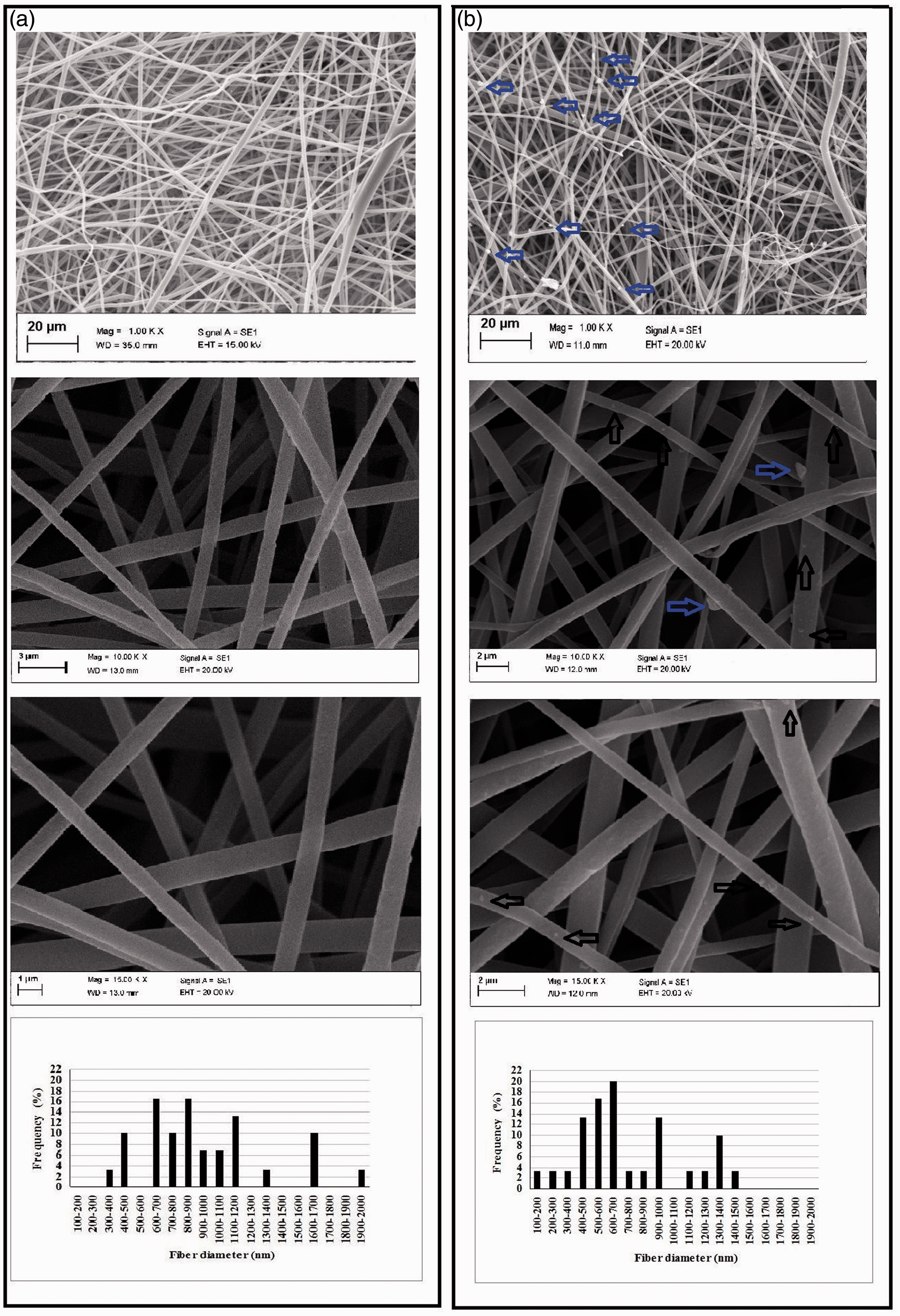

SEM photographs showed that the electrospun PET and PET/TM nanofibrous mats were composed of randomly oriented nanofibers with a wide range of diameters. Bead-free, continuous and smooth fiber formations were observed for both of the nanofibrous mats. The average fiber diameters of the nanofibrous mats produced from PET and PET/TM solutions were 804 ± 393 and 645 ± 458 nm, respectively. The diameters and diameter variations of polyester nanofibers were high, as in earlier studies.24,25 The decrease in fiber diameters for the PET/TM mat was attributed to the increase in conductivity and to the decrease in viscosity of the PET/TM solution. It was confirmed through SEM images that TM was incorporated on the surface of PET nanofibers or fully embedded in the nanofibers.
According to EDS analysis, while only two peaks belonging to C and O were found for the PET nanofibrous mat, typical TM elements such as Na, Mg, Al, Si, K, Fe, F, Ca, Zn, Cr, Mn were also observed for the PET/TM nanofibrous mat. This situation proved that the PET/TM nanofibrous mat contained TM nanoparticles. It was understood that fluorine was mainly in the structure of TM, which was used in the study.
FTIR analysis results
FTIR spectra of PET and PET/TM nanofibrous mats are presented in Figure 4.
Fourier transform infrared spectroscopy spectra of poly(ethylene terephthalate) (PET) (a) and PET/tourmaline (b) nanofibrous mats.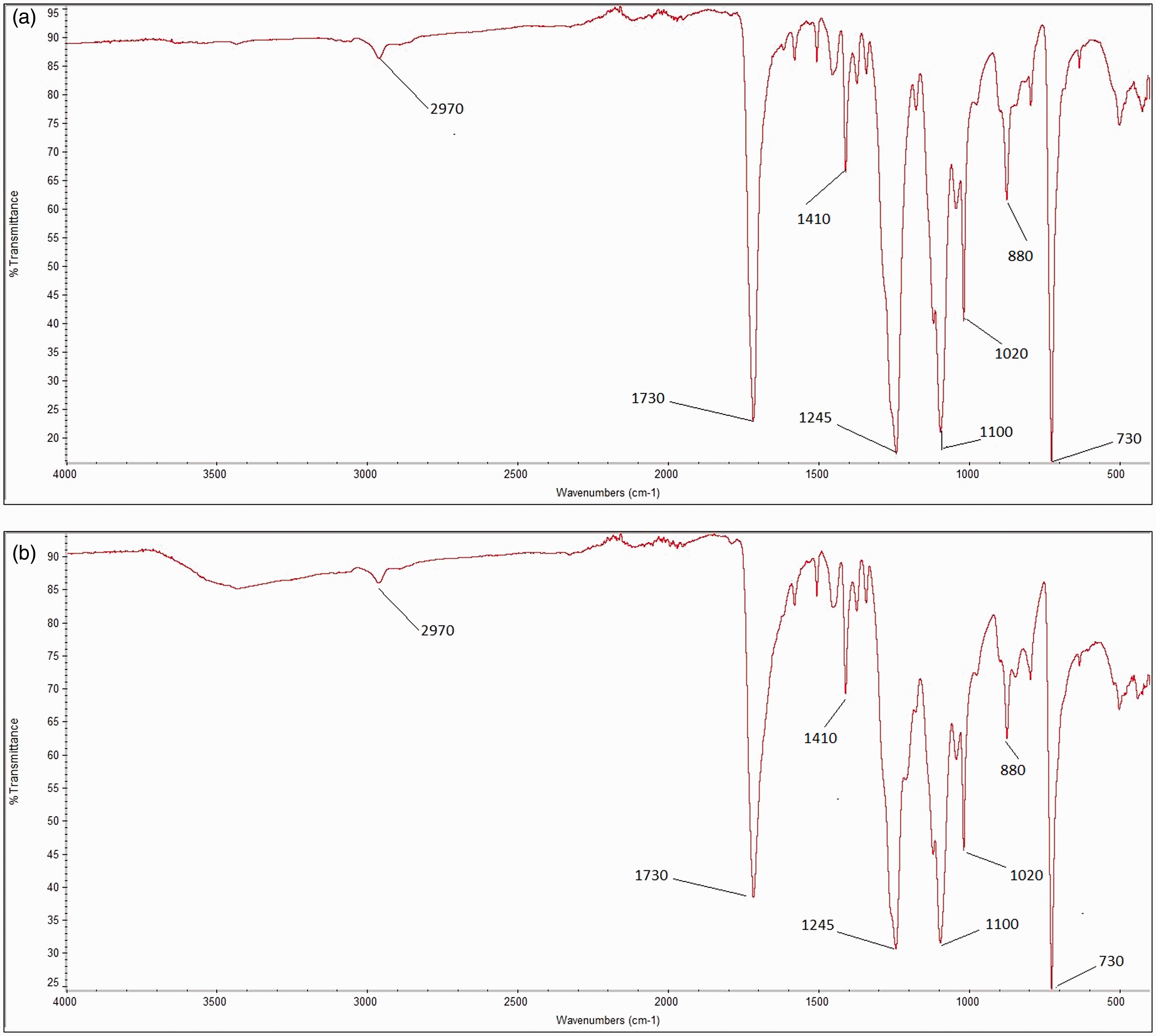
In the FTIR spectra of PET and PET/TM nanofibrous mats, the main absorption bands of PET have been assigned as follows:1,26,27 the band at 3100–2850 cm−1 was attributed to the C–H bond stretching in the aromatic ring and aliphatic groups, at 1730 cm−1 to the C = O bond stretching in the ester groups, at 1320–1420 cm−1 to the bending and wagging vibrations of the ethylene glycol segment, at 1245 cm−1 to the C–O bond stretching vibration in the ester groups, at 1100 cm−1 to the stretching of the ester C–O–C bond, at 1020 cm−1 to in-plane bending of the C–H bond in the aromatic ring, and at 730 cm−1 to out-of-plane bending of the C–H bond in the aromatic ring.
On the FTIR spectrum of the PET/TM nanofibrous mat, the shifts at 1200 cm−1 and at the region of 3100–3700 cm−1 were observed due to the addition of TM nanoparticles. It was concluded that the weak peak at 1200 cm−1 was the C–F bond stretching 28 due to the existence of fluorine in the TM. The wide band in the 3100–3700 cm−1 region was attributed to the OH groups in TMs.29,30 The O–H stretching band, which was not observed in the spectrum of the PET nanofibrous mat, might indicate the presence of molecular interactions such as hydrogen bonding between TM and PET.
Water contact angle measurement results
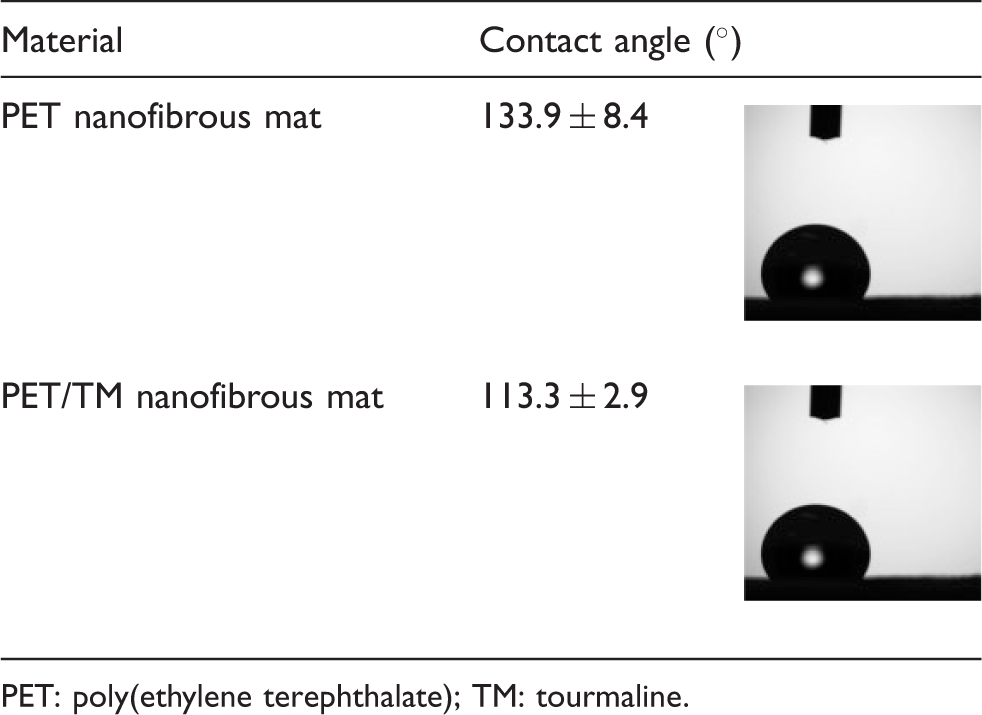
The contact angles of the electrospun nanofibrous mats.
PET: poly(ethylene terephthalate); TM: tourmaline.
For heterogeneous structures like textile materials, the contact angle depends on various factors such as a material’s chemical composition, polar groups, molecular orientation, porosity and surface morphology. 2 Investigations13,16 revealed that TM can change the hydrogen bond arrangement due to its surface electric field. The TM mineral has a permanent polarity and releases hydroxyl ions, forming hydrogen bonds with water molecules, so the TM additive can change the wetting properties of materials. As expected in this study, TM content reduced the contact angle value of the PET/TM nanofibrous mat compared to the PET nanofibrous mat. Thus, TM showed the potential to develop the wettability of PET nanofibers.
Electrical conductivity results
The electrical conductivity results of the electrospun nanofibrous mats.

PET: poly(ethylene terephthalate); TM: tourmaline.
The electrical conductivity of PET polymer is relatively low as compared with other main synthetic polymers. Therefore, PET polymer is used for the production of electro isolating materials. Electrical conductivity in normally insulating polymers results from the migration of ionic impurities and it is affected by the mobility of these ionic species. Absorption of water increases the mobility of ionic species, which also reduces volume resistivity and increases electrical conductivity.31,32
One of the most important properties of TM is its electric property. TMs have spontaneous and permanent poles, which form electrostatic fields around TM particles. Under the effect of the electrostatic field of TM, water molecules are electrolyzed and hence produce active molecules of H3O+ and OH–. The former attracts impurities to the TM surface and the latter combines with water molecules to form negative ions. 33 In this study, it was concluded that the addition of TM into PET nanofibers developed the water absorption of the electrospun mat and, hence, the electrical conductivity of the resulting nanofibrous mat increased approximately six times.
Negative air ion measurement results
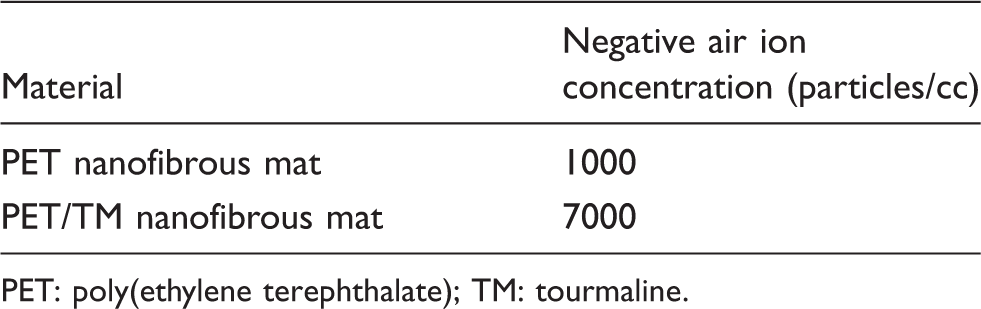
The negative air ion values of the electrospun nanofibrous mats.
PET: poly(ethylene terephthalate); TM: tourmaline.
The ionization of the air causes the conversion of the adjacent water and oxygen molecules into negative oxygen ions. The oxygen ions move in the air and transfer negative charges to dust particles, smoke particles and water droplets, resulting in purification of the air. Negative ions present in air are generally recognized as being capable of exhibiting an invigorating effect on living bodies by normalizing the nervous system. Biological functions of the person under the influence of negative ions is improved, such as sleep stimulation, good mood, activation of body cells, acceleration of metabolism, blood circulation, fatigue recovery and so on.19,20
The negative ion value of the PET/TM nanofibrous mat, including TM nanoparticles that have pyroelectric and piezoelectric characteristics, increased significantly (seven times). At that rate, the PET/TM nanofibrous mat completely met the standard of the World Health Organization, which requires the anions number to be more than 1000 particles/cm3.
Conclusions
In this study, a PET nanofibrous mat containing TM nanoparticles was prepared by the electrospinning process and was compared with neat a PET nanofibrous mat. The presence of TM in the electrospinning solution increased the electrical conductivity and decreased the viscosity, resulting in thinner nanofiber diameters for the PET/TM composite mat. SEM, EDS and FTIR characterizations confirmed the presence of TM nanoparticles in the PET nanofibrous mat and the interaction of the TM to PET structure. The contact angle of the PET/TM nanofibrous mat decreased to approximately 113° from 134° for the PET mat. Thus, the contribution of TM into PET nanofibers improved its hydrophilicity. The electric conductivity and negative air ion concentration of the pure PET nanofibrous mat were 7.6 × 10⁻² siemens/m and 1000 particles/cc, respectively. The contribution of TM into PET nanofibers, which has arresting characteristics such as surface electric fields, pyroelectric and piezoelectric under temperature and pressure conditions, increased the electric conductivity approximately six times and the negative air ion concentration seven times. The present results suggested that the PET/TM composite nanofibrous mat might be a potential candidate for use in health protective, filtration, electronic device and medical applications.
Footnotes
Acknowledgement
The authors thank to SASA Polyester Industry Corporation (Adana) for their cooperation in the chip production stage.
Declaration of conflicting interests
The authors declared no potential conflicts of interest with respect to the research, authorship and/or publication of this article.
Funding
The authors received no financial support for the research, authorship and/or publication of this article.