



Abstract
This paper presents an experimental study on the vibration isolation performance of weft-knitted spacer fabrics under forced harmonic excitation. The weft-knitted spacer fabrics with two different thicknesses were first designed by varying the linking distance of the spacer monofilament and fabricated using an electronic flat knitting machine. Then, their vibration isolation performance was tested under forced vibration condition via sinusoidal sweeps from low to high frequencies. The typical acceleration transmissibility curve and effects of fabric thickness, load mass and excitation level were discussed in detail. The results obtained show that the thicker spacer fabric has a lower resonance frequency than the thinner fabric due to lower stiffness, and thus can isolate the vibration at a lower frequency level. The results also show that changing the load mass and excitation level changes the loading conditions of the fabric structure, and thus also changes fabric stiffness and vibration isolation performance due to nonlinear behavior of spacer fabrics. It is expected that this study could provide some useful information to promote the application of weft-knitted spacer fabrics for vibration isolation.
The human body is sensitive to vibrational environments coming from electrical and pneumatic powered rotary tools and processes in mining, quarrying, demolition and road construction, 1 which may cause discomfort and disease. For example, workers with considerable exposure to hand-transmitted vibrations may develop hand arm vibration syndrome (HAVS) such as vibration-induced white finger (VWF) and peripheral neurological disorders. To buffer vibration effects on the human body, passive anti-vibration materials such as rubber and polyurethane foams have been made into car cushions, anti-vibration gloves and so on.2–5 However, these conventional anti-vibration materials are not very comfortable due to their low air and moisture management. Knitted spacer fabrics could be an alternative choice for vibration isolation because they can provide better thermophysiological comfort for the human body.
Knitted spacer fabrics are a type of sandwiched textile structure consisting of two outer layers that are connected but kept apart by a spacer layer of monofilaments. Because of this structural feature, knitted spacer fabrics have been developed for a number of applications such as compression bandages and wound dressings,6–10 sound attenuation,11,12 concrete reinforcement,13,14 geotextiles,15,16 solar thermal insulation, 17 impact protection18–20 and piezoelectric effect for energy harvesting. 21 Knitted spacer fabrics with unusual behaviors, such as negative Poisson’s ratio22–24 and negative stiffness, 25 have also been developed. There is no doubt that knitted spacer fabrics can also be developed to reduce the magnitudes of sportive and occupational vibrations due to their versatility and good mechanical performance. However, relevant studies are still very limited.
At present, there have been very few studies conducted on the vibration properties and isolation performance of knitted spacer fabrics. Blaga et al.26,27 used impact tests to study the dynamic response of both warp- and weft-knitted spacer fabrics along different fabric directions based on the transmissibility curves obtained from the fast Fourier transform. Arabzadeh et al. 28 built mathematical models for the free vibration of multi-layer warp-knitted spacer fabrics under impact force. They found that decreasing the fineness and length of monofilaments and increasing their density could increase the transmitted force. Liu and Hu 29 studied the vibration isolation properties of warp-knitted spacer fabric top-loaded with a mass, and found that the resonance frequency measured by the vibration test matched with the quasi-static compression curve. However, these studies were mostly focused on warp-knitted spacer fabrics. Until now, studies on the vibration isolation performance of weft-knitted spacer fabrics are still needed.
This paper presents an experimental study on the vibration isolation performance of weft-knitted spacer fabric under forced harmonic excitation. Compared with warp-knitted spacer fabrics, weft-knitted fabrics have a greater extensibility and can better conform to the shape of an object due to the loop nature of weft-knitted stitches. In addition, elastic yarns can be easily used for knitting weft-knitted spacer fabrics to increase fabric elasticity. As a result, they are more suitable for producing products for vibration isolation, such as anti-vibration gloves. On the other hand, it is well known that the main approach to achieving good vibration isolation is to reduce the dynamic stiffness of isolation material. Previous studies25,30 have already shown that a thicker weft-knitted spacer fabric has lower stiffness. Hence, to reduce the stiffness of weft-knitted spacer fabrics for obtaining a low resonance frequency in vibration isolation, the use of thicker spacer fabrics is recommended. However, the thickness of weft-knitted spacer fabrics is usually low due to the limitation in adjusting the distance between two needle systems in a weft knitting machine. Therefore, relatively thick knitted spacer fabrics are realized by a proper fabric design in this study. In order to test the vibration isolation performance of these spacer fabrics, a vibration test system with a mass loaded on the upper layer of spacer fabric was used. The effects of different factors, such as fabric thickness, load mass and excitation level, on the vibration transmissibility of the mass-spacer fabric system are discussed. It is expected that this study could strengthen the understanding of the vibration behavior of weft-knitted spacer fabrics, and provide some useful information to promote their applications in anti-vibration.
Preparation of fabric samples
Design of fabric structure
Due to the limited distance between two needle systems in a weft knitting machine, a special fabric structure was first suggested to fabricate thicker weft-knitted spacer fabrics by employing a longer linking distance of spacer monofilaments to knit the spacer layer and elastic yarns to knit the outer layers in this study. As shown in Figure 1(a), the suggested spacer structure is constructed of two outer layers knitted with elastic yarns in single jersey and a spacer layer knitted with tuck loops using monofilaments in an “X” shape. As the outer layers are knitted with elastic yarns, they will shrink after a steaming treatment, causing the inclined monofilaments to rotate to the thickness direction of the fabric structure and thus making the fabric thickness increase, as shown in Figure 1(b). If different linking distances of spacer monofilaments are adopted, spacer fabrics with different thicknesses can be easily realized. In fact, this design concept has been used in the development of spacer fabrics with negative stiffness.
25
Design concept of weft-knitted spacer fabric structure: (a) before steaming treatment; (b) after steaming treatment.
In order to obtain a spacer fabric that is as thick as possible, a linking distance of 20 needles, which is the maximum distance for a normal knitting process, was first selected after a series of preliminary trials, as shown in Figure 2(a). Beyond this distance, knitting becomes very difficult as needles for tucking could not catch the monofilaments well, causing knitting defects. On the other hand, in order to study the effect of the fabric thickness, the linking distance was reduced to 12 needles to obtain a thinner spacer fabric but still having sufficient thickness for good vibration isolation for comparison, as shown Figure 2(b). The two fabric structures were named Spacer-20h and Spacer-12h, where the number indicates the floating distance of each monofilament between two tucking points on the same needle bed, and “h” indicates only half numbers of needles knitting tuck stitches. From Figure 2, it can be seen that the tuck positions are evenly distributed. It should be pointed out that as the cross-over structure of the spacer monofilaments in the “X” shape along the course direction makes the fabric structure balanced under compression loads, the transverse shift along the courses of the fabric does not arise. It is possible to let all needles knit tuck stitches. However, twofold monofilaments limit the shrinkage of the outer layers during the steaming treatment, resulting in relatively low fabric thickness, which limits the range of displacement under vibration. Therefore, the structure with all needles knitting tuck stitches was not adopted in this study.
Fabric structures with different linking distance of spacer monofilaments: (a) Spacer-20h; (b) Spacer-12h.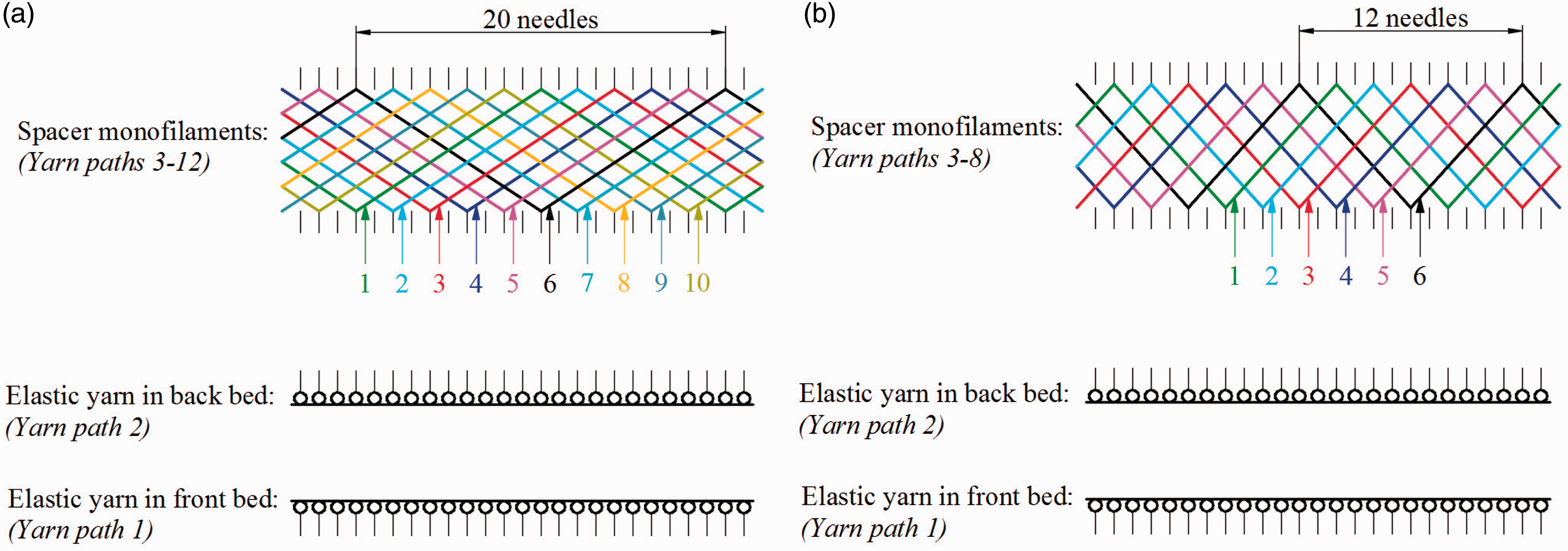
Fabrication of fabric samples
The characteristics of the two weft-knitted spacer fabrics

Note: Standard deviations are given in parentheses.
Figure 3 shows the cross-sectional views of the as-fabricated weft-knitted spacer fabrics. It can be found that the cross-sectional views along the course direction and the wale direction are different. Along the course direction, spacer monofilaments have a crossed structure. However, along the wale direction, spacer monofilaments have a curved shape. Moreover, linking points A and B of each monofilament with two outer layers are not located on the same vertical line. This dislocation between A and B should be taken into consideration when preparing the fabric samples for vibration testing.
Cross-sectional views of spacer fabrics produced: (a) and (c) Spacer-20h; (b) and (d) Spacer-12h.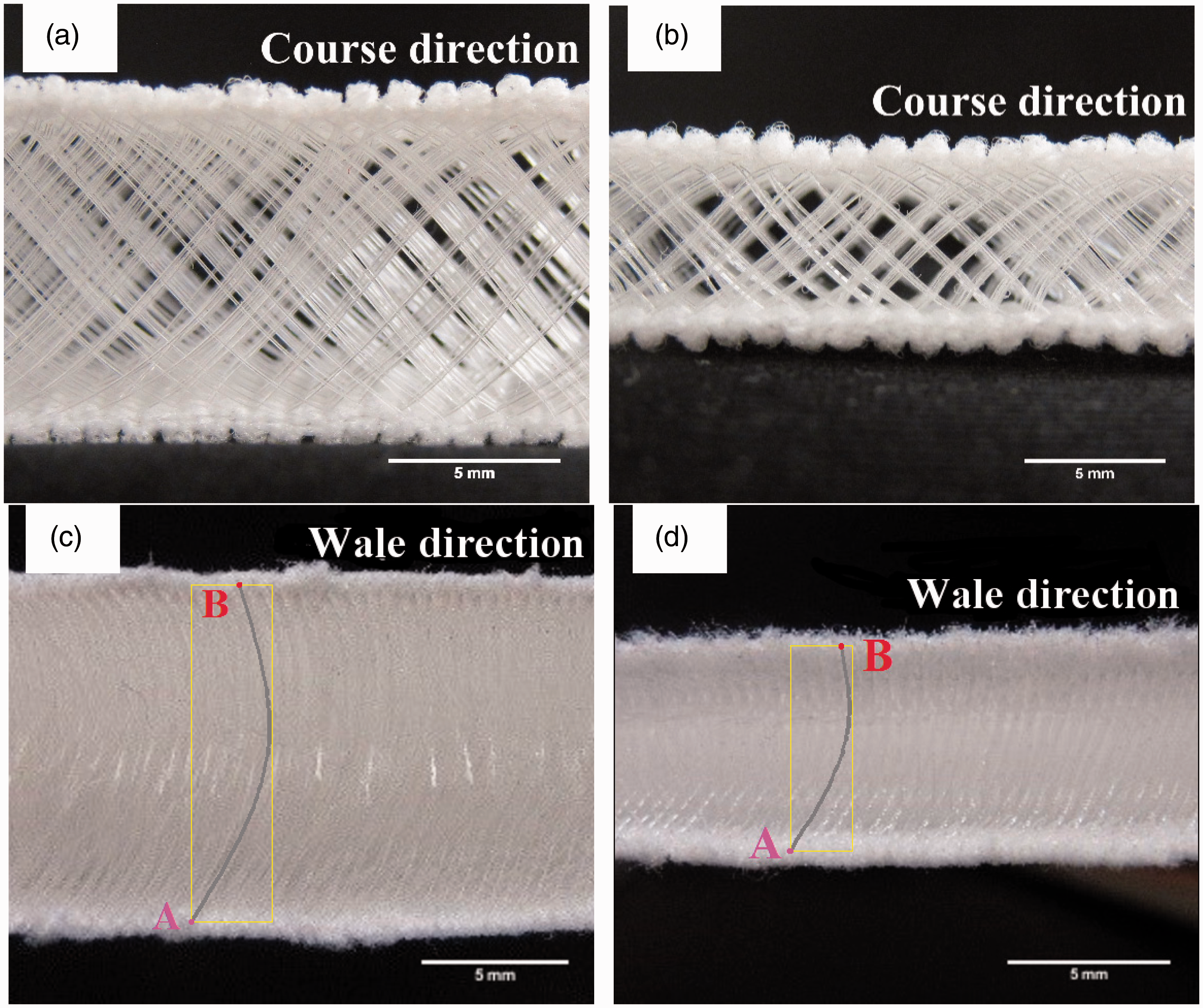
Fabric lamination
As mentioned before, all the monofilaments have a curved shape in the wale direction view. The formation of this shape mainly comes from the bending moments developed at the linking points by tuck loops. As shown in Figures 3(c) and (d), the linking points A and B for each monofilament are not located on the same vertical line in the fabric thickness direction. The main reason is that the courses where points A and B are located are not knitted simultaneously. As points A and B of each monofilament are not on the same vertical line, the transverse instability could take place along the wale direction when a single spacer fabric is subjected to a vibration test under a loaded mass. In order to circumvent the undesirable transverse shift along the wale direction of the spacer fabric structure during vibration tests, two identical spacer fabrics were bonded together using a double-sided adhesive tape, as shown in Figure 4(a). Thus, point A and point C are located on the same vertical line. In this case, the topmost layer and the base layer of the laminated fabric can maintain opposite to each other under the mass loaded, as shown in Figure 4(b). As two fabrics are bonded together, the relative slip between the two fabrics can be avoided. In this way, the transverse motion of the spacer fabric has no interference on the vertical motion of the mass-spacer fabric system.
Schematic of fabric structure with two identical fabrics laminated together: (a) before compression; (b) under compression.
Vibration test
A vibration test system EM-400F3K-30N80 manufactured by the King Design Instrument Technology (Kun Shan) Co., Ltd was used to measure the vibration transmissibility of laminated weft-knitted spacer fabrics. The system mainly consists of an electromagnetic vibration shaker equipped with a vertically connected 35 cm × 35 cm square platform made of aluminum, a digital vibration controller VCS 102, a high power amplifier and protector, and a cooling blower. The schematic of the system is shown in Figure 5. The controller VCS 102 has one output channel (Output) and two input channels (Input 1 and Input 2), and generates voltage signals transmitted through the power amplifier to drive the shaker platform to vibrate at predefined frequencies and excitation levels. Then, acceleration signals measured by two accelerometers respectively mounted on the shaker platform (Accelerometer 1) and the load mass (Accelerometer 2) were sent back through Input 1 and Input 2 to the controller for data acquisition. It should be noted that Accelerometer 1, Input 1, Controller and Output form a feedback control system to ensure that the shaker platform vibrates correctly according to the predefined profile. The controller was also connected to the test software of a PC for waveform display and analysis. The cooling blower cooled down the shaker for safety purposes.
Schematic of the vibration testing system.
The mounting of two accelerometers for measuring the acceleration transmissibility of the mass-spacer fabric system is shown in Figure 6. The spacer fabric to be tested is placed on the center of the shaker platform and top-loaded with a metallic mass. The accelerometer stud-mounted on the shaker platform was a Brüel & Kjær 4514-004 accelerometer with a sensitivity of 50.9 mV/g and an acceleration range of 100g, where g is the gravitational acceleration (9.81 m/s2). The other accelerometer, PCB 352A56, with a sensitivity of 101.7 mV/g and an acceleration range of 50 g was adhesively mounted on the center of the load mass using petro wax.
Photo of the mass-spacer fabric system and the mounting of two accelerometers.
The size of the fabric sample and that of load mass were selected by referring to the International Standard BS EN ISO 13753:2008. 31 According to this standard, the material to be tested shall contain a circular area of no less than 45 mm in radius; in addition, the load block shall be a circular cylinder with a radius of 45 mm and a mass of 2.5 kg. However, due to the nearly orthotropic material properties of the weft-knitted spacer fabric structure, it would be appropriate to have fabric samples cut into a square shape rather than a circular one. Consequently, spacer fabric samples used were cut into a size of 150 mm × 150 mm. In order to weaken the edge effect and avoid mass eccentricity, square steel blocks with a surface area smaller than that of spacer fabric samples (90 mm × 90 mm), but with different masses, were used as the load masses.
The shaker was excited by sinusoidal sweeps from 4 to 500 Hz with a sweep rate of 1.0 Oct/min. It should be noted that the sweep rate has an influence on the transmissibility behavior of fabric. With a high sweep rate, the response of the system may have not yet reached steady state before the driving frequency moves to the next magnitude. With a low sweep rate, however, the amount of time spent becomes greatly prolonged, thus bringing another problem that involves the fatigue and viscoelasticity of materials. Consequently, a compromise between both requirements for the sweep rate is needed to ensure the reliability of results. After a series of trials, it was found that a sweep rate of 1.0 Oct/min could ensure the reliability of results for this kind of knitted spacer fabrics. During each sweep process, the excitation level was kept constant. Three excitation levels, namely, 0.1, 0.2 or 0.3g, were selected. It should be noted that excitation amplitude decreased as the driving frequency increases. Five different load masses from 1 to 5 kg were used. Acceleration transmissibility values at desired frequencies were obtained during tests. Three replications were carried out for each testing condition.
Quasi-static compression test
In order to better understand how the nonlinear behavior of spacer fabrics affects the vibration isolation performance, a quasi-static compression test was also conducted for the laminated fabrics on an Instron tester 5566 installed with two compression platens. The compression speed was set as 12 mm/min and the maximum compression strain was chosen as 60% of the original fabric thickness. The sample size used was 90 mm × 90 mm, the same as that of load blocks.
Results and discussion
Typical transmissibility curve
The vibration isolation performance of the weft-knitted spacer fabrics was evaluated by the acceleration transmissibility T, which is defined as the ratio of the acceleration of the load mass to that of the shaker platform. As shown in Figure 7, a typical curve of T as a function of the excitation frequency obtained for Spacer-12h when tested under 0.3g excitation level and 2 kg load mass is selected as an example to explain the vibration isolation performance of this type of spacer fabrics. Although the tests were conducted from 4 to 500 Hz, all the acceleration transmissibility curves shown afterwards are only until 100 Hz to get a better demonstration. From Figure 7, it can be seen that under low excitation frequencies, the acceleration transmitted from the platform to the mass approximately equals the excitation level. However, with increasing the excitation frequency, the transmissibility rapidly increases until the resonance peak. The transmissibility reading above one unit ( Typical acceleration transmissibility curve for Spacer-12h under 0.3g excitation level and 2 kg load mass.
To achieve a wider isolation region, the resonance frequency fr should be reduced. In a linear single-degree-of-freedom (SDOF) system, the curve shape near the resonance peak looks symmetric. In such a system,
32
fr is related to the dynamic stiffness kd and the load mass m, and is defined by equation
Therefore, an ideal isolator should keep the dynamic stiffness as low as possible. However, due to the nonlinearity of weft-knitted spacer fabric, the value of kd is affected by the load mass, the fabric thickness and the excitation level. For this reason, the following sections will discuss the effects of these factors on the isolation performance of the mass-spacer fabric system. For better comparison, two physical quantities, the resonance frequency fr and the cross-over frequency fc, are selected. Since the amplification region is to be avoided during the use, the peak transmissibility
Effects of fabric thickness and load mass
Under the same excitation level, the effect of the fabric thickness on the vibration isolation performance also depends on the load mass due to nonlinear behaviors of spacer fabrics under both static and dynamic loading conditions. In other words, the spacer fabrics will be deformed at different compression strains and will have different stiffness when the load mass changes. In this regard, the effects of the fabric thickness and load mass are discussed together in this section. For ease of discussion, only the testing results for one excitation level of acceleration are presented here. The effect of the excitation level will be discussed in the next section.
Figures 8(a) and (b) respectively show the transmissibility curves of Spacer-20h and Spacer-12h with different load masses when the excitation level is kept at 0.1g. It can be seen that the resonance peaks of the transmissibility curves shift to the left-hand side when the load mass increases. This implicates that fr and fc decrease with the increase of the load mass (Figure 8(c)). However, as shown in Figure 8(a), an exceptional case is found for Spacer-20h when the load mass increases from 4 to 5 kg. In this case, the transmissibility curve with 5 kg load mass shifts back to the right-hand side instead of shifting to the left-hand side, resulting in a slight increase of fr and fc, as shown in Figure 8(c). When observing the effect of the fabric thickness, it can be found that fr and fc of Spacer-20h are smaller than those of Spacer-12h, indicating that fr and fc decrease with the increase of the fabric thickness.
(a) and (b) Transmissibility curves under 0.1g excitation level with load mass varied. (c) Variation of fr and fc with load mass.
The above phenomena can be explained by stiffness changes of spacer fabrics when the load mass changes. As shown in Figure 9, the quasi-static compression curves of both laminated Spacer-20h and Spacer-12h are nonlinear, which indicates that their static stiffness ks cannot be kept constant under different compression loads. It can be seen that although the compression curves of the two spacer fabrics are very different, the variation trends of their static stiffness ks are very similar. This is that ks first increases at the very beginning stage, then slightly decreases and finally rapidly increases due to the compaction of the fabric structure under high compression loads. However, the ks values of the two fabrics are different. It should be pointed out that under the vibration condition, the dynamic stiffness kd should be used to explain the vibration isolation performance of spacer fabrics. According to the quasi-static compression curves in Figure 9, it can be derived that the compression behavior of two weft-knitted spacer fabrics is similar to that of damping materials. Therefore, their dynamic stiffness kd should be different from their static stiffness ks due to history-dependent mechanical properties under vibration condition. In spite of the nonlinear compressive force–displacement relationship of spacer fabrics, under 0.1g excitation level, the vibration is so localized that the mass-spacer fabric system could be treated as linear. Using Quasi-static compression curves (solid line “—”) and stiffness curves ks (dashed line “- -”) of spacer fabrics. kd values of the mass-spacer fabric system for a fixed excitation level at 0.1g
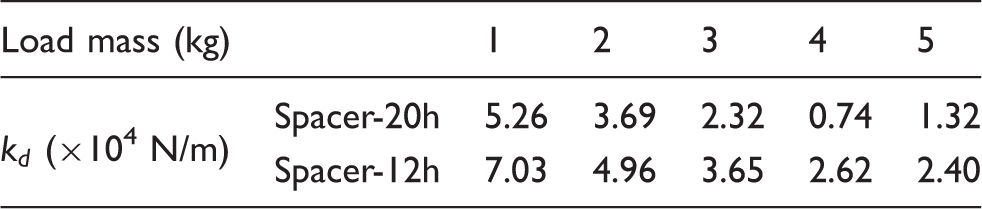
The variation trends of kd also explain why fr and fc decrease with the increase of the load mass, because the kd values also decrease with the increase of the load mass. The exceptional case for Spacer-20h, in which fr and fc increases when the load mass increases from 4 to 5 kg, can be also explained by the kd value change and static compression curve. As shown in Figure 9, when the load mass increases from 4 to 5 kg, Spacer-20h changes into the compaction stage with a rapid increase of stiffness. As the effect of the increase of stiffness is higher than that of the increase of load mass, fr and fc increase when the load mass increases from 4 to 5 kg. Table 2 also confirms that the kd values increase when the load mass increases from 4 to 5 kg.
Effect of excitation level
The previous section discussed the effects of both the fabric thickness and load mass with a fixed excitation level. In this section, the effect of excitation level is discussed with a fixed load mass. Figures 10(a) and (b) respectively show the transmissibility curves of Spacer-20h and Spacer-12h with different excitation levels when the load mass is kept at 2 kg. It can be seen that the resonance peaks of the transmissibility curves shift to the left-hand side when the excitation level increases. This implicates that fr and fc decrease with the increase of the excitation level (Figure 10(c)). From Figures 10(a) and (b), it can be also found that the shapes of transmissibility curves at the resonance peaks become bent to the left-hand side when the excitation level increases, indicating that the mass-spacer fabric system becomes softened. As the increase of softening implicates a decrease of the dynamic stiffness kd, fr and fc decrease with the increase of the excitation level.
(a) and (b) Transmissibility curves under 2 kg load mass with excitation level varied. (c) Variation of fr and fc with excitation level.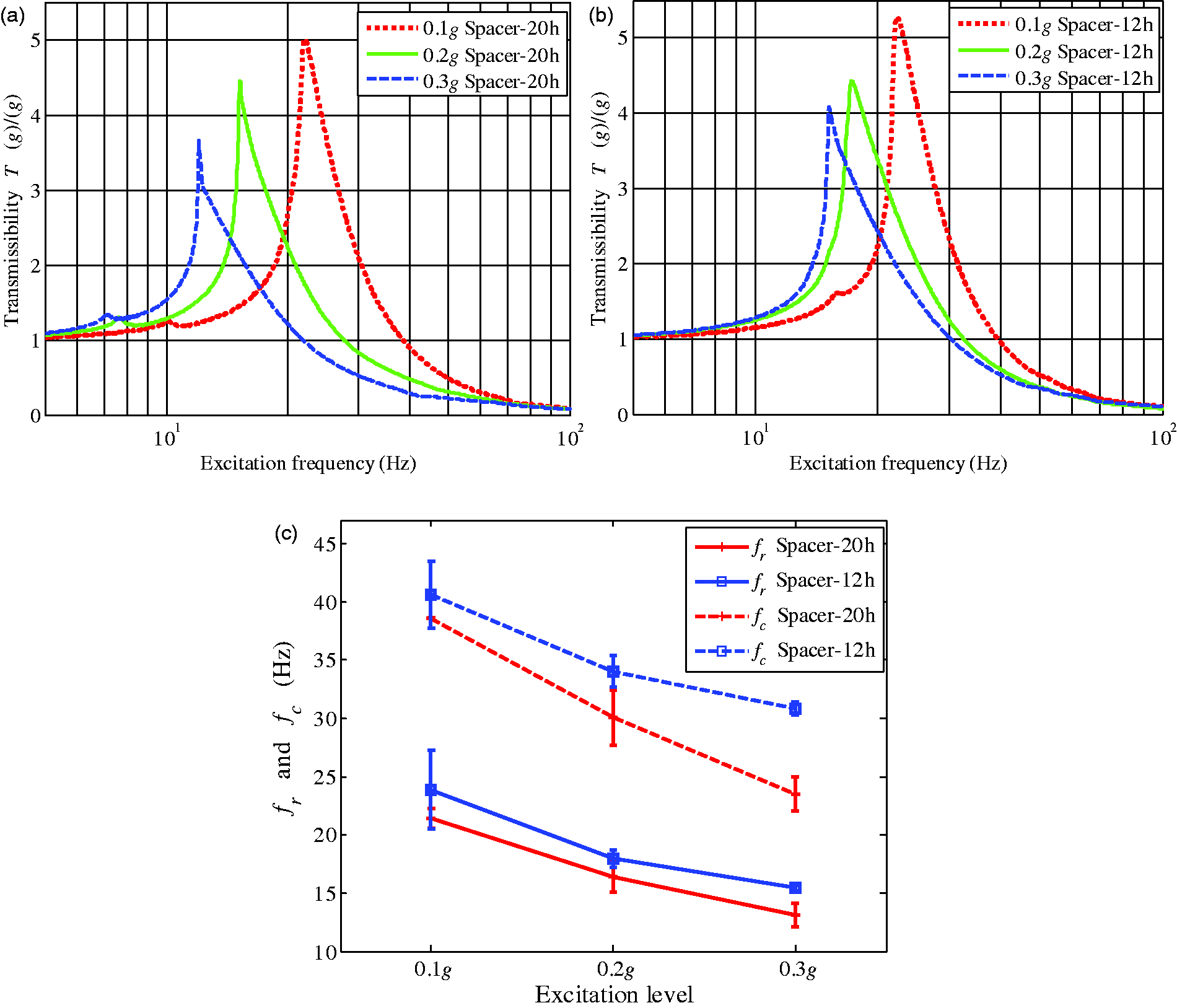
From Figure 10(c), it can also be found that the fr and fc values of Spacer-20h are lower than those of Spacer-12h for all the excitation levels, which confirms again that the thicker spacer fabric has better vibration isolation performance than the thinner spacer fabric. The result in Figure 10(c) also shows that the difference in fr and fc between the two spacer fabrics increase with the increase of excitation level. This may be explained by the fact that at low excitation level, the dynamic loads applied to the fabric are relatively smaller and the two fabrics work at their low deformation regions where the difference of their stiffness is not high. However, with increasing the excitation level, the dynamic loads applied to the fabric increase and the two fabrics will work in different deformation regions where their stiffness becomes more important. The detailed explanation needs a further theoretical analysis by considering the nonlinear softening of the mass-spacer fabric system, which is beyond the scope of this paper.
Conclusions
According to the results above obtained, the following conclusions can be drawn.
The vibration behaviors of weft-knitted spacer fabrics are not linear due to their nonlinear compression force–displacement relationships, which result in different stiffness under different load mass and excitation level. Increasing the fabric thickness can result in a decrease of the resonance frequency and cross-over frequency due to reduction of stiffness, and thus improve the vibration isolation performance of spacer fabrics. The higher load mass normally results in a smaller resonance frequency and a smaller cross-over frequency. However, too high a load mass makes fabric compact, resulting in a higher resonance frequency and a higher cross-over frequency due to a rapid increase of fabric stiffness. Increasing the excitation level results in a smaller resonance frequency and a smaller cross-over frequency, and thus a broadened frequency region for vibration isolation. The nonlinear effect gets more important when the excitation level increases.
It is expected that this study could promote the commercial application of weft-knitted spacer fabrics for the vibration isolation. By proper design of fabric structures, vibration risks in different working environments, such as during transportation and hand arm vibration from operating hand-held power tools, can be reduced. Moreover, this study can be extended to other textile structures for the anti-vibration purpose. Due to the great varieties of textile products, not only weft-knitted and warp-knitted spacer fabrics but also three-dimensional woven and nonwoven fabrics can also be designed as vibration isolators.
Footnotes
Declaration of conflicting interests
The authors declared no potential conflicts of interest with respect to the research, authorship and/or publication of this article.
Funding
The authors disclosed receipt of the following financial support for the research, authorship, and/or publication of this article: This work was supported by the Research Grants Council of HK Special Administrative Region Government (Grant No. 516011).