



Abstract
Stretch woven fabrics are widely used owing to their comfortable properties such as formability, fitting to the human body and shape retention after wearing. These distinguishing properties are determined by stretch and recovery tests. The aim of this study is to determine the optimum elastane draw ratio, load and relaxation type for best stretch and recovery properties of woven stretch fabrics. An optimization model is developed to determine the optimum draw ratio of the elastane core in the yarn, load applied to the fabric and relaxation type for the best response variables of stretch and permanent stretch. The effects of the elastane draw ratio, load applied to the fabric and relaxation type on stretch and permanent stretch properties are found to be statistically significant according to analysis of variance results. Regression models are obtained to estimate the stretch and recovery properties for different elastane draw ratios and load levels. Additionally, the effect of the elastane draw ratio of the yarn on the fatigue properties of woven bi-stretch fabrics is investigated for dry relaxed and laundered states.
Woven fabrics are used for many clothes such as pants, shirts, dresses, suits and jackets. Woven fabrics provide better strength, appearance and fashion properties than their knitted counterparts, but they do not physically fit to the human body, owing to low stretch properties. In recent years, core spun yarns containing elastane have been widely used to increase the stretch properties of woven fabrics. As this type of elastic fabrics can stretch far more than conventional fabrics, they have become more desirable for the wearers and the use of these fabrics has increased gradually. Therefore many researchers have made investigations on the stretch and recovery properties of woven stretch fabrics.
Oğulata et al. studied the prediction of elongation properties of woven bi-stretch fabrics. ANN (artificial neural networks) and linear regression methods were used for predictions. This study demonstrated that, regarding the prediction of elongation properties, both methods showed high predicting power. 1 Baghaei et al. investigated the bagging deformation of elastic woven fabrics for different numbers of cyclic loads, levels of draw ratio of the elastane core in the yarn and twist factor of the yarn. It was determined that the decrease in draw ratio and increase in twist coefficient of core spun yarns lead to a decrease in elastic recovery. Also, the number of cyclic loads was found to be significant on bagging deformation up to 1000 cycles. 2
In another experimental study, the effects of the elastane core spun yarn on fabric abrasion resistance, strength and extension properties were investigated. In this study it was concluded that the presence of elastane core spun yarn in fabric structure improves the abrasion resistance, strength and extension properties of woven fabrics. 3
El-Ghezal et al. examined the impact of the elastane’s ratio and finishing process on the mechanical properties of stretch denim. As a result of this study, it is observed that as the elastane’s ratio increases, the breaking elongation decreases. It should be noted that a consistent trend is not observed for the breaking strength of the sample fabrics. 4
Mourad et al. studied the physical and stretch properties of woven cotton fabrics containing different rates of elastane. In this study, the different rates of elastane on the fabric were obtained by applying the different layout of the elastane yarn in the weft direction. According to the results, it was revealed that higher maximum stretch and fabric elastic recovery are seen as the elastane rate increases. However, it is reported that tensile strength, tear strength, air permeability and permanent stretch decrease as the elastane rate increases. 5
Another experimental study was done to investigate the performance properties of woven fabrics made from cotton/elastane spun yarns that contain different rates of elastane. As a result of the study it is observed that increasing the elastane ratio enhanced the fabric extensibility and air permeability and reduced the tensile strength, shrinkage and permanent stretch of woven fabrics. 6
Gorjanc and Bukosek investigated the behaviors of the one-way and two-way stretch wool fabrics during stretching. Higher elastic extension was observed for two-way stretch fabrics than one-way stretch fabrics. In this study, a significant influence of the percentage of the elastane content in yarn was noted on the elastic extension above the yield point. 7
Özdil presented an experimental study on the performance properties of denim fabrics containing different rates of elastane. The different rates of elastane on the fabric were obtained by applying the different layouts of the elastane yarn in the weft direction. It is reported in the study that, as the elastane content in the fabric increases, tensile and tearing strength decrease and fabrics become stiffer. In the case of stretch properties, it was observed that as the elastane content in the fabric increases, the stretching and maximum stretching percentages increase, whereas the permanent stretching, bagging and permanent bagging values decrease. 8
The effects of weft sett, weft yarn linear density and weave type on the performance properties of one way stretch woven fabrics were investigated by Şekerden and Çelik. According to the results of this study, the effects of weft sett and weft yarn linear density on fabric tensile strength were found to be significant. Also, the important influence of weave type on fabric stretch property was noted. 9
Gürarda and Meriç studied the effects of silicone and pre-fixation temperature on the elastic properties of cotton/elastane woven fabrics produced from nylon/elastane air-covered yarns, which have different elastane draw ratios. Increased elongation values of fabrics were observed as the elastane draw ratio increased. Besides, it is noted that fabrics have a dense, hard and more elastic structure along with high elastane draw ratios. 10
In another study, the effects of elastane denier and elastane draft ratio on the mechanical properties of woven fabrics were examined. As a result of this study, it was revealed that, by using a higher denier elastane in the yarn, the fabric tear strength, stretchability and recovery after stretch increase, whereas the fabric tensile strength decreases. Furthermore, by increasing the elastane draft ratio, the fabric tensile strength and stretchability increase, whereas the fabric tear strength and recovery after stretch decreases. 11
Previous studies showed that the draw ratio of the elastane core in the yarn is the foremost parameter that affects the stretch and recovery properties of woven fabrics. In contrast to earlier research, this study aimed to investigate the effects of the elastane draw ratio on stretch and recovery for different levels of loads. Thus, this study provides a better understanding of the effect of different tension levels on stretch and recovery owing to the elastane draw ratio. It is also intended to examine the effects of load applied to the fabric and elastane draw ratio on stretch and recovery for dry relaxed and laundered states of the samples. It would therefore be possible to clarify the effect of fabric dimensional change on stretch and recovery due to elastane draw ratio and load applied to the fabric. In addition, an optimization technique is used to determine the optimum draw ratio of the elastane core in the yarn, applied load and relaxation type for woven stretch fabrics.
Materials and methods
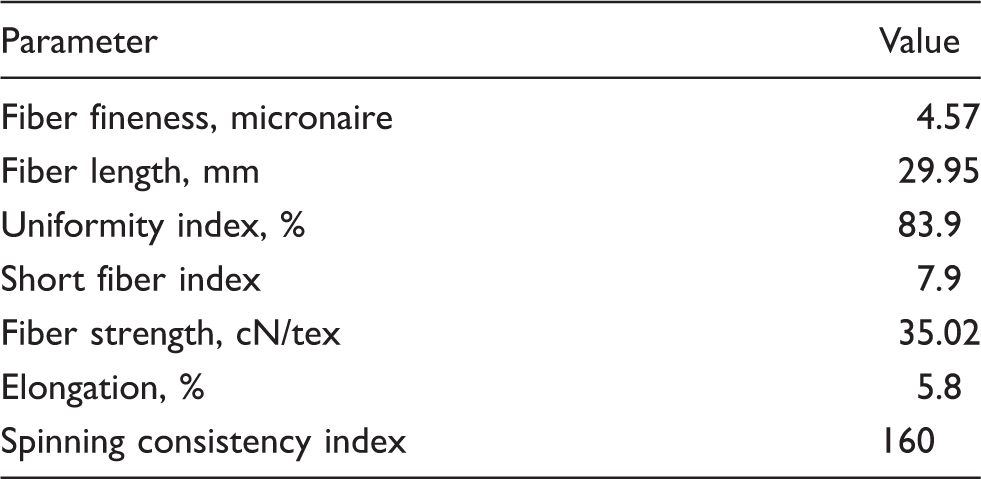
Cotton fiber properties
Properties of sample yarns
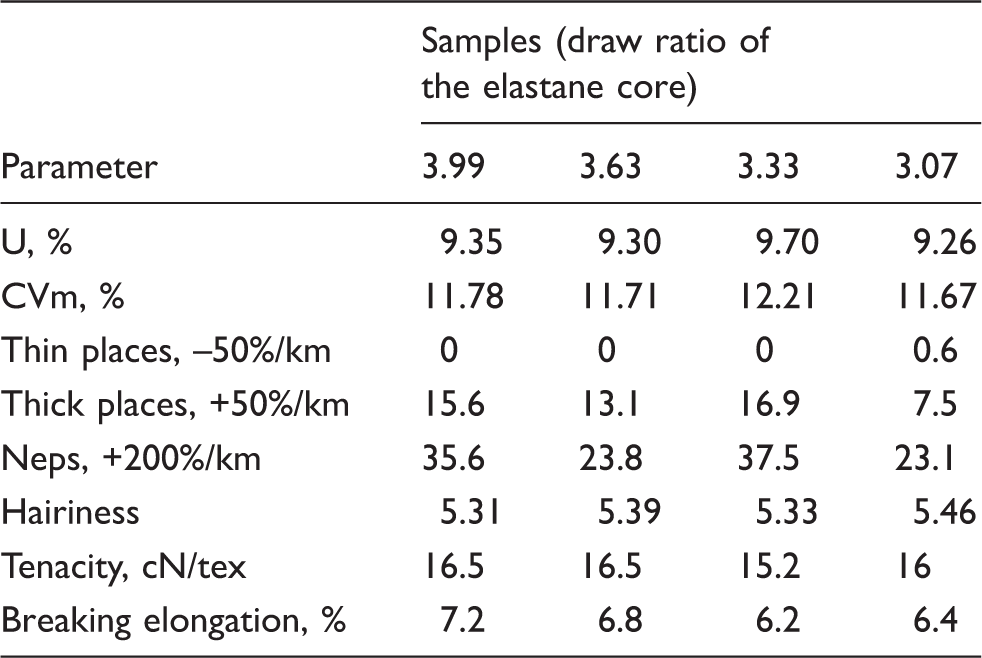
Four woven fabric samples were produced by using these sample yarns as weft with 2/1 twill weave type. A 21 Tex X 2, 65/35 % polyester/viscose, elastane core spun ring yarn was used as warp without sizing. Then the structural properties of fabric weight, fabric density and thickness and performance properties of stretch, permanent stretch and fatigue properties of these samples were determined after dry relaxation and after home laundering. The samples relaxed in the standard atmosphere of 20 ± 2℃ and 65 ± 4% relative humidity for 24 hours for dry relaxation and home laundering was applied according to AATCC 135:2012. 12
Structural properties of the dry relaxed and laundered samples
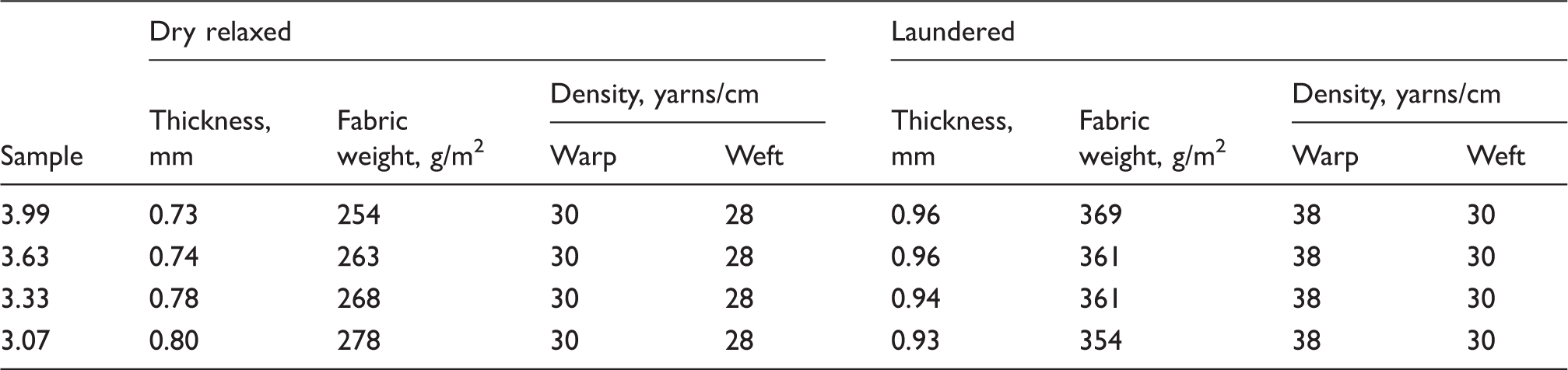
All fabric samples were conditioned according to TS EN ISO 139 16 before the tests, and the tests were performed in the standard atmosphere of 20 ± 2℃ and 65 ± 4% relative humidity. Stretch and recovery properties of the samples were tested according to BS EN 14704-1:2005, 17 . The stretch property of the samples was tested with a CRE type test device to extend the specimen to a specified load principle. Three different loads were applied: 25 N, 30 N and 35 N. Strip shaped samples 50 mm in width and 200 mm in length were used in the testing. Permanent stretch values of the samples were determined with respect to the recovery property of the samples. For this aim, the specimens were applied to 1 hour relaxation after 25 N, 30 N and 35 N loadings. The permanent stretch was determined by the length as the difference between the initial length before loading and after the relaxation period. These values were then expressed as a percentage of the initial length.
In the context of this study, an optimization technique was used to determine the optimum values of the elastane draw ratio of the yarn, load applied to the fabric and relaxation type for the best stretch and recovery properties of stretch woven fabrics. For this aim the ‘numerical optimization’ principle in the Design Expert package program was used. ‘Factorial’ analysis was chosen for optimization and a ‘desirability’ approach was used for the assessments. The fatigue property was determined by a Truburst test device. In this test, the samples were applied to 100 kPa loading five times during 5 s with a 50 cm2 test head and the average height of the samples were obtained as the fatigue height.
Results and discussion
Dimensional change
In this study, two relaxation types were applied to the samples: dry relaxation and domestic home laundering. Dimensional changes of the samples after domestic home laundering for both weft and warp directions are seen in Figure 1.
Dimensional changes of samples after home laundering.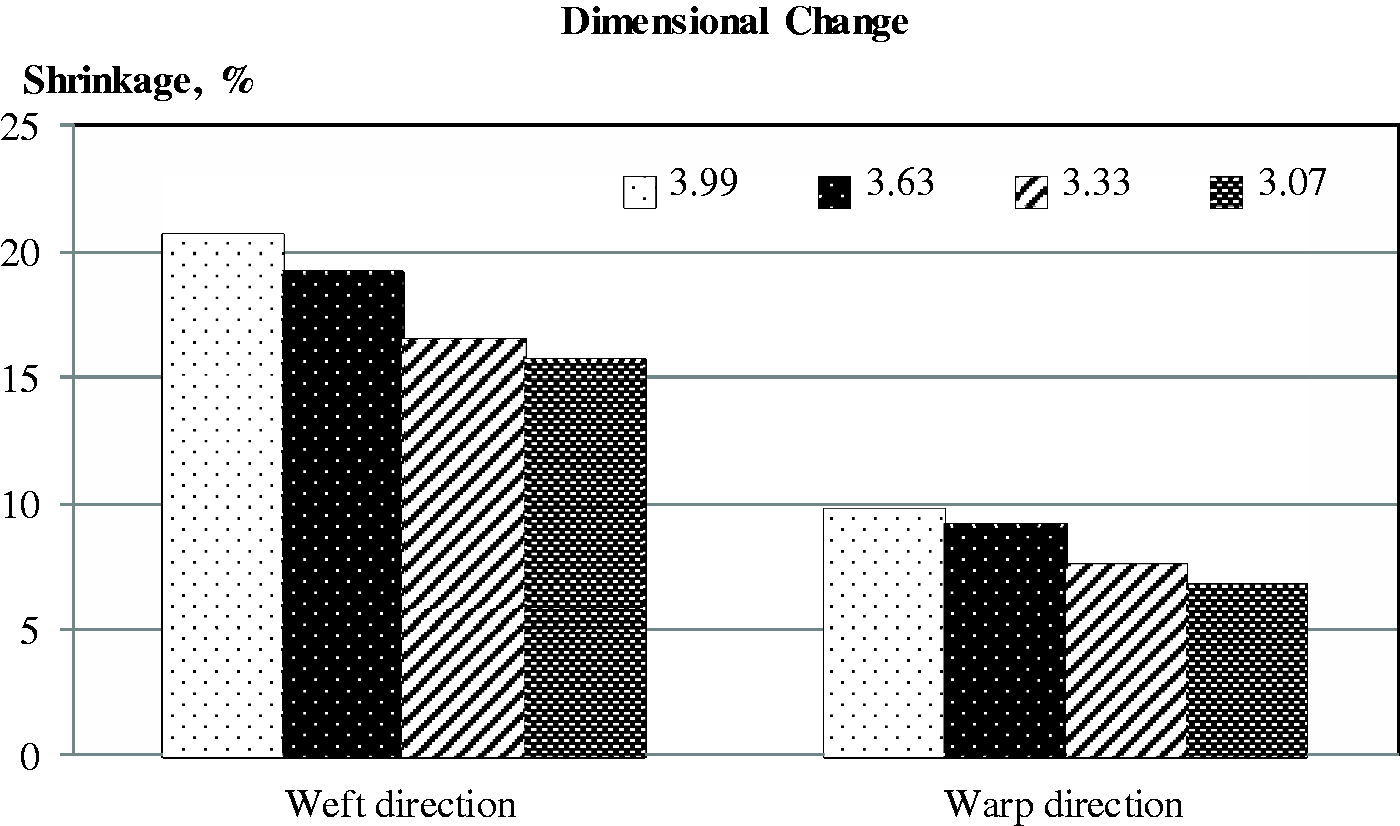
As seen from Figure 1, the shrinkage is observed for both warp and weft direction for all the samples. Even though the yarn samples produced with a different elastane draw ratio are used in only the weft direction, different warp direction shrinkage values are observed. It is also seen in Figure 1 that, for both, warp and weft directions, the shrinkage values decrease as the elastane draw ratio decreases. Since the elastane draw ratio increases, the length of the elastane core in the yarn decreases and the contraction of the yarn increases. During the laundering process, a higher tendency of shrinkage occurs. On the other hand, the warp direction shrinkage is affected by the weft direction shrinkage. The higher weft direction shrinkage causes higher warp direction shrinkage. In addition, weft direction shrinkage values are higher than that of the warp direction values.
Stretch and recovery
In this study, the stretch and the permanent stretch values of the samples were compared to assess the stretch and recovery properties. The stretch property was tested for both the warp and weft directions with the extension at a specified load principle. For this principle, the sample was applied to a specified load and the stretch of the sample at this specified load was determined. The BS EN 14704-1:2005 test method suggests 30 N load for this type of test. For this study, 25 N and 35 N load values were applied in addition to the 30 N value. Stretch values of the dry relaxed samples for different loads are given in Figure 2.
Stretch of dry relaxed samples for different loads.
As seen from Figure 2, the warp direction stretch values do not exhibit a regular tendency with respect to the draw ratio of the elastane core in the yarn. Also, as an expected result, a slight increase of stretch property is observed as the applied load increases. In the weft direction, however, the stretch values increase with the decrease of the elastane draw ratio for all load values because as the elastane draw ratio increases, the length of the elastane core in the yarn decreases. The lower length of the elastane core in the yarn causes a lower stretch of yarn and fabric produced from it. In addition, a slight increase of weft direction stretch is seen as the load rises. This increase is an estimated result, whereas the amount of this increase is extremely low. The stretch values of the laundered samples for different loads are seen in Figure 3.
Stretch of laundered samples for different loads.
It is seen from Figure 3 that, in contrast to the dry relaxed samples, there is no consistent effect of the elastane draw ratio on the stretch property of the laundered samples. This is a probable result of high contraction of the fabric samples after home laundering. The compact structure of the fabric samples after laundering compensates for the effects of different elastane draw ratios on the stretch properties. It is also seen from Figures 2 and 3 that warp and weft direction stretch values are higher for the laundered samples than dry relaxed ones. This is because the contraction of the fabric samples occurred owing to laundering process. During the application of loads on the laundered samples, the contraction caused by laundering is removed. Besides, as seen from Figure 3, for the laundered samples a slight increase is observed in the stretch values as the load increases from 25 N to 35 N for both warp and weft directions.
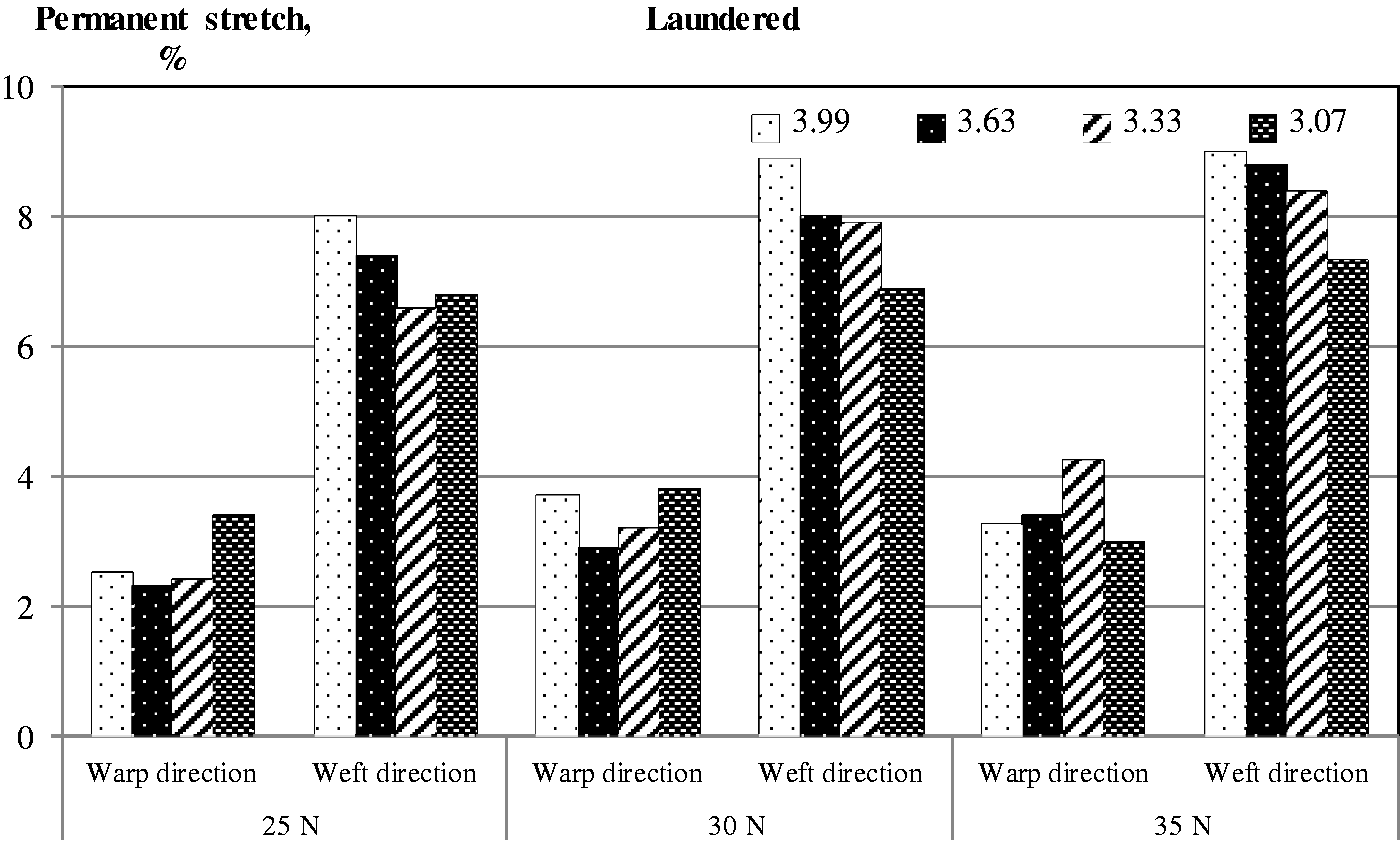
The permanent stretch values of the dry relaxed and laundered samples are obtained after a 1 hour relaxation period, following the application of the three different loads. Figures 4 and 5 exhibit the permanent stretch properties of the dry relaxed and laundered samples, respectively.
Permanent stretch of dry relaxed samples for different loads. Permanent stretch of laundered samples for different loads.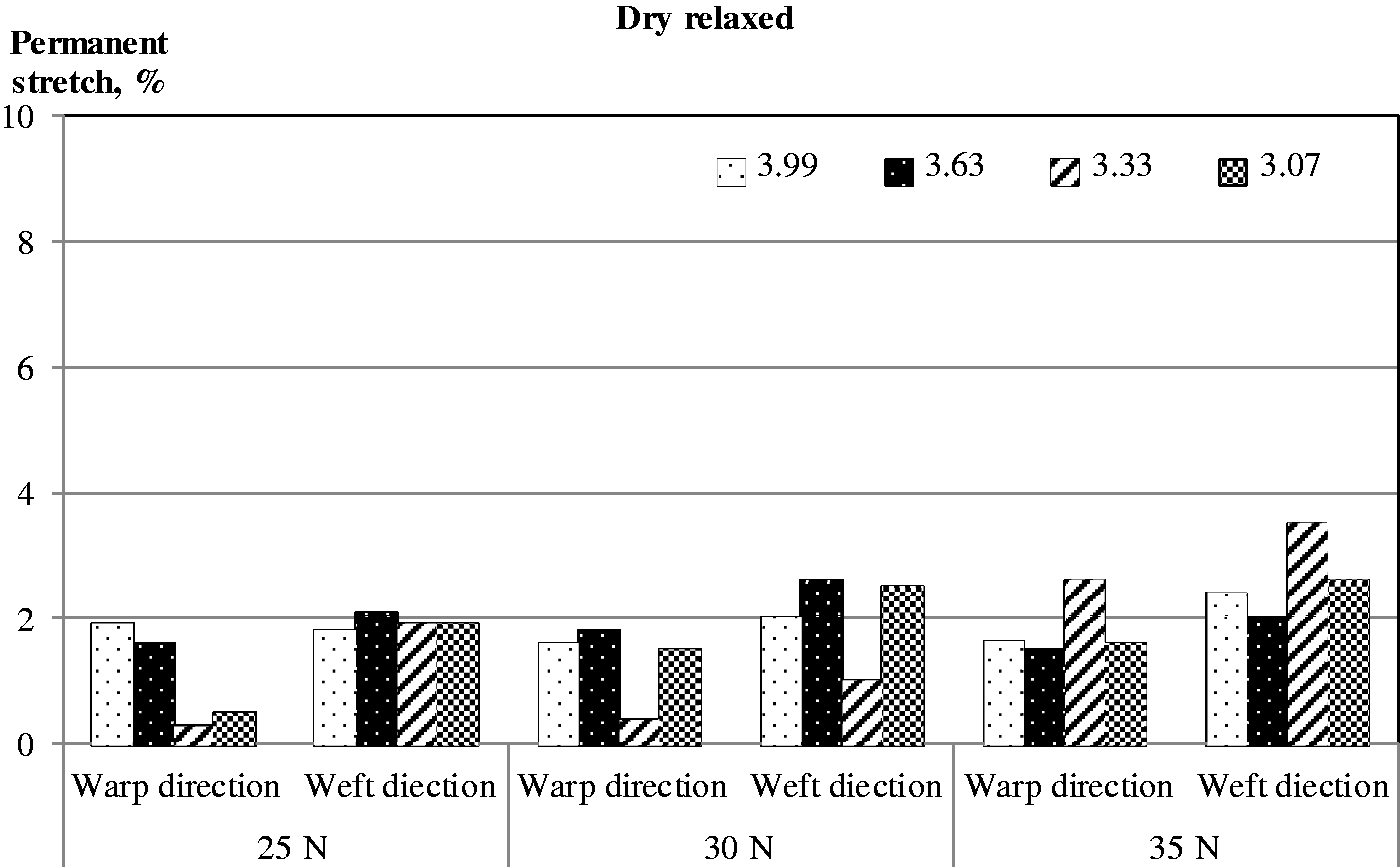
As seen from Figure 4, a consistent trend for the effect of draw ratio and load on the permanent stretch cannot be observed for the dry relaxed samples. It should be noted that the permanent stretch values are very low for all of the samples.
It is evident from Figure 5 that the laundered samples exhibit a regular tendency of lower permanent stretch values with lower load. This is an expected result of lower deformation of the samples owing to lower load application. On the other hand, it is seen that a decreased elastane draw ratio causes lower permanent stretch results. Besides, the weft direction permanent stretch values are considerably higher than that of the warp direction ones. This is due to higher weft direction shrinkage after laundering.
Optimization
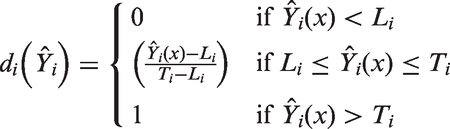
In this study, the ‘desirability’ approach is used for the optimization process. The desirability approach is used to determine the best combination of the responses. Overall desirability D involves the use of a geometric mean of the individual desirability values (d) of all responses. d, which ranges from 0 to 1 (least to most desirable respectively), represents the desirability of each individual response.
18
If an individual response is to be maximized, the individual desirability is defined by the following function
If an individual response is to be minimized, the individual desirability is defined by the following function
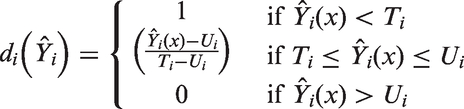
Li, Ui and Ti are the lower, upper, and target values, respectively, that are desired for response Yi, with Li ≤ Ti ≤ Ui.
19
Overall desirability can be obtained by equation (1), where n is the number of responses being optimized
18

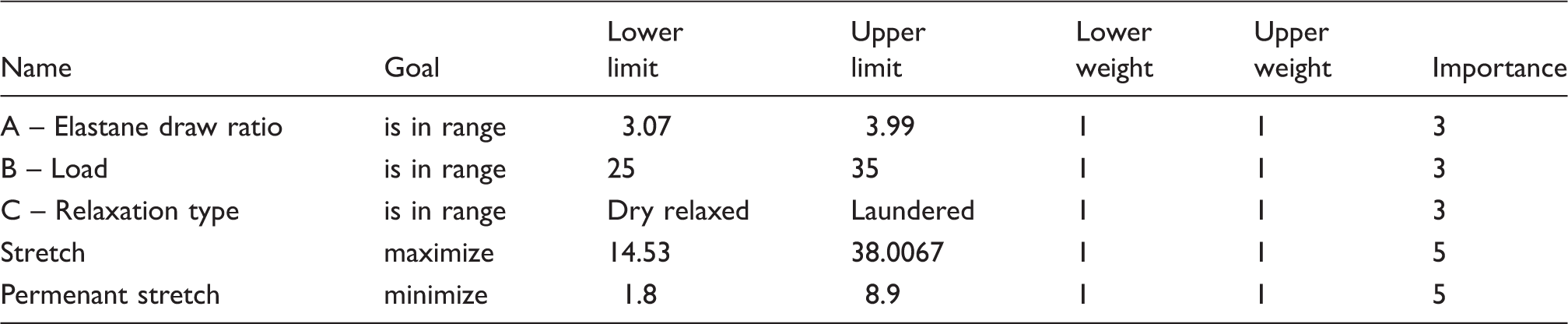
The Design Expert program supposes the highest value of the D value as the optimum level. The program determines the optimum values of process variables, the values of response variables for these process variables and individual and overall desirability values.
Levels of process variables
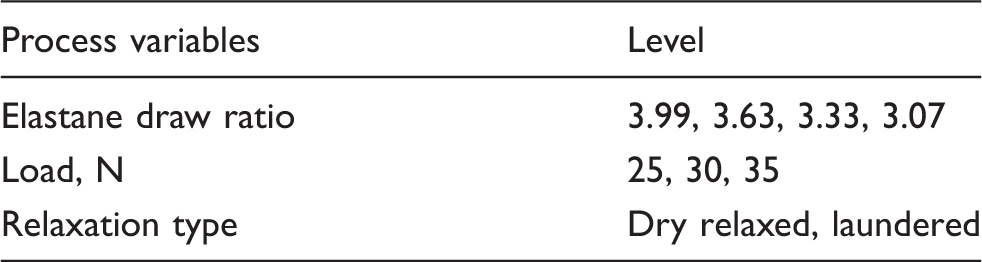
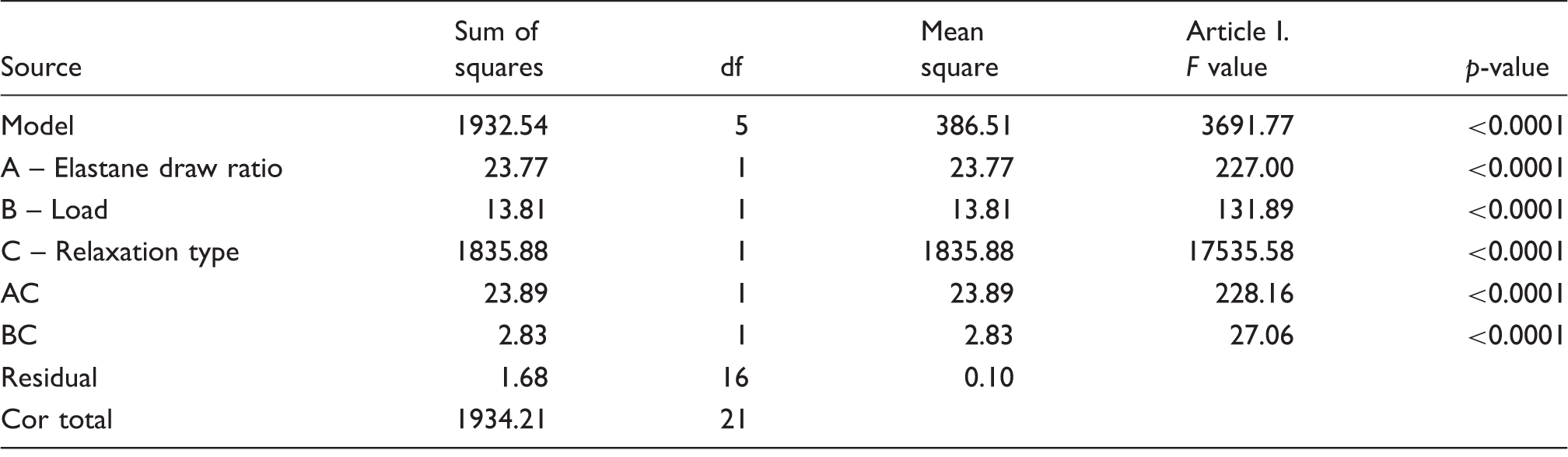
ANOVA results for response surface reduced 2FI model for stretch property
df: degree of freedom.
It is seen from Table 5, that the p-value of the 2FI model is smaller than 0.05. This model is considered to be statistically significant in 95% confidence interval. This means that this model is suited for ANOVA and optimization. It can also be concluded from Table 5 that the effect of the elastane draw ratio, the load and the relaxation type on stretch is statistically significant. Also, it is seen from Table 5 that the relaxation type has the most important effect on stretch property with the highest F value (17,535.58). The statistically significant p-value of the terms AC and BC demonstrates the important interactions between elastane draw ratio and relaxation type and between load and relaxation type. In other words, the effect of the elastane draw ratio on the stretch property differs for different relaxation types and the effect of load on stretch property differs for different relaxation types. This situation can be confirmed by comparing Figures 2 and 3, which show that the elastane draw ratio has a considerable effect on the stretch property of the dry relaxed samples, whereas there is almost no effect for laundered ones. On the other hand, the effect of load on stretch property of the laundered samples is obvious, whereas a slight effect of load on stretch property is seen for the dry relaxed samples. The regression equations (2) and (3) obtained for fabric stretch property for dry relaxed and laundered states are as follows. Values of the stretch of other combinations within the design space can be derived using these equations


It is obvious from equations (2) and (3) that the elastane draw ratio plays an important role regarding the stretch property of the dry relaxed samples, whereas in the case of the laundered samples it is almost negligible. It is particularly evident from Figures 2 and 3 that stretch values of the dry relaxed samples are influenced by the elastane draw ratio, whereas the laundered samples have similar stretch values for different levels of the elastane draw ratio. It is also clear from these equations that the load applied to the fabric has a more important effect on stretch property of the laundered samples than that of the dry relaxed ones. This situation can be confirmed by comparing Figures 2 and 3. The load applied to the fabrics has a considerably higher effect on the laundered samples owing to contraction of fabrics after laundering.
ANOVA results for response surface reduced 2FI model for permanent stretch
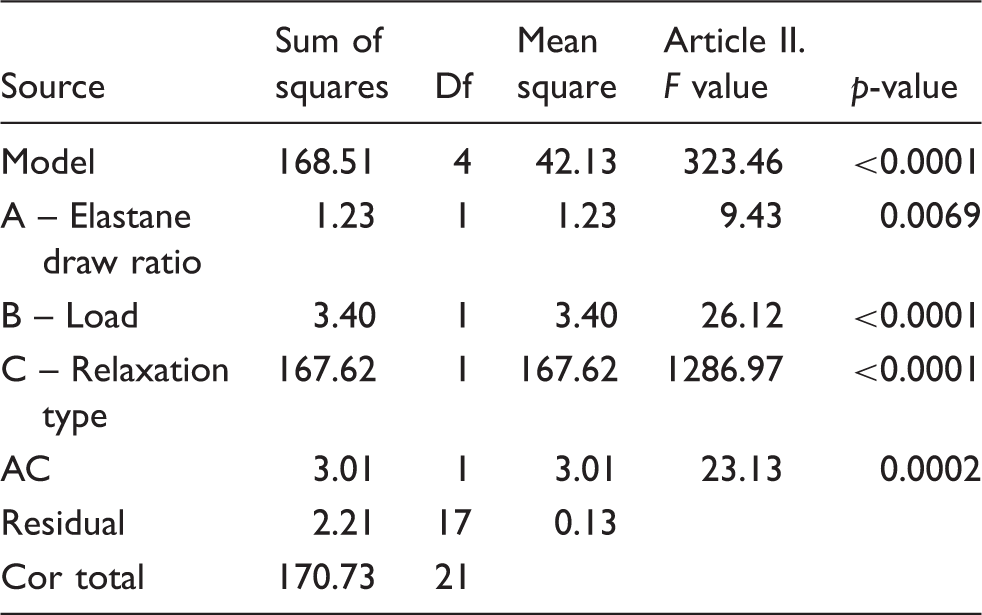
Table 6 exhibits the significant p-value (p < 0.05) of the 2FI Model, which shows the suitability of the model for ANOVA and optimization process in 95% confidence interval. In addition, it is seen that elastane draw ratio, load and relaxation type factors have statistically significant effects on permanent stretch. Besides, the relaxation type has the most important effect on stretch property with the highest F value (1286.97). The statistically significant p-value of the term AC means that there is an important interaction between elastane draw ratio and relaxation type. In other words, the effect of the elastane draw ratio on permanent stretch property changes due to relaxation type. It is also evident from Figures 4 and 5 that the increasing elastane draw ratio has an increasing effect on the permanent stretch of the laundered samples, whereas there was no consistent trend for the dry relaxed ones. The regression equations (4) and (5) can be used to make predictions on the permanent stretch property of woven fabrics within the design space, for dry relaxed and laundered states, respectively


Equations (4) and (5) for permanent stretch of the dry relaxed and laundered samples identify the different effects of the elastane draw ratio on permanent stretch with respect to relaxation type. The permanent stretch of the dry relaxed samples is negatively affected by increasing elastane draw ratio, whereas a positive effect is obtained for the laundered samples. The increasing effect of the elastane draw ratio on permanent stretch is also clear from Figure 5. Besides, the elastane draw ratio has a higher impact on the laundered samples than that of the dry relaxed ones. This situation can be drawn by comparison of Figures 4 and 5.
Values of process and response variables for the optimization process
The results of the numerical optimization process
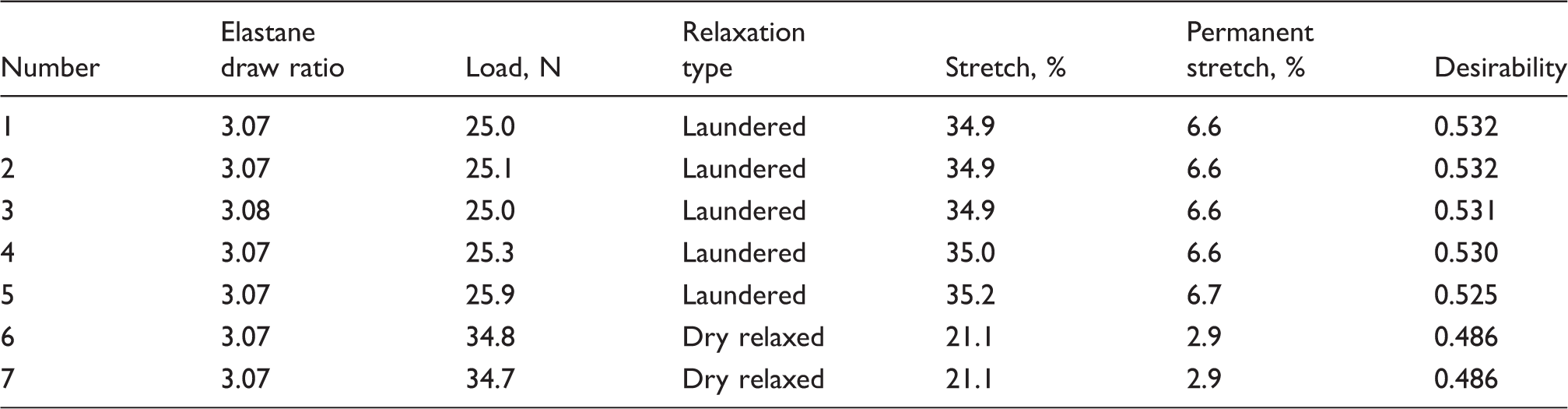
Table 8 shows the overall desirability values of the multi response optimization process. The highest overall desirability value can be ‘1’ and the lowest ‘0’. The solutions of the optimization process are sorted by desirability value, based on how well the specified goals are achieved. The closer all the goals are met, the higher the overall desirability value is. Achieving a maximum overall desirability of 0.532 means that it is not possible to meet all the stretch and permanent stretch goals with the levels of draw ratio and load used in this study. Table 8 also shows the obtained response variables of stretch and permanent stretch values for every desirability value. Additionally, Table 8 exhibits the optimum elastane draw ratio and load values and optimum relaxation type to obtain these response variables. The first line of Table 8 gives the best result of the optimization process. This line clarifies the maximum stretch (34.9%) and minimum permanent stretch (6.6%) values as desired at the beginning of the optimization process. Additionally, the required draw ratio (3.07), load (25 N) and relaxation type (laundered) for this result can be obtained from this table.
The Design Expert program also gives the individual desirability values for every result of the numerical optimization process. Figure 6 shows the individual desirability values for the best result of the optimization process with 0.532 overall desirability value.
Individual desirability values of response variables for 0.532 overall desirability.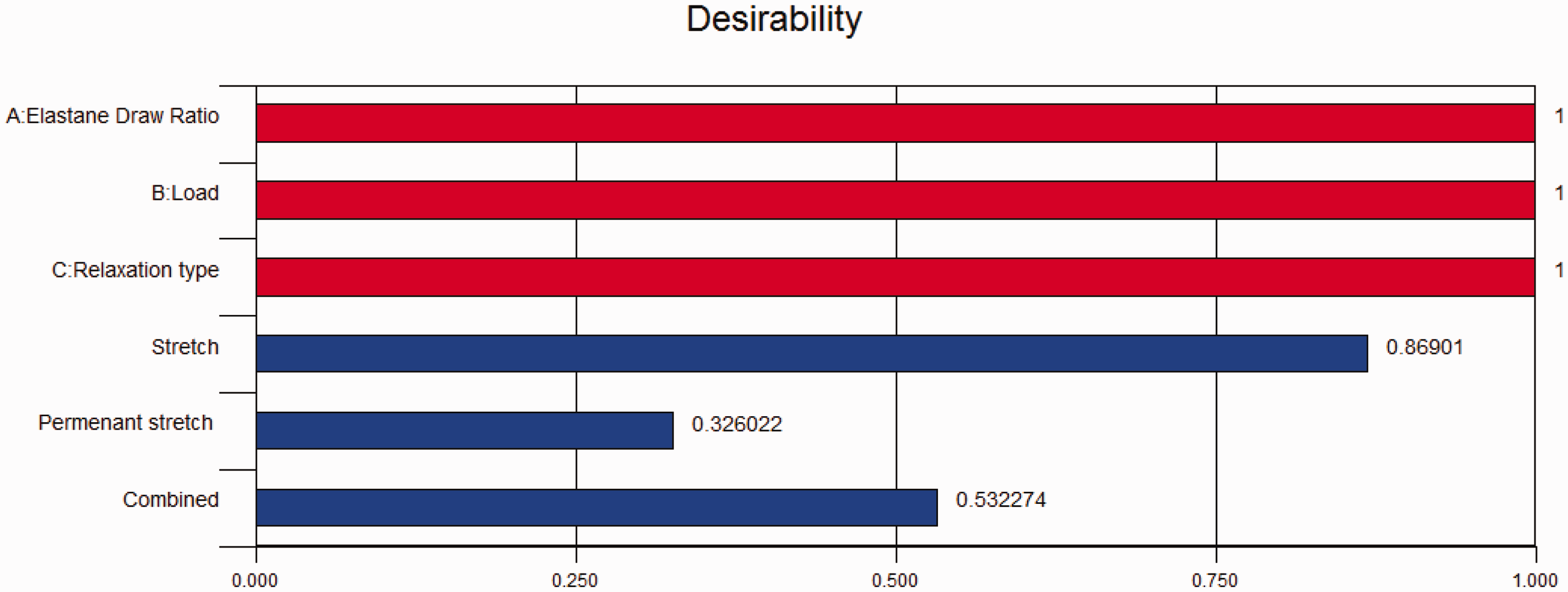
It can be concluded from Figure 6 that a higher individual desirability is obtained for the stretch property (0.86901) than permanent stretch (0.326022), for a combined or overall desirability value of 0.532274. This means a better success of achieving the target of stretch property is obtained than that of permanent stretch. The individual desirability values of ‘1’ for process variables imply that the desirability values of response variables are obtained within the design space of this study.
Fatigue
Figure 7 shows the fatigue property of the samples. This property is measured with a Truburst test device. For this test, 50 cm2 circular area of the sample is applied to 100 kPa loading for five cycles, and for each cycle the sample is applied to 100 kPa loading for 5 s. Then average extension of the sample for these five loading cycle is determined.
Fatigue of dry relaxed and laundered samples with Truburst test device.
ANOVA results for response surface linear model for fatigue
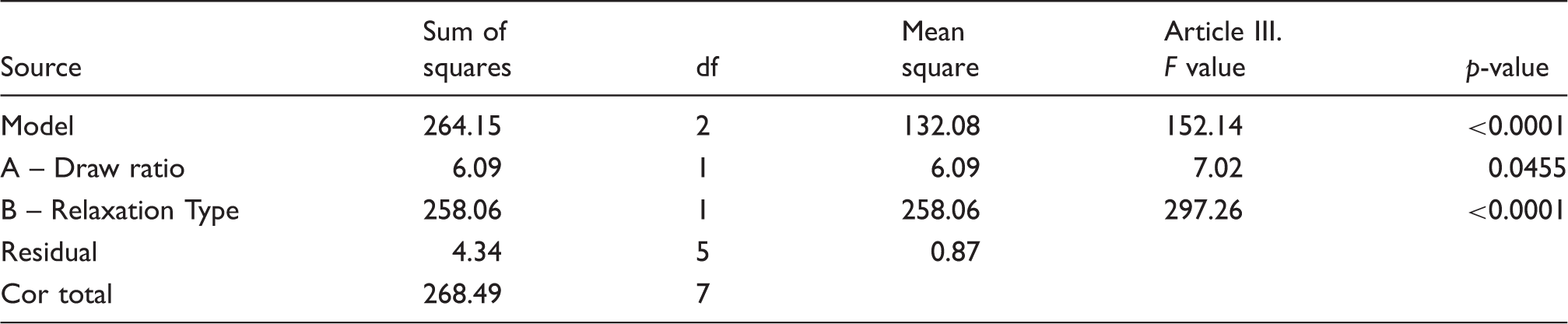
Elastane draw ratio (p = 0.0455 < 0.05) and relaxation type (p < 0.0001 < 0.05) have a statistically significant effect on extension, which is obtained by fatigue test in 95% confidence interval. Also relaxation type has a statistically more important effect on extension with a higher F value (297.26) than the elastane draw ratio.
Conclusion
There are two phenomena that must be kept in mind in the context of stretch woven fabrics: firstly, the stretch property of the fabric, which shows the formability and fitting to human body of the fabric; and secondly, the recovery property, which shows the aesthetic appearance of a fabric after fatigue.
In this study, an experimental investigation on the stretch and recovery properties of woven stretch fabrics is reported. Also, an optimization technique is used to determine the optimum elastane draw ratio, load and relaxation type for the best stretch and permanent stretch values. In this context, higher stretch values are observed for higher load values for both the dry relaxed and laundered samples. It is desirable for a garment to have an increased stretch level under higher tensions. This means that the fabric can provide a good formability and does not restrict the movement of the body for increased tension levels. On the other hand, higher stretch values are observed for low elastane draw ratio for the dry relaxed samples, whereas the elastane draw ratio has no effect on stretch property of the laundered samples. Higher stretch with lower power is always preferred for wearer’s satisfaction. On the other hand, the permanent stretch values of the dry relaxed samples are very low and similar. In the case of the laundered samples, a regular tendency of lower residual deformation is detected for lower load and lower elastane draw ratio. So, it would be convenient to prefer low elastane draw ratio and low load values for aesthetic appearance of the garment. Besides, the results of the fatigue test confirm this approach. Consequently, as a result of the optimization process, 3.07 elastane draw ratio and 25 N load are determined as the optimum values for lowest permanent stretch and highest stretch with the laundered samples within the design space.
Footnotes
Acknowledgement
The author is grateful to Selçuk Íplik for production of yarn samples and Modena Mensucat for production of fabric samples.
Declaration of conflicting interests
The authors declared no potential conflicts of interest with respect to the research, authorship, and/or publication of this article.
Funding
The authors received no financial support for the research, authorship, and/or publication of this article.