



Abstract
The water soluble and reactive O-methyl acrylamide quaternary ammonium salt of chitosan (NMA-HTCC) was prepared with a view to develop an antibacterial finishing on cotton fabric. 2-hydroxypropyltrimethyl ammonium chloride chitosan (HTCC) was synthesized by the chemical reaction of chitosan and 2,3-epoxypropyltrimethyl ammonium chloride. Then, NMA-HTCC with reactive groups was synthesized by the chemical reaction of HTCC and N-(hydroxymethyl) –acrylamide, and its chemical structure was characterized by the Fourier transform infrared spectroscopy and nuclear magnetic resonance (NMR). The antibacterial activities of chitosan and NMA-HTCC were tested and compared by the minimal inhibitory method. Cotton fabrics were finished by NMA-HTCC under the alkalinity condition using sodium bicarbonate as the catalyst. The antibacterial activity of cotton fabric before and after finishing was measured by the oscillation flask method. The results showed that both chitosan and NMA-HTCC had a significant antibacterial effect on staphylococcus and coli, and the antibacterial activity of NMA-HTCC was better than that of chitosan. The antibacterial activity of cotton fabric to staphylococcus and coli were significantly improved after finishing by chitosan and NMA-HTCC, and the antibacterial activity of the cotton fabric finished by NMA-HTCC was better than that finished by chitosan.
Chitosan has been widely used in many fields, such as the textile industry, daily environmental protection, biological medicine and so on due, to its biocompatibility, degradability, lack of antigenicity, adsorption and so on.1–3 However, chitosan cannot be dissolved in water and organic solvent, and can only be dissolved in acid solution, which greatly limits its application. Therefore, where solubility in water at neutral or high pH is required, it is necessary to improve chitosan solubility by chemical modification. As one of the important modification methods of chitosan, alkylation modification has been widely researched and applied.4–7 Chitosan quaternary ammonium salt, with strong antibacterial ability and good moisturizing property, can be dissolved in acid, neutral and alkaline conditions. It has been widely applied in medicine and health, wastewater treatment and so on,8,9 but so far there has been little study on the application of the chitosan quaternary ammonium salt for textile finishing. Based on the good water-solubility and biocidal properties of quaternary ammonium salt of chitosan, 2-hydroxypropyltrimethyl ammonium chloride chitosan (HTCC) was synthesized using chitosan and 2,3-epoxypropyltrimethyl ammonium chloride, and then HTCC reacted with N-(hydroxymethyl)-acrylamide to synthesize the O-methyl acrylamide quaternary ammonium salt of chitosan (NMA-HTCC) with reactive bonds and solubility, which could directly crosslink react with cellulose fibers to form a strong combination between NMA-HTCC and fibers.6–8,10 The antibacterial activities of chitosan and NMA-HTCC were tested and then applied on the antibacterial finishing of cotton fabrics.8,11–14 The antibacterial activities of cotton fabrics before and after finishing were tested to explore the feasibility and prospect of NMA-HTCC in antibacterial finishing of cotton fabrics. It could provide the theoretical basis for the functional development of cotton fabric.
Experimental details
Materials
Chitosan with the deacetylation degree of 92% and the molecular weight of 2.1 × 10⁴ was supplied by Nantong Xingcheng biological industrial Co. Ltd; 2, 3-epoxypropyltrimethyl ammonium chloride, N-(hydroxymethyl)-acrylamide and 4-methoxyphenol and ammonia chloride were provided by Yancheng Chunyu chemical Co. Ltd; all chemical reagents, including isopropyl alcohol, citric acid, sodium bicarbonate, ethanol and acetone, used for the following investigations were of analytical grade. Deionized water was used throughout the work.
Preparation of NMA-HTCC
Chitosan, 2, 3-epoxy propyl trimethyl ammonium chloride and isopropanol were put into a four-mouth flask. The solutions were reacted at 80℃ for 12 h in a water bath, washed by ethanol and acetone after cooling, then filtrated, dried and the yellow product obtained was HTCC. After that, HTCC, N-methylol acrylamide, 4-methoxyphenol and NH4Cl were put into the flask and stirred evenly until dissolution. The solutions were reacted for 15 min at 140℃ in an oil bath. Ethylalcohol and acetone were put into the reaction solutions and stirred to precipitate the product. The product was washed in a mixture of ethylalcohol-acetone and dried. Finally, the white product was NMA-HTCC.7–9,15 The reaction equation was as follows
Fourier transform infrared spectroscopy of NMA-HTCC
Infrared spectra of NMA-HTCC were obtained with a Nicolet 5700 infrared spectrometer using the traditional transmission technique for KBr pellets. Infrared (IR) spectra were recorded at 4 cm−1 resolution and 64 scans were taken for each sample. The measurements were performed at 20 ℃ and 65% relative humidity.
Proton nuclear magnetic resonance spectra of NMA-HTCC
Proton nuclear magnetic resonance (1H-NMR) spectra of NMA-HTCC were obtained with a Unity Inova 400 high-resolution nuclear magnetic resonance (NMR) spectrometer. The 1H resonance frequency was 400 MHz. The rotor speed of rotation was 4.5 kHz and the 90° pulse length was 6 µs.
Antibacterial activities test of chitosan and NMA-HTCC
Staphylococcus ATCC 6538 and coli 8099 were used in the experiment, the minimal inhibitory method (agar dilution method) was adopted and the “Technical Specification for Disinfection” by the Ministry of Health was referenced.7,9,16 The grinded chitosan and NMA-HTCC were put into the sterilization phosphate buffer solution and shaken for full dissolution to prepare the uniformly dispersed solution or suspension with the concentration of 10%, which then was diluted into test solution with different concentrations (0.2, 0.3, 0.4, 0.5, 0.6, 0.70, 0.80, 0.90, 1.00, 1.20, 1.25, 1.30 mg/mL). The 10 ml test solution and nutrient agar, both with different concentrations, were taken. They were put into the nutrient agar and mixed fully and evenly. After solidification, the 1–2 µl bacterium suspension (the amount of bacteria is about 107 cfu/ml) was taken for dibbling in the plate. The diameter of the formed bacterium solution circle after inoculation ranges from 5 to 8 mm or so (the amount of bacteria in each point was about 104 cfu). Then the inoculated plate was put into the incubator, and was upside down cultured for 24 hours. The growth of bacteria was observed. The concentration of the test solution in which colony growth was completely inhibited was the minimal inhibitory concentration (MIC) of this sample to the tested bacteria.7,9,16 The agar plate without the test solution was inoculated by the same method to carry out the controlled experiment.
Treatment process of cotton fabric with chitosan
Because of the lack of chemical cross-linking between chitosan and cotton fiber and the limited water-solubility of chitosan, the reaction between chitosan and cotton fibers must be taken under acidic conditions, and citric acid was used as the catalyst and solvent, which could not only catalyze the cross-linking reaction but also make the chitosan dissolve. Chitosan solution was prepared with a bath solution ratio of 1:50, chitosan concentration of 7 g/L and the citric acid mass fraction of 2%.9,14,16 The treatment process was as follows: cotton fabrics→ treated in chitosan solution at 60℃ for 1 h→pre-baked at 80℃ for 5 min→ baked at 160℃ for 3 min→ washed with deionized water→ dried at 80℃.
Treatment process of cotton fabric with NMA-HTCC
NMA-HTCC has a fiber reactive group of side double bond, which can directly crosslink with the hydroxyl in the cellulose molecule under the alkalinity condition. Sodium bicarbonate was used as the catalyst in this experiment, which could not only catalyze the cross-linking reaction but also facilitate the effective permeation of NMA-HTCC to fibers by reducing the hydrolysis of NMA-HTCC and promoting swelling of cotton fibers. NMA-HTCC solution was prepared with a bath solution ratio of 1:50 under the alkalinity condition, NMA-HTCC concentration of 7 g/L and NaHCO3 mass fraction of 2%.9,16,17 The treatment process was as follows: cotton fabrics→ treated in NMA-HTCC solution at 60 ℃ for 1 h→pre-baked at 80 ℃ for 5 min→ baked at 160 ℃ for 3 min→ washed with deionized water→ dried at 80 ℃. The reaction equation was as follows
Antibacterial activities test of cotton fabrics
The oscillation flask method was adopted and staphylococcus ATCC6538 and coli 8099 were used in this experiment.
The cotton fabrics before and after treatment were cut into the samples and packed separately. The treated and untreated samples, phosphate buffered solution and bacterial suspension were put into a conical flask, which was shocked for 2 minutes at 25℃. Then 1 ml solution was taken as the sample solution before shocking. The treated and untreated samples, phosphate buffered solution and bacterial suspension were put into a conical flask, which was shocked for 60 minutes at 25℃. Then 1 ml solution was taken as the sample solution after shocking. The sample solutions before and after shocking were inoculated in the plate by the agar pour method. Each sample solution was inoculated for two plates to count the viable bacteria. The blank control experiment was the group without the sample wafer. A certain amount of phosphate buffered solution and bacterial suspension were put into a conical flask, mixed and evenly shocked for 60 minutes. A total of 1 ml of solution before and after shocking was taken to count the viable bacteria.9,18
GB/T 20944.3-2008, “Evaluation of Antimicrobial Properties of Textiles,” was referenced to evaluate the antibacterial properties of cotton fabrics before and after treatment. The bacteria inhibition rate was calculated from the average colony number difference of solution before and after shocking

Result and analysis
Characterization of NMA-HTCC
Figure 1 showed the Fourier transform infrared spectroscopy (FTIR) spectra of the chitosan and NMA-HTCC. In Figure 1(a) two absorption peaks at near 3400 cm−1 corresponded to the primary amine in chitosan, which was changed into one absorption peak (Figure 1(b)) corresponding to the secondary amine, which indicated that the H on the primary amine in the chitosan molecular had been replaced and had become the secondary amine. A peak at 1580 cm−1 corresponding to the N–H bending of the primary amine in Figure 1(a) was replaced by two absorption peaks at 1490 and 1640 cm−1 corresponding to the C–H bending of the trimethylammonium group and the C = O stretch of the secondary amide, respectively in Figure 1(b), which indicated that the H on –NH2 in the chitosan molecular was replaced by the group of CH2CH(OH)CH2N+(CH3)3Cl−. Two peaks at 1535 and 1670 cm−1 in Figure 1(b) corresponded to the N-H bending and the C = O stretch of the secondary amide in the acrylamidomethyl group.8,16,19 A new absorption peak at 1630 cm−1 corresponded to the C = C stretch of the conjugated vinyl group in Figure 1(b), which illustrated that the group of –CH2NHCOCH = CH2 was linked onto the chitosan molecular and NMA-HTCC was synthesized.
Fourier transform infrared spectra of (a) chitosan and (b) O-methyl acrylamide quaternary ammonium salt of chitosan (NMA-HTCC).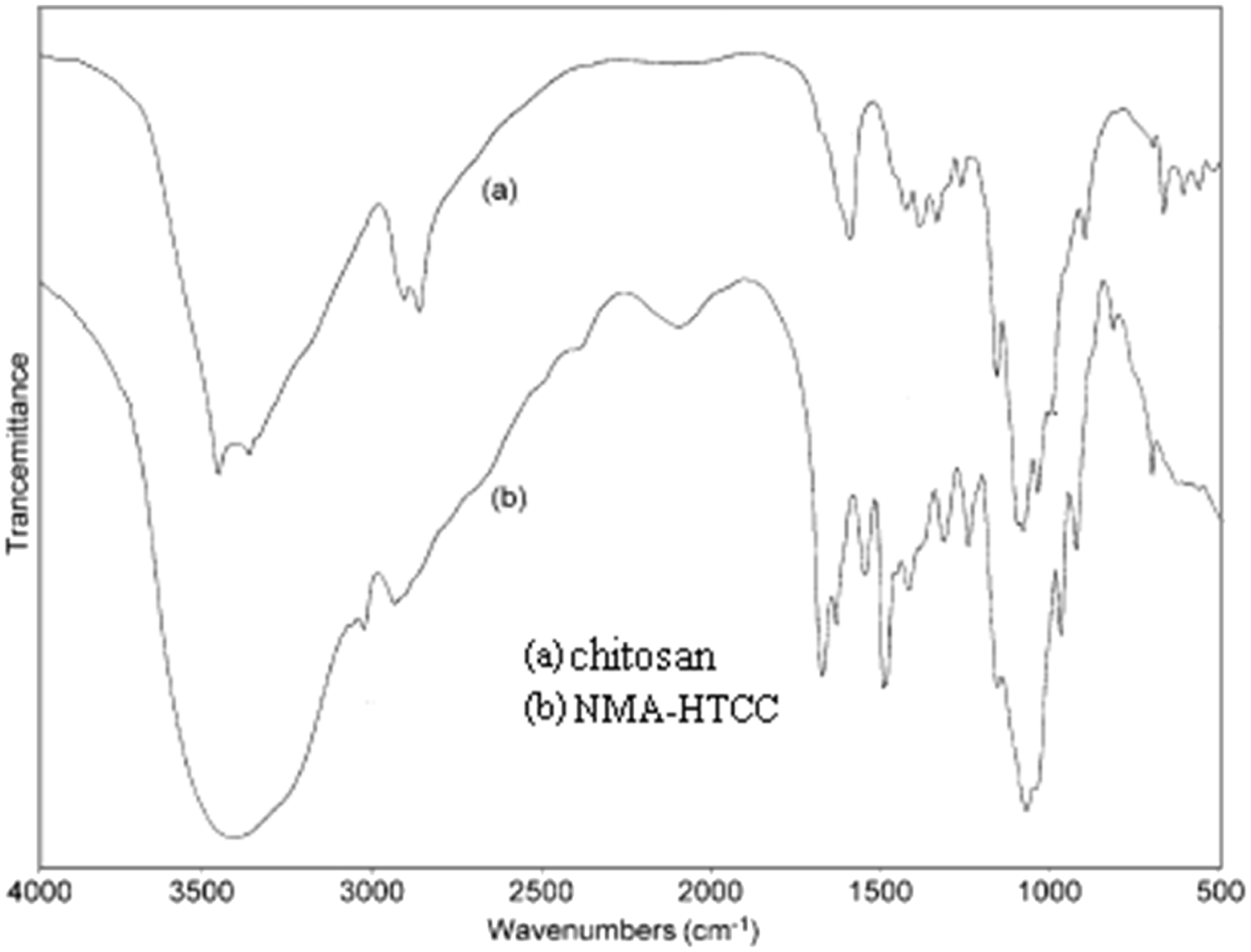
Figure 2 shows the 1H-NMR spectra of the chitosan and NMA-HTCC. In Figure 2(b), a new strong absorption peak at 3.2 ppm corresponded to the methyl groups in the quaternary ammonium salt group, which indicated that the H on chitosan had been replaced by the quaternary ammonium group.8,16 The acrylamidomethylation was further confirmed by two absorption peaks at 6.35 and 5.85 ppm corresponding to the vinyl group, which indicated that the methyl acrylamide group had been linked onto chitosan molecularly and O- methyl acrylamide chitosan quaternary ammonium salt was synthesized. The 1H-NMR analysis result was consistent with the IR spectrum analysis result.
Proton nuclear magnetic resonance spectra of (a) chitosan and (b) O-methyl acrylamide quaternary ammonium salt of chitosan (NMA-HTCC).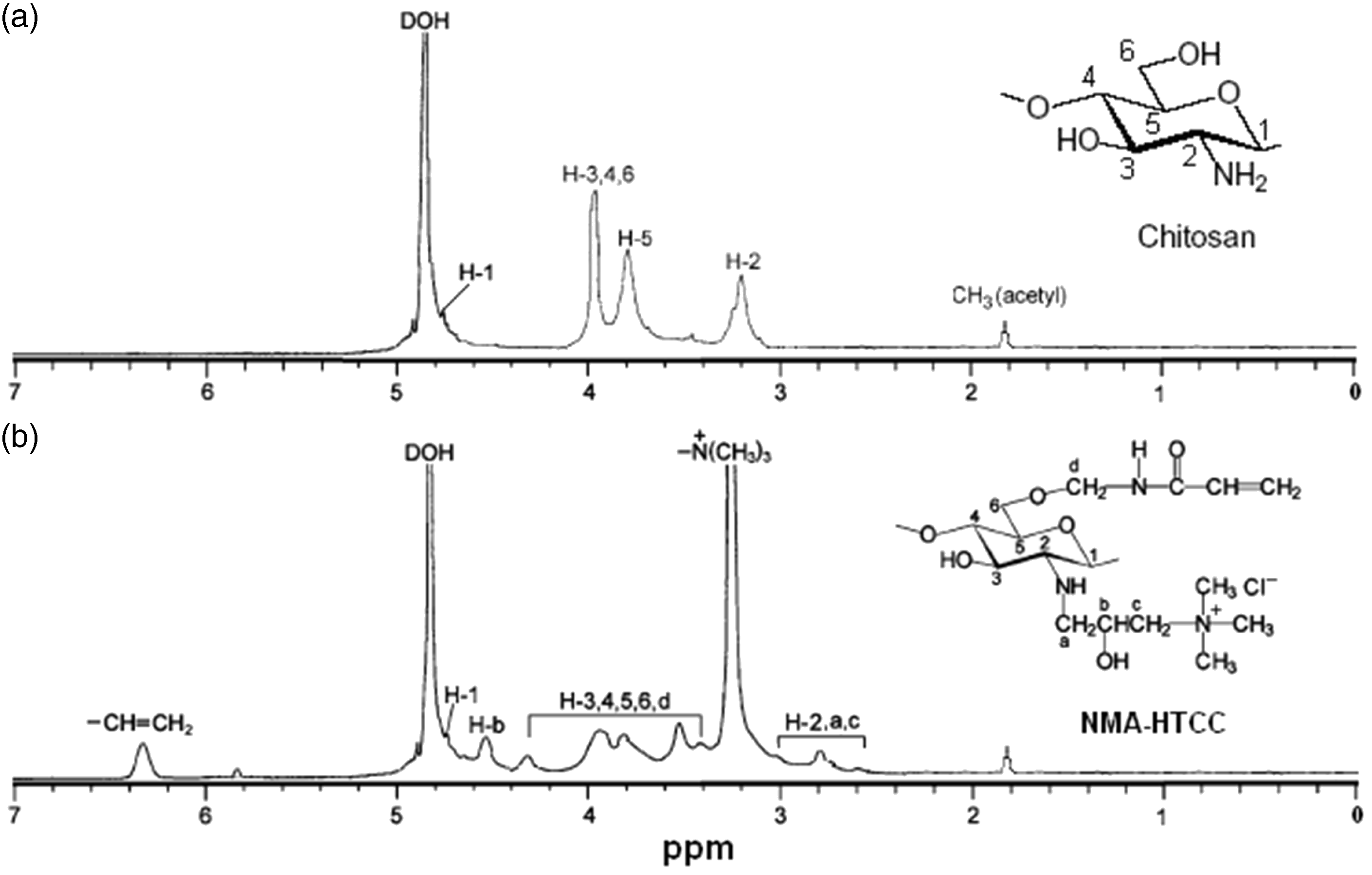
Antibacterial activities of chitosan and NMA-HTCC
Figures 3 and 4 showed the inhibition rates of chitosan and NMA-HTCC to staphylococcus and coli, respectively. It could be seen that the inhibition rate to staphylococcus and coli increased with the concentration of NMA-HTCC and chitosan increasing. When the concentrations of NMA-HTCC and chitosan were 0.50 and 1.25 mg/ml, respectively, the inhibition rate to staphylococcus reached 100%. While the concentrations of NMA-HTCC and chitosan were 0.70 and 1.25 mg/ml, respectively, the inhibition rate to coli reached 100%. Therefore, the MIC of NMA-HTCC was less than that of chitosan for staphylococcus and coli, namely, the antibacterial effect of NMA-HTCC was better than that of chitosan.
Inhibition rate of chitosan and O-methyl acrylamide quaternary ammonium salt of chitosan (NMA-HTCC) to staphylococcus. Inhibition rate of chitosan and O-methyl acrylamide quaternary ammonium salt of chitosan (NMA-HTCC) to coli.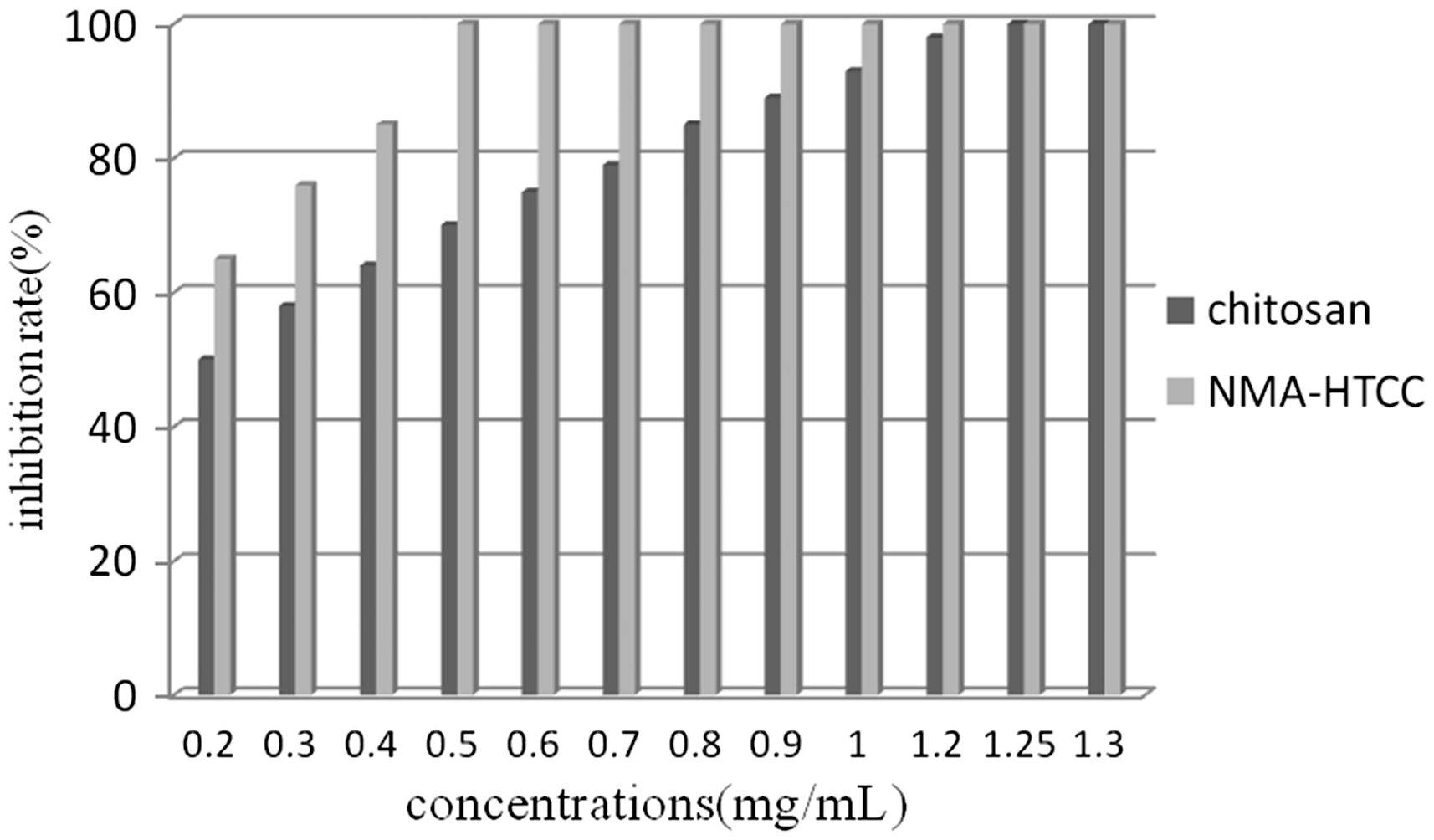

Antibacterial activities of cotton fabrics
Figure 5 shows the inhibition rates of cotton fabrics to staphylococcus and coli, respectively. It shows that the antibacterial activity of cotton fabric could be improved after chitosan or NMA-HTCC treatment. The antibacterial activity of cotton fabric treated by NMA-HTCC was better than that of cotton fabric treated by chitosan. The cotton fabrics treated by NMA-HTCC solution would not turn yellow and still felt soft; moreover, the strength of the fabric after treatment was almost unchanged. The double bonds of the side chain in the NMA-HTCC could take a cross-linking reaction directly with cotton fabrics under alkaline conditions and combined with cotton fabrics firmly. In order to explore the washing resistance of cotton fabric after treated by NMA-HTCC, the inhibition rate after soaping 30 times was determined, and the result showed that the inhibition rate of cotton fabric was not descended obviously after because of the strong combination between NMA-HTCC and the cotton fabric. It could be seen that NMA-HTCC was an excellent anti-bacterial finishing agent for textiles.
Inhibition rate of cotton fabrics. NMA-HTCC: O-methyl acrylamide quaternary ammonium salt of chitosan.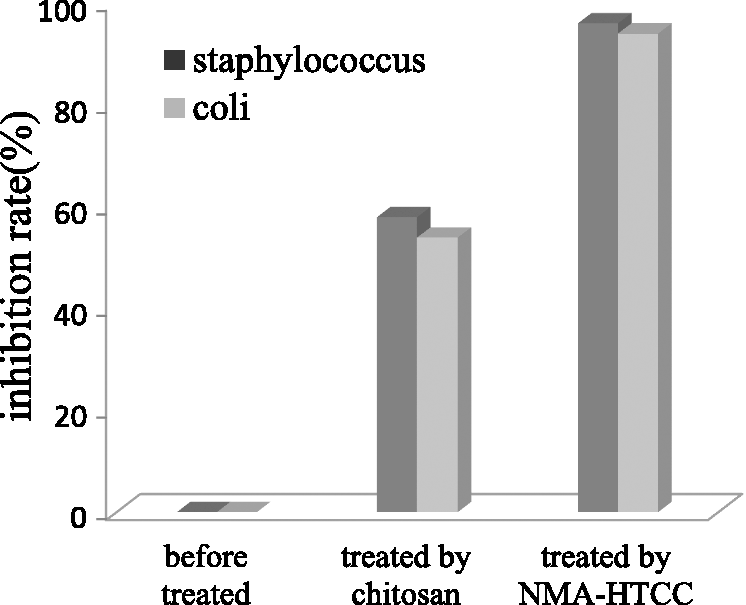
Antibacterial mechanism analysis
There are many bacteria that produce disease in nature. Staphylococcus aureus and Escherichia coli are the most representative. The staphylococcus aureus is the most common pathogenic bacterium in suppurative infection of humans, as well as the pathogenic bacteria with the strongest resistance in non-spore bacteria. Its cell wall consists of peptidoglycan and teichoic acid. Coli is the major and maximum bacterium in the intestinal tract of humans and many animals.2,6 It has a kind of pathogenicity for the human body. The lipopolysaccharide in its cell wall can prevent the external macromolecule from entering.
Chitosan has an antibacterial effect on staphylococcus and coli. It can be explained as follows. Chitosan can be absorbed on the cell surface to form a polymeric membrane, which prevents the nutrients from transporting internally, and thus inhibits the growth and reproduction of bacteria.7,9,11 However, the generated NMA-HTCC is a kind of strong cationic polymer after alkylation modification; NMA-HTCC cannot be extracted by acid solution or solvent, and its quaternary ammonium ions can take a flocculation effect with protein, peptidoglycan, teichoic acid and lipopolysaccharide with negative charge on the surface of bacteria to destroy the plasma membrane, disturb the normal physiological activity of bacteria and restrict and destroy various physiological functions inside the bacteria.17,20 The negatively charged bacteria are absorbed to disturb the synthesis of the cell wall, which makes the cell wall dissolve and die. The antibacterial mechanisms of chitosan and NMA-HTCC were compared using an adsorption kinetics experiment and bacterial activity experiment to measure the liquid light absorbency after the reaction of chitosan, NMA-HTCC and coli by other researchers. 7 The results show that the adsorption effect of chitosan on bacteria is less than that of chitosan quaternary ammonium salt. Chitosan almost has no killing effect on the bacteria. However, the chitosan quaternary ammonium salt can kill the vast majority of coli, which is adsorbed on the surface. The killing effect is enhanced with the extension of the action time.7,14,20 This shows that the antibacterial effect of chitosan quaternary ammonium salt exists in an adsorption–kill way. Its antibacterial mechanism is dominated by the killing effect. Hence, the antibacterial effect of chitosan quaternary ammonium salt is much better than that of chitosan.
Conclusion
HTCC was synthesized using chitosan and 2,3-epoxypropyltrimethyl ammonium chloride, and then HTCC reacted with N-(hydroxymethyl)-acrylamide to synthesize the NMA-HTCC with reactive bonds and solubility, which could directly crosslink react with cellulose fibers to form a strong combination between NMA-HTCC and fibers. The antibacterial activities of chitosan and NMA-HTCC were tested and compared by the minimal inhibitory method. The results showed that both chitosan and NMA-HTCC had a significant antibacterial effect on staphylococcus and coli, and the antibacterial activity of NMA-HTCC was better than that of chitosan. Then, cotton fabrics were finished by NMA-HTCC under the alkalinity condition using sodium bicarbonate as the catalyst, and the antibacterial activity of cotton fabric before and after finishing was measured by the oscillation flask method. The results showed that the antibacterial activities of cotton fabric to staphylococcus and coli were significantly improved after finishing by chitosan and NMA-HTCC, and the antibacterial activity of the cotton fabric finished by NMA-HTCC was better than that finished by chitosan.
Footnotes
Declaration of conflicting interests
The authors declared no potential conflicts of interest with respect to the research, authorship and/or publication of this article.
Funding
The authors disclosed receipt of the following financial support for the research, authorship, and/or publication of this article: This study was supported by the research fund of the school-enterprise cooperation project, No.2015043 and city agriculture project, No.YKN 2015006.