



Abstract
The treatment of cotton fibers using different chemicals, such as alkalis, acids and salt solutions, has captured the attention of researchers because of their important effects in dyeing, cross-linking and mercerizing processes. However, these agents are difficult in terms of process application and the requirement for major effluent treatment prior to discharge. In this paper, we report on the treatment of cotton in aqueous glycine solutions that were moderated, utilizing glycine’s amphoteric nature at different pH values, to enhance the morphological and moisture regain properties of cotton fiber. Treatment in an aqueous glycine solution buffered to pH 11 increased fiber ribbon width by 4.5%, cross-sectional area by 53% and moisture regain by 16%. Changes were dependent on the treatment solution pH value. This paper describes the glycine treatments and their influence on the cotton fiber cross-sectional morphology and regain properties. The results suggest that at suitable pH values aqueous glycine solutions have the ability to enhance cotton fibers in ways very similar to mercerizing.
Mercerization is a chemical process applied to swell cotton fibers in yarn or fabric form to improve dye affinity, appearance (luster) and strength. The original patent granted to John Mercer in 1851 described a method of changing the properties of cotton by treatment with concentrated (25% w/w) caustic soda (sodium hydroxide) at a temperature of 15–18℃ for 5 minutes. Following the removal of alkali by neutralization with acid and rinsing with water, the effects on the properties of cotton were found to be permanent to subsequent wet finishing or washing processes. The contorted and flattened tape-like cross-sections of raw cotton were converted into smoother, less convoluted fiber shapes having more circular cross-sections. There was also an increase in strength and an increase in affinity for dyes. One effect was good dye coverage of immature fibers. The latter was regarded by Mercer as the major benefit of his invention. The disadvantage of the treatment was a contraction in fiber length of up to 18%, which accompanied the increase in fiber diameter. With an already short fiber, the decrease in fiber length limited the commercial success of Mercer’s process, which is now more commonly called slack mercerization.
In 1889, Lowe discovered that preventing fiber shrinkage during the caustic soda treatment by holding the fibers under tension during treatment produced fibers with a substantially rounder cross-section. There was also an increase in the affinity for dyes and an increase in fiber strength. Lowe’s discovery improved the usefulness of Mercer’s process and turned it into the typical mercerization process, carried out under tension, that we know today. While mercerization has been used for a long period and produces a range of beneficial qualities in cotton yarn and fabric, the process is not routine because it requires significant engineering in its equipment requirements and is expensive in terms of energy and the reclamation of concentrated sodium hydroxide. As a result, other agents and processes for the swelling of cotton fibers have been investigated.1–7
Liquid ammonia-based mercerization is also used in the cotton industry. Like NaOH, an ammonium solution penetrates cotton’s cellulose and reacts with the hydroxyl groups after breaking the hydrogen bonds. The reaction first occurs in the amorphous region followed by passage into more crystalline regions. When cotton fiber (Cellulose I) is treated with ammonia, first an intermediate ammonia–cellulose complex (Cellulose II) is formed. This complex then decomposes to give Cellulose III. The resultant fiber has improved dimensional stability, abrasion resistance and appearance.8,9
Treatment of cotton with acids and salt solutions to swell fibers has also been investigated. For example, examinations of inter and intra crystalline swelling of cotton fiber after treatment with phosphoric acid showed that the swelling was dependent on both the concentration and temperature of the solution. Appreciable changes in physical properties after treatment in phosphoric acid concentrations above 77% and temperatures greater than 10℃ had an effect on fiber swelling.4,10 Zinc chloride solution also swells cotton fiber with the degree of swelling also dependent on the concentration and temperature of the solution. 11
Most swelling agents used in the textile industry are corrosive chemicals and so there are significant concerns around their use in terms of pollution and reclamation. It is therefore important to examine non-hazardous and user-friendly swelling agents to change the properties of cotton fibers. Some ionic liquids are considered ‘green’ solvents and have been tried as swelling agents, but these are expensive and the efficiency of their removal/recovery is a major concern. 12
Some environmentally friendly chemical treatments on cotton fibers have been reported. Treatments include chitosan and sericin-like proteins, which have been applied to improve the dyeing ability of cotton fabric.13,14 Recently, Ming Guo et al. 15 reported a grafting process between cellulose and glycine and studied the biodegradability of this complex. Edwards et al. 16 investigated cellulose glycine esters formed when they immobilized lysozyme on glycine-bound cotton through a carbodiimide reaction. The application was found to give the material significant antibacterial qualities.
In this work we investigate the morphology and moisture absorption by cotton fiber after treatment in aqueous glycine solutions at different pH values. To the best of our knowledge, the treatment of cotton with glycine at different pH values has not been reported. This work represents the first example of using an aqueous glycine solution as a swelling agent for cotton fibers.
Experimental details
Materials and sample preparation
The cotton fiber used in this study was obtained from the Australian Cotton Research Institute (ACRI) in Narrabri (30.3° S 149.8° E). The cotton, Australian variety Sicot 71BRF (Gossypium hirsutum), was grown under full irrigation in the 2012/2013 season. It was machine-harvested and ginned without delay with minimal pre-cleaning using a narrowed Continental Eagle 119 saw gin with one lint cleaning passage.
Scouring of cotton fiber
Scouring of cotton fibers was done using a conventional sodium hydroxide method. 17 Cotton fibers in slack form were boiled in a 4% sodium hydroxide (Sigma Aldrich analytical grade) aqueous solution for 1.5 hours in a fiber (grams):liquor (milliliters) ratio of 1:100. The sample was then washed with a large volume of distilled water until free from any traces of scouring agent. After washing, scoured fibers were dried overnight at 50℃ in a laboratory convection oven.
Glycine treatment
Fiber treatments and codes

UTC: untreated fibers.
Methods
The effect of glycine treatments on the longitudinal morphology of cotton fibers was examined under bright field illumination using a Leitz Dialux optical microscope (×10). Bundles of treated fibers were sampled from the treatment liquor and padded dry. Fibers were then individualized from the bundle specimen and mounted in longitudinal fashion on a slide with a small drop of immersion oil as the mounting medium.
Changes in the diameter or ribbon width of the fibers were determined using the Cottonscope instrument. 18 Fibers were conditioned for 48 hours at 21℃ and 65% relative humidity (RH) prior to the measurement. Replicates of 50 mg of fiber snippets, each snippet being around 0.9 mm long, were prepared using a purpose made fiber guillotine and weighed to ±0.1 mg. After weighing, snippets were transferred to the Cottonscope’s measurement bowl for dispersion and measurement. Two replicate measurements were made for each sample with each replicate representing an average of around 20,000 fibers.
Changes in fiber cross-section area were observed using scanning electron microscopy. Treated and untreated fibers were embedded in TAAB TLV medium resin and then sectioned into 100–200 nm slices using an ultra-microtome (Leica EM UC6). The as-prepared cross-sections were gold sputter coated (Bal-Tec Sputter Coater SCD 050) and then observed under a Zeiss Supra 55vp scanning electron microscope (SEM) at an accelerating voltage of 2 kV. The cross-sectional area was determined using image analysis software (Image J software ver. 1.45 K). To measure the cross-sectional area of each SEM micrograph, a known scale bar (obtained from the SEM micrograph) was set using the software and a line manually drawn with a freehand tool to outline the fiber cross-sectional area. 19 One hundred cross-sections from different fibers for each treatment were imaged to determine the average cross-sectional area.
Changes in moisture regain (MR) as a result of the treatments were determined using a standard gravimetric procedure.20,21 Fiber specimens of around 2.5 g were conditioned at 21℃ and 65% RH for 48 hours and weighed to an accuracy of ±0.001 grams. Conditioned samples were then dried at 105℃ for four hours in a conventional laboratory oven, cooled for 15 minutes in a desiccator and then reweighed in weighed Schott bottles. Three test specimens per treatment were measured.
Equation (1) was used to calculate MR

Results and discussion
Changes in cotton fiber morphology as a result of the treatments with aqueous glycine solution at different pH values were examined under an optical microscope. Figures 1(a)–(h) show longitudinal images of cotton fibers after scouring and treatment in either with or without glycine aqueous solutions at different pH values. It is well known that dried raw cotton fibers are flattened and convoluted along their length as a result of the turgid fibers’ protoplasm collapsing upon drying.
22
However, dried fibers can be re-swollen using swelling agents such as concentrated NaOH. These treatments remove the fibers’ convolutions and makes fibers more cylindrical in shape.23,24 Optical microscopy gives the first insights into the effectiveness of glycine as a swelling agent.
Optical microscopic images (×10) of scoured and treated fibers: (a) SC; (b) CG7; (c) CG9; (d) CG5; (e) W3; (f) CG3; (g) W11; (h) CG11.
Images of glycine-treated fibers at pH 9 and pH 5 are shown in Figures 1(c) and (e). Some reduction in convolutions of the fibers can be seen, but the convolutions were not completely removed. However, for treatments at low (pH 3 and pH 4) or high pH (pH 10 and pH 11) conditions, fibers were turned into more rod-like cylinders and the convolutions were completely removed. Control experiments using acidic and alkaline water without glycine, for example, pH 3 and pH 11 solutions, and neutral glycine solution did not remove convolutions completely. These results show that glycine at a suitable pH value has the ability to de-convolute the fiber.
Fiber measurements
Figures 2 shows the ribbon width of fiber measured using the Cottonscope instrument after various treatments and the difference between treated and untreated (UTC) fibers. The error bars in the figure represent the standard error between means. Mean values for each glycine/pH treatment with 95% confidence interval and probabilities of differences between the UTC and treated means by a two-sided t-test are shown in Table 2.
Ribbon width of fiber after various treatments. Error bars indicate 95% confidence intervals (SE*1.96) for ribbon width means. UTC: untreated fibers. Ribbon width (um) values (n = 40,000) and t-test statistics for the difference between untreated (UTC) and other glycine/pH treatments
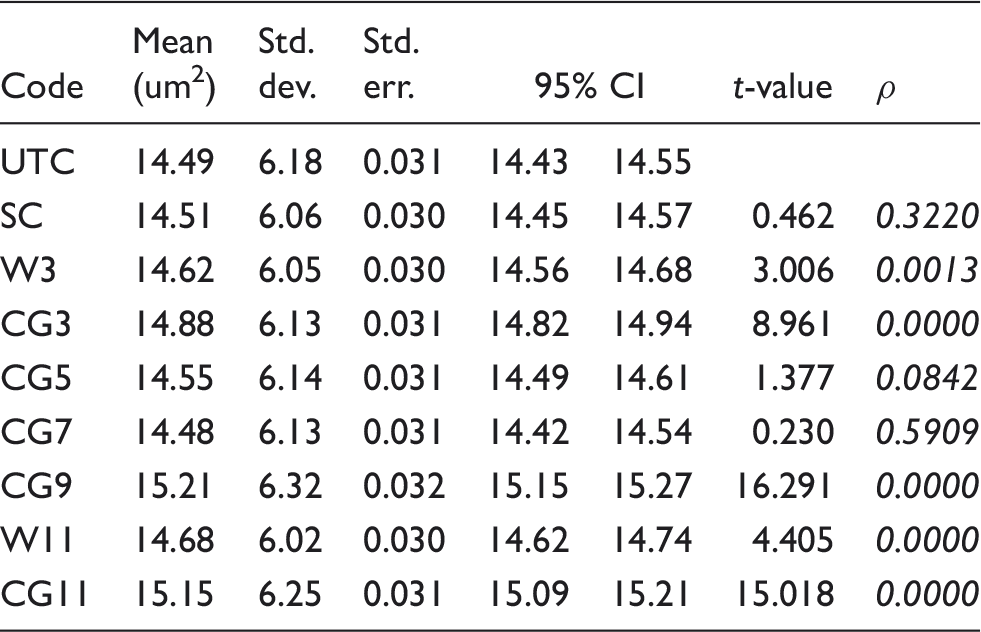
Whilst there was no significant difference in ribbon width between untreated fiber and scoured and fiber treated with glycine at pH 7, there were significant differences for fibers treated with glycine at more extreme pH values. Ribbon width values increased after glycine treatments at pH 3, 9 and 11, although the changes were more prominent in basic conditions. The changes in fiber treated in the buffered control solutions without glycine were smaller, indicating the role of glycine in the swelling of the cotton fibers. Similar increases in fiber width were reported by Shenouda and Happey 2 when cotton fibers were treated with zincoxen (tri (ethylene diamine)-zinc hydroxide solution). Observed outcomes included the disappearance of convolutions and an increase in ribbon width.
Scanning electron microscopy images of treated and untreated sample cross-sections are presented in Figures 3(a)–(g). Evident in these, as in Figures 1(a)–(h), are the differences in cross-sectional shape as a result of the various treatments. Figure 3(a) shows the cross-sectional shape of untreated (raw) cotton fibers. These are in stark Contrast with the cross-sectional shape of fibers treated in pH 11 glycine solution (Figure 3(g)), where the cross-sectional morphology has become more circular. The same effect is also observed in fibers treated with glycine in an acid pH solution (CG3, see Figure 3(f)). The alkaline water alone without glycine-treated samples did not show any appreciable change (Figure 3(d)), whereas for the acidic water without glycine-treated samples, cross-sections showed some swelling (Figure 3(e)). Overall, fiber cross-section morphology changed significantly after glycine treatments at both pH 3 and pH 11.
Scanning electron micrographs of untreated and treated cotton fibers cross-sections: (a) UTC; (b) SC; (c) CG7; (d) W11; (e) W3; (f) CG3; (g) CG11. UTC: untreated fibers.
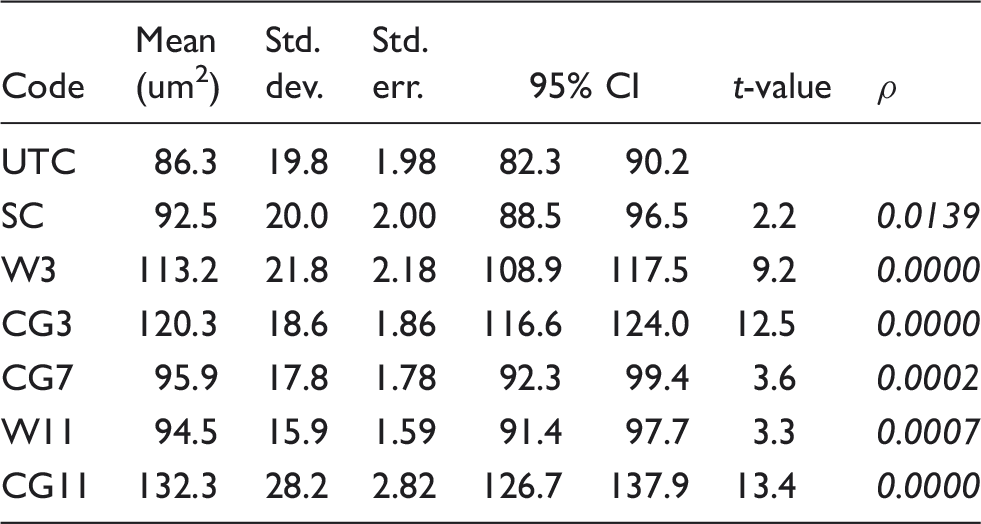
Cross-sectional wall area (um2) (n = 100) and t-test statistics for the difference between untreated (UTC) and other glycine/pH treatments

Changes in fiber cross-sectional area with treatment. Error bars indicate 95% confidence intervals for cross-section area means. UTC: untreated fibers.
Cross-sectional area differences between treatments were all significant with the largest differences between UTC and fibers subject to glycine treatments at pH 3 and 11. Differences were smaller although statistically significantly different between UTC fibers and other treatments. Further work is required to understand the practical implications of these treatments in terms of process efficiencies and fiber quality. Increases in cotton fiber cross-sectional area have been similarly reported for treatments with ethylamine and ammonia-like bases.25,26 Fibers treated with ethylamine solution increased in cross-sectional area by 27%.
26
This increase is similar to the glycine treatment at pH 11 observed here, which increased the cross-sectional area by nearly 30%. As expected, cross-sectional area measurements have a strong positive correlation between ribbon width measured by the Cottonscope instrument (R2 = 0.78) (see Figure 5).
Correlation between cross-sectional area and width of the fiber. Untreated fiber is highlighted (□).
Moisture regain
Moisture regain values (%) (n = 3) and t-test statistics for the difference between untreated (UTC) and other glycine/pH treatments
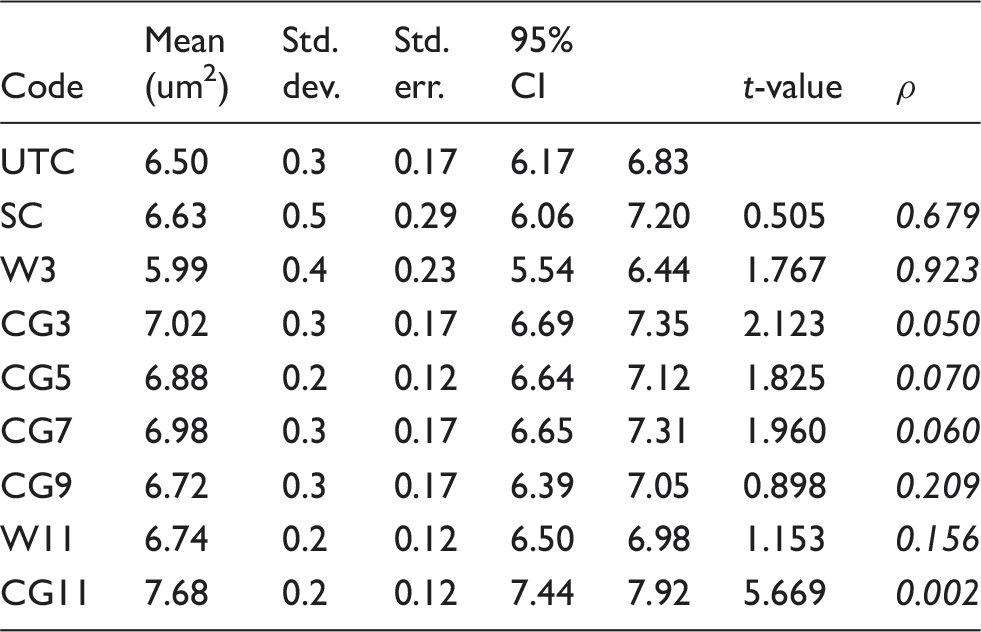

Moisture regain (%) of untreated (UTC) and treated cotton fibers. Error bars indicate 95% confidence intervals for moisture regain means.
The observed results are due in part to the amphoteric behavior of amino acids, that is, amino acids can act either as a base or an acid.29–32 Amino acids consists of both –NH3+ and – COO− groups and the basic/acidic nature is tunable by changing the pH of the solution (as shown in Scheme 1).
33
Reaction mechanism of glycine zwitterion in acidic and alkaline pH.
At an acidic pH, the aqueous glycine solution acts like a mild acid. 29 It is known that dilute acids at higher temperatures react with cellulose in cotton. 34 It is also known that the carboxyl group of an amino acid forms esters by reacting with alcoholic groups in presence of acid. 35 Because of the presence of hydroxyl groups in cotton cellulose, there is a chance that glycine esters are formed in the presence of HCl. When an alkaline pH is used, the nature of the glycine changes and the solution turns to basic. 29 It has been reported that both bases and acids can swell cotton fibers by breaking the intermolecular hydrogen bonds,7,17,36 improving the mobility of chains. It is thus hypothesized that under optimized conditions aqueous glycine solutions can change the intermolecular hydrogen bonding in the cotton cellulose.
Conclusion
In this work the swelling of raw and scoured cotton fibers in buffered glycine solutions was investigated. Glycine solutions buffered to pH 11 effectively swelled fibers and removed convolutions, resulting in an increase of fiber width and cross-sectional area. The degree of swelling was dependent on the solution pH. Results were confirmed by light and electron microscopy and Cottonscope measurements of fiber ribbon width. Glycine-treated fibers also absorbed more moisture. Controlled buffer solutions without glycine confirmed that the changes in fiber properties, that is, fiber width, cross-sectional area and MR, occurred due to an interaction between cotton’s cellulose structure and glycine and not because of the pH change alone. The ability to remove convolutions to swell the fiber and increase fiber MR was significant. The treatment offers the promise of a less aggressive (corrosive) processing route for ‘mercerizing’ cotton. Further work is required to understand the treatment in terms of industrial-scale processing times and conditions and its effect on cotton’s mechanical and fabric handle properties. This work ensues.
Footnotes
Declaration of conflicting interests
The authors declared no potential conflicts of interest with respect to the research, authorship and/or publication of this article.
Funding
The authors disclosed receipt of the following financial support for the research, authorship, and/or publication of this article: We would like to acknowledge the financial support from Cotton Research & Development Corporation (CRDC), Australia (DU, 401) that enabled us to carry out this research work.