



Abstract
Fabric hand is an indispensable characteristic for the selection of fabric and product development and the buying consideration for manufacturers and consumers. However, there is little comprehensive work on the hand feel property of warp-knitted fabrics due to the mainstream natural fibers (cotton, wool and silk) and other fabric structures (woven, weft-knitted and nonwoven). The increasing potential for the wide variety of applications and development of warp-knitted fabrics is not only because its fabric hand gives better determination for fabric marketing, but also because it provides extensive scope for fabric performance and appearance. This paper reports an experimental study on the integrated fabric hand behavior of a series of warp-knitted fabrics made for various apparel applications, such as sportswear, lingerie and leisure wear. These 105 fabrics were produced by varying different physical parameters, including fabric weight and fabric thickness. The Kawabata Evaluation System for Fabric (KES-F) was employed to obtain the fabric hand properties (primary hand value and total hand value) related with stiffness, smoothness and softness. All low-stress mechanical properties and fabric hand values from the testing results were used to verify the applicability of the KES-F on warp-knitted fabrics and to analyze the relationships of fabric parameters and hand characteristics. The results indicate that the KES-F is an appropriate tool to measure the hand attributes of warp-knitted samples, and moderate correlations between physical properties and mechanical behavior were found.
Keywords
Handle is a comprehensive term representing physical, psychological and social response to the touch of a fabric. 1 It is concerned with the subjective judgment of roughness, smoothness, harshness, pliability, thickness, etc. 2 As early as 1930, Peirce 3 termed fabric hand as customers’ perception and he initially proposed evaluation of fabric handle using a series of measurable low-stress physical and mechanical properties of fabrics. Howorth and Oliver 4 then pioneered the application of multiple factor analysis to identify factors affecting the handle of suiting materials. According to their analysis, the handle of worsted suiting can be specified in terms of three quality attributes: fabric smoothness, stiffness and thickness.
Fabric hand is an indispensable characteristic for the selection of fabric and product development and the buying consideration of manufacturers and consumers. However, there is little comprehensive work on the hand feel property of warp-knitted fabrics due to the mainstream natural fibers (cotton, wool and silk) and other fabric structures (woven, weft-knitted and nonwoven). The increasing potential for the wide variety of applications and development of warp-knitted fabrics is not only because its fabric hand gives better determination for fabric marketing, but also because it provides extensive scope for fabric performance and appearance.
Fabric objective measurement, as defined by Bishop, 5 is “the evaluation of fabric handle, quality and related fabric-performance attributes, in terms of objectively measurable properties.” The most well-known method, the Kawabata Evaluation System for Fabrics (KES-F), aimed to relate objective measurement of important mechanical properties in fabric hand to subjective evaluation.6–9 Hand descriptors, namely stiffness, smoothness, fullness and softness, were termed as primary hand values (PHVs). The quantitative component of the system was determined by a series of instruments that measure fabric responses to low deformations. The method of measuring fabric mechanical properties involves a complete fabric deformation–recovery cycle for tensile, shear, bending and lateral compression properties. In all cases, the deformation–recovery cycle was accompanied by a significant energy loss or hysteresis. The system relies on the multiple linear regression technique to correlate the mechanical measurements data to subjective fabric hand evaluation and shows clear physical interpretation of test results. Researchers have adopted the KES-F for evaluating low-stress mechanical properties of different textile materials.10–14
However, the validity of multivariate regression analysis is often severely influenced by collinearity of data, which appears to exist between the mechanical parameters obtained from the KES-F instruments. 15 There could be problems such as uncertainty, overlapping and instability in the meaning of the PHVs. 16 Limitation also appears on the types of fabrics used in the equations calculating fabric hand values. Those equations are mostly based on woven and weft-knitted suit fabrics, which are obviously different from the warp-knitted fabrics used in this paper. In such a case, efforts have been made to investigate the applicability and accuracy of the KES-F on warp-knitted fabrics regarding hand characteristics and physical parameters.
With the interest of low cost, high productivity and wide structure variations, warp-knitted fabrics have become more attractive for various applications in economic and technological development. Although there are some experimental studies17–20 on the mechanical properties of warp-knitted fabrics, there has been rather little research of the overall load–displacement measurement and integrated hand relationship with fabric physical properties. Therefore, the purpose of this report is to expound the interrelation of warp-knitted fabric with hand behavior in detail. Low-stress mechanical properties measured by the KES-F are verified so as to descant the significant coefficient of the experimental data.
Experimental details
Preparation of samples
Specifications of sample

Fabric weight and thickness
The 105 warp-knitted fabrics were of different types: mesh, spacer mesh, shiny mesh, brushed mesh, tricot, brushed tricot and micro brushed tricot. Distinct fabric weight and thickness were measured and sample conditions were kept at 65 ± 2% relative humidity and 21 ± 2℃ for at least 24 hours before measurement. Fabric weights of different sizes (100 cm2) and thicknesses were calculated according to ASTM Standards D3776 and ASTM D1777, respectively. The fabric weight ranged from 55 to 260 g/m2 and thickness ranged from 0.25 to 2.26 mm. These two basic physical properties are important for determining fabric hand value and mechanical properties.
Parameters measured by the KES-F
Properties measured by the Kawabata Evaluation System for Fabric
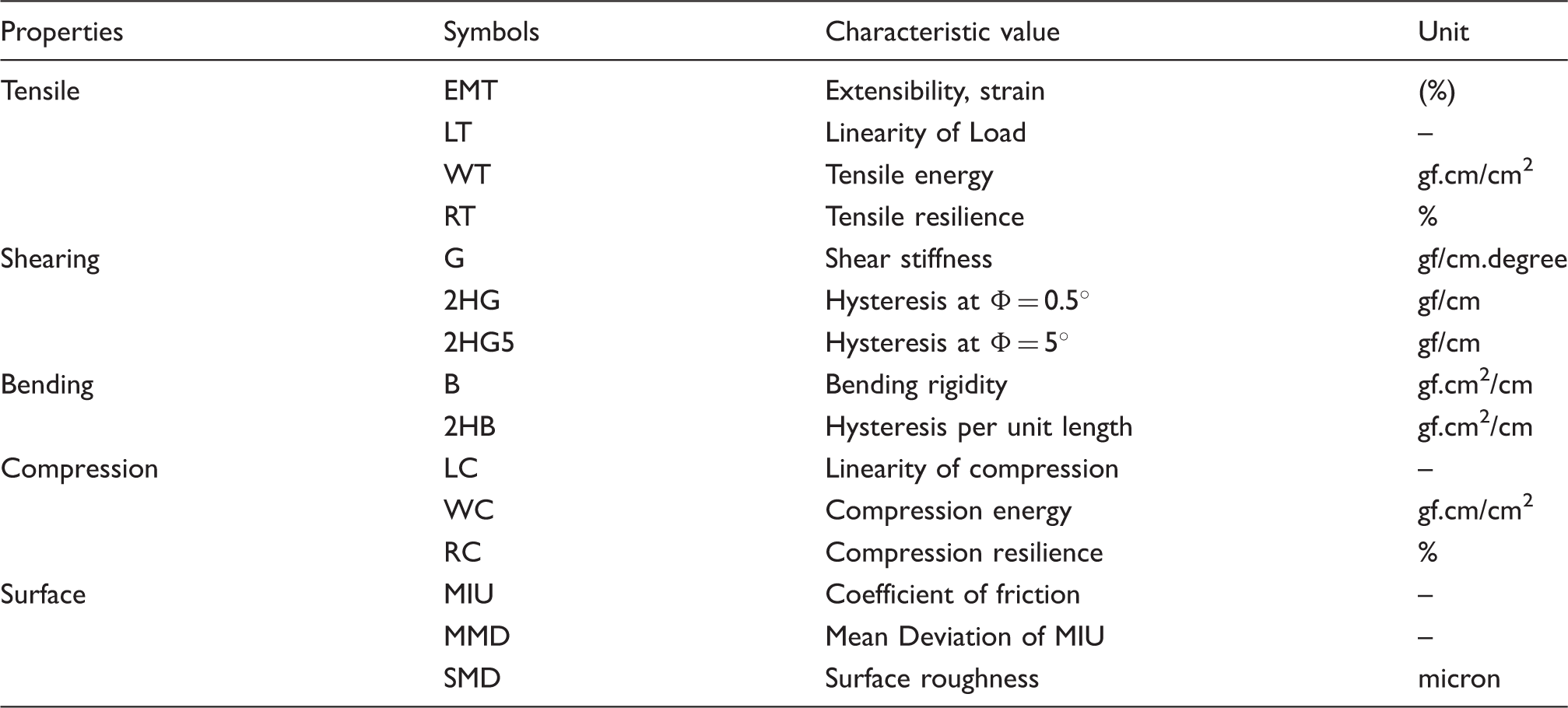
Primary hand expressions and the definitions from the Kawabata Evaluation System for Fabric

Results and discussion
Comparative study of low-stress mechanical properties on warp-knitted fabrics
The results of objective assessments of hand value were compared with physical properties, including weight and thickness. The correlations between mechanical properties and fabric parameters were explored in order to determine whether the hand feel characteristic was highlighted under quality evaluation. Objective measurement of warp-knitted fabrics using the KES-F was derived from low-stress mechanical parameters in terms of tensile, shear, bending, compression and surface properties. With the result of PHV and THV, fabrics were analyzed in relation to their fabric weight and thickness.
Tensile property
The extensibility (EMT), tensile linearity (LT) and tensile energy (WT) of warp-knitted fabrics show differences in the warpwise (w) and weftwise (c) directions. According to Figure 1, it is obvious that the average values of EMT(w), LT(w) and WT(w) are higher than that of EMT(c), LT(c) and WT(c), respectively. It is true that in warp-knitted fabric structures, extensibility in the warpwise direction is always higher than in the weftwise direction. Because of higher extensibility in the warpwise direction, more energy is needed to extend the warpwise samples than the weftwise. Under the t-test, the to values for relationship between EMT(w) and EMT(c), LT(w) and LT(c), and WT(w) and WT(c) are 5.68, 2.63 and 4.88, respectively, which are higher than the t-value (2.576), indicating that the relationships are significant at the 0.01 level (two-tailed). The warp fabrics statistically have better extensibility (EMT), tensile linearity (LT) and tensile energy (WT) in the warp direction than in the weft direction.
Tensile property of warp-knitted fabrics.
The tensile resilience (RT), however, is higher in the weftwise direction than in the warpwise direction. The average value of RT(c) is 56.44% and RT(w) is 49.28%. As the tensile resilience measures the fabric recovery process in the force–extension curve, a higher tensile extensibility contributes to lower tensile resilience for longer time of fabric recovery process. This result is again attributable to the compact structure of warp-knitted fabrics.
Correlation coefficients for tensile properties

w: warpwise direction; c: weftwise direction; W: weight; T: thickness.
Correlation is significant at the 0.01 level (two-tailed).
Correlation is significant at the 0.05 level (two-tailed).
Shearing property
Correlation coefficients for shear properties

w: warpwise direction; c: weftwise direction; W: weight; T: thickness.
Correlation is significant at the 0.01 level (two-tailed).
It can also be seen from Table 5 that the correlation coefficient between G(w) and G(c) is 0.908, implying a positive relationship. This result means the shear test can be done in only one direction, as the two measurements are highly correlated. It should also be noted that a correlation was found between 2HG5(w) and 2HG5(c), being 0.807. Therefore, the shear test for all warp-knitted fabrics was conducted for tension applied in one direction (the warpwise direction). Similar to the results of tensile properties, shear rigidity shows a correlation with fabric weight and thickness, where the correlation coefficient between G(w) and W and T is 0.585 and 0.500, respectively (significant at the 0.01 level). Similar to the tensile property, the heavier and bulkier the fabric, the more difficult it is to shear in parallel with warpwise and weftwise yarns.
Bending property
A reasonably wide range of fabric bending rigidity values were observed in the 105 warp-knitted fabric samples. The highest value of warpwise bending rigidity is 1.448 gf.cm2/cm, and the lowest is 0.03 gf.cm2/cm. For the weftwise direction of the fabric, the highest and the lowest bending rigidity is 1.47 and 0.02 gf.cm2/cm, respectively.
Generally speaking, bending rigidity increases with increase of fabric weight per unit area. For all warp-knitted fabrics, bending rigidity in the weftwise direction is higher than in the warpwise direction, as shown in Figure 2. The unusually high value of bending rigidity (1.448 gf.cm2/cm) can be explained by the fact that this fabric (spacer fabric) is the thickest fabric (2.26 mm) among the 105 fabrics.
Warpwise (wale direction) and weftwise (course direction) bending rigidities of warp-knitted fabrics.
Correlation coefficients for bending properties

w: warpwise direction; c: weftwise direction; W: weight; T: thickness.
Correlation is significant at the 0.01 level (two-tailed).
Compression property
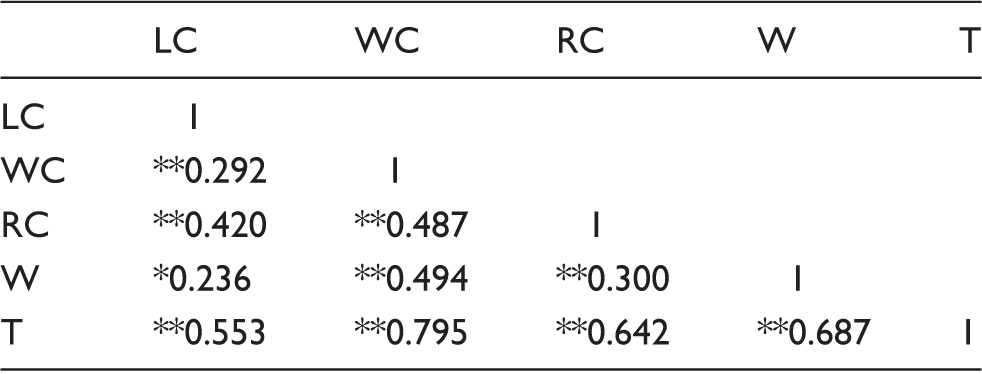
Correlation coefficients for compression properties
W: weight; T: thickness.
Correlation is significant at the 0.01 level (two-tailed).
Correlation is significant at the 0.05 level (two-tailed).
The results show that fabric weight has a correlation with fabric thickness when using the KES-F. It can be explained that when fabric thickness is measured under pressure, surface fibers and irregularities are compressed into the main body of the fabric. The result is denser fabric and, therefore, the measurement of fabric thickness under pressure gives a correlation with fabric weight.
For all fabrics tested, the correlation coefficient between fabric compression linearity (LC) and fabric weight (W) is relatively low at 0.236. Under the t-test, the to value for the relationship between LC and W is 2.46, which is higher than the t-value (1.960), indicating that the relationship is significant at the 0.05 level (two-tailed).
The correlation coefficient between fabric compression linearity (LC) and fabric thickness (T) is 0.553. The first result indicates that there may be a tendency for fabric compression linearity to be raised with increasing fabric weight and the second result shows that there is a moderate tendency for fabric compression linearity to be raised with increasing fabric thickness. It is found that increasing fabric thickness produces a softer fabric in compression.
The correlation coefficient between compression linearity (LC) and compression energy (WC) is 0.292, significant at the 0.01 level. Under the t-test, the to value for the relationship between LC and WC is 3.10, which is higher than the t-value (2.576), indicating that the relationships are significant at the 0.01 level (two-tailed). The two parameters are directly related because compression energy is measured as the total energy stored and the compression linearity is measured as the ratio of compression energy stored in the fabric to the total energy or area under a hypothetical linear compression–thickness curve. Therefore, a higher value of compression linearity would generally give a higher value of compression energy.
The compression energy (WC) shows a significant correlation with fabric thickness (T). The correlation coefficient between WC and T is 0.795. This result illustrates that a thicker fabric needs larger compression energy.
As Table 6 shows, a relationship exists between fabric thickness (T) and fabric compression resilience (RC). The correlation coefficient between RC and T is 0.642. It is clear that the fabric compression resilience goes up with an increase in fabric thickness. This result suggests that light fabric is relatively difficult to compress, having high compression resilience, or, in other words, thicker fabrics are more elastic in compression than thin fabrics.
Surface property
Fabric surface properties can be described using the KES-FB-4 surface tester to measure properties, such as coefficient of friction (MIU), fabric mean deviation (MMD) and fabric roughness (SMD).
Correlation coefficient of surface properties

w: warpwise direction; c: weftwise direction; W: weight; T: thickness.
Correlation is significant at the 0.01 level (two-tailed).
Correlation is significant at the 0.05 level (two-tailed).
Primary hand value and total hand value
The warp-knitted fabrics were measured objectively by using the KES-F. The calculated PHVs and the THV are analyzed by using the Hand Evaluation and Standardization Committee (HESC) translation equation for women’s suit medium-thick fabric materials. 6 The PHV for fabric stiffness ranges from 1.08 to 9.82 for all warp-knitted fabrics. For smoothness and softness, the PHV ranges from 1.64 to 7.58 and from 0.51 to 7.98, respectively. The THV for these 105 fabrics ranges from 0.99 to 3.98.
The correlation matrix for the THV to the PHVs obtained from the measurements using the KES-F (Table 8) was calculated so as to access their relationship for the warp-knitted fabrics for women’s suits.
Correlation matrix for primary hand values and total hand value (THV)

W: weight; T: thickness.
Correlation is significant at the 0.01 level (two-tailed).
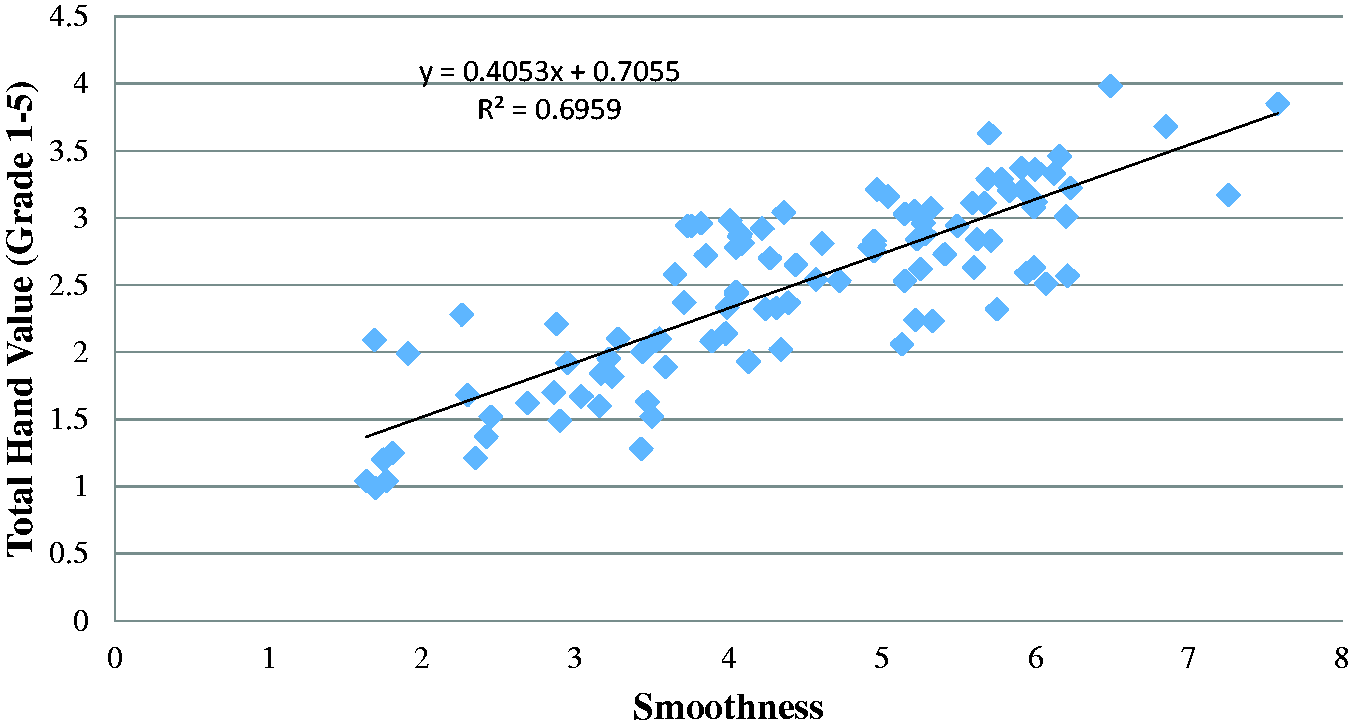
Relationship between total hand value and primary hand value of smoothness.
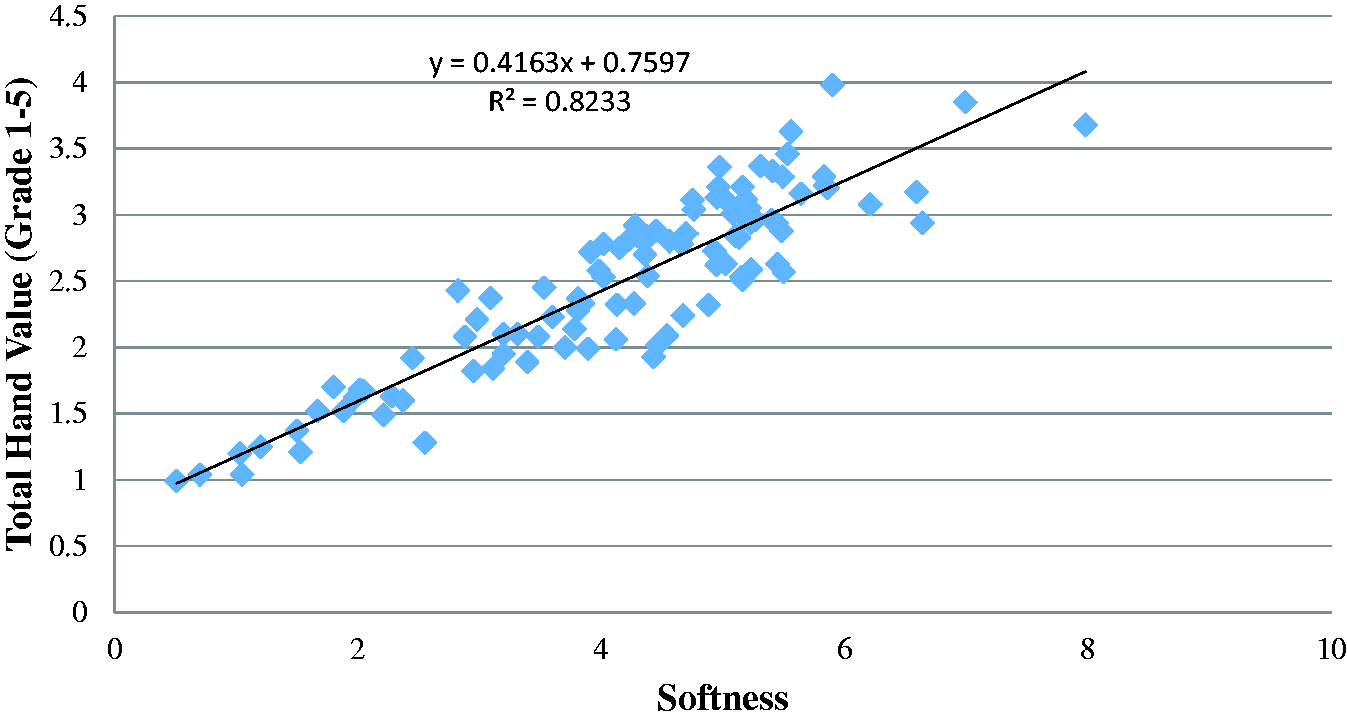
Relationship between total hand value and primary hand value of softness.
Depending on Table 9, the stiffness of warp-knitted fabric is highly correlated to weight and thickness. The correlation coefficients between fabric stiffness and fabric weight and thickness are 0.821 and 0.611, respectively. This represents that heavier and thicker fabric is stiffer consequently. It is necessary to point out that such analysis on warp-knitted fabric is corresponding and equivalent with Peirce’s work.
3
The relationships of stiffness with weight and thickness are shown in Figures 5 and 6, respectively, but the relationship is weakly correlated.21,22
Relationship between fabric weight and hand value of stiffness. Relationship between fabric thickness and hand value of stiffness.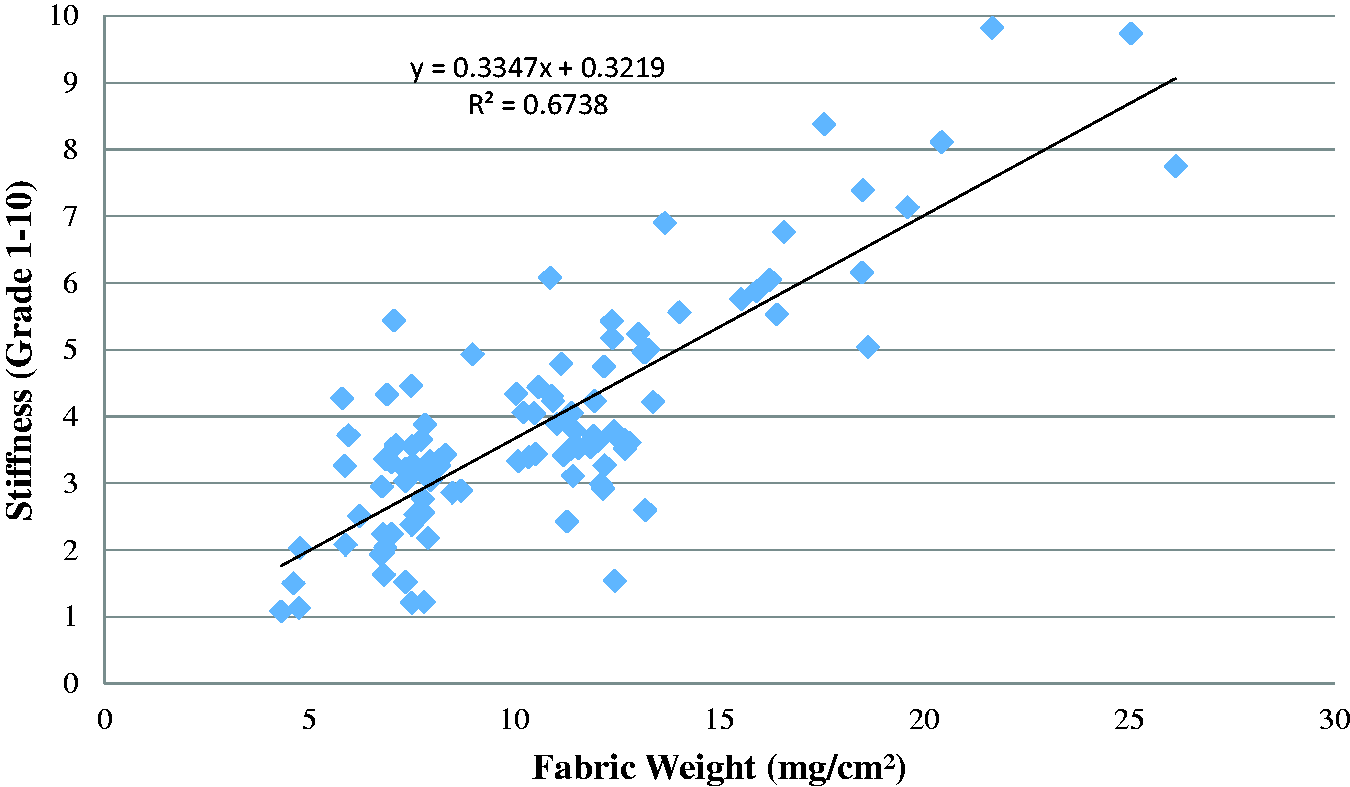

Conclusion
This paper reports the objective assessment of fabric hand for warp-knitted fabrics by the KES-F. The results of low-stress mechanical properties were compared with physical parameters. The effect of different fabric weight and thickness toward hand attributes, including stiffness, smoothness and softness, were explored. According to the experimental results and analysis, the following conclusions can be drawn.
The KES-F is an applicable and precise tool of measuring the mechanical performance and hand feature for warp-knitted fabrics. Physical properties are found to be positively related to stiffness and THV and invalid for fabric smoothness and softness. In accordance with THV rating, brushed mesh has the best fabric hand performance, for which most THVs achieve a score of 3 or above. The physical attributes, such as fabric weight and thickness, have an effect on the low-stress mechanical properties but have a different extent depending on the fabric type. For example, light fabrics (e.g. mesh and tricot) are good in extensibility, shear stiffness and bending rigidity. However, heavy fabrics (e.g. spacer fabrics and brushed mesh) performed well for compression properties. Statistical analysis was conducted to evaluate different pairs of properties with low correlation coefficient values. Such low correlation coefficient values may be due to the friction and viscoelasticity and geometry of threads. However, statistical analysis revealed that even at a low correlation coefficient, the relationship between those pairs of properties was still significant statistically.
Footnotes
Declaration of conflicting interests
The author(s) declared no potential conflicts of interest with respect to the research, authorship and/or publication of this article.
Funding
The authors disclosed receipt of the following financial support for the research, authorship, and/or publication of this article: This work was supported by the Hong Kong Polytechnic University. Grant number is RTBQ.