




Abstract
This paper presents the test results of multifunctional thin-coating textile finishing with the use of hybrid Al2O3/SiO2 sol modified with metallic nanoparticles of Ag/Cu powder and TiO2 P25. The modified hybrid Al2O3/SiO2 sol was deposited on polyester/cotton (67/33) woven fabrics by the padding method, followed by drying and thermal heating to obtain a thin and elastic xerogel coating on the fabric fiber surface. The woven fabrics finished in this way were characterized by very good bioactive properties against Staphylococcus aureus and Escherichia coli bacteria and Candida albicans and Aspergillus niger fungi (83–92% reduction in bacteria and 87–93% reduction in fungi) and showed photocatalytic self-cleaning capabilities and a high protection against ultraviolet (UV) radiation. The color difference (ΔE) obtained after UV irradiation for 112 h was 11.6, and the ultraviolet protection factor (UPF) value considerably exceeded the limiting standard value of 50, while in the case of a reference woven fabric, ΔE = 4 and UPF was about 40. At the same time, the woven fabrics finished were characterized by a high resistance to abrasion.
Keywords
Good functional and aesthetic properties of textiles made of fiber blends have led to the fact that they now constitute the majority of textiles produced worldwide. In this case, textiles made of (from) polyester/cotton blends (PET/CO) in different percentages (e.g. 80/20, 67/33, 50/50) and designed for clothing, as well as for interior decorations, public buildings, communication means and technical applications, show particularly profitable features. Their good functional properties result from the mutually complementing features of the blend components. PET fibers provide a high resistance to stretching and abrasion and good elastic recovery as well as shape stability of fabrics during use and laundering. On the other hand, cellulose fibers provide hydrophilic properties and a high capability to absorb water/perspiration, a soft feel and attractive appearance. A great potential of further widening the functional applications of such woven fabrics and imparting several new properties (multifunctionality) to them is created by the use of physical–chemical methods of fiber surface modification, including the deposition of various thin and elastic protective coatings.1,2
In this aspect, particularly effective is the sol-gel method, which makes it possible to form on the fiber surface thin, 200–300 nm, xerogel coatings from polymeric inorganic–organic hybrids, first of all on the basis of SiO2 or TiO2.3–6 The sol-gel method is based on colloidal suspensions made from appropriately selected precursors (e.g. semi-metal alkoxides, metal oxides or organometallic compounds). The sols obtained in this way are deposited on the fiber surface followed by thermal treatments at higher temperatures (drying and polycondensation processes) to obtain lyogels containing a considerable content of liquid phase. The liquid phase is removed by drying and the thin porous layer on the fiber surface is formed. Further drying, due to progressing polycondensation, converts this layer into a cross-linked gel coating physically or/and chemically combined with the fiber surface.7–10 The properties of the coating formed depend on the type of precursor, the conditions of sol synthesis and the method of its modification.11–16
The modification of silica sol with nanoparticles of aluminum trioxide imparts resistance to abrasion to fabrics,17–21 the addition of TiO2 protects them against ultraviolet (UV) radiation and imparts self-cleaning capability,3,22–25 the addition of silver imparts antibacterial properties26–31 and the addition of phosphorus compounds imparts flame retardancy.32–34 Particularly important is the possibility to obtain in this way multifunctional finishes in the form of nano-coatings either by the proper selection of nanoadditives with multifunctional action or by the incorporation of several types of nanoparticles with different functionalities into the synthesized sols. For example, the incorporation of silver together with zinc oxide into the sol imparts antibacterial and photocatalytic properties to it. 35 This makes it possible to considerably extend the functional applications of fabrics modified in that way.
The basic assumption of our studies was to assess the possibility of simultaneous imparting to PET/CO woven fabrics several new properties by nano-coating finishing using the sol-gel method on the condition that the primary features of these fabrics will be maintained, especially their functional stability, determined by the resistance to abrasion. In this article, we present the results obtained by treating PET/CO woven fabrics using a hybrid silica sol. The hybrid silica sol was synthesized on the basis of (3-glycidoxypropyl)trimethoxysilane and aluminum (III) isopropoxide, and modified with Ag/Cu and TiO2 P25 nanoparticles by the sol-gel method. The effect of the thin-coating finishing of PET/CO woven fabrics using the hybrid silica sol on photocatalytic properties, protection against UV radiation, bacteria and fungi is presented.
Experimental work
Materials
Woven fabrics
A commercial woven fabric, consisting of a PET/CO blend (67% PET and 33% CO), was used in this study. The characteristics of the PET/CO fabric were as follows: twill weaves, mass per unit area – 165 g/m2; thickness – 0.36 mm, warp and weft yarns – 23 tex; warp threads – 42/cm; weft threads – 21/cm. The finishing treatments (desizing, bleaching, washing, drying and thermo-stabilization) of the fabrics were applied to prepare the fabrics for sol application. A detailed description of these finishing treatments has been gathered by Kowalczyk et al. 36
Precursors of the hybrid Al2O3/SiO2 sol
To synthesize the hybrid Al2O2/SiO2 sol two precursors, (3-glycidoxypropyl)trimethoxysilane and aluminum (III) isopropoxide (ABCR GmbH & Co.KG, Germany), were used.
Functional nanoparticles
For modification of the hybrid Al2O3/SiO2, sol nanoparticles of alloy Ag/Cu (97.5% Ag, 2.5% Cu, particle size ≤ 100 nm, Sigma-Aldrich, Germany) and TiO2 P25 (≥ 99.5%, particle size ∼21 nm, Sigma-Aldrich, Germany) were used.
Preparation of the hybrid Al2O3/SiO2 sol
The sol was prepared by mixing two separately synthesized sols, Al2O3 and SiO2, in 1:1 volumetric proportion by an intensive stirring at 20–25℃. The details of the preparation of these sols have been previously reported. 36 Briefly, Al2O3 sol was prepared by mixing aluminum (III) isopropoxide with ethanol and water (in a molar ratio of 1:2.5:1) by an intensive stirring for 2 h at 80℃. Next, the poly(vinyl alcohol) under continuous stirring was added. SiO2 sol was prepared by the hydrolysis of (3-glycidoxypropyl)trimethoxysilane in a water–alcohol medium for about 2 h at 80℃. After combining the synthesized sols, the hybrid Al2O3/SiO2 sol was obtained, which after dilution with water (1:20) was deposited on the fiber surface. 37
Preparation of the hybrid Al2O3/SiO2 sol with functional Ag/Cu and TiO2 P25 nanoparticles
In order to obtain a high, possibly mono-particle, dispersion of nanoparticles in the sol, Ag/Cu and TiO2 P25 were separately dispersed in a small quantity (about 10 mL) of hybrid Al2O3/SiO2 sol by means of an ultrasonic homogenizer (power 200 W, amplitude 30%, frequency 50/60 Hz) for 60 min. They were then added to the 0.5 L diluted (1:20) hybrid Al2O3/SiO2 sol. The whole mixture was again treated with an ultrasonic homogenizer for 20 min followed by mixing with a magnetic stirrer for 60 min. The content of Ag/Cu and TiO2 P25 nanoparticles in the hybrid Al2O3/SiO2 sol was equal 0.2% and 1%, respectively.
Preparation of sol-gel coatings doped with functional Ag/Cu and TiO2 P25 nanoparticles
The hybrid Al2O3/SiO2 sols containing functional nanoparticles were applied on the fabric surface by the padding method using a laboratory two-roller padding machine from BENZ GmbH, type KLFH 322K (Switzerland). The nip-pressure was adjusted so as to reach a wet pick up of 70–85%; the padding rate was 1 m/min. After padding, the fabric samples were dried at 60℃ and then heated at 160℃ for 1 min. Under these conditions, a thin, hard and elastic silica coating was formed on the fiber surface. The total dry solids deposited on the fabric (A, wt%) was determined by weighing fabric before (W0) and after padding with sols and the subsequent thermal treatment (W1). The A value was evaluated according to equation (1)

According to equation (1), the A value for fabric with deposited hybrid sol, Al2O3/SiO2, Al2O3/SiO2 + Ag/Cu, Al2O3/SiO2 + TiO2 P25, Al2O3/SiO2 + TiO2 P25 + Ag/Cu, was equal 2.6%, 3.0%, 3.5% and 3.7%, respectively.
Examination of the fiber surface with deposited sol-gel coatings, doped with functional nanoparticles
Scanning electron microscopy/energy dispersive spectroscopy analysis
The surface and chemical elements of the analyzed samples were examined by means of a VEGA 3 scanning electron microscope (Tescan, Czech Republic) with an energy dispersive spectroscopy (EDS) INCA Energy microanalyzer (Oxford Instruments Analytical, England). The three-dimensional (3D) analysis of the fabric surface was carried out with the use of Alicona MeX software (Alicona Imaging GmbH, Austria) connected to a VEGA3 scanning electron microscope. Based on the 3D topography of the fabric surface, the parameters of its roughness were determined as follows.
Sa – average height of the selected area – average roughness
Sdq – root mean square gradient
Sdr – developer interfacial area ratio
where A is the defined area, that is, an area used to define the parameters that characterize the surface, and z(x,y) is the value of the ordinate, a function representing the height of the surface with a limited range in position x, y.



Parameter Sa – the amplitude parameter – is the arithmetic mean of the absolute values of ordinates inside the area tested and is determined as average roughness. Parameters Sdq and Sdr are hybrid parameters: Sdq determines a general measurement of the slopes of particular elevations on the surface tested, while Sdr defines the percentage of an additional surface raised up by the texture compared to the perfectly flat surface with the same size of measurement area. These parameters were determined according to standards ASME B46.1-2009, 38 PN-EN ISO 1302:2004 39 and PN-EN ISO 25178-2:2012. 40
Detection of silver and copper content
The content of silver and copper in the samples was determined by means of an atomic absorption spectrometer with flame atomization (SpectrAA 250 Plus, Varian, Australia) equipped with hollow cathode lamps (HCL) tubes for the determination of silver (338.3 nm) and copper (324.8 nm). The details of the determination of these heavy metals have been previously reported. 36
Assessment of antibacterial and fungicidal properties
The assessment of antibacterial and fungicidal properties was performed according to AATCC Test Method 100 by the quantitative method to determine the percentage reduction in bacteria: Staphylococcus aureus (ATCC 6538), Escherichia coli (ATCC 8739) and the percentage reduction in fungi: Candida albicans (ATCC 10231) and Aspergillus niger (ATCC 16404) in relation to unmodified materials. The degree of bacteria and fungi reduction (R) was calculated from equation (5)

Assessment of photocatalytic properties
The photocatalytic properties of modified fabrics were assessed by self-cleaning tests. The self-cleaning performance of fabrics was measured by following the discoloration of methylene blue under UV radiation. For this purpose, the fabrics were dyed with an aqueous solution of methylene blue (0.175 mg/L). The dyeing of fabrics was carried out in an automatic laboratory dyeing machine, AHIBA NUANCE Top Speed (AHIBA, Switzerland), with a liquor ratio of 1:100. The process of dyeing was performed at 20℃ for 30 min. After drying the fabrics were exposed to UV radiation (λ = 302 nm, power 8 W, intensity 340 µW/cm2). The maximum exposure time was 112 hours.
Color measurements
The colorimetric analysis of the colored fabrics was recorded using a spectrophotometer, CM-2600d (Konica Minolta, Japan). The spectra were recorded in the range of 360–740 nm. Measurements were performed under standard illuminant D65, at a 10° observing angle and d/8 viewing geometry. The three coordinates (L*, a* and b*) of the CIE Lab color system and the color difference (ΔE) of the fabric were measured by colorimetry software. The color differences (ΔE) were evaluated according to equation (6)

UV protection
The UV protection properties of the modified fabrics, as determined by the ultraviolet protection factor (UPF) and UV transmission spectra, were recorded by a double beam ultraviolet-visible (UV-Vis) spectrophotometer, Jasco V-550 (Jasco Inc., USA), with an integrating sphere attachment. The tests were carried out according to standard PN-EN 13758-1:2007.
42
The fabric UPF value was determined as the arithmetic mean of the UPF values for each of the samples, reduced by statistical value depending on the number of performed measurements, at the confidence interval of 95%, according to equation (7)

According to the Australian classification scheme, fabrics can be rated as providing good, very good or excellent protection if their UPF values range from 15 to 24, 25 to 39 and above 40, respectively. For UPF ratings of 55 or greater, the term 50+ shall be used.
Testing the resistance to abrasion
The tests were carried out according to standard PN-EN-ISO 12947- 1:2000+AC:2006 43 with the use of Nu-Martindale 864 apparatus (James H. Heal & Co. Ltd, England). The pressure of the abrasive heads was 12 kPa. A standard wool woven fabric was used as the abradant fabric.
Results and discussion
Surface characteristics of modified PET/CO woven fabric
Figure 1 shows PET/CO woven fabrics before and after the deposition of modified and unmodified hybrid Al2O3/SiO2 sol. Figure 1(a) shows fibers with a characteristic “twisted ribbon” and heterogeneous developed surface with visible micro-fibrils, corresponding to CO fibers (left-hand image) and smooth fibers with a circular cross-section corresponding to PET fibers (right-hand image). Once the hybrid Al2O3/SiO2 sol is deposited on the fiber surface, followed by drying and thermal heating, a thin, elastic xerogel coating is formed.
44
The properties of the modified woven fabric depend on the uniform, mono-particle distribution of nanoparticles in the sol, and then on the structure of thin xerogel coatings formed on the fiber surface. The quantity of the hybrid sol deposited on the fiber surface depends on the surface properties of woven fabric, especially its wettability and absorbing capacity.
Scanning electron microscopy images of the cotton fiber (CO) (left) and the polyester fiber (PET) (right) surface: (a) unmodified; (b) modified with the hybrid Al2O3/SiO2 sol; (c) modified with the hybrid Al2O3/SiO2 sol containing Ag/Cu and TiO2 P25 nanoparticles.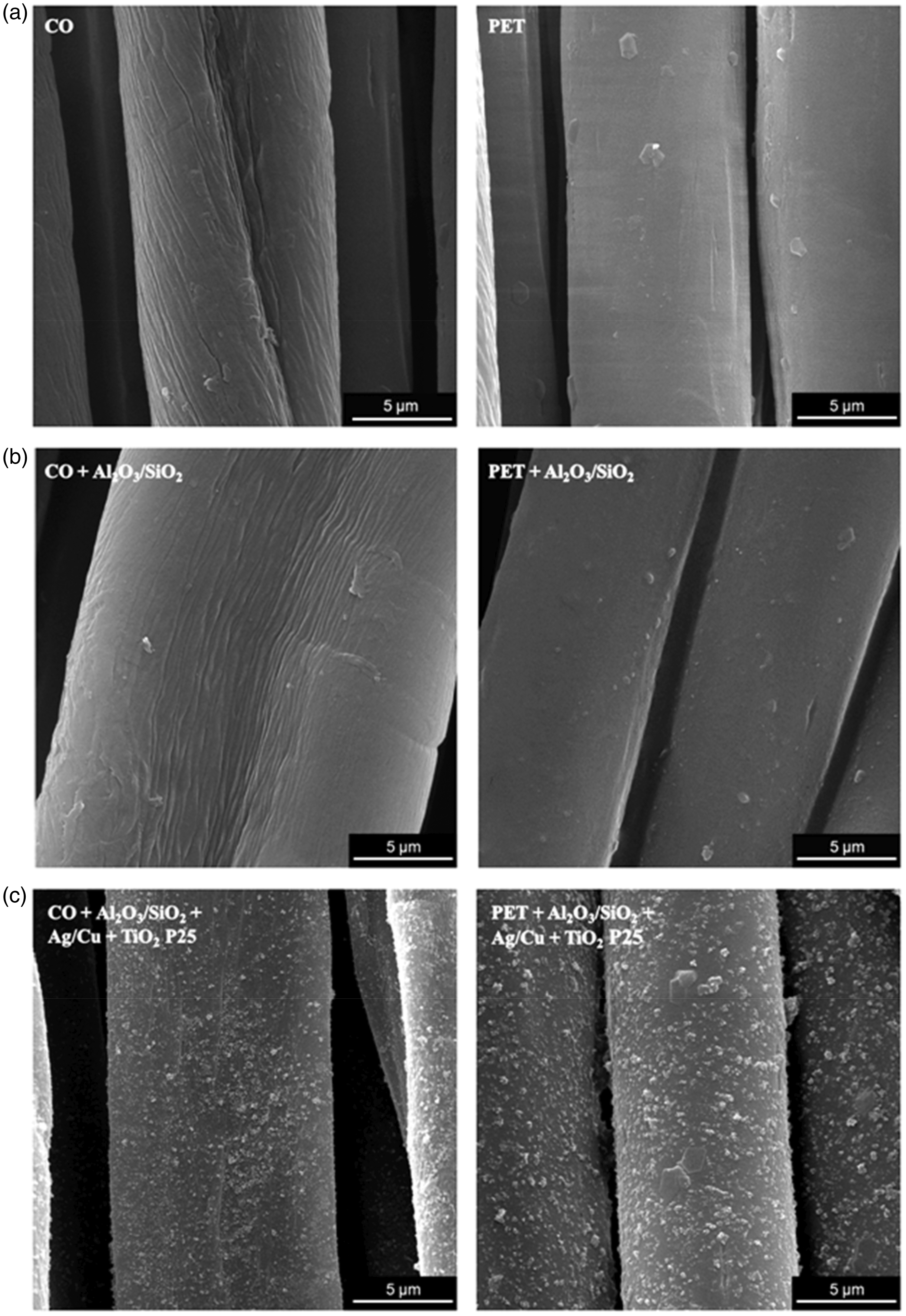
Weight percentage elements determined for unmodified and modified polyester/cotton (PET/CO) woven fabrics

The xerogel coating formed fulfills the function of the “binding element” of functional nanoparticles with the fiber surface. This immobilization of particles causes an increase in roughness and, consequently, the development of the fiber surface. The increase in fiber roughness resulting from the modification with hybrid Al2O3/SiO2 sol doped with functional nanoparticles depends on the physical–chemical properties of the fibers.
Three-dimensional (3D) surface roughness parameters determined for unmodified and modified polyester/cotton (PET/CO) woven fabrics

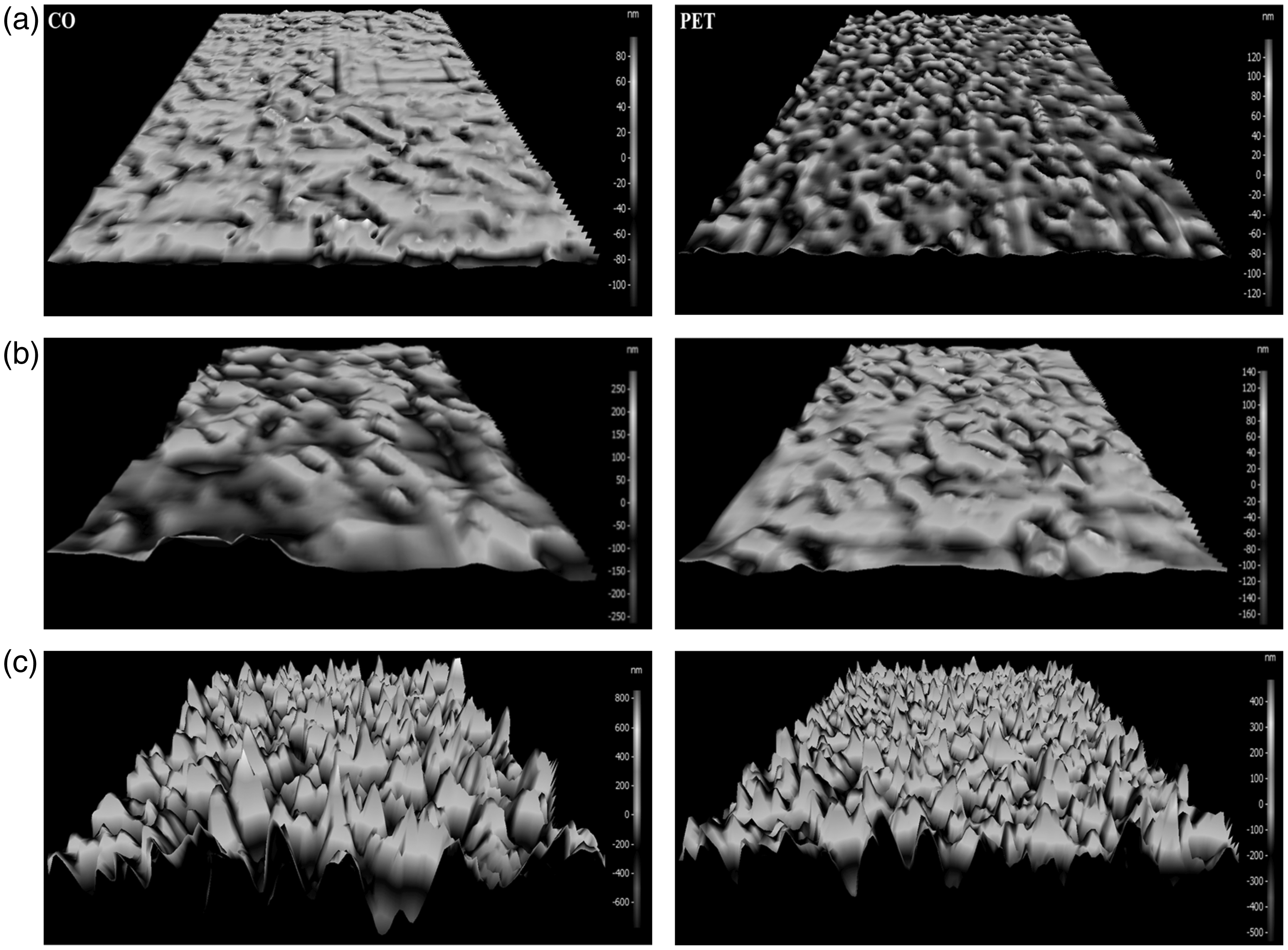
Three-dimensional scanning electron microscopy images of the topography of the cotton fiber (CO) (left) and polyester fiber (PET) (right) surface: (a) unmodified; (b) modified with the hybrid Al2O3/SiO2 sol; (c) modified with the hybrid Al2O3/SiO2 sol containing Ag/Cu and TiO2 P25 nanoparticles.
About a double and fourfold increase in the value of Sa was obtained after the deposition of the hybrid Al2O3/SiO2 sol containing nanoparticles of Ag/Cu and TiO2 P25, respectively, on the surface of PET fibers. The highest differences in the increase in the value of Sa between the two types of fibers were obtained after their modification with the hybrid Al2O3/SiO2 sol containing the nanoparticles of Ag/Cu and TiO2 P25. In the case of PET fibers, the value of Sa increased only four times, while for CO fibers, the increase was over seven times greater (Table 2). These differences may result from the properties of PET fibers that, contrary to CO fibers, show hydrophobic properties and have a less developed surface. Consequently, there is a lower adsorption of the hybrid Al2O3/SiO2 sol and nanoparticles on the surface of PET fibers. In contrast, the CO fibers show hydrophilic properties, which in turn results in a higher adsorption of the hybrid sol containing nanoparticles. This is confirmed by the values of parameters Sdq and Sdr, especially Sdr, a parameter of the surface area development. These parameters characterize both the oscillations of height and their arrangement (Sdq) and the number of topographic elements (Sdr) that can be related to the nanoparticles adsorbed on the fiber surface. The comparison of these parameters determined for unmodified and modified fibers with hybrid Al2O3/SiO2 sol containing functional nanoparticles shows that their higher increase was obtained for CO fibers. However, it should be mentioned that for both types of fibers, a considerable increase in parameters Sa, Sdq and Sdr was obtained as a result of their modification. This indicates a developed structure of their surface and uniform arrangement of nanoparticles in the xerogel coating formed on the fiber surface of both PET and CO fibers (Figure 2). This development of the fiber surface with thin-coating modified with functional nanoparticles can also influence the effectiveness of processes proceeding on their surface, for example, photocatalytic self-cleaning, since the surface of “impurity” contact with nanoparticles of the photocatalyzer, determining the effectiveness of the process, is increased.
Properties of photocatalytic self-cleaning
As a result of the formation of a thin xerogel coating containing nanoparticles of Ag/Cu and TiO2 P25 on the fiber surface, the PET/CO woven fabric showed properties of photocatalytic self-cleaning. The assessment of these properties was carried out on the basis of the values of components CIE L*a*b for PET/CO woven fabric dyed with methylene blue, after UV irradiation. The decomposition of the dye adsorbed on the PET/CO unmodified with functional nanoparticles occurs only to a slight extent (Figure 3). After 112 h of UV irradiation, the color difference ΔE amounted to about 4. This small decomposition of dye may result from the presence of a photocatalyzer – titanium dioxide used as a matting agent in PET fibers, whose presence (0.08%) was confirmed by EDS tests (Table 1). An increase in the decomposition of adsorbed dye was obtained for the woven fabric with the xerogel coating containing Ag/Cu. Silver nanoparticles show the capability to absorb electromagnetic radiation within the range of UV and visible light. The absorption of UV radiation results in the interband electron transition and localized surface plasmon resonance effect.45,46 The electrons in silver nanoparticles are excited as a result of the absorption of UV radiation, and then they cause the decomposition of the dye adsorbed on the surface of PET/CO fibers. The degradation of dye on the PET/CO woven fabric modified with Ag/Cu nanoparticles proceeds faster than in the case of unmodified woven fabric. Color difference ΔE = 4 was obtained already after 32 h exposure to UV light, and after 112 h exposure ΔE = 6.3. The influence of Ag/Cu on the rate of dye degradation was also observed in the case of the woven fabric modified with both TiO2 P25 and Ag/Cu. As a result of the exposure of the xerogel coating containing TiO2 P25 to UV light, the particles of the photocatalyzer are activated. The electrons of the low-energetic valence band of TiO2 are transferred to the highly energetic band of conductance, which results in the formation of electro-hole pairs (e– i h+) that participate in the formation of •OH and O2•– radicals responsible for the photodegradation of dye.25,47–49 The photocatalytic efficiency of TiO2 is determined by the rate of recombination of photoinduced holes and electrons. This recombination can be caused by the doping of the photocatalyzed surface with the elements trapping the excited electrons or holes. The role of such an element in the xerogel coating formed on the surface of PET/CO woven fabric is fulfilled by silver nanoparticles. They capture the electrons from the conductance band of TiO2 and consequently decrease the recombination of the electron-hole pair. At the same time, they contribute to increasing the photocatalytic efficiency of TiO2. This is confirmed by the measurements of the color difference determined for the PET/CO woven fabric with the xerogel coating containing TiO2 P25 or both TiO2 P25 and Ag/Cu, for which after 112 h exposure to UV radiation, the following values – ΔE ≅ 8.7 and ΔE ≅ 11.6 – were obtained, respectively (Figure 3).
Change in color difference (ΔE) of polyester/cotton woven fabric dyed with methylene blue: (a) unmodified or modified hybrid Al2O3/SiO2 sol containing (b) Ag/Cu, (c) TiO2 P25 and (d) Ag/Cu and TiO2 P25 nanoparticles. UV: ultraviolet.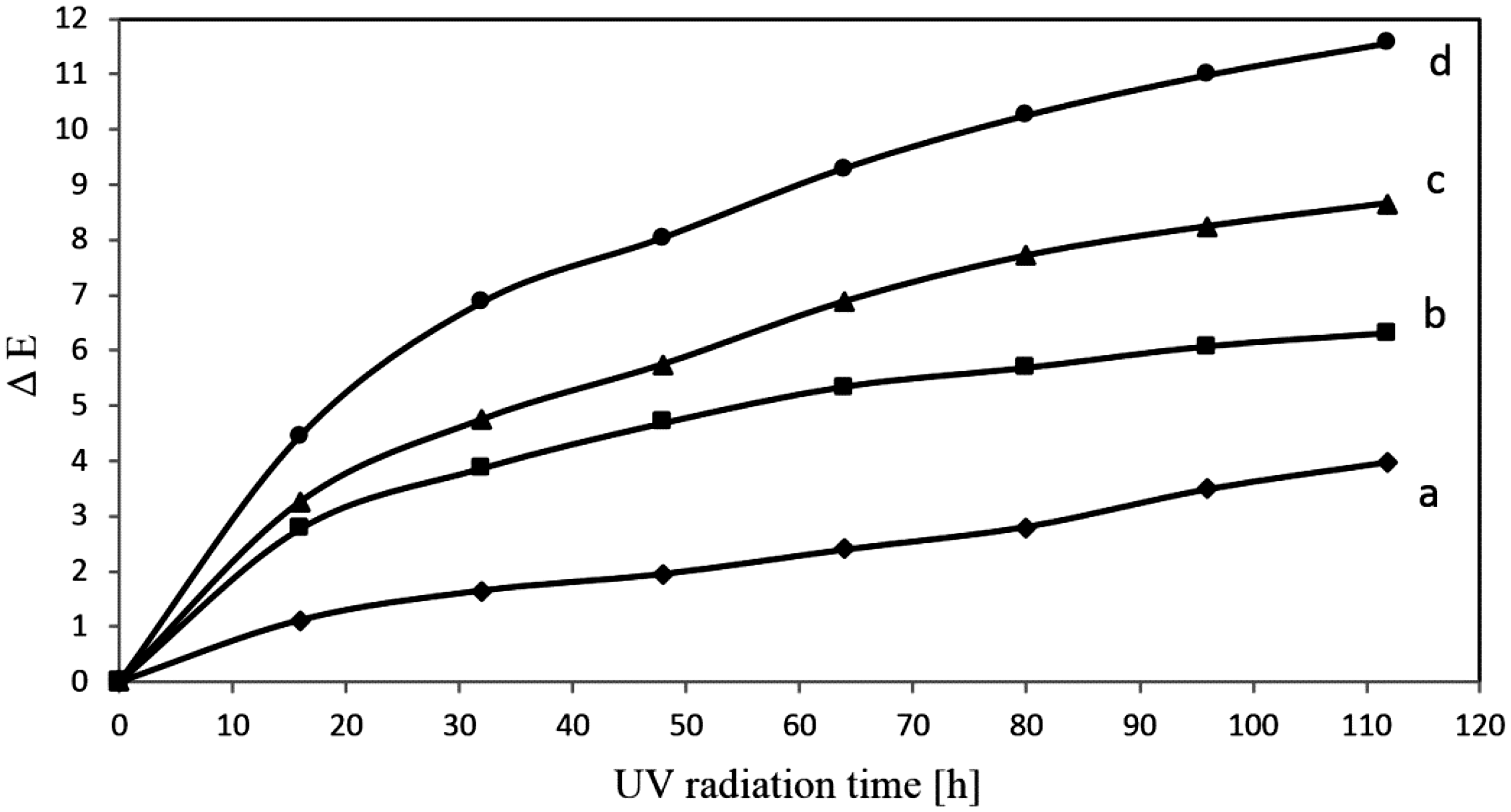
These values indicate a high degree of photocatalytic degradation of the dye on the surface of PET/CO woven fabric. Relating the values of ΔE obtained to the gray scale, we obtained a change in the color shade at the level of 2 and 1-2, respectively. In contrast, for the unmodified woven fabric or that modified with Ag/Cu, after 112 h UV irradiation, we obtained the color shade at a level of 3 and 3-2 of the gray scale, respectively.
Protection against UV radiation
Apart from the properties of photocatalytic self-cleaning, the woven fabric showed protective properties against UV radiation. According to standard PN-EN 13758-1:2007, 42 the fabric has protective properties when the UPF parameter is higher than 50.
According to the accepted categorization, the unmodified PET/CO woven fabric shows good protective properties against UV radiation. The barrier parameter (UPF) determined for it within the wavelength range from 290 to 400 nm amounted to 39.68 (<40 rating). This indicates that about 1/40 of UV radiation passes through the woven fabric and reaches the user’s skin. 47 In the case of unmodified woven fabric, the value of UPF depends on the type of yarn from which the fabric is made, the density and structure of the woven fabric and the finishing processes used. The xerogel coating, containing TiO2 P25 or both Ag/Cu and TiO2 P25, formed on the surface of PET/CO woven fabric considerably increases its barrier capability in relation to UV radiation. The UPF parameter determined for this modified fabric was >>50+, so it exceeded the value that characterizes a woven fabric with excellent protection against UV radiation. The increase in the protective properties against UV radiation of the fabric modified with TiO2 P25 results from the absorption and the scattering of UV radiation by TiO2 P25 particles because of their large refractive index.50–52
Bioactive properties
Bioactive properties of polyester/cotton (PET/CO) fabrics after deposition of modified hybrid Al2O3/SiO2 sol with Ag/Cu and TiO2 P25 nanoparticles

Kowalczyk et al. 36
The degree of reduction in bacteria and fungi obtained is similar to that obtained for the PET/CO woven fabric modified with hybrid Al2O3/SiO2 sol containing Ag/Cu (without TiO2 P25). This indicates that the addition of TiO2 P25 has no negative effect on the bioactive properties of the woven fabric with nanocoating finishing containing Ag/Cu. At the same time, the use of these two nanoparticles can contribute to creating a synergetic effect whereby the PET/CO woven fabric modified will show bioactive properties in visible light (owing to the addition of Ag/Cu) as well as under the influence of UV radiation (owing to the addition of TiO2 P25). 53
Resistance to abrasion
Previous studies have shown that the thin xerogel coating formed on the fiber surface contributes to an increase in the resistance of PET/CO woven fabric to abrasion.18,44 However, on account of the very low thickness of the formed coating, the addition of functional nanoparticles can contribute to the deterioration of its protective properties. Nanoparticles considerably increase the roughness of the xerogel coating and simultaneously constitute an additional abrasive element that during abrasion can damage particular fibers of the fabric. Therefore, it is important to incorporate functional nanoparticles in such a quantity that will not deteriorate the strength properties of the coating produced and, on the other hand, will provide the PET/CO fabric with multifunctional properties. As the tests showed, the PET/CO woven fabric with the xerogel coating containing Ag/Cu and TiO2 P25 was damaged after 40,000 abrasion cycles. The PET/CO woven fabric without the xerogel coating was damaged after the same number of abrasion cycles. This indicates that the amount of nanoparticles added to the hybrid Al2O3/SiO2 sol allows their good immobilization in the formed xerogel coating. It also prevents nanoparticles from breaking away (releasing) during the abrasion process and acting as an additional abrasive element. Thus, the content of 0.2% Ag/Cu and 1% TiO2 in the hybrid Al2O3/SiO2 sol has no influence on the functional stability of the woven fabric finished by the developed method.
Conclusion
The process of multifunctional nanocoating finishing of textiles of PET/CO fiber blend by the sol-gel method makes it possible to impart to these fabrics good photocatalytic properties, protection against UV radiation and bioactive properties against bacteria and fungi without any change in their functional stability – resistance to abrasion. The thin xerogel coating formed on the fiber surface constitutes a binding element fixing the functional nanoparticles to the PET/CO fiber surface. The modification of hybrid Al2O3/SiO2 sol with nanoparticles of Ag/Cu allows one to obtain a xerogel coating imparting to PET/CO woven fabric microbiological activity in relation to bacteria and fungi and the properties of photocatalytic self-cleaning (the surface plasmon resonance effect). The modification of hybrid Al2O3/SiO2 sol with nanoparticles of TiO2 P25 allows one to obtain a xerogel coating imparting to PET/CO woven fabric the properties of photocatalytic self-cleaning and protective capability against UV radiation. The PET/CO woven fabric containing on its surface the xerogel coating containing nanoparticles of both Ag/Cu and TiO2 P25 shows better properties of photocatalytic self-cleaning and protective capability against UV radiation than those of the PET/CO woven fabric with the xerogel coating modified only with Ag/Cu or TiO2 P25, which indicates that there occurs a synergetic effect in the interactions between both types of nanoparticles. The protection of fibers by thin xerogel coatings formed on their surface means that even despite the increased roughness of the modified coatings due to the content of Ag/Cu and TiO2 P25 nanoparticles, and the consequently increased abrasion coefficient, the woven fabric with such a finish maintains its high functional stability, that is, the resistance to abrasion. The synthesis of modified hybrid Al2O3/SiO2 sol and the conditions of its deposition on both CO and PET fibers to form effective multifunctional xerogel coatings increases the prospects of the industrial implementation of the coating finishing of PET/CO textiles by the sol-gel method for various applications, especially protective clothing materials.
Such a multifunctional textile finishing may be applied to materials for various purposes, significantly impacting the safety and comfort of use, thereby increasing their area of application.
Footnotes
Acknowledgements
The authors wish to express their thanks to Mrs Beata Borak, PhD, of the Institute of Materials Science and Applied Mechanics, Wroclaw University of Technology, for preparing Al2O3/SiO2 sols and Mr Marcin Kudzin, PhD, of the Textile Research Institute, Lodz, for providing UV measurements.
Declaration of conflicting interests
The authors declared no potential conflicts of interest with respect to the research, authorship and/or publication of this article.
Funding
The authors disclosed receipt of the following financial support for the research, authorship, and/or publication of this article: The work was carried out within the Key Project – POIG.01.03.01-00-004/08 Functional nano- and micro textile materials – NANOMITEX, co-financed by the European Union with the financial resources of the European Regional Development Fund and the National Centre for Research and Development within the framework of the Innovative Economy Operational Programme, 2007–2013, Priority 1. Research and development of modern technologies, Activity 1.3. Supporting R&D projects for enterprises undertaken by science establishments, Subactivity 1.3.1. Development Project, and Project WND-RPLD.03.01.00-00-001/09 and the statutory research work of the Textile Research Institute (BZT 01 43/2015) financed by the Polish Ministry of Science and Higher Education.