



Abstract
To avoid the generation of hazardous, long-chain perfluoroalkyl carboxylic acids (C
n
F2
n
+1COOH, n ≥ 7), we develop relatively safer superamphiphobic alumina nanofiber mats. Our fabrication process focuses on two principles: lowering the surface energy using trimethoxy(1H, 1H, 2H, 2H-nonafluorohexyl)silane (C4F9CH2CH2Si(OCH3)3), which has short-chain perfluoroalkyls that are relatively safer than long-chain ones; and creating a high-roughness surface from electrospun alumina nanofibers with an average fiber diameter of 155 nm and inter-fiber spacing of 451 nm. Such mats exhibit super-repellency for water (contact angle
Superamphiphobic surfaces exhibit both water and oil repellency, with contact angles
To reduce surface energy, almost all traditional superamphiphobic surfactants consist of long-chain perfluoroalkyls (RF, C n F2 n + 1–; n refers to the perfluorinated carbon number ≥ 7), due to their highly crystallized structure and hydro- and oleophobic nature. 9 However, such RF chains inevitably degrade into hazardous long-chain perfluoroalkyl carboxylic acids (PFCAs, C n F2 n +1COOH, n ≥ 7). 10 One typical long-chain PFCA, perfluorooctanoic acid (PFOA, C7F15COOH), is seriously harmful to people and the environment, owing to its extreme persistence, bioaccumulation, and toxicity.11–13 Thus, the phase-out of long-chain PFCAs and their precursors has been underway since the US Environmental Protection Agency (EPA) initiated the 2010/15 PFOA Stewardship Program. 14 As a result, there is an urgent need to replace traditional noxious super-repellent surfactants with alternatives that are securer and simultaneously oil-repellent. Since non-fluorinated alternatives lack oil-repellency, fluorinated substitutions are essential for superamphiphobicity. 15 Short-chain PFCAs have been found to be relatively safer than long-chain ones in hazard assessments. 16 Hence, surfactants with a shorter chain RF (C n F2 n +1–, n < 7) could be a reasonable substitute. However, short-chain RF is non-crystallized, leading to limitations that make super-repellency difficult to realize. 17
To overcome this difficulty, we utilized the other principle that boosts the repellency of superamphiphobic surfaces, that is, enhanced roughness. Electrospinning (ES) is an efficient way to achieve high roughness.18–22 Pan et al. 23 created a superamphiphobic chemical shield by ES of fluorodecyl polyhedral oligomeric silsesquioxane. Ganesh et al. 24 created a super-repellent TiO2 surface using ES with modifications involving (tridecafluoro-1,1,2,2-tetrahydrooctyl)-1-trichlorosilane. Both studies, however, used the long-chain RF that is likely to degrade into toxic PFCAs. Meanwhile, little attention has been paid to the formation of relatively safer superamphiphobic surfaces with short-chain perfluoroalkyl surfactants.
In the textile field, alumina nanofibers (ANs) are considered the most promising candidate for high-temperature air filtration and wastewater treatment filtration, due to the advantages of their alumina material and nanofiber structure.25–29 Alumina material is both cheap and thermally and chemically resistant, as well as abundant in active hydroxyl groups.30,31 The nanofiber structure can provide high capture efficiency and low pressure drop for high-efficiency particulate filtration, due to its inherent high porosity and large specific surface area.32,33 Meanwhile, the development of superamphiphobic ANs has generated fruitful research linking the self-cleaning and filtration fields.34–36 Hayase et al.
37
created a superamphiphobic AN surface for crude oil antifouling applications using supercritical drying to achieve a rough substrate, and then reducing the surface energy by chemical vapor deposition with (1H, 1H, 2H, 2H-heptadecafluorodecyl)-trimethoxysilane, which are toxicological long-chain perfluorinated compounds. Zhang et al.
38
fabricated amphiphobic alumina microfiber mats (water
To the best of our knowledge, no study has yet investigated the formation of relatively safer superamphiphobic ANs. Here, we increased the relative safety of super-repellent AN fabrication in two ways: firstly, we used water instead of hazardous or flammable solutions as a solvent and, secondly, short-chain perfluorinated compounds (the perfluorinated carbon number is 4) were used to reduce the risk to humans and wildlife.
ANs can easily be prepared by ES.39–41 We previously fabricated well-formed ANs by heating electrospun composite nanofibers containing poly(vinyl alcohol) (PVA)/boehmite nanoparticles [AlO(OH)ċH2O]. 42 FAS have become popular surfactants, given that they are commercially available and have high reaction activity in silanization. 43 Thus, in this study we utilize electrospun AN mats as a high-roughness surface and short-chain FAS as a surfactant to develop relatively safer superamphiphobic alumina nanofibrous mats for high-temperature air filtration.
Experimental details
Materials
Surface tension of testing liquids 6

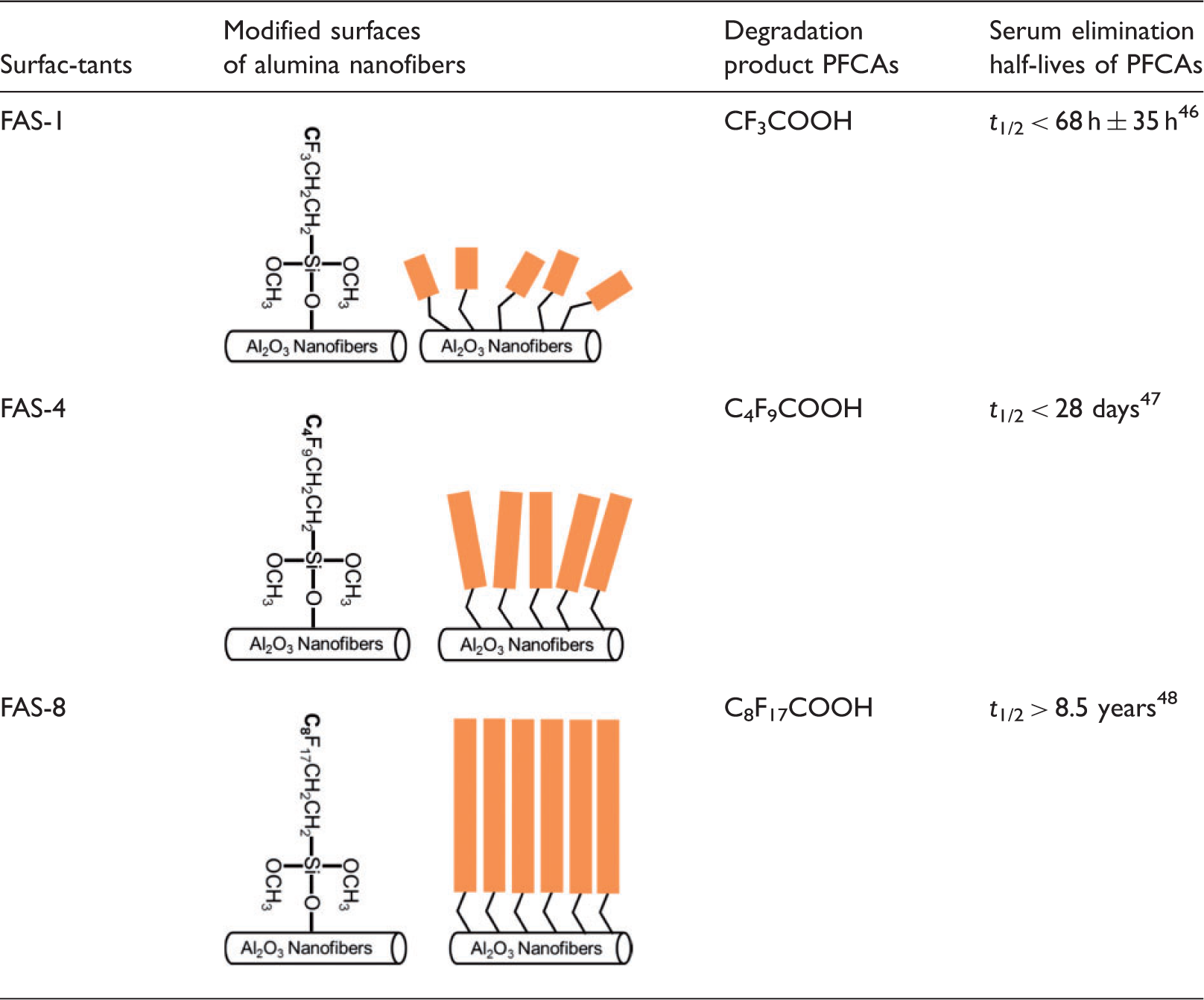
FAS: perfluoroalkylsilanes.
Formation of PVA/boehmite precursor nanofibers and alumina nanofibers
Water-dispersible boehmite nanoparticles were added to 10 wt.% PVA aqueous solution at PVA/Alumina =70/30 wt.% with moderate agitation at room temperature for 30 min, resulting in a homogeneous PVA/boehmite precursor solution. During ES, the precursor solution was loaded in a plastic syringe with a 0.4-mm needle diameter, and electrospun at a feeding speed of 1 ml/h, 20-kV voltage, and 150-mm collection distance. Two kinds of collectors, a square copper plate (size 150 mm × 150 mm) and a rotating drum collector (diameter 160 mm, rotation speed 4000 rpm), were used to obtain isotropic and aligned PVA/boehmite precursor nanofibers, respectively. In order to create inorganic ANs, precursor nanofibers were heated in an electric furnace (Nitto Kagaku Co., Ltd, NPCTD3, Japan) at 500℃ for 5 h in air, with a heating rate of 10℃/min.
Formation of smooth alumina film
PVA/boehmite precursor solution was spread on a glass plate and dried at 40℃ for 12 h, followed by calcination at 500℃ for 5 h to eliminate organic components.
Surface modification of alumina nanofibrous mats
AN mats were dipped into 3 wt.% FAS of hexane solution for 10 h at room temperature, washed with methanol to remove residual FAS, and finally heated at 80℃ for 1 h, and 100℃ for 1 h. In order to prevent auto-polymerization of FAS, an argon atmosphere was used to protect the initial dipping step during surface modifications. FAS with labile methoxy group (CH3O-) easily reacted with the hydroxyl groups (HO-) of ANs to form covalent linkages with concomitant loss of methanol, enabling the development of an amphiphobic AN surface. In this paper, AN/FAS-n refers to AN mats modified by FAS.
Instrumentation
Morphological images of nanofiber samples were captured by a scanning electron microscope (SEM; VE-9800, Keyence, Japan). Fiber diameter and relevant standard deviation were calculated using image-processing software (Image J). The infrared spectrum was carried out with Fourier transform infrared spectroscopy (FT-IR; Shimadzu, IRAffinity-1, Japan) in the mode of attenuated total reflectance (ATR), and collected from 4000 to 400 cm–1. Inter-fiber spacing data were calculated by an advanced capillary flow porometer (CFP-1200AEXLTC; Porous Materials, Inc., USA). The thermogravimetry of AN/FAS-n was analyzed in air from room temperature to 600℃ with a thermal analysis device (DTG-60; Shimadzu, Japan).
Contact-angle measurements (static, advancing, receding) were obtained with video optical contact-angle equipment (VCA Optima-XE; AST Products, Inc., USA). The testing temperature and humidity were kept at 25℃ and 50%, respectively. Each contact-angle value was the average of five drops at different points, and droplet volume was set to
Results and discussion
Surface morphology of alumina nanofiber mats before surface modification
Figure 1 shows the fiber morphology and diameter distributions of precursor PVA/boehmite nanofibers, and corresponding ANs calcinated for 5 h at 600℃. In order to compare their textures, two types of fiber orientation were prepared, isotropic and aligned. Differing fiber orientation is due to different collectors during ES. The plate collector accumulated isotropic fibers, while the rotating drum collector with a rotation speed of 4000 rpm gathered aligned fibers. All fibers were well formed with three-dimensional (3D) structures. Compared to precursor nanofibers, the diameter of AN fibers were shrunken due to the sintering effect. Furthermore, ANs exhibited rough and reentrant textures, leading to the necessary robust Cassie–Baxter state for the design of a superamphiphobic surface.
50
The average fiber diameter for isotropic and aligned AN mats were 155 and 230 nm, respectively. According to the Cassie–Baxter equation, to calculate the theoretical contact angle it is necessary to obtain not only the fiber diameter, but also the inter-fiber spacing.
51
Therefore, the inter-fiber spacing of AN mats was measured with a capillary flow porometer. The measures were 451 nm for isotropic angles and 720 nm for aligned angles.
Scanning electron microscope images of: (a) isotropic and (c) aligned electrospun precursor poly(vinyl alcohol)/boehmite nanofibers; (b), (d) corresponding alumina nanofibers after calcination for 5 h at 600℃; (e), (g) histograms of fiber diameter distribution for precursors; (f), (h) for alumina. AN: alumina nanofiber.
Superamphiphobicity of fluoroalkoxysilane modified alumina nanofiber mats
Composition changes after modification
Figure 2 presents the FT-IR spectrum of ANs and FAS-modified ANs. Bands between 1000 and 500 cm–1 can be attributed to Al-O vibrations.
52
After modification with FAS, new peaks at 1400–1000 cm–1 result from fluoroalkyl groups. In particular, the band at 1209 cm–1 indicates symmetric stretching of the -CF2- moiety, while that at 1146 cm–1 is due to the stretching vibrations of the -CF3 group.
53
Therefore, FAS modifications are successful in grafting fluoroalkyl groups onto ANs.
Fourier transform infrared spectra of pure alumina nanofiber (AN) and AN modified with different perfluoroalkylsilanes (FAS).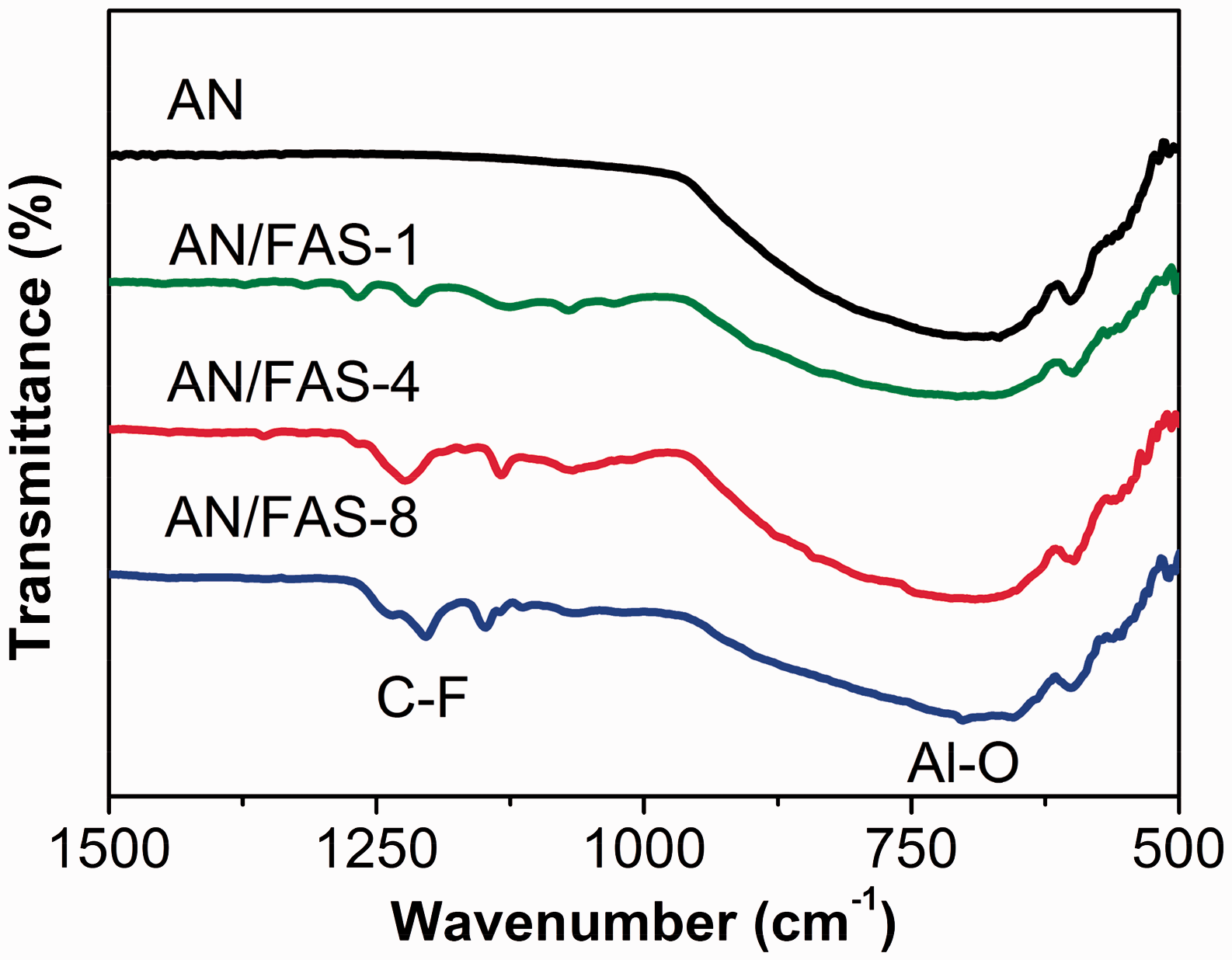
The effect of perfluoroalkyl chain length on amphiphobicity
Before surface modification, AN mats possess capillary structures and many superhydrophilic hydroxyl groups, leading them to absorb water and oil quickly, that is, water (
As shown in Figure 3, for the same testing liquid, contact angles increased in the order FAS-1 < FAS-4 < FAS-8, because the surface tension of modifiers declined in the sequence FAS-1 (33.5 mN/m) > FAS-4 (23 mN/m) > FAS-8 (16.6 mN/m).
54
For the same surface, when the liquid surface tension ( Surface contact angles and testing liquids in alumina nanofiber (AN)/FAS-1 mats, AN/FAS-4 mats, and AN/FAS-8 mats (inset contains photographs of testing liquid droplets on AN/FAS-4 mats; from left to right: water, diiodomethane ethylene glycol, olive oil, n-hexadecane, tetradecane, and dodecane). FAS: perfluoroalkylsilanes.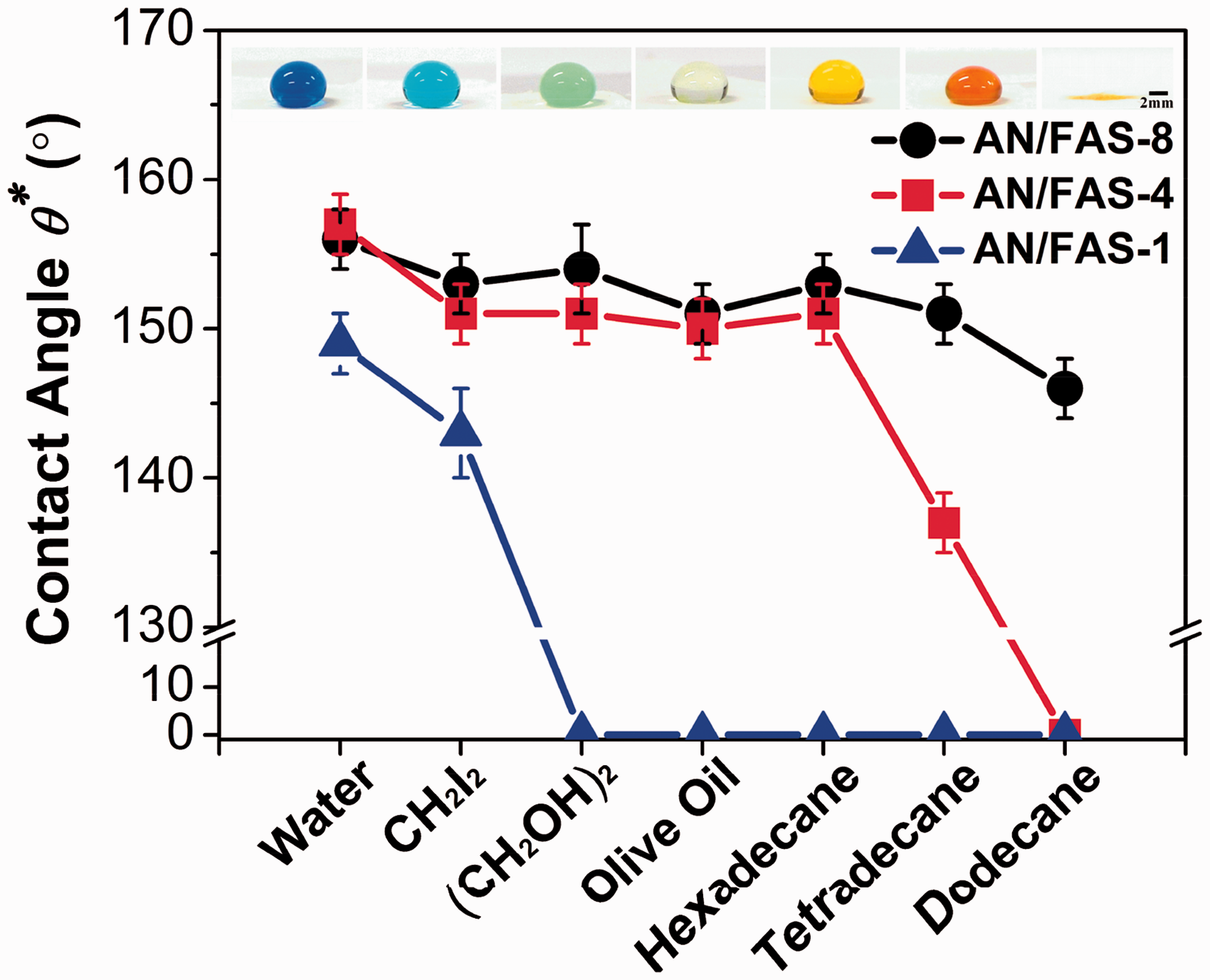
As expected, AN/FAS-8 displayed excellent superamphiphobicity to water (
The effect of surface morphology on amphiphobicity
Surface-contact angles and contact-angle hysteresis of different liquids on different texture surfaces modified by FAS-4
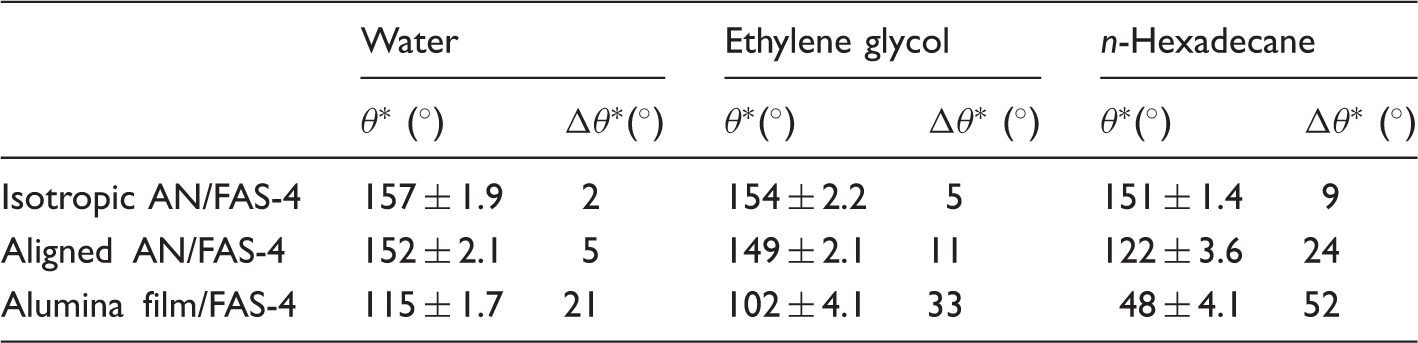
AN: alumina nanofiber; FAS: perfluoroalkylsilanes.
The Cassie–Baxter state is the preferred explanation for amphiphobic surfaces, in which small air pockets are trapped under liquid droplets, resulting in a composite solid–liquid–air interface.
55
The formula is as follows

Here
As the water-contact angle of smooth alumina film θ is 115°, and according to Equation (1), the
In isotropic fibrous mats, fiber radius (R) and inter-fiber spacing (two-dimensional (2D)) are key factors in contact angles (
For isotropic AN/FAS-4 mats, the calculated contact angle from Equation (2) is 156°, which is very close to the experimental contact angle of 157°, indicating that the obtained superamphiphobic AN mats conformed to the theoretical model.
Heat resistance of superamphiphobic alumina nanofiber mats
High-temperature air filtration is widely used in environments with industrial exhaust, coal combustion, car exhaust, biomass burning, and other forms of air pollution. Temperatures in such exhausts can range from 50℃ to 300℃, which means that filters must have high-temperature stability.
59
We thus measured the high-temperature stability of AN/FAS-4 superamphiphobicity after annealing in air from 100℃ to 500℃ for 1 h. Figure 4 shows that the contact angles of water and n-hexadecane stayed equal or higher than 150° in the temperature range of 25–350℃; moreover, the contact-angle hysteresis of water and n-hexadecane remained below 10°. Such results demonstrate that AN/FAS-4 maintained super-repellency to water and oil up to 350℃, indicating good thermal resistance. When the temperature reached 400℃, all repellency disappeared due to the decomposition of hydro- and oleophobic RF, which is identical to the decomposition starting point of 308℃ in the thermal gravimetric graph.
Surface contact angles on alumina nanofiber/FAS-4 after heat treatment for 1 h at increasing temperatures. FAS: perfluoroalkylsilanes.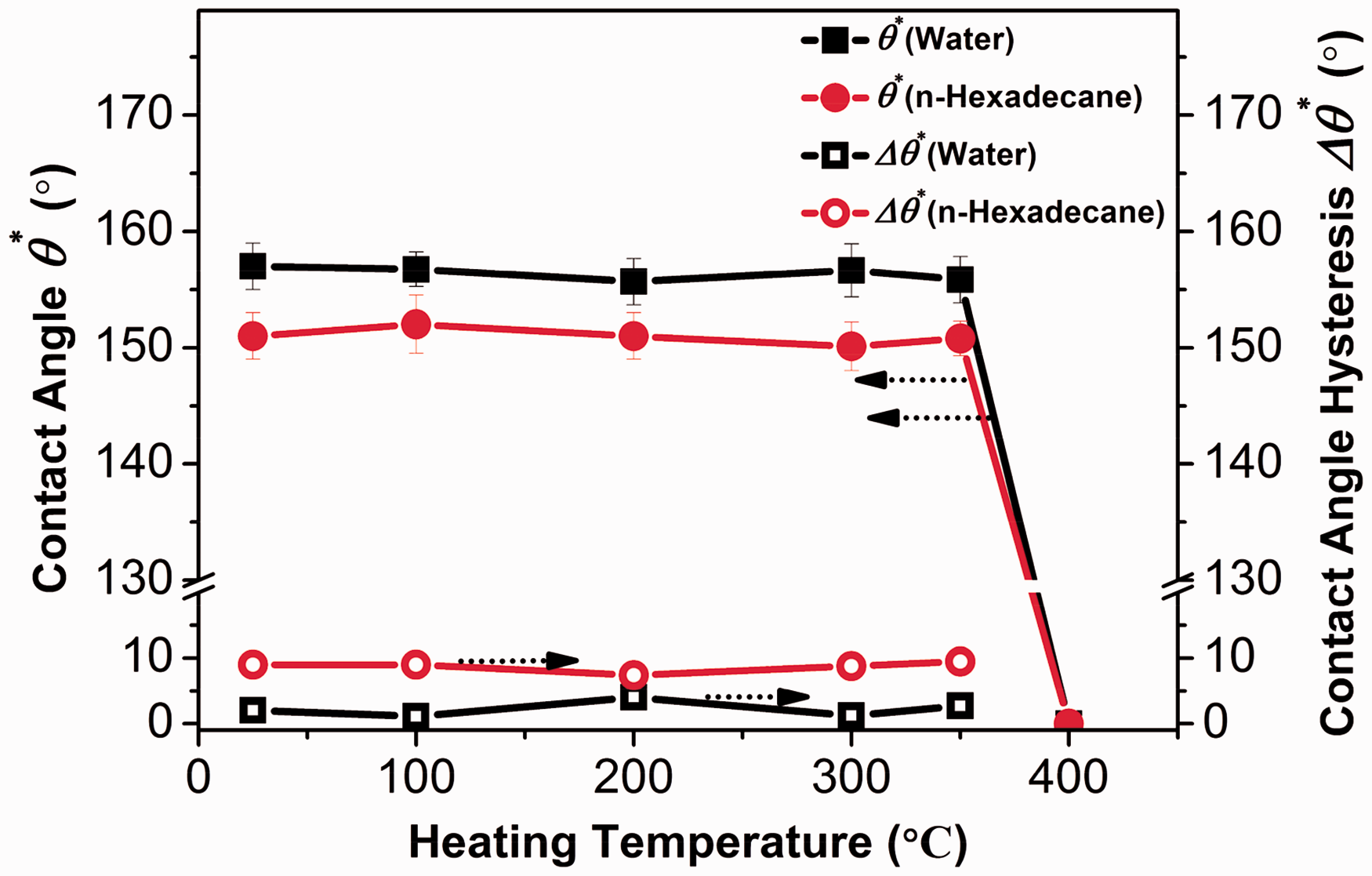
Conclusions
Here, for the first time, we combined rough AN mats with surfactant trimethoxy(1H, 1H, 2H, 2H-nonafluorohexyl)silane (FAS-4) to realize a surface that is both relatively safer and superamphiphobic. Compared to the aligned nanofibrous texture, the isotropic nanofibrous texture was more suitable for producing a super-repellent surface. The AN mats displayed super-repellency to water (
Footnotes
Declaration of conflicting interests
The authors declared no potential conflicts of interest with respect to the research, authorship, and/or publication of this article.
Funding
The authors received no financial support for the research, authorship, and/or publication of this article.