




Abstract
Shape-memory materials have recently gained significant attention from scientists and industries around the world. Their useful properties and ability to change their shape when triggered by different stimuli have encouraged researchers to develop this area of science. The examinations conducted herein concern a nonwoven material with thermally induced shape-memory properties, produced by the melt-blown technique. The subject of the research was a nonwoven fabric made from biodegradable poly(L-lactide) (PLLA) blended with atactic polyhydroxybutyrate (a-PHB). The main aim of the presented research was to determine the technological parameters of the melt-blown process and investigate the shape fixing and recovery mechanisms in the obtained material. Thermal, mechanical, and structural analyses were conducted to describe the properties of the smart fabric. The results obtained for the nonwoven fabric produced under specific conditions and selected process parameters showed that it possesses a controllable, thermally induced shape-memory effect. Shape-memory textiles have great potential for diverse applications, in particular in medical science.
Introduction
A review of the literature reveals the increasing interest in research on smart materials and their utilization in specific applications. The use of smart materials can be seen in biomedicine, textiles, civil engineering, and aeronautics, as well as in many commercial applications of everyday products. According to the literature, smart materials have the ability to respond to external triggers, such as temperature, UV light, pH change, and magnetic or electric fields, and to change their properties in a particular manner.1–4 Shape-memory polymers (SMPs) belong to the class of intelligent materials, in which different stimuli may activate a change in their molecular structure.
5
The main advantages of SMPs are their ability to create complex shapes and to respond to a wide range of external stimuli, which results in diverse applications.
6
One of the first types of SMPs, which attracted scientists’ attention in the field of medicine, were segmented polyurethanes, which have been thoroughly investigated and described by Jinlian Hu from the Hong Kong Polytechnic University.
7
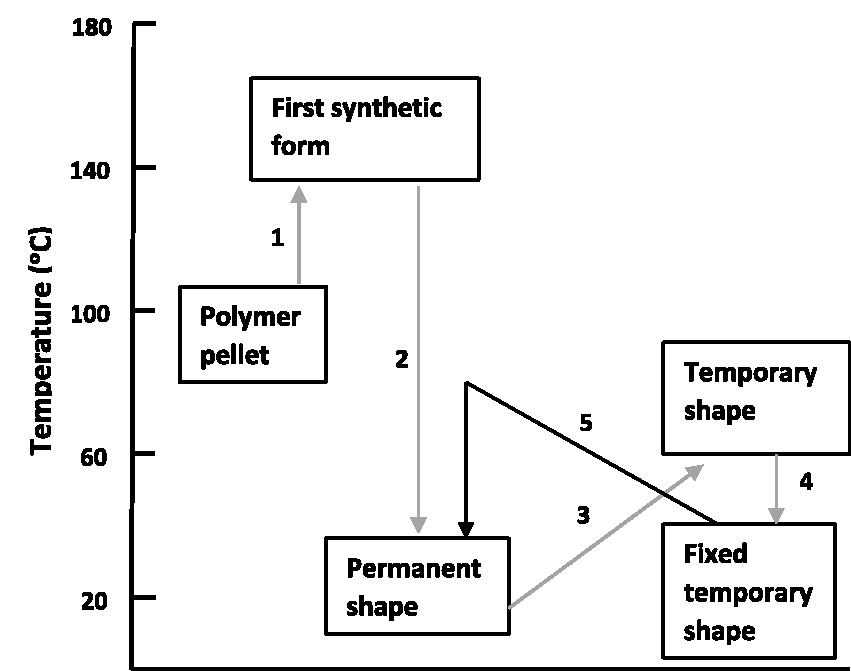
The thermally induced shape-memory effect in polymers is the result of a phase transformation in the material at a characteristic temperature and a change in entropy during deformation. SMPs have the ability to singly or cyclically return to their original shape after deformation under the influence of temperature change. The temperature above which the shape change occurs is called the shape-memory transition temperature (Ttrans); the fixation of the deformation occurs below Ttrans; and the shape recovery is automatically induced above Ttrans.7,8 The shape-memory effect is characterized by the shape recovery ratio and shape fixity ratio. Figure 1 describes the mechanism of the one-way, programmed shape-memory behavior in polymers.
Thermal cycle of the one-way, programmed shape-memory mechanism in polymers.
7
The thermally induced shape-memory effect is currently being examined for its biomedical applications.9–11 In this case, the shape-memory transition temperature should be around a patient’s body temperature. In the literature, we can find various biomedical applications using the shape-memory mechanism in polymers, such as self-expanding materials used for vascular stents,12–14 actuators for blood clot removal, 15 neuroprosthesis to stimulate brain activity, 16 and scaffolds in minimally invasive tissue engineering.17,18 Shape-memory orthopedic devices, which constitute another branch of commercial applications for SMPs, use self-deploying materials for suture anchors, soft-tissue fixation, and self-fixing implants.9,19
In recent years, there has been a noticeable increase in research on SMPs based on polylactide (PLA) for medical applications.20–23 This trend results from the many advantageous properties of this biopolymer, such as its production from natural renewable sources, low molecular weight, ease of processing, biocompatibility, and the ability to program controlled biodegradability. The shape-memory behavior in PLA was noticed and investigated during thermomechanical testing.22,23 In the conducted examinations, shape recovery was observed to be dependent on the stretch ratio and the temperature of deformation. Recent studies have examined copolymers and blends with PLAs in order to obtain an optimal biodegradation rate, to improve its brittleness at room temperature, and to obtain other desirable properties for certain applications.23–26 Herein, poly(L-lactide) (PLLA) blended with synthetic, atactic poly[(R,S)-3-hydroxy butyrate] (a-PHB) is used to obtain a thermally induced shape-memory effect at a programmed transition temperature. 27 Both polymers belong to the aliphatic polyester group and are considered to be bioresorbable and biocompatible. The tested biocompatibility revealed excellent cell proliferation of the materials with addition of amorphous polyhydroxybutyrate (PHB). 28 According to other publications concerning PLLA–a-PHB blend,29–31 it is considered to be a thermoplastic material with fiber-forming properties. The addition of a-PHB to the PLA changes its structural and thermal properties. Ohkoshi and colleagues proved that PLA and a-PHB are miscible in the melt temperature, and addition of a-PHB lowered the glass transition temperature of pure PLA. 32 Furthermore, the miscibility and thermal properties are strongly dependent on a-PHB molecular weight and blend composition. The glass transition temperature associated with shape-memory transition temperature Ttrans can be programmed by changing the mass weight ratio of the blend components and modifying the molecular mass of PLA and a-PHB.31,32 What is more, Bartczak and colleagues observed increased ultimate strain in tension, tensile impact resistance, and ductility in PLA blends with increasing content of a-PHB. 31
SMPs can be in the form of powder, solution, films, foams, fibers, or yarns. The research presented in this paper examines thermally induced shape-memory fabrics in the form of nonwovens. Smart textiles are defined as materials that upon interaction with the environment or a user, change their physical parameters such as color, permeability, porosity, stiffness, or shape. 33 These properties are highly advantageous in creating specific garments, exemplary surgical protective garments with thermal insulating properties or blood-barrier fabrics. Smart textiles are used in the production of various breathable fabrics with moisture and heat control regulated by body temperature in order to increase the thermophysiological comfort of the user.33–35 Other novel inventions include fabrics with spontaneous wrinkle or crease retention properties after hot stream treatment. 36 Textiles with thermally induced shape-memory effects have also found numerous biomedical applications in controlled drug release, as smart wound dressings to monitor wound healing, and in scaffolds for minimally invasive tissue engineering.33,35 The literature provides information on the progressive research into self-tightening sutures for wound closure.37,38
The use of PLLA blended with a-PHB to form nonwoven fabrics with thermally induced shape-memory effects may significantly contribute to textile engineering and medicine. The melt-blown technology applied for smart textile production has the characteristic of ease of formation, does not require solvent, is relatively economical, and has high efficiency. The melt-blown technique enables the production of fibers and nonwoven fabrics directly from molten polymer by using high-velocity hot air streams. 39 Melt-blown nonwoven fabrics are often used as filtering materials due to the thin microfibers in the material structure. The aim of this research was to obtain the optimal processing parameters to produce smart nonwoven fabrics and investigate the shape-memory mechanism and shape recovery ratio for certain transition temperatures in the produced material.
Materials and methods
Polymeric blend characterization
The selected material for the following research was commercially available PLLA 3001D (Nature Works® Minnetonka, USA) blended with a-PHB at a weight ratio of 90:10. The PLA used in this work is characterized for an average molecular weight of Mn = 123,794 g/mol, dispersity index Mw/Mn = 1.84, and melt flow ratio MFR = 8 g/10 min (210℃, 2.16 kg). a-PHB was synthesized in the Centre of Polymer and Carbon Materials, Polish Academy of Sciences, in Zabrze, Poland. The polymer was obtained by the bulk anionic ring-opening polymerization of cyclic β-butyrolactone in the presence of t-butyl ammonium acetate. The polymerization reaction occurred at room temperature with 100% monomer inversion.40,41 a-PHB is characterized by an average molecular weight of Mn = 53,886 g/mol and dispersity index Mw/Mn = 1.38. The polymers’ molecular mass was estimated by gel permeation chromatography (GPC). Chloroform (CHCl3) was used as the solvent at 35℃ at a flow rate of 1 ml/min. The injection volume of the sample solutions was 100 µl. The PLLA:a-PHB blend was prepared in the molten state at 190℃ in a mini twin-screw extruder, providing granulates as the first synthetic form. 27
Production of nonwoven fabric by melt-blown technique
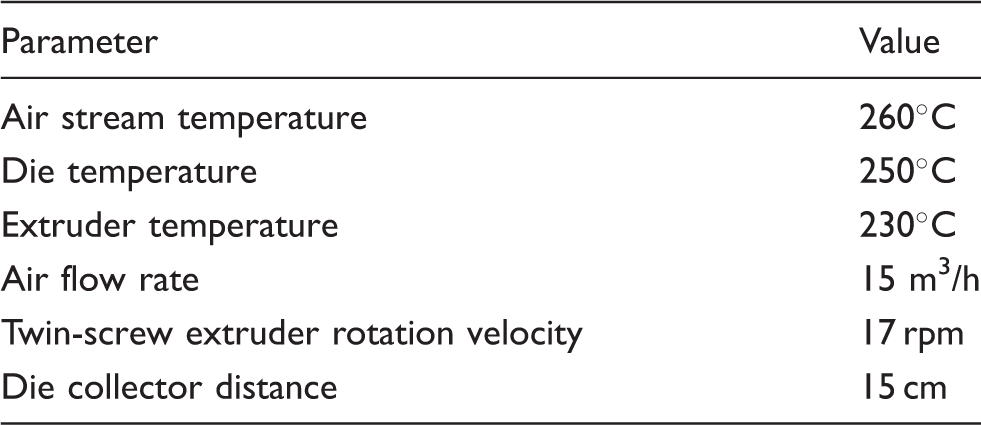
To produce nonwoven fabric from the PLLA:a-PHB blend, the melt-blown technique was used, which allows the processing of thermoplastic polymers. The machine used for this purpose was a MiniLab Haake twin-screw extruder at the Technical University of Lodz. In the melt-blown process, the previously prepared polymer blend was introduced directly to the twin-screw extruder and melted above the melting temperature. Afterwards, the molten polymer was delivered to a spinning pump and passed through the die holes. Fiber formation results from the transition from high-velocity hot air to cooled air after leaving the die. The formed fibers were gathered on the collector, where they self-bond into a web. After solidification of fibers, a nonwoven fabric was produced. The manufacturing equipment for the melt-blown nonwoven fabrics is presented in Figure 2.
Laboratory setup for the melt-blown process for nonwoven fabric formation. X = the distance from the die hole to the collector.
Melt-blown processing parameters for nonwoven fabric formation from the polymeric blend PLLA:a-PHB (90:10)
Thermal analysis of nonwoven fabrics
Differential scanning calorimetry
Differential scanning calorimetry (DSC) measurements were made using a DSC Q2000 device (TA Instruments, New Castle, USA) according to ISO standard EN ISO 11357:2009. The thermal properties of the material were analyzed in the heating range from −25℃ to 200℃ at a rate of 10℃/min under nitrogen atmosphere and flow rate 50 ml/min. After the first heating cycle the samples were immediately cooled to −25℃ and reheated to 200℃. The sample mass ranged from 5 to 10 mg, and each sample was packed and compressed in an aluminum pan using a standard crimper press. The DSC apparatus allows the determination of the glass transition temperature (Tg), the melting temperature (Tm), and the crystallization temperature (Tc). DSC curves of the starting materials were recorded during the second heating cycle, thus the samples had the same thermal history and could be compared directly. In case of the nonwoven fabrics DSC measurements, there was recorded the first heating cycle in order to show the changes in the thermal properties after polymeric blend processing. The melting temperature (Tm), as well as crystallization temperature (Tc), were determined as the peak maximum of the endotherm and exotherm respectively. The glass transition temperature (Tg) was determined at the half-height of the heat capacity change in the thermal transition. Investigation of characteristic temperatures of the material was crucial in the shape-memory effect and transition temperature examinations. According to the literature, the glass transition temperature can be associated with the transition temperature (Ttrans), above which the formation of a temporary shape and shape recovery occurs.
Thermal shrinkage
The nonwoven material from the melt-blown process is characterized by a high shrinkage ratio at temperatures above the glass transition temperature. To stabilize the material dimensions, a multidirectional thermal stabilization process was applied in a specially constructed tool (Figure 3). The tool construction consists of two plates, which are fixed by four corner screws. Aluminum frames were placed between the plates, between which the nonwoven sheet was placed. The construction of the frame allowed for the rebuilding of the fiber microstructure in every direction to achieve fixed dimensions. The nonwoven sheet in the frame was stabilized above the glass transition temperature at approximately 65℃ for 60 min and then immediately cooled to a temperature of approximately −67℃. The heating medium was hot air and the cooling medium was freeze spray. The final process of thermal stabilization by freezing resulted in the stabilization of the physical microstructure of the fibers and inhibited crystallization.
Construction of the tool used in the thermal stabilization process.
The shrinkage of the nonwoven fabric before and after the thermal stabilization process was investigated in water at 100℃ and measured with thermomechanical equipment DMTA Q800 (TA Instruments, New Castle, USA). The samples for shrinkage analysis in water were cut from the nonwoven sheet and had dimensions of 10 mm × 40 mm × 0.4 mm. In DMA analysis, strips of the samples with dimensions of 6 × 25 × 0.4 mm were tested in tensile mode, allowing the examination of the change in strain value over a temperature range from room temperature to a maximum of 150℃ at a constant temperature rate of 10℃/min.
Structure characterization of materials
Microscopic characterization of fabrics
The surface morphology of the nonwoven fabrics before and after the thermal stabilization process was analyzed by high-resolution scanning electron microscopy on a FEI NOVA NanoSEM 230. The samples were coated with a gold layer by the ion sputtering method. Microscopic examinations were done in high vacuum, and the accelerating voltage was 5 kV. The transverse dimensions of the formed fibers were examined using the Lucia Gon VGA software for image analysis. One hundred fibers were analyzed for the nonwoven before and after the thermal stabilization process to calculate the fibers’ transverse dimension values.
Thickness of fabrics
The average thickness of the nonwoven fabrics was determined by a thickness gauge with a loading of 0.5 kPa (weight 75 g). The study was conducted according to the ISO standard PN-EN ISO 9073-2:2002. The accuracy of the measuring apparatus is ± 0.01 mm. The measurements were made on three samples, and a total of 10 measurements were obtained.
Mechanical properties of the nonwoven fabrics
The tensile strength and elongation of the studied nonwoven fabric was conducted using a BIO Puls Instron 5944, according to the EU standard EN 29073-3:1992 ‘Methods of test for nonwovens. Determination of tensile strength and elongation.’ The prepared samples were six strips with dimensions of 35 mm × 10 mm × 0.4 mm, and the distance between the clamps of the test machine was 20 mm. The mechanical tests were conducted under normal environmental conditions according to the EU standard. The samples before mechanical examination were acclimatized by 24 h in normal climate.
Evaluation of shape-memory of fabrics
Thermomechanical analysis
Thermomechanical experiments were conducted to evaluate the shape-memory properties using a DMA apparatus (TA Instruments DMA Q8000). The experimental procedure follows five steps:
Step 1: Preparing the initial, permanent shape below the transition temperature Ttrans in the form of a strip with dimensions of 9.90 mm × 0.40 mm. Step 2: Increasing the temperature in the DMA apparatus at a rate of 10℃/min until it reaches 60℃. Step 3: Forming the temporary shape by 100% stretching of the sample at 60℃ (above Ttrans). Step 4: Fixing the shape by immediate cooling using a freeze spray at approximately −67℃ (below Ttrans). Step 5: Increasing the temperature at a rate of 10℃/min, and recording the shape recovery over a temperature range of 30–100℃.
In the thermomechanical analysis conducted using the TA Instruments Q800 DMA equipment, it was possible to determine the material relaxation temperature related to the glass transition temperature. Analysis of the thermographs provides information about the shape-memory mechanism occurring in the studied nonwoven fabric through the recovery of the stretched samples. The effectiveness and value of the shape-memory effect can be described by the shape recovery ratio (RT) parameter, which is calculated from equation (1):

Shape-memory of spiral-shaped nonwoven fabrics
Another experiment investigated the shape-memory properties in the nonwoven fabric by creating a temporary shape in the form of spirals, as well as the shape recovery after immersion in water at the transition temperature. The experiment can be divided into four main steps:
Step 1: Preparing the initial, permanent shape below the transition temperature Ttrans in the form of a strip with dimensions of 60 mm × 6 mm × 0.4 mm. Step 2: Forming the temporary spiral shape from the nonwoven strip above the transition temperature Ttrans. The sample was wrapped around a wire with a diameter of 4 mm and was kept in hot air at 65℃ for half an hour. Step 3: Fixing the shape by immediate cooling using a freeze spray at approximately −67℃. Step 4: Observing the shape recovery after immersing the nonwoven fabric in its temporary shape in water at temperatures of 38℃, 45℃, and 65℃ (above Ttrans).
The experiment was repeated three times at 45℃ in order to examine the cyclic shape recovery behavior.
Results and discussion
Basic characteristics of the nonwoven fabrics
Physical characteristics of the PLLA:a-PHB nonwoven fabric

a-PHB, atactic polyhydroxybutyrate; PLLA, poly(L-lactide).
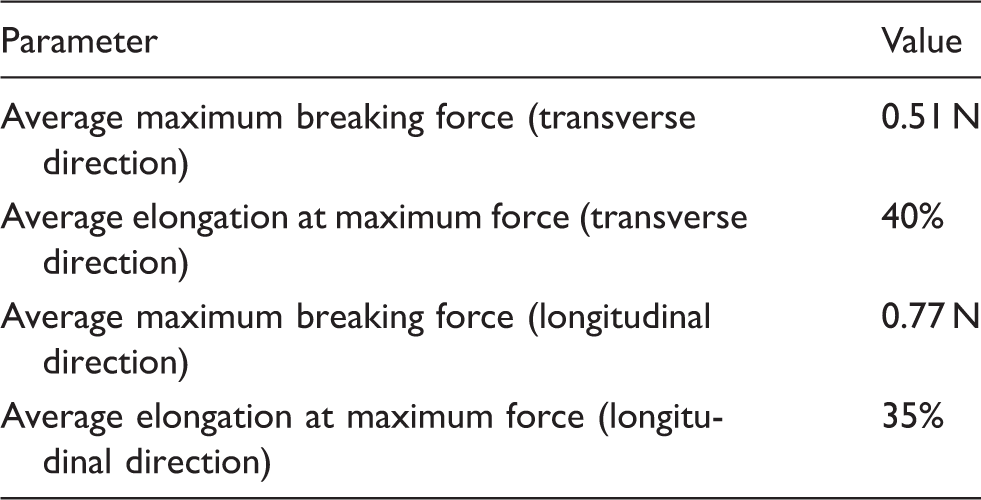
Mechanical properties of the nonwoven fabric before the thermal stabilization process
The microstructure of the produced nonwoven fabric can be characterized by randomly distributed fibers with diverse diameters and cross-sections of irregular shapes. The analysis of the effect of the thermal stabilization process on structural properties of the nonwoven fabrics resulted in increased transverse fiber dimensions, with higher variability and decreased thickness. The increased transverse fiber dimensions resulted from fiber shrinkage and partial fusion due to the thermal stabilization process; however, lower thickness may be explained by fiber rearrangement and unraveling in the nonwoven microstructure after thermal treatment. The non-uniform fiber distribution is the result of the applied melt-blown spinning technique. Changes in the twin-screw extruder rotation velocity, collector distance, and rotation velocity in the melt-blown technique may influence the thickness of the nonwoven materials. Increasing the distance from the die to the collector and the efficiency of polymer production produces a thicker product. By modifying the collector rotation velocity, the thickness can be tuned.
Mechanical testing revealed the relatively low mechanical parameters of the nonwoven fabric at temperatures below its glass transition temperature (Tg). The changes in the mechanical values in the transverse and longitudinal directions do not differ drastically, which indicates that the obtained nonwoven material has isotropic properties.
Differential scanning calorimetry results
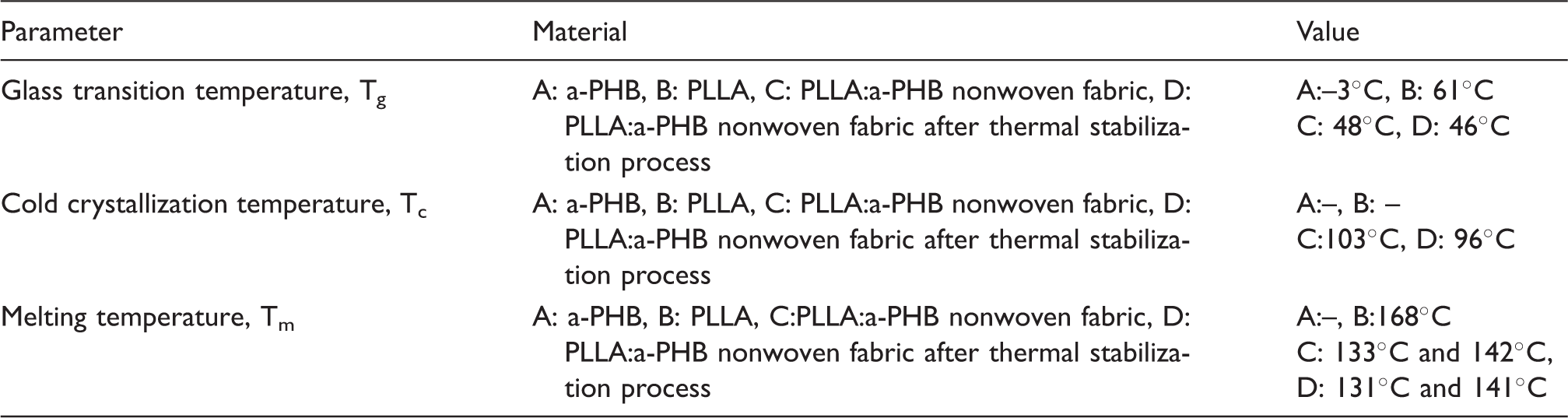
Characteristic temperatures of the studied material
a-PHB, atactic polyhydroxybutyrate; PLLA, poly(L-lactide).
The obtained thermograms of the changes in heat flow in the starting polymers and nonwoven fabric before and after thermal stabilization are presented in Figure 4a–d.
The characteristic temperatures determination in DSC thermal analysis of (a) a-PHBl; (b) PLLA; (c) PLLA:a-PHB nonwoven fabric; and (d) PLLA:a-PHB nonwoven fabric after thermal stabilization.
The characteristic temperatures of the individual polymers (Figure 4a,b) were compared to the PLLA:a-PHB nonwoven fabrics before (Figure 4c) and after (Figure 4d) the thermal stabilization process. DSC thermogram of the pure a-PHB indicates its amorphous nature; however, the PLLA is characterized by a semi-crystalline structure. Nonwoven fabrics produced from PLLA:a-PHB blend exhibit one Tg value, which indicates that the created blend is a miscible system.32,42 Comparing thermal characteristics of the PLLA and PLLA:a-PHB nonwoven fabrics, there is a noticeable decrease of the melting temperature and glass transition temperature value due to the a-PHB plasticizer content in the used blend. What is more, the thermal properties of the nonwoven fabric are influenced by drawing condition and temperature in the nonwoven formation process. In the nonwoven fabric production process there is stress-induced crystallization triggered by internal tensile stresses. Nonwoven fabric before the thermal stabilization process (Figure 4c) exhibits higher cold crystallization temperature and its peak became broader than after the thermal stabilization process (Figure 4d). This behavior can be explained by a-PHB working as a plasticizer in the PLLA:a-PHB nonwoven fabric, increasing crystal nucleation in PLLA. After the nonwoven fabric thermal stabilization process (Figure 4d), the cold crystallization and glass transition temperature is slightly shifted to lower temperatures, which may be the result of the reduced internal stresses in fibers after thermal treatment. After fiber relaxation due to heat influence, there is a slight difference in the ability to form a crystalline structure. Melting temperatures (Tm) of the PLA:a-PHB nonwoven fabrics mostly did not change in the thermal stabilization process. Crystallinity estimated from area under crystallization and melting peaks in the nonwoven before and after thermal stabilization process (Figure 4c,d respectively) are almost the same, which demonstrates no increase of the crystalline phase in the nonwoven fabric after the thermal stabilization process. The presence of one cold crystallization temperature (Tc) suggests that the PLLA:a-PHB nonwoven fabrics has a single homogeneous phase through the heating process; however, double melting can be associated with melt–recrystallization of original crystals and more stable crystals. Obtained double melting in the nonwoven fabric made from PLLA:a-PHB indicates that addition of a-PHB may contribute to reduction of crystal thickness in the blend.31,43
Thermal shrinkage and stabilization process
The nonwoven fabric produced by the melt-blown technique is characterized by a large change in dimensions during thermal treatment above its glass transition temperature. As a result of the thermal stabilization process, there is a change in the physical fiber microstructure, leading to elimination of the tendency for fiber shrinkage and setting the final nonwoven fabric shape and dimension. The thermal stabilization process is the most effective when it starts melting the crystalline regions of the fibers in the nonwoven structure, thus creating stronger physical bonds. Further, removal of internal stresses in the fibers during thermal stabilization leads to nonwoven fabric shrinkage elimination. The effectiveness of the applied thermal stabilization process is presented in Figure 5a,b, and thermograms are shown in Figure 6a,b. The methodology for evaluating the shrinkage was described earlier.
Thermal shrinkage of the nonwoven material after immersion in hot water (∼100℃): (a) before the thermal stabilization process (high dimension change) and (b) after the thermal stabilization process (no dimension change). Examination of the nonwoven fabric thermal shrinkage by DMA analysis: (a) the nonwoven fabric before the stabilization process and (b) the nonwoven fabric after the stabilization process.
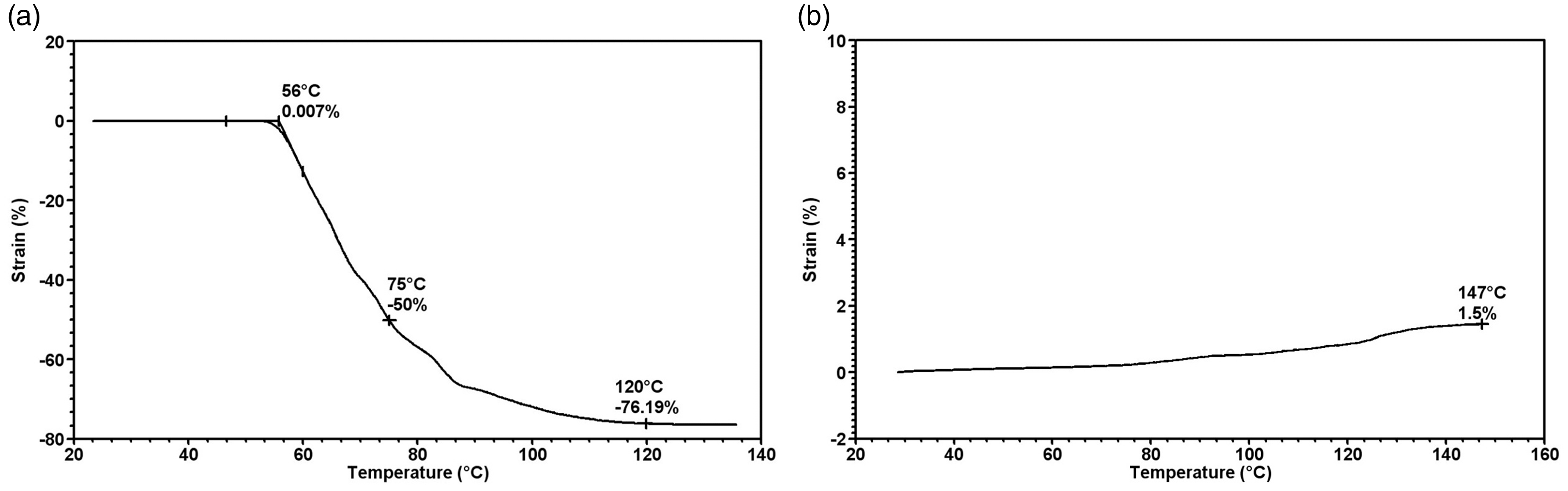
Thermomechanical analysis confirmed the high shrinkage of the produced nonwoven fabric and the effectiveness of the thermal stabilization process, which entirely eliminated the change in dimensions after increasing the temperature above Tg. Nonwoven fabric shrinkage started at approximately 56℃; 50% shrinkage occurred at approximately 75℃; and the maximum of 70% shrinkage occurred at approximately 90℃ (Figure 6a). There was no registered shrinkage after stabilization of the nonwoven fabric (Figure 6b). The strain equal to 1.5% was related to the applied initial preload and slight movement of the sample in the machine grips.
Evaluation of the surface morphology by scanning electron microscopy
Structural analysis of the shape-memory nonwoven fabric was performed by scanning electron microscopy. The surface morphology is presented in Figure 7a,b.

Microscopic observations of the fibrous nonwoven fabric structure revealed that the structure is composed of microfibers with a relatively wide range of diameters (high standard deviation). The nonwoven fabric is characterized by a non-oriented structure with spaces between the fibers. In the nonwoven after thermal stabilization (Figure 7b), more interconnections between the fibers are noticeable, as well as a more linked structure. There is a visible rearrangement of the microstructure after thermal stabilization; the fibers have higher thicknesses due to the partial fusion of the fibers to each other, and a greater variation in the fiber transverse dimension was observed. As a result of the thermal stabilization, densification of the nonwoven fabric structure occurred.
Thermomechanical shape-memory experiment
The nonwoven sample after thermal stabilization was 100% elongated from the initial linear dimension of 9.90 mm until the vertical dimension reached 19.80 mm. The shape recovery after 100% elongation reached a maximum of ∼81% at approximately 90℃, and the sample after recovery reached a final length of 11.72 mm (Figure 8). The shape-memory effect started at 57℃, which can be associated with the shape recovery activation temperature.
Shape recovery process after 100% elongation of the nonwoven fabric at 60℃, immediate cooling and increasing temperature.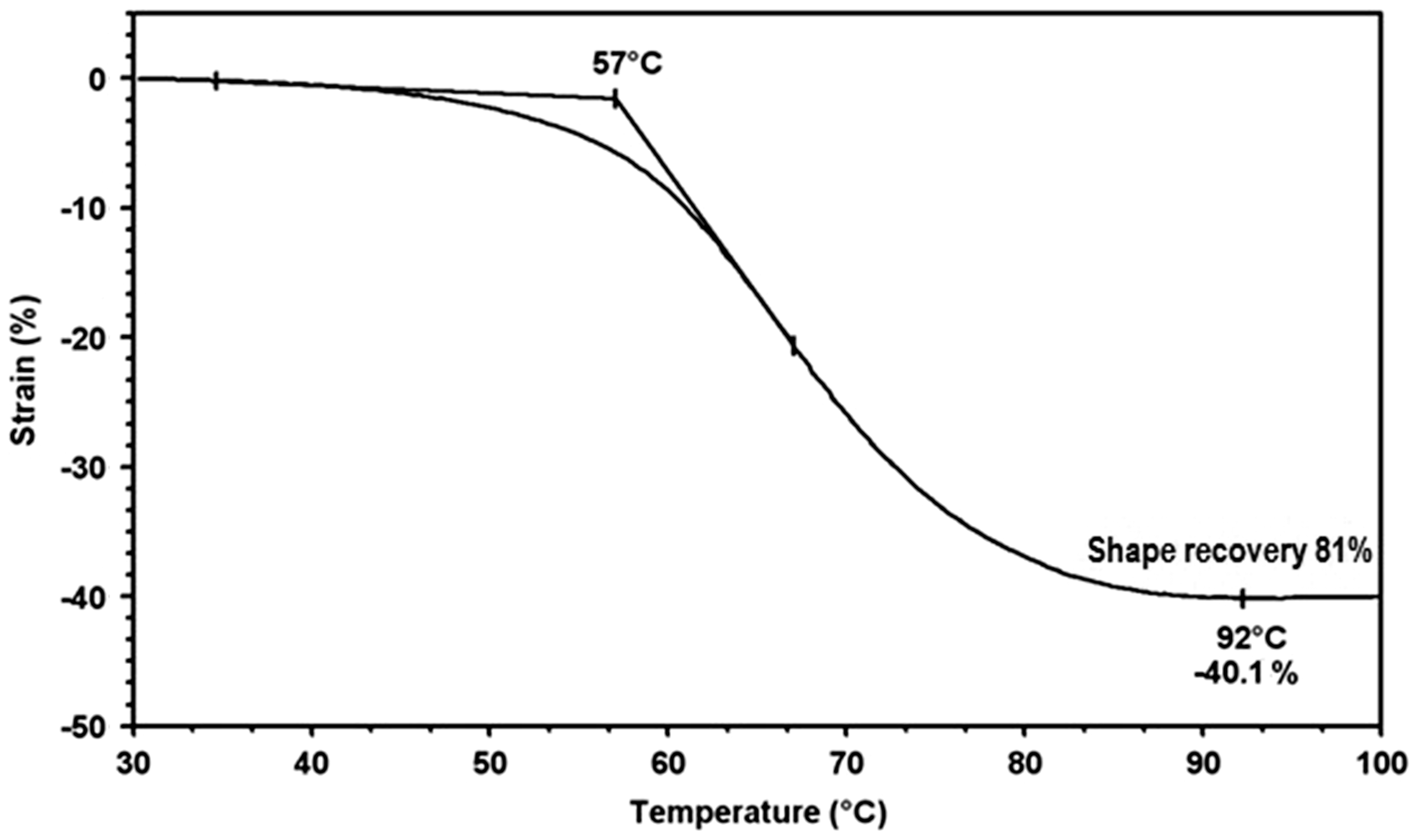
The value of the shape recovery ratio (RT) was calculated from equation (1) and is 81% at a temperature of 92℃.
Complete shape recovery was not obtained; however, the process of recovery was immediate and high. After increasing the temperature above Ttrans, the molecular chain becomes mobile, and sample deformation is possible. In contrast, the freezing process inhibits the mobility in the nonwoven fabric microstructure, and the deformed shape is fixed. Increasing the temperature above Ttrans again induces mobility in the polymeric chain, and the material is able to simultaneously recover the initial shape with a shape recovery ratio of 81%. The reason for not obtaining 100% shape recovery may be the increased content of crystalline structure after deformation above the glass transition temperature, which impedes the mobility of the molecular chain above Ttrans.
Shape-memory spiral experiment
The spiral experiment showed the shape-memory effect with full shape recovery in the produced nonwoven fabric (Figure 9a–c). The secondary, temporary shape obtained by the described methodology after shape fixing was stable over time below transition temperature Ttrans (Figure 9b).
Shape-memory spiral experiment on the studied nonwoven material PLLA:a-PHB. (a) Initial shape (permanent shape) T < Ttrans; (b) Secondary shape (temporary shape) T > Ttrans and T < 0℃; (c) final shape (permanent shape) T > Ttrans.
In the tested materials, immediate and complete shape recovery from the temporary shape to the permanent shape was observed at temperatures of 45℃ (∼30 s) and 65℃ (∼1 s). At 38℃ after immersion in water for 1 min, full shape recovery was not achieved. The temperature 45℃ is the transition temperature at which shape recovery is the most effective (Figure 9c). The transition temperature is near to the glass transition temperature of the nonwoven fabric after thermal stabilization. This result is consistent with the literature and the hypothesis made at the beginning of this research. The shape-memory properties were investigated for the same sample over three cycles. In each case, the result was almost identical. The experiment was recorded on video to visualize the mechanism of shape recovery from the temporary shape to the initial, permanent shape in three cycles.
Conclusions
In this paper, new smart nonwoven fabrics were successfully obtained from a polymeric blend of poly(L-lactic acid) (PLLA) and atactic poly[(R,S)-3-hydroxybutyrate] (a-PHB) mixed at a weight ratio of 90:10. The high shape recovery determined by two experiments demonstrated that the PLLA:a-PHB nonwoven fabric exhibits thermally induced shape-memory properties. Obtained via DSC thermogram, one Tg value of the nonwoven fabric proves high miscibility of the blend components and provides information about their compatibility, properly selected molecular weights, and proportions of components in the blend. The nonwoven fabric production process, drawing condition, and processing temperature influence thermal and crystallization behavior of the final textile product, which is proved by changes in the melting and crystallization temperatures on the DSC thermograms. It can be concluded that the addition of a-PHB with an irregular amorphous structure changes the thermal, mechanical, and structural properties of the PLLA material. Potentially the incorporation of a-PHB with methyl side groups reduces the arrangement of the PLLA polymer chains and works as a plasticizer in the polymeric blend, significantly lowering the glass transition temperature of the PLLA. Determined empirical thermal stabilization parameters (65℃, 60 min) with applied air heating medium and specially constructed frames contribute to elimination of high shrinkage of the nonwoven fabric. The effectiveness of the shape recovery depends on the conducted experiment. In the thermomechanical experiment with spirals, the complete and immediate (∼30 s) shape recovery was obtained at a transition temperature of 45℃, which is near to the nonwoven fabric glass transition temperature. It can be concluded that lowering the transition temperature from 65℃ to 38℃ extended the time of shape recovery. The incomplete shape recovery (81%) obtained in the stretching experiment may indicate that during the tensile strength test there were changes in crystallinity, which impeded shape recovery from the temporary stretched shape to the permanent shape. Future research will focus on understanding the influence of the orientation and degree of crystallization in the nonwoven fabric structure on the shape-memory mechanism, shape recovery, and time of return, as well as lowering the shape-memory activation temperature to near human body temperature. It can be assumed that the degree of return to the permanent shape can be regulated by the degree of crystallization of the material. According to the literature, PLA-based implants are biodegradable and biocompatible with humans. The new innovative approach to apply PLA-based nonwoven smart fabrics has high potential to be a revolutionary solution in medicine. Based on the conducted research, it can be concluded that the chosen material may have potential applications as self-fixing and self-adjusting implants, smart scaffolds, wound dressings, or part of an anchor system for grafts.
Footnotes
Declaration of Conflicts of Interest
The author(s) declared no potential conflicts of interest with respect to the research, authorship, and/or publication of this article.
Funding
The author(s) disclosed receipt of the following financial support for the research, authorship, and/or publication of this article:The manuscript was financed from funds assigned for 14-148-1-2117 statuary activity by Lodz University of Technology, Department of Material and Commodity Sciences and Textile Metrology, Poland.