




Abstract
Fiber technology has stepped into an essential position in the textile industry. It is forecasted that smart textiles will keep on developing constantly and vigorously. Having a convenient drug delivery system for treating various illnesses and bacterial infections is always in demand. Hollow fibers, which consist of a hollow structure and exceptional characteristics, such as high loading capacity and high surface reactivity, have been considerably used in medical equipment. A pilot study was performed in this paper for opening up environmentally friendly, convenient and repeatable drug delivery functions of industrial, ready-made hollow fibers for sustainable development in various aspects. The hollow fiber drug delivery system of this project is believed to tackle the challenges observed from the traditional drug delivery system, which include the following: (1) replacement of one-time delivery by repeatable drug loading and releasing; (2) loading complex drugs, such as in Chinese medicine; (3) using common materials available in the current textile market. Nylon 6 hollow fiber was the main subject of the pilot study. Its drug loading capability was investigated with the application of woven fabrics via the process of simple and direct drug loading under negative pressure (i.e. vacuum). The antibacterial performance of the drug-loaded fabrics and the drug release kinetics of the hollow fibers were examined.
Keywords
People have been led into an era with the advancement of knowledge and technology. The textile industry has also dominated a large portion with its important role and effects on economics, politics, culture and the entire society. The functional capability of textiles has been enhanced to a great extent with the optimization of both materials and structures; applications have expanded all the way from textile spinning to industrial uses. An increase in efficiency is followed by overconsumption and producing the ‘by-products’ of surplus and wastage. However, the application technology is also generating new ways of thinking that are influencing and supporting a new form of industry.
Hollow fiber, which consists of one or multiple inner channels, can be produced by utilizing a spinneret. Fibers with different hollow structures can be extruded via a particular orifice.1–3 Comfortable textiles, such as intimate apparels, can be made by using hollow fibers due to their excellent texture of lightness and softness. Besides, thermal insulation can also be provided by trapping air inside the channels of the fibers. In addition to being a promising material in textiles and clothing, they have been widely applied in the medical area over the past decades. They had been implemented for kidney and liver dialysis for effective countercurrent flow of dialysates and blood filtering with lower resistance;4,5 for making cell-culture cartridges with effective exchange of nutrients to promote cell growth;6–9 and for screening anti-cancer drugs by loading cells into the lumen of hollow fibers, which would be implanted inside a rat.10–13 Apart from these medical applications, hollow fibers have also become the predominant drug carriers due to their high loading capacitance and high surface-area-to-volume ratio.14,15
Thereupon, more significant drug delivery could be performed because of a higher dispersion of drug molecules inside the channels with the promotion of surface reactivity. 16 It was investigated whether the hollow fiber drug delivery system could help to cure different illnesses. For example, it could be applied in a contraceptive device for treating vaginal bacteria. 17 It was also discovered that tetracycline-loaded hollow fibers could help in treating periodontal disease when being positioned in the gingival sulcus. 18 Furthermore, hollow fibers have been an essential component for manufacturing some bioactive scaffolds and wound dressings with a drug delivery system.19–21
In order to get rid of the sophisticated drug loading processes of the traditional methods, such as by dissolving drugs with electrospinning liquid solvent or by forming drug-loaded micro-particles and granules,19,22–25 this paper as a pilot study aims to implement a handy drug delivery system utilizing industrial, ready-made hollow fibers. The system consists of both the drug loading process inside the channels of fibers and the release of drugs from the hollow structure. Drugs, which may be complex in nature, can be simply and directly loaded into the lumens of fibers through the two ends under negative pressure (i.e. vacuum) at which the drugs can flow along the hollow fibers. The drugs can be encapsulated and protected inside the lumens of fibers via physical encapsulation and attraction. 23 For the drug releasing process, it is believed to be released from the interior hollow of the fibers to the place outside by capillary action and diffusion.26,27
In addition, this paper also focuses on excavating the new medical function (i.e. a novel drug delivery functional design) of industrial, ready-made hollow fibers with overcapacity so as to give them a ‘second life’ with various applications other than those limited to making daily apparels. As a result, the problem of wastage of the over-produced hollow fibers could be eliminated. An environmentally friendly, convenient and repeatable drug delivery medical system could hence be unearthed with the application of the hollow fibers. It is believed that this textile-based drug releasing system could moderate the current medical problems and solves the incompleteness of recent drug delivery apparatus. This is because some of them could not allow repeated drug loading and some might require sophisticated preparation processes with the use of chemical methods. In general, the hollow fiber drug delivery system of this project could help to solve the problems of traditional drug delivery systems, which include the following: (1) replacement of one-time delivery by repeatable drug loading and releasing; (2) loading complex drugs, such as in Chinese medicine; (3) using common materials available in the current textile market. The implementation and acknowledgement of a textile-based drug delivery system for industrial production and public use could therefore be preserved. Moreover, it is also considered that the delivery function of hollow fibers is not only confined to drug delivery but also other matters for a variety of purposes.
In this project, hollow fiber was selected due to its structure and exceptional characteristics with regard to the drug loading function.3,25,28,29 The industrial, ready-made nylon 6 hollow fiber was the major subject of the pilot study. The drug loading capability of the fibers was observed and examined with the use of woven fabrics through the negative pressurized drug loading process. The effect of drug loading was verified by an antibacterial experiment. Therapeutic drugs, which were in phases of liquid, oil or solid, were significantly loaded into the bores of the hollow fibers respectively. The change of fiber length was observed to be one of the factors affecting the rate of drug release by diffusion. A slower rate of drug delivery was shown by using longer hollow fibers at which the diffusion distance was prolonged. Moreover, a steady and controlled release rate was observed when equilibrium was reached over the following delivery period. Moreover, bacterial growth inhibition was affirmed with the release of antibiotics from the drug-loaded hollow fiber-based fabrics.
It would provide a novel value of hollow fibers that could have both textile and medical benefits and also a new concept of fluid dynamics in conjunction with transdermal and skin protective treatment, textile technology and design. The optimization of spinnerets and the structure of yarns could be exploited. In addition to the function of hollow fibers, they were not only limited to the application of drug release but also could be made good use of with other functional materials. For example, flavor release and functional finishing could be exhibited on the basis of the drug release ability of hollow fibers. For the conventional hollow fiber textile industry, the benefits of the hollow fibers could be extended from ‘light yet warm’ to ‘material loading and release’.
Experimentation and development
Preparation of hollow fiber and fabric samples
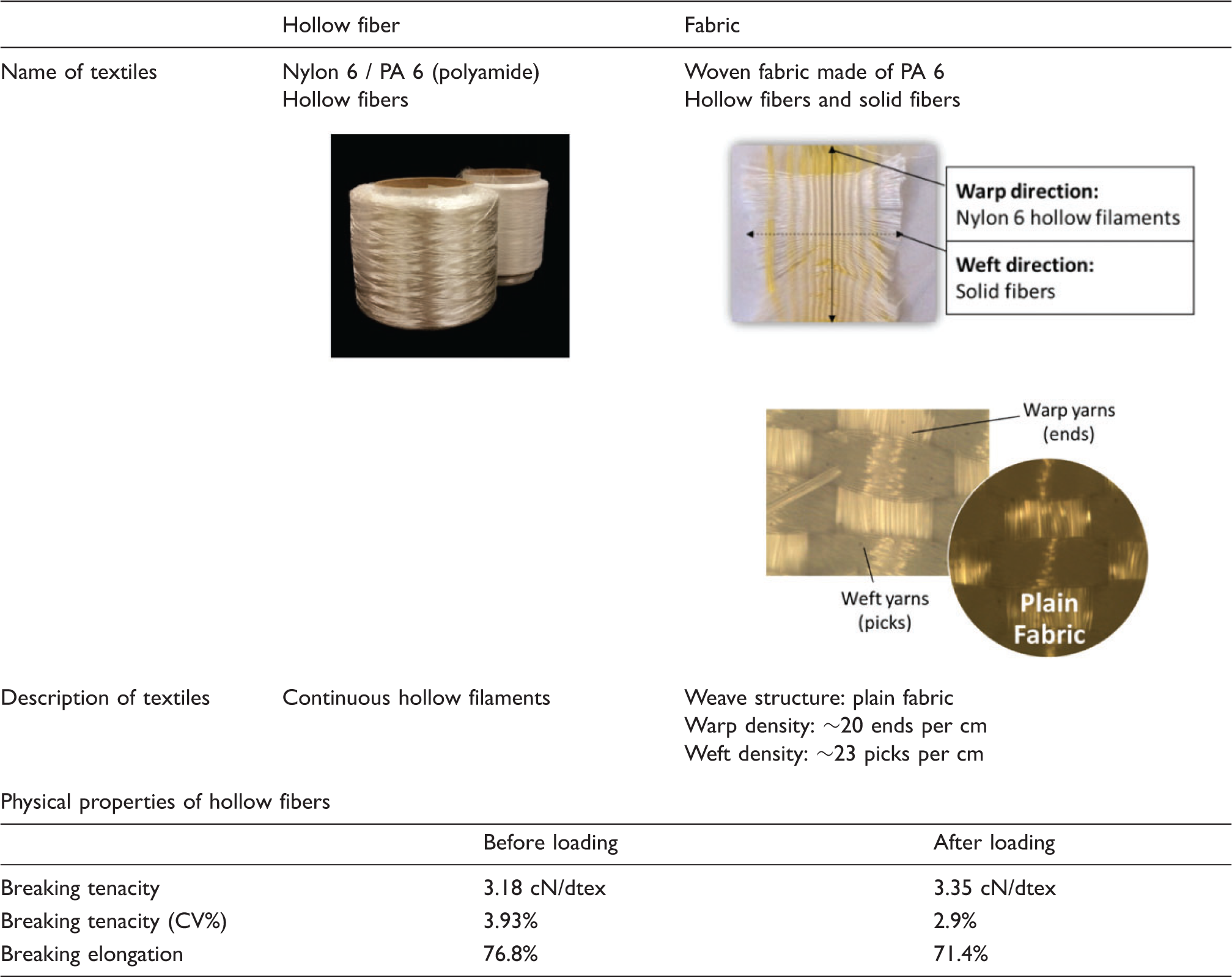
Hollow fiber and fabric samples
Scanning electron microscopy
The general structure, cross-sectional shape and the surface morphology of the nylon 6 hollow fibers were analyzed by applying scanning electron microscopy. A total of 10 cm of the fiber was cut for observation. There were a total five lumens found in the cross-sectional area, one large lumen with approximately 15 µm internal diameter and four small channels in the peripheral of the core. The general diameter of the hollow fibers was approximately 40 µm. A smooth and non-porous surface could be seen (Figure 1).
Scanning electron microscopy micrographs of nylon 6 long hollow fibers. One large lumen with 15 µm internal diameter surrounded by four small channels could be observed per fiber. A smooth surface could also be seen.
Methods of loading the drug solution into long hollow fibers and fabrics
For the method of loading the drug solution into a long hollow fiber, a 10 cm specimen was cut. One end of the fiber was connected with the pump while the other end was submerged into the drug solution. A negative pressure of 0.5 atm (i.e. vacuum) was subjected to the pump for 45 minutes in order to drive the drug solution into the lumens of the hollow fiber (Figure 2(a)). For the method of loading the drug solution into fabric or short fiber samples, the specimens were firstly submerged into the vacuum beaker of a specific drug solution. The vacuum beaker with the samples and the drug solution was sealed and swung slowly and thoroughly by hand until the large bubbles inside were removed. A negative pressure of no more than 0.5 atm was applied and subjected to the beaker for 15–30 minutes. The drug-loaded samples were then flushed by deionized water (DI water) three times and were finally cured in air (Figures 2(b) and 6(aI)).
(a) Schematic figure of the method of loading drugs into long hollow fibers. The drug solution was pumped into one end of the fiber by negative pressure. (b) Schematic figure of the method of loading drugs into fabrics or short hollow fibers. The hollow fibers were submerged into the drug solution and the vacuum beaker was sealed. The drug solution was driven into the lumen of fibers by negative pressure.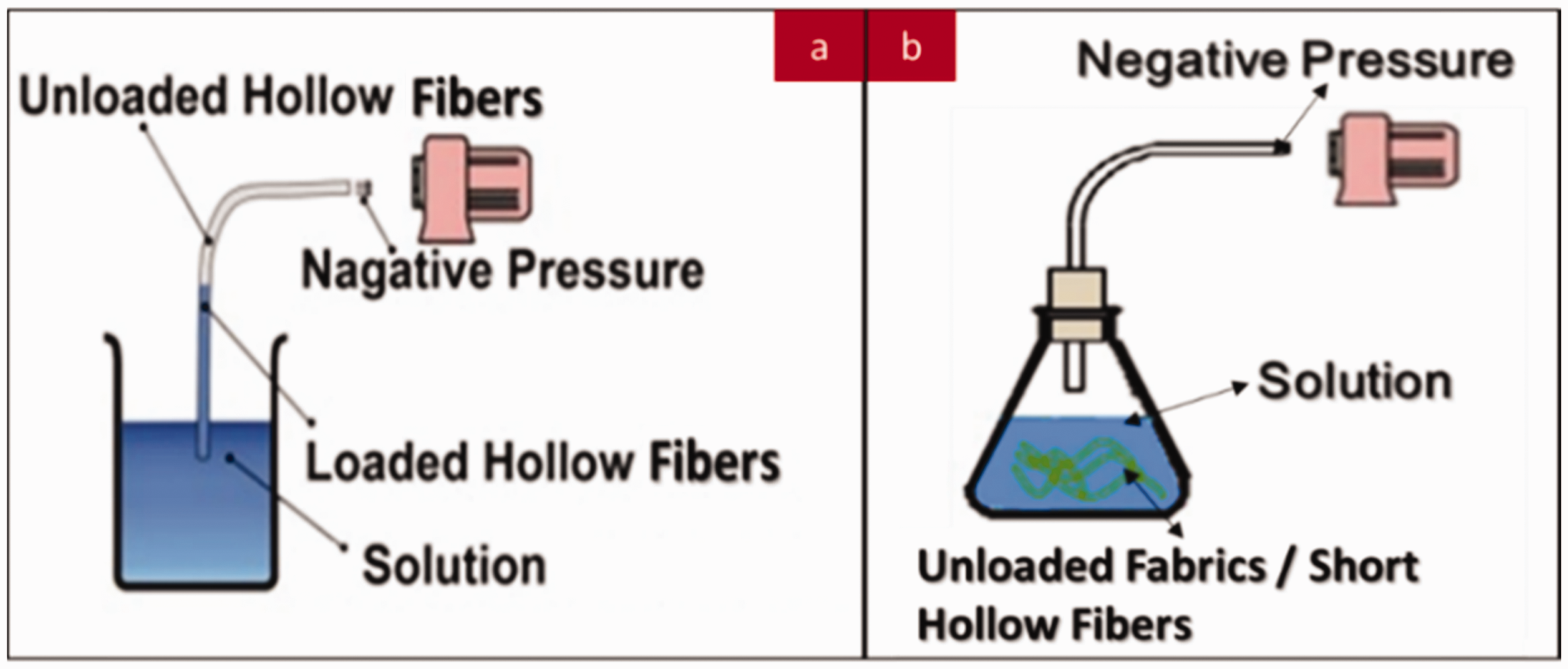
Experimental procedures of antibacterial analysis
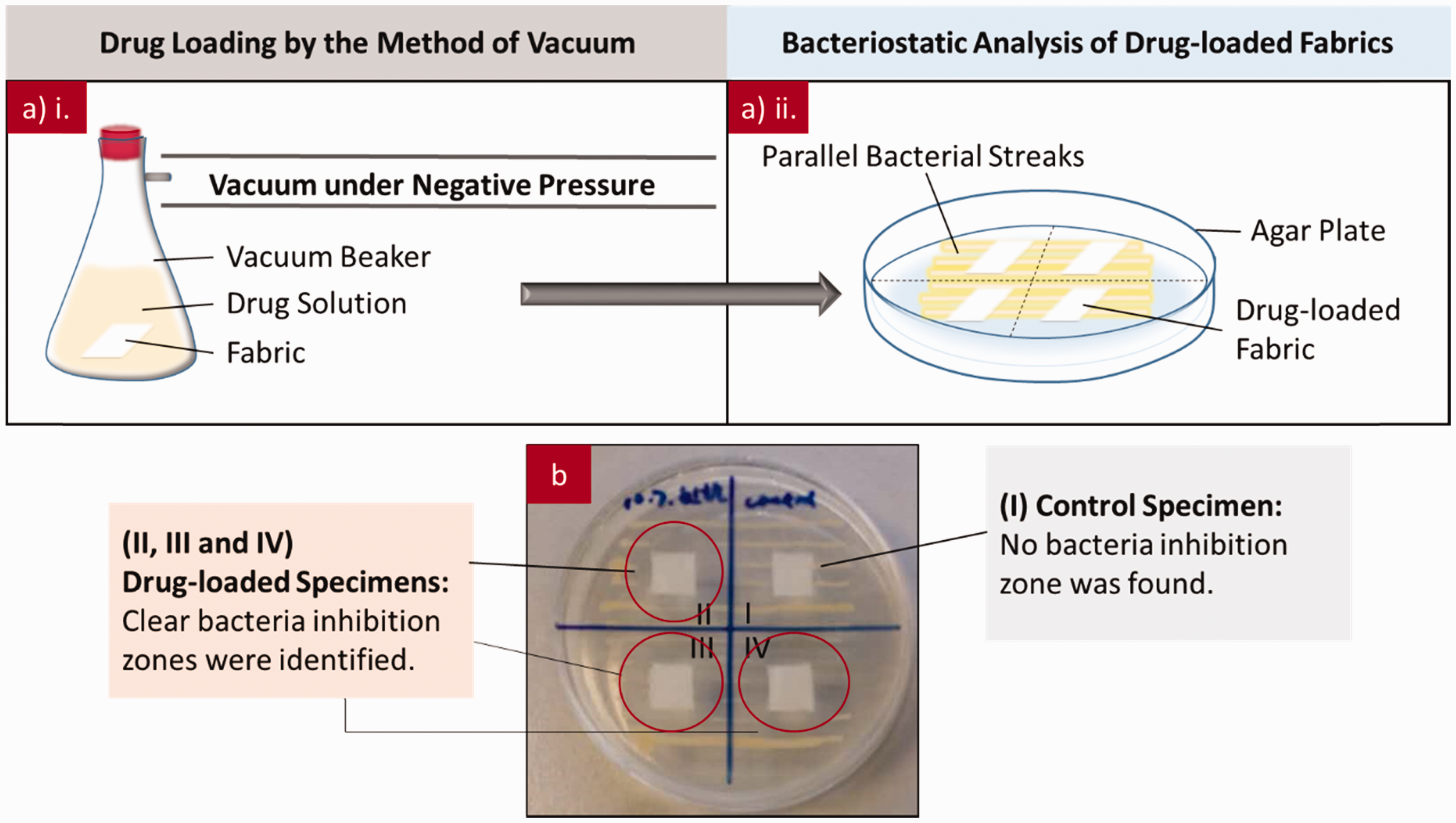
This study aims to focus on the in vitro drug releasing system for investigating the effectiveness and efficiency of drug release from hollow fibers fundamentally. Further implementation of the textile drug delivery system is believed to be supported based on this investigation. The objective of the antibacterial analysis was referred to the principle of the AATCC 147 method, 30 with some amendments to the requirements of the analysis. Four pieces of hollow fiber-based fabric samples with an area of 1 cm × 1 cm each were cut. Three of the four pieces were loaded with antibiotic Penicillin-Streptomycin solution by the method of vacuum shown in Figure 2(b) and one of them was the control specimen. After the drug loading process, the surfaces of the drug-loaded fabrics were washed with DI water to remove the drug attached on the surface of fabrics. The drug-loaded fabrics were then cured in air. The control and the drug-loaded specimens were placed onto an agar plate. Each of the specimens was laid across the parallel bacterial inoculum streaks, which were spaced 0.5 cm apart. The bacteriostatic activity of the drug-loaded fabrics was determined qualitatively based on the narrowing of streaks and the size of inhibition zone (Figure 6(aii)).
Investigation of the drug releasing kinetics
The drug releasing kinetics, which is based on the liquid-driven drug delivery system of the hollow fibers, was studied. Polyethylene glycol (PEG) solution, DI water and ethanol were used as the loading agents for studying the relationship between the drug releasing kinetics of the lumen and the length of the hollow fibers. Lengths of 3 and 20 cm of the hollow fibers were cut for comparing the differences in drug releasing kinetics between the short and long length of fibers. The liquid release from the lumens of the specimens was evaluated by a precise balance weighting. In order to eliminate the releasing of liquid out of the inner channel of the fibers, the completed fiber specimens should be hung up in a ‘U’ shape. The two opposite ends of the long fibers should be positioned in parallel alignment.
Results and discussion
The results and discussion are divided into two main parts based on the criteria of the experimentations, which are (1) investigation of the drug loading capability through optical and fluorescence microscopies and also methyl orange dye-loading analysis; (2) investigation of the drug releasing function through drug release kinetics analysis and anti-bacterial analysis. The drug loading method by vacuum under negative pressure was examined along with the drug delivery performances.
Characterization of hollow fiber and the drug loading capability
The industrial, ready-made nylon 6 hollow fibers were the main components of this pilot study. Fourier transform infrared spectroscopy (FTIR) analysis was performed for characterizing the structure of molecules of the nylon 6 hollow fibers by the spectrum of transmittance and the infrared absorption wavenumbers. The chemical formula of PA 6 is known as (C6H11NO)n.
31
Several absorption regions could be identified as the fingerprint of PA 6, which include a C = C stretch at 1610–1680 cm−1, C = O stretch at 1680–1750 cm−1, C-H stretch at 2840–3095 cm−1 and N-H stretch (primary amines) at around 3350 cm−1 (Figure 3(a)).
32
(a) Fourier transform infrared spectroscopy analysis of nylon 6 hollow fiber. Optical microscopy analysis of (b) unloaded and (c)–(e) loaded hollow fibers. (b) Unloaded hollow fiber; (ci)–(cii) loaded hollow fibers in the liquid phase; (d) in the oil phase; and (e) in the solid phase.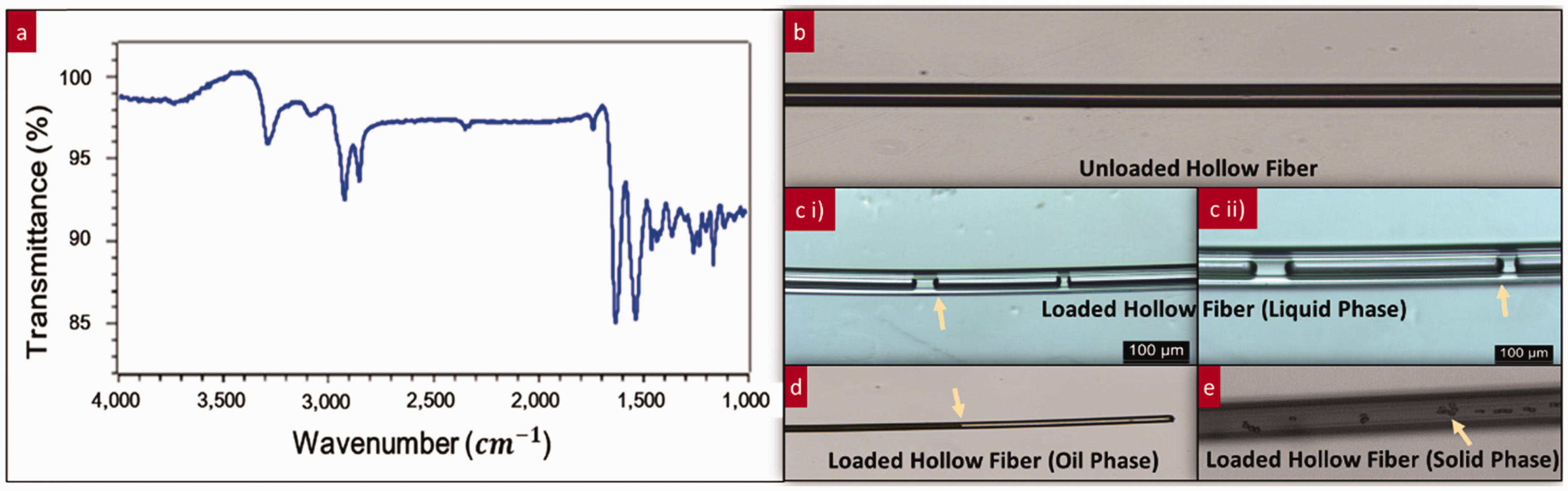
The drug loading capability of the hollow fibers was analyzed by the utilization of optical microscopic characterization. It was observed that drugs were loaded into the channel of the hollow fibers in the liquid phase, oil phase and suspended solid phase, respectively. The drug loading method under negative pressure (vacuum), which was known for assisting in pulling water upward inside the lumens based on the capillary action, 33 was verified. Various types of therapeutic drugs, which include argyi oil, antibiotics and anti-cancer agents, could be loaded successfully into the lumens of hollow fibers, which are believed to be feasible in contributing to the applications of bio-medical smart textiles and clothing with drug delivery capability 34 (Figures 3(c)–(e)).
The micro-channels of hollow fibers could be observed by the cross-sectional view (Figure 4(a)). The capillary of the hollow fibers could also be clearly identified with the use of fluorescence microscopy (Figure 4(c)). To further examine the drug loading capability of the hollow fibers, loading dyes into the channels of fibers was performed. Methyl orange dye solution was loaded into the hollow fibers through pumping into one end of the fiber by negative pressure. Two woven fabrics were made for the dye-loading analysis, one consisted of nylon 6 hollow fibers as the warp yarns and the other with the hollow fibers as the weft yarns. Although hollow fibers were woven in two directions (i.e. lengthwise and widthwise), there was no difference between the two fabrics as they had the same interlacement of the weave structure. It was observed that dyes were favorably loaded into the hollow fibers, either in the warp or weft direction of the woven fabrics (Figure 4(b)). It was thought that the drugs could be loaded into the channels of the fibers via the capillary action and the alteration of pressure. Fibers with lumens could facilitate the capillary action of fluid.
35
Fluid could rise inside the capillary of hollow fibers with an aid of the surface-tension effect and the capillary action, which was induced by the molecular forces between the fluid molecules and the wall of the capillary channel.
36
(a) Cross-section of a bunch of hollow fibers where the lumens could be clearly identified. (b) Two woven fabrics were produced for the dye-loading analysis, where one set of yarns (in the warp or weft direction) was made of nylon 6 hollow fibers. Methyl orange dye solution was successfully loaded into the nylon 6 hollow fibers through pumping into one end of the fibers. (c) Fluorescence microscopy was conducted to observe the capillary of the hollow fibers.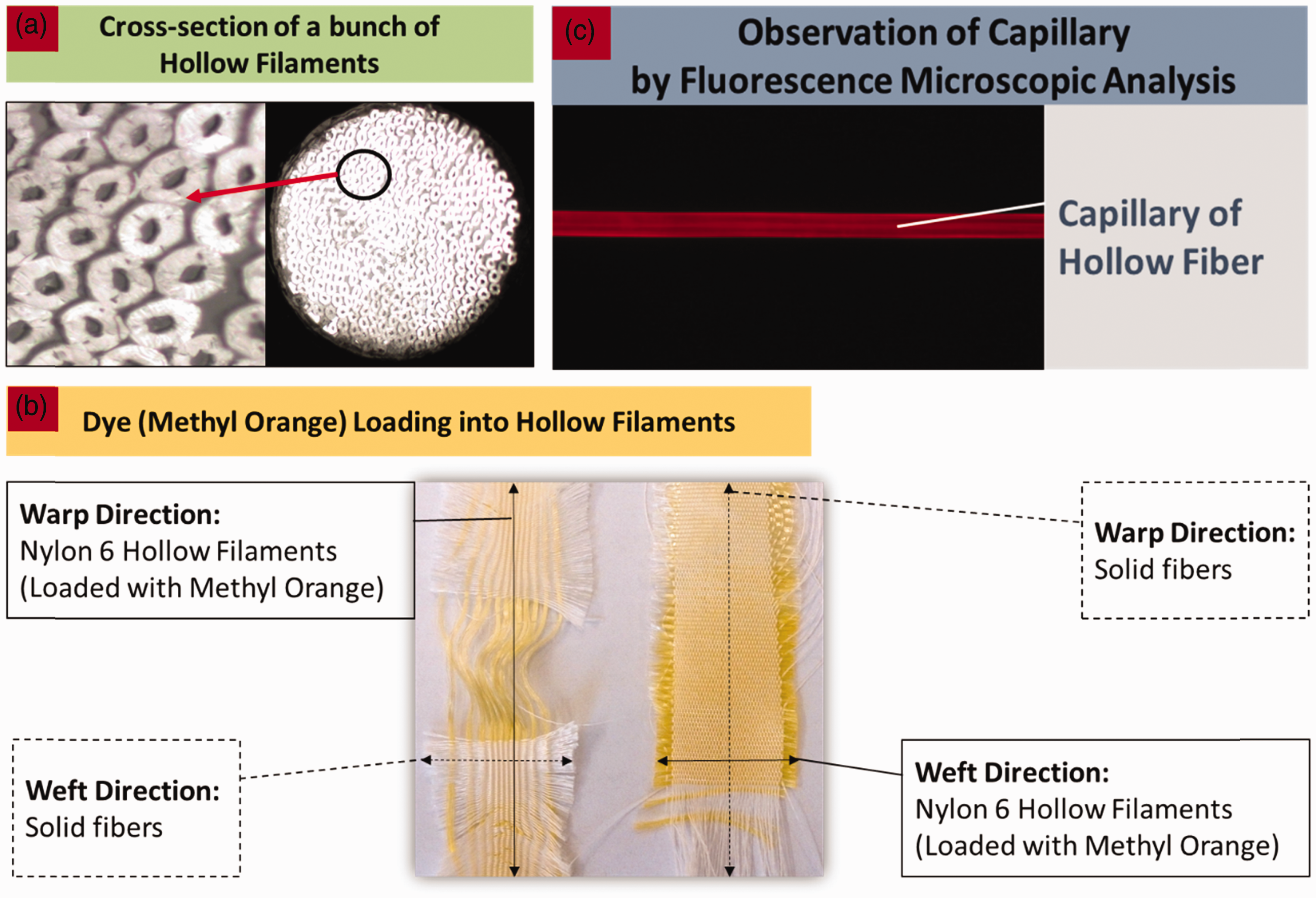
Drug releasing kinetics analysis and antibacterial analysis
In the study of the drug loading and releasing performances of the nylon 6 hollow fibers, both bio-medical and physical practices were accomplished with the capillarity of the fibers.
For the drug releasing kinetics analysis, 3 and 20 cm lengths of hollow fibers were cut and loaded with three kinds of liquids (i.e. ethanol, DI water and PEG4000 solution), respectively, so as to make a comparison between shorter and longer fibers. The hollow fibers were cut with an intact surface for the drug release-length study as the surface morphology and the integrity could affect the efficiency of drug loading. The liquid releasing speed from the channels of hollow fibers was presented by the measurement of the weight ratio (Wr/W0), where W0 was the original weight of hollow fibers after drug loading and Wr was the weight of hollow fibers after a duration of drug release. Specimens of both ethanol and PEG4000 solution were found to release relatively faster from the lumens of the shorter fiber (i.e. 3 cm) than that from the longer fiber (i.e. 20 cm), while the releasing speed of water from the shorter and the longer fiber was believed to be similar at the initial stage of duration. A constant releasing speed of the three types of fluids could be identified when equilibrium was reached after a period of time (Figures 5(a)–(c)). Ethanol was found to have the fastest releasing or evaporating speed among the three liquid samples, while PEG4000 solution was found to have the lowest speed at a specific duration (Figures 5(di) and (dii)). It was implied that PEG could help to decrease the escaping velocity of water molecules and that could assist the slow and controlled release of drugs with the use of hollow fibers in the textile drug delivery system. Moreover, the change of the fiber length and size was generally believed to influence the drug releasing speed, as reducing the length of fibers (i.e. shorter fibers) would diminish the amount of drug loading and promote the rate of drug release.
37
Releasing kinetic analysis of (a) water, (b) ethanol and (c) PEG4000 solution from 3 and 20 cm hollow fibers, respectively. (a) Similar releasing speed of water was observed from both the shorter and longer hollow fibers at the initial stage. (b), (c) Ethanol and PEG4000 solution were found to have relatively faster releasing speed from the lumens of the shorter hollow fiber (i.e. 3 cm) than from the longer one (i.e. 20 cm), initially. (di), (dii) Ethanol was found to have the fastest releasing or evaporating speed among the three liquid samples, while PEG4000 solution was found to have the slowest speed. PEG: polyethylene glycol. (a) Schematic diagram of the drug loading process by vacuum (i) and the antibacterial analysis of the drug-loaded fabrics (ii). b) Specimens II, III and IV were the antibiotic Penicillin-Streptomycin drug-loaded samples, while I was the control specimen. Narrowing of streaks and a clear bacteria inhibition zone were formed for drug-loaded fabric samples II, III and IV.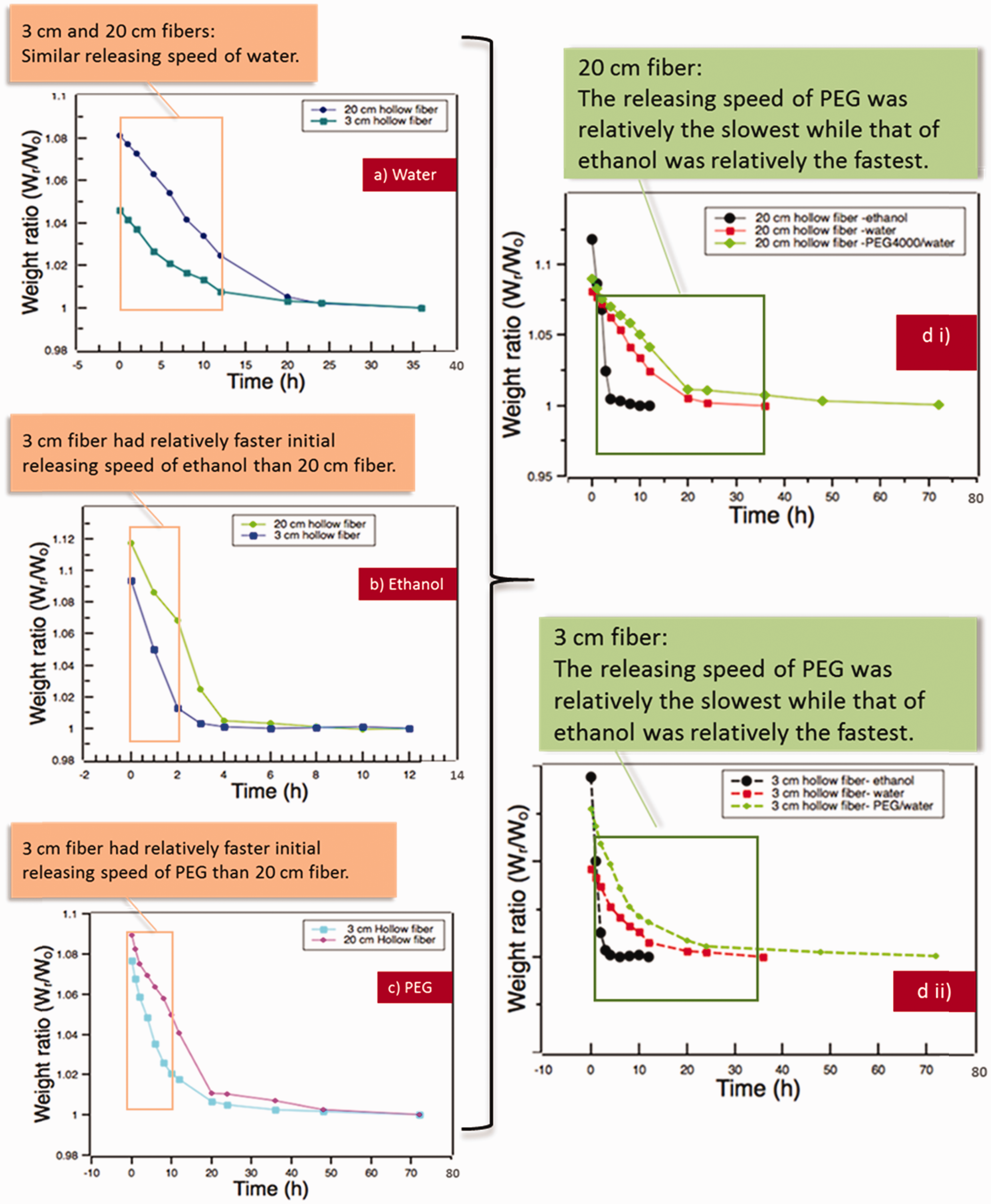
Consequently, the results indicated that the drugs contained in the core of hollow fibers were protected by the fiber wall and released to the exterior through diffusion. The initial release rate was found to be faster, at which a larger amount of drugs could be released at the beginning. After a period of time, a steady release rate was observed at which a controlled drug release could be given during the subsequent delivery time intervals. The change of size of hollow fibers had significant influence in controlling the rate of drug release from the capillary for different medical purposes. The risks of overdosing and chemical toxicity of drugs at the initial stages were believed to be prevented with the control and slower rate of drug delivery38,39 by applying longer fibers in order to lengthen the distance of delivery and to reduce the diffusion velocity consequently.
To further examine the significance of the hollow fibers on the primary function of drug delivery, bio-medical analysis was conducted in respect to treating bacteria by using antibiotic-loaded hollow fiber-based woven fabrics. Before performing the antibacterial experiment, the percentage of liquid loading of fabric by the method of vacuum was calculated. The formula of [(W2 – W1)/W1] × 100% was used for the calculation, where W1 was the dry weight of the fabric and W2 was the wet weight of the fabric with the removal of surface liquid after vacuum loading. It was observed that the percentage of liquid loading could be up to 68%.
For the antibacterial analysis of the drug-loaded hollow fiber-based woven fabrics, a qualitative estimate of bacteriostatic activity of the antibiotic Penicillin-Streptomycin loaded hollow fiber-based textile samples was resulted (Figure 6(b)). This was indicated by the growth of the bacteria decreasing from one end of the streak to another. The narrower the bacterial inoculum streaks, the thicker was the clear zone of inhibition, and the stronger was the bacterial growth inhibition. It was observed that narrowing of streaks and a clear bacteria inhibition zone were successfully formed by the drug-loaded fabrics (i.e. II, III and IV), while there was no obvious change by the control specimen (i.e. I). The bacterial growth inhibition was believed to be significant for the drug-loaded hollow fiber-based fabrics through the method of vacuum. Since the drug-loaded fabric samples had been washed three times before the antibacterial testing, it was therefore believed that the drugs adhered on the surface of the fabrics had been washed away and the bacteriostatic effect would be induced by the delivery of drugs from the channels of the hollow fibers to the target site of action by diffusion.
Conclusion
In this paper as a pilot study, the drug loading and releasing functionality from the interior channels of the hollow fibers were examined and verified summarily through the two textile dimensions, fibers and fabrics. Accordingly, the subsequent experimental procedures can be further refined and clarified. The first-hand primary data can help to specify an appropriate direction of hollow fibers’ usages. Through the direct purchase of the ready-made hollow fibers, the idea of ‘new uses for old things’ has been successfully proved. Matters in phase of liquid, oil or solid were favorably loaded into the channels of the hollow fibers and the release of antibiotic Penicillin-Streptomycin could also be affirmed. Nevertheless, some deficiencies still occur in the project, such as the way to arrange the releasing point inside the lumen of the hollow fibers. Thus, future works should concentrate on the hydrodynamic characterization between the fiber wall and the viscosity of loaded drugs, as well as the proper way of optimizing the releasing area and speed via the structures of yarns and fabrics. Thereupon, the sustainable use of hollow fibers with the drug loading and releasing functions can be exhibited. The commercial textile-based medical devices or clothing for compressing the growth of malignant cells or eliminating bacteria at the therapeutic sites can be potentially manufactured with the application of hollow fibers.
Footnotes
Declaration of conflicting interests
The authors declared no potential conflicts of interest with respect to the research, authorship and/or publication of this article.
Funding
The authors disclosed receipt of the following financial support for the research, authorship, and/or publication of this article: This research was supported by the General Research Fund [PolyU 154031/14H].