



Abstract
The dispersion of carbon nanotubes in solvents is crucial for their practical applications. In this study, multi-walled carbon nanotubes (MWCNTs) functionalized with water-soluble silk fibroin (SF) were prepared via chemical modification on the carbon nanotube surface in water solution. These fillers are low in toxicity and environmentally friendly. The SF-functionalized MWCNTs greatly improved dispersion in H2O and methanoic acid. Additionally, a methyl thiazolyl tetrazolium assay was performed to assess biocompatibility and the results indicated the favorable biocompatible properties of MWCNTs due to SF functionalization. Therefore, SF-functionalized MWCNTs have potential applications in waterborne polymer-based nanocomposites, especially in the biomedical field.
Recently, carbon nanotubes (CNTs) have attracted considerable attention due to their unique structural and outstanding electrical, mechanical and optical properties.1–4 For instance, CNTs show great potential in polymer composites and in biological and biomedical fields.3–8 However, the smooth surface of nanotubes, the lack of interfacial bonding across the interface of a nanotube/polymer and the level of dispersion of nanotubes in the matrix are critical factor for the fabrication of the reinforced composites.9–12 Thus, numerous methods for the chemical functionalization of CNTs have already been reported.1,9 Chemical functionalization of CNTs can maintain stable chemical covalent bonding between CNTs and the material of interest.13–15 Amino-functionalized CNTs have been researched because the amino group exhibits high reactivity.16–18 However, the functionalization of most amino groups is through organic solvents, which are not environmentally friendly and sometimes toxic.9,19 In recent years, many researchers have explored waterborne polymer-based composites because they are non-toxic.20,21 Therefore, CNTs with high water dispersibility possess great advantages in the preparation of waterborne polymer-based composites.22–24 Furthermore, much effort has been devoted to demonstrating the potential of CNTs for a wide variety of opportunities and applications (due to their unique structural and other properties) in biological and biomedical systems and devices.25–27 However, the high toxicity of CNTs should be immediately addressed.28,29 The high water dispersibility of CNTs is beneficial for applications in biological and biomedical systems and devices.30–32
Biomass materials, which exhibit remarkable biocompatibility with several cell types, promoting adhesion, growth and functionality are promising raw materials to modify CNTs and obtain low-toxicity functionalized CNTs.33,34 Silk fibroin (SF) is a traditional biomaterial that displays high biocompatibility.35–39 SF molecules are amino-terminated and are reasonably reactive with the carboxyl group.16,33
In this study, raw multi-walled CNTs (MWCNTs) (Raw-Ms) were first prefunctionalized through acid oxidation (to gain oxidized MWCNTs), followed by water-soluble SF (owning –NH2) modification in water solution and mild reaction conditions. In the process of modifying the acid-oxidized MWCNTs (AO-Ms), no toxicant was used or introduced. Moreover, the modification generated only a small amount of polluted air or wastewater. The chemical reactions for the functionalization of MWCNTs are illustrated in Figure 1. A series of tests was carried out to characterize the properties of such functionalized CNTs. These properties included thermal properties, dispersibility and cytotoxicity.
Schematic of the reaction scheme to form multi-walled carbon nanotubes with amino functionalization.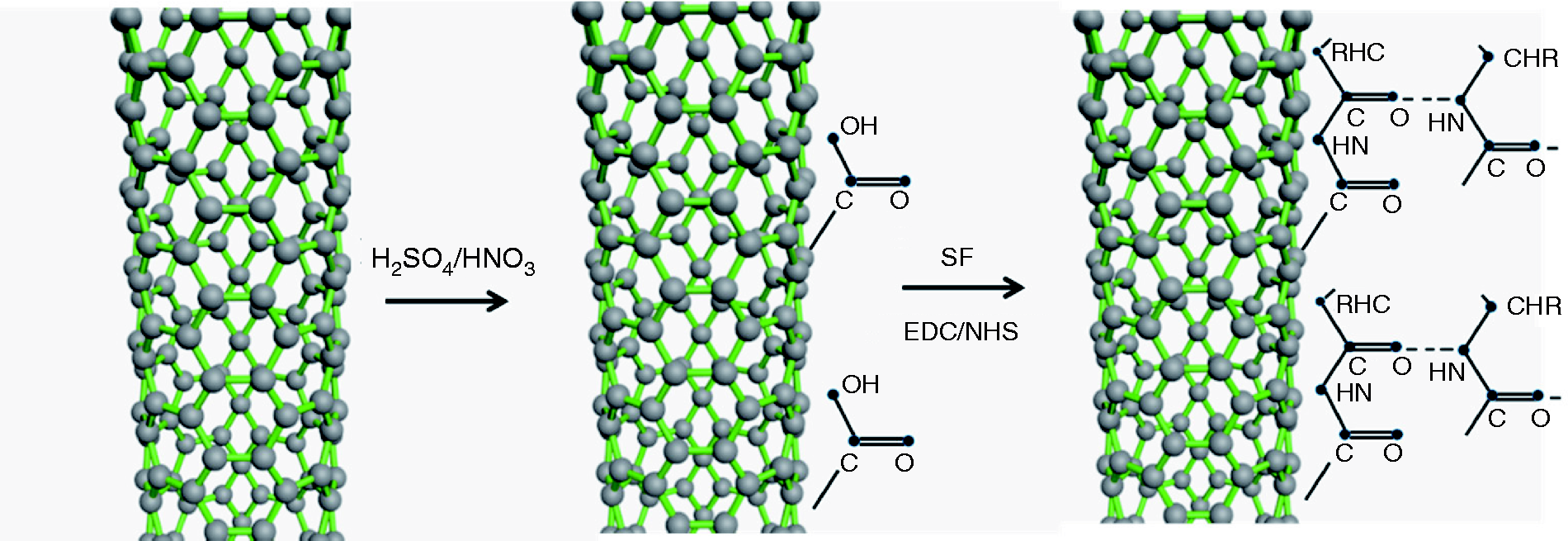
Materials and methods
Materials and preparation of functionalized MWCNTs
Water-soluble SF (powder, 0.1–2 µm diameter, bulk density = 0.2 g·cm−3, Mn = 12,000) was prepared in our laboratory (SF obtained by “0.05 M (w/v) Na2CO3 aqueous solution at approximately 120℃ under 0.24 MPa for 2 h” was used). 40 N-(3-Dimethylaminopropyl)-N′-ethylcarbodiimide hydrochloride (EDC, 98%) and N-hydroxysuccinimide (NHS, 98%) were purchased from Aladdin (Shanghai, China). MWCNTs (98%, 10–20 nm outer diameters and 10–20 µm lengths) were purchased from Chengdu Organic Chemistry Limited Company (Sichuan, Chengdu, China). All the reagents were purchased from commercially available sources and used without further purification unless otherwise stated.
Raw-Ms were oxidized with a mixture of H2SO4 (98%)/HNO3 (68%) (3:1, v/v) at 60℃ for 3 h. The carboxylated MWCNTs were filtered, washed with deionized water until pH 7 was reached and dried in a vacuum oven. The as-prepared AO-Ms (100 mg) were suspended in 10 ml of deionized water by sonicating the mixture for 30 min. Subsequently, 4.5 mmol EDC and 4.5 mmol NHS were added to the above suspension and mixed sufficiently. After stirring the mixture for 24 h, SF (1.98 g, to obtain a saturated solution) was added. The reaction was allowed to stir for another 36 h. After centrifugation, sonication and repeated washing, the SF-functionalized MWCNTs (SF-Ms) were obtained. The control sample, which was prepared following the same steps but without adding catalyst (EDC/NHS) as per the reaction was in Figure 1, was called SF/M (mixture of SF and MWCNTs).
Characterization
Functionalization of MWCNTs was confirmed by FTIR spectra recorded on a Nicolet 5700 spectrophotometer (Thermo Fisher Scientific, USA). X-ray photoelectron spectroscopy (XPS; K-Alpha, Thermo Fisher Scientific) was conducted using an Al Ká X-ray source at 250 W. The binding energy scale was calibrated with respect to the C1s peak of hydrocarbon contamination fixed at 285.0 eV. The peak at around 400 eV corresponded to N 1s, which was derived from the C–N bond. The structure was analyzed via transmission electron microscopy (TEM; JEOL JEM-2100, Japan). Thermal properties were determined with TG209F1 (NETZSCH, Germany).
Dispersibility experiment
After mixing 5 mg of MWCNTs in 10 ml of three kinds of solvents (H2O, methanoic acid and methanol) and sonicating with a KQ-400DE sonicator for 1 h, we took optical micrographs of the samples in these kinds of solvents obtained 6 h after the solution had been sonicated for 1 h. Furthermore, the dispersions of MWCNTs were determined by a UV–vis spectrophotometer (TU-1901 spectrophotometer, Pgeneral, China) and conducted quantitative analysis for the as-prepared samples in the same three kinds of solvents at a concentration of 1 mg/10 ml taken 6 h after the solution had been sonicated for 1 h.
MTT assay
The cytotoxicity of the as-prepared samples was further evaluated via the MTT assay. Murine preosteoblastic MC3T3-E1 cells were grown in a 96-well plate containing α-MEM cell culture media at 37℃ in a 5% CO2 incubator. After culturing for 1 day, the culture medium was removed and incubated with supernatant (100 µl), followed by ultrasonication for 30 min. After additional incubation for 1 day, 20 µl of MTT (MTT concentration = 5 mg/ml) was added to each well. The cultures were then incubated for 4 h at 37℃ and the supernatants were removed from the wells. About 150 µl of dimethyl sulfoxide was added to each well and 100 µl of mixed liquid from each well was transferred to a 96-well plate. Finally, the plate was read in an automated microplate spectrophotometer with 490 nm as the reference. Every 48 h, the same test was performed as mentioned above until 168 h had passed.
Results and discussion
FTIR spectroscopy
Figure 2(a) shows the FTIR spectra for the as-received raw-M, AO-M, SF/M and SF-M samples. The peak at 1631 cm−1 in spectrum B was attributed to the C = O stretching frequency of the carboxylate (COO-) group, which was stronger than the one in spectrum A contributing to the acid oxidation, and there was no other evident difference between spectra B and A. The peak at 1631 cm−1 without any red or blue shift (spectrum C) confirmed that the oxidized MWCNT did not graft with SF. The difference between spectra C and B may be caused by the SF attaching to the MWCNT (around 1534 cm−1 and 1250 cm−1, attributed to amide II and amide III bands of SF, see spectra C). Furthermore, the small vibration at 1700 cm−1 may have arisen from the reacted SF. The FTIR spectrum of the SF-M samples in spectrum D indicated that the C = O stretching frequencies shifted from 1631 cm−1 of COO- to 1636 cm−1 (which was obviously stronger) assigned to the amide I, arising from amide functional group. Moreover, the presence of stronger bands at 1535 cm−1, 1256 cm−1 and 3283 cm−1 corresponding to amide II, amide III and N-H bond stretching, respectively, further confirmed the presence of the amide functional group, namely, the SF functional group. A previous study reported similar results.9,16,40
(a) FTIR spectra of raw-Ms (spectrum A), AO-Ms (spectrum B), SF/Ms (spectrum C) and SF-Ms (spectrum D). (b) TGA curves of raw-Ms, AO-Ms, SF/Ms and SF-Ms in N2 at 10℃/min.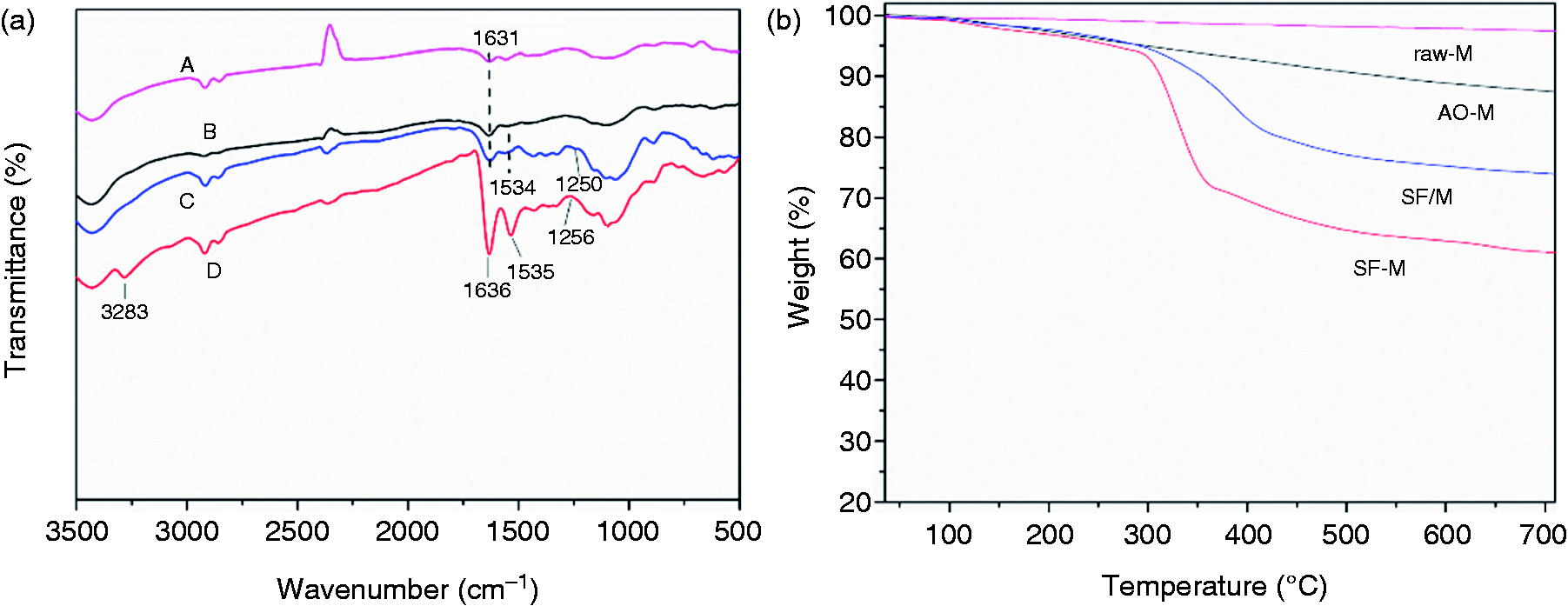
Thermogravimetric analysis
Thermogravimetric analysis (TGA) measurements of SF-Ms were conducted for the quantitative evaluation of the amino grafted onto MWCNTs (Figure 2(b)). TGA traces of raw-Ms illustrated minimal weight loss, which was 3% below 700℃. The AO-M sample demonstrated a small amount of weight loss: 8%, which can be attributed to the evaporation of the adsorbed water and the hydroxyl and carboxyl on the oxidized MWCNTs through the oxidation, in order to obtain enough carboxyl groups, so the acid treatment was stronger than usual. 41 In contrast, the curves of SF/Ms and SF-Ms both displayed noticeable weight loss. The weight loss of SF/Ms may be due to the SF attached on the surface of MWCNTs, whereas the weight loss of the SF-Ms was attributed to the SF grafted and attached on the MWCNT surfaces. Therefore, the weight loss in the SF-M sample was about 16% higher than that of the SF/Ms. Thermal analysis indicated that the surfaces of SF-grafted MWCNTs were coated with a large amount of SF and SF/Ms displayed low coating efficiency.9,33
XPS analysis
XPS analysis patterns for raw-Ms, AO-Ms, SF/Ms and SF-Ms are shown in Figure 3 to determine the chemical species introduced by the modification. Samples were degassed overnight within the XPS chamber (10−3 mbar) prior to analysis. As shown in Figure 3(a), unmodified MWCNTs displayed a single peak at 285 eV because of carbon. The peaks around 284.6 and 532.7 eV (Figure 3(b) to (d)) were attributed to carbon and oxygen, respectively. In addition, the peak at 400.2 eV in Figure 3(d) was due to nitrogen, which agreed with the results of FTIR analysis and confirmed that the surfaces of MWCNTs were grafted with a certain amount of SF. SF/M and SF-M samples were washed several times and most of the SF on the surfaces of the SF/Ms was washed away due to the weak combination. Therefore, there was no N1 peak in Figure 3(c). However, the combination of SF on the surfaces of SF-Ms and SF-Ms was much stronger so that there was an N1 peak in Figure 3(d) despite the washing. The atomic ratio of nitrogen was 6.287%,
9
as reported in previously published reports, and the steric effect may influence the grafting efficiency. Moreover, the Mn of the SF used in this study was 12,000, which was much higher than common amines, thereby resulting in a strong steric effect.
16
XPS spectra of (a) raw-Ms, (b) AO-Ms, (c) SF/Ms and (d) SF-Ms.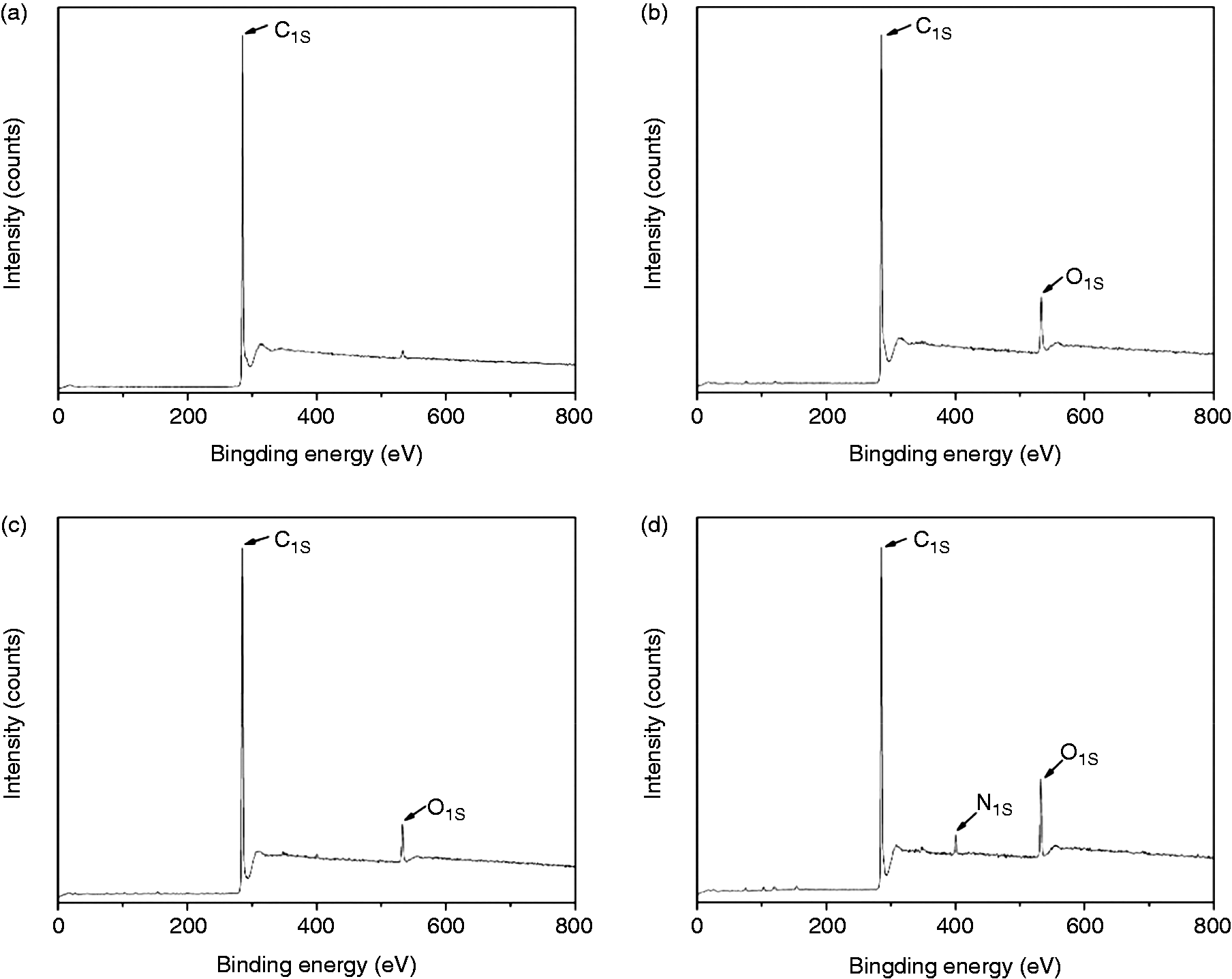
TEM analysis
The morphology and nanostructures of raw-Ms, AO-Ms, SF/Ms and SF-Ms were observed by TEM, and the results are shown in Figure 4. The detailed morphology is presented in Figure 4(a) to (d). The unevenness of the SF-M surface differed from the other three surfaces. In EDS analysis, the appearance of a nitrogen peak in Figure 4(c) could be ascribed to the SF attaching on MWCNTs, and the stronger nitrogen peak could be attributed to the modification. To further prove the effect of SF modification, SF/Ms and SF-Ms were compared (Figure 4(e) to (h)). The representative fields were marked as clearly displayed in Figure 4(f). The MWCNT surface was notably coated with SF, which may be attributed to chemical processing. The grafted SF may result in more quantities of coated SF because of the interaction between SF molecules. Meanwhile, SF/Ms showed minimal changes, namely, in the difference in quantity between these two samples, which agreed with the previous images.
33
The difference between SF/Ms and SF-Ms in Figure 4 reflect the different coating efficiencies of these two kinds of materials, and those between the SF-Ms and SF-Ms in Figure 4 result from different magnifications and different areas.
Nanostructures of (a) raw-Ms, (b) AO-Ms, (c) SF/Ms and (d) SF-Ms, and TEM images of (e) SF/Ms, (g) magnified SF/Ms, (f) SF-Ms and (h) magnified SF-Ms.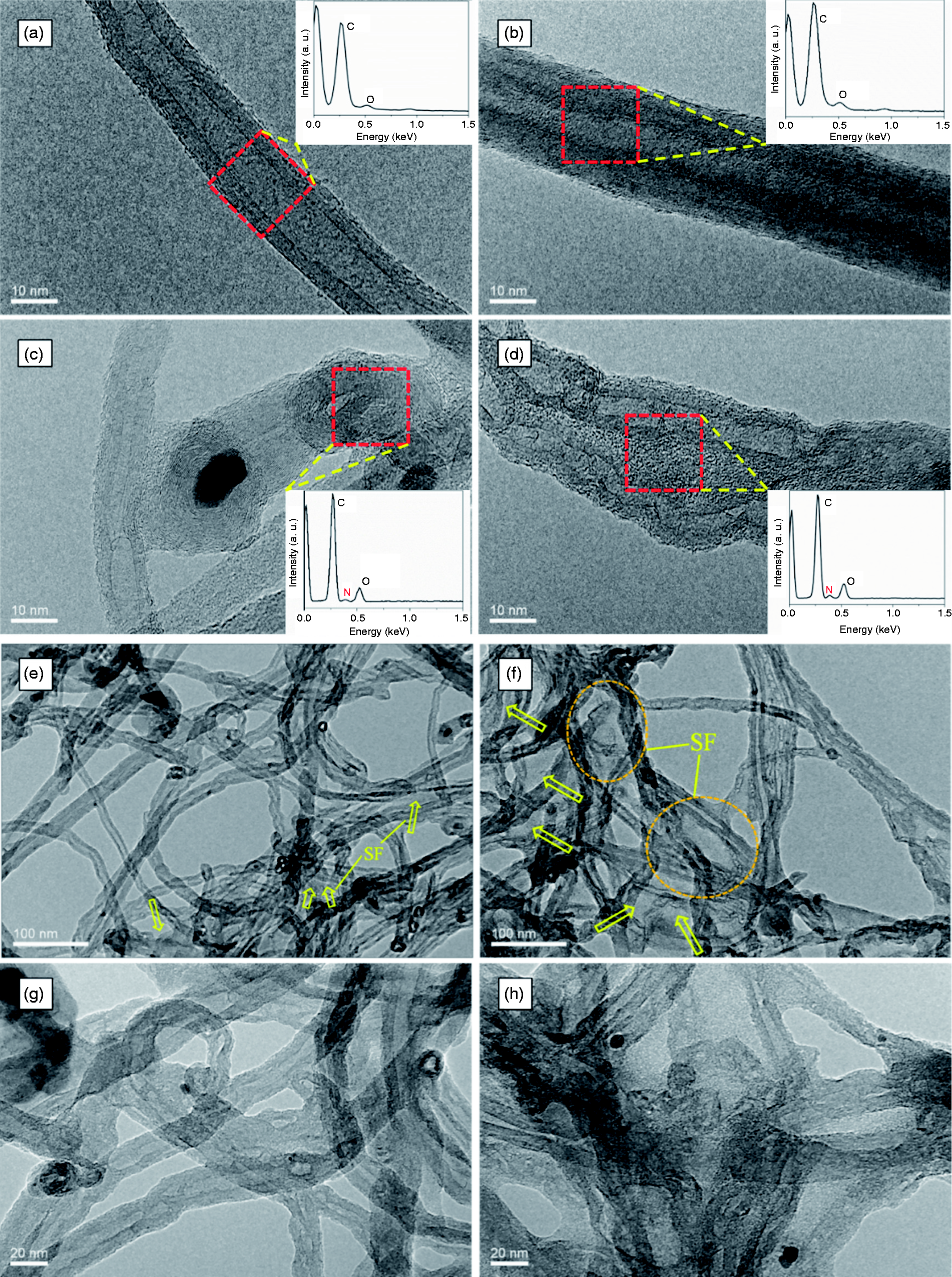
Evaluation of dispersibility
Dispersion of multi-walled carbon nanotubes in different solvents after various times (23 ± 2℃)

A: well dispersed; AO-M: acid-oxidized multi-walled carbon nanotubes; B: mainly dispersed; C: partly precipitated; D: fully precipitated; MWCNT: multi-walled carbon nanotube; SF/M: mixture of silk fibroin and MWCNTs; SF-M: silk fibroin-functionalized MWCNTs. 9

(a) Optical micrographs of the samples in (A1) H2O, (A2) methanoic acid and (A3) methanol obtained 6 h after the solution had been sonicated for 1 h. The concentration was 5 mg/10 ml; (b) UV–vis spectra of the samples in (B1) H2O, (B2) methanoic acid and (B3) methanol at a concentration of 1 mg/10 ml taken 6 h after the solution had been sonicated for 1 h. (c) MTT results of raw-M, AO-M, SF/M, SF-M and control samples.
Cytotoxicity analysis
The cytotoxicities of the raw-M, AO-M, SF/M, and SF-M samples were evaluated by MTT assay. The control group, in which cells underwent the same process but without the addition of any MWCNTs, provided a comparison. As shown in Figure 5(c), all samples displayed a certain amount of cytotoxicity and restricted cell viability on the first day of incubation. Further comparison revealed that SF-Ms demonstrated high cell viability, suggesting enhanced biocompatibility. The following results also showed a similar trend, which may be due to two aspects. On the one hand, the SF-M sample possessing better dispersion (as shown in Figure 5(a) and (b)) may prevent the occurrence of sectional toxicity. On the other hand, the favorable biocompatibility of SF could play a critical role as a positive factor. 43
Conclusion
In this study, SF-Ms were prepared by carboxylation and grafting. The SF-functionalized CNTs displayed outstanding dispersibility in H2O and methanoic acid, which may result from the excellent solubility of SF for H2O and methanoic acid, indicating the modification of the MWCNTs. This kind of functionalization is believed to offer nanotube derivatives suitable for a number of applications such as waterborne polymer/CNT composites. Moreover, this low-toxicity and environmentally friendly filler meets the requirements for several applications, especially in the field of biomaterials. Cytotoxicity analysis was conducted and good proliferation for SF-Ms was found. Thus, functionalization of nanotubes dramatically improved the biocompatibility of these nanomaterials. Future work will focus on the biomedical applications and other properties of SF-M composites.
Footnotes
Declaration of conflicting interests
The authors declared no potential conflicts of interest with respect to the research, authorship, and/or publication of this article.
Funding
The authors disclosed receipt of the following financial support for the research, authorship, and/or publication of this article: This work was supported by the National Natural Science Foundation of China (Grant Number 51473147) and the Zhejiang Sci-Tech University graduate innovation foundation (Grant Number YCX15005).