




Abstract
Digitization in the textile industry provides an effective manufacturing process; however, the integration of automation with computerization requires an excellent computer support system with a long lifespan. The lifespan of a computer is dependent on the heat generated from the system. The use of heatsinks combined with elastomeric thermal pads is a solution for heat dissipation. Silicone rubber composites exhibit excellent thermal conductivity with the incorporation of boron nitride (BN) as a filler. In this study, tetraethoxy orthosilicate (TEOS), a silane coupling agent, was doped onto to the surface of hydroxyl-functionalized BN using a simple sol–gel process for surface modification. The addition of BN filler up to 45 wt% enhanced the thermal conductivity of the composites and the surface modification of BN had an appreciable effect on the thermal conductivity, with a 16.52% improvement. The addition of TEOS improved the filler dispersion in the composite system and reduced the interfacial mismatch between the BN and silicone rubber. The tensile strength and hardness increased with the addition of the BN filler, but elongation at the break decreased at high filler loadings. Surface modification with 7 wt% TEOS improved the mechanical properties of the composite.
Keywords
The high thermal conductive silicone rubber in this study can be combined with a textile using any weaving method for the heat dissipation of electronic products. 1 In particular, as the world moves toward Industry 4.0 and applies artificial intelligence in the textile industry,2,3 the textile industry needs to apply a large number of related electronic devices and components in the manufacturing process. Procedures such as spinning, weaving, dyeing, and finishing require robust computer systems with a long lifespan. 4 The reliability of a computer system, including the microprocessor in the control module, depends on its operating temperature.5,6 Therefore, it is crucial to dissipate the heat generated from the system and maintain the operating temperature at a safe level. To achieve these conditions, this study used the typical method of heat dissipation using a heatsink with elastomeric thermal pads. Elastomeric thermal pads are typically made from a polymer or silicone rubber material. Silicone rubber is an elastomer (rubber-like material) composed of silicone together with carbon, hydrogen, and oxygen. 7 The concurrent presence of organic groups attached to an inorganic backbone provides silicones with a combination of preferential properties, such as high transparency, air permeability, electrical insulation, mechanical flexibility, and wear resistance.8,9 However, silicone rubber has low thermal conductivity, which cannot be satisfied with the required application. In addition, the utilization of silicone rubber is limited due to its poor mechanical strength.10,11 Its thermal conductivity can be achieved by the use of suitable thermally conductive ceramic powders. The addition of ceramic powders into silicone rubber can also improve its mechanical properties.
Boron nitride (BN) has recently attracted attention as a composite filler because its morphology consists of covalently bonded B-N rings, which is similar to graphite. As it has high intrinsic thermal conductivity and is chemically stable, it has been widely used as a thermally conductive filler. 12 Previous experimental work has already shown that the incorporation of BN particles can successfully improve the thermal conductivity of the composite. The improvement of the thermal conductivity varies depending on the size of the filler particle; the micro-size shows higher enhancement than the nano-size, as reported by Kemaloglu et al., 13 Zhou et al., 14 and Wang et al. 15 In a composite system, the interaction between the filler and rubber matrix plays an important role. The interfacial adhesion mismatch between the filler and matrix can lead to a detrimental effect on the composite properties, especially in thermal conductivity and mechanical properties. Filler functionalization using an appropriate coupling agent can result in improvements to the heat transfer capability of the composite.16,17 The experimental reports by Wang et al., 15 Wattanakul et al., 18 and Muratov et al. 19 proved that the incorporation of BN filler can enhance the thermal conductivity of composites.
In summary, the present study proposed the incorporation of BN particles in silicone rubber to form a conductive silicone composite for elastomeric thermal pads. The high intrinsic thermal conductivity of the BN particles could provide good heat transfer inside the composite. Filler functionalization using tetraethoxy orthosilicate (TEOS) as a coupling agent could increase the compatibility between the filler and silicone rubber matrix. Finally, a silicone conductive composite was fabricated. The purpose of this study was to investigate the influence of incorporating BN particles as a filler on the thermal conductivity and mechanical properties of silicone rubber composites. This study used micro-sized BN particles and TEOS as a coupling agent, and then investigated the structural change of the particles. Filler loading was limited to avoid difficulties in manufacturing.
Experimental details
Materials
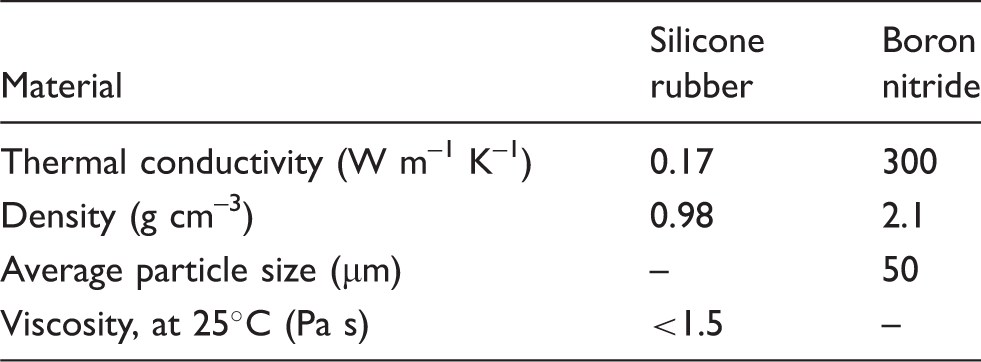
Material properties of silicone rubber and boron nitride
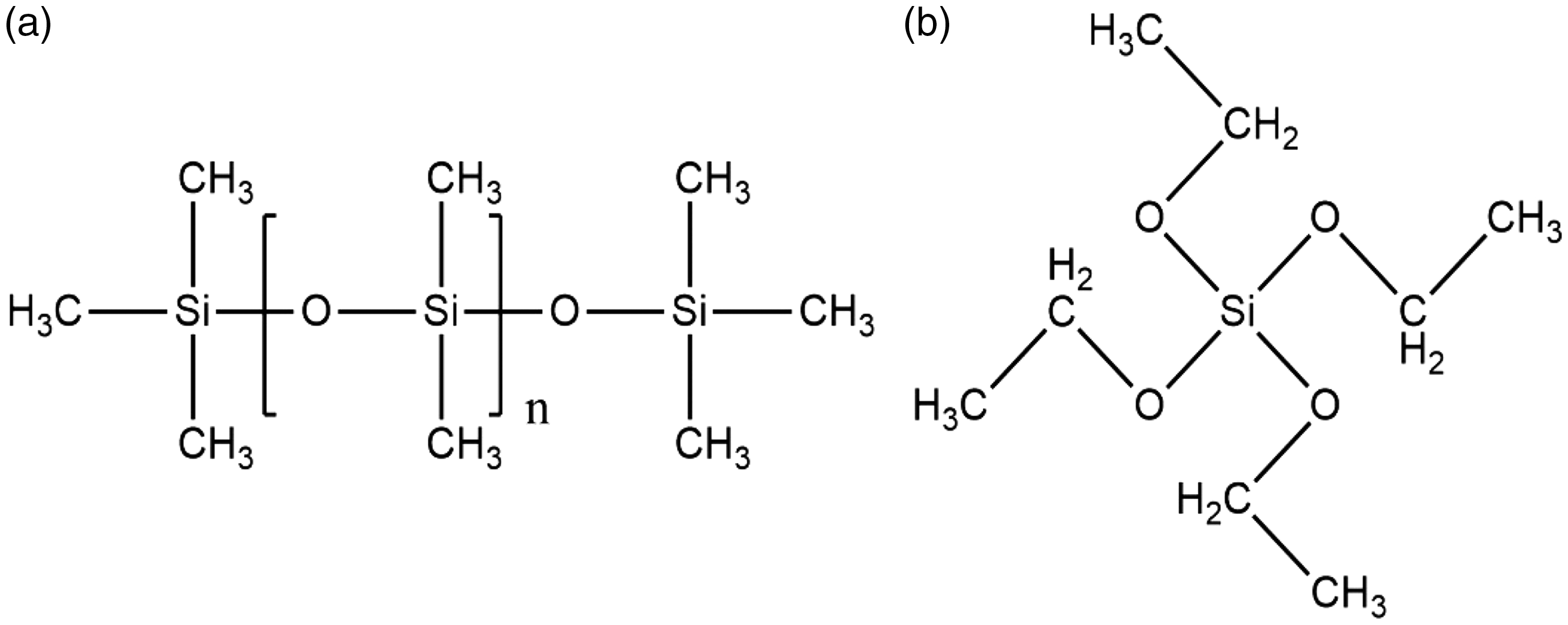
Chemical structure of (a) poly(dimethyl siloxane) and (b) tetraethoxy orthosilicate (TEOS).
Sample preparation
Surface modification of BN
The surface modification of the BN particles with a TEOS coupling agent used a simple sol–gel process and involved the following: (1) making a 95 wt% aqueous methanol solution; (2) adding the BN particles into the solution and mixing it for 15 min with a magnetic stirrer; (3) adding the TEOS coupling agent (5%, 7%, and 9% of the whole BN filler mass) into the solution, adjusting the pH of the mixture to 3–5 with dilute HCl, and mixing for 20 min; (4) further stirring the mixture for 1 h at room temperature; (5) rinsing the mixture with deionized water and methanol by filtration until the pH returns to normal to remove any unreacted coupling agent; and (6) drying the particle at 120℃ for 24 h to ensure that all of the solvents are removed. The pristine BN filler was denoted as P-BN, the modified BN with 5 wt% TEOS was denoted as BN-T5, the modified BN with 7 wt% TEOS was denoted as BN-T7, and the modified BN with 9 wt% TEOS was denoted as BN-T9.
Preparation of BN/silicone rubber composite
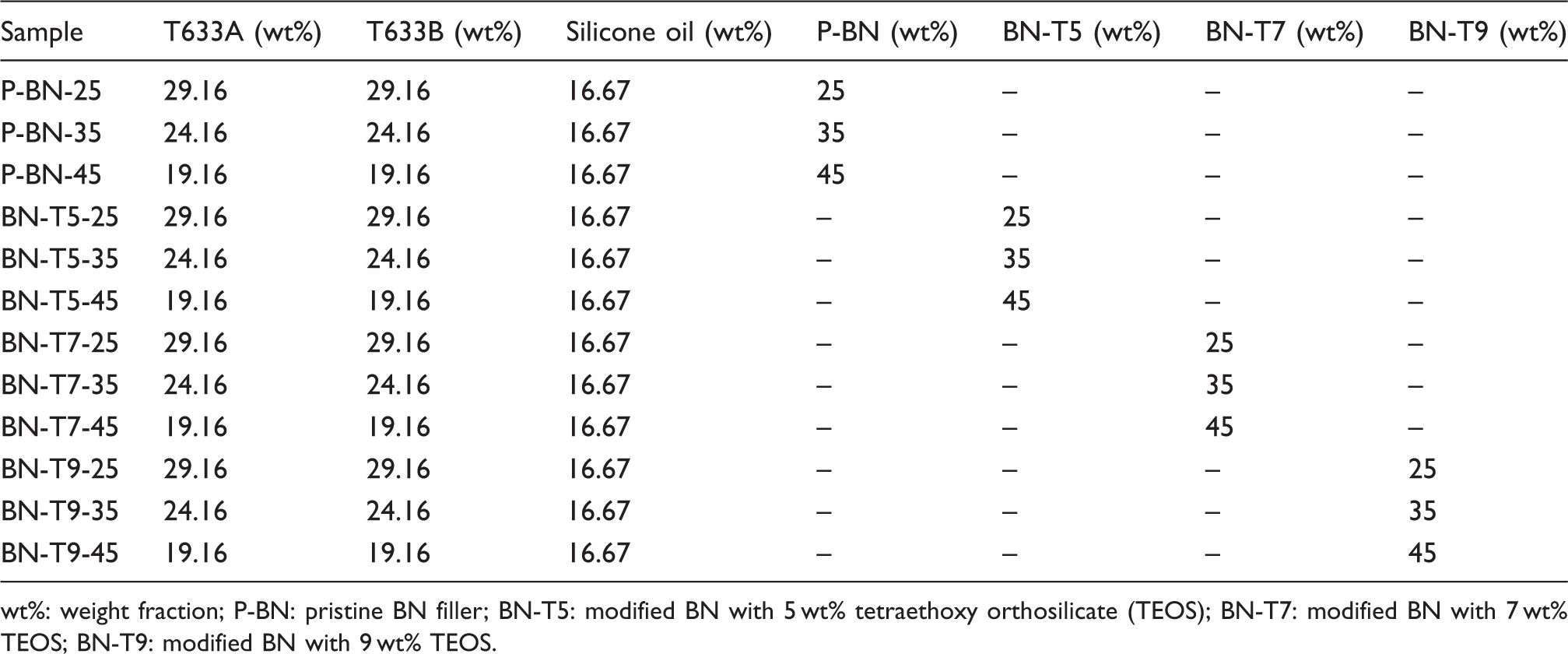
The preparation process of the BN/silicone rubber composite is shown in Figure 2. Silicone rubber and silicone oil were mixed with the BN filler according to the composition given in Table 2. Compounding was carried out on a two-roll mixing mill machine, and the total mixing time for all the different variations was 30 min. After the mixing process, the mixture was placed in a stainless steel mold with dimensions of 60 mm × 60 mm × 1 mm to prepare the thermal conductivity samples with a dumbbell shape in accordance with ASTM D412 for preparation of the mechanical test specimen. The mixture was then compression-molded at 150℃ at a pressure of 50 kg/cm2 for 5 min in an electronically heated hot-press machine (Taiwan: GF-50, You Found Hydraulics Industrial Co. Ltd).
Schematic showing the reactions of the tetraethoxy orthosilicate (TEOS) coupling agent with the boron nitride (BN) particle surface and the compatibility between the modified BN and silicone rubber matrix. Formulations of the boron nitride (BN)/silicone rubber composites. wt%: weight fraction; P-BN: pristine BN filler; BN-T5: modified BN with 5 wt% tetraethoxy orthosilicate (TEOS); BN-T7: modified BN with 7 wt% TEOS; BN-T9: modified BN with 9 wt% TEOS.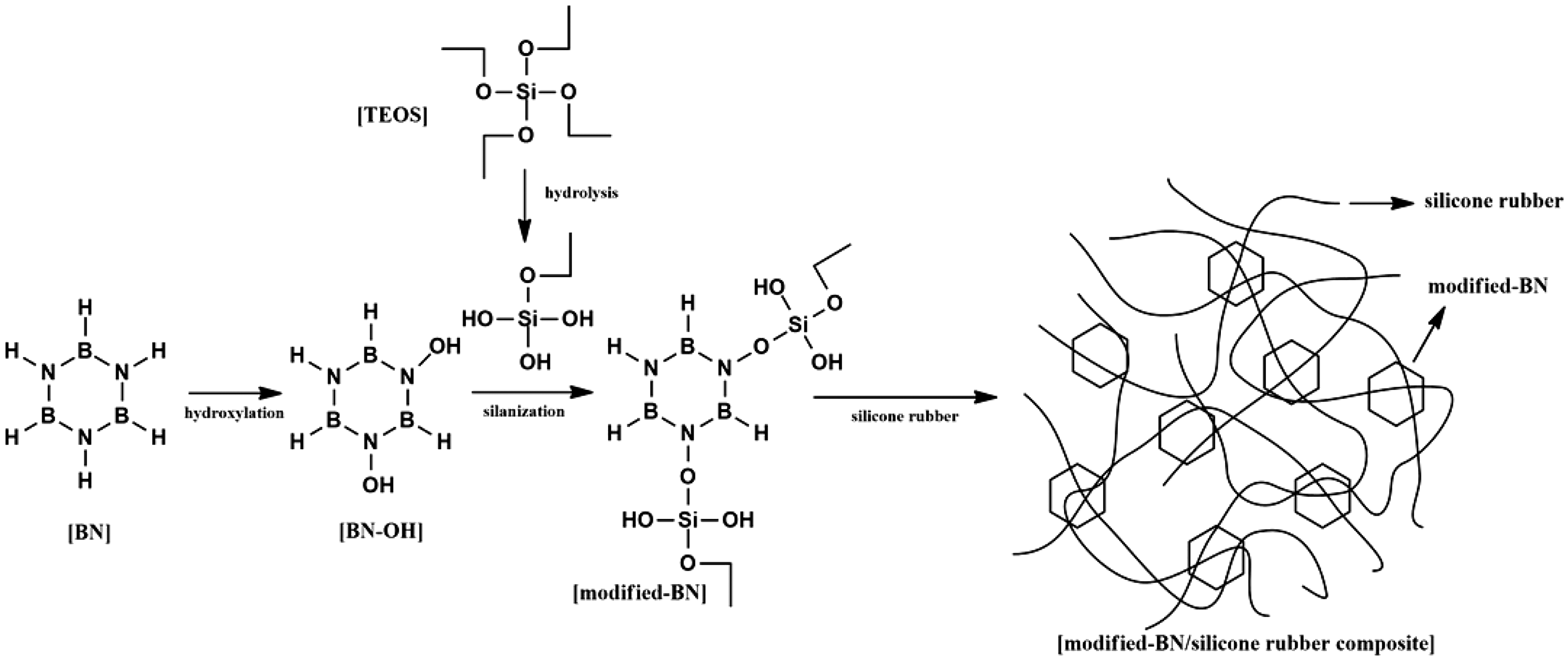
Characterization
The surface modification of the filler was characterized by Fourier transform infrared spectroscopy (FTIR) (Bio-Rad Digilab, Scimitar FTS-1000) in the frequency range of 4000–400 cm–1 with a resolution of 4.0 cm–1. The specimen was prepared using the potassium bromide (KBr) pellet technique. The sample was scanned from 4000 to 400 cm–1 in the transmission mode. The morphology of the functionalized filler and composites was observed using scanning electron microscopy-energy disperse X-ray spectroscopy (SEM-EDS) (JEOL, JSM-6390LV). The observed surface was the fractured surface of the specimen from a tensile test. The samples were platinum coated to enhance conductivity with an auto fine coater (JEOL, JFC-1300) for 90 s. The sample was observed at 1000–2000× magnification with the energy of 10 kV for the SEM images and 20 kV for the EDS results. A heat transfer analyzer (Applied Precision, ISOMET model 2104) was used to determine the thermal conductivity of the composite. The measurement was performed at 27 ± 1℃. The thermal conductivity of the composite was calculated by the following equation

Results and discussion
Surface modification analysis
It is well-known that the heat transfer performance of a composite is largely dependent on the interaction between the matrix with the filler. Therefore, their compatibility can be improved by modification of the filler surface with surfactant-like silane. Surface modification of the filler will reduce the interfacial thermal resistance and increase the thermal conductivity of the composite.
The chemical structure of the surface-modified BN particles was determined using FTIR and SEM-EDS analysis. FTIR is an extremely powerful technique for observing the modifying agent–filler system and determining the structural changes of the modifying agent on the filler surface.
20
Figure 3(a) shows the FTIR spectra of the pristine and modified BN. The FTIR spectrum of P-BN, BN-OH, and modified BN had similar results. The strong characteristic band at 1375 cm–1 resulted from the in-plane BN stretching vibration, and the peak around 820 cm–1 was the out-of-plane B-N-B bending vibration.
21
The broad peak at the wavenumber range of 3200–3700 cm–1 was assigned to the hydroxyl groups (OH). A comparison between the P-BN and BN-OH spectra did not reveal significant differences. In spite of the fact that P-BN had relatively few hydroxyl groups from atmospheric moisture, a disparity in hydroxyl group peak intensity between P-BN and BN-OH could not be observed.21,22 The spectrum of BN-OH exhibited a larger hydroxyl group peak than P-BN; however, a quantitative difference in the peak intensity was indistinguishable. For the modified BN, some peaks at 2930 and 2830 cm–1 could be ascribed to asymmetric and symmetric stretching vibrations of the -CH2- group as part of TEOS.22,23 The addition of TEOS in the BN structure could also be validated with a widened peak at 1350–1400 cm–1. This phenomenon was due to the appearance of a new peak at 1370 cm–1, which could be ascribed to B-O-Si bonding, in addition to another existing peak at 1375 cm–1 for in-plane BN stretching vibration.
21
The two adjacent peaks in the same wavenumber range revealed a strong-widened peak in the FTIR spectrum. Some peaks were revealed at the wavenumber range of 1150–750 cm–1, as shown in Figure 3(b). The appearance of new peaks in the modified BN spectrum at 997–972 and 901–841 cm–1 corresponded to O-Si-O bonding and the Si-OH stretching the vibration (silanol) band, respectively.
24
When the silanes were activated in an alcohol–water medium, hydrolysis and condensation reactions occurred. The activated silanes turned to silanol and were deposited onto the filler surface to form a siloxane layer.
Fourier transform infrared spectra of (a) pristine and modified boron nitride (BN) particles, and (b) specific wavelength of 1150–750 cm–1.
The SEM-EDS characterization was performed to validate the surface modification of BN with TEOS. The comparison surface morphology and elemental compositions result between P-BN and modified BN revealed significant differences, as shown in Figure 4. As shown in Figure 4(a), the SEM images of P-BN exhibited flake-shaped BN filler and tended to spread to each other. The elemental composition of P-BN showed the presence of boron, nitrogen, and a few oxygen atoms. The addition of TEOS to the BN particles resulted in a different filler morphology than that of the former particles, as shown in Figures 4(b)–(d). The BN-T5 particles, as shown in Figure 4(b), exhibited similar morphology to P-BN; however, a few small particles with a smooth-edged shape could be found in the micrograph. When additional TEOS solution was added into the system, some particles with a smooth-edged shape were observed in the micrograph, as shown in Figure 4(c). In addition, as shown in Figure 4(d), more particles with smooth edges were formed as the dosage of TEOS was increased. Furthermore, the particles also tended to congregate with the addition of TEOS. The EDS spectrum of the modified BN (BN-T5, BN-T7, and BN-T9) showed a new peak, which indicated that silicon atoms existed in the surface of the BN particles and that the percentage increased with the increase of the TEOS addition. The appearance of silicon atoms in the EDS spectra of the modified BN confirmed the existence of a siloxane layer on the BN particles.24,25
Scanning electron microscopy-energy disperse X-ray spectroscopy results of (a) P-BN, (b) BN-T5, (c) BN-T7, and (d) BN-T9 particles.
Morphology analysis
The morphology of the fracture surface of the BN/silicone rubber composite was observed by SEM analysis, as shown in Figure 5. It can be seen that increasing the addition of filler loadings results in a more compact structure of the composites. The matrix layer covering the filler becomes thinner with the further addition of filler loadings. As seen in Figure 5(a), with the addition of 25 wt% filler loadings, the BN filler was randomly distributed with microvoids between the particles. The existence of microvoids resulted in the decrease of some properties of the composite.
20
Furthermore, as shown in Figure 5(b), the layer of the matrix between the filler decreased and the filler tended to congregate and form agglomerates. Filler agglomerates can provide a better conductive path to improve thermal conductivity; however, too many agglomerates will lead to a larger interface and cause higher phonon scattering. The addition of 45 wt% filler loadings, as shown in Figure 5(c), exhibited larger quantities of agglomerates inside the composites and easily detached due to the thinner matrix layer of the composite.
Scanning electron microscopy-energy disperse X-ray spectroscopy images of boron nitride(BN)/silicone rubber composites: (a) P-BN-25; (b) P-BN-35; (c) P-BN-45.
Figure 5 shows the fracture surface of the silicone rubber composite with pristine BN filler. As seen in Figure 5(a), the filler did not attach well to the matrix, indicating poor interfacial interaction. The poor interaction could form microvoids and influence the properties of the composites. Surface modifications of the filler would increase the interfacial interaction between the filler and matrix and enhance the homogeneous dispersion of the filler in polymer matrices.
23
The morphology comparison between the pristine and modified BN/silicone rubber composite is shown in Figure 6, which shows composites with 35 wt% filler loadings. Figure 6(a) exhibits the randomly distributed filler in the polymer matrix, which tended to congregate and form agglomerates, indicating poor filler dispersion in the composites. The addition of TEOS, as shown in Figures 6(b)–(d), exhibited better filler dispersion than the unmodified BN composites. The composites with BN-T5, as shown in Figure 6(b), showed better filler dispersion than the former composite; however, some agglomerates still formed. Better filler dispersion could occur due to the good interfacial interaction between filler and matrix. The siloxane layer that formed onto the filler surface improved the compatibility between the BN filler and silicone rubber. As shown in Figure 6(c), some agglomerates still existed, but the agglomerate dispersion was better than that for composites using BN-T5 filler. Furthermore, as shown in Figure 6(d), no agglomerates formed and the filler was completely surrounded by the siloxane layer, resulting in better interfacial adhesion between filler and matrix. Filler dispersion and agglomerate formation are important factors for heat transfer. Good filler dispersion will enhance thermal conductivity. However, if the distance between the filler particles is too great, it will be difficult to form the conductive network path. Agglomerate formation has an adverse impact on mechanical properties, but it will enhance thermal conductivity. Agglomerates have a large particle size and smaller interfacial phase between filler and matrix when compared with ordinary fillers. By reducing the interfacial phase, the thermal resistance will decrease and the heat transfer process will be more effective.24,25
Cross-sectional images of silicone rubber composites: (a) P-BN-35; (b) BN-T5-35; (c) BN-T7-35; (d) BN-T9-35.
Thermal conductivity analysis
Figure 7 exhibits the thermal conductivity of composites with the addition of pristine BN particles. It could be seen that the thermal conductivity rose with increasing the filler loadings of the filler. The increasing trend of thermal conductivity was not significant when the filler loadings were lower than 35 wt%, and further increased significantly. In general, the thermal conductivity system in polymers filled with high conductive filler varies with the loadings of particles and can be classified into two systems. One is a system with low filler content, in which dispersed filler particles hardly touch each other, and the other is a system with higher content, in which conductive chains are exponentially formed by filler particles and contribute to a large increase in the thermal conductivity of the composites.26,27 At low filler loadings, the conductive filler is surrounded by a matrix and particles cannot touch each other, resulting in a low increase of thermal conductivity. In this system, the thermal conductivity of the composite depended on the intrinsic thermal conductivity of the matrix. At higher filler loadings, the conductive filler particles began to touch each other and form a more compact packing structure. The compact structure gradually formed a thermally conductive network path, resulting in a thinner layer of matrix that decreased the thermal resistance, thus enhancing the thermal conductivity.
28
In this system, the thermal conductivity of the composite depended on the intrinsic thermal conductivity of the filler. The thermal conductivity of the composites reached 0.493 W m–1 K–1 at 25 wt%, increased to 0.593 W m–1 K–1, and then was further enhanced to 0.638 W m–1 K–1 at 45 wt% filler loadings.
Thermal conductivity of silicone rubber composites with various boron nitride filler contents.
The efficiency of the heat transfer in a composite depends on the bonding between matrix and filler. Poor interface bonding can cause microvoids and enhance the thermal resistance of composites.16,18 The surface modification of BN particles with TEOS is useful for increasing the thermal conductivity of silicone rubber composites because the coupling agent can promote the adhesion of the filler to the rubber matrix. The effect of the addition of TEOS on the thermal conductivity of silicone rubber composites is shown in Figure 8. As shown in Figure 8(a), filler surface treatment with TEOS successfully enhanced the thermal conductivity of the composites. Composites with BN-T7 filler exhibited better thermal conductivity than composites with BN-T5 and BN-T9. From Figure 8(b), with 45 wt% filler loadings, BN-T7 could enhance the thermal conductivity by up to 16.52% from the pristine filler, compared with 3.76% for BN-T5 and 5.64% for BN-T9. It is well-known that phonons are very sensitive to surface defects. The thermal resistance in the composite is mainly due to the scattering of phonons from acoustic incompatibility and the lack of association with the filler–matrix interface. Furthermore, the intrinsic thermal conductivity of the filler will decrease with functionalization, and therefore the filler and matrix interface should be reduced and the compatibility improved. Such improvement will lead to decreasing phonon scattering at the interface and enhance the thermal conductivity of the composite.29,30 However, excessive coupling agent could disperse in the interface of the filler and matrix as a kind of low thermal conductivity material. Filler agglomerations in the composite could provide a conductive network path for heat transfer. High filler dispersion in the matrix results in more interface and also reduces the possibility of the fillers forming a conductive path, which is the main aspect to accelerate the heat transfer phenomenon in a composite system. The redundant coupling agent will cause the bond between filler and matrix to weaken and enhance the interfacial phonon scattering.
20
It will lead to decreased thermal conductivity of the composites, thus producing materials with low thermal conductivity.
The thermal conductivity of silicone rubber composites: (a) with various additions of tetraethoxy orthosilicate; (b) enhancement of thermal conductivity in percentage.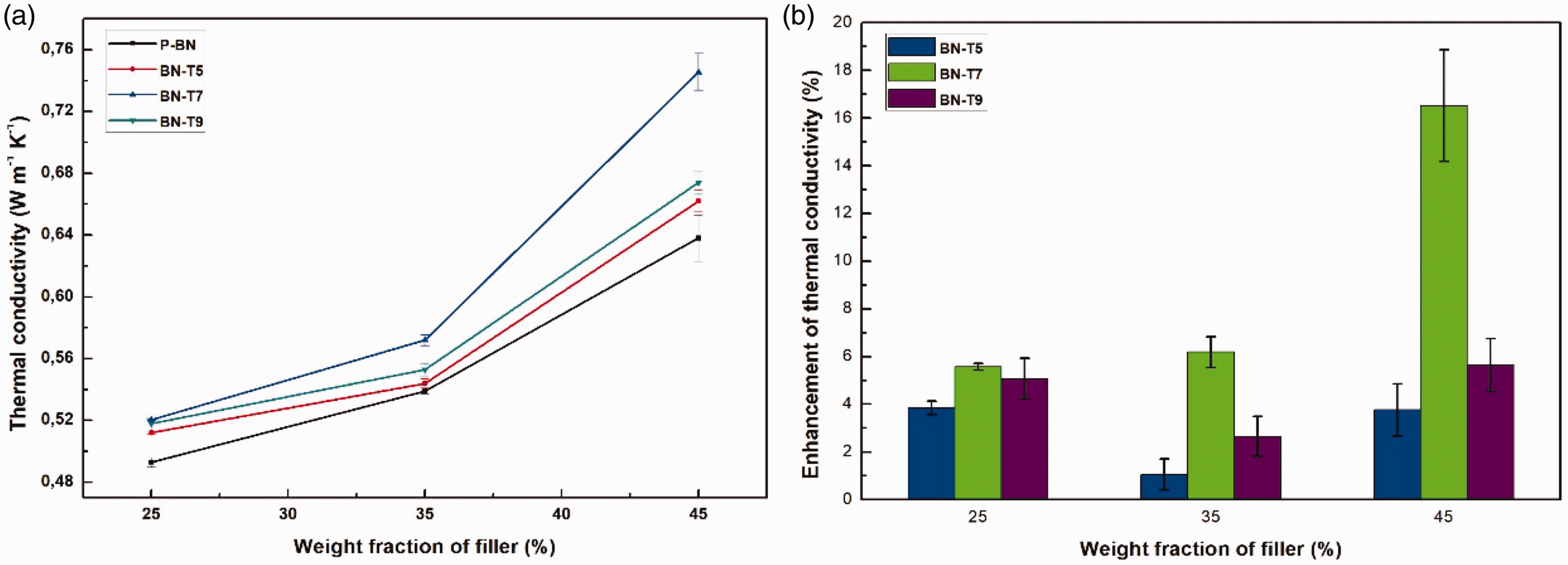
Mechanical properties
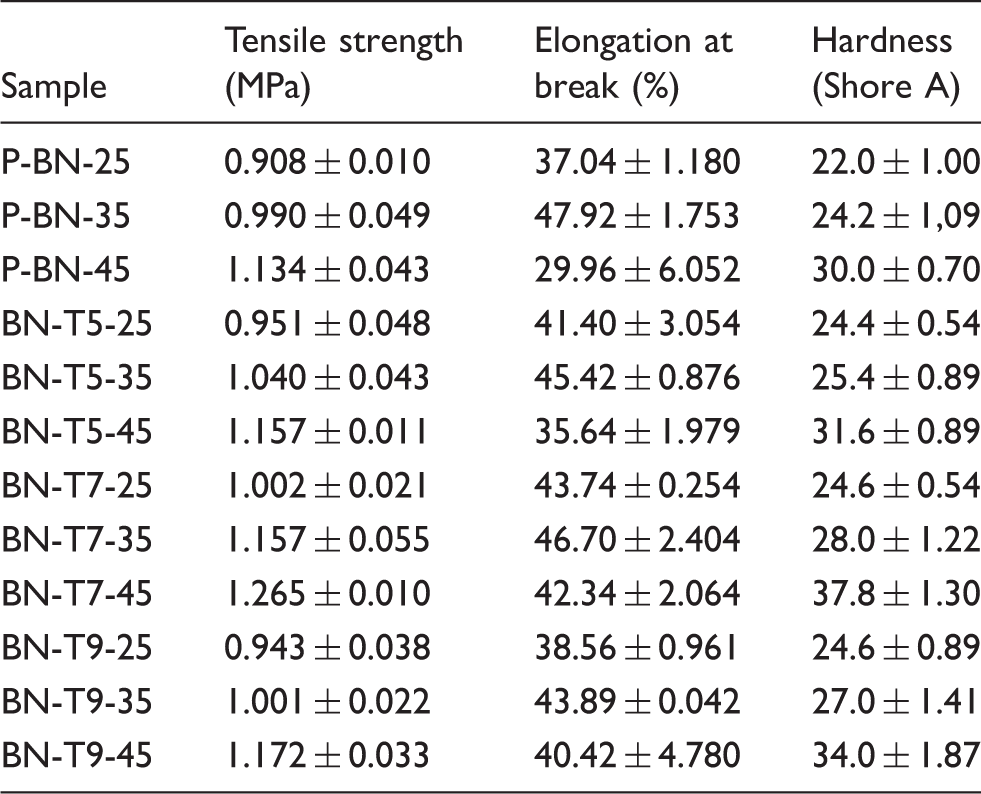
Mechanical properties of silicone rubber with various filler contents
Conclusion
This study synthesized and characterized silicone conductive composites for elastomeric thermal pads. To enhance its thermal conductivity, the addition of BN particles as a filler and the surface modification of BN particles using TEOS as a coupling agent were explored by applying variations on filler loadings and coupling agent concentrations. The FTIR results indicated that the BN particles were successfully modified by TEOS to form a siloxane layer on the BN surface. The SEM-EDS results of the modified filler exhibited changes in the structural morphology of the filler and the emergence of silicon atoms in the surface of the filler. For the morphology of the composite, the SEM images also showed that increasing the filler loadings would form a more compact structure in the composite and that surface modifications of the filler improved the filler distribution in the composite system. The thermal conductivity of the composite increased with the increase of the filler loadings and improved with the filler modification. Composites with 45 wt% filler loadings showed thermal conductivity up to 0.638 W m–1 K–1, which increased to 0.745 W m–1 K–1 with the incorporation of 7 wt% TEOS. The addition of a coupling agent reduced the interfacial mismatch between filler and matrix and provided a good heat transfer system inside the composites; however, the use of excessive coupling agent would reduce the thermal conductivity due to the characteristic thermal properties of the coupling agent itself. The mechanical properties of the composites also increased with the filler addition. The tensile strength and hardness improved by increasing the BN filler loadings, but elongations at the break of the composites were reduced with the addition of 45 wt% filler loadings. Modified BN filler with 7 wt% TEOS enhanced the mechanical properties. The addition of an excessive amount of coupling agent did not result in optimal results due to the thicker layer formation on the filler surface, which weakened the filler–matrix interaction.
Footnotes
Declaration of conflicting interests
The authors declared no potential conflicts of interest with respect to the research, authorship, and/or publication of this article.
Funding
The authors disclosed receipt of the following financial support for the research, authorship, and/or publication of this article: The work was supported by the Ministry of Science and Technology of the Republic of China (Grant Number 106-2221-E-011-137-MY2).