



Abstract
Superhydrophobic and superoleophilic glass-fiber fabric with high water-in-oil emulsion separation efficiency was prepared by a simple sol–gel process using MTES (triethoxymethylsilane) as precursor. The surface chemical composition, micromorphology, pore size distribution, thermal stability, and the wetting behavior of the glass-fiber fabric were characterized using scanning electron microscopy, Fourier transform infrared spectroscopy, capillary flow porometry, thermogravimetric analysis, and water (pH = 1–14)/oil contact angle measurement. The contact angle of the treated fabric at different temperatures was tested in a muffle furnace. The results show that the micromorphology of the glass-fiber fabric almost remains the same after MTES treatment, while the pore size of the treated glass-fiber fabric decreases slightly. Hydrophobic –CH3 groups are grafted onto the fiber surface and MTES copolymers are formed on the junction of fibers of the glass-fiber fabric. The treated glass-fiber fabric shows superhydrophobicity and superoleophilicity and its separation efficiency for emulsified water in the oil can reach 96.80 wt %. Besides, the treated glass-fiber fabric can withstand acid/alkaline, high temperature environments and maintain high separation efficiency after multiple cycle uses.
Moisture in oil can lead to remarkable quality deterioration of fuel due to its serious impact on the engine, the “heart” of transportation vehicles such as airplanes, cars, and ships. 1 Owing to the different interfacial effects of oil and water, utilizing the superwetting behavior (such as superhydrophobicity and superoleophilicity) of solid surfaces to design an water/oil separation process is considered a much more effective technique than traditional techniques such as oil skimmers, centrifuges, coalesce agents, settling tanks, depth filters, magnetic separations, and flotation technologies.2,3 To date, superhydrophobic and superoleophilic materials with the substrates of metallic meshes and fabrics have been successfully developed and achieved reasonable success in separating oil/water immiscible mixtures.4–12 Such superhydrophobic and superoleophilic surfaces allow oil to permeate easily, while rejecting water droplets in the oil–liquid emulsion by controlling the pore structure or their own surface properties. Thus, water droplets can be effectively separated from the oil–liquid emulsion. Therefore, the oil–water separation efficiency of such materials is greatly related to the pore size of the materials and their surface properties.
However, most of these materials are not applicable for emulsified oil/water separation because the pore sizes of these materials (>50 µm) are much larger than the droplet sizes of the emulsion (<20 µm).13,14 Filtration materials have been successfully applied for the separation of various emulsions. Due to their small pore size, membrane filtration technology, including ultrafiltration and microfiltration, has been extensively investigated and a variety of membranes have been fabricated via the rational control of chemical composition and surface structure.15,16 Nevertheless, these conventional one layer (2D) membranes with small pore sizes suffer the disadvantages of high energy consumption, low flux, and quick decline of permeation due to surfactant adsorption and pore blocking. 17 Therefore, 3D (multi-layer) porous structure materials with special wetting behavior, suitable pore size, and an interconnected permeation path could be a promising candidate to achieve excellent separation performance. For instance, Huang et al. developed a superhydrophobic–superoleophilic nanofiber membrane by the combination of silica nanofibers and in situ polymerized fluorinated polybenzoxazine (F-PBZ). 18 This membrane can effectively separate micron-sized surfactant-stabilized water-in-oil emulsions. Ma et al. prepared a nanofiber membrane by the combination of electrospun core-sheath structured polyamide/cellulose acetate nanofibers and then modified with F-PBZ/silica nanoparticles to become superhydrophobic and superoleophilic. 19 Si et al. created a superelastic and superhydrophobic aerogel with a hierarchical cellular structure that consisted of bonded nanofibers aerogels, 20 which present superhydrophobic–superoleophilic wettability, high pore tortuosity, and high efficient separation efficiency of surfactant-stabilized water-in-oil emulsions with a high flux. Lv et al. constructed a novel 3D multi-scale poly(melamine formaldehyde) (PMF) sponge with controlled pore sizes by introducing layered double hydroxides and SiO2 electrospun nanofibers as the pore size regulators by overlapping the PMF mainframe; 21 the prepared sponge shows excellent oil/water emulsion separation properties. However, the above methods also have some problems such as complicated and lengthy processes and the use of high-price reagents or devices, which hinders the use of these materials in practical and commercial applications. Therefore, a facile and inexpensive method that provides a comprehensive performance for the fabrics or filters in water-in-oil emulsion separation is still in high demand.
In this study, we present a robust methodology to fabricate a superhydrophobic and superoleophilic glass-fiber fabric by a simple sol–gel process using MTES (triethoxymethylsilane) as precursor. By this method, no toxic or expensive reagents are used and no special devices are needed. The prepared fabric can effectively separate micron-sized surfactant-stabilized water-in-oil emulsions solely driven by gravity. Most importantly, this fabric can withstand acid/alkaline and high temperature environments. Besides, the separation efficiency of as-prepared glass-fiber fabric remains high after being used 20 times. Hence, this simple, efficient, and low-cost preparation of fabrics with special wettabilities shows potential in industrial application.
Experiment details
Materials
MTES (98%, A.R.) was purchased from Aladdin Industrial Corporation; ammonia (NH3∙H2O, 25%, A.R.), ethanol (EtOH, 99.5%, A.R.), hydrochloric acid (HCl, 37.5%, A.R.), sodium hydroxide (NaOH, 98%, A.R.), and emulsifier (NP-10, 99%,C.P.) were purchased from Guangzhou Chemical Reagent Company. Pristine glass-fiber fabric, which was provided by Guangzhou Huachuang Chemicals and Materials Technology Development Co., Ltd., was made from glass fibers with diameters of 0.6 µm, 1 µm, and 2.6 µm (weight ratio = 3:3:4) via a wet-forming method. Water was purified by a Milli-Q system (Millipore, Bedford).
Preparation of the superhydrophobic and superoleophilic glass-fiber fabric
Firstly, a mixture solution of 30.0 g MTES, 150.0 g EtOH, 10.0 g water and 5.0 g NH3∙H2O was prepared. The pristine glass-fiber fabric was then dipped into the mixture solution and stirred gently for 8 h at room temperature. The soaked fabric was then taken out, air dried, and placed in an oven at 150℃ for 20 min to obtain the superhydrophobic and superoleophilic glass-fiber fabric. The formation mechanism of the superhydrophobic and superoleophilic glass-fiber fabric is detailed in Figure 1.
Schematic diagram for the preparation of glass-fiber fabric by in situ polymerization.
As shown in Figure 1, the hydrolysis and condensation reaction of alkoxysilanes occurs in a mixture of alcohol, water, and ammonia. Due to the fact that the surface of glass fiber is covered with reactive –OH groups, CH3Si(OH)3 formed by hydrolysis of MTES is easily grafted onto the glass-fiber surface by a condensation reaction. Therefore, the methyl groups of MTES are expected to graft onto the surface of the glass fiber. Besides, the hydrolysis and condensation reactions of MTES also take place at the conjuncture of glass fibers and act as an adhesive, therefore enhancing the strength of the glass-fiber fabric.
Characterization
Chemical composition changes of the glass-fiber fabric before and after treatment were investigated by Fourier transform infrared (FTIR) spectroscopy (Vector 33, Bruker, Germany). The sample was washed with ethanol three times and then dried before testing. The surface morphology of the glass-fiber fabric was observed by scanning electron microscopy (SEM, Zeiss EVO18, Germany). The pore size distribution of the glass-fiber fabric was measured with capillary flow porometry (CFP, Flow Porometer-1100-A, PMI, USA). Static contact angle measurements were performed with an optical contact angle meter (OCA40 Micro, Dataphysics, Germany). The hydrophobicity and oleophilicity of the glass-fiber fabric were measured with 5 µL water per drop. The thermal stability of the superhydrophobic and superoleophilic fabric was tested by thermogravimetric analysis (TGA, Q500, USA) at a heating rate of 20℃/min from 50 to 700℃ under nitrogen atmosphere, and the contact angles at different temperatures were tested in a muffle furnace.
Water-in-oil emulsion removal efficiency
Firstly, a mixture of oil and water (containing 4.0% NP-10 emulsifier) in accordance with a mass ratio of 9:1, treated by a high-speed mixer at 6000 r/min for 0.5 h and for 10 min with a 2 kW ultrasonic instrument, was used to prepare the oil-liquid emulsion containing emulsified water. Then, a universal research microscope (Olympus, BX51, Japan) was used to observe the particle size of emulsified water drops. Finally, a Karl Fischer moisture titrator (Cou-Lo Aquamax, C20, USA) was used to examine the water content in the oil–liquid emulsion. The oil–water separation efficiency was calculated from the ratio of the D-values before and after filtration and the original water content in the oil–liquid emulsion.
Result and discussion
FTIR spectra
FTIR spectra of the pristine glass-fiber fabric and the treated glass-fiber fabric are shown in Figure 2.
FTIR spectra of pristine glass-fiber fabric (curve a) and MTES-treated glass-fiber fabric (curve b).
As shown in the Figure 2, the peak at 1020 cm−1 of pristine glass-fiber (curve a) is the absorption peak of Si–O–Si groups, and the peak at 3540 cm−1 is the absorption peak of Si–OH and –OH groups. The peak at 1400 cm−1 is the absorption of other oxides (such as aluminum oxide, boron oxide, and so on). Compared with curve a, the peak at 3540 cm−1 of curve b obviously decreases and peaks for Si–C (1260 cm−1) and C–H (2970 cm−1 and 2862 cm−1) in the methyl group can be observed. This indicates the presence of methyl groups on the surface of glass fiber and also further confirms condensation reactions between hydroxyl groups on the surface of glass fiber and H3CSi(OH)3 groups from the hydrolysis of MTES. According to the above facts, methyl groups are successfully grafted onto the surface of glass fiber.
Micromorphology and pore size distribution of the glass-fiber fabric
By making use of SEM, the surface morphology of the pristine and treated fabric samples was investigated (Figure 3), and the pore size distribution of the fabric was measured by CFP (Figure 4).
Micromorphology of pristine glass-fiber fabric (a) and treated glass-fiber fabric (b). Pore size distribution of the pristine glass-fiber fabric (a) and treated glass-fiber fabric (b).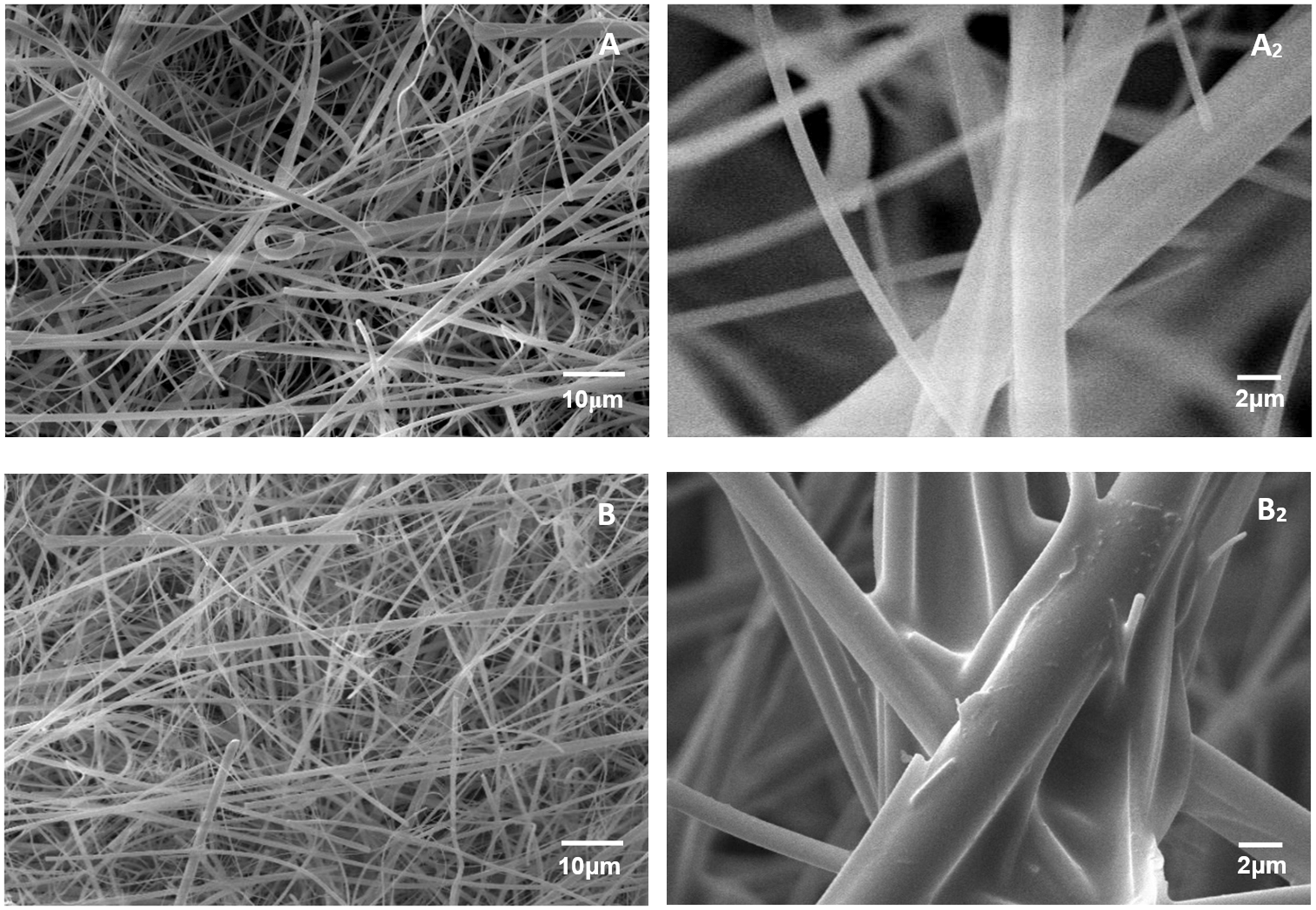
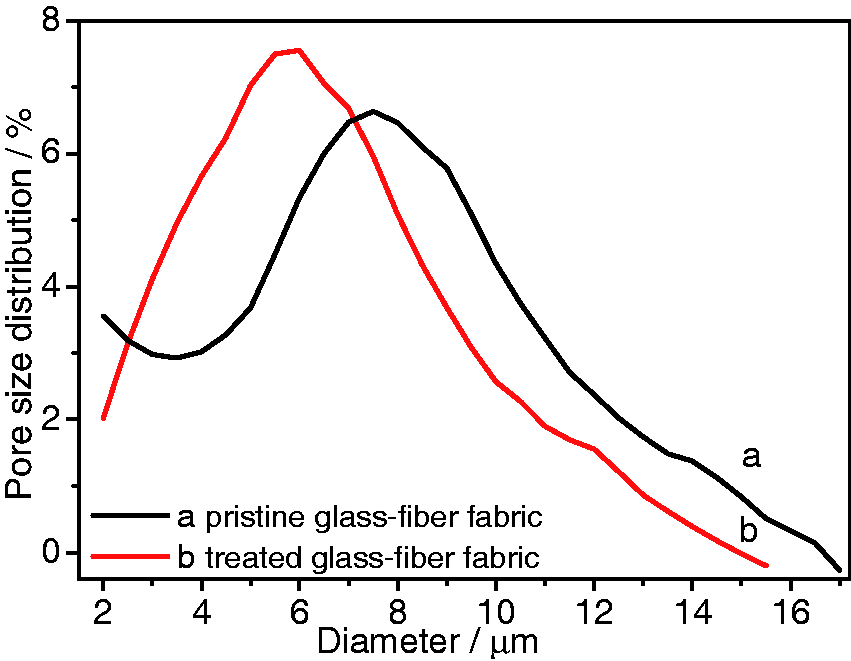
As can be seen in Figure 3, the morphology of glass-fiber filtration fabric before and after being treated is basically unchanged. But after a closer observation, copolymers can be observed at the conjuncture of the fibers. Besides, from Figure 3(a) (pristine fabric), a smooth surface of glass fiber is clearly observed. In contrast, after being treated by MTES, the cross-linking structure formed by MTES copolymer and the junction fiber can be observed from Figure 3(b). In combination with FTIR results, it is known that H3CSi(OH)3 groups condense with not only –OH groups, but also themselves to form the cross-linking structure. As indicated from Figure 4, compared with the pristine glass-fiber fabric, the average pore diameter of treated fabric is slightly less and the pore size distribution is more concentrated due to a trifling shrinkage among glass fibers of the fabric, which indicates the cross-linking structures among glass fibers formed by MTES copolymer contributing to tighten the bond and shorten the distance among fibers. The above phenomena observed are in accordance with the mechanism depicted in Figure 1. Besides, the MTES copolymers formed at the junction of fibers also act as an adhesive and therefore enhance the mechanical strength of the glass fabric. The tensile strength of the glass fabric was found to be 850.3 kN m–1, which is much higher than that of the pristine glass fabric (120.3 kN m–1).
Water (pH = 1–14) and oil contact angles
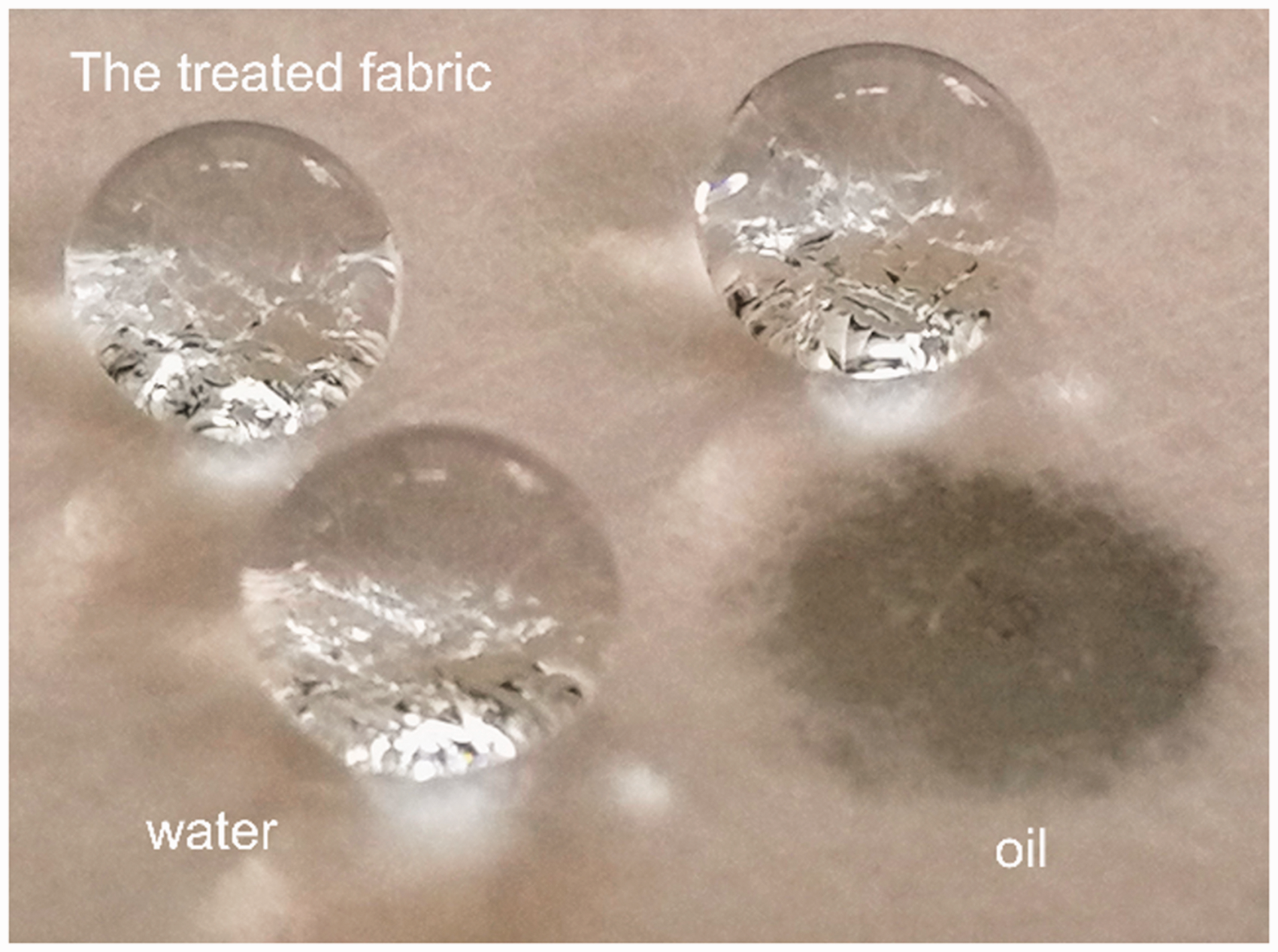
Figure 5 shows the relationship between pH value and contact angle (CA) on the MTES-treated surface. There is no obvious fluctuation of the CA values within the experimental errors over a pH range from 1 to 14. All CA values are in the range from about 140.6° to 154.2°, indicating that pH values of the aqueous solution have little or no effect on CA for as-prepared surface. This phenomenon indicates that surface, which is superhydrophobic for not only pure water but also corrosive liquids, such as acidic and basic aqueous solutions, thus can be used in wide pH environments. Figure 6 shows the picture of oil and water droplets on the treated glass-fiber fabric surface. The water droplets stay in a spherical state on the treated fabric surface for a very long time, while oil droplets (diesel, vegetable oil, and hydraulic fluid) penetrate through the fabric when they touch the treated fabric surface.
Relationship between pH value and CA on the MTES-treated surface. State of the oil and water droplets on the MTES-treated glass-fiber fabric surface.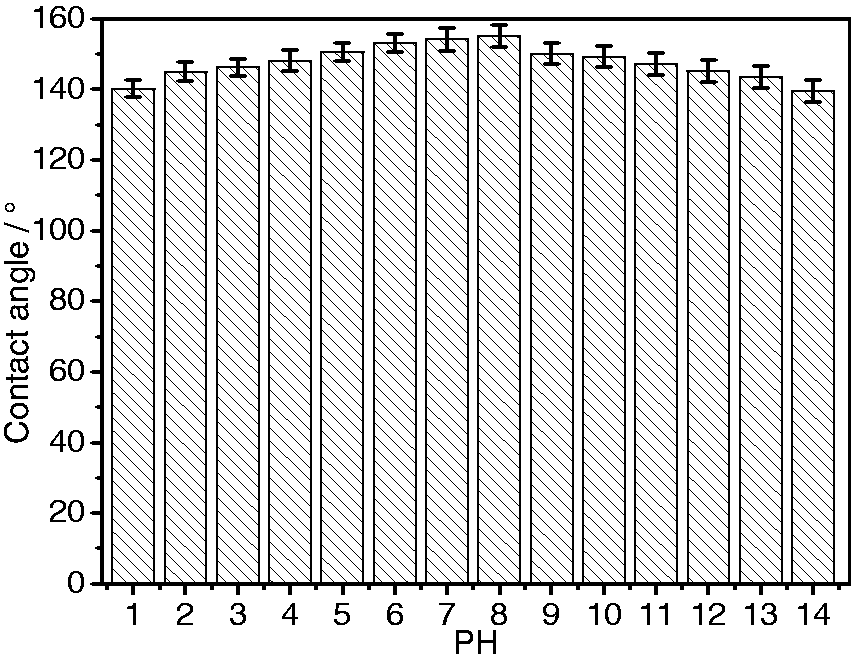
Thermal stability of the treated glass-fiber fabric
The CAs of the treated glass-fiber fabric at different temperatures were confirmed by putting samples in an oven at various temperatures for 0.5 h in ascending gradient order, then testing the water CA until the wetting behavior of the treated fabric changed obviously. The test results (Figure 7) show that the treated glass-fiber fabric is thermally stable up to nearly 400℃, and above this temperature the hydrophobicity decreases and finally turns into superhydrophilicity when the temperature reaches 500℃.
Relationship between CA and treated temperatures.
The TGA curve for the treated glass-fiber fabric is depicted in Figure 8. There is about 2.5% weight loss from 400 to 500℃, corresponding to the oxidation decomposition of –CH3 groups. The weight loss between 500 and 700℃ is likely to be caused by the decomposition of other trace elements. Combining the results of Figures 7 and 8, at 400℃ where the hydrophobicity of the treated fabric starts to decrease, the –CH3 groups start to decompose, which implies that the methyl group is the crucial factor for the superhydrophobic property of the fabric.
TGA curve for the MTES-treated glass-fiber fabric.
Water-in-oil emulsion separation efficiency
A series of surfactant-stabilized, water-in-oil emulsions were prepared to evaluate the separation capability of the fabric, and the results are shown in Figures 9 and 10.
Water-in-oil separation equipment (a) and optical microscopy of water-in-oil emulsion before (b) and after filtration (c). Separation efficiency of the treated fabric.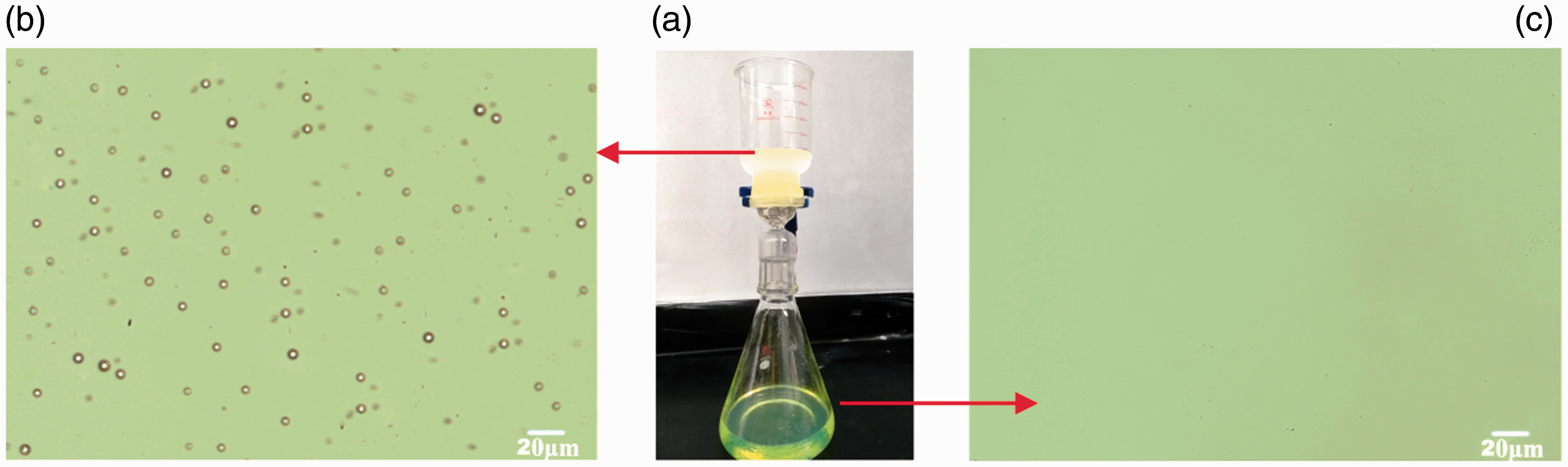
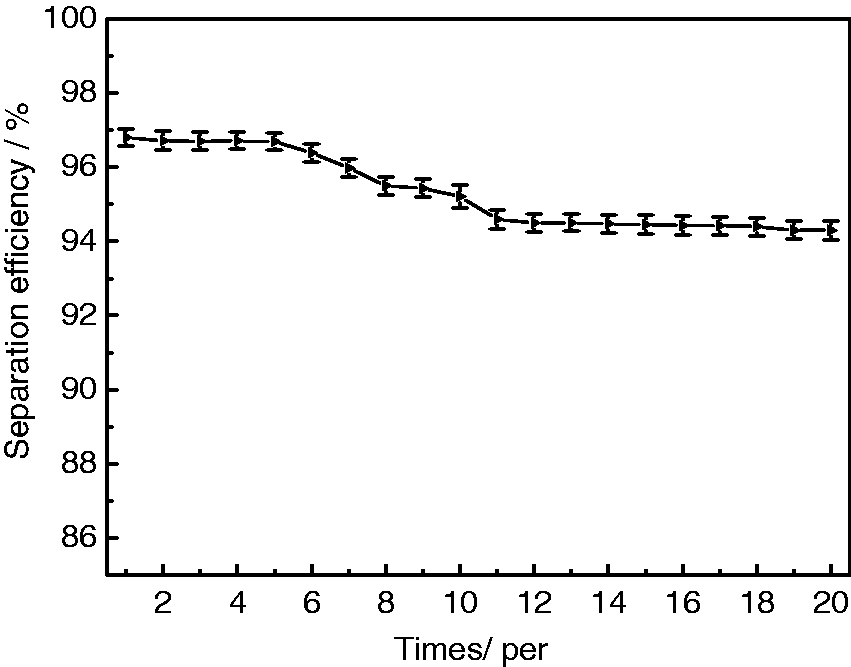
As shown in Figure 9(a), the collected filtrate (bottom) is transparent compared with the original milky white feed emulsion (top). Optical microscopy was used to examine the separation effectiveness by comparing the feed with its collected filtrate. In the feed solution, there are densely packed droplets flooding the entire view, and the size of the droplets is about 4–10 µm. No droplets are observed in the collected filtrate in the entire view, indicating the excellent separating properties of the treated glass-fiber fabric. According to Figure 4, the pore size of the treated fabric is mostly concentrated at 2–8 µm and therefore it can effectively intercept and separate the emulsified water droplets (4–10 µm). The separation efficiency is up to 96.80 wt % for diesel oil, indicating an extremely high separation efficiency of the treated glass-fiber fabric. Meanwhile, no external driving force was used during the fast separation process, only the weight of the droplets. The water-in-oil emulsion separation efficiency of the treated glass-fiber fabric for multiple cycle use is presented in Figure 10.
Figure 10 indicates outstanding reusability with nearly no flux decrease upon 20 cycles, revealing the excellent antifouling properties of this fabric for long-term use. The emulsified water separation efficiency decreases slightly (from 96.80% to 94.30%) after 20 cycles. The reason for the degradation in the separation efficiency is not because the material has deteriorated during the application, but because the fabric is washed and dried every time after water separation efficiency test, which might cause a little damage to the fabric.
Conclusion
A superhydrophobic and superoleophilic glass-fiber fabric with high water-in-oil emulsion separation efficiency is reported in this paper, produced by a simple sol–gel method. FTIR spectra prove that methyl groups from MTES are grafted onto the glass-fiber surface. SEM observation and pore size distribution tests indicate that MTES copolymers are formed on the junctions of fibers, which causes the average diameter of treated fabric to become slightly smaller. Thermal stability analysis shows that the treated glass-fiber fabric is thermally stable up to nearly 400℃, while maintaining stable superhydrophobicity and high separation efficiency under extreme conditions, including high or low temperature and strongly acidic or alkaline solutions. The above results show that under alkaline conditions, H3C-Si-(OH)3 groups from the hydrolysis of MTES condense with –OH groups on the surface of glass fiber while also carry out intramolecular condensation reactions by themselves to form MTES copolymers containing –CH3 groups which endow the glass-fiber fabric with superhydrophobicity and superoleophilicity. When the oil–liquid emulsion containing emulsified water penetrates the treated fabric, oil droplets can go through without any hindrance. In contrast, the emulsified water droplets will be blocked. Therefore, as shown in this paper, the simple preparation process, stable superhydrophobicity, and effective separation performance make the prepared fabric a promising candidate in various practical applications, such as fuel purification and commercially relevant oil/water separation.
Footnotes
Declaration of conflicting interests
The authors declared no potential conflicts of interest with respect to the research, authorship, and/or publication of this article.
Funding
The authors disclosed receipt of the following financial support for the research, authorship, and/or publication of this article: This work was supported by the Financial support from the National Key Research and Development Program of China (2017YFB0308000 and 2017YFB0308100), Science and Technology Program of Guangdong (2015B090925003), The Open Fund of the State Key Lab of Pulp and Paper Engineering (201834).