



Abstract
In this paper, the synthesis, characterization and application of a copolymer as a sizing agent obtained by the grafting of methacrylic acid on hydrolyzed potato starch were investigated. Starch hydrolysis was performed in order to reduce the average molar mass (i.e. the size of the macromolecules). Grafting of methacrylic acid on hydrolyzed potato starch was performed to obtain a product that can be effective in textile processing, for example, for sizing yarn. The grafting of the monomer has been confirmed by Fourier transform infrared spectroscopy spectra of hydrolyzed and grafted potato starch. The distribution of molar masses was determined chromatographically. The results obtained by sizing of cotton yarn with the new starch agent confirmed its higher breaking strength, elongation, abrasion resistance, reduced hairiness, better evenness, etc. Grafted hydrolyzed potato starch (almost identical to the commercial medium) exhibits better performance as a potential agent for sizing cotton yarn than ungrafted hydrolyzed starch.
It is well known that starch possess various significant properties, such as biodegradability, abundance of sources, reduced environmental pollution, low price, adhesion ability, the formation of layers, etc. For years, a large amount of native starch has been used as an agent for sizing in textile yarns and paper production. Starch is polysaccharide consisting of anhydroglucose units (each with three hydroxyl groups) linked via D-glucose bonds. The cyclic structure and numerous hydroxyl groups make the starchy material fragile and rigid, which leads to inflexible melted starch film with insufficient adherence to the fibers.1,2
Regardless of whether it is used in the textile or paper industry, adequate and sufficient adhesion to fibers or paper is considered to be the most important feature and basic characteristic for this type of application. During the process of wrap sizing in the textile industry, adhesion, among other things, decreases the hairiness of the yarn by sticking the fibers back to the yarn body, which is crucial for the later undisturbed weaved process. 3
Chemical modification provides a new chance to improve the essential shortcomings of natural starch, so current research on the improvement of the adhesion of starchy materials is directed to the application of chemical modification.1–4 Of all the modification methods, co-polymerization of vinyl monomers and starch is a very significant research field, with unlimited possibilities for improving the starch properties.
In this paper, the synthesis of a specific polymeric material, copolymer, as well as the verification of its final efficiency, is described. The study includes the acidic hydrolysis of potato starch due to the control of its molecule size, as well as its subsequent copolymerization with methacrylic acid (MA). The final product, designed as hydrolyzed starch (HS) grafted with MA, was used for sizing cotton yarn while preparing for the weaving process – fabric production.
The research objectives were primarily related to the formation of adequate, environmentally friendly and productive systems for the sizing of cotton yarn through the analysis and systematization of synthetic methods correlated with the characterization and properties of the grafts copolymer obtained from the hydrolyzed potato starch and MA. This work was inspired by sporadic examples of the use of similar monomers in the grafting process of the native starch for textile finishing, but not for yarn sizing. Starch hydrolysis leads to a decrease in the molar mass of native starch, which assumes easier solubility without bulky agglomerates in the solution, easier penetration into the yarn structure and easier removal of the raw fabric through the desizing process. Further, the monomer grafts to shorter macromolecules of starch, creating shorter or longer side branches on the main chain. This kind of product is more suitable in textile processing, particularly warp threads. Also, a newly synthesized agent requires a new approach and a new technological organization of the sizing process itself. Therefore, part of the research was related to the optimization of the technological process conditions for sizing in a laboratory sizing machine. This was done based on copolymer characteristics, especially rheology. Optimization was primarily related to the definition of individual device parameters: yarn tension between the creel with the yarn packages and sizing trough; starch temperature of the sizing agent in the sizing trough; sizing rate – passage of threads; pressure on the second pair of nip rolls for squeezing; temperature on the contact drying cylinders and the outlet moisture, etc.
Experimental procedure
Materials and methods
Potato starch 99% (CHP GmbH, Germany), hydrochloric acid p.a. 35% (Centrohem, Serbia), ethanol p.a. 99.8% (Reahem, Serbia) and sodium carbonate p.a. (LG Hemija, Serbia) were used as active agents. Potassium persulfate p.a. (Centrohem, Serbia) was used as an initiator during the grafting on MA 99% (Sigma-Aldrich, SAD) as a monomer. Sizing process was performed on 100% raw cotton ring yarn with nominal fineness 20 tex and twist 890 m–1.
Procedures
Hydrolysis procedure
Starch hydrolysis was carried out in an aqueous solution of 1 M hydrochloric acid at 60℃, adding the starch with vigorous mixing. 5,6 The reaction product was precipitated in ethanol (100 ml) and neutralized with a dilute solution of 1% sodium carbonate, then washed and dried in an electric drying chamber at 60℃ for 3 h. The sample designation is HS.
Grafting-copolymerization procedure
The aqua solution of HS (10 g) was heated at 50℃ for 15 minutes over a water bath. Subsequently, 5 g of MA was added with vigorous mixing, and the initiator was added at the concentration of 1% (relative to the weight of starch monomers).7,8 The temperature was maintained at 50℃ for 120 min with reflux. The reaction product was precipitated in ethanol (100 ml). The monomers were removed by washing the precipitate with ethanol at the room temperature for 30 min. The homopolymer of MA was removed from the product by acetone in the Soxhlet apparatus. 9 Finally, the white precipitate was dried in an electric dryer at 60℃. The designation of the sample is GHS (grafted hydrolyzed starch).
During copolymerization, the formed grafted branches bind with the starch backbone only via oxygen, since graft copolymerization is initiated by expelling the active hydrogen atom from the starch hydroxyl group (Figure 1).
2
Methacrylic acid grafting on hydrolyzed starch.
Applying the sizing agent on yarn-warp
Three different concentrations of GHS, 10%, 15% and 20% were used for impregnating the warp. The application was carried out on a specially designed laboratory device for this purpose, which has been previously detailed. 10
The optimized sizing conditions at this laboratory level were as follows:
yarn tension between the creel with yarn packages and sizing trough, 42 cN; starch temperature in the sizing trough, 85℃; sizing rate, ≈3 m/min; pressure on the second pair of nip rolls for squeezing size solution, 1.5 N/cm2; temperature on the contact drying cylinders, 130℃; output moisture, 5.5%.
Desizing
Desizing of the starched yarn samples was carried out using a non-ionic detergent, Lavan NH (Textilcolor, Switzerland) at a concentration of 2 g/l at a ratio of 1:30. After its aqua solution was heated up to 40–50℃, a sample of the starched yarn was added and intensively treated for 30 min at the same temperature. Finally, the sample was water rinsed and dried in air.
The following measurements methods were used.
The efficiency of starch hydrolysis and grafting with MA
11
:
yield of starch hydrolysis, %: grafting percent, %: grafting yield, %: percent of grafting efficiency, %: conversion of monomer to polymer, %:
where w1 is the weight of hydrolyzed starch, w0 is the weight of native starch, w2 is the weight of grafted starch, w3 is the weight of the used monomer and w4 is the weight of the residual monomer.
The mean molar mass and distribution of molar masses were determined using the GPC Agilent 1100 Series gel permeation chromatograph, with the use of a differential refractometer (refractive index detector (RID)) 1200 Series as a detector. The column used was a Zorbak PSM 300, 250 mm × 6.2 mm, 5 µm, with a nominal range of molar masses 3×10³ – 3 × 10⁵ g/mol. Redistilled water was used as an eluent, with a flow rate of 1 ml/min. The column was thermostated at 25℃ and the injected volume of the sample solution was 20 µl.
The sizing and desizing degree (%) are determined by weight difference. Breaking strength and elongation of yarn (ISO 2062 standard) were evaluated by using the dynamometer Statimat M company Textechno; yarn unevenness (ISO 16549 standard) using Keisokki apparatus; hairiness of the yarn (ASTM D 5674-01 standard) using Zweigle G 565 apparatus; and wear-resistance of yarn using Zweigle G551 apparatus. The Fourier transform infrared spectroscopy (FTIR) spectra were recorded with a Michaelson Bomen MB-series spectrophotometer, using the KBr pellet (1 mg/100 mg) technique. The surface modifications caused by the treatment were visualized by scanning electron microscopy (SEM) (Jeol, JSM–6610LV, Japan). Viscosity and its stability were determined by a rotational viscometer, Visco Basic Plus series.
Experimental results
Copolymer characterization
Parameters of hydrolysis and grafting methacrylic acid on hydrolyzed starch

± values are SD of individual measurements.
GHS: grafted hydrolyzed starch; HS: hydrolyzed starch.
The table also contains the standard deviation (SD), as an absolute measure of dispersion. In this particular case, the small SD ranges from 1.8% to 3.6% for all tested parameters, indicating that the displayed results are satisfactory (the number of samples per tested parameter was five).
Synthesis of poly(methacrylic acid) and starch copolymers with a high percentage of grafting was carried out in a similar fashion. 13 The influence of temperature (55–75℃), concentration of MA monomer (0.775–1.452 mol/dm 3 ), quantities of potassium persulfate as an initiator (0.00075–0.0025 mol), reaction time (30–270 min) and the nature and amount (0.001–0.005 mol) of amine activator to the percentage of grafting were investigated. The percentage of grafting increases with temperature and decreases, as expected, with the decreasing concentration of monomers. An exception was the reaction at 75℃, where the grafting percentage was lower than that for the reaction at 70℃. This anomaly is the result of a very fast poly(methacrylic acid) polymerization at 75℃, so poly(methacrylic acid) cannot be grafted on starch at higher concentrations. A large part of the poly(methacrylic acid) remained in the form of a homopolymer, which could not be stemmed to starch. 13
MA grafting on HS was confirmed by absorption vibrations in the FTIR spectrum (Figure 2). The spectrum of GHS have exhibited ν(C = O) stretching vibration at 1716 cm–1, which could not be found in the spectrum of HS. Both spectra possess ν(OH) stretching vibration (strong and very broad), which suggests intermolecular H-bonded hydroxyl functional groups. The band is wider and bathochromically shifted in the spectrum of GHS (3410 cm–1), which confirms the grafting of MA on HS. The spectrum also contains an appropriate deformation vibration δ(OH) at 1559 cm–1. The absorption band at 2927 cm–1 can be assigned to νas(CH2) asymmetric stretching vibration, while an appropriate bending vibration at 1457 cm–1 confirms the presence of the CH2 group.
13
Also, the new CH3 vibration can be found in the spectrum of GHS as stretching ν(CH3) at 2876 cm–1, and as a bending one at 1419 cm–1.
Fourier transform infrared spectroscopy spectra of hydrolyzed starch (0) and hydrolyzed starch grafted with methacrylic acid (1).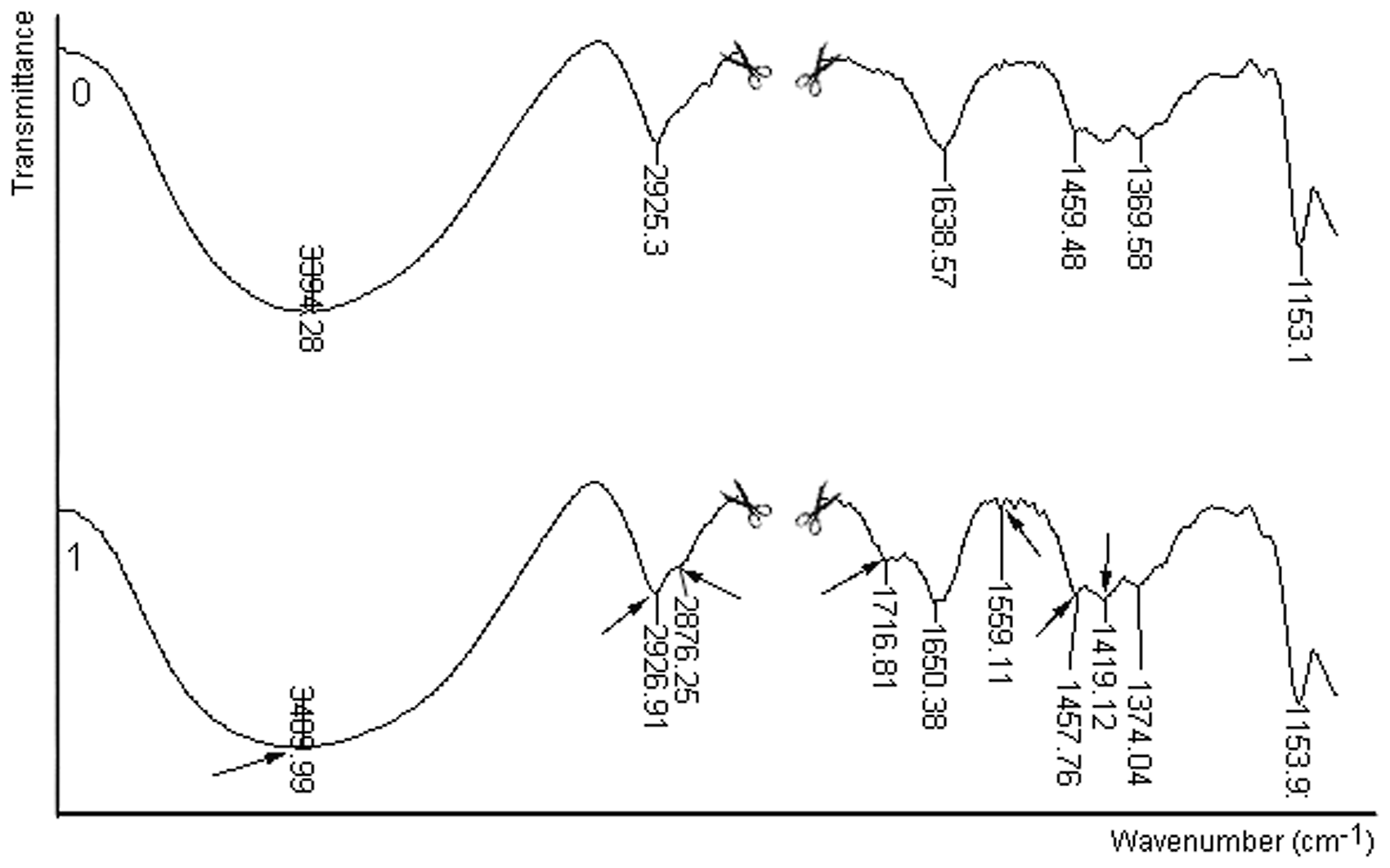
Molar masses of the samples

GHS: grafted hydrolyzed starch; HS: hydrolyzed starch; Mn: number average molecular mass; Mw: weight average molecular mass; Mz: z-average molecular mass; D: polydispersity index (degree), D = Mw/Mn.
Higher values of Mn, Mw and Mz molar masses are due to a higher fraction of higher molar masses. The results are consistent with known facts that molecules of natural polymers, for example, polysaccharides and practically all synthetic polymers, have different sizes. These polymers are non-uniform or polydispersed.14,15
All the samples tested exhibit Mw > Mn, which makes them polydispersive systems. The higher the difference between Mw and Mn, the greater the polydispersity of the system. It is known that all synthetic polymers are polydispersed as follows: Mz > Mw > Mn.
Cotton yarn sizing
Viscosity of grafted hydrolyzed starch at the different concentrations

± values are SD of individual measurements
GHS: grafted hydrolyzed starch.
As the concentration of the starch agent decreases, the viscosity decreases, which is expected. The influence of the temperature of the copolymer solution on viscosity is also evident. The viscosity of the copolymer solution grows from 40℃ to 60℃, but eventually starts decreasing at a higher temperature (80℃) at the same concentration, which is also expected. Small viscosity differences indicate that the copolymer with shorter chains is more soluble than HS.
The lower average deviation of the results from the arithmetic mean (minimum SD = 1.6; maximum SD = 2.3) for the tested viscosity parameters at different temperatures confirms the acceptability of the results without much variation around the mean values. In this particular case in determining the SD, the number of samples, according to the same test condition for the viscosity parameter, was 10.
It is known that unstable sizing solutions are unsuitable for fine cotton yarns due to unequal sizing and the formation of great hairiness. This means that starch copolymer solution, as a sizing agent for cotton yarns, should have a stable viscosity after storage over different periods. The viscosity of the potential sizing agent solution was investigated by heating at 95℃ for 7 h. The viscosity measurements were carried out every hour. 16
The viscosity of copolymer solutions is presented in Figure 3. The stability of GHS viscosity is 92.4%. This result confirms that the copolymer solution has a good stability of viscosity and it can be used successfully for sizing fine cotton yarn. The stability of the ungrafted HS is 75%.
Viscosity variation of 10% copolymer solution during storage (the horizontal line represents the mean copolymer viscosity).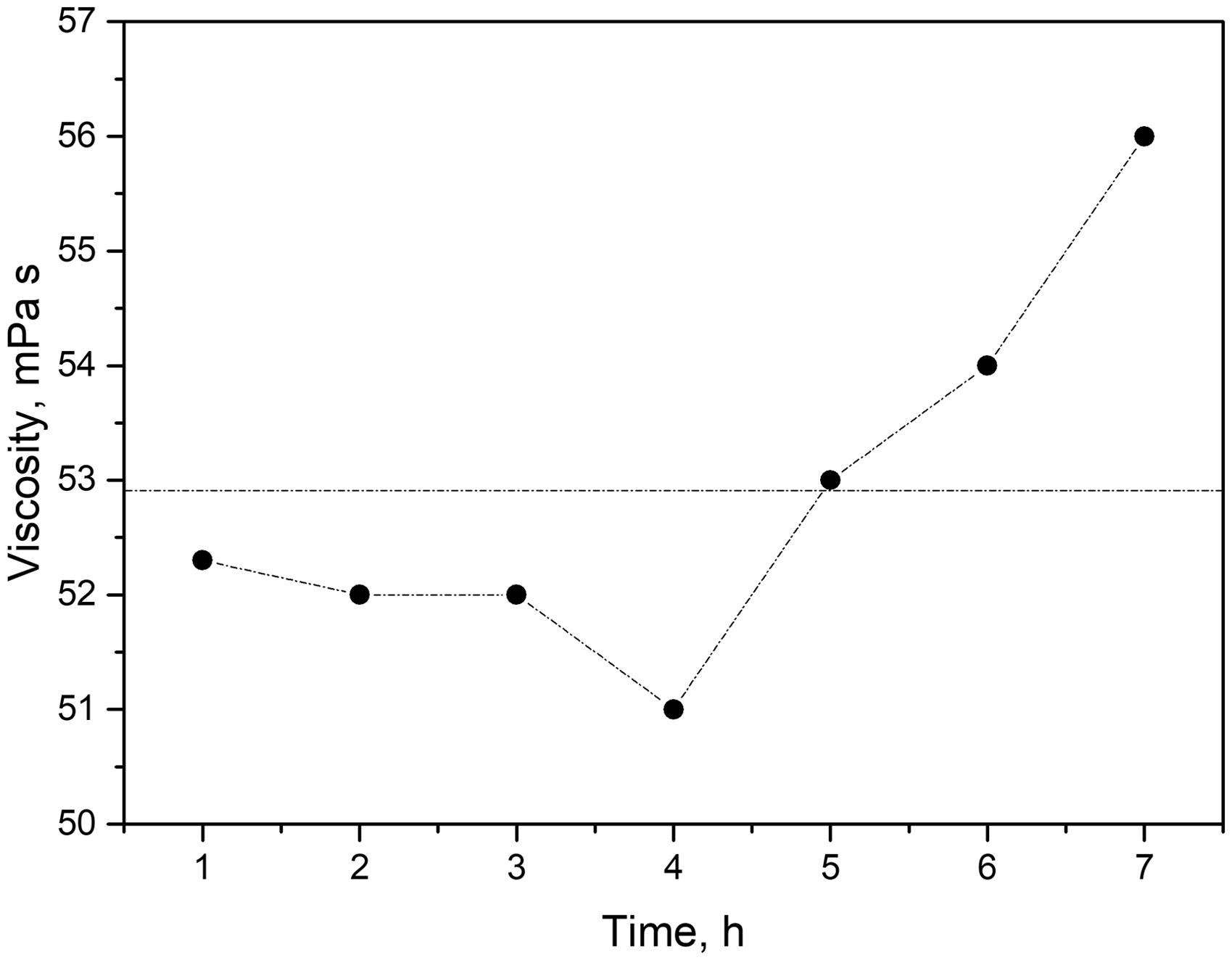
In a similar study of MA grafting on potato starch and hydrolyzed potato starch, the specific viscosity was also taken as a measure of the starch molecule size. 6 There is an inverse relationship between the copper number and the specific starch viscosity. The higher specific viscosity implies a higher number of molecules and, therefore, lower solubility. The grafting reduces the starch molecule size, which is unusual, even if it is assumed that starch passes partial oxidation under the influence of the initiator during the grafting. It can be assumed that the presence of poly(methacrylic acid) grafted molecule chains in the molecular starch structure causes profound changes in starch behavior, especially to aqueous solutions. The MA chain of the molecule acts as a solvent based on its large sorption of the water molecule. In addition, the ability of the molecular association during the measurement seems to be minimal in the case of the copolymer. It seems that the poly(methacrylic acid) chain (a) acts as a solvent, (b) releases the structure of starch and (c) prevents the possible association of the copolymer molecules. The combination of those effects dominants over the expected higher molecules due to the introduction of poly(methacrylic acid) into the molecular structure of starch.
Therefore, the properties of the grafting agent solution will depend on the viscosity. As the viscosity increases, the surface coating is higher, and vice versa.
The higher temperature usually means an automatically lower viscosity, which is not the case with the applied starch agent. The higher temperature also causes faster movement of the sizing agent molecules, as well as a greater degree in overcoming the adhesion force. It also provides better adsorption of the sizing agent for fibers inside the yarn.
Considering all of the above, it can be suggested that an effective sizing of the yarn depends primarily on the state of the starch (concentration, viscosity, temperature, composition, mechanical start), as well as the parameters of the sizing machine (tension, cylinder pressure, drying mode, temperature). The interaction of these listed parameters, antagonism or synergism, will determine the effectiveness of sizing.
Characteristics of the sized cotton yarns
GHS: grafted hydrolyzed starch; HS: hydrolyzed starch.
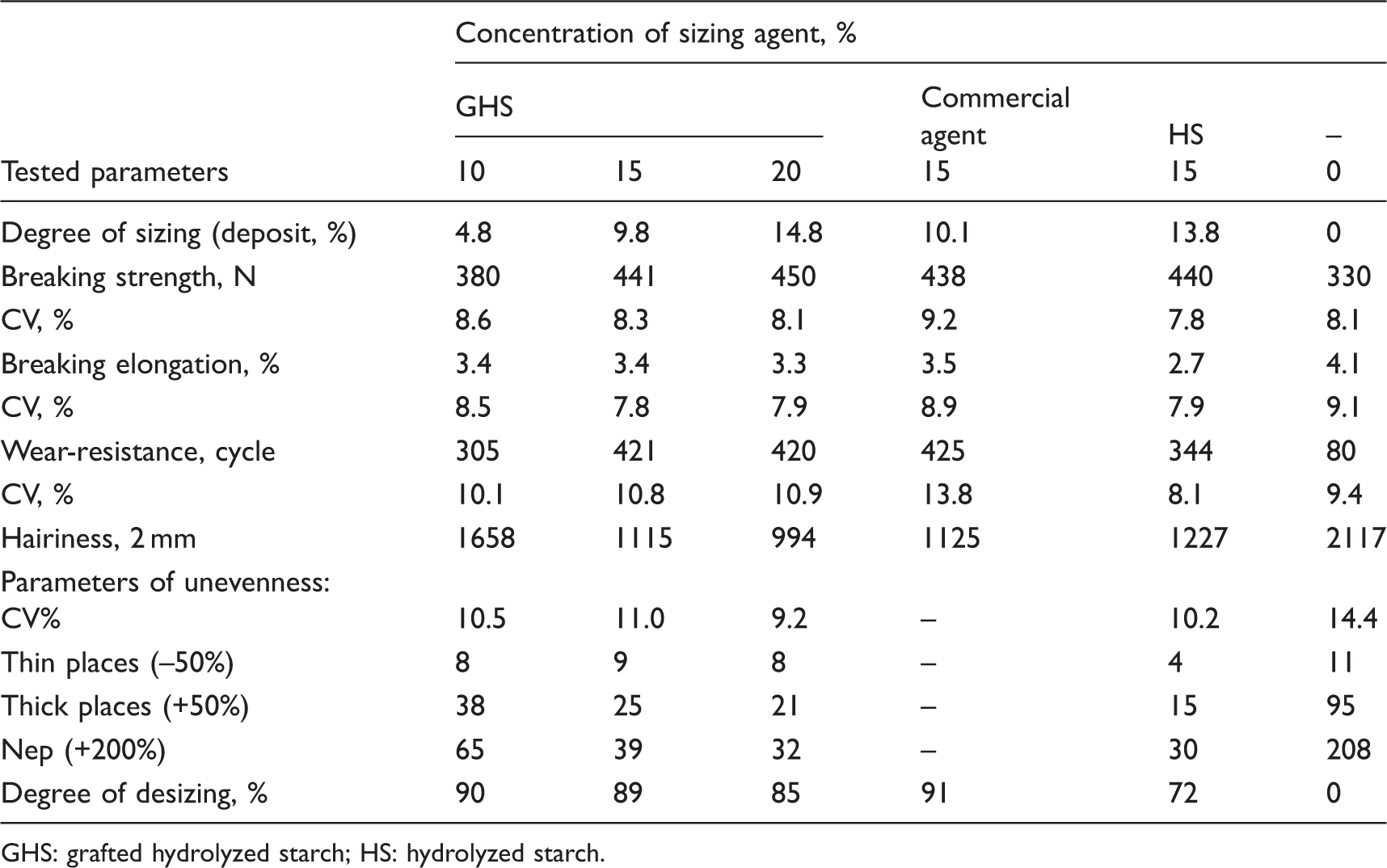
The treatment with higher concentration increases the sizing degree. Also, if the concentration of sizing agent increases, then the weight increases, too. A commercial sizing agent (Tuboflex PVA 80+Tubowax 24) leaves a higher amount of chemicals on the yarn at the same concentration, compared with the copolymer, but less than that with HS.
The results show that the sizing process increases the breaking strength of the analyzed yarn with respect to the unsized one. At the same time, as a result of sizing, the elongation at break is reduced, because sized yarns have become somewhat more rigid in comparison to the unsized ones. This reduction in the elongation at break represents the disadvantage of the sizing. 12
Compared to the raw sample, yarn treatment with 15% HS increases the breaking strength, but less than treatment with 15% GHS. Also, the HS sizing agent provides yarn with the lowest breaking elongation. Treatment with 20% GHS has the maximum breaking strength value, compared to the raw sample, but it is only slightly higher than that the yarns treated with 15% GHS. Commercial agents have similar results for breaking strength and elongation, as well as GHS.
It can be expected that the treatment with sizing agents at higher concentrations will cause higher breaking strength. This can be achieved with kinetic macromolecule arrangement of grafted starch along the fibers on the surface and inside the yarn. It is necessary to obtain the precise viscosity of the solution with accurately defined flow energy, as well as the exact moment of tension appearances, which ultimately leads to the most favorable arrangement of the sizing agent macromolecules.
Also, one of the basic aims of the sizing process is the formation of smooth surfaces of starchy yarns in order to reduce their friction with the working parts of the loom, which can come into contact with the wrap during the weaving process. The increased wear-resistance of the yarn, after sizing, can be explained by the direct influence of the active components. The GHS concentration of 15% indicates a good but not the best result in terms of wear-resistance, since the commercial starch agent produces a slightly better result. However, considering the higher CV, in the case of commercial starch, the authors confirmed their similar behavior. A higher GHS concentration yields a weaker result, due to weaker elasticity or thickening of thicker layers of the sizing agent.
As is expected after sizing, the yarn hairiness (measuring zone 2 mm) decreases, a smooth yarn is created, so the friction forces are reduced. This is a result of the contact between yarn and the back beam (platen), rods, heddle eyes and reed comb. It is known that due to reduced friction, the overall yarn tension in the weaving process is reduced, as well as the number of warp breaks. An increase in the amount of the starch agent causes a reduction in hairiness.
The test of uneven parameters showed that after sizing, the yarn core becomes slightly uniform in thickness, which is the consequence of the influence of the starch-based coating on the basis in the sizing process. The evenness of the yarn depends heavily on the process, as well as the number of fibers in the cross-section of the yarn. When it comes to irregularity, it is usually defined as thin and thick places as well as neps per 1000 m of yarn. The examination of evenness of yarn fineness (thickness) is of fundamental significance because of its impact on other quality parameters of the yarn and the final product. The fineness of the yarn is even if its weight is constant at the same length units. The unevenness of the yarn, expressed by CV%, practically decreases with the increase of sizing agent concentration. Also, as the concentration of the sizing agent increases, the number of thin and thick places, as well as the number of neps on the yarn, decreases compared to the unsized yarn.
While sizing requires the sizing agent to have a satisfactory degree of stickiness, desizing requires starch that can be easily removed in order to save energy and to facilitate the processes that follow (finishing processes).
The process of desizing yarn, in this case, is a process of washing the starch yarn in order to test the efficiency of removal and cleaning the applied sizing agent.
A slight change in weight is noticeable after the desizing in relation to the change in the sizing process (less is removed than applied to the yarn). This is probably due to the behavior of sizing agent macromolecules observed in relation to rheological parameters, adhesion forces and the intensity of mechanical start-up during the disinfection.
The best result for the degree of desizing is given by the yarn treated with a commercial sizing agent, (about 2% better than the processing of the yarn with GHS), at the same concentration of the sizing agent.
Statistical analysis of the results, via a CV, which includes the results of the research with the aim of qualifying the significance of the obtained results, is shown in Table 4. The visible larger variation of this coefficient for the breaking strength and the elongation, as well as the wear-resistance of the yarn, suggests that the results can be taken with a certain degree of caution. On the other hand, the CV has similar values for raw, unsized yarn and sized yarn (breaking strength: CVGHS20% = 8.1%; CVraw = 8.1%), which suggests that the sizing process does not affect the original unevenness of the raw yarn for the parameters tested, even in some cases improving it (breaking elongation: CVGHS10% = 8.5%; CVGHS15% = 7.8%; CVGHS20% = 7.9%; CVraw = 9.1%).
Micrographs of cotton yarn-fabrics in the sizing regime are shown in Figure 4. A micrograph of the surface of an unsized yarn with a characteristic relief structure due to a greater number of threads is also shown (Figure 4(a)). The surface is clean with some of the scattered fibers around the basic parallelized structure. When treating GHS with a 15% active ingredient, Figure 4(b), a calmer structure with fibers glued together and a parallel structure in the direction of the longitudinal axis of yarn are noticeable. The presence of a sizing agent leads to greater adhesion of the protruding fibers around the body with greater adhesion. The appearance of the desized yarn, shown in Figure 4c, shows the individual fibers with retained deposits of the copolymer – a sized agent that was left behind after the washing up – desizing.
Micrographs of unsized (a), sized (grafted hydrolyzed starch 15%) (b) and desized yarns (c).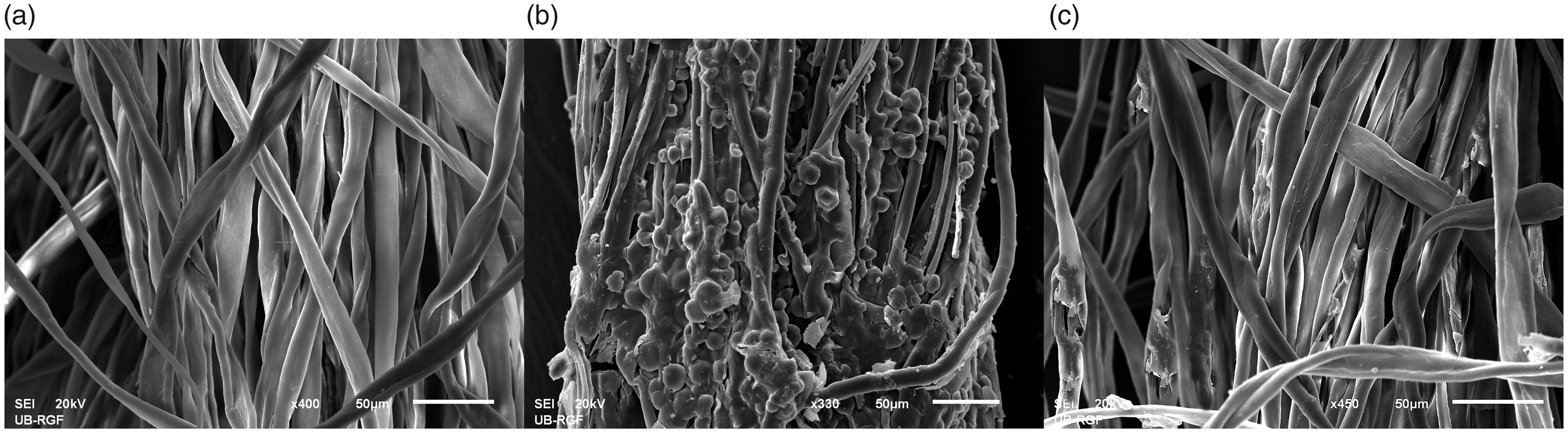
One interesting phenomenon was observed during the investigation. It was found that the weaving process is not influenced by extreme opposite changes of the yarn properties (based on a practical test on a Picanol Omni breaks 4P). If relevant properties of yarn were moderately improved, then the newly made product will have much better quality and it will endure against all stress forces produced during the time of weaving. It can be said that one extremely improved property means also one extremely poor property, which is not acceptable at the macro level. For example, a large increase in breaking strength of the yarn requires a higher coating of sizing agent, but it also produces greater brittleness and less elasticity, which is not good for the weaving process. This can be applied to other properties as well.
Conclusion
Copolymerization of the vinyl monomer can have a significant influence on the properties of native starch and possible application in yarn sizing processes. This kind of HS was used because starch granules were broken up into lighter molecular fragments after hydrolysis, with a yield of over 84%. Considering the results of yield, percentage and efficiency, the grafting of MA on starch was successful. FTIR spectra of hydrolyzed and grafted starch confirm that grafting of the monomer was successfully performed. The chromatographically determined molar mass distribution suggests that the lower value of the polydispersity index of the copolymer means greater uniformity of the grafted macromolecules per molar masses.
The obtained results also show that the HS grafted with MA can be used as a sizing agent for cotton yarn. The treatment of the yarn with GHS 15% gives the best results in terms of savings and side effects.
The process of desizing should lead to the removal of the sizing agent from fibers, preferably by ordinary washing in hot water, due to the cost and facilitating subsequent processing in the finishing stage. The applied modified sizing agent, GHS, meets this requirement, since it can be easily removed by ordinary washing with detergent.
Statistical parameters, SD and CV, which determine the validity of test results of this study, are generally satisfied, that is, there is a weaker scattering, and it can be concluded that the results for the parameters that define the quality of the starched yarn are satisfactory and reliable.
Additional research, with the introduction of different procedures (sizing with the pre-soaking, addition of different additives, etc.) or by varying the treatment conditions (temperature, passage speed, degree of squeezing, etc.) and with new agents (new monomers for starch grafting, mixture of natural and synthetic agents, etc.) can contribute to improving the processing effects in terms of acceleration, savings and process simplification.
Footnotes
Declaration of conflicting interests
The authors declared no potential conflicts of interest with respect to the research, authorship and/or publication of this article.
Funding
The authors disclosed receipt of the following financial support for the research, authorship, and/or publication of this article: We would like to thank Prof. Stana Kovačević and the University of Zagreb, Faculty of Textile Technology, Croatia (Grant No. TP2/18), on financial support for the publication of this article.