




Abstract
An investigation of green and sustainable impregnation of viscose substrate was performed for the first time by employing nicotinamide as a drug model for manufacturing drug-loaded cosmetic textiles in supercritical carbon dioxide fluid. The effects of impregnation time, operating temperature, pressure, and cosolvent on the drug loading capacity (DLC) of nicotinamide into viscose fabric were explored. The results show that the DLC increased gradually with impregnation time up to an equilibrium value at 60 min. The DLC significantly increased with temperature from 40 to 80℃ at a system pressure higher than 12 MPa, accompanied by a decrease at a higher temperature. However, a smaller effect of the system temperature on the DLC was also observed at a system pressure lower than 12 MPa. DLC was much higher at 40℃ when the operating pressure was 10 or 12 MPa. Different improvements for the DLC were also achieved with different system pressures at various system temperatures, especially at operating pressures higher than 12 MPa. While DLC initially increased with pressure, it decreased afterwards when the operating temperature was 40℃. Moreover, the results from different cosolvents show that the DLC was evidently enhanced with the dosage of acetone as well as methanol in supercritical carbon dioxide fluid, whereas an overall tendency to decrease was also encountered for the utilization of ethanol. Furthermore, impregnation was characterized and validated by scanning electron microscopy, Fourier transform infrared, X-ray diffraction and elemental analysis.
Supercritical carbon dioxide (SCCO2) has low polarity, good infiltration, is non-toxic and non-ignitable, has gas-like mobility and is a liquid-like carrier. 1 Its critical pressure is 7.383 MPa and its critical temperature is 31.06℃, 2 and is an environmentally friendly solvent that can be used instead of water and organic solvents. It enables the recovery of a final impregnated implant free of any solvent residue just by depressurization after impregnation. 1 SCCO2 has been applied to a lot of fields, such as through the impregnation of small molecules (such as dyes, 3 drugs, 4 organic metal complexs 5 and so on) into polymers. Saus et al. 6 reported the dyeing of poly(ethylene terephthalate) and other synthetic materials, and factors influencing dye uptake and levelness with SCCO2 as the dyeing media. Costa et al. 7 reported that commercial silicone-based hydrogel contact lenses (Balafilcon A) could be impregnated with two anti-glaucoma drugs (acetazolamide and timolol maleate) using a discontinuous supercritical solvent impregnation methodology. Yu et al. 8 reported a green and simple approach for synthesis of cellulose/TiO2 hybrids through the combination of SCCO2-assisted adsorption and impregnation into cellulose fibers. Zaidi et al. 9 reported that an SCCO2 process of dispersion of multi-walled carbon nanotubes (MWCNTs) into epoxy resin had been developed to achieve MWCNT/epoxy composites (CECs) with improved mechanical, thermal and electrical properties.
Clothing has several functions, from primarily being used for protection against environmental influences to being central to style and fashion. Textiles are pivotal in functioning as our ‘second skin’, and their type and function are continuously evolving. 10 In recent years, in attempts to lead a more natural and healthier life, cosmetics have been found in applications in the textile field. A new sector of cosmetic textiles called cosmetotextiles has been introduced and a number of commercial cosmetotextiles products are currently available on the market. On contact with the human body and skin, cosmetotextiles are designed to transfer an active substance for cosmetic purposes. The principle is achieved by simply imparting cosmetic and pharmaceutical ingredients into the fabric of clothing so that, with the natural movement of the body, the skin is slowly freshened and revitalized. 11 Usually, large amounts of cosmetic ingredients must be transferred to the skin while the cosmetotextile is being worn but, on the other hand, as little as possible should be lost when the textile is washed. 10 The current methods usually focus on microencapsulation technology,12–14 which can hold a large amount of active ingredients and protect the active ingredients from hazardous environments such as those causing degradation by oxidation, or polymerization during drying and/or heat setting processes and garment storage. However, this technology also has a weakness in that the shell carrying the active ingredients, for example cyclodextrin, must be conjoined with the fabric or fibre by chemical treatment, and sometimes results in residual solvent and the production of harmful components. Meanwhile, the fabrics treated by microencapsulation technology are worse than untreated fabrics with regard to how they feel when they touch the skin. Therefore, the identification of a more environmentally friendly way to produce cosmetotextiles, that does not affect efficacy and touch, would be a promising development.
Regarding dyeing and drug loading, SCCO2 can load cosmetics into textiles with supercritical fluid impregnation (SSI) for cosmetotextiles. Cellulose is environmentally freindly, 15 renewable 16 and skin friendly. 17 Cosmetics loaded into cellulose can be absorbed percutaneously rather than per os, which is more economical and promising compared to SCCO2 dyeing. Thus, cosmetotextiles can be processed by SSI, making the fabric itself a shell or container like cyclodextrin. 18
The amount of cosmetic that can be loaded into the fabric, namely the drug loading capacity (DLC), is critical for cosmetotextiles. The DLC is affected by the solubility of the drug and its interaction with the polymer,19,20 which is also closely related to the operating conditions of the SSI process.21,22 This paper will focus on the supercritical impregnation of viscose substrate by employing nicotinamide as a model drug for the manufacture of drug-loaded cosmetic textiles in SCCO2. Viscose fabric and nicotinamide are used as the polymer matrix and model cosmetic, respectively, to investigate the loading of nicotinamide into viscose fabric via an SSI process. The effects of the operating conditions and cosolvent on the SSI process are examined. Furthermore, the fundamental factors of loading capacity are explored.
Materials and methods
Materials
Viscose fabric (a woven, with a fabric weight of 204.7 g m−2) was provided by Shandong Woyuan New-type Fabrics Co. Ltd. Nicotinamide was purchased from J&K Co. Ltd. Pure carbon dioxide gas (purity ≥ 99.8 %) was supplied by Chengxing Industrial Gas Supply Co. Ltd (Suzhou, P. R. China). Methanol, ethanol and acetone were of analytical grade and available commercially (supplied by Sinopharm Chemical Reagent Co. Ltd, Beijing, P. R. China).
Impregnation of nicotinamide in SCCO2
The apparatus used for the SSI process is described in detail elsewhere23,24 and is similar to that used in SCCO2 dyeing. The nicotinamide uptake process was begun by circulating the fluid and dissolved nicotinamide with a request time ratio of fluid circulation to static dyeing (Rtime) of 0.10. The viscose fabric was wound around a cylinder shape made from metal mesh in order to extend the surface in contact with the SCCO2 bath. The weight of the viscose fabric was between 5.0 and 6.0 g. The amount of nicotinamide introduced in the autoclave was 5% of fabric weight, which allowed us to have a saturated bath at system temperatures ranging from 40 to 90℃, system pressures ranging from 8 to 20 MPa and impregnation durations ranging from 30 to 120 min in SCCO2, respectively. After each treatment time, the system was expanded to atmospheric pressure, and the viscose fabric was removed and used for further analysis. The whole batch system was completely cleaned after every run; other procedures were described in our previous report. 23
Evaluation of DLC
Nicotinamide dissolves easily in ethanol and the amount of loaded nicotinamide on the viscose fabric was evaluated by extraction with ethanol. When the temperature was 105℃, the liquids dropped steadily. The amount of nicotinamide loaded into viscose fabric can be totally extracted in 6 h. Then, viscose fabric extracted was dried at 105℃ for 4 h and placed on a dry plate for 24 h to obtain the weight.
The construction of a calibration curve for the determination of DLC was carried out by proper standard solutions of nicotinamide in ethanol. Its absorbance was monitored on an ultraviolet–visible spectrophotometer (TU-1810, Beijing Purkinje General Instrument Co. Ltd, Beijing, China) at wavelengths between 190.0 and 400.0 nm. Then, the calibration curve was constructed and regressed in a linear fashion with characteristic absorbance at 262.0 nm, as shown in Figure 1(a) and (b) and equation (1):
The violet spectra (a) and calibration curve (b) for nicotinamide determination from the standard solution in a series of concentrations of nicotinamide.

By knowing the weight of the extracted viscose fabric and the concentration of the extracting solution, it is possible to evaluate DLC, which can be calculated according to the following equation (2):

Characterization of viscose fabric
The surface morphology of viscose fabric was followed by environmental scanning electron microscopy (SEM, */Quanta250) with an acceleration voltage of 15.0 kV at 5000× magnification. Before investigation, viscose fabrics were sputtered with gold on an ion sputter at 10.0 mA for 60.0 s. Viscose fabrics, before or after being subjected to SCCO2 media at different conditions, were also analyzed on a Fourier transform infrared (FT-IR) instrument (Nicolet 5700, Thermo electron Co. Ltd, USA) with a traditional KBr pellet sampling method under identical measurement conditions. The transmittance of the infrared in individual powder samples of viscose fabric was recorded from 400.0 to 3800.0 cm−1 at a resolution of 2.0 cm−1 for infrared spectra. The element percentage composition of each viscose fabric was analyzed with an elemental analyzer (Vario EL III, Germany) according to the general rule of JY/T 017-1996.
Results and discussion
The effect of the SSI process on the DLC
SSI is widely applied to drug-loaded polymers in medical fields,21,25–27 which is similar to textile dyeing in principle. Firstly, the dye or drug dissolves in SCCO2 and diffuses to the polymer interface through molecular movement or thermal motion, and is then absorbed on the surface or interior of the polymer through intermolecular forces, which include Van der Waals forces and hydrogen bonds. The Van der Waals forces consist of the direction of force, the induced force and the dispersion force, thus forming a chemical potential difference or density difference inside and outside the polymer, producing a diffusion osmotic pressure and driving the dye or drug into the interior of the polymer, which achieves the adsorption of the dye or drug inside the polymer. Finally, the pressure is released and SCCO2 transforms into CO2 gas, escaping from inside the polymer; the dye or drug stays on the surface and in the interior of the polymer in the state of a chimera or through intermolecular forces. Through these steps, the DLC changes with operating conditions including impregnation time, temperature, and the pressure of CO2 in the impregnation vessel. Moreover, the cosolvent used can improve the solubility of solutes under the same operating conditions. So, the dosage and variety of the cosolvent must be taken into account.
Effect of impregnation time on the DLC
The impregnation time is a key factor in the SSI process. The effect of the impregnation time on the DLC is shown in Figure 2, where the impregnation temperature ranged from 40 to 70℃ and the impregnation pressure from 8 to 20 MPa. While the impregnation time was prolonged, DLC increased and slowly approached a definite value, which was based on the partition equilibrium of the drug between the polymer and fluid phases.28,29
Effect of impregnation time on the drug loading capacity of viscose fabric in the supercritical fluid impregnation process.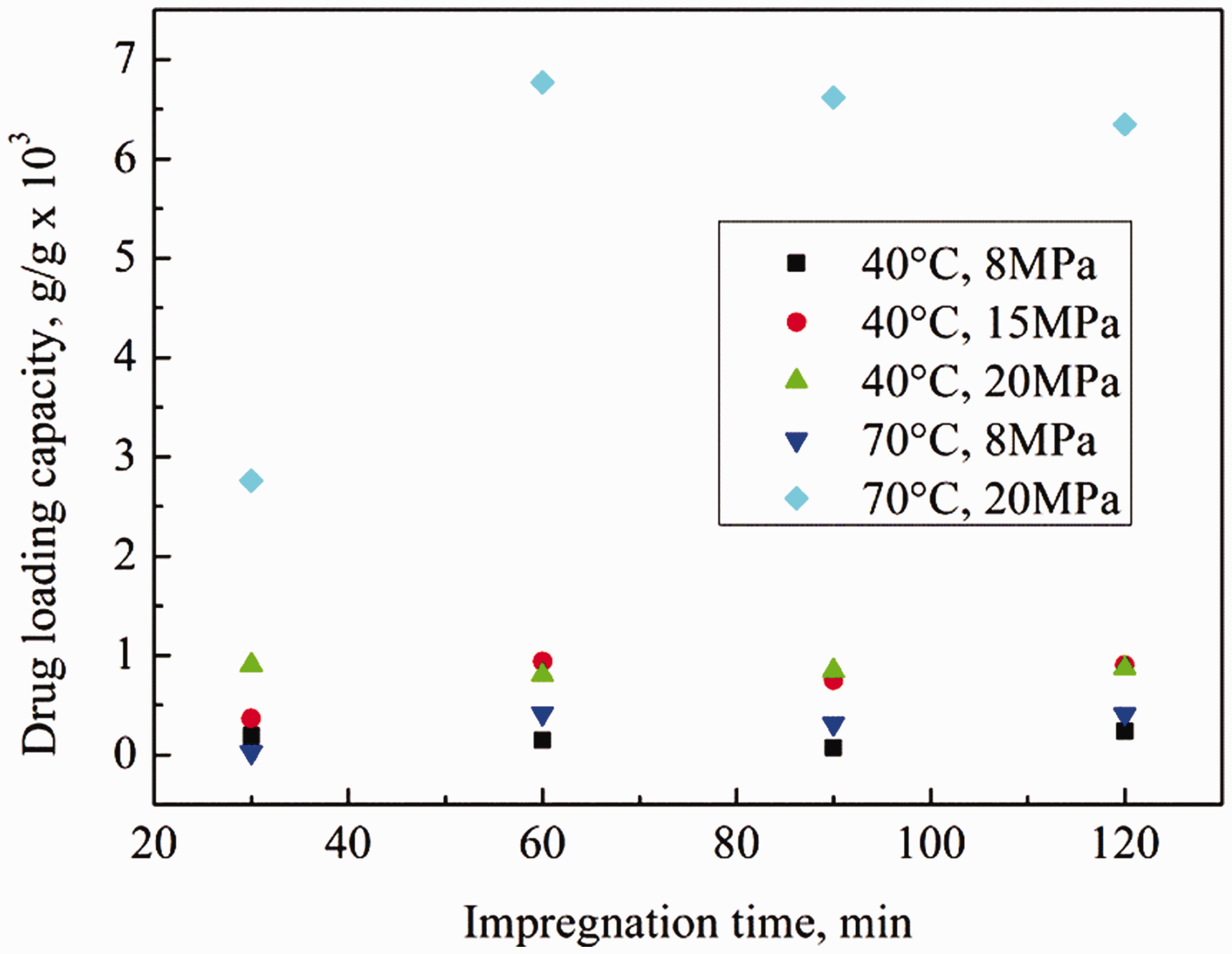
From Figure 2, it can be seen that the DLC reached an equilibrium value when the impregnation time was greater than 60 min and was related to temperature and pressure, although temperature had more of an influence than pressure. When temperature was relatively low the SSI process could reach equilibrium more quickly. In contrast to other synthetic fibres,22,28,30 the equilibrium time of the viscose fabric was shorter. The main reason is that the SCCO2 fluid can not only swell synthetic fibres to a greater extent, but can also act as a kind of “lubricant”, making it easier for chain molecules to slip over one another, and thus causing synthetic polymer softening, a process called plasticization. 31 Cellulose does not have “plasticization” characteristics and the volume to be swollen is smaller, so the SSI process can reach equilibrium more quickly. This also explains why pressure had little effect on the equilibrium time.
Effect of impregnation temperature on the DLC
The DLC was measured at different conditions with an impregnation time of 90 min. The effect of the impregnation temperature on the DLC is shown in Figure 3. The variation was complicated. When the operating pressure was 8 MPa, the DLC increased slightly with temperature from 50 to 60℃ and was kept constant between 60 and 90℃. However, when the operating pressure was 10 or 12 MPa, the DLC was very high at 40℃, dropped sharply at 50℃, increased a little at 70℃ and dropped at temperatures greater than that. In addition, the DLC was kept nearly constant at 10 MPa and increased at 12 MPa at temperatures between 80℃ and 90℃. When the operating pressure was 16 MPa, the 20 MPa DLC increased with temperature, but the DLC began to decrease at 90℃.
Effect of impregnation temperature on the drug loading capacity of viscose fabric in the supercritical fluid impregnation process (impregnation time of 90 min).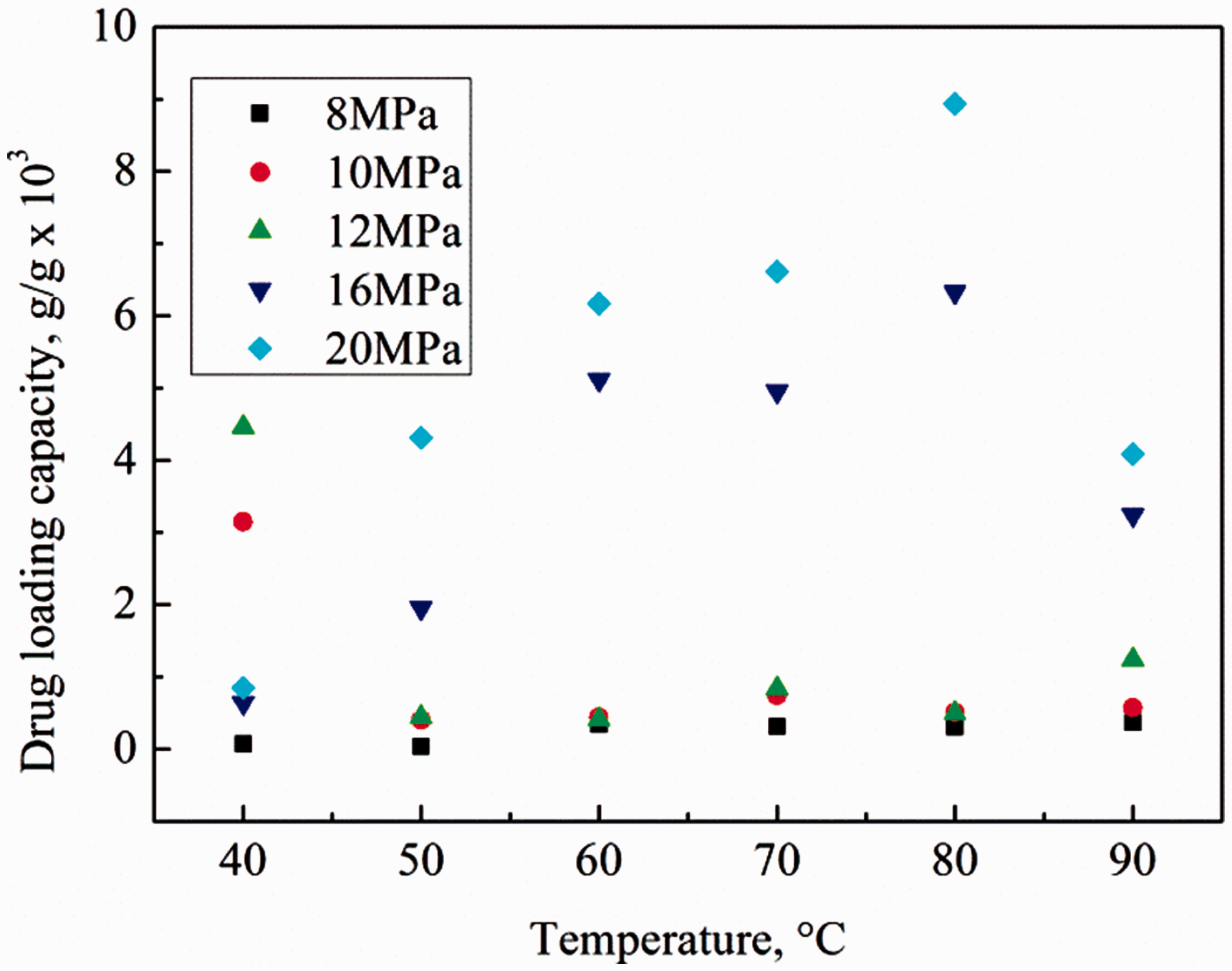
Solubility and partition coefficients can affect the DLC greatly. Firstly, the solute must dissolve into SCCO2 in order to reach the fabric or fibre. A high solute concentration in the bath strongly influences the impregnating time due to a high driving force in the mass transfer process. 32 The solubility in SCCO2 is highly dependent on the CO2 solvating power, which strongly evolves with pressure and temperature. The solubility increases with pressure or the density of CO2. The temperature has two opposing effects on solubility under isobaric conditions: the vapor-pressure of a solute increases with the temperature whereas the CO2 density decreases. 33 A critical point exists that can also be called the crossover pressure. Solubility decreases with temperature below the crossover pressure. In contrast, solubility increases with temperature above the crossover pressure. 34 The equilibrium partition coefficient is the ratio between the equilibrium concentration of the drug in the fabric and that in the SCCO2, and is determined by the “affinity” between drug and polymer, which is also affected by SCCO2 at different working conditions. For example, Ferri et al. 32 reported that the partition coefficient monotonously decreased versus fluid density at each temperature. This trend was expected, since dye solubility in the supercritical fluid at the tested operative conditions showed an exponential increase with density, while the dye uptake into the yarn showed the effect of saturation of the substrate.
Figure 3 demonstrates the complexity of the design of SSI. Though the solubility was low, the DLC was still much higher at 40℃ than at other temperatures when the operating pressure was 10 MPa or 12 MPa because of the high partition coefficient. From the above analysis, it can be concluded that the combined effects of both solubility and the partition coefficient change the DLC. The choice of the optimal working conditions should be a compromise between the needs for proper solubility in the bath and a proper partition coefficient, without operating at temperatures or pressures that are too high.
Effect of impregnation pressure on the DLC
The effect of the impregnation pressure on the DLC is described in Figure 4. When the operating temperature was 40℃, the DLC increased sharply under 12 MPa. In contrast, the DLC decreased sharply above 12 MPa. When the operating temperature was between 50 and 80℃, the DLC increased slightly from 8 to 10 MPa and was kept nearly constant from 10 to 12 MPa. The DLC increased sharply with pressure above 12 MPa. When the operating temperature was 90℃, the DLC increased with pressure.
Effect of impregnation pressure on the drug loading capacity of viscose fabric in the supercritical fluid impregnation process (impregnation time of 90 min).
The correlation between the DLC and pressure was approximately linear, except when the operating temperature was 40℃. It showed that the DLC usually increased with pressure or the density of CO2 in an isotherm curve. As mentioned above, the solubility increased with pressure. Ferri et al. 32 previously reported that the partition coefficients of three dyes decreased and their solubility increased with pressure at each temperature. Thus, such behavior is not new and has previously been observed in other experimental works. For example, Kazarian et al. 35 investigated the partition coefficient of D2O between SCCO2 and Poly(methylmethacrylate) (PMMA), which decreased rapidly with an increase in CO2 density in the near-critical region and flattened at higher density in the supercritical region. Figure 4 was also formed by the combined effect of the increased solubility and the decreased partition coefficient.
Effect of cosolvents on DLC
The effect of cosolvents on the DLC is shown in Figure 5; the experiment was operated at 50℃ and 16 MPa for 90 min. The DLC increased and decreased subsequently, and was evidently enhanced with a dosage of 4 mL acetone and methanol, but was kept constant after 6 mL of ethanol. The use of cosolvents in SCCO2 is a common technique and can improve the solubility by interacting with solutes. Solubility usually increases with the volume of cosolvent and is kept constant beyond a certain amount. The DLC varied in a nonlinear fashion with the dosage of cosolvent, which indicated that solubility was not the only influencing factor. The cosolvent might cause other variations. Kazarian et al.
35
found that the cosolvent methanol self-associated, which prevented the OH group of the methanol molecules from interacting with Poly(dimethylsiloxane) (PDMS). It may be that the cosolvents’ self-association prevents the interaction with the viscose fabric, so that the interaction between nicotinamide and the viscose fabric is restrained. Besides, another factor causing the partition coefficient to decrease with solubility may exist. Nicotinamide was subjected to fierce competition between the SCCO2 and the viscose fabric when solubility was relatively low, when the dosage of the cosolvent was between 2 and 4 mL, and more nicotinamides stayed in the SCCO2. When the dosage of cosolvent was greater than 4 mL solubility increased significantly, more nicotinamides interacted with the viscose fabric and the DLC increased. This needs to be researched further. It can also be concluded that the DLC can be high with cosolvent in spite of low temperature and pressure.
Effect of the content and variety of cosolvents on the drug loading capacity of viscose fabric in the supercritical fluid impregnation process (impregnation time of 90 min).
Characterization of the impregnation of the viscose substrate
SEM analysis
The surface morphologies of viscose fibres magnified 5000× under different processes were investigated by SEM and the photos are shown in Figure 6. They show that the surface morphologies of viscose fibres did not change, and that a large amount of nicotinamide stayed on the surface and were dispersed inhomogeneously in the form of particles, which suggests nicotinamide dissolved in SCCO2 re-crystallized on the surface of the viscose fibres.
Scanning electron microscopy images of the surfaces of viscose fibres: (a) viscose fibres before treatment; (b) viscose fibres treated at 80℃ and 20 MPa for 90 min without nicotinamide; and (c) nicotinamide-loaded viscose fibres using supercritical fluid impregnation at 80℃ and 20 MPa for 90 min. Magnification: 5000×.
FT-IR spectra of viscose fabrics
Figure 7 shows the FT-IR spectra of viscose fabric before treatment, viscose fabric treated at 80℃ and 20 MPa for 90 min without nicotinamide, and nicotinamide-loaded viscose fabric using SSI at 80℃ and 20 MPa for 90 min measured by transmission mode. It can be noticed that the typical absorption band at 3452.0 cm−1 was assigned to the stretching vibration of the –OH groups of cellulose between 3500.0 and 3200.0 cm−1.
36
The absorbency intensity of the –OH groups decreased, and the peak became relatively narrow for nicotinamide-loaded viscose fabric compared with viscose fabric before treatment and viscose fabric treated without nicotinamide. The broad peak in the 3000–2800 cm−1 region was for C–H stretching. Cellulose has –CH2– groups in its structure.
37
A peak around 1640.0 cm−1 was due to the adsorbed water molecules, and the absorption peaks at 1382.7 cm−1, 1164.8 cm−1, 1060.6 cm−1 and 894.8 cm−1 were due to C–H bending (deformation stretch), bridge C–O–C (asymmetric), in-plane ring stretching (asymmetric) and out-of-phase ring stretching C1–O–C4 ß-glucosidic bonds (asymmetric), respectively.
37
The absorbency intensity of the peaks around 1000.0 cm−1 notably decreased, and the peak at 1060.6 cm−1 was shifted to a higher wavenumber at 1078.0 cm−1 after nicotinamide loading. These results indicated that the interactions of the O–H and C–O groups among the inter- and/or intra-macrochains of the viscose fabric decreased due to the loaded nicotinamide. Nicotinamide contains –NH2, C=O and N–H, which can form hydrogen bond interactions with the molecular chains of the viscose fabric. The FT-IR spectra indicated that nicotinamide was loaded into the viscose fabric and interacted with macrochains of the viscose fabric.
Fourier transform infrared spectra of viscose fabric: (1) viscose fabric before treatment, (2) viscose fabric treated at 80℃ and 20 MPa for 90 min without nicotinamide, and (3) nicotinamide-loaded viscose fabric using supercritical fluid impregnation at 80℃ and 20 MPa for 90 min.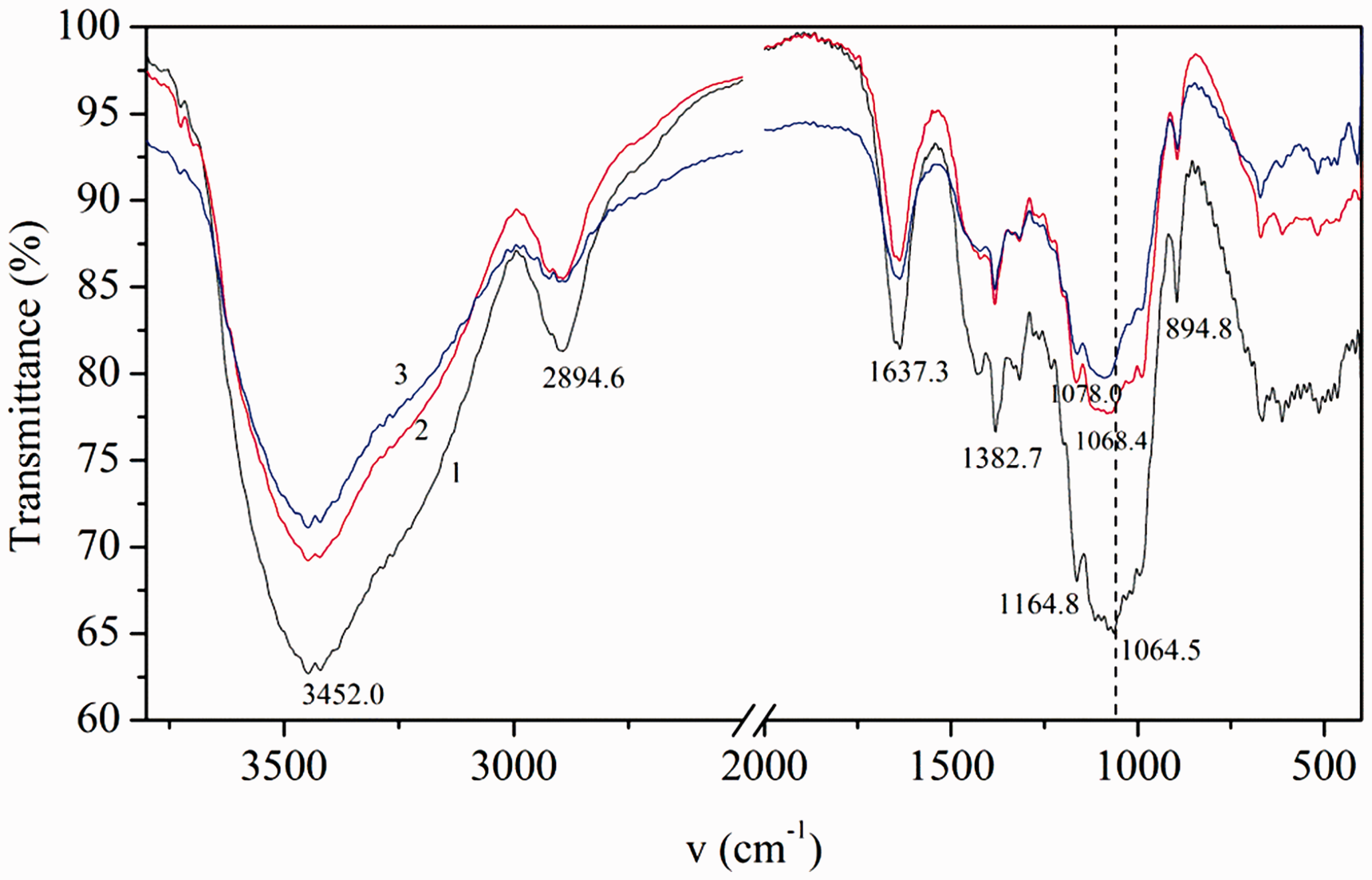
X-ray diffraction
Cellulose has a crystalline structure due to hydrogen bonding interactions and Van der Waals forces between adjacent molecules.
38
X-ray diffraction analysis was completed to evaluate the crystallinity of viscose fabrics after different treatments. Figure 8 shows the diffraction patterns obtained for viscose fabrics before treatment, viscose fabric treated at 80℃ and 20 MPa for 90 min without nicotinamide, and nicotinamide-loaded viscose fabric using SSI at 80℃ and 20 MPa for 90 min, as measured by X-ray diffraction. It could be noticed that the intensities of the main peaks at 2θ = 20° and 2θ = 22° decreased, and that the intensities of the peaks at 2θ = 35° and 2θ = 38° increased for viscose fabric treated at 80℃ and 20 MPa for 90 min without nicotinamide. However, the intensities of the peaks recovered to the same extent as viscose fabric before treatment and after it was drug-loaded using SSI, and the peak at 2θ = 20° was more defined. Besides, the results showed that the crystallinity was similar for the three viscose fabrics (crystallinity = 40 % ± 2).
X-ray diffraction spectra of (1) viscose fabric before treatment, (2) viscose fabric treated at 80℃ and 20 MPa for 90 min without nicotinamide, and (3) nicotinamide-loaded viscose fabric using supercritical fluid impregnation at 80℃ and 20 MPa for 90 min.
These results evidently indicate that SCCO2 can swell viscose fabric to a certain extent and change the diffraction patterns. When nicotinamide was loaded into the viscose fabric, the intensity of the main peaks increased again and nearly returned back to the diffraction pattern of viscose fabric before treatment.
Element characterization of viscose fabric
Elemental composition obtained from elemental analysis for different samples
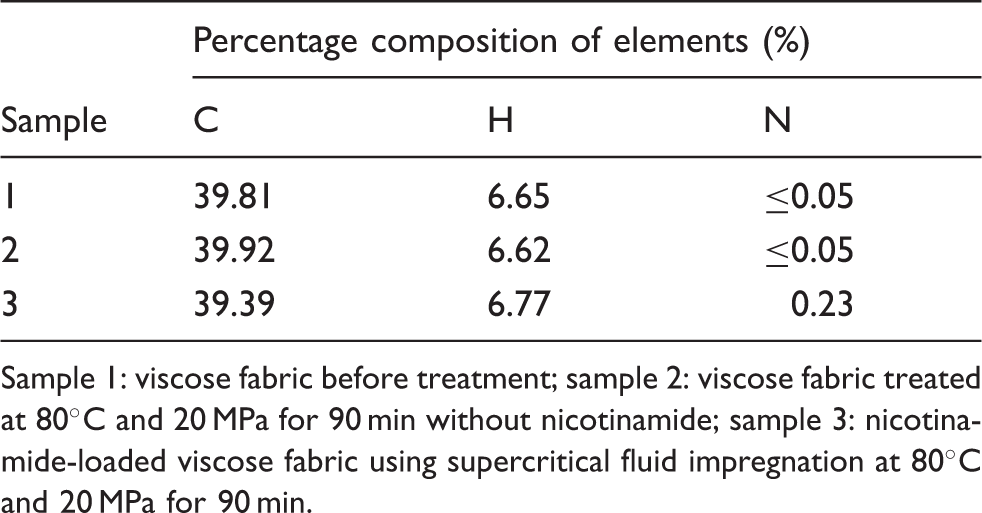
Sample 1: viscose fabric before treatment; sample 2: viscose fabric treated at 80℃ and 20 MPa for 90 min without nicotinamide; sample 3: nicotinamide-loaded viscose fabric using supercritical fluid impregnation at 80℃ and 20 MPa for 90 min.
Conclusions
A green and sustainable approach for the impregnation of viscose substrate with nicotinamide as a drug model was investigated and successfully characterized for the first time, in order to supply some bases for the manufacture of cosmetic and functional textiles. The parameter effects of impregnation time, temperature, pressure and cosolvent on the DLC were discussed. The DLC increased gradually with impregnation time up to an equilibrium value at 60 min. In addition, the DLC greatly increased with temperature from 40 to 80℃ when the system pressure was higher than 12 MPa, but decreased at a higher temperature. However, the impact of the system temperature on the DLC was small at a system pressure lower than 12 MPa, but the DLC was relatively high at 40℃ when the operating pressure was 10 or 12 MPa. The DLC was improved at different levels with system pressures at various system temperatures, especially at operating pressures greater than 12 MPa. However, the DLC initially increased and decreased afterwards with pressure when the operating temperature was 40℃, And the variation of DLC was fluctuant with cosolvent. The fundamental reason was that the solubility and partition coefficient varied with temperature, pressure and cosolvent, thus the DLC was influenced by the combined effects of all three. The loading of nicotinamide into the viscose fabric, and the interaction between nicotinamide and the viscose fabric was verified further by SEM, FT-IR, X-ray diffraction and elemental analysis. Additionally, the achieved results also reveal that there is the potential to employ this green and environmentally friendly impregnation method in the industrial production of cosmetic substrates with SCOO2 medium.
Footnotes
Authors’ note
Meiwu Shi is now associated with Institute of Military Engineering Technology, Institute of Systems Engineering of Academy of Military Science.
Declaration of conflicting interests
The authors declared no potential conflicts of interest with respect to the research, authorship and/or publication of this article.
Funding
The authors disclosed receipt of the following financial support for the research, authorship and/or publication of this article: This work was supported by the science and technology support project of Jiangsu Province of China (Grant No. BE2013051) and the Six Talent Peaks Project in Jiangsu Province (Grant No. 2016-JY-057).