



Abstract
Fiber identification is the primary task of waste textile recycling, which plays an important guiding role in the recovery and reuse of waste textiles. In this study, 186 pure spinning textiles with different fiber species were chosen as the raw materials, the near-infrared spectra were collected and the differences among various fibers species were also studied. The fast and accurate classification/identification model of textile fiber was established using the near-infrared spectral modeling technique. The soft independent modeling of class analogy method was used to construct the model. The results show that the model recognition rate can be up to 97% after selecting the wavenumber range of 6800–5300 cm–1 with the first derivative treatment on the spectra. It was found by external validation that the prediction accuracy of the model was 100% for polyester, polyamide, acrylic, silk and wool. The prediction accuracy of cotton fiber and polyester fabric was higher than 90%. The above result demonstrated that the textile fiber identification model established in this study can be used for fast and accurate identification and sorting of waste textiles.
The global demand for textile products is steadily increasing; China is a large country in terms of textile production and consumption, and produces lots of textile and clothing waste every year. According to the statistics, the waste of textile and clothing in China has reached one million tons every year, and the trend is increasing. However, the recycling and reuse of waste textiles is still at the early stage.1,2 Therefore, the research on recycling technology of waste textiles is urgent. Currently, textile recycling routes are typically classified as being mechanical, physical and chemical recycling.3–6 Chemical recycling is one of the best methods for textile recycling, as not only can it take full advantage of textile materials, but also it can reuse expensive textile materials. No matter what kind of recycling method is used, the waste textiles need to be classified according to the source of raw materials. In particular, the process technology required by the chemical recycling method is demanding, and the cost is relatively high, which makes it unsuitable for mass production. The requirements for the raw materials contained in the recycled waste textiles are relatively strict, so the textiles need to be classified according to their origin. However, now the classification of textiles, due to the limitations of technology, is still done by manual sorting. There are so many defects for this kind of method. On one hand, the work efficiency is extremely low, which leads to the increased cycle and high cost; on the other hand, great labor intensity and poor working environment pose a great threat to the health of workers. Finally, manual sorting is subjective and restricted by professional base and experience. Misclassified materials could seriously affect the resource utilization and the subsequent recycling. 7 Therefore, a fast and accurate method for rapid identification of waste textiles is necessary.
In addition to manual identification, fiber identification and classification methods are broadly divided into two categories, namely the physical method and the chemical method. The chemical method (dissolution method) is harmful to the sample, so it is not considered to be used for the sorting of waste textiles. The common physical methods include density identification, melting point identification, chromatography identification, infrared spectroscopy identification, birefringence identification and microscope identification. The density and melting point methods cannot identify each fiber accurately; the chromatography and birefringence methods are limited in the identification of fiber; and the microscopical procedure is complicated, so it is not suitable for testing a large amount of waste textiles. Although infrared spectroscopy can be used for the detection of waste textiles,8,9 the interpretation of infrared spectra needs professional technicians, so there are still some restrictions.
Near-infrared (NIR) technology is a fast, real-time and nondestructive testing technology. It is possible to classify, identify and even quantify substances containing hydrogen groups. 10 In recent years, the identification of some textile fibers has been studied using NIR technology. Cleve et al. 11 reported a quantitative and qualitative technique for the identification of textiles, moisture measurements, textile coatings and process control, using NIR spectroscopy in combination with chemometric methods; Langeron et al. 12 described the use of kernel methods to classify fabric samples using NIR spectra. The aim of that study was to identify an alternative method to classify textile products using NIR spectroscopy in order to improve quality control, and to aid in the detection of counterfeit garments; Wu et al. 13 proposed a quick and nondestructive way to completely identify textile fibers with NIR technology; Ishfaq 14 discussed the availability of NIR technology in the recycling of waste textiles; Jiang et al. 15 used NIR technology to establish the NIR identification model of ramie, kenaf, apocynum venetum and various kinds of wood. Therefore, the classification and identification of waste textiles with NIR technology is theoretically feasible. However, there is little systematic research on the classification and identification of waste textiles by NIR technology.
The goals of this study were to construct a model to classify pure textiles from recycling by NIR technology and lay the foundation for the rapid identification of waste textiles.
Experimental details
The experiment was performed as described in Figure 1. The main steps were spectra collection, NIR model construction and model prediction. The details will be given in the following.
Experiment scheme. NIR: near-infrared; SIMCA: soft independent modeling of class analogy.
Materials
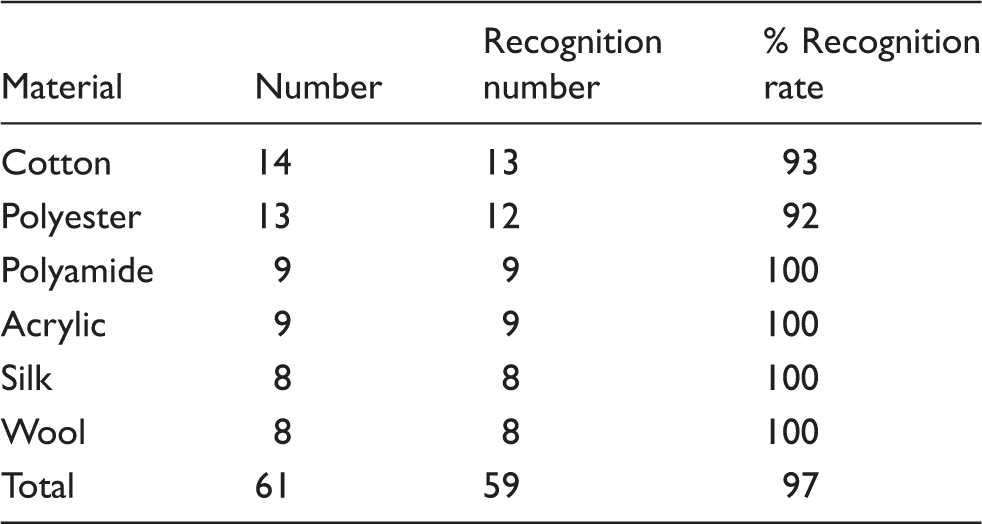
The samples were pure spinning textiles, including old clothes, towels, scarves and bedclothes (Qingdao, China). After cleaning and drying, they were classified according to the fiber, and the fiber species were identified according to the tag on the samples. The total number of the samples used for the modeling was 186, including cotton textiles (46), polyester textiles (37), polyamide textiles (30), acrylic textiles (26), wool textiles (24) and silk textiles (23). The additional 61 samples were used for external validation, including cotton textiles (14), polyester textiles (13), polyamide textiles (9), acrylic textiles (9), wool textiles (8) and silk textiles (8). They were used to validate the accuracy of the model.
NIR spectra acquisition
The NIR spectra were collected by directly placing the fabrics on the collection window of a NIR spectrometer and acquiring the diffuse reflection spectra. A PerkinElmer (Waltham, MA, USA) spectrum 400 NIR spectrometer was utilized for spectra collection. The spectra covered the range of 10,000–4000 cm–1 at a spectral resolution of 4 cm–1. Each spectrum was collected from an average of 32 scans with 1 cm·s–1 scan rate. No smoothing was applied to the raw spectra, because there was no difference between the raw spectra and smoothed spectra after 16 scans.
NIR modeling construction and prediction
The NIR spectral modeling used AssureID software. To reduce spectral noise and extract effective spectral information, the effect of the first derivative on the baseline normalization was studied. In addition, multiplicative scattering correction (MSC) and standard normal variate (SNV) on the noise reduction of the spectrum were also studied. Meanwhile, the soft independent modeling of class analogy (SIMCA) recognition technology combined with the optimized wavenumber interval were applied to establish fiber the classification model to classify/identify the fibers in waste fabrics.
Results and discussion
NIR spectra analysis
The spectra of the 186 samples show that similar fibers have the similar spectra patterns. The spectra of 46 samples of cotton, 37 of polyester, 30 of polyamide, 26 of acrylic, 23 of silk and 24 of wool are shown in Figure 2. Because the NIR spectra are the hydrogen bond information of the samples, for the same fiber composition of the textile its spectral trend is the same, consistent with the spectral collection results. The dispersion of the spectral curve of the wavenumber 10,000–7500 cm–1 is due to the noise error caused by different colors of the selected textiles. Therefore, the wavenumber range of 10,000–7500 cm–1 should be avoided in the following model calibrating process, which can guarantee the quality of the NIR model.
Near-infrared spectra of 186 total samples.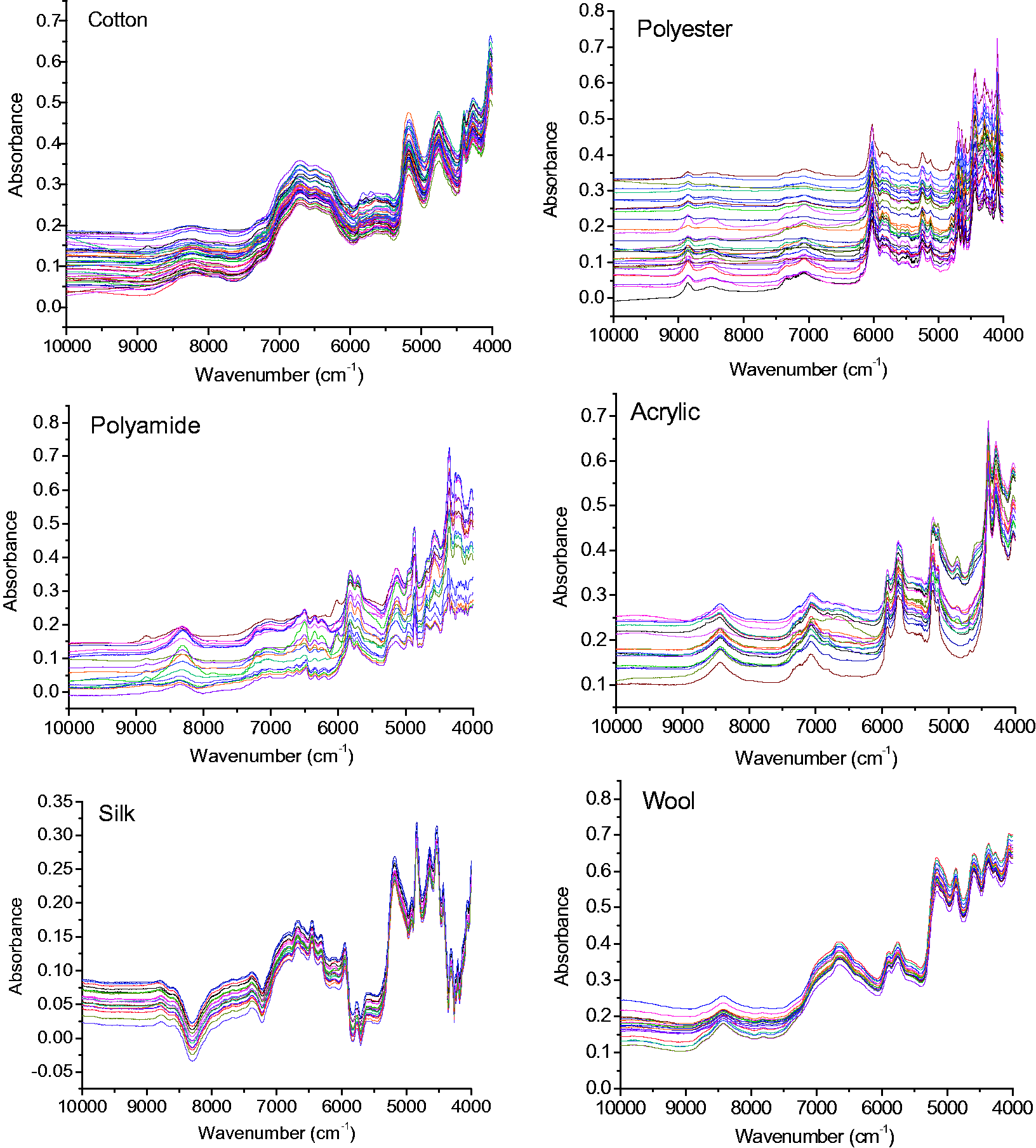
We chose one spectrum randomly from 46 cotton samples, and the other five spectra were chosen from polyester, polyamide, acrylic, silk and wool samples using a similar method. The NIR spectra comparison among six kinds of fiber textiles are shown in Figure 3(a). The spectral difference is obvious because of the different raw materials, which inferred that the construction of the NIR classification model is feasible. Figure 3(b) shows the first derivative pretreatment spectra of six kinds of textiles. After the first derivative baseline correction, the baseline impact was reduced dramatically. Compared with the raw spectra, the first derivative pretreatment spectra revealed an obvious difference in the range of 7500–4000 cm–1; it was thus deduced that NIR modeling should have higher accuracy above this wavenumber range, which is consistent with previous studies.16,17
(a) Raw spectra and (b) first derivative pretreatment spectra of six kinds of textiles.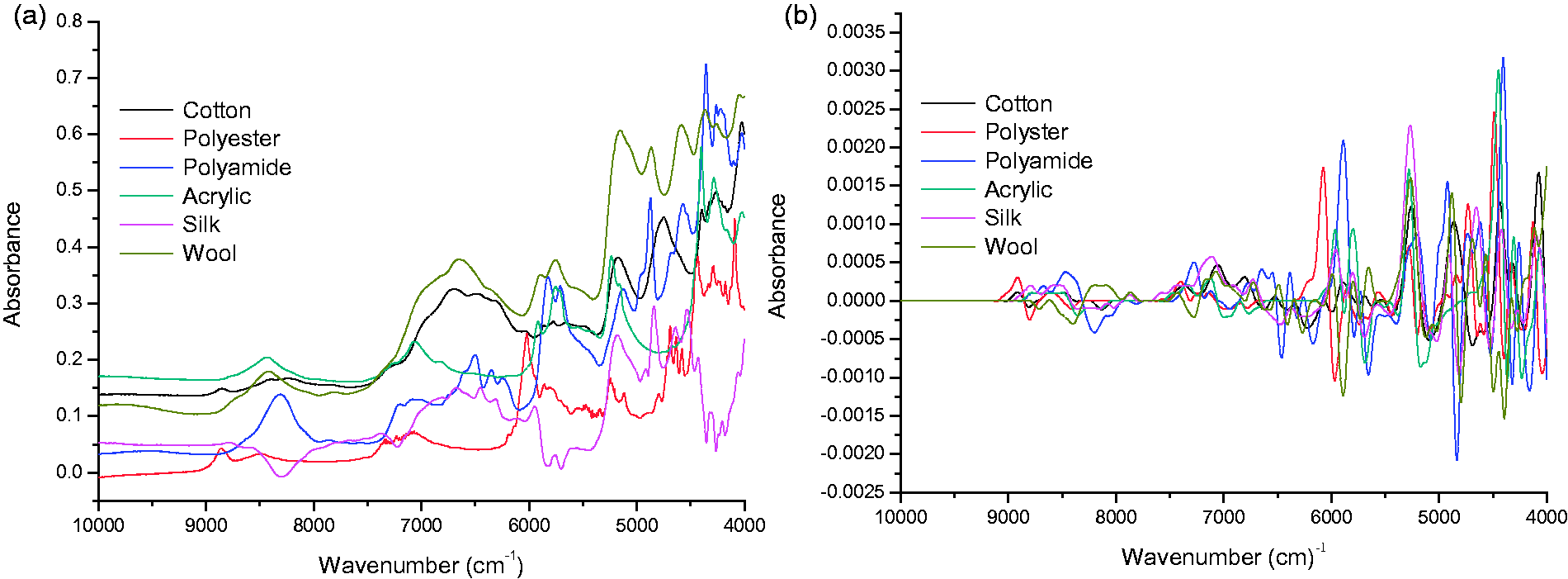
Fiber classification model construction
The SIMCA recognition technology was utilized to conduct NIR models of six kinds of textiles. In order to improve the prediction ability of the model, this study investigated full spectrum modeling and optimization range modeling, together with the different spectral pretreatment methods, and optimized the optimal modeling parameters.
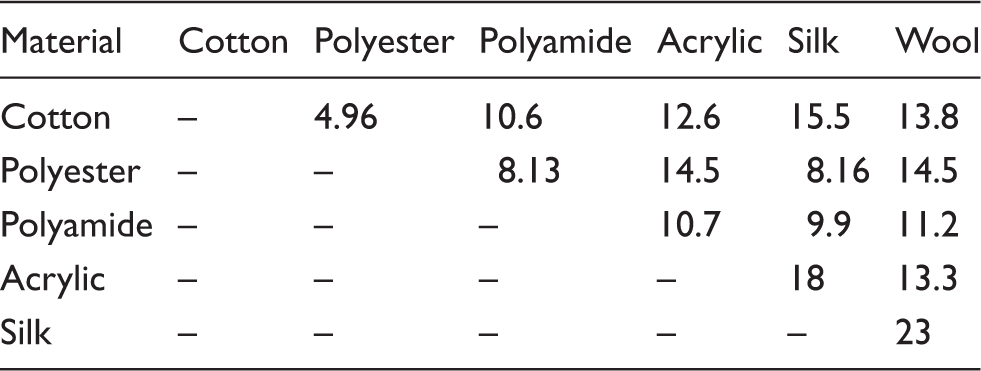
Inter-material distances of the six fabrics
Comparison of model accuracy after different pretreatment methods
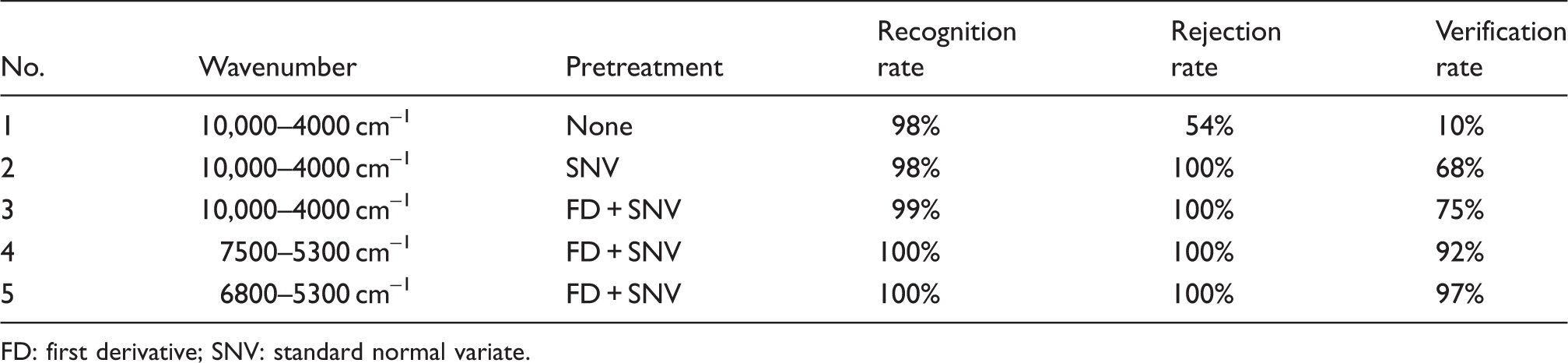
FD: first derivative; SNV: standard normal variate.
In the process of spectral analysis, it was found that 10,000–7500 cm–1 was mainly the color noise section, containing less spectral information, so it was judged that 7500–4000 cm–1 was a better spectral range. The preliminary study found that 5300–4000 cm–1 was mainly the NIR absorption of water, 18 which should be removed to improve the accuracy of the model. Therefore, the 7500–5300 cm–1 wavenumber range was selected for the NIR modeling, and the external validation accuracy of the model increased to 92%. Wavenumber range optimization was further carried out to determine the optimal wavenumber range of 6800–5300 cm–1; the internal recognition rate and rejection rate of the final model were 100%, and the external verification accuracy was 97%.
Model prediction
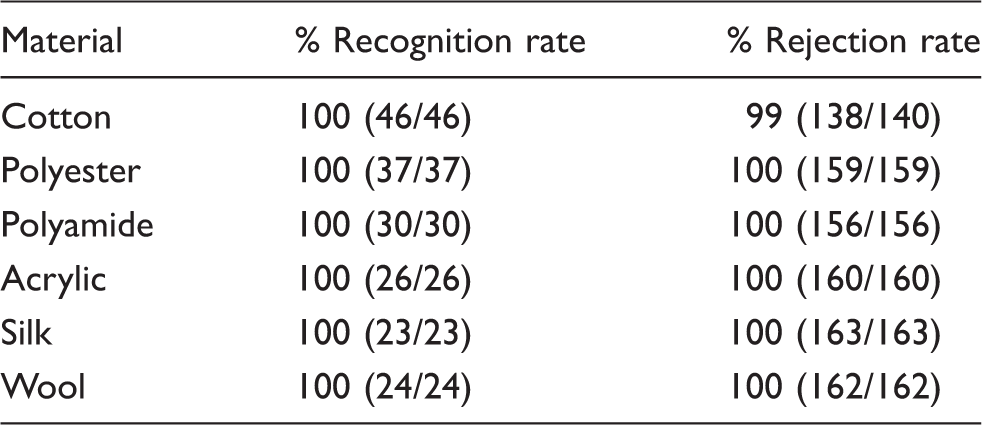
The final optimized model internal prediction results and clustering effect diagrams are shown in Table 3 and Figure 4. It is found that the model has excellent prediction ability on cotton, polyester, polyamide, acrylic, silk and wool. All of them except cotton show a 100% recognition rate and rejection rate. Cotton has a 100% recognition rate with a 99% rejection rate, which means the model may identify other samples to cotton. As the rejection rate is close to 100%, it has little influence on the prediction ability of the model.
Classification model cluster effect diagram. Optimized model internal prediction results
External validation results
Overall evaluation of the NIR method
Until today, there has been no standard or method to identify the fiber in textiles for all kinds of fiber species, including natural and man-made fibers. The results of this study demonstrate the outstanding merits of the NIR method. Firstly, the results indicate that using the NIR modeling technique can identify fibers with a recognition rate higher than 95%. Moreover, this method is nondestructive for the samples. As described in NIR spectra acquisition section, the NIR spectra can be collected directly on the fabrics without any other treatment. The method is also simple and fast. As described in Figure 5, after collection of the NIR spectra of the samples, the constructed NIR model can directly predict the spectra of the known fibers, and the total time that is consumed is less than 5 min. Most importantly, all the other identify methods (including Fourier transform infrared spectroscopy (FTIR)) require a well-trained scientist to conduct the experiment or analyze the data. However, the NIR method can be operated by anyone with only 0.5–1 h training. In conclusion, the NIR method is proven to be a promising way to classify and identify fabrics.
Process to identify the unknown samples. NIR: near-infrared.
Conclusions
This work chose 186 fabrics of cotton, polyester, polyamide, acrylic, silk and wool as samples, using NIR modeling technology, studied the influence of spectral preprocessing and wavenumber selection on the robustness and accuracy of the model and finally established an identification model of pure spinning textiles. The total recognition rate of the model is 97%, and the recognition rate of polyamide, acrylic, wool and silk is 100%, which achieves the ability of fast and accurate identification of textile fiber raw materials. In order to quickly identify textile fiber components, this work provides technical support for the identification and sorting of waste textiles.
Footnotes
Declaration of conflicting interests
The authors declared no potential conflicts of interest with respect to the research, authorship and/or publication of this article.
Funding
The authors disclosed receipt of the following financial support for the research, authorship, and/or publication of this article: This work was supported by the Qingdao Postdoctoral Applied Research Project and the Natural Science Foundation of Shandong Province (ZR2017BEM045).