



Abstract
Oil spills have become a global concern due to their environmental and economic impact. Various methods, including the use of fibers as sorbents, have been developed for oil spill concern. Poplar seed fiber is a plant biomass that has the potential of being used as low-cost sorbent. In this study, the physicochemical and sorption characteristics of poplar seed fiber as an oil sorbent was evaluated. Fourier transform infrared and scanning electron microscopy analyses showed that poplar seed fiber was a lignocellulosic material with smooth surface and hollow lumen. Oil sorption tests showed that loose poplar seed fibers could absorb 53.74 g/g of diesel oil, 65.85 g/g of motor oil and 67.97 g/g of vegetable oil, which were higher than that of kapok and cotton fiber. The availability of void fraction inside the fiber assembly coupled with hollow fiber structure and hydrophobicity/oleophilicity of poplar seed fiber were the main contributing factors. Moreover, the oil sorption kinetics of poplar seed fiber, including the effect of packing density of fiber assembly, oil types on sorption capacity and rate, was analyzed by a wicking method. Results illustrated that the oil sorption capacity was closely related to the packing density of fiber assembly, with an apparent decrease when the packing density changed from 0.05 g/cm3 to 0.09 g/cm3. For sorption rate, the highest oil sorption coefficients were observed for diesel oil, of 0.36 g2/s, 0.32 g2/s and 0.30 g2/s at the packing densities of 0.05 g/cm3, 0.07 g/cm3 and 0.09 g/cm3, respectively, which were about 10 times higher than that of vegetable oil and 70 times higher than that of motor oil.
With the rapid development of oil production and transportation, oil spill accidents increase. Oil spill has caused not only environmental problems but also great loss of energy resources.1,2 There are various ways for oil removal and recovery such as mechanical, biological and photochemical methods.3,4 Among them the mechanical extraction by sorption materials is regarded as one of the most desirable choices for oil removal due to its simplicity and relatively lower processing cost. 5 Researchers have made great efforts on the development of various sorbents, including inorganic minerals, synthetic organic polymers and organic natural material. For inorganic minerals, such as sepiolite, silica, zeolites and vermiculite, the low oil sorption capacity, inadequate buoyancy and non-biodegradability are the main disadvantages.6–9 Synthetic organic polymer, polypropylene, for example, represents the ideal oil sorption material which has low density, low water uptake and great physical and chemical resistance. It is reported that exfoliated graphite could absorb 83 g oil/g fiber and polyurethane foam could absorb 100 g oil/g fiber.10,11 However, they are not renewable and biodegradable, which limit their further application.5,12 Organic natural materials, such as cattail fiber, milkwood fiber, wheat straw, corn cobs and sugarcane bagasse, not only have good oil sorption capacity, but also are cost-effective, biodegradable and environmentally and ecologically friendly.13–17 Recently, natural fibers with unique hollow structure, such as Calotropis gigantea fiber and kapok fiber, have drawn more and more attention due to their considerable oil sorption capacity and excellent buoyancy. Zheng et al.18,19 revealed that Calotropis gigantea fiber exhibited fast sorption kinetics and high sorption capacity between 22.6 and 47.6 g/g for various oils. Hori et al. 20 reported that kapok fibers in bulk could absorb approximately 40 g oil per gram fiber from surface water. Dong et al.21,22 demonstrated the non-negligible effect of large lumen of kapok fiber on oil sorption.
Poplar seed fiber is another natural cellulose fiber with waxy coating and large lumen which is obtained from seeds of poplar tree belonging to the Salicaceae plant family. 23 The fiber is yellowish-brown in color, soft and extremely light, with the density of 0.36 g/cm3. Typical analyses carried out by previous researchers indicated that poplar seed fiber has a cylindrical hollow structure and is composed of 41–44% cellulose, 19–21% hemicellulose, approximately 29% lignin, and 4–9% extractives (mainly wax). 24 Chen et al. 25 reported that poplar seed fiber can be used as textile thermal insulation material due to its large porosity which could provide considerable room for still air. Sebeia et al. 26 demonstrated that poplar seed fiber can be used for bio-sorption. Spiridon et al. 27 illustrated that the fiber had great potential in the application in biodegradable composites. Likon et al. 24 identified the high oil sorption capacity of poplar seed fibers to high-density motor oil and diesel fuel. The research of Likon et al. focused on the oil sorption capacity of poplar seed fiber. However, for a sorbent used in the oil spill management, apart from the high oil sorption capacity, the oil sorption rate is another essential factor that determines whether the spilled oil can be effectively collected in a short period of time. 28 In this study, much attention was paid on the sorption kinetics of poplar seed fibers to different oils which included both the oil sorption capacity and sorption rate. Physicochemical and sorption performance of loose poplar seed fiber assembly were first evaluated by Fourier transform infrared (FTIR) and scanning electron microscopy (SEM) tests, respectively. However, loose fibers in practical applications are not conducive to processing and transportation. For practical applications, loose fibrous sorbents need to be compacted into mats, booms, or pads. It is necessary to study the oil sorption property under certain compacted conditions. Therefore, an attempt has been made to develop poplar seed fibers with various packing densities by wicking tests to study the oil sorption kinetics behavior.
Materials and methods
Materials
The poplar seed fibers studied in the work were from Henan Province, China and hand harvested. The kapok fiber and cotton fiber were provided by local companies. The morphological structure of the fiber was analyzed using a scanning electron microscope (SEM-TM3000, Hitachi, Japan). For SEM observation, samples were first mounted on a round stainless steel sample holder with double-sided conductive adhesive tapes. Then the sample surface was sputtered with gold to provide a conductive coating which can improve the clarity of the image. The external diameter and the thickness of the tube wall were obtained by measuring the SEM image of poplar seed fiber. Image measurement was done with image analysis software Image-Pro Plus. The length of poplar seed fiber was measured at its naturally elongated state. Measurements were performed 20 times to obtain an average value.
Infrared spectrum was performed using an FTIR spectrometer (Nicolet6700, Thermo Fisher, USA). Poplar seed fiber of 2 mg was mixed with 200 mg of KBr and compressed into a pellet by using a hydraulic pump. Scans were carried out at 400 until 4000 cm−1 wavenumber. The specific surface area was determined by Brunauer–Emmett–Teller (BET) analysis (ASAP 2460 Analyzer BET). The contact angle of fiber assembly was measured with an optical contact angle meter (OCCA15EC, DataPhysics, Germany).
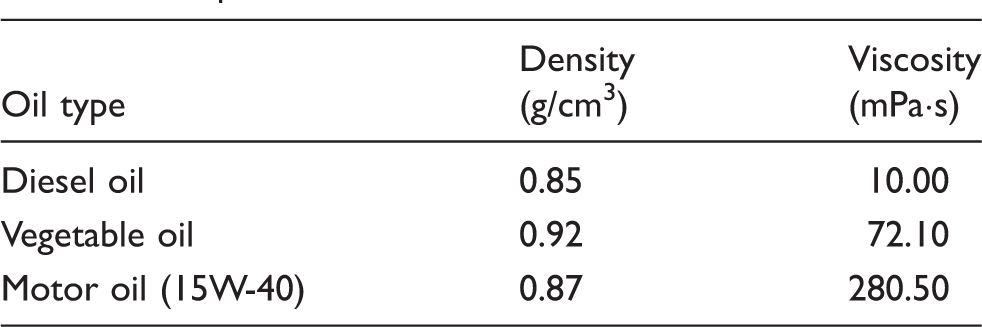
Properties of the test oils
Method to test wettability
First, poplar seed fibers (0.2 g) were put into a 500 ml beaker with 300 ml water for 24 h. Then 300 ml water and 10 g motor oil were put into another 500 ml beaker to obtain the mixture solution. Poplar seed fibers (0.2 g) were put into the mixture solution. Motor oil was dyed with Sudan III dye, and water was dyed with methylene blue dye. The test temperature was maintained at 22–24℃.
Measurement of oil sorption capacity
Oil sorption capacity was performed as follows. First, 200 ml of oil was poured into a 500 ml beaker. Fibers (0.5 g) were put into the oil. 15 min was taken as the equilibrium oil sorption time, since no obvious weight difference was observed for the fibers after a longer soaking time. Then the sample was taken out and drained for 2 min, and quickly weighed. Each oil was tested five times. The oil sorption capacity was calculated according to the following equation

To evaluate the reusability of poplar seed fibers and collect absorbed oil, oil-loaded poplar seed fibers were squeezed by a gripper and then used for the next oil sorption. The test temperature was maintained at 22–24℃.
Evaluation of oil sorption kinetics
The sorption kinetics of poplar seed fibers was measured using a wicking method carried out on tensiometer DCAT11. A cylindrical sample tube with internal diameter of 12 mm and length of 40 mm was used. The different packing densities of the fiber assemblies were controlled by packing different weight fibers evenly in the tube, which were then compressed by screwing the piston of the tube to a filled length of 20 mm. After the experiment started, the test oil level was then increased until the liquids touched the fibers. The data of the weight change versus time was detected by the electro-balance and recorded on a computer. Every test was characterized three times and plotted as an average of three trials with error bars depicting the standard deviation. The test temperature was maintained at 22–24℃.
Method of drop-on-fiber test
The drop-on-fiber test was conducted on an optical contact angle meter (OCCA15EC, DataPhysics, Germany). Sample was prepared on a special sample frame, where a single fiber was horizontally suspended by fixing two ends of the fiber with double-sided tape onto the sample frame. When the test started, the oil-filled springe needle above the single fiber dripped oil to the fiber. Wetting shapes on fiber were recorded by charge-coupled device camera software OCA20 provided by optical contact angle meter. The test temperature was maintained at 22–24℃.
Results and discussion
Characterization of fibers
The morphological structures of three fibers were observed by SEM. As depicted in Figure 1, poplar seed fiber had a smooth surface and large lumen, which was similar to kapok fiber, but showed great difference with cotton fiber. The average external diameter, thickness of the tube wall and length of poplar seed fiber were 12.7 ± 4.8 μm, 600 ± 100 nm and 4 ± 1 mm, respectively. This demonstrated that 90% of the fiber total volume is empty lumen which is higher than that of kapok fiber (77%).
29
One can speculate that such a large lumen is beneficial to the oil sorption property. Moreover, the hollow structure of fiber resulted in large specific surface area. BET test based on N2 adsorption showed that the specific surface areas of poplar seed fiber, kapok fiber and cotton were 2.51 m2/g, 2.99 m2/g and 1.13 m2/g, respectively. A higher value of specific surface area meant more oil sorption sites, resulting in higher oil sorption capacity.
Scanning electron microscopy images; (a) surface of poplar seed fiber, (b) cross-section of poplar seed fiber, (c) surface of kapok fiber and (d) surface of cotton fiber.
FTIR spectra of cotton fiber, kapok fiber and poplar seed fiber are presented in Figure 2. For test fibers, there are broad and strong absorption peaks near 3418 cm−1 produced by O-H stretching vibration,
30
which is a characteristic peak of all cellulose fibers. The well-pronounced peak at 2921 cm−1, corresponding to the asymmetric and symmetric aliphatic CH2 and CH3 stretching vibration, which is associated with the presence of plant wax.
31
The peak intensity at 2921 cm−1 of poplar seed fiber and kapok fiber is stronger than that of cotton fiber, which demonstrates that the wax content of poplar seed fiber is higher than that of kapok fiber. In addition, great similarity of functional groups between poplar seed fiber and kapok fiber was depicted. The peaks at 1375 cm−1, 1737cm−1 and 1250 cm−1 of poplar seed fiber and kapok fiber resulted from the wax surface.29,32 The peaks at approximately 1600 cm−1, 1505 cm−1 and 1425 cm−1 of poplar seed fiber and kapok fiber related to C-O stretching in lignin.
22
FTIR results indicated that poplar seed fiber was a lignocellulosic fiber with a wax-coated surface.
Fourier transform infrared of cotton fiber, kapok fiber and poplar seed fiber.
Wettability of poplar seed fiber
The wettability of poplar seed fiber is displayed in Figure 3. For blue-colored water droplets, a near spherical shape was observed on the surface of poplar seed fibers, with the contact angle of 135° (as shown in Figure 3(a)). However, for red-colored oil droplets, quick penetration along the surface was depicted, with the contact angle of nearly 0° (as shown in Figure 3(b)). Results demonstrated that poplar seed fiber possessed an apparent hydrophobic-oleophilic characteristic, which was largely attributed to the waxy surface of the fiber. Also, the wettability of fiber was a critical factor for oil sorption properties. Figure 3(c) to (f) further depicted the wettability of the fiber to water and oil. When dried poplar seed fibers were put into pure water, they would not sink, which showed good buoyancy. When the fibers were put into the mixture of oil and water with an oil layer above, the fibers absorbed oil immediately, with the oil-absorbed fibers still floating above the water layer. For reusability of poplar seed fibers, approximate 80% of initial sorption capacity remained after 10 cycles of sorption/desorption. The decreased oil sorption capacity was considered to be the result of irreversible deformation of fibers by squeezing.
Digital images: (a) blue-colored water droplets on the surface of poplar seed fibers, (b) red-colored motor oil droplet diffuse into poplar seed fibers, (c) 0.2 g poplar seed fibers were put into the beaker with 300 ml blue colored water after 24 h, (d) the mixture of 300 ml water and 10 g motor oil, (e) several seconds after 0.2 g poplar seed fibers were put into the mixture solution, (f) after the oil-absorbed fibers were removed; inserts are the images of removed oil-containing fibers.
Oil sorption capacity
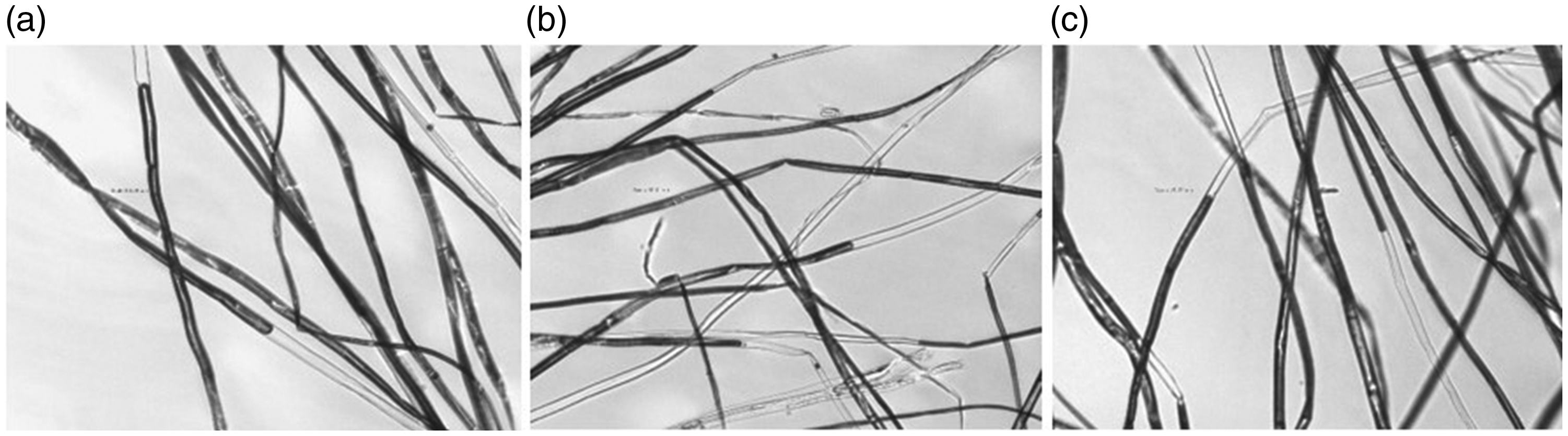
The oil sorption capacity of loose poplar seed fibers to three test oils is demonstrated in Figure 4, taking kapok fiber and cotton fiber as reference samples. Here the loose fibers refer to the assembly of fibers in a natural state without external force. The packing densities of loose poplar seed fibers, loose kapok fibers and loose cotton fibers were 0.0036 g/cm3, 0.0053 g/cm3 and 0.073 g/cm3, respectively. The oil sorption capacities of poplar seed fiber to diesel oil, vegetable oil and motor oil were 53.74 g/g, 67.97 g/g and 65.85 g/g, respectively, which were about 1.7 times higher than that of cotton fiber, and about 1.3 times higher than that of kapok fiber. The excellent oil sorption of poplar seed fiber was mainly attributed to the small packing density of the loose fibers, together with its large lumen and oil-loving surface characteristic. To further illustrate the role of large lumen in oil sorption, micrographs of diesel oil, vegetable oil and motor oil penetrating into fiber lumens are shown in Figure 5. It can be seen from Figure 5 that the large lumen of poplar seed fiber provided much space for oil storage.
Oil sorption capacity of loose fibers. Micrographs of (a) diesel oil, (b) vegetable oil and (c) motor oil penetrating into lumen of poplar seed fiber.
Oil sorption capacity of natural loose fibrous oil sorbents

Sorption kinetics of poplar seed fiber
Plots of oil mass square versus time of poplar seed fibers at three packing densities for different oils were presented in Figure 6(a)-(c), respectively. The recorded points depicted in Figure 6 indicated that the sorption process of oil mainly consists of two phases, including an initial rapid phase with relatively high sorption speed and then a slow phase which gradually reduced to reach sorption equilibrium. The high rate of oil sorption at the first stage may be attributed to the filling up of fiber lumens and capillaries formed between fibers. However, as less sorption sites were available, only a small amount of oil uptake occurred after the initial quick sorption period. The calculated oil sorption capacity per unit mass (M) of poplar seed fibers at various packing densities to test oils are listed in Table 3. For each test oil, M decreases with the increasing of packing density, which was ascribed to the reduction of the available voids inside the poplar fiber assembly, especially among the inter-fiber pores. Besides, under the same packing density of fibers, they were under the same pore volume, and the differences in sorption capacities between the three oils were mainly a result of their different densities. Therefore, the sorption capacity of poplar seed fibers to vegetable oil depicted the highest value, resulting from the highest density of vegetable oil. It is worth mentioning that the oil sorption capacities of poplar seed fibers at the packing density of 0.07 g/cm3 to diesel oil, vegetable oil and motor oil were 13.20 g/g, 15.14 g/g and 13.96 g/g, respectively. The value was slightly higher than that of kapok fiber reported in our previous paper,
22
which largely resulted from shorter fiber length, better fineness and smaller microtubes of poplar seed fibers.
Plots of oil mass square with time for (a) diesel oil, (b) vegetable oil and (c) motor oil of poplar seed fibers at different packing densities. Obtained parameters for poplar seed fiber to different oils C: liquid sorption coefficient; M: oil sorption capacity.

The sorption rate of oil into poplar seed fibers was determined according to the modified Washburn capillary theory,36,37 as shown in the following equation

It is shown that the absorbed liquid mass (m2) is linearly related to sorption time (t). The ratio between m2 and t is defined as the liquid sorption coefficient (C).
38
The linear fitting of m2 to t at initial wetting period is shown in Figure 7, with all regression coefficient R > 0.99. It can be shown from Figure 7 and Table 3 that poplar seed fibers to different oils displayed large differences with regard to the parameter of C. The highest values of C were observed for diesel oil, of 0.36 g2/s, 0.32 g2/s and 0.30 g2/s at the packing densities of 0.05 g/cm3, 0.07 g/cm3 and 0.09 g/cm3, respectively. The values of C for diesel were about 10 times higher than that of vegetable oil and 70 times higher than that of motor oil, which was largely attributed to the viscosities of oils, different wettability and adhesiveness between fiber and oil. For each test oil, larger packing density meant larger penetration resistance, which resulted in smaller C, as shown in Figure 7. Figure 8 illustrates the wetting shapes of single poplar seed fiber to the three test oils which formed cylindrical barrel shapes, greatest for motor oil and smallest for diesel oil. Diesel oil with low viscosity (10.00 mPa·s) would spread rapidly through the fiber. However, motor oil with high viscosity (280.50 mPa·s), was more likely to be retained and entrapped within the poplar seed fiber microstructure, thus resulting in the low penetration rate through the fiber assembly. This is also shown by equation (2) when viscosities of oils in Table 2 were substituted. For the oil under different packing densities of the fibers, there was little difference between the values for C, which illustrated that oil viscosity was the governing factor of the oil transfer rate. The high oil sorption capacity and fast sorption rate benefit from the hydrophobic-oleophilic property of the fiber and its hollow lumen physical configuration makes poplar seed fiber an attractive sorbent for the removal of spilled oil.
Initial wetting kinetics of poplar seed fiber at different packing densities for (a) diesel oil, (b) vegetable oil, (c) motor oil. Wetting shapes of (a) diesel oil, (b) vegetable oil and (c) motor oil on single poplar seed fiber.

Conclusion
The physicochemical and sorption characteristics of poplar seed fiber as an oil sorbent were presented. According to the experimental results and analysis, the following conclusions can be drawn.
Results showed that poplar seed fiber was a typical lignocellulosic fiber with smooth surface and large lumen. The fiber depicted apparent hydrophobicity/oleophilicity, with water contact angle of 135°. Oil sorption tests exhibited that loose poplar seed fibers could absorb 53.74 g/g of diesel oil, 65.85 g/g of motor oil and 67.97 g/g of vegetable oil, which showed great oil sorption capacity. Kinetics results showed that the oil sorption capacity of poplar seed fiber was closely related to the packing density of fiber assembly, with an apparent decrease when the packing density increased. The highest sorption coefficients were observed for diesel oil, ranging from 0.30–0.36 g2/s, which were about 10 times higher than that of vegetable oil and 70 times higher than that of motor oil. Drop-on-fiber micro-sorption experiments demonstrated that oils with different properties depicted various drop sizes, which further illustrated the different wettability between fibers and oils.
Footnotes
Declaration of conflicting interests
The authors declared no potential conflicts of interest with respect to the research, authorship, and/or publication of this article.
Funding
The authors received no financial support for the research, authorship, and/or publication of this article.