



Abstract
The presented work deals with the thermal ageing evaluation for polyester-reinforced and polyvinyl chloride coated fabrics. The architectural fabric AF9032 was exposed to artificial thermal ageing by subjecting the material samples to temperature levels of 80℃ and 90℃ for up to 12 weeks. The mechanical properties of the aged fabric have been separately described by the identified linear piecewise model (with assumption of the elastic behavior) and by the Bodner–Partom model (with assumption of the viscoplastic behavior). The evolution of the obtained parameter values for various ageing temperatures and over ageing periods have been approximated by linear functions achieving a good convergence. The simplified methodology of Arrhenius has been incorporated for the extrapolation of functions obtained for 90℃ and consequently used for ageing analysis. For the fill direction, the lines describing evolution of the mechanical parameters over ageing time coincide fully with the ultimate tensile strength and elongation at break and are parallel for the Bodner–Partom model parameters (
Modern roofing membranes must exhibit satisfactory long-term durability toward climate phenomena and service stresses, which can be evaluated precisely only during real-life outdoor exposure studies. However, well prepared accelerated ageing tests can shorten the time necessary to predict the life durability of the particular material, which is necessary to start a construction assembly earlier. The artificial ageing experimental program should be accompanied by analytical and statistical studies. The authors' interest in the technical fabric durability evaluation arose when the local authorities of Sopot city decided to rebuild the hanging roof of the Forest Opera in Sopot (Poland) in 2006. The Forest Opera (Figure 1) is a unique open-air theater, the history of which started more than 100 years ago. Concerning its construction over the years, the most important thing to note is the fact that the theater has been covered with different types of hanging roofs (polyamide and polyester threads) since 1964. During calculations of the new construction, the polyester (with polyvinyl chloride (PVC) coating) AF9032 fabric (Shelter-Rite, Seaman Corporation) was planned as the roof material, but finally the technical fabric Sheerfill I (glass threads, polytetrafluoroethylene (PTFE) coating), fabricated by Global Performance Plastics, was selected.
1
All of these materials, including the old material VALMEX (polyester threads, PVC coating, 1992–2009), have been analyzed with regard to durability properties. The entire research covers the analysis of the accelerated and natural ageing, including also the influence of the service conditions on material performance.
2
Forest Opera in Sopot: (a) 2006 and (b) 2011.
This paper presents a particular part of the research and deals with the artificial thermal ageing evaluation of architectural fabrics. It focuses on the influence of ageing time and temperature level on the material parameters detected for AF9032 fabric. Therefore, it has been decided to carry out the laboratory simulation of ageing at two temperature levels: 80℃ and 90℃. Next, the basic strength properties and the parameters for two constitutive models describing the fabric behavior (the piecewise model and the Bodner–Partom model) will be identified for artificially aged and unaged samples. The selected material models allow one to describe the mechanical properties of the polyester-reinforced PVC coated fabrics in different exploitation conditions, which can be described by the elastic and even viscoplastic approaches. An additional aim of this work is to verify whether the well-known Arrhenius methodology could be used for the durability evaluation of polyester-reinforced PVC coated textiles.
Durability of building materials
Ageing types and factors
A durable material is one that can resist erosion coming from various media during its service life. 3 Building materials are subjected to two types of influence: external environmental conditions and mechanical stresses. The environmental impacts include the following 4 : weather factors (e.g. high–low temperature cycles, freeze-and-thaw changes, humidity, ultraviolet (UV) radiation), chemical active particles (e.g. oxygen, acid, alkali or salt aqueous solutions causing destruction of material chemical composition) and biological organisms (e.g. fungi, alga and microorganisms that can molder or rot materials). Mechanical stresses can be initiated either naturally (e.g. wind blow) or during the service of a material (e.g. during construction assembly). High stresses cause cracking, delamination and the increase of porosity (e.g. delamination of composite panels). The overall impact on building materials is obviously a synergic action of all (or some) of the above components. Owing to chemical material composition and usage conditions, particular materials have different kinds of durability. For instance, stone, concrete, mortar and clay bricks struggle with frost, wind, carbonization and wet-and-dry change impacts. Steel is known to exhibit rusting (the formation of iron oxides), while organic materials (asphalt, plastic, rubber) may be destructed by physical ageing.3,5
Physical ageing of polymers
Most polymers have two distinct transition phases defined by the melting temperature
Laboratory accelerated ageing methods
The service life of a material is defined as the time after which replacement of the built-in material is obligatory, or when its service function comes to an end. 11 To improve the durability of building materials, their ageing process has to be monitored. However, when a new material is designed, there is no time for analyzing its natural ageing process. Instead, accelerated methods of the ageing process are incorporated to evaluate material durability. They will never give a perfect answer about the future behavior of the material, but are still worthwhile and give information on the material performance under different ageing conditions. 12
The main point in laboratory accelerated ageing is that artificially established circumstances should reflect as closely as possible the environmental and service conditions of a particular material. For example, in the case of naval structures, hydrothermal treatment (combining different temperature levels with immersion in natural or synthetic sea water) is a sufficient simulation of ageing, 13 while for electrical cable insulations the high voltage and stress must be taken into account. 14 Another example of accelerated ageing is presented by Wei et al., 15 who checked the dynamic properties of rubbers aged at high temperature and simultaneously pre-strained. Ageing by subjecting a material to different conditions in a cyclic sequence (e.g. UV radiation, high/low temperature, humidity, salt spray, etc.) is conducted in weather chambers.16,17 Cyclic ageing has been practiced, for example, by Deflorian et al. 18 on organic coated galvanized steel, and by Jakubowicz et al. 19 on commercial PVC. However, the most common and simple approach to ageing simulation is the dry heat method carried out in a dedicated oven with constant air flow.16,20 This procedure often includes the performance of accelerated tests at various temperature levels and time durations. In addition, it can be easily coupled with the Arrhenius relation toward the foreseen durability of the tested material.
As the architectural fabrics are generally composed of polymer components (e.g. polyester fibers and PVC coating for AF9032 fabric), they undergo physical ageing. Thus, the main aim of the presented research is to evaluate the thermal ageing influence, which accelerates the physical ageing, on the mechanical response of the fabric material.
Artificial thermal ageing – laboratory set up and experimental program
In this research, the authors proposed to induce the accelerated ageing by thermal treatment. The temperature of the accelerated ageing
Polyvinyl chloride (PVC) and polyester materials with their ageing temperature based on the literature study

Taking into account all of the above facts, it has been decided to carry out the simulation of ageing at two main temperature levels: 80℃ and 90℃. A thermal chamber with constant air flow, which enables one to obtain temperatures ranging from –70℃ to + 250℃, was used for inducing such artificial ageing process. Strip samples of 300 mm × 50 mm were cut in two material directions (warp and fill) and then subjected to thermal ageing with relative humidity of 50%. The first group of specimens was maintained for the period of 5 weeks at 90℃, while the second one was maintained for 12 weeks at 80℃. Every week (for the 90℃ case) or every 2 weeks (for the 80℃ case) several specimens were withdrawn and kept at room temperature for the following week before testing. These ageing periods and samples withdrawn at intervals were selected to allow for the Arrhenius extrapolation, which is presented and discussed in the next section. To track only the temperature influence on the material behavior, additional reference tests of the specimens maintained only for 1 hour at elevated temperatures of 80℃ and 90℃ (and then consequently 1 week at room temperature) were also carried out.
For each group of AF9032 fabric specimens maintained at elevated temperature, uniaxial tensile tests with three different but constant strain rates of 0.005, 0.001, 0.0001 1/s were carried out. Tests with different and constant strain rates are necessary to conduct the Bodner–Partom model parameter identification. The grip separation for all the tests has been established at 200 mm, while the elongations of the samples were recorded by a video extensometer with the basis of about 50 mm. For each strain rate two samples for the warp and two samples for the fill direction were examined. In total, there were at least six tests for each material direction.
As the results of all experiments exhibit the same character, the typical stress–strain curves for the temperature of 80℃ and a strain rate of 0.001 1/s are presented in Figure 2. For the warp direction we can distinguish three and for the fill direction four characteristic linear phases in the stress–strain curves. These are caused by the fabric manufacturing technology, which is probably different for the warp and fill directions. The results presented in Figure 2 suggest that the yarns in the warp direction have been prestressed during the prefabrication coating process and therefore become stiffer. In the fill direction the threads have probably not been prestressed, and therefore the first part of the strain–stress curve is related to the tensioned PVC coating and the second to the state when the threads in the fill direction are fully tensioned and start to carry the subjected load. This phenomenon could be seen in the stress–strain relation, when in the fill direction we observe two linear phases below the stress level of 15 kN/m, while for the warp direction there is one distinct linear phase. This phenomenon was studied and discussed by Kłosowski et al.
35
Influence of time with thermal ageing at 80℃ on the stress–strain response for the warp and fill direction of the AF9032 fabric for the strain rate of 0.001 1/s.
There is an outstanding difference between ageing for 1 hour only and the rest of the proposed periods (Figure 2). For the warp direction, the ageing time seems not to affect the material response very much, as the obtained stress–strain relations are very repeatable and there is no significant difference between them in the ultimate tensile strength (UTS). For the fill direction the discrepancies are more distinct. Firstly, the UTS is much lower for aged samples than for unaged ones. Secondly, the stress–strain curves have different shapes for the lower strain ranges (up to 0.06), indicating that the stiffness identified for them would obtain various values and implying that an increase in ageing time results in an increase of stiffness.
Arrhenius extrapolation
A basic and very common approach for material life prediction and mathematical explanation of many processes related to the ageing has been offered by Arrhenius. The Arrhenius equation is a simple empirical relation describing the temperature dependence of chemical reaction rates. It was proposed by Swedish scientist Svante Arrhenius in 188936,37 and is expressed as the reaction rate constant k (Bystritskaya et al.
38
and Hukins et al.
20
)

It has been observed during tests that in particular conditions (e.g. an appropriate range of temperatures) the Arrhenius law can be simplified to the so-called “the 10 degree rule,” which means that increasing the ambient temperature by about 10℃ increases the rate of many reactions by the factor of two and can be expressed as
20

The Arrhenius approach has been widely applied by many scientists. For example, Boxhammer 39 confirmed this relation for the dependence between color change and ageing temperature. Mercier et al. 40 observed that the parameter of diffusivity in the Fickian diffusion obeys the Arrhenius type relationship when analyzing water absorption in epoxy matrix composites reinforced with E-glass fibers. A comprehensive study of the Arrhenius and non-Arrhenius behavior of polymer materials has been presented by Wise et al. 41 They showed that for some macroscopic properties (e.g. the tensile elongation), the Arrhenius approach is applicable, while for chemical reactions, such as oxygen consumption, it fails. Further research has proven that the activation energy of aged rubber materials depends on a temperature level, and thus is contrary to the basic assumption of the Arrhenius formulation. 42 Other publications suggest that the Arrhenius extrapolation methodology is incorrect and should be used with great care.43,44
Calculations according to the Arrhenius simplified equation (2)
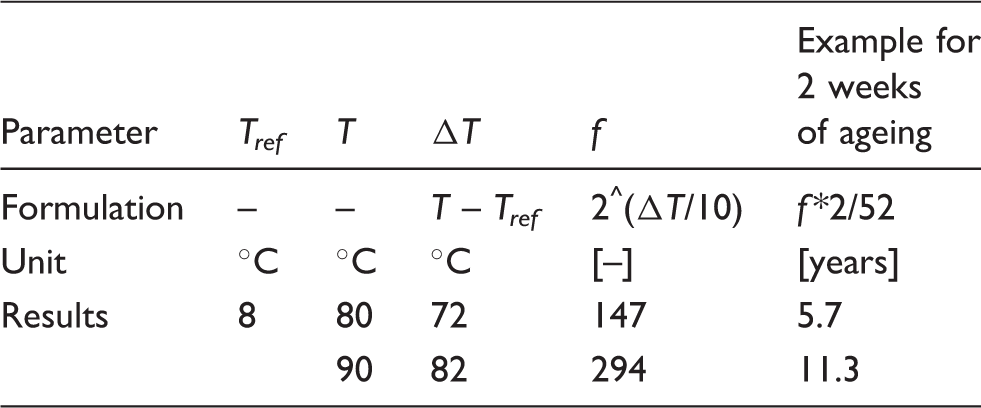
Extrapolation of ageing time according to the Arrhenius equation for two ageing temperatures

Experimental results and discussion
Strength properties and piecewise stiffness linear approximation
Firstly, the estimation of the tensile properties of the AF9032 material was made for all the tests performed at temperatures of 80℃ and 90℃ for three different strain rates and for both material directions. For the warp direction two ( Typical stress–strain curves of coated fabrics with characteristic linear sections and the notation of longitudinal stiffness for the uniaxial tensile tests.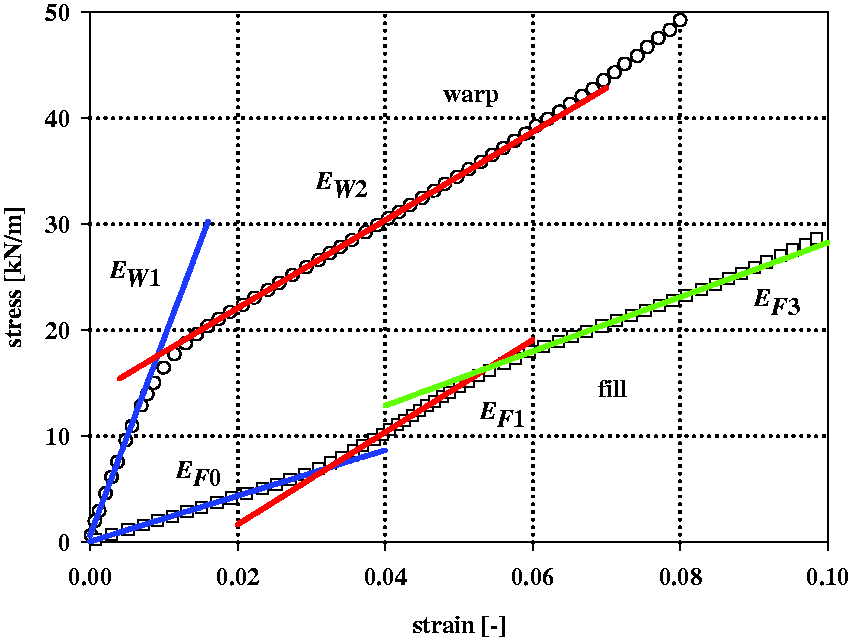
To better understand the evolution over the ageing time of the above-mentioned parameters, their values have been separately plotted versus the ageing time with distinction for the warp and fill directions (Figure 4). Each presented parameter value is the mean value of six tests (all tests for three different strain rates) made for the certain direction of the fabric. All of the results are presented in the normalized form of Tensile strength parameters (
The results have also been redrawn with respect to the ageing time recalculated into “real” time according to the Arrhenius simplified law – see Equation (2). If the evolution curves of the parameters of both temperatures fall into the same path, it confirms that the values of the obtained parameters actually follow the Arrhenius equation.
The analysis of the results from Figure 4 can be summarized in the following points.
The stiffness For both fabric directions and the ageing temperature of 80℃, the increase of The longitudinal stiffness The technical yield limit The ultimate tensile stress and strain ( Almost all strength parameters for AF9032 fabric (apart from Analyzing the Arrhenius extrapolation of the results, it is seen that the ultimate tensile properties (
Bodner–Partom model parameters
The Bodner–Partom model formulation
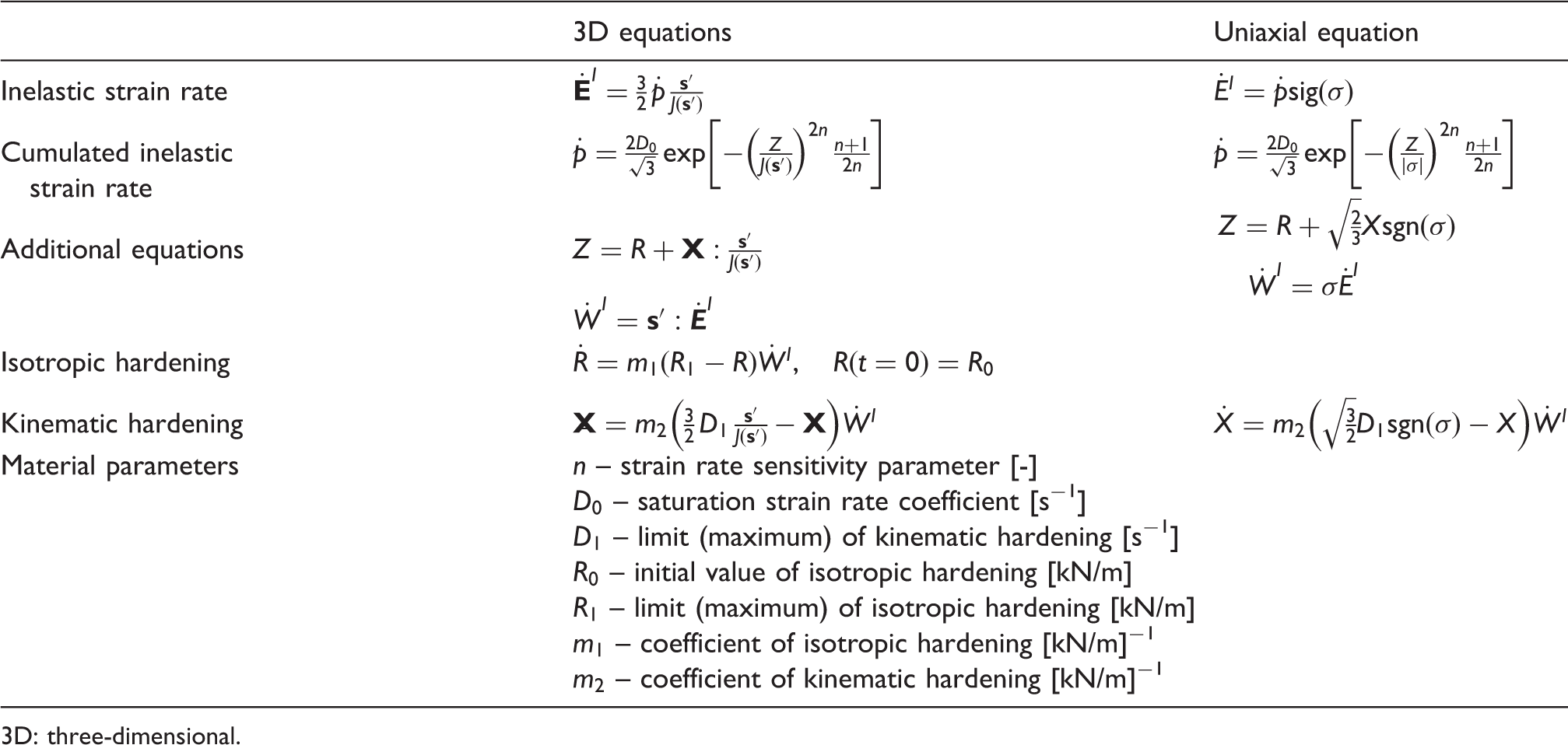
3D: three-dimensional.
Like in the previous section, for the clarity of results presentation, each parameter has been normalized by the reference value determined for the sample aged only for 1 hour and then plotted versus ageing time, for the warp and fill directions separately (Figure 5). The parameter of the maximum strain rate has been assumed constant Variability of the Bodner–Partom model parameters (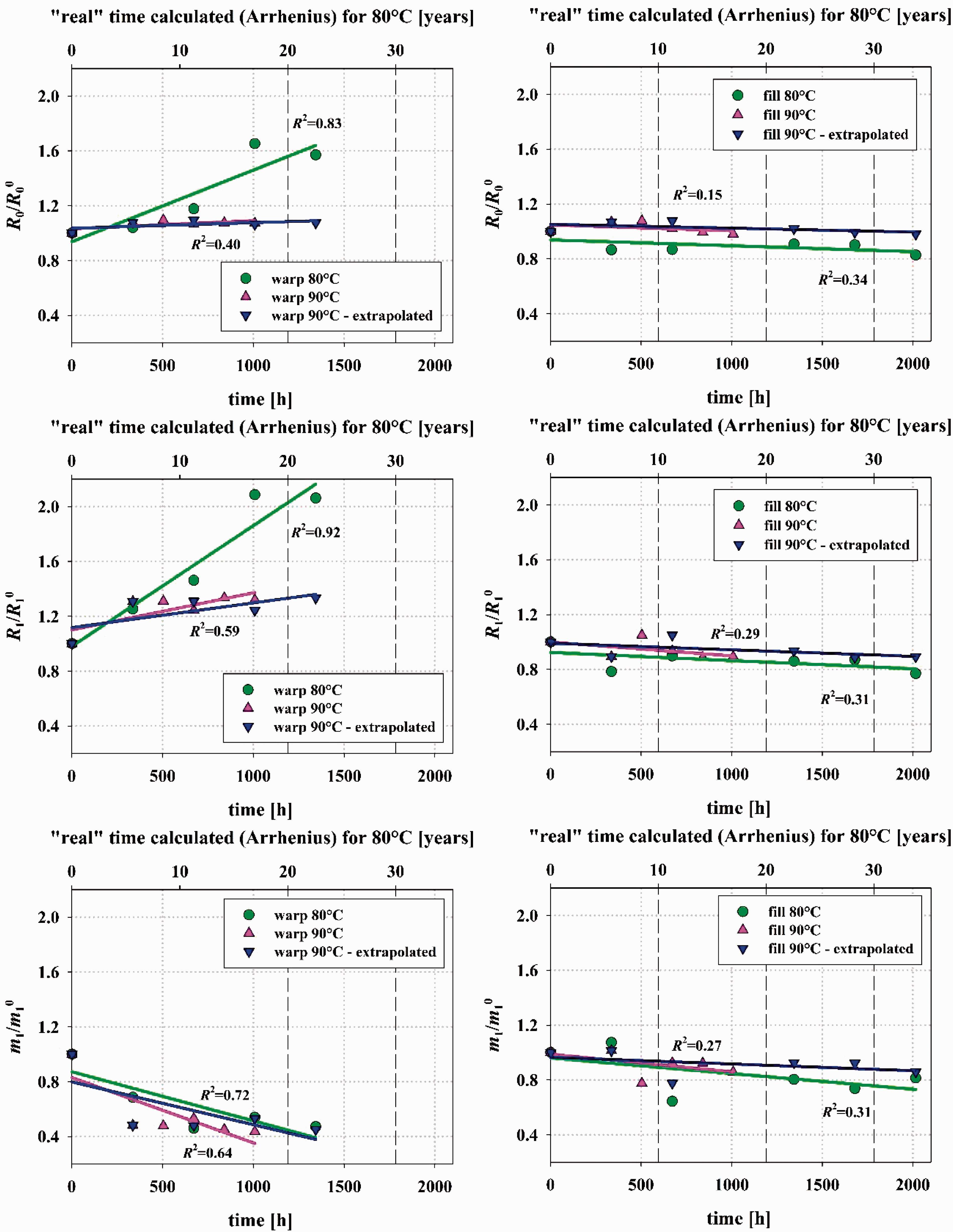
The most important observations made from Figure 5 can be summarized as follows.
The parameters of the initial The maximum value for kinematic hardening The parameter Comparison of the coefficients The temperature of 90℃ for the warp direction does not influence the value of the strain rate sensitivity parameter n. However, the temperature of 80℃ causes a great decrease of the values of this parameter. For the fill direction the tendency is the same for both temperatures – it results in an increase, which is a little more pronounced for the temperature of 90℃ Evolution over the ageing time of all observed parameters in the presented case can always be described by linear functions with good convergence. All of the parameter trends for the temperature of 80℃ and extrapolated for 90℃ in the fill direction coincide well and the evolution of the parameters concerning isotropic hardening (
For validation of the proposed Arrhenius ageing theory, the obtained results should be superposed with the results from the same material aged in real conditions. Therefore, the results of the piecewise and Bodner–Partom model parameters reported in the current study have been compared with the analogous parameters found during comparative analysis between real, in-service aged material and the same material but without service ageing. 51 The in-service and laboratory ageing have resulted in an increase of PVC stiffness EF0 (fill direction), decrease in UTS (the warp and fill directions) and decrease in elongation at break ɛ ult for the warp direction. The stiffness of the threads (EW1, EF1) did not change upon service ageing, but in the case of the artificial ageing the tendencies of the results were not as obvious, as it occurred that the temperature of ageing played a great role. The influence of both ageing methods also influenced in the same manner the Bodner–Partom parameters D1 and m1, while the tendencies of the remaining parameters depended on the temperature level, which are of key importance due to the physical ageing taking place in polymer materials at the appropriate temperature level. For a more detailed analysis of the service ageing influence on the mechanical properties of the technical fabric, the study of results reported by Żerdzicki et al. 51 is suggested. Both of the fabrics, VALMEX analyzed in aforementioned paper and AF9032 in the current study, are polyester-reinforced PVC coated fabrics, but it should be remembered that producers and time of manufacturing is different for both fabrics and therefore conclusions based on material comparisons must be drawn with care.
Conclusions
The presented work considers the investigation of the influence of the ageing phenomenon on the mechanical behavior of polyester-reinforced PVC coated fabrics used in civil engineering structures. The testing program covered the artificial ageing of the AF9032 material at two temperature levels of 80℃ and 90℃, and included the identification of strength parameters and the Bodner–Partom model parameters.
It has been revealed that the thermal ageing has influenced mostly the behavior of the PVC coating, which has become more rigid over time. It has been also shown that the fabric is more prone to accelerated ageing at elevated temperatures for the fill direction than for the warp direction. This phenomenon could be explained by the manufacturing process of the knitted fabrics. The yarns in the warp direction have been probably prestressed during the prefabrication coating process and therefore become stiffer. In the fill direction the yarns have not been prestressed, giving greater material elongation and becoming more prone to the thermal treatment.
Another observation is that the evolution over time of most strength parameters and the Bodner–Partom model parameters for AF9032 fabric can be easily approximated by linear functions with very good correlation for temperatures of 80℃ and 90℃. This finding can be used for modeling the behavior of the fabric material in the numerical calculations for the elasto-viscoplastic approach as the linear dependence of the model parameters in the function of temperature and time.
The results of the thermal ageing have been extrapolated for much longer time periods using the Arrhenius methodology. The correctness of this approach has been tested by the superposition of the results obtained for temperatures of 80℃ and 90℃. For the fill direction, the lines describing the evolution of mechanical parameters over ageing time coincide fully for the UTS and elongation at break and are parallel for the Bodner–Partom model parameters (
The predicted response of the material theoretically used for 20 years was then compared with the corresponding results concerning similar architectural fabric (VALMEX polyester-reinforced PVC coated, 1 mm thickness) but aged in natural service conditions for about 20 years. 51 For the VALMEX material the basic mechanical properties as well as the piecewise linear, Burgers and Bodner–Partom model parameters were identified from the data obtained through the wide range of different experiments. The comparative analysis between the thermal accelerated and natural service ageing results (piecewise linear model, Bodner–Partom model) suggested that the Arrhenius methodology offers quite good prediction of the fabric performance. Therefore, the findings of the model identification and parameter evolution relations acquired from the accelerated laboratory ageing tests can be used in the finite element method (FEM) calculations of textile structures taking into account ageing effects. During the design process of structures made of architectural fabric, it could be estimated how the particular mechanical property will change depending on time taken for calculations using the linear relations obtained within the presented research.
Footnotes
Declaration of conflicting interests
The authors declared no potential conflicts of interest with respect to the research, authorship and/or publication of this article.
Funding
The authors disclosed receipt of the following financial support for the research, authorship, and/or publication of this article: This work was supported by the Faculty of Civil and Environmental Engineering at Gdansk University of Technology (grant GRAM (2017–2018)), a scholarship for young Polish researchers aimed at their scientific and developmental work in a year 2014–2016, and the French Government (Bourse du Gouvernement Français).