




Abstract
Novel textile moisture sensors based on multi-layered braiding constructions offer attractive monitoring possibilities for many application fields of e-textiles (electronic textiles), especially for ambient air, which is the main focus of this work. In this paper the theoretical foundations and the production, as well as the procedural, mechanical and humidity tests on newly developed, textile-based sensors for moisture measurement are described. The sensor, which is based on a capacitive measurement principle, was tested in environments ranging from 22% to 94% relative humidity. Within this range, the electrical capacitance of the sensors changed up to 135% of the base capacitance, giving it a very high sensitivity.
Humidity is one of the essential components of the near-Earth atmosphere and it therefore has a considerable influence on people, machines and technical processes. 1 Humidity sensors are used to monitor this influence. The relative humidity (RH), as a complex physical parameter, depends on both temperature and pressure. In the immediate vicinity of machines and processes, the temperature and pressure can deviate greatly from the rest of the environment. This also applies to the human body. 2 The physiologically relevant moisture range (22–94% RH) was at the focus for the design efforts presented here.
Transportable sensor systems are particularly important for the monitoring of human body functions in the areas of health care and sports. The sensors must not interfere with the carrier in these areas of application, but they must nevertheless deliver reliable and accurate measured values. There is also a need for flexible sensors in technical processes. The closer the sensors can be used to the process without influencing it, the more meaningful the measured values obtained are.
Possible medical uses of the flexible sensors are, for example, the monitoring of prosthesis with smart skin, 3 e-textiles in assisted physical rehabilitation scenarios 4 or sports medicine. 5 Furthermore, flexible/stretchable electronics and especially sensors are of current interest in other application fields, such as infrastructures, 6 soft robotics 7 and many more. 8 Despite their enormous economic importance, flexible moisture sensors, which can be integrated directly into textiles, are not available today.
A large number of sensor types and concepts exist that have the task of monitoring humidity. The sensor concepts are based on different physical effects to detect moisture. Most sensors use capacitive, resistive, frequency-dependent or optical effects.
Most widely used for industrial applications are capacitive sensors. 9 With these sensor types, a thin layer of hygroscopic material is used as a dielectric layer between the electrodes. Capacitive sensors with very fine dielectric layers can be produced easily and economically using thin-film processes. In addition to their low price, they are characterized by their high electrical capacitance and low measurement uncertainty. As dielectric materials, polyamides (PAs) or acetates are usually used, but other hygroscopic polymers, such as poly-2-hydroxyethyl methacrylate (pHEMA) 10 or cellulose acetate butyrate (CAB),11,12 are currently under research. In addition, comparatively exotic materials, such as microporous aluminum phosphates, for example FeAPO-5, are also investigated as dielectric. 13
The measuring principle of the resistive moisture sensor is based on the change of the electrical surface resistance of hygroscopic, ionic materials depending on the relative air humidity. 14 The hygroscopic sensor layer absorbs moisture from the ambient air up to a state of equilibrium. The conductance of the material decreases exponentially to the absorbed moisture content. In addition to porous ceramics, 9 salts, 14 ionic polymers,15–17 electrolyte liquids 18 or carbon nanotubes (CNTs)19–21 are used as materials.
None of the above-mentioned measuring principles, however, are entirely suitable to integrate sensors into a bandage, a band-aid, a piece of cloth or clothing due to their material, measuring method and/or the high requirements of accuracy and flexibility under mechanical stresses and large-area application. Flexible approaches, such as printed sensors based on films, can be stretched and bent. The disadvantage of combining films sensors with textile materials is that the sensors are generally much stiffer than the textile, meaning an unpleasant wear. Their foil characteristics furthermore do not allow sufficient removal of sweat or other body fluids, which is essential for long-term monitoring in different areas, such as wound monitoring.22–24
Our approach for the moisture measuring in monitoring applications for e-textiles is a yarn-based sensor that offers flexible design and suitability for the integration into textiles, which provides good metrological behavior under mechanical stresses.
Materials and methods
Concept
The concept addressed here is based on a cylindrical capacitance structure, fabricated by braiding. This technique allows the processing of fine fibers and thin metallic wire materials for complex, multi-layered yarn constructions that are manufactured productively and reproducibly.
For the manufacturing of the textile moisture sensor, the braiding technology has many advantages to process a sensor based on the capacitive principle. The capacitive measuring principle is particularly well suited for the detection of air humidity, since even small quantities of absorbed water lead to a significant change in capacitance.
A braided yarn has high flexibility while maintaining good tensile strength. These abilities are especially suited for the integration into textile fabrics, such as woven, knitted or stitched structures.
Idealized capacitor structures for sensors
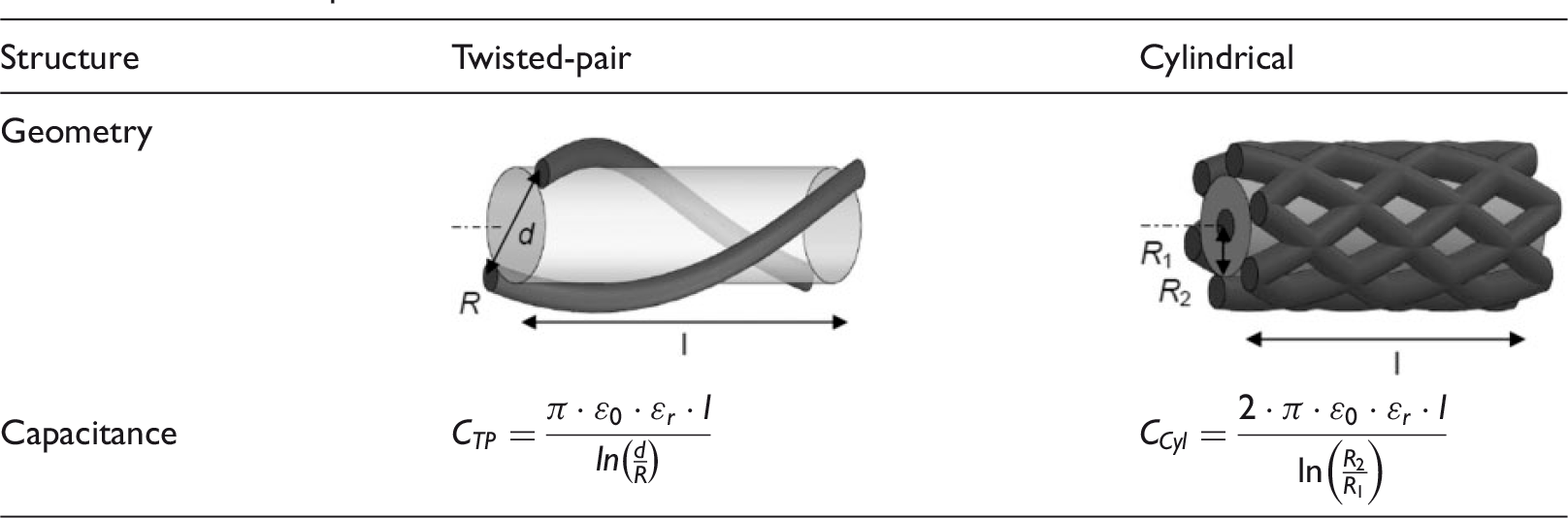
Compared to the twisted-pair capacitor, the cylinder capacitor offers almost five times the electrical capacitance with the same wire diameter and outer diameter of the sensor yarn. It has to be noted that with the open outer sheath, which is needed for accessibility to the environmental moisture, the overall electrical capacitance declines, depending on the coverage of the outer surface. 25
Materials
Both the wires and the dielectric textile materials have to fulfill textile-technological requirements. These relate primarily to the mechanical strength for textile processability. The textile materials and wires to be used must have a tensile strength of at least around 100 cN due to the geometrical conditions and given parameters of the braiding machine used for the manufacturing of the sensor yarn.
Considering the requirements of flexibility and mechanical stability, fine textile materials and thin wires were taken into consideration for the development. In braiding, the textile material is not only exposed to tensions, but also to bending and shear loads due to the process-inherent crossing of the braiding threads. Therefore, brittle materials are less suited to such requirements.
Apart from the mechanical properties needed for the manufacturing process, the textile materials for moisture monitoring have to have certain thermal, electrical and, of course, moisture absorption properties. The latter, also called hygroscopicity, depends on the following factors
26
τηɛ presence of hydrophilic functional groups carboxyl (-COOH), sulfonic (-SO2OH), hydroxyl (-OH) and amine (-NH2); accessibility of the above groups to external moisture; porosities in which water molecules can accumulate.
A distinction is made between the reaction of gaseous and liquid water onto the surface of the textile. Gaseous water (steam), first deposits on the fiber surface. This adsorption process takes place within a few seconds and depends on the prevailing surface forces of the fiber substance, the number and type of functional groups, surface roughness and overall available fiber surface. In general, fibrous materials have very large surfaces due to their structure, giving them preferable adsorption properties.
Moisture absorption of selected fiber materials

For the conductive material, enameled copper wire was chosen, given the high conductivity and good isolation properties. Copper wire with a diameter of 120 µm also has good mechanical flexibility, meeting the requirements for the braiding process.
The airspun viscose yarn from Lenzing AG was manufactured with an Air-Jet Spinning Tester J20 (Rieter Holding AG, Swiss). The enameled copper wire Type P155 with a diameter of 120 µm was purchased from Elektrisola GmbH & Co. KG, Germany.
The different salts KC2H3O2, K2CO3, NH4NO3, NaCl, (NH4)2SO4 and KNO3 for adjusting the moisture level in the desiccator were purchased from Sigma Aldrich/Merck KGaA, Germany.
Methods
An RU 2/12-80 braiding machine by August Herzog Maschinenfabrik GmbH & Co. KG, Germany, was used for the production of the braiding yarn. For the first production step, the inner conductor was braided. Six enameled copper wires were produced with a braiding pattern of 1:1-1 (diamond braid half load) and a braiding density of 5.77 braids per 10 mm. This braided inner conductor both offers a high stability under mechanical loads (tension) while maintaining a high bending flexibility and also offers an increased electrical capacitance of the structure (see Table 2). The second production step is the overbraiding of the inner conductor with 12 viscose yarns (each 19 tex), forming the dielectric sheath. A braiding pattern of 2:2-1 (regular braid) was used, with a braiding density of 11.54 braids per 10 mm. The third and final production step was the overbraid of the previously manufactured structure with the outer conductor. To achieve the accessibility of the sensor for the ambient air, an open structure has been braided using six enameled copper wires. A braiding pattern of 1:1-1 and a braiding density of 5.77 braids per 10 mm were used. All braids were manufactured with a machine speed of 200 rpm. The final sensor yarn with skinned and crimped connections is shown in Image 1.
Manufactured sensor yarn with crimped connections.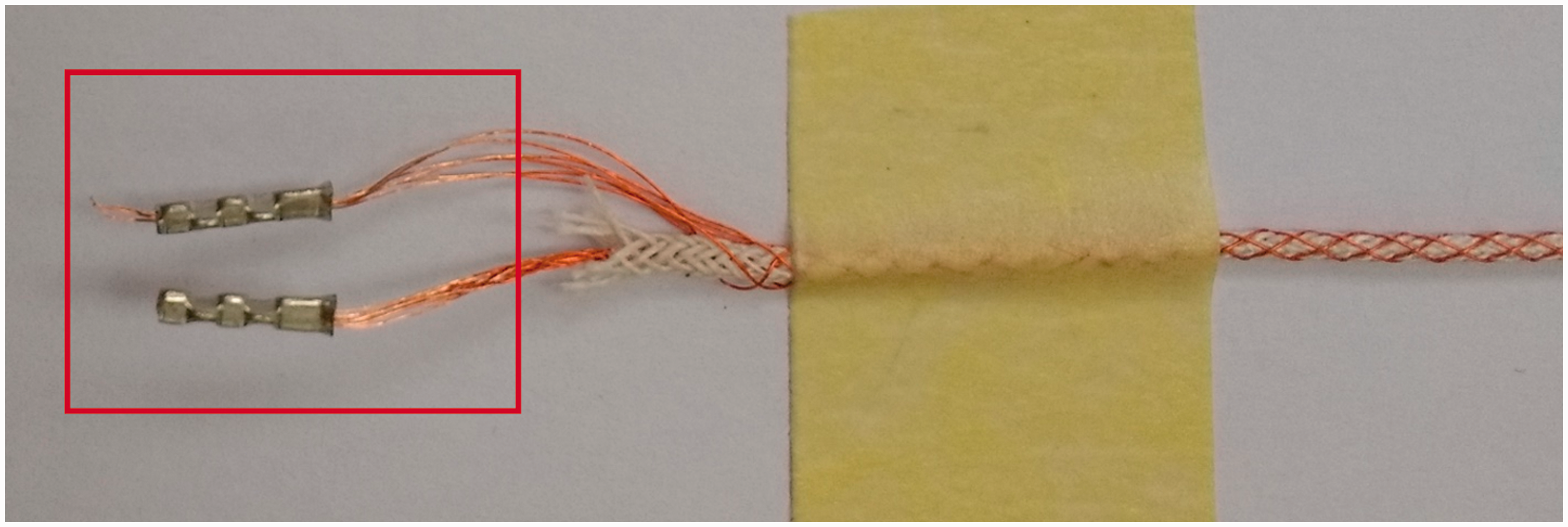
To measure the capacitance, an LC Meter AE20204 by Ascel Electronic, Germany, with a resolution of 0.01 pF was used. The fineness of the yarns were determined based on DIN EN ISO 2060. 27 To determine the dry mass of the yarns, the method according to DIN 53800-T1 was used. 28
A reference sensor DHT22 was purchased from Aosong Electronics Co., Ltd, China. The specified measuring accuracy is maximum ±5% RH. The data signal of the reference sensor was collected with a Raspberry Pi 3 Model B, purchased from Raspberry Pi Foundation, UK.
The test setup for the measurement of sensitivity by means of the change of the electrical capacitance (sensor output) for varying humidity levels (sensor input) is shown in Image 2.
Testing of humidity levels with the desiccator and reference sensor.
For the determination of the characteristic curve of the sensors, solutions with different salts were prepared to adjust the desired humidity levels within the desiccator. The samples of the developed sensor and the reference sensor were stored for 20 hours within the desiccator, while the final signal was used for data. The used salts and related humidities are as follows: KC2H3O2 (22.5% RH), K2CO3 (43.2% RH), NH4NO3 (65% RH), NaCl (75.5% RH), (NH4)2SO4 (81.3% RH) and KNO3 (94.6% RH). This test was repeated four times with each salt.
The absorption behavior was tested in 65% RH (NH4NO3) and 94.6% RH (KNO3). The electrical capacitance of the developed sensor and the humidity given by the reference sensor were recorded for 20 hours.
To test the ability of the sensors for dynamic, rapid humidity changes, the desiccator were prepared with 94.6% RH (KNO3) to achieve a high difference compared to ambient humidity. The lid of the desiccator was lifted up after 2 hours of conditioning and closed again after 30 minutes of exposure to the ambient humidity. Two dynamic circles were carried out, both with the developed sensor and the reference sensor.
All samples used for the determination of the sensor characteristics, absorption behavior and the dynamic humidity changes were prepared with a length of 20 cm.
A test setup (Image 3), specifically developed for bending tests, allowed multi-cycle bending with a defined bending radius and angle by providing an adjustable piston rod and bevel gears. With a bending radius of 2 cm and a bending angle of 120°, the yarns were examined regarding the influence of bending on metrological properties. The electrical capacities of the samples were measured prior to insertion into the clamp, as well as before and after loading (15 minutes, which corresponds to ca. 300 bending cycles).
Test setup for the bending test.
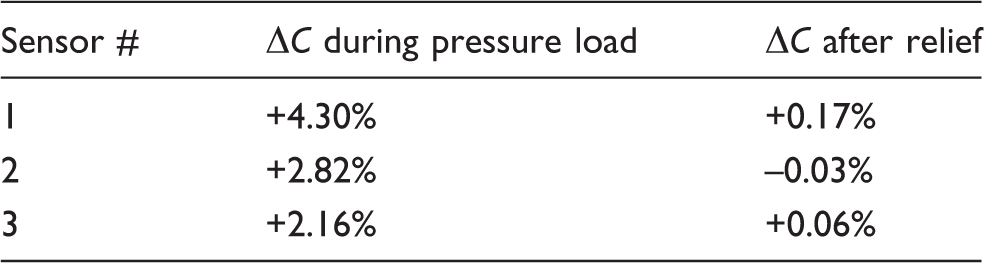
A pressure test was conducted using two small acrylic glass blocks (Image 4). The weight of the upper block and added masses accumulate to 725 g. Given the area of the block, a pressure of 10.33 kPa applied to the yarn. The electrical capacitance was recorded before and during the 15 minutes of testing as well as afterwards.
Test setup for the pressure test without additional weight.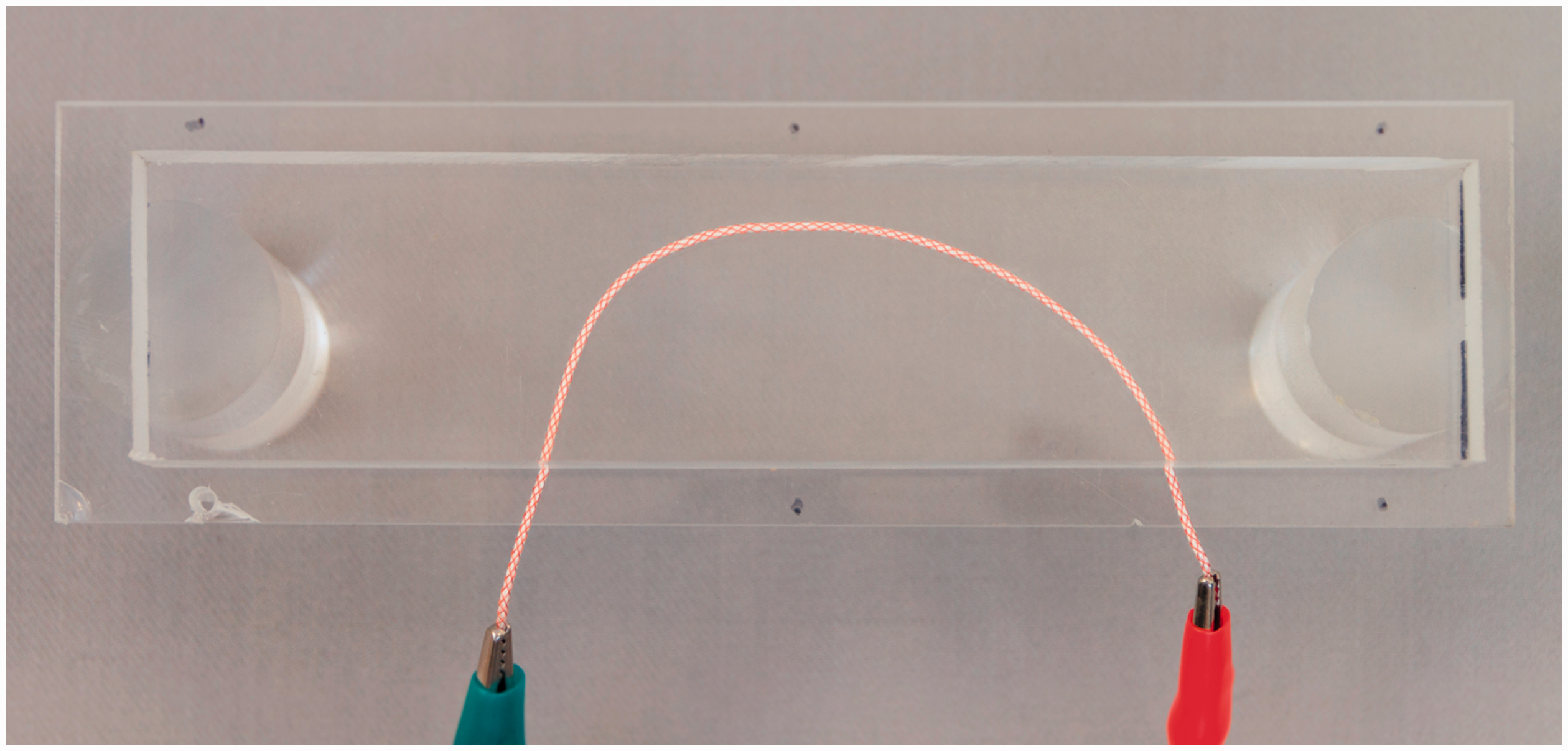
All samples used for test of the influence of bending and pressure were prepared with a length of 15 cm.
The sensor stability regarding tensile load was determined by using different masses, while one end of the sensor was attached to a fixed suspension with a clamp. The overall length of the test samples was 25 cm, while the effective length where elongation occurred was about 21 cm. The mass of the clamping and suspension system (15 g) for the attachments of the masses has been taken into account.
Results and discussion
Sensitivity
The determination of the sensitivity and therefore the sensor characteristic curve was conducted on one sample. The recorded data for the electrical capacitance signal of the developed sensor, including the deviation of the four repeats for reproducibility and the corresponding data for the given humidity according to DIN EN ISO 1257129 from the reference sensor (including the deviation according to the specified measuring accuracy of maximum ±5% RH
30
), are given in Figure 1.
Change of resistance of the tested sensor yarn in comparison with the reference sensor and the absorption isotherm according to DIN EN ISO 12571.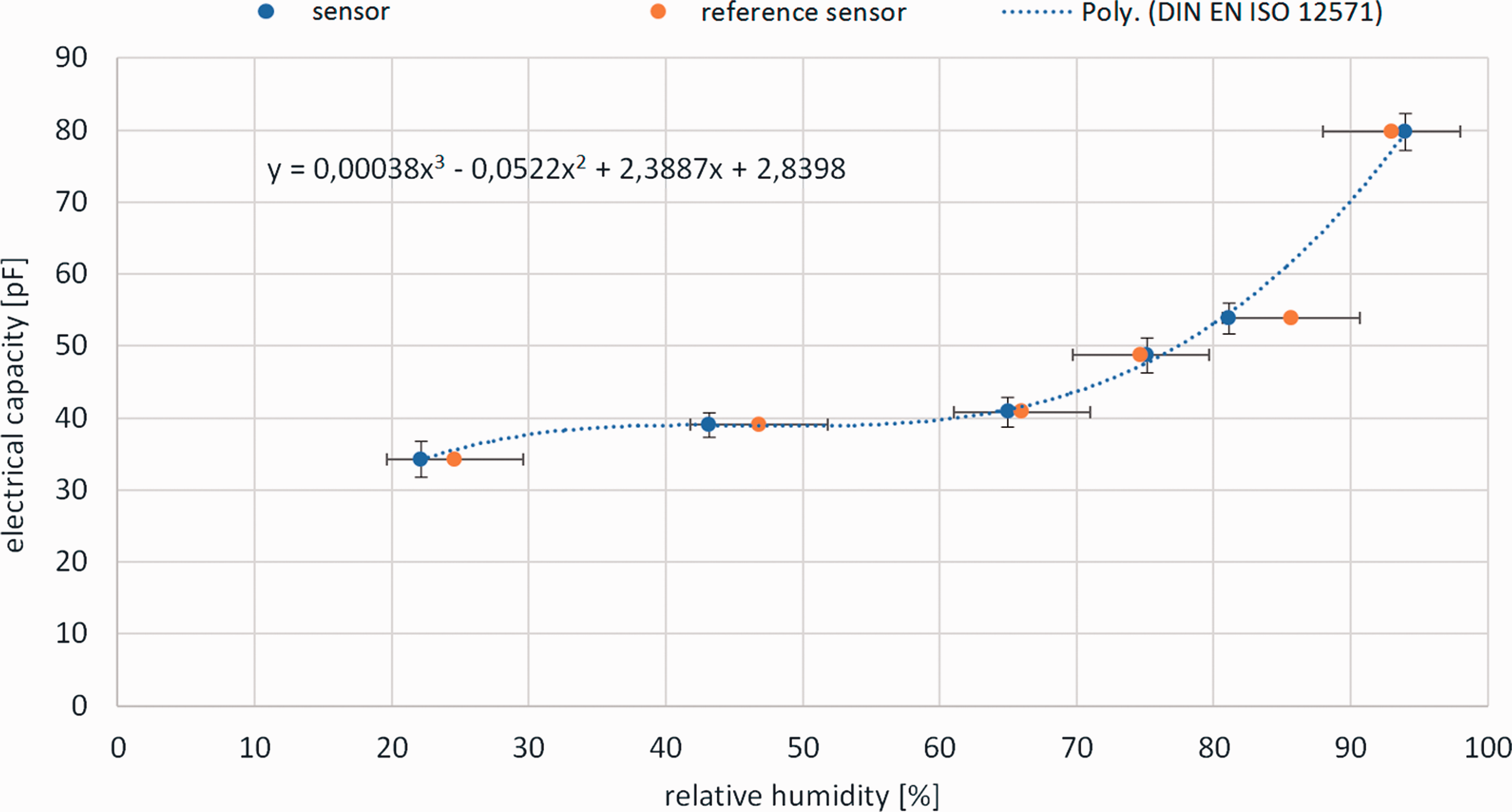
The sensor behavior highly correlates with the absorption isotherm of the fiber material according to Bobeth,
26
where the relation between the humidity level and the water content is given. As expected, the sensitivity highly depends on the humidity levels, showing a rather low sensitivity in the range of 35–55% RH but a very high sensitivity from 65% RH and above. The sensor characteristic curve of the corresponding humidity level rH to the capacitance C can be expressed with Equation (1), where the first term is given with an additional decimal number because of the higher influence, caused by the third power

Behavior during humidity changes
Both for the absorption behavior and the dynamic absorption behavior of the developed sensor, the RH has been calculated with the formula for the acquired sensor characteristic curve. The sensors absorption behavior and the reference sensor recorded humidity is given in Figure 2.
Absorption behavior of the developed sensor and reference sensor.
A stable plateau (deviation of < 5% of the final value) was reached by the developed sensor after about 10 hours, while the reference sensor leveled after 4 hours.
In Figure 3, the dynamic behavior of the developed sensor yarn is shown in contrast to the reference sensor.
Signal of dynamic humidity changes of the developed sensor and reference sensor.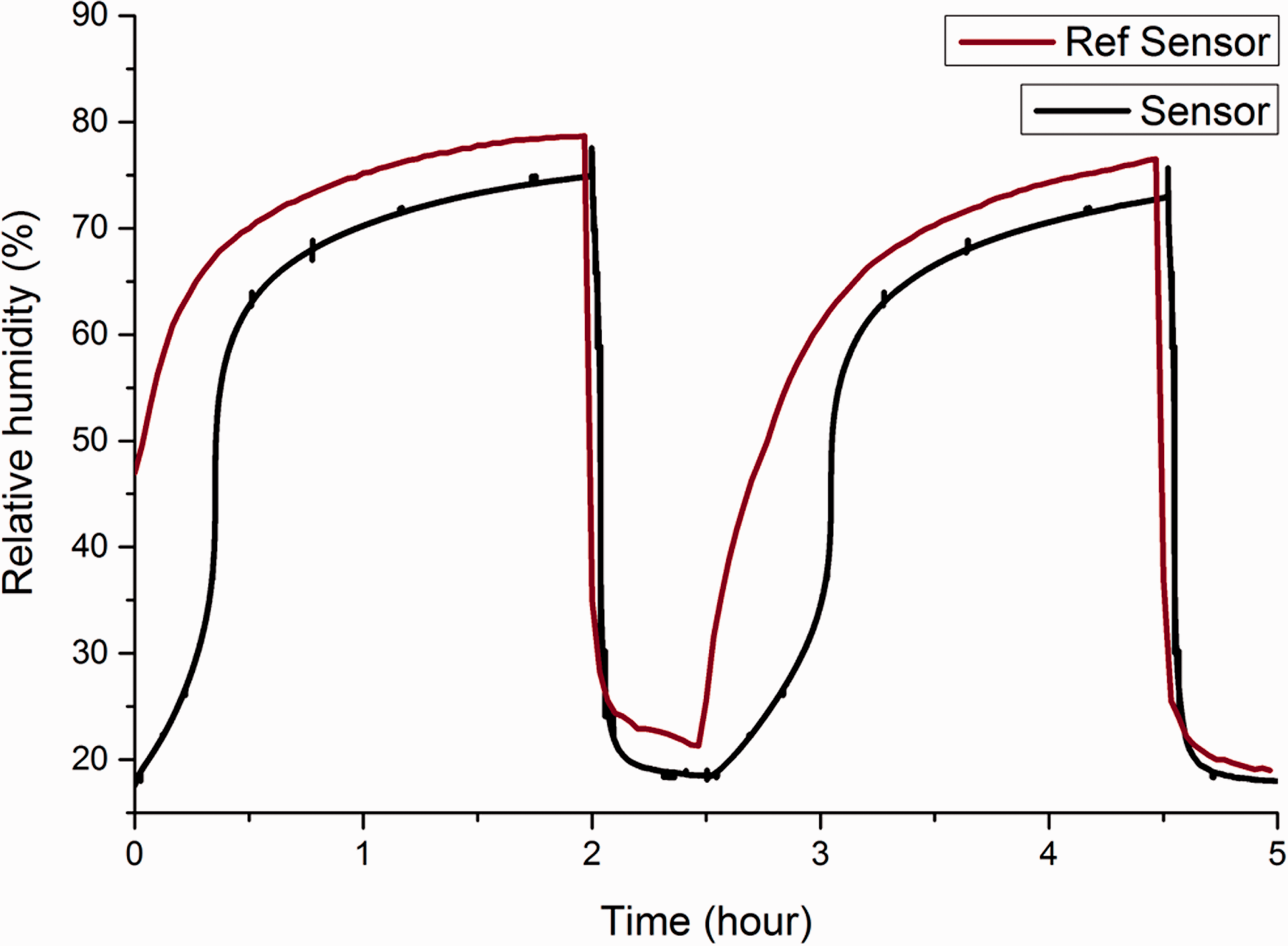
The developed sensor behavior correlates to the reference sensor. The difference in the response of the developed sensor in contrast to the reference sensor is probably caused by different moisture absorption abilities. The usage of a different, non-textile hygroscopic polymer material as a sensing element in the reference sensor as well as the thin planar sensor layout 30 allows higher adsorption rates of humid particles. It has to be noted that, in regard to the absorption behavior mentioned before, neither the developed sensor nor the reference sensor leveled out during the dynamic humidity changes.
Influence of mechanical stresses
After the bending stress test with the three sensors, increases in electrical capacitance of 0.28%, 0.58% and 0.93% were detected. According to the hygrometer in the laboratory, the humidity in the test environment was about 30% RH. With the humidity level in this test environment and the given sensors characteristics, this would correlate to a deviation of about ± 1.5% RH.
Influence of pressure stress
Influence of tensile stress
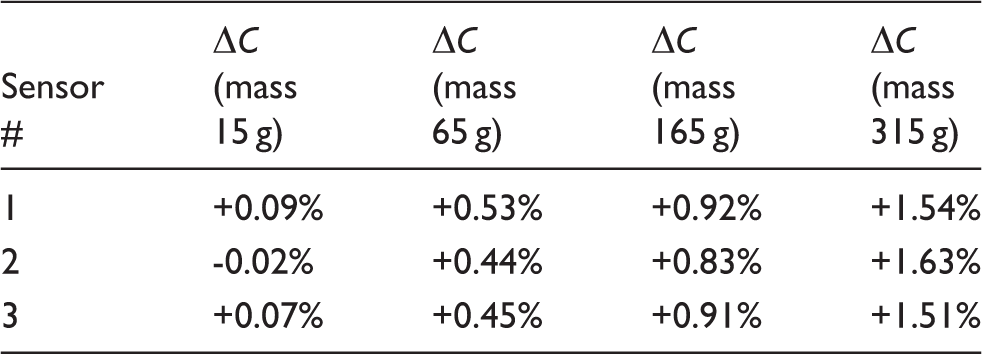
The bending, pressure and tensile tests show high metrological stability of the developed sensor during mechanical stresses.
Conclusions
A reproducible production of moisture sensor yarns by braiding has been proven to be feasible. The developed textile-based sensors for medical applications are highly flexible and also metrologically stable under mechanical loads, such as bending, pressure and tensile. The sensors show a high sensitivity in the tested humidities above 65% RH.
The novel approach of manufacturing moisture sensors using purely textile technologies like braiding opens up a wide range of possible applications in e-textiles while offering superior mechanical flexibility compared to common sensors. Furthermore, they are easy to produce with known textile materials as well as easy to assemble.
Further development will include the usage of finer yarns to miniaturize the sensor configuration, thus creating an even higher sensitivity and faster settling times while enabling a better integration into textile fabrics.
Footnotes
Declaration of conflicting interests
The authors declared no potential conflicts of interest with respect to the research, authorship and/or publication of this article.
Funding
The authors disclosed receipt of the following financial support for the research, authorship, and/or publication of this article: The authors declare that there is no conflict of interest. The IGF research projects 17826 BR/1 and 18640 BR/1 of the Forschungsvereinigung Forschungskuratorium Textil e. V. in cooperation with the Forschungsgesellschaft für Messtechnik, Sensorik und Medizintechnik e. V. are funded through the AiF within the program for supporting the “Industriellen Gemeinschaftsforschung (IGF)” from funds of the Federal Ministry of Economics and Energy (BMWi) by a resolution of the German Bundestag.