



Abstract
This study presents the functionalization of organic cotton fabric (OCF) by green synthesized silver nanoparticles (AgNPs). Nontoxic sodium alginate (SA) was utilized as a reducing and stabilizing agent. Scanning electron microscopy (SEM), Fourier transform infrared spectroscopy (FT-IR), X-ray diffraction (XRD), thermogravimetric analysis (TGA), UV–vis spectroscopy, color coordinates, Ag content, and release (%) were used for characterization of the AgNPs and the functionalized OCF. The results reveal that AgNPs were successfully deposited on the surface fibrils of the OCF. Optimistic colors were observed from the treated OCF due to the localized surface plasmon resonance (SPR) of AgNPs. Moreover, studies of mechanical properties in terms of breaking strength and elongation at break (%), crease recovery angle, bending length, and hand-feel were performed, and better results were found in comparison with the control OCF. It was also observed that the presence of AgNPs significantly enhanced the UV resistance and antibacterial activity of the OCF.
Textile surface modification has a significant impact on garments, particularly in terms of mechanical strength and comfort, whereby it offers new and diverse properties. At present, functional finishes on textile fabrics have vital significance in enhancing fabric products via multifunctional properties. The functional finishes (i.e., antistatic, durable press, antimicrobial, dirt-resistant, flame resistant/retardant, waterproof/repellent, wrinkle recovery, self-cleaning, and UV protection) are commonly implemented specifically to adjust properties associated with care, comfort, and durability.1,2 There have been many attempts in recent years aimed at enhancing the functionalities of textiles. In particular, the application of noble metal nanoparticles has turned out to be one of the most important means for the production of multifunctional textiles. 3 Among them, silver nanoparticles (AgNPs) have attracted much attention because of their low toxicity and unique antibacterial and antifungal performance. It is worth noting that Ag has been historically used as an antibacterial agent.4,5 AgNPs have enhanced antimicrobial performance, which can be attributed to the nano-size of the particles. 6 Moreover, metal particles can provide better coloration because of their localized surface plasmon resonance (SPR) capabilities.7,8 Therefore, different approaches, including physical, chemical, and biological methods, have been introduced for the synthesis of AgNPs. 9 It has been noted that physical and chemical methods are costly and generate hazardous by-products. Thus, there has been an increasing interest in “green” synthesis methods.10–12 Motivated by the need to minimize the generated hazardous waste, the fundamental principles of green chemistry are utilized.13–15
The primary requirements for the green synthesis of AgNPs include the use of nontoxic substances, eco-friendly solvent medium, and environment-friendly reducing agents to enhance the stability. 16 In this context, sodium alginate (SA) can be a good choice as it is a natural bio-based polymer that can be extracted from brown marine algae (Phaeophyceae) as a hydrophilic anionic polysaccharide. It is worth mentioning that the toxicity of AgNPs primarily occurs due to leaching of the Ag ions from AgNPs, 17 and this can be minimized by a nontoxic capping agent such as SA. As SA has abundant multifunctional groups in its structure, it could act as an excellent stabilizer for colloids and an admirable preventer of agglomeration in the synthesis of homogeneous AgNPs. 18 We have also demonstrated in our previous report that it can be used as both a reducing and stabilizing agent at different reaction times and temperatures. 19 In addition to its availability, cost, and wide application in textiles, SA has the capability to form a double network.20,21. For example, it has been frequently used with reactive dyes in the preparation of thickener for digital ink-jet printing paste. 22
Meanwhile, researchers have found that the –OH functional groups of the cellulose fabric surface can absorb Ag+ ions, and at the same time Ag+ ions behave like seeds that cause the deposition of reduced AgNPs. 23 Chemical reduction has been considered as the most viable method for the synthesis of AgNPs in the presence of a distinct reducing and stabilizing agent. However, most reducers are available as hydrazine and N,N-dimethylformamide, which have high reactivity and toxic effects for the environment and bioorganisms, which limits their diverse application. 24 To overcome these issues we have used a natural polysaccharide, SA. 25 There are numerous complex and time-consuming methods, such as sonochemical coating, 26 in-situ synthesis, 27 and immobilization, 28 . that have been reported to functionalize the cotton surface by using metal NPs. For example, Huang et al. suggested that thermal stability and flame-retardant properties of cotton fabric can be improved via graphene nano-coatings. 29 Ding et al. recently studied hybrid NPs for photocatalytic activities toward dye degradation and formation of regenerated cellulose films.30–33
Nowadays, academic and industrial researchers are interested in the use of organic cotton in textile applications.34,35 The organic cotton production process is different from the traditional cotton production process. Genetically modified organism seeds, synthetic fertilizers, herbicides, insecticides, pesticides, and toxic chemicals are not used in organic cotton production. 36 Therefore, in order to overcome the complexity, we have introduced a facile and cost-effective method in this study for embedding AgNPs on organic cotton fabric (OCF) surfaces via “dip and dry coating.” To the best of our knowledge, no report has been made to demonstrate the functionalization of OCF by SA mediated AgNPs, especially for the preparation of UV-protected colored fabric. The OCF coatings with AgNPs show satisfactory stability and fastness. Moreover, AgNPs-functionalized OCFs have good mechanical characteristics with the functions of UV protection, antibacterial activity, and superior coloration effect.
Experimental
Materials
Plain weave 100% bleached OCF were purchased from Henan Pingmian Textile Group Co., Ltd. (Pingdingshan, China). AgNO3 (Shanghai Zhanyun Chemical Co., Ltd., Shanghai, China), sodium alginate (SA, Mw ∼ 68,000 Da, Qingdao Yingfei Chemical Co., Ltd., Qingdao, China), sodium hydroxide (Sinopharm Chemical Co., Ltd., Beijing, China) were used to synthesize AgNPs. Nonionic commercial detergents were used to wash the OCF sample. All chemicals were used as received.
Green synthesis of AgNPs
Green synthesis of AgNPs was done according to our previous report.19,37 Briefly, silver nitrate salt was used to prepare 1.0 mM AgNO3, while deionized water was used to prepare 1% w/v of SA solution; 100 ml deionized water was also used to prepare the NaOH solution by dissolving NaOH (0.399 g). In a typical process, 4.0 ml of silver nitrate (0.001 M) solution was added into 1.0 ml SA (1% w/v) solution. To maintain pH 11 and accelerate the reaction, NaOH solution (approximately 1.0 ml of 0.01 M) was added. It was stirred for 1 min and kept in a heat bath (60℃) for 40 min. A significant change in color from colorless to pale yellow and then to brownish-red is noticed, indicating the formation of AgNPs.
OCF functionalization
The OCF was washed, dried, and then cut into a number of pieces of size 20 × 20 cm. The pieces were then immersed independently in colloidal solutions of AgNPs at concentrations of 70 ppm and 35 ppm in a shaking bath while maintaining a material to liquor ratio of 1:100 at 60 rpm for 60 min. In order to ensure an eco-friendly and cost-effective technique, no other chemical—such as a binder, bridging agent, or fixing agent—was used. The samples were then dried in an oven for 20 min at 70℃. For thermal fixation of AgNPs on the OCF surface, a curing operation was carried out for 5 min at 120℃. The schematic diagram of the functionalization process is illustrated in Figure 1.
Schematic diagram of Ag nanoparticle synthesis and treatment of organic cotton fabric.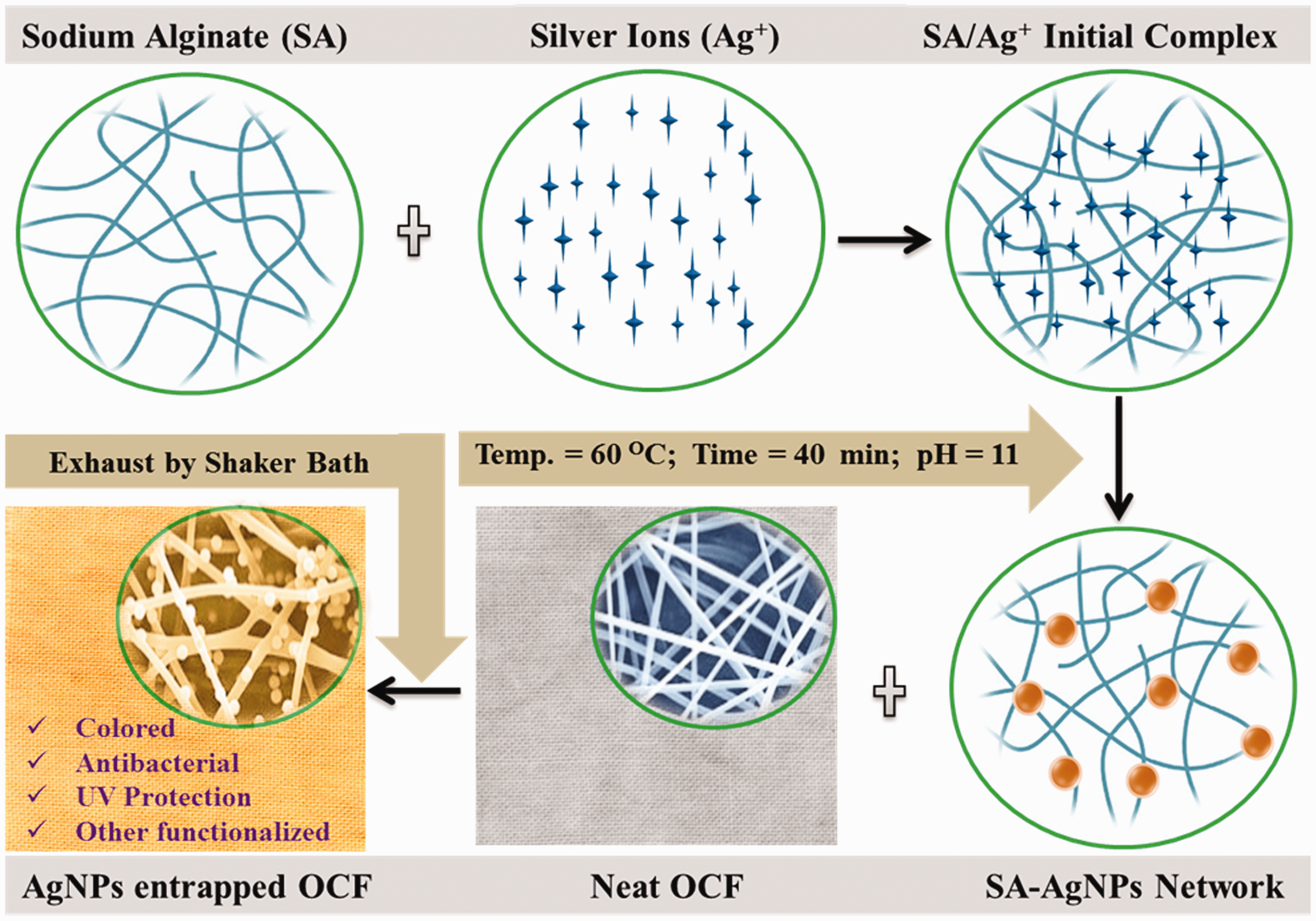
AgNP-treated OCFs were then washed by immersing them in a washing solution of 10 g/L nonionic commercial detergent with a material to liquor ratio of 1:40. Then, the OCF pieces were stirred for 15 min at 60℃ followed by gentle squeezing. They were finally rinsed 15 times with tap water. The control OCF was used as a control sample for comparison.
Characterization
Spectroscopic studies were performed on a Shimadzu UV −2600 spectrophotometer (Shimadzu Corporation, Kyoto, Japan) with a wavelength range of 200–700 nm. After silver coating, scanning electron microscopy (SEM) equipment (JEOL, Tokyo, Japan) was used for examination of the morphologies of the samples. X-ray diffraction (XRD) was carried out using a Bruker D8 ADVANCE XRD (Bruker, Karlsruhe, Germany). Using a normal transmission mode, Fourier transforms infrared spectroscopy (FT-IR, Bruker Corporation, Tensor 27, Karlsruhe, Germany) measurements were performed. Thermogravimetric analysis (TGA) instruments (Mettler-Toledo Corp., Greifensee, Switzerland) were used to investigate the weight loss of the OCF functionalized by AgNPs. Under a nitrogen atmosphere with a heating rate of 10℃/min, differential scanning calorimetry (DSC) measurements were carried out in a DSC analyzer (Mettler-Toledo).
Silver content and silver release (%) were determined according to the method of Kulthong et al. 38 Color measurements of samples were subjected to CIE Lab values system for evaluation of L*, a*, and b* values and color strength (%) with the help of a Color Eye 7000A spectrophotometer (Gretag Macbeth Ltd., Regensdorf, Switzerland) with illuminant (D65 calibrated). Colorfastness to light and washing were performed according to ISO 105:B02 and ISO I05:C06, respectively.39,40
The UV protective characteristics were determined using a UV–visible spectrophotometer, according to the Australian/New Zealand standard AS/NZS 4399:1996. 41 Furthermore, the OCFs were tested for mechanical properties before and after AgNPs treatment according to ASTM D5035–95, using a Mecmesin tester (Mecmesin Limited, Horsham, UK). The crease recovery angle of the samples was determined according to the AATCC Test Method 66–2003 using a crease recovery tester (SASMIRA, Mumbai, India). Stiffness in the bending length of control and AgNP-treated OCFs was tested according to AATCC Test Method 115–2005 using a profile stiffness tester (SASMIRA).
The determination of the antibacterial efficiency of samples was carried out with Gram-positive bacteria Staphylococcus aureus (S. aureus) ATCC 6538 and negative bacteria Escherichia coli (E. coli) ATCC 8739 37 after five washing cycles. Nutrient agar medium (cooled to 37 ± 2℃) was used to culture these bacteria, which were dispensed into each Petri dish by pouring 15 ± 2 ml and used as inocula, where the circular OCF were placed equally. Pictures of the agar plates were captured after incubation at 37℃ for 12 hours. The antimicrobial activity of the OCF was assessed based on the area of the bacterial inhibition zones.
Results and discussion
Characterization of AgNPs
Green AgNPs were synthesized without using toxic reducing and stabilizing agents; the detailed optimized conditions were explained in our previous work.19,37 Confirmation of AgNP formation was determined using UV–vis absorption spectra, as shown in Figure 2(a). The average particle size of AgNPs was 8.2 nm, with face cubic crystal (FCC) structure and spherical shape. Furthermore, XRD patterns of AgNPs demonstrated that all peaks matched successfully. It is also seen that the visual appearance of AgNP-treated OCFs changed from creamy white to light yellow because of the surface plasmon absorption of AgNPs (Figure 3). The reduction mechanism of silver ions (Ag+) for the growth of colloidal AgNPs are:
UV–vis spectra with inset colloid picture (a) and X-ray diffraction (b) of green synthesis of AgNPs. Photographs of control (a) and treated organic cotton fabric with (b) 35 ppm and (c) 70 ppm.


When Ag+ cations are dispersed in the SA aqueous matrix, a complex of alginate [Ag (SA)]+ is formed by reacting SA with the Ag+ (equation 1). This complex is turned into AgNPs by further reacting with OH− anions. Here, the reduction of Ag+ is achieved by the regeneration of alginic acid (A) from SA (equation 2). 42
Characterization of AgNP-coated OCF
The UV–vis absorption spectra of AgNPs colloid before applying on OCF and the residual solution after the application are presented in Figure 4(a). The SPR properties of AgNPs offer the coloration effect of the treated OCF. It is found that the absorption intensity of the 70 ppm AgNP solution is higher than that of the 35 ppm AgNP solution after immobilization. This can be attributed to the affinity of cellulosic materials to absorb nearly all Ag+ and AgNPs. The consequential UV–vis absorption spectra of 35 and 70 ppm AgNP-treated OCF are given in Figure 4(b). It was observed that absorbance increased with the increase in AgNP concentration on the OCF surface, and the principal plasmon peak was found at around 430 nm. Furthermore, there was no substantial tangible shift of absorption band by varying the AgNP concentration. However, with increasing AgNP concentration, the intensities and absorption peaks also increased. This can be attributed to the interaction of the nano-sized particles with the cellulose polymer system.
(a) UV–vis absorption spectra of residual Ag nanoparticle solution; (b) UV–vis absorption spectra of organic cotton fabric.
The bonding between AgNPs and the cellulose structure of the OCF was further investigated by FT-IR spectroscopic analysis. The characteristic peaks of OCF due to cellulose structure, at 3334 cm−1 for O–H stretching, 2900 cm−1 for C–H stretching, 1430 cm−1 for C–H wagging, 1368 cm−1 for C–H bending, and 929 cm−1 for C–O stretching
43
are shown in Figure 5. AgNP-treated OCF does not exhibit new peaks in comparison to the control OCF, which indicates that no chemical interaction on the cellulose structure of OCF takes place during the treatment of AgNPs. Therefore, their interaction only results from physical adsorption and entrapment of AgNPs on the surface of the treated OCF. A similar result was previously observed when starch-mediated AgNPs were applied to cotton fabric.44,45 However, the increased intensity of peaks, especially for O–H stretching, C–H stretching, and C–O stretching is probably ascribed to the domination of SA.
Fourier transform infrared spectra of control and treated organic cotton fabric with 35 ppm and 70 ppm Ag nanoparticles.
Based on the above results, the mechanism of OCF treatment in this study could be explained in both immobilization and adsorption of AgNPs (Figure 6). In the immobilization, comparatively bigger particles from their broad size distribution are entrapped inside the fiber/fibril network of the OCF texture, and the alginate layer can adhere tightly through molecular force on the surface of the fiber after drying. A similar mechanism for the entrapment of starch-mediated AgNPs in the cotton fiber/fibril network was reported by Vigneshwaran et al.
45
In adsorption, on the other hand, smaller particles could penetrate into the fiber holes due to osmotic pressure and be entrapped by the possibility of developing a double network by alginate. It is more stable to immobilize AgNPs this way than through physical adsorption. The report of Rous et al. demonstrated that the NPs could penetrate and be firmly entrapped in the holes of cotton fibers due to osmotic pressure.
46
Schematic diagram of organic cotton fabric treatment by Ag nanoparticles.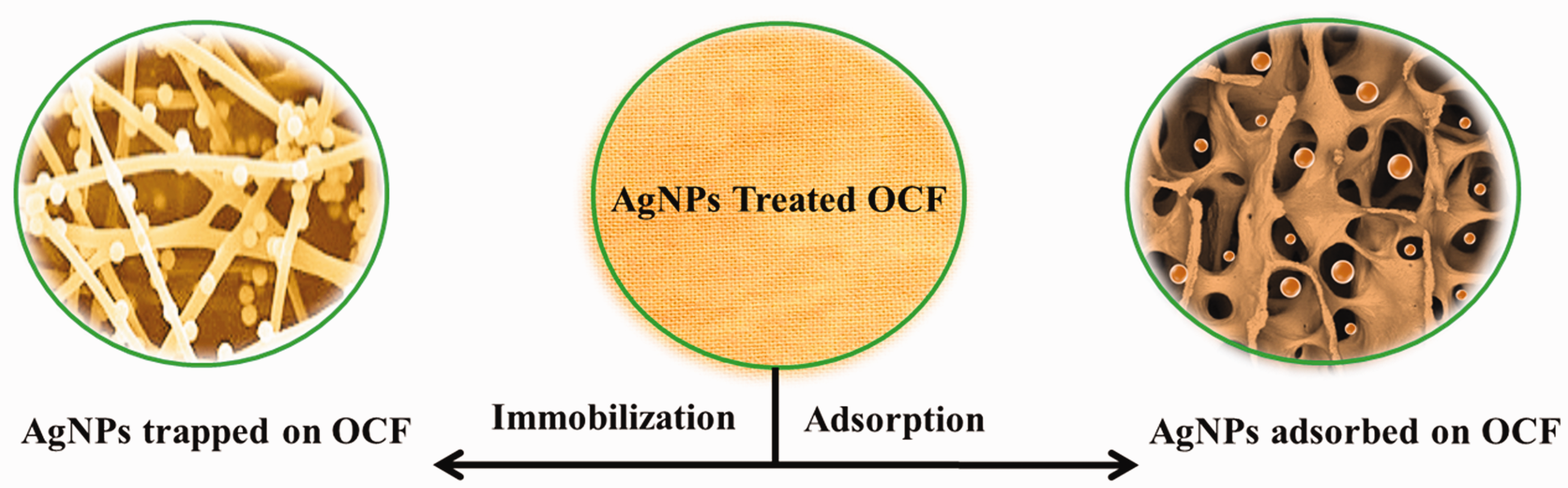
The changes in surface morphology of the OCF caused by the treatment of AgNPs were investigated using SEM. The micrographs of the control and the treated OCF with 35 ppm and 70 ppm AgNPs colloids are presented in Figure 7. The presence of AgNPs on the surface of the treated OCF (marked by circles) was confirmed. The control OCF has a smooth, uniform surface, whereas the treated OCF shows a rough surface, which can be attributed to the immobilization of AgNPs on the OCF surface. The morphology also confirmed a certain degree of aggregation (marked by rectangles). It can be observed that SEM pictures of the treated OCFs seem to indicate a negligible amount of particle deposition on the fibers. It is expected that the particles coated on the OCF surface could not be observed in SEM due to their smaller size. Another fact could be that AgNPs may be embedded in the alginate polymer matrix. Logically, only big particles from within the broad size distribution can be seen in the SEM. Therefore, it could be assumed that SEM images reveal only large particles and aggregates of somewhat larger units. However, the overall surface morphology indicated that the AgNPs are successfully deposited onto the OCF.
SEM morphology of (a) control (b) 35 ppm treated organic cotton fabric (OCF); (c) 70 ppm treated OCF. Their higher-magnification image shown at right.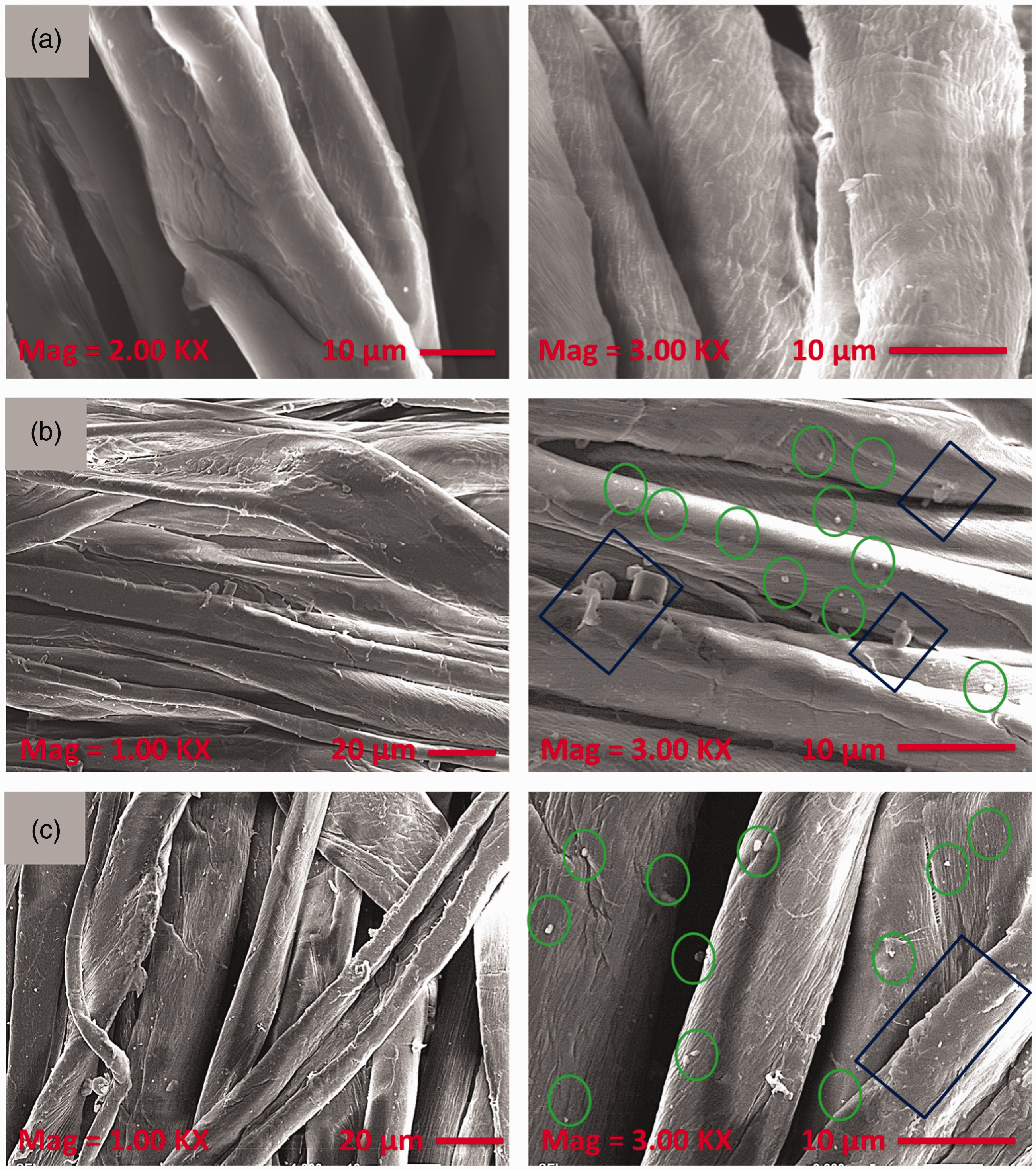
The thermal stabilities of control and treated OCFs (with 35 ppm and 70 ppm AgNPs) were measured by TGA, as shown in Figure 8(a). The control OCF shows sufficient thermal stability until 288.38℃, and maximum decomposition occurs at 386.38℃. In the final step, 84% weight loss was observed at 700℃ due to the dehydration of the internal area of the fibers. OCF treated by AgNPs shows a similar degradation pattern to the control OCF, but the resultant thermal stability tremendously improved with increased concentration of AgNPs after the degradation of the cellulosic portion (>400℃). The increased AgNP concentration means an increased number of collisions between NPs and fiber surfaces. These findings indicate that the approach is effective for integrating large quantities of AgNPs on the OCF surface from AgNPs colloids.
Thermogravimetric analysis pattern of untreated organic cotton fabric and organic cotton fabric treated with silver nanoparticles.
Figure 8(b) shows DSC curves for control and treated OCFS loaded with 35 ppm and 70 ppm AgNPs colloids from 0℃ to 700℃ at a heating rate of 10℃/min, under nitrogen gas. In the case of the control OCF, there were two significant peaks in the DSC curves: peak I at 364℃ and peak II at 490℃. Peak I can be attributed to the loss of moisture adsorbed in the OCF material. However, after treatment of OCF by AgNPs, this peak shifts to higher temperatures with respect to the control OCF. Peak II corresponds to the thermal degradation of relative molecular weight fractions of celluloses. 47 This is clear evidence for effective adsorption of AgNPs by OCF from colloids. On the other hand, the melting peaks of the control OCF disappeared after AgNP treatment, implying an improvement in thermal characteristics of OCF treated by AgNPs.
In order to ensure human safety, it is important to know the amount of Ag content in the treated OCF and the amount of Ag released from the OCF during the washing process. Therefore, we have calculated for 5.0 g OCF treated with 35 ppm and 70 ppm AgNPs after different washing cycles. The data are summarized in Figure 9. The results showed that a certain amount of Ag was released in the bath after washing of OCF in each cycle. It could be supposed that the AgNPs are possibly physically bound to the OCF. However, the lowest Ag content was obtained for the OCF treated with 35 ppm AgNPs (49.23 mg/kg) compared to the OCF treated with 70 ppm AgNPs (73.28 mg/kg). At the fifteenth washing cycle, Ag content decreased dramatically to 36.07 mg/kg and 42.64 mg/kg, respectively. This means the Ag release in wastewater for each washing cycle could be calculated to be approximately 2.04 mg/kg. During the washing process the materials to liquor ratio of 1:40 was used; therefore, only 51.07 µg/L Ag can be released into the washing bath by each cycle. This value is much lower than the permitted value (100 µg/L) according to the Austrian legal regulations (April 1996, 58. Stück, 462 Bundesministerium für Land- und Forstwirtschaft). Furthermore, human cytotoxicity was not observed as the Ag content is ≤0.035 Ag (wt/v)% in cellulose.
48
Thus, 2.04 mg/kg of Ag released in 40 L wastewater by each washing of treated OCF suggests that our technique could be described as safe.
(a) Silver content and (b) silver release of the Ag nanoparticle-treated organic cotton fabric after different numbers of washing cycles.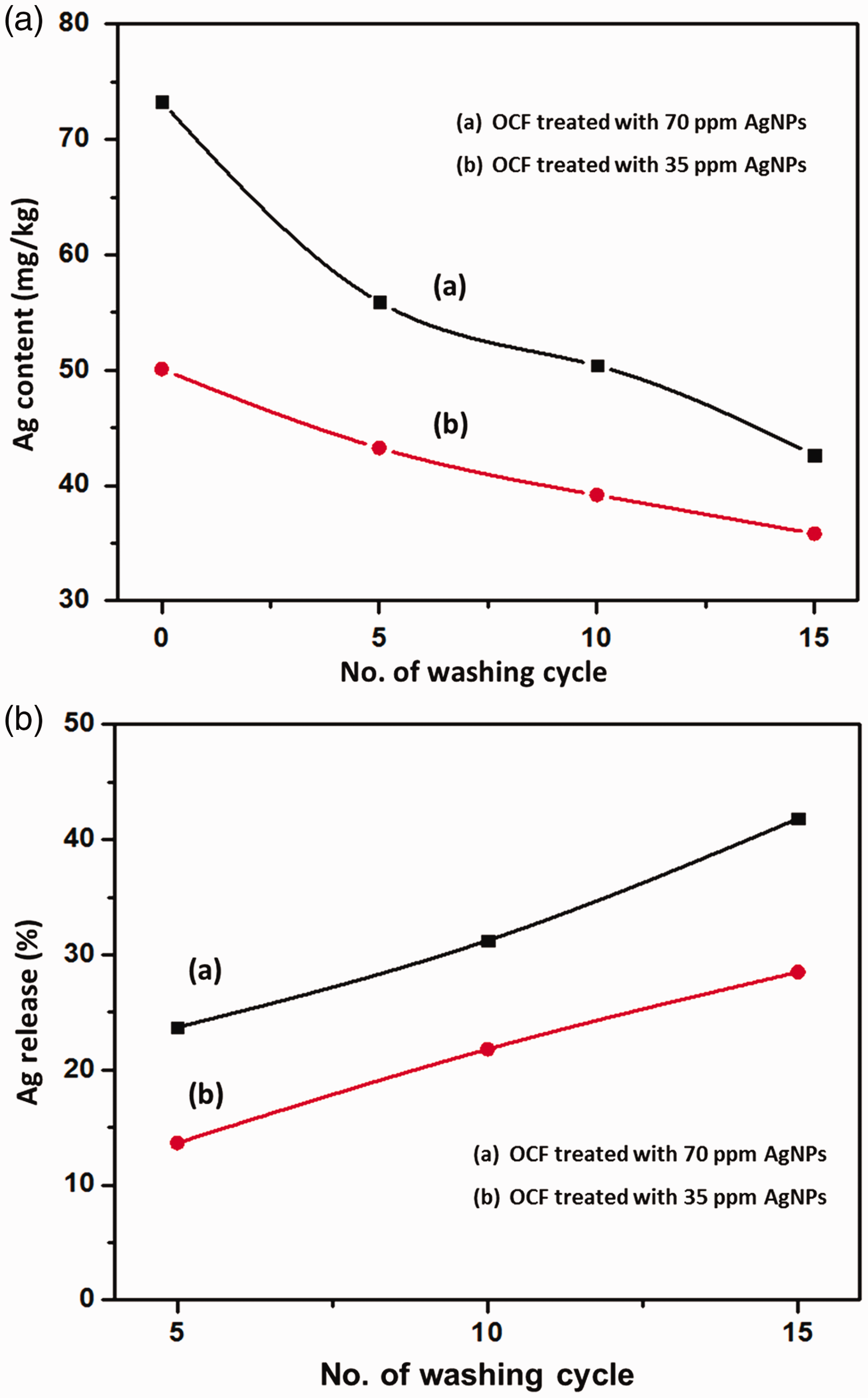
Color measurements and colorfastness
The development of fabric coloration is one of the prime objectives in this work. Color properties of the treated OCF is a significant issue because it influences market demand and consumer preferences. The coloration effect of the treated OCF corresponded to the plasmon resonance properties of AgNPs on OCF surfaces. Treated and control OCFs are shown in Figure 3, and show clear coloration effects on the materials. This process certainly revealed the efficient deposition of AgNPs on the various depths of shade on OCF. Color depth can be regulated by the concentration of synthesized nano-silver colloid, which could correspond to the LSPR optical properties of AgNPs. By an increase in the concentration of AgNPs, the subsequently treated OCF transformed in shade from pale light yellow to a deep yellow color (Figure 3).
Color coordinates data and color fastness of Ag nanoparticle-treated organic cotton fabrics

CIE a* value defines the greenish or reddish hue, where reddish hue can be obtained from positive CIE a* value and greenish hues are responsible for negative CIE a* values. From Table 1, it can be seen that the treated OCFs possess a reddish hue, which progressively grew with increased concentration of AgNPs. Hence, CIE a* values of the OCFs considerably increased from 2.29 to 6.21. After repeated washing cycles the reddish hue reduced. CIE b* values define the yellowish or bluish color, where a positive value indicates a yellowish color and negative values indicates a bluish color. This most significant parameter in colorimetric data changed after treatments. The b* value was −6.85 for the control OCF, indicating that the control OCF has a more bluish color. After treatment, the OCF color changed to a light yellowish color and the yellowness color increased with increasing AgNP concentration. These findings show that the treated OCF can be varied over a relatively broad range of shade because of the unique optical properties of AgNPs.
Color strength of the fabric is denoted by the K/S value and is considered to be a significant parameter for colored materials. K/S data for the treated OCF were recorded as a function of washing cycles, as shown in Table 1. The data showed that K/S increased from a zero value for the control to over 0.794. The higher the AgNP concentration and number of washing cycles, the higher the K/S sum value. From all colorimetric data, it could be summarized that the color of the OCF changed from white to yellow after treatment. The change of the OCF shade is due to the change of SPR of AgNPs with different concentrations.
The coloration requirements are not only restricted by imparting color into fabrics, but the attained color should resist certain conditions. Thus, the different colorfastness properties of colored fabrics were measured under different application conditions such as washing and light (Table 1). With respect to light fastness, all colored fabrics provided a good fastness property, with ratings above 6. The washing fastness property of all colored fabrics represents a rating above 3, which is also satisfactory. It can be summarized that the color fabric fastness properties are in acceptable ranges in accordance with the Chinese National Standards for Textiles.49,50
UV protection
Currently, metal salts and metal NPs are widely used as UV protecting agents.
51
UV-A band (320–400 nm), UV-B band (290–320 nm), and UV-C band (200–290 nm) regions are considered as the constituents of the UVR band. The UV transmittance of control and AgNP-treated OCFs was observed on a wavelength range of 200–440 nm (Figure 10). The transmittance spectra confirmed an apparent distinction between all samples. Typically, the spectrum of the control OCF showed less UV-blocking ability, that is a high percentage of UV-A and UV-B radiation could deposit on their surface, with this occurring more for the UV-B region than the UV-A region. The transmittance spectrum of the 30 ppm AgNP-treated OCF sample demonstrated slightly better UV-blocking ability than the control OCF sample, but a significant reduction in transmittance percentage was achieved for the 70 ppm AgNP-treated OCF sample, which is attributed to the high percentage blocking of UV-B and UV-A radiation as a result of the AgNP coating. The large refractive index of AgNPs result in efficient scattering of UV rays, which enhances UV protection.
52
Another study showed that the plasmon structure of AgNPs is enormously responsible for the UV protection property of the fabric.
53
Thus, this study shows that prepared green AgNPs can absorb and scatter UV rays, which is in agreement with the recent report.
41
UV transmission spectra for the control and treated organic cotton fabrics.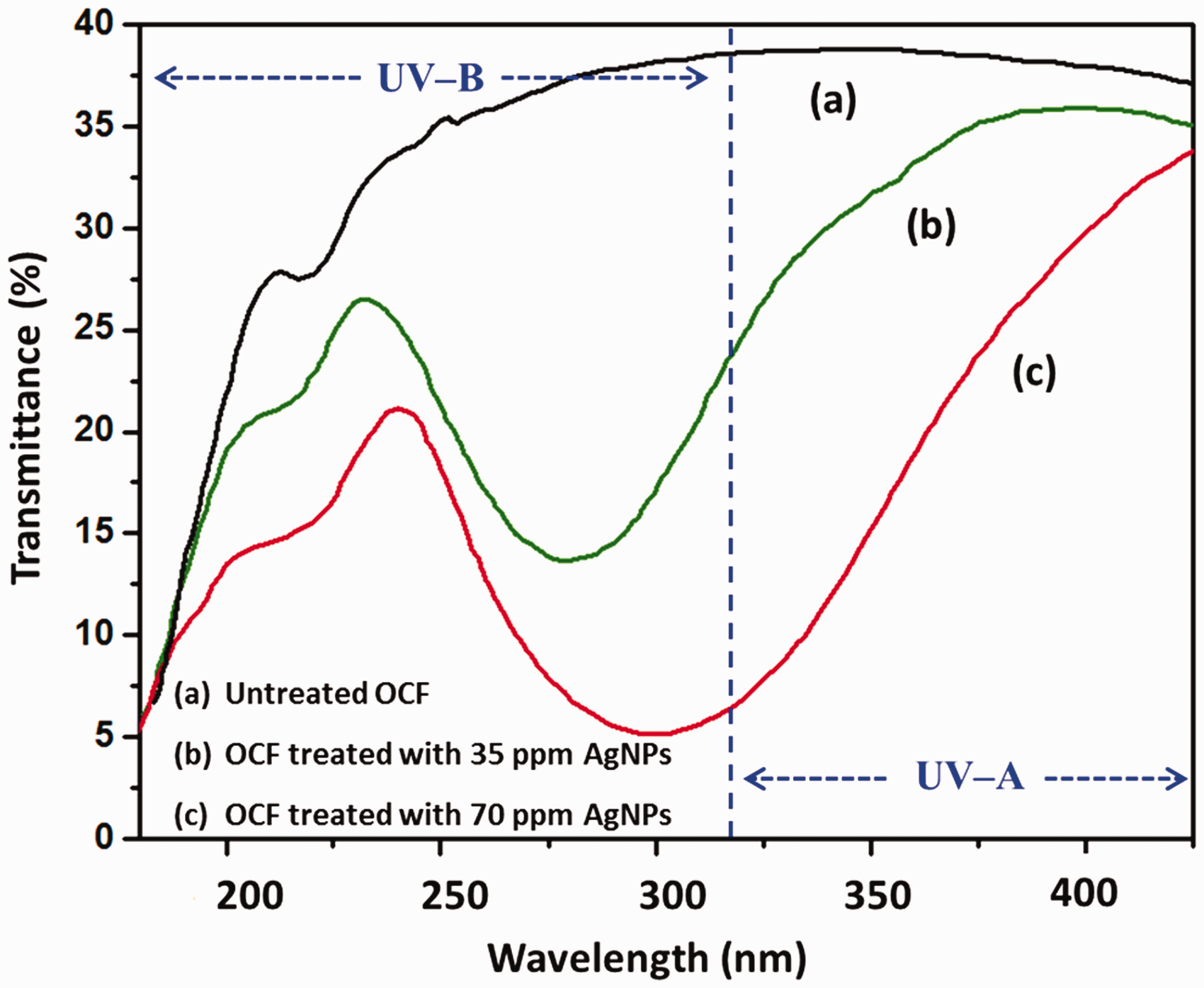
Mechanical and functional properties
Mechanical and functional properties of control and treated organic cotton fabrics

*Values indicate the percentage change; †values calculated in the warp direction.
The functional properties, namely, crease recovery angle and bending length of the control and treated OCFs were also analyzed (Table 2). In the case of crease recovery angle property, it increased as the concentration of AgNPs increased on the OCF. This finding illustrates that there is no significant effect on polymer flexibility due to the particle penetration between the polymer structures. Hence, the hand-feel property of the material is not affected. An equal softness and smoothness quality was observed due to less significant variation in hand-feel between the control and treated OCF. The bending length is subject to handling or stiffness behaviors of the fabric. To confirm the effect of the AgNPs on hand-feel properties of the OCF, the bending length was calculated. There was a slight increase in bending length with AgNP treatment. These findings suggest that the immobilization of AgNPs on the OCF has no influence on hand-feel, which may be due to the size of the particles being within the nano range.
Moreover, the K/S values were measured to assess the steadiness of the particles on the OCF surface after storage at room temperature for six months and compared with freshly immobilized AgNPs on OCF (data not shown). The results demonstrate that the AgNP-treated OCF possesses excellent storability, which is significant for commercial applications. Although the surface of the colloidal AgNPs can be converted into oxide in the presence of dissolved oxygen in solution under an ambient heating environment, 54 the atmospheric oxygen is unable to convert the AgNPs into oxide on the surface of the OCF.
Antibacterial activity
The efficiency of bacterial inhibition of AgNP-immobilized OCFs was explored by means of zone inhibition techniques (i.e., agar disk diffusion test). To visualize the antibacterial action, samples after five washing cycles were placed on bacteria-inoculated agar plates (Figure 11). Bacterial growth was studied on the surface of the OCF treated with traditional antibiotics (gentamicin for Gram-negative and ampicillin for Gram-positive bacteria) and AgNPs. Both samples demonstrate a distinct inhibition zone around the sample, with different diameters (Table 3). The agar plate after the zone inhibition test is shown clearly in Figure 11, with the antibiotics displaying the greatest inhibition zones for E. coli (22.06 ± 4.04 mm) and S. aureus (26.47 ± 4.42 mm). The AgNP-treated samples displayed very distinct inhibition zones around the OCF, and the diameter of each inhibition zone was similar to that of the antibiotics.
Antibacterial activity of the antibiotics (1) and treated organic cotton fabrics at 35 ppm (2) and 70 ppm (3) on E. coli (a) and S. aureus (b). Antibacterial activity of organic cotton fabrics coated with green-based Ag nanoparticles Values represent means ± standard deviations from three experiments.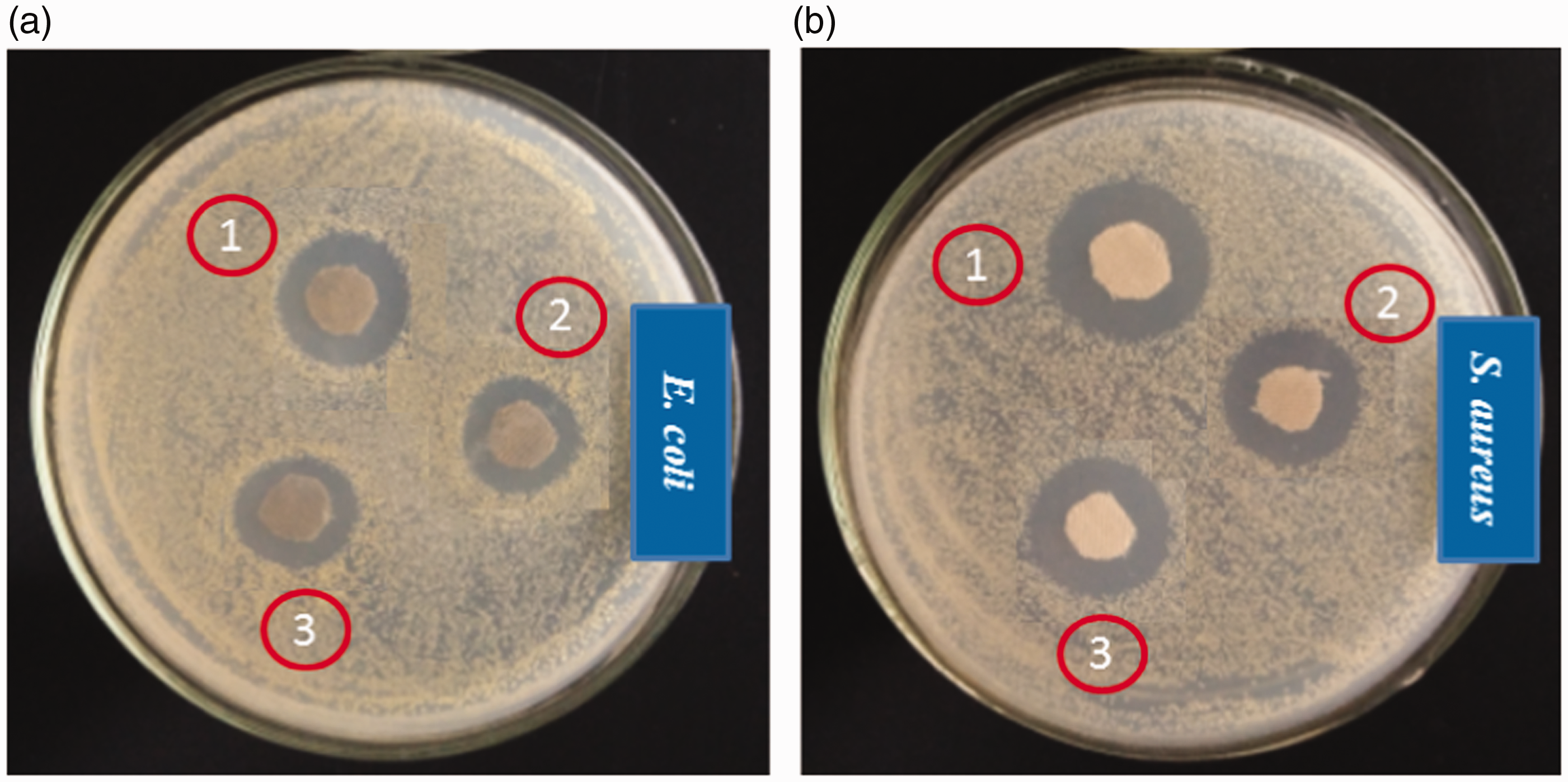

The variation in the zone inhibition was influenced by the concentrations of AgNPs during the preparation of the NPs. As shown in Table 3, the amount of AgNPs was higher when the fabric was immobilized by 70 ppm AgNPs, which presented a superior inhibitory action against both bacteria, with up to 20.09 ± 2.38 mm inhibition for E. coli and 24.15 ± 2.22 mm diameter for S. aureus on the finished OCF. The OCF treated by 35 ppm AgNPs shows up to 18.28 ± 1.24 mm inhibition for E. coli and 21.35 ± 1.84 mm inhibition for S. aureus. This observation is related to the mechanism of the fabric's biocidal action due to the smaller AgNPs. 55
In addition, the quantitative analysis of the antibacterial action of functionalized OCF was performed according to the percentage reduction technique (AATCC 100), displayed in Table 3. AgNPs have a substantial influence on bacterial death in the case of both 30 ppm and 70 ppm, which induced an inhibition rate of >90%. The antibacterial action against both Gram-positive and -negative bacteria improved slowly but steadily with increased AgNP concentration due to the catalytic attributes of AgNPs, which play a role in the development of the sterilizing effect by interacting with the bacteria. 56 Because of the extremely large relative surface area, AgNPs are capable of enhancing their contact with microorganisms and consequently increasing the antimicrobial activity. The antimicrobial activity presented in this study is clearly in agreement with the wide range of antimicrobial performances of AgNPs, and it could be an eco-friendly alternative to traditional antimicrobial agents.
Conclusion
In summary, we have demonstrated a simple, novel approach to decorate green AgNPs on OCFs for multifunctional applications. Alginate has abundant multifunctional groups in its structure which can be used as both a reducing and a stabilizing agent for the synthesis of stable and homogeneous AgNPs colloid. Moreover, it has the capability to form a double network to entrap AgNPs in the cavity. In addition, alginate film can adhere tightly to the textile surface through molecular force. There was an improvement in the physical and thermal properties of OCF upon immobilization by AgNPs. Furthermore, AgNP treatments induce the coloration effect of OCFs and also improve the color fastness against washing and light, thus overcoming the limitation of the traditional dyeing process. The method is highly effective for antibacterial action as confirmed by the bacterial test. Therefore, this kind of treatment is considered to be a nontoxic, economical, and eco-friendly process for the multifunctional treatment of organic cotton-based textiles.
Footnotes
Acknowledgments
Authors thank Dr. Anthony Pembere (2015 CAS-TWAS Fellow, Institute of Chemistry, Chinese Academy of Sciences, Beijing, China) for his assistance in revision.
Declaration of conflicting interests
The authors declared no potential conflicts of interest with respect to the research, authorship, and/or publication of this article.
Funding
The authors disclosed receipt of the following financial support for the research, authorship, and/or publication of this article: This work is supported by the Key Laboratory of Biomass Fibers and Eco-dyeing & Finishing, Hubei Province (STRZ201906) and Innovation Platform Projects of Wuhan Textile University (183052), the 2014 CSC Enterprise Scholarship (2014RHS008) from the Runhe Chemical Industry Co. Ltd. Ningbo, P. R. China, and Color Root (Hubei) Technology Co., Ltd. Songzi P. R. China.
