



Abstract
The statistical distribution of the number of fiber intersections in a unit area is of great importance in determining the physical and mechanical properties of random fiber webs and the products produced. The distribution of the number of fiber intersections determines the non-uniformity of the basis weight and can be used in designing optimal control strategies relating to such physical properties as strength, elongation, air/water permeability, acoustics and filtering efficiencies of fiber webs and nonwoven fabrics. This paper developed a geometrical and probabilistic model for the number of fiber intersections in two-dimensional random fiber webs, where two distinct fiber lengths are mixed at varying ratios. This work is an extension of a previously derived paper where the model assumed that all fiber lengths are equal. Here, we present a geometrical probabilistic model, theories for deriving expectations and variances of the number of intersections in random fiber webs. The model and statistical parameters are validated through an extensive computer simulation study.
Due to their random nature, probabilistic models and statistical distributions play key roles in characterizing the non-uniformities of random fiber webs and nonwoven fabrics, as well as other physical and mechanical properties. More specifically, the average number of fiber intersections within a unit area and its variance are of great significance when a certain number of fibers of known lengths are thrown onto the unit area. They are the founding blocks for determining various properties of two-dimensional random fiber webs and the nonwoven fabrics produced therefrom. While the development of models is essential, the ultimate validation of the model requires a massive amount of computer simulations pertinent to the theories. The validated model then can be applied to the basic understanding of non-uniformity, basis weight variations and various mechanical and structural properties of the resulting nonwoven webs. Most importantly, the models would provide an insight into designing products that exhibit optimal performance functions and lead to control strategies for the desired levels of such physical properties as strength, elongation, air/water permeability, acoustics, filtering efficiencies, etc. 1,2 Implicitly, the theories relating to fiber intersection geometry directly influence the pore size distributions and the product performances resulting therefrom. In particular, the variance of the number of intersections should be proportional to that of pore sizes even without a proof.
The variance and expectation of the number of fiber intersections are statistically the most important parameters to determine the distribution of the number of intersections and also practically influence the uniformity of nonwoven web and products made by fibers. Kallmes and Corte, 3 Komori et al., 4 Williams et al. 5 and Yi et al. 6 all tried to obtain the theoretical mean and variance of the number of intersections for fibers of equal lengths. While some of the theories presented provided ways to obtain the expected number of fiber intersections, either insufficient or a complete lack of computer simulations led to incomplete proof of the theories or produced significant discrepancies of the theories presented. On the variance of the number of fiber intersections, no convincing theories were developed and no proof based on simulation existed due to a lack of computing power at the time the studies were conducted. In 2010, Suh et al. 7 presented a set of new theories for obtaining the mean and variances of the number of fiber intersections within a unit area of two-dimensional fiber web produced by throwing a known number of fibers of equal lengths at random. They also presented a new simulation method by introducing the concepts of “seeding area” and “counting area” in validating the models presented. The work not only has established a proof on the validity of their model, but also demonstrated where the errors were in all previous papers, both in the theories as well as in the simulation methods in which the “border effects” are not considered in counting the intersections originating from outside the counting area. In essence, the models of Suh et al. 7 could not have been validated without the advent of computing speed and the new way of handling the edge effects associated with the seeding and counting areas, especially if the area is relatively small with respect to fiber lengths.
As a natural extension of the earlier work of Suh et al. 7 with fibers of equal length, we now present theories for computing the mean and variance of the number of fiber intersections when fibers of two different lengths are thrown onto a two-dimensional area at random with varying mixture ratios. The theories developed will also be validated by applying the concepts of “seeding area” and “counting area,” following the method adopted in the earlier work. From the results, a basis weight theorem is proposed by observing the structure of the equations. The results of the mixtures of two different fiber lengths are applied to cases with more than two fiber length mixtures, and eventually to a more complex fiber mix geometry and to cases for arbitrary fiber length distributions.
Geometrical and probabilistic model for mixtures of two fiber lengths
We will extend the results from planar random fiber webs formed by equal fiber lengths to that formed by a mixture of two distinct fiber lengths
Let us assume that
Unlike the simple Buffon's needle experiment,
8
the number of fiber intersections will be found from the fiber-to-fiber contact points generated by multitudes of fibers thrown at random instead of just two fibers of known length. For our study, the simplest fiber lot may consist of a fixed number of fibers with known identical lengths. A lot may also consist of two or more groups of fibers for which the number and length are specified for each component group. A mixture lot consisting of two fiber length groups is completely specified by a set of four parameters
Intersection probability and expectation for the number of fiber intersections
The probability for a straight fiber of known length to meet another fiber of the same or different length within a specified area, called the “intersection probability,” was considered in the Buffon's needle problem.9,10 Michael and Michael 11 showed how to improve the efficiency in the estimation of the value π experimentally by improving the speed of convergence by considering the probability of a needle hitting vertical grids in addition to horizontal grids formed within a plane. The work of Suh et al. 7 was aimed at obtaining the number of intersection points formed by all fibers, departing completely from the estimation of π. Undoubtedly, however, the speed of convergence to true value π can be maximized by letting a large number of fibers hit each other instead of counting the hits on parallel or square grids.
In this paper, we first assume that fibers with length

Suppose that the midpoints of
From these

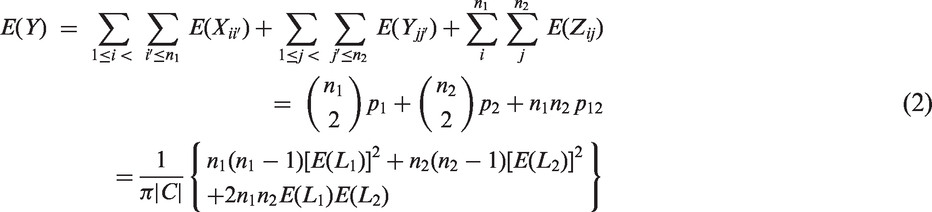
Note that the total number of fiber intersections within C is divided into three parts as follows

Its expectation, therefore, is obtained easily as follows
Variance for the number of fiber intersections
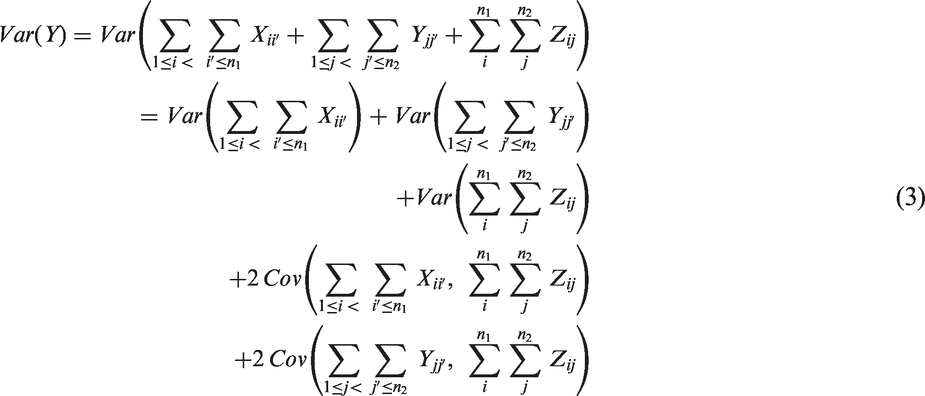
The variance
Note that
Thus


The third term of Equation (3) can be divided into variance and covariance terms
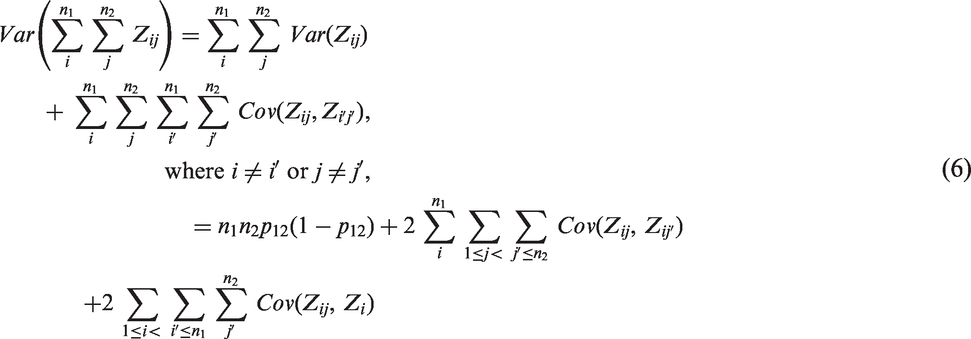
Examining

Then, by taking the expectation with respect to
By applying this and using the definition of covariance and Equation (1)
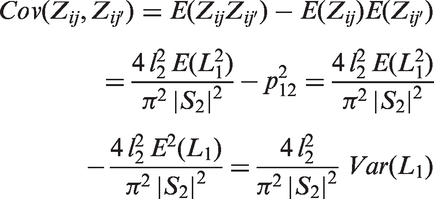
Similarly, we can find
For examining the number of terms of the form
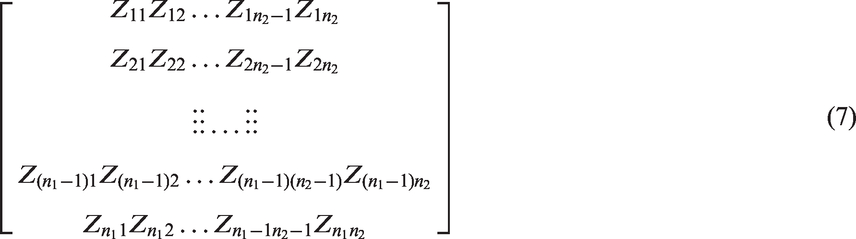
If two elements are selected from each row of (7) and they are summed up, the number of ways that each fiber of length
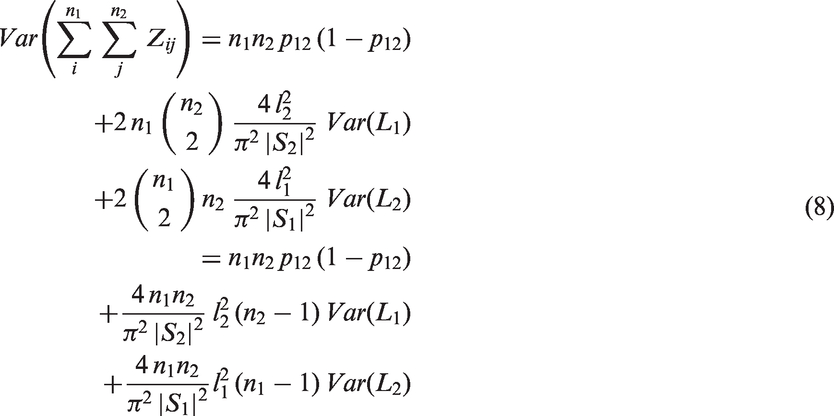
In order to obtain the fourth term of Equation (3), consider the number of ways for having

In (9),

Therefore, it follows that

For
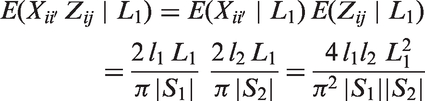
Taking the expectation with respect to random variable
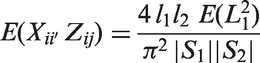
Also, by the definition of covariance and Equation (1)
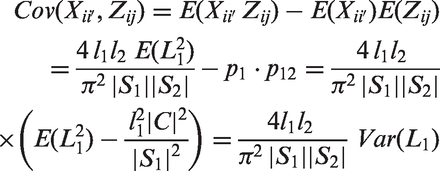
Therefore

Similarly, the last part of Equation (3) can be obtained
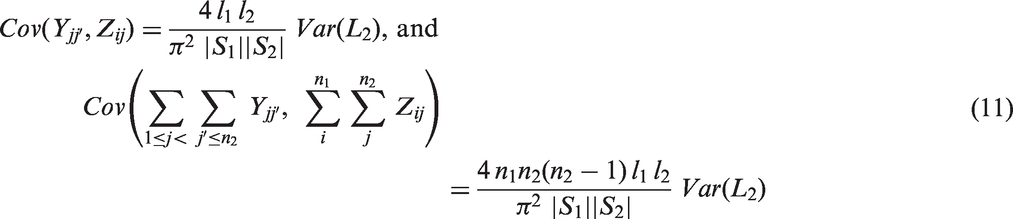
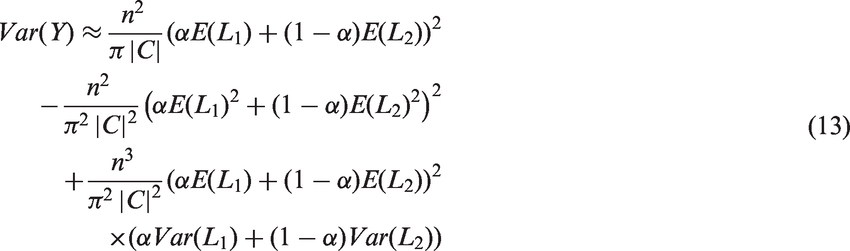
Finally, after adding Equations (4)–(6), (10) and (11) all together, and by writing
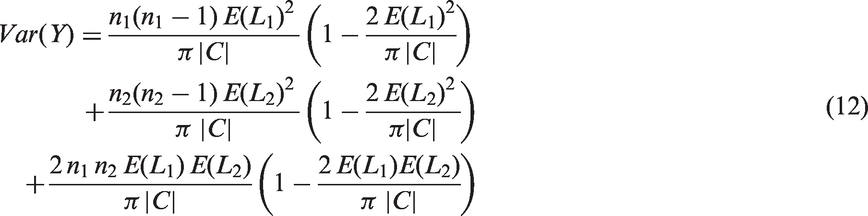
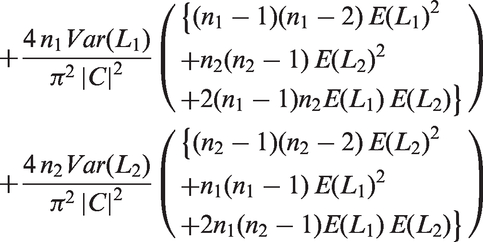
If
Basis Weight Theorem
The results obtained in the previous sections provide the following important Basis Weight Theorem, which has been hypothesized and speculated but has not been proven to date.
In a random fiber web formed by mixtures of two fiber lengths, the expected number of fiber intersections depends only on the total (aggregate) fiber length, regardless of the differences in fiber lengths or their mixture ratio
Let Y be the total number of fiber intersections in a random fiber web of two fiber length mixtures specified by □Proof:

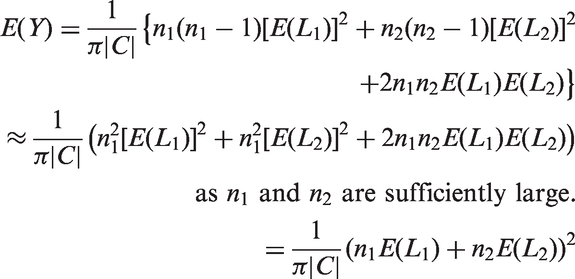
This theorem tells us that the expected number of fiber intersections in a random fiber web within a unit area is constant and proportional to its basis weight or volume when the fibers are the same in thickness, regardless of the makeup of the fiber lengths. This theorem, however, is only for the expected number of fiber intersections and not for the variance. Heuristically, the variance of the number of intersections would decrease when the fibers are of shorter lengths and the numbers are large. The proof for this, while not given here, could be demonstrated easily by simulations. However, a statistical proof for this would require much more effort.
Validation of theories by simulations
Historically, some of the previous studies have shown that the theories did not fit simulations, proving that either the theories or the simulation methods, or both, were wrong. Because different probability models may produce different numerical results, one of the necessary and sufficient conditions is to validate the theories has been developed by simulations. Here, we will apply the same simulation method developed by Suh et al.,
7
where the theories were satisfactorily validated by the simulations by using the “counting area” of a 100×100 square and a “seeding area” outside the square. This time, two different seeding areas are employed outside the square in order to accommodate two different fiber lengths. It is assumed that the number of fibers is fixed and the orientation angles of each fiber is given randomly with respect to the horizontal axis. The process is as follows.
Create a random fiber web as follows: (a) throw randomly Count the number of fiber intersections that occur only within the counting region Repeat the process in Steps 1 and 2 above 100 times with For plotting, each point represents the average of 100 simulations for Two random fiber webs of n = 1000 for two lengths 10 (red) and 30 (blue) at a mixture ratio of Comparison of theory and simulations for and Comparison of theory and simulations for

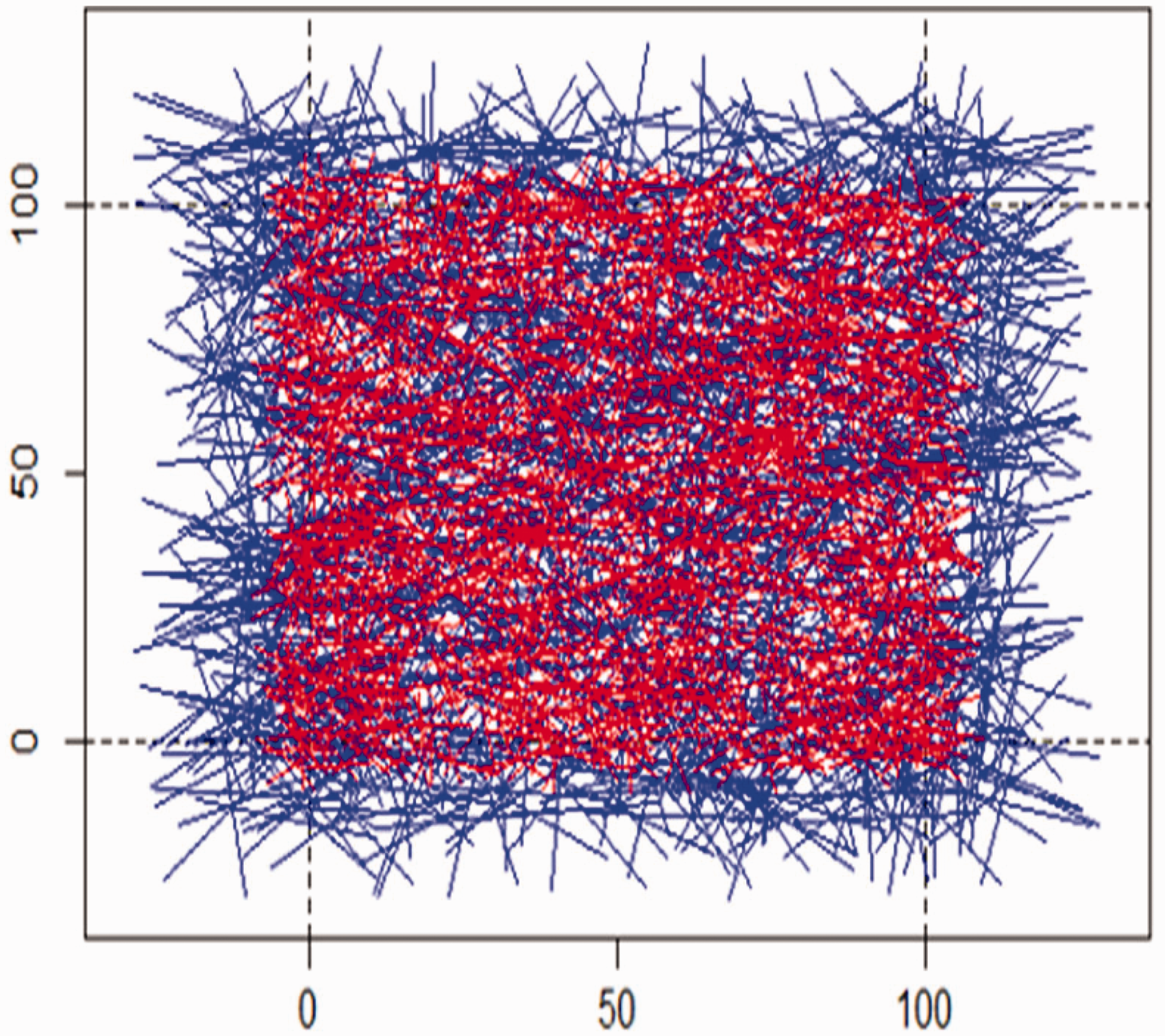

Figures 1 and 2 illustrate two two-dimensional random fiber webs generated by employing 1000 fibers and 3000 fibers, respectively, by choosing length Two random fiber webs of n = 3000 for two lengths 10 (red) and 30 (blue) at a mixture ratio of 
Figures 3 and 4 show the simulation results against the theoretical means and variances. As explained earlier, each expectation value represents 100 replicated simulations, Coefficient of variation comparisons of theory and simulations for (
Figure 5 shows the fit of variance using the CV in order to show that lack of fit is insignificant when the CV is used in place of variance. The fit is shown to be almost perfect.
Concluding remarks
In this study, we obtained statistical theories for obtaining the mean and variance of the number of fiber intersections to be found within a unit area when two fiber populations with distinct lengths and a known mixture ratio are thrown at random to form a two-dimensional random fiber web. This is an extension of an earlier work by the authors on webs formed by fibers of identical lengths. This time, the theories are validated by applying a simulation method using two seeding regions relevant to the two distinct fiber lengths. The theories developed were well validated based on the simulation method developed for the two fiber length populations. Needless to say, the validation was possible only because of the speed of simulation available today, which was not available some 20 years ago. For example, in order to generate a single data point in Figures 2, 3 and 5, we had to perform 100 simulation replicates, each replicate consisting of
The number of fiber intersections can be approximated to normal distribution using theoretical mean and variance values obtained in this study if the number of fibers becomes large. Also, the asymptotic distribution of the number of fiber intersections can be theoretically derived by discrete distribution as count data. This approximate distribution and related probabilistic properties will theoretically be derived in future studies.
The results of this study clearly provide a foundation for estimating the number of fiber intersections and its variance, which in turn control and predict the mechanical and other properties of nonwoven fabrics, such as strength, elongation, basis weight uniformity, porosity, air/liquid permeability, insulation and acoustics. The structural and geometrical properties, once understood in statistical terms, would be invaluable in all applications.
Footnotes
Declaration of conflicting interests
The authors declared no potential conflicts of interest with respect to the research, authorship, and/or publication of this article.
Funding
The authors received no financial support for the research, authorship and/or publication of this article.
