




Abstract
Diabetic foot ulcers have a negative impact on the lives of patients and are highly vulnerable to infection, leading to amputation too often. It is essential that the patient with a diabetic foot ulcer receives the best possible care. Herein, we developed a new functionalized cellulosic wound dressing with high-improved healing properties, able to be a serious alternative for diabetic acute wounds. First, a bioactive polysaccharide was extracted from the Carthamus tinctorius plant. Then a new crosslinked polymer-based alginate/C. tinctorius polymer extract was prepared and checked for combined antimicrobial and tissue regeneration properties. Afterward, the efficiency of the textile functionalization process was optimized through studying the influence of different grafting parameters: curing conditions and the concentration of the impregnating solution. The drop method wettability technique exhibited significant improvement in the hydrophilicity behavior of treated textile samples, which increased with the grafting rate. Attenuated total reflection Fourier-transform infrared spectroscopy and thermogravimetric analysis or differential thermal analysis were investigated to test whether the chemical permanent grafting resisted the severe standard washing conditions. The tensile strength characteristics showed that the grafting does not affect the original mechanical properties of treated textile dressings. A morphological study via scanning electron microscopy images confirmed the permanent textile finishing performance and permitted us to assess its chemical grafting approach onto the treated surfaces. The biological and the bacteriological investigations of functionalized dressings proved that the functional biomaterial could be used as a medical bioactive device with improved biological properties.
Foot ulcer is the most feared complication of diabetes. 1 Thousands of patients in the world are hospitalized to treat this wound. 2 And due to an increased risk of gangrene, amputations are performed.3 Surgery is seven times more common in patients with diabetes. 4 The rarefaction of nerve fibers at the extremities loses sensitivity. This neuropathy causes the emergence of cracks, crevices (autonomic neuropathy), horn accumulation, deformity of the feet (motor neuropathy), significant infectious risk (osteitis, sepsis) and delayed healing.5,6 And, above all, it prevents the perception of small wounds. Diabetes leads then to loss of sensitivity and bone deformity of the feet that promotes the onset of the injury. 7 These wounds often go unnoticed and are difficult to treat. However, bioactive dressings can be a serious alternative to provide an effective cure and a reduced healing time. Faced with the urgent need for public health and the limitation of existing dressings, several bioactive new dressings have been developed. Indeed, hydrocellular dressings, made of absorbent polymers (usually polyurethane foam), have been valued.8,9 They are made with or without adhesive plates, with anatomical shapes adapted to fill the wound cavity. Hydrocolloid dressings based on absorbent polymers whose properties are linked to the presence of carboxymethylcellulose have also been evaluated.10,11 They exist in the form of adhesive plates, powders or pastes. Hydrogels with more than 50% of water have also been proposed as effective dressings. They are mainly intended to ensure the wetting of wounds. They exist in the form of plates, impregnated compresses and gels. 12 Vaseline silver dressings have also been developed. These are dressings with a weft, impregnated or coated with petroleum jelly and silver sulfadiazine cream.13,14 Their removal is sometimes painful because they gradually adhere to the wound. Interface dressings have also been explored as functional biomaterials. They include a surface coated with polymers of different types, such as silicone gel. They are distinguished from simple fatty dressings by low adhesion, which does not increase throughout use in direct contact with the wound (no migration of the impregnated or coated substance), in order to limit the trauma and pain induced by removal of the dressing. Recently, activated charcoal dressings have been widely investigated. They are made of different supports to which activated charcoal has been added, in order to absorb the molecules responsible for bad odors from wounds.15,16 They exist in the form of plates and compresses. In addition, silver dressings have also been investigated. They are composed of different supports (creams, compresses, plates, etc.) to which silver has been added in various physicochemical forms, theoretically for antibacterial purposes.17,18 Furthermore, a new generation of efficient dressings based on hyaluronic acid has been established. They contain hyaluronic acid (a natural constituent of the dermis) at varying concentrations.19,20 They exist in various forms (creams, compresses, sprays, etc.). The insufficiency in terms of care provided by all these dressings for chronic or acute wounds, particularly for diabetics, has led to the development of a new generation of functional dressings. The functionalization of cellulose dressings with cyclodextrins and its derivatives have provided an efficient bacteriological performance as well as a controlled release of different active principles.21–23 Recently, the functionalization of dressings by natural active polymers and bioactive extracted molecules have offered a good alternative for the treatment of chronic and acute wounds. Among these polymers, we find chitosan,24–26 alginates 27 and extracts of natural plants such as curcumin,28,29 aloe vera,30,31 hematoxylin 32 and berberine.33,34. Cellulose is the most investigated natural polymer in the development of wound care products,35–37 due to its abundance and excellent biocompatibility. 38 In this study we propose to functionalize cellulose biomaterial with the alginate biopolymer and a bioactive polysaccharide extracted from C. tinctorius (CTP). Alginates are salts of alginic acid, a polysaccharide biopolymer, which is an essential component of the cell wall of brown algae. Alginates and alginic acid are excipients in various drug compositions, and are used for their therapeutic properties: platelet aggregation (platelet mobilization by ion exchange), acceleration of the healing rate, and so on.39,40 C. tinctorius, widely known as safflower, is a herbaceous plant of the Asteraceae family, containing various active constituents, including flavonoids, quinochalcones, alkaloids and safflower polysaccharides.41,42 It is considered a miracle plant in the medical field owing to its various therapeutic effects. The literature is full of studies, investigating and enumerating its medicinal benefits and showing the recent advances in the polysaccharides of C. tinctorius as phytotherapy and illustrating its potential as a therapeutic agent.43–45 With the current information, it is evident that C. tinctorius has pharmacological functions including antioxidant, anti-inflammatory, analgesic, antidiabetic, hepatoprotective and antihyperlipidemic activities, among others. There has been ample evidence to support the use of safflower medicines for menstrual problems, the treatment of ulcers and cardiovascular complications, as well as pain and swelling in trauma cases.46,47
The aim of this research work is to study the feasibility of functionalizing a cellulose-based dressing with the alginate biopolymer and the CTP polymer extract, a biological mixture crosslinked and fixed to the dressing via a polycarboxylic acid: citric acid (CTR). The optimization of the various grafting parameters will aim to achieve an efficient functionalization which preserves the original properties of the cellulosic grafted textile support.
Firstly, we have studied the grafting of the CTP extracted polysaccharide and the alginate polymer in the presence of the crosslinking CTR agent. Different parameters have been varied such as the temperature and time of curing and also the concentration of different reactants. Next, infrared, thermogravimetric analysis (TGA) and differential thermal analysis (DTA) characterizations were investigated. The hydrophilicity effectiveness was then evaluated on the functionalized dressings with various grafting rates. In addition, mechanical properties of untreated and functionalized samples were performed. Scanning electron microscopy (SEM) was used to evaluate the morphology and the grafting manner via our new biopolymer.
Finally, biological and bacteriological experiments were investigated in order to assess the effectiveness of the functionalization process as an added value of a new generation of functional medical dressings.
Experimental
Chemicals and materials
Dressing materials investigated in this current study are in the form of cellulosic textile woven of 22 yarns/cm and 50 g/m2 surface weight. They were obtained from SOTUPA company (in Tunisia), designed for research purposes. Sodium alginate (AG, with molecular weight of 23,000–40,000 g/mol), citric acid, sodium dihydrogen hypophosphite (SHP catalyst) and ammonium hydrogen phosphate (AHP used for the post-treatment) were Aldrich chemicals. C. tinctorius L. petals were cultivated in Saudi Arabia. Textile grafting materials include a padder machine and a curing oven.
Extraction of C. tinctorius L. polysaccharide
A simple and effective method of extraction was selected.
41
C. tinctorius L. petals (100 g) were previously washed with water before being dried at 60℃ in a vacuum oven for 24 h. Next, extraction was performed four times in boiling water with agitation for 1 h. The extract was then centrifuged for 20 min. Afterward, the supernatants were precipitated in four volumes of ethanol solution (95%) during 24 h at 4℃. After being dissolved in water and freeze-dried, the resultant was again dissolved in water and adjusted to pH 3 (with HCl) and then centrifuged. The supernatant was again adjusted to pH 7 (with NaOH) and then precipitated in ethanol and freeze-dried. After Sepharose CL-2B column chromatography and centrifugation, the water-soluble extract was collected by 70% of ethanol and finally freeze-dried. The safflower polysaccharide (light yellow powder) was composed of
Steric exclusion chromatography
The molecular weight and the different macromolecular properties of the polysaccharide extracted from safflower were carried out via steric exclusion chromatography (SEC) analysis. The apparatus was coupled to a differential refractometer and a multi-angle light scattering detector. The analysis was performed using dimethylformamide as solvent. The reported molecular weights were expressed as equivalent poly(ethylene oxide). The results were investigated via the OmniSEC software.
Grafting of polymer-based AG/CTP onto cellulosic dressings
We began with a pre-treatment which consists of washing (according to ISO1, 30 min at 40℃) and drying the dressings. Then the dressings were padded and roll-squeezed three times, before being dried in the oven for 30 min at a temperature of 104℃. We then arrived at the most important stage where polymerization occurred, which is thermofixation. The samples were subjected to higher temperatures and varying times of curing in the oven. In standard conditions, samples were impregnated in a solution of CTR (80 g/L or 0.38 mol/L), SHP (20 g/L or 0.22 mol/L), AG (60 g/L or 1.71 × 10⁻³ mol/L) and CTP (40 g/L or 0.36 × 10⁻³ mol/L) in distilled water. This concentration is called C in the experimental section. In order to eliminate the excess of poorly fixed grafts and to improve the touch of functionalized dressings, a post-treatment was required. The latter consisted of an alkaline treatment followed by an aqueous impregnation in an ammonium hydrogen phosphate solution. A three-dimensional polymer network was formed between the two biopolymers (AG and CTP) and the cellulose fibers via a series of polyesterification reactions using the CTR as crosslinking agent.
After the post-treatment, the samples were exposed to standardized washes to remove the unfixed polymer. Virgin and grafted samples were then dried at 100℃ for 40 min and finally they were weighed with higher precision. The grafting rate of the treated dressings (expressed as %wt), which referred to the weight gain, was then calculated according to equation (1) (for each determined value 10 replicates were carried out)

The different values of mi and mf depict the weights of the sample taken respectively before and after the functionalization.
Washing tests
The standardized washing tests were carried out in order to evaluate the permanence and solidity of our grafting. These tests were also useful in evaluating the resistance of the treated dressings during their eventual storage against moisture. The standard ISO1 (washing at 40℃ during 30 min with the adding of 2 g/L of sodium carbonate and 3 g/L of detergent) and ISO3 (washing at 60℃ during 30 min with the adding of 2 g/L of sodium carbonate and 3 g/L of detergent) were applied.
Damping study
Wettability and surface damping properties of the virgin and grafted samples were evaluated by the study of their capacity of absorption using the glycerol liquid test (having a surface tension of 63.4 mJ/m2). This was performed via the drop contact angle technique, using a digidrop apparatus and according to the ASTM D5725-99 standardized test. The measurements were taken 5 s after depositing the droplet (5 μl) on the surface of the dressing at 37℃. Each value was the mean of 10 measurements, calculated by the following formula

TGA and DTA
A TA Instruments apparatus (TGA Q500, USA) was used to evaluate the thermal stability and temperatures of degradation of both untreated and functionalized samples by our combined bioactive polymer. A temperature range of 25–600℃ was running with a heating rate of 10℃/min. Thermal curves represented the weight loss during heating, according to temperature and time increases.
Infrared spectroscopy analysis
Infrared spectroscopy analysis was carried out using a Fourier-transform infrared (FTIR) spectrometer (Cary 600 Series, Agilent Technologies, USA) via the attenuated total reflection (ATR) accessory (GladiATR, PIKE Technologies, USA). A range of 4000–400 cm−1 and a resolution of 2 cm−1 were fixed for recording different spectra.
Mechanical characterization (tensile strength)
The mechanical characteristics (tensile strength) of the virgin and functionalized cellulosic textile dressings were performed using a tensile tester (Lhomargy 2/M) according to the standard test NFG 07–119. The tests were carried out on wet and dry samples with different grafting rates. Wet samples were prepared after impregnation in distilled water for 1 h before being padded and then analyzed. Ten different assays were taken for each sample.
SEM
Surface morphology of untreated and grafted cellulosic textile dressings was evaluated using SEM (FEI Quanta scanning electron microscope, FEI Company, the Netherlands). An acceleration voltage of 5 kV with a variation of the magnification was used for the surface observation of the samples. Before the test, all samples were covered with a fine layer of carbon to improve their surface conductivity.
Biological assessments
Biological tests were performed according to the ISO standard ISO 10993-5. The virgin and functionalized textile samples were cut into disks 11 mm in diameter, and then the samples were sterilized by ultraviolet light for 15 min. Thermanox® and nickel were used as negative and positive controls, respectively. A temperature of 37℃ and an atmosphere of 5% CO2 at 100% relative humidity were used for different in vitro cell incubations. In vitro biological assessments were carried out with epithelial HepG2 cells.
The MTT tetrazolium assay technology was used to evaluate cell viability. Previously, cultivated HepG2 cells were seeded on 96-well culture plates; the virgin and grafted cotton samples were drenched in prepared culture medium in contact with the cells. After 24 h, 48 h and 72 h of cell seeding and before the cell counting, the culture medium was removed. Then a solution of 0.5 mg/mL MTT medium was pipetted into each well. After 3 h of incubation, the solutions were relocated into 96-well plates (Nunc) and we added DMSO (100 μl in each well). The absorbance was recorded using an ELISA Reader (Awareness Technology Stat Fax 3200 Microplate Reader) at 545 nm. The cell viability measurement was expressed as the mean percentage of the relative formazan formation with respect to the control culture. At least five distinct tests were performed in triplicate for each assay.
Antibacterial efficiency
The antibacterial activity of the virgin and treated samples was evaluated using the Mueller–Hinton agar diffusion technique (according to the standardized Kirby–Bauer disk diffusion method). 48 The samples were cut into disks (11 mm in diameter) and then sterilized. The pathogenic bacteria tested were Gram-positive Micrococcus luteus NCIMB 8166 and Staphylococcus aureus ATCC 25923 and Gram-negative Pseudomonas aeruginosa ATCC 33787 and Escherichia coli ATCC 35218. They were cultivated in a nutrient broth for 24 h at 37℃, and then on nutrient agar for 24 h at 37℃. Bacterial suspensions were prepared in physiological saline with a bacterial load of 106 CFU/mL; 1 mL of each bacterial suspension was spread on Mueller–Hinton agar followed by a 30-min incubation at 37℃. Next the samples were deposited on the plates of the Mueller–Hinton agar. The dishes were held at 4℃ for 2 h so that the tested samples could diffuse into the agar, then incubated at 37℃ for 24 h. Finally, the dishes were examined to measure the clear inhibition area around the disks.
Results and discussion
Characteristics of CTP extracted polysaccharide
Macromolecular characteristics of the polysaccharide extracted from Carthamus tinctorius
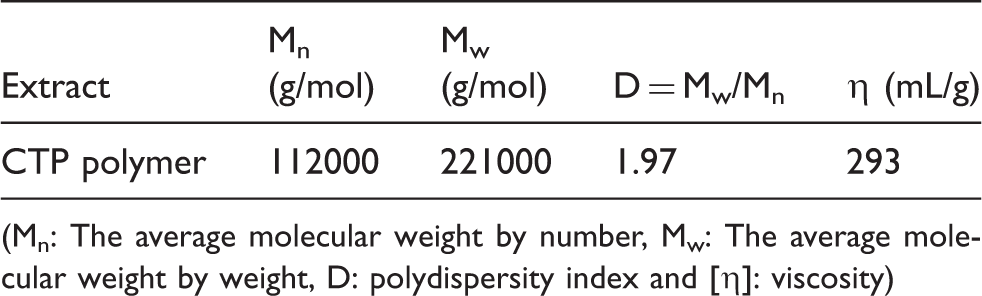
(Mn: The average molecular weight by number, Mw: The average molecular weight by weight, D: polydispersity index and [η]: viscosity)
Grafting of polymer-based alginates/CTP on cellulosic dressings
The variation of the temperature and the time of thermofixation (Figure 1) resulted in an increase in the grafting rate with the augmentation of these two parameters until a plateau was reached where the grafting rate became almost constant (maximal conversion of reactants). The optimal selected conditions were therefore a temperature of 140℃ and a curing time of 15 min. The results also showed a much greater grafting proportionality with the polyCTR-AG-CTP than that recorded with the polyCTR-AG. This could be explained by the greater reactivity of hydroxyls at the position 6 (primary alcohols) which reacted in the case of the CTP polymer compared with the reactivity of the hydroxyls in position 2 or 3 (secondary alcohols) concerned by the esterification reaction with alginate.
Grafting rate according to curing time (temperature fixed at 140 ℃) and temperature of thermo-setting (time fixed at 15 min).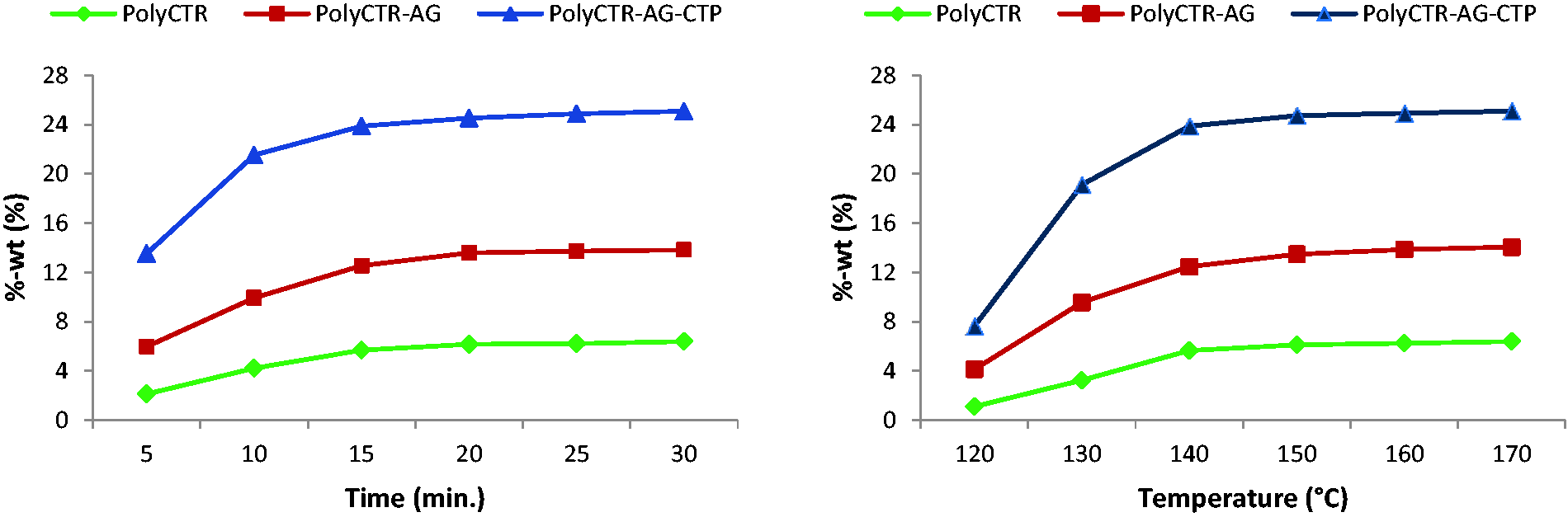
The grafting was the result of the in situ polymerization reaction between the CTR and the two bioactive polymers (alginate and CTP) and between the CTR and the cellulosic polymer of the textile dressing. So, the CTR acted as a crosslinking agent in the grafting reaction. The reaction begins with a dehydration of the CTR at the temperature of curing, resulting in a cyclic anhydride of five links (Figure 2). This anhydride is an intermediate which will react easily with the hydroxyl functions in position 6 of the glucoside groups of the CTP, by esterification reaction. The two remaining carboxylic acid functions will form a second anhydride, which will react with a hydroxyl group in position 2 or 3 of the alginate glycosidic moiety.49,50 In the same way the CTR could thus react with the hydroxyl functions of the cellulose of the dressings. We thus obtain a network of polyCTR-AG-CTP chemically linked to the cellulosic dressings.
Grafting of alginate and Carthamus tinctorius polysaccharide onto cellulosic dressing via polyesterification reactions through the CTR as a crosslinking agent.
The dilution of the impregnation bath was then carried out as a third parameter for the perfect control of the grafting rate, as indicated in Figure 3. The grafting rate of dressings treated with our polymer showed a perfect proportionality to the concentration of the reactants in the impregnation bath. The treatment of the dressings with the made polyCTR-AG-CTP in standard conditions incited a maximum weight increase of 23.8 %wt. These results reveal that the grafting reaction is easily controllable and that a desired functionalizing rate could be reached by adjusting the impregnating solution and the curing conditions.
Grafting rate function of the concentration of the polyCTR-AG-CTP. C corresponds to SHP = 20 g/L, CTR = 80 g/L, AG = 60 g/L, CTP = 40 g/L, curing 15 min at 140℃.
Washing test
The washing of dressings does not make sense in their use, but this test is useful for us to evaluate the fastness and the permanence of our grafting. The results in Figure 4 show an excellent washing fastness upon the two different standardized tests. The dressings with a low concentration of polymer (C/2) were less resistant to washing. This could be explained by a partial recovery of the treated surfaces with a low polymer concentration. The total recovery of the dressing surfaces with an adequate concentration (C) has improved the resistance of the graft. The chemical covalent bound via the polyesterification reaction, linking the polymer to the treated dressings, was behind the excellent permanence of our graft, exhibited by these good results of washing fastness.
Washing fastness of functionalized cellulosic dressings according to standard tests ISO1/ISO3. C corresponds to SHP = 20 g/L, CTR = 80 g/L, AG = 60 g/L, CTP = 40 g/L, curing 15 min at 140℃.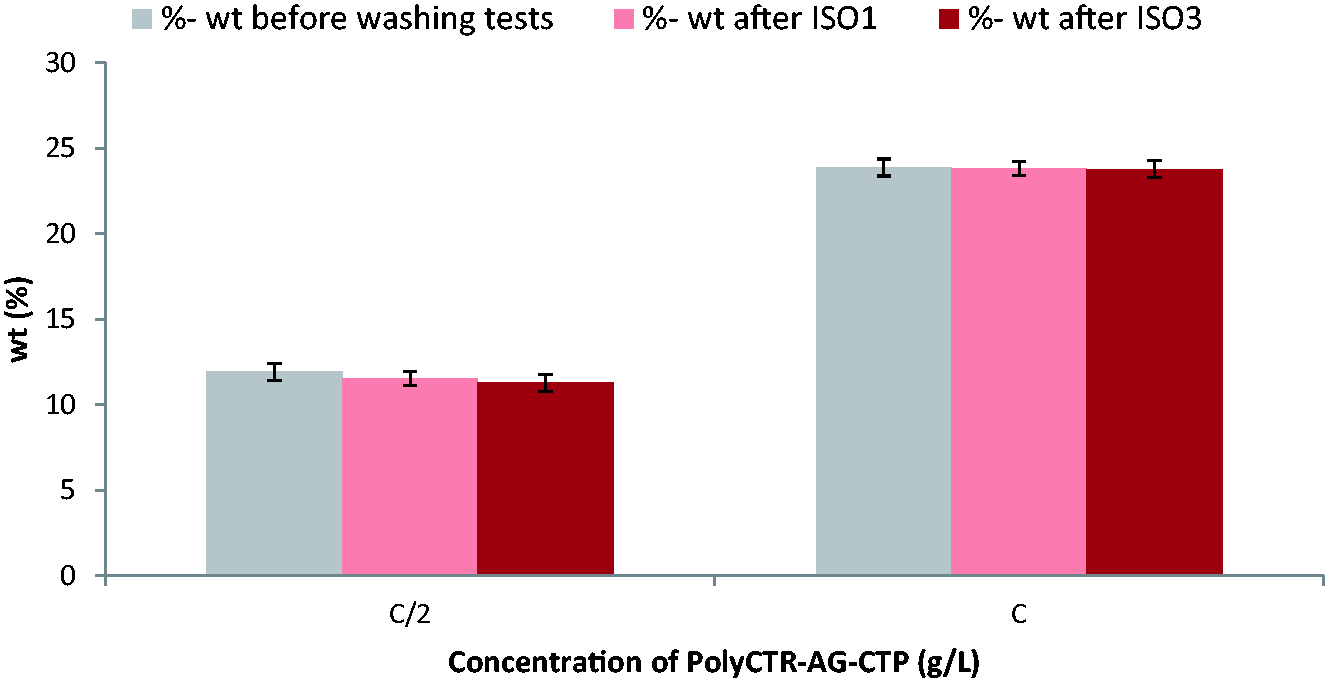
Damping study
Wound treatment requires dressings with good hydrophilic properties. Hydrophilicity is effective in treating wounds because it allows good absorbance of exudates and easy change of dressings. Thus, it accelerates the cure of wounds. The wettability was evaluated via the measurement of the contact angle of the virgin and grafted wound dressings. Figure 5 shows a clear decrease in the contact angle with the increase of the grafting rate of the functionalized dressings. Therefore, the functionalization with our polymer-based AG/CTP enhanced the hydrophilic characteristic of the treated dressings, which is important to reach optimal wound management. This improvement of the hydrophilicity behavior after grafting could be explained by the different hydrophilic groups provided by the grafted polymer such as the hydroxyl groups of the alginate and the CTP extract and also the free carboxylic groups of the CTR crosslinking agent.
Damping study via contact angles of virgin and grafted cellulosic dressings with polyCTR-AG-CTP.
TGA and DTA
The two techniques of TGA and DTA have been useful for confirming the permanence of our grafting that has occurred via a polyesterification reaction. This could be shown by the changes observed in the decomposition thermograms and the variation of the thermal stability of the virgin sample compared with the behavior of the grafted one (Figure 6).
Thermogravimetric analysis (left panel) and differential thermal analysis (right panel) of untreated dressing and polyCTR-AG-CTP grafting cellulosic dressing.
The analysis of the various thermograms can be performed by comparing the dehydration, denaturation and degradation of the virgin and functionalized samples. These different phenomena corresponded, at a characteristic temperature, to the decrease of the weight percentage signal (from TGA) and the significant peak of the derivative signal (from DTA). Polymer functionalization on a material can be confirmed by the observation of two temperatures of degradation, a first one that refers to the material and a second new one that belongs to the polymeric graft.
Concerning the virgin sample, the results from the TGA revealed two phenomena. The first one, showing a slight decrease in the weight of the sample at a temperature close to 100℃, corresponds to the evaporation of water and water humidity, continuous in the sample. This was confirmed from the DTA by the appearance of the endothermic peak near the temperature 100℃. The second one, characterized by a significant loss of weight, corresponds to the degradation of the virgin cellulosic sample at a temperature close to 370℃.
Three distinct zones appeared with the treated sample. The first one is similar to that observed previously with the virgin sample around 100℃. It is due to the evaporation of water absorbed by the treated sample. The second zone centered at a temperature of 280℃, which corresponds to the degradation temperature of the grafted alginate biopolymer and the CTP extract. The third zone revealed a significant loss of weight at 380℃, due to the degradation of the cellulosic material. This degradation temperature was slightly higher than that of the virgin sample, which could also confirm the evidence of the chemical functionalization. The different degradation temperatures for the treated sample were also demonstrated by the appearance of the different exothermic peaks in the thermograms from the DTA.
In addition, the residual weight after degradation observed for the virgin sample was approximately 8%, while for the grafted sample it persisted with a value greater than 20%. This variation in residual weight after grafting could well confirm the functionalization involving new covalent chemical bonds, obviously via polyesterification reaction.
Infrared spectroscopy analysis
Infrared spectroscopy analysis, via solid material surfaces, was investigated to identify different functional groups proving grafting reaction. Using the ATR mode, both spectra of the virgin and functionalized samples were analyzed.
The two spectra of untreated dressing and grafted cellulosic dressing with the polyCTR-AG-CTP are presented in Figure 7. Results revealed two principal bands that are able to confirm our successful grafting upon polyesterification reaction. The first was the wide band close to 3290 cm−1, which referred to the hydroxyl groups present in the grafted alginate polymer, to the CTP extracted polysaccharide and obviously to the cellulosic dressing material (this band was more extensive in the grafted material compared with the virgin dressing). In addition, a second peak centered at 1714 cm−1 appeared clearly in the spectrum of the grafted sample, which corresponded to the ester group of the polyCTR-AG-CTP grafted on the dressing material.
51
This finding confirmed the chemical covalent bond established by the grafting procedure. This is in line with previous studies, which confirmed by infrared testing the evidence of a polyesterification reaction between the cellulosic textile material and other polysaccharides crosslinked with different polycarboxylic acids.52–54 Furthermore, a clear band close to 1050 cm−1 appeared well on the spectrum resulting from the treated sample, which corresponded to the etheroxyde function of the alginate and the cellulosic dressing material. The analysis of the two spectra allowed us to conclude on the permanence of the grafting and confirmed well the efficiency of the investigated functionalizing process, which happened through a chemical solid bound via a polyesterification reaction.32,55
Fourier-transform infrared spectra of (a) untreated dressing and (b) polyCTR-AG-CTP grafting cellulosic dressing.
Mechanical characterization (tensile strength)
As with any applied medical textile material, the mechanical properties must be well defined for an effective exploration during their use. This characterization was performed to study the effect of the condition of grafting on the tensile strength behavior of functionalized dressings. The results in Figure 8 showed that the tensile strength of wet samples is higher than that of dry samples. This could be attributed to the structural changes in cellulose induced by the absorbed water. Indeed, Wang et al. reported that the crystallinity of cellulose increases as a result of higher relative humidity. In addition, the diffusion of water molecules inside the cellulose fibers promotes a uniform sharing of the charge between the cellulose molecules.
56
Moreover, we noticed a slightly more enhanced tensile strength with samples grafted with the two polymers compared with those grafted with only AG; this can be explained by a more compact grafting and a more connected and stable polymer network in the presence of the two grafted polymers.
Tensile strength of untreated and grafted cellulosic dressings.
In addition, the results revealed that with the selected optimum conditions of grafting (15 min at 140℃ of curing), the functionalization didn't affect the mechanical characteristics of the treated dressings, even though there was no significant decrease in the tensile strength after grafting.
SEM analysis
SEM characterization was performed with the aim to evaluate the surface morphology of dressing samples, before and after grafting with our combined bioactive polymer. Analysis of both untreated and grafted micrographs, showed a clear modification of the surface's morphology resulting after the grafting process. A regular smooth surface appeared for the virgin textile dressings (Figure 9).
Scanning electron microscopy images: (a1) and (a2) untreated dressing and (b1) and (b2) polyCTR-AG-CTP grafting cellulose dressing.
A significant change on the surface aspect was noticed on micrographs of the grafted sample, in which a uniform layer of grafted polymer appeared and coated the surface of the dressing's fibers.
In addition, micrographs of treated samples revealed that the grafting was carried out around the fibers without obstructing the useful spaces between the dressing threads. Therefore, the grafting did not affect the porosity (macropores) of the treated dressings, a very important result showing the efficiency of the present grafting process. We reached this conclusion because of the permanence and the good distribution of the polyCTR-AG-CTP grafted around the fibers with respect to the various surface characteristics of the original textile dressings.
Biological assessments (cell viability test)
To have the potential for clinical use, wound dressings must validate excellent biocompatibility, which is an essential required property for their effective use in the medical field. They should not have any cytotoxicity in contact with human cells and must ensure an excellent cellular metabolism. Cell viability assays were performed with untreated and grafted cotton dressings using HepG2 human cells.
The absorbance of the blue formazan, resulted after metabolization of the yellow tetrazolium salt (MTT) in the presence of the cells that proliferated on the samples, is proportional to the cell viability, and reveals the optimal adaptation of the support to biological activity. The absorbance, recorded with the control, was considered as the maximum cell viability and was set at 100%.
The results in Figure 10 revealed, for the untreated sample, a gradual decrease in cell viability according to the augmentation of the contact duration with cells. However, the various values remained high (75% after incubation time of 72 h). The grafted sample presented very interesting results of cell viability. For all durations of direct contact, the cell viability manifested an increase compared with untreated and control materials. This improvement of the cell viability after polymer grafting meant that the functionalized wound dressings provided enhanced biological activity.
Viability tests of the HepG2 epithelials on the untreated and grafted supports.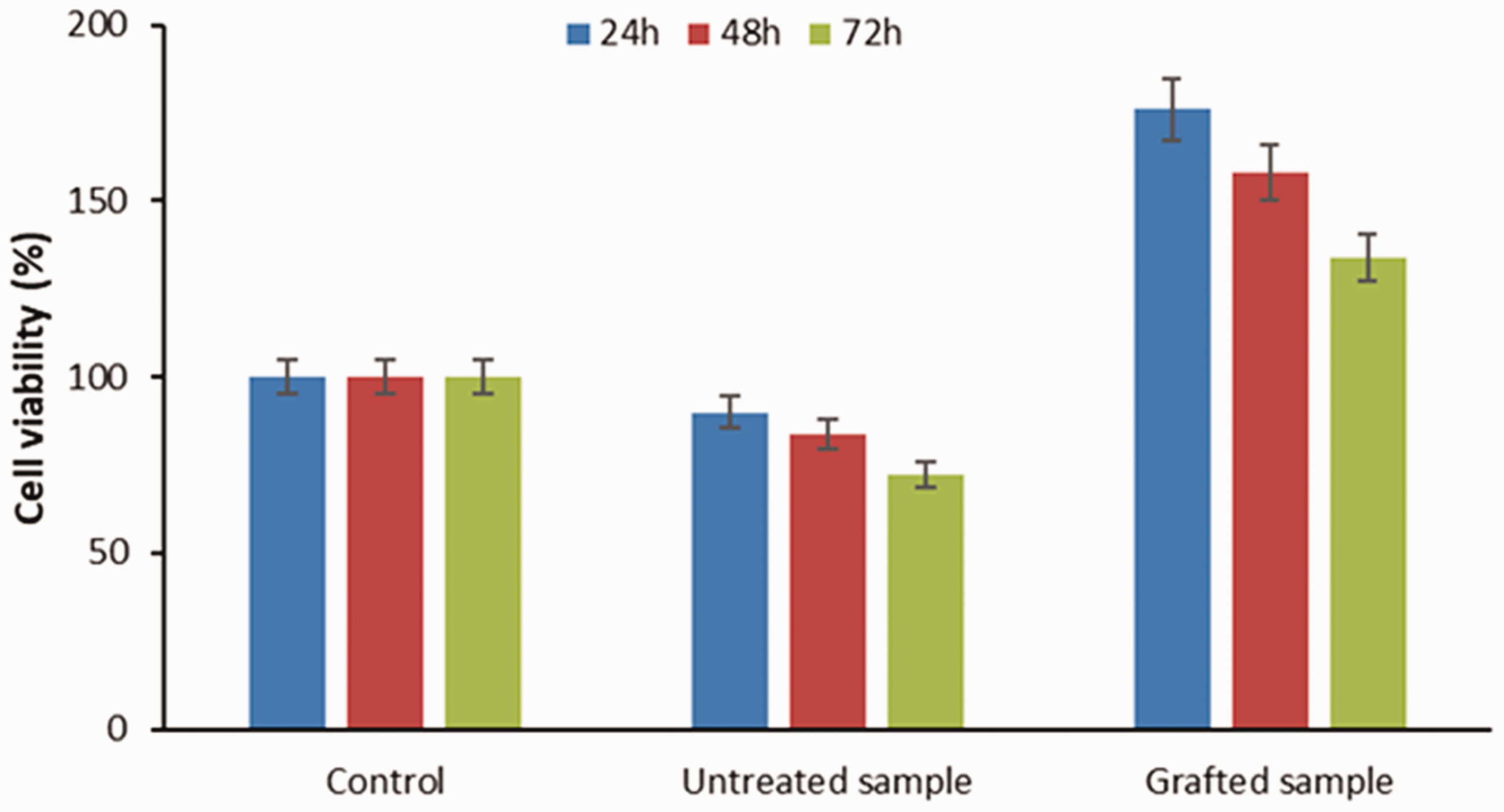
The increase of cell viability after functionalization upon different times of incubation confirmed that our grafted polymer induced no toxicity with the tested HepG2 human cells. Furthermore, the functionalization with the polyCTR-AG-CTP gave the wound dressing an excellent microenvironment able to promote strongly both a rapid healing and a good tissue regeneration.
Antibacterial efficiency
Bacteriological assessments were performed against four different pathogenic bacteria; two were Gram-positive, Micrococcus luteus and Staphylococcus aureus, and two Gram-negative, Pseudomonas aeruginosa and Escherichia coli. The antibacterial efficiency of polyCTR-AG-CTP grafted dressing samples was compared with untreated cellulosic dressings upon disk diffusion assessment. According to the experimental method presented above, the antibacterial behavior of the various analyzed samples was expressed as the diameter of the inhibition area appearing around the samples. Concerning the untreated dressing sample (Figure 11), there was no clear inhibitory zone around the samples. Therefore, the virgin cellulosic samples had no antibacterial effect against the four different bacteria strains. The grafted cellulosic dressings revealed a good antibacterial effect against the four tested bacteria. This important inhibitory effect was higher in the case of the two Gram-positive bacteria. This shows evidence of the enhancement of the antibacterial behavior of cellulosic dressings after their grafting with the polyCTR-AG-CTP. The resulting important and higher efficiency was due to the combined effect exerted by the two bioactive protagonists of the grafted polymer, the alginate and the CTP extracted polysaccharide.
Antibacterial evaluation of grafted cellulosic disks against different bacteria types via the determination of the inhibition zone around bacteria (sample disk diameter = 11 mm).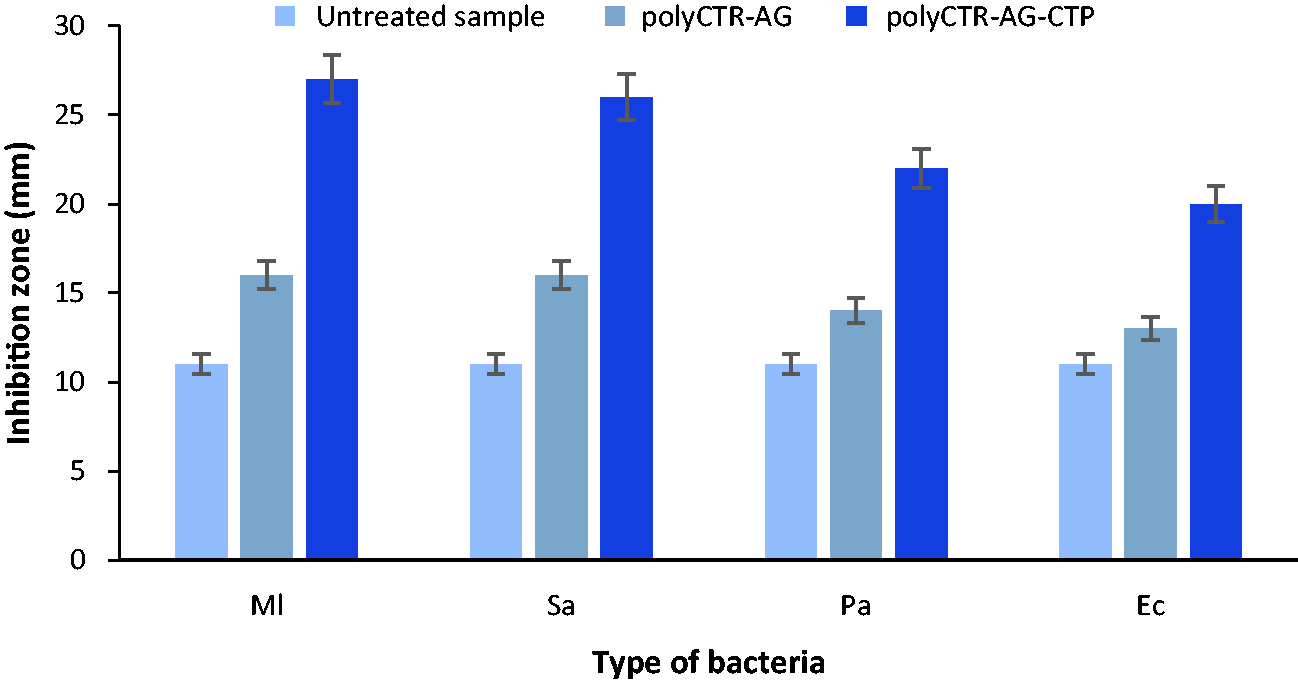
Conclusions
The current work has provided a study on the physicochemical, morphological, biological and bacteriological properties of new functionalized cellulosic textile dressings with a combined bioactive polymer of alginates and CTP polysaccharide extract. The first challenge consisted of a successful grafting of the cellulosic dressings with the synthesized crosslinked polymer of alginate and CTP extract, aiming to take advantage of their various biological effects. The grafting process developed in solid phase inside an oven was simple and safe. It required the use of non-toxic chemicals and did not involve any organic solvent; the only by-product generated after the polyesterification reaction was water. Consequently, it could be considered as a green textile finishing process.
The successful grafting was validated with different rates after an optimization study of the different treatment parameters. The selected improved parameters were a curing temperature of 140℃ and a period of 15 min. The variation of the concentration of the different reactants permitted the control of the grafting rate of the treated dressings.
The permanence of our chemical functionalization via polyesterification reaction and the efficiency of the grafting textile process were confirmed using gravimetric (TGA/DTA) and spectroscopic (FTIR/ATR) characterizations. Drop angle assessments revealed the increase of the hydrophilicity of the treated dressings with our bioactive polymer, which was considered as a required advantage for an enhanced healing property. Mechanical properties demonstrated that with the optimum parameters of grafting, there was no significant variation of the mechanical characteristics (tensile strength) of the grafted wound dressings. The morphological analysis confirmed that the functionalization occurred by a uniform coating of the fibers without affecting the original porosity of the treated dressings. The different biological studies revealed a very good biocompatibility of the polyCTR-AG-CTP grafted cellulosic dressings and confirmed their non-toxicity in contact with human cells. Viability assessment showed a significant improvement in the cell vitality of the treated samples. The excellent activity exhibited by the cells in the presence of grafted dressings can be explained by the increase of the hydrophilicity behavior of the treated samples, as mentioned above.
Bacteriological tests achieved on agar cultures against the four different bacterial strains validated a higher antimicrobial effect with the grafted dressings compared with the untreated textile samples.
The expounded treated wound dressings confirmed a promising potential of resistance to different bacterial colonization, which represent a serious interest currently in diabetics' lives.
Based on the biological results, the polymer grafting was shown to be very efficient, since it promotes a faster cure and an enhanced healing with an easier change of the functionalized dressing.
Knowing the multiple uses of cellulose-based biomaterials and the various biological effects of alginate and C. tinctorius to treat various diseases, cellulosic dressings functionalized by the proposed crosslinked biopolymer might offer promising potential, or even replacement, for an effective medical textile device to treat diabetics' injuries and more still other serious and acute wounds.
Footnotes
Declaration of conflicting interests
The authors declared no potential conflicts of interest with respect to the research, authorship, and/or publication of this article.
Funding
The authors received no financial support for the research, authorship, and/or publication of this article.
