



Abstract
Low liquor ratio (material to liquor ratio = 1:5) dyeing of cotton fabric with C.I. Reactive Blue 21 using dioctyl sodium sulfosuccinate as a surfactant was thoroughly analyzed. The dye–surfactant interactions in the micelles during low liquor ratio dyeing were investigated by ultraviolet-visible spectroscopy and the chemical mechanism of the process was evaluated by Fourier-transform infrared spectroscopy analysis. Cotton fabric was subjected to low liquor ratio dyeing and conventional dyeing by varying the temperature, pH, treatment time, and non-identical chemical concentration. The effectiveness of the process was assessed based on the color strength (K/S), exhaustion (%), fixation (%), and levelness. Low liquor ratio dyeing afforded superior dyeing compared to conventional dyeing, attributed to the anti-agglomeration effects of the former, which also had no adverse impact on the fastness of the dye. The lower environmental impact due to the lower effluent footprint (biological oxygen demand, chemical oxygen demand, total dissolved solids, and dissolved oxygen) is another benefit of low liquor ratio dyeing. High-pressure liquid chromatography and gas chromatography-mass spectrometry analyses revealed that the low liquor ratio dyed fabric is free of toxic substances (alkylphenol ethoxylates and formaldehyde). Moreover, low liquor ratio dyeing is more cost-effective and outperformed conventional dyeing in all aspects, while being a sustainable process.
Keywords
Due to their availability, affordability, wide range of hues, and good color fastness, reactive dyes are the dyes of choice for cotton fibers. 1 The most important characteristic of reactive dyes is that they form covalent bonds with the substrate. Thus, the dye molecule has specific functional groups that can undergo addition or substitution reactions with the hydroxyl groups of cellulose fibers. 2 Based on the number of reactive groups, reactive dyes are generally classified as mono-, double-, or multiple-anchor dyes. Another classification is based on the variety of chromophores, including azo, anthraquinone, phthalocyanine, etc. Hot, medium, and cold brand dyes are categorized further according to the application process. 3 Multiple-anchor dyestuffs are known to have the highest fixation rates and the lowest rates of transfer of the hydrolyzed dye to wastewater.4,5 Previously reported data suggest that the percentage of unfixed reactive dye is generally in the range of 5–50%. The highest value is documented for phthalocyanine-based reactive dyes. 6 Reactive dyes with copper-phthalocyanine-based anchors, commonly referred to as turquoise blue dyes, produce bright blue shades with exceptional tinctorial strength. 7 There are three major variants of the dyeing procedure for reactive dyes: discontinuous exhaust dyeing, which is still the dominant method for knitwear; semi-continuous dyeing (so-called cold pad batch dyeing, which is mainly applied to woven fabric); and the continuous process, which is exclusively applied to woven fabric.8,9 The equipment currently used for exhaust dyeing consists of jet machines, package dyeing, and hank dyeing machines, while winch becks and jiggers are less frequently employed. The exhaust dyeing process can be categorized based on isothermal and migration methods. Generally, dyers tend to apply the migration-dyeing method at 70–90℃ for copper phthalocyanine reactive dyes on cotton fabric due to the large molecular size of these dyes. The high energy consumption required to heat the dyeing liquor in the migration-dyeing method is another concern.10,11 Usually, the conventional reactive dyeing process is carried out by utilizing significant amounts of water, with the addition of different chemicals such as sodium chloride or sodium sulfate (up to 100 g/l) and sodium carbonate (up to 20 g/l). 12 Under usual circumstances, dye houses tend toward using a material to liquor (M:L) ratio of 1:10–1:15 for the conventional dyeing of cotton fabric, where dyeing 1 kg of cotton fabric requires 70–250 l/kg of water. 13 This process causes environmental hazards due to the use of numerous chemicals, such as sodium sulfate, sodium carbonate, leveling agents, sequestering agents, and detergents, that are mixed with excess water.14–16 Numerous studies have been conducted to develop technology with the ability to minimize wastage of water and energy, alongside being environmentally friendly.17,18 One such example is supercritical fluid dyeing, which is an alternative to water-based medium dyeing for synthetic fibers. Unfortunately, this process requires the use of high-pressure equipment and is only suitable for certain synthetic fibers, such as polyester and polyamides. This not only means that the process costs are higher in terms of the capital outlay, but it also decreases the range of applications. 19 Another example of non-aqueous dyeing is solvent dyeing. Using organic chemicals eliminates the issue of effluent control. 20 However, dyeing cotton is still considered a great challenge for dyers. 21 In recent years, various methods have been developed to conserve water and energy, such as low liquor ratio dyeing for cotton fabrics with reactive dyes.22,23 Countless studies have been conducted for modifying the dyeing machines and fibers. Despite all these efforts, low liquor ratio dyeing still suffers certain limitations due to dye agglomeration, which causes uneven dyeing and poor color fastness.24–27 Dye aggregation can significantly affect the exhaustion, fixation, and leveling properties.28,29 It is highly interesting to resolve dye aggregation in low liquor ratio dyeing technology. Hence, the development of effective auxiliaries or surfactants is the major challenge for researchers.30,31 Dialkyl maleic acid ester was used as a surfactant with azo- and anthraquinone-based reactive dyes to prevent dye agglomeration. Micelle formation by dibutyl maleic acid ester sodium sulfate afforded good anti-agglomeration effects, which allowed reduction of the liquor ratio from 1:15 to 1:5 and also reduced the amount of water and energy. 24 No studies have been carried out concerning low liquor ratio dyeing using copper-phthalocyanine-based C.I. Reactive Blue 21 dyes. Moreover, phthalocyanine-based dyes are highly sensitive to non-ionic surfactants, which cause clouding, and in extreme cases can cause precipitation. Dioctyl sodium sulfosuccinate (also known as AOT or Aerosol-OT) is an anionic surfactant that considerably reduces the surface tension of fluids. It is also used as a food additive, emulsifier, dispersant, and wetting agent. The chemical structure of AOT is made up of a moiety of sulfonate groups as the hydrophilic head and twin aliphatic chains as the hydrophobic tail covalently connected at the head group. 32 These surfactant micelles may exert anti-agglomeration effects on copper phthalocyanine dyes. The purpose of this study is to reduce the liquor ratio by using AOT to generate micelles of phthalocyanine reactive dyes. In addition, reduction of the dyeing costs and environmental pollution and better dyeing quality are discussed to establish a sustainable low liquor ratio dyeing process.
Experimental details
Materials
Scoured and bleached cotton (100%) single jersey knitted fabric (160 g/m2) having 25 wales/inch and 40 courses/inch was obtained from Fakhruddin Textile Mills Ltd, Gazipur, Bangladesh. The commercial reactive dye Rifazol Turquoise Blue G (C.I. Reactive Blue 21; see Figure 1) was procured from Rifa Industrial Company Ltd, South Korea. In this study, and an anionic sequestering agent, leveling agent, and non-ionic soaping agent were used. The chemical structure of AOT is shown in Figure 2; this compound was purchased from Merck KGaA, Darmstadt, Germany. All chemicals used in this study were of laboratory-reagent grade.
Chemical structure of C.I. Reactive Blue 21. Chemical structure of dioctyl sodium sulfosuccinate (AOT).

Dyebath preparation
AOT was dissolved in distilled water along with the reactive dye to prepare a 0.05 g/l solution and heated at 30℃ with stirring for 30 min. To analyze formation of the dye-AOT micelles, four different options were considered: (a) dye only (0.05 g/l); (b) dye (0.05 g/l) with salt (50 g/l); (c) dye (0.05 g/l) with (5 g/l) leveling agent and (5 g/l) sequestering agent; and (d) dye (0.05 g/l) with AOT (5 g/l). The absorption of these solutions was measured using an ultraviolet-visible (UV-vis) spectrophotometer (Cintra 2020, GBC, Australia) with the aim of determining the physico-chemical changes during micelle formation.
Fourier-transform infrared spectroscopy
The specific functional groups of the dyed fabrics under the conventional dyeing condition and the low liquor ratio dyeing condition were characterized using Fourier-transform infrared spectroscopy (FT-IR) (IR Prestige 21, SHIMADZU, Japan). The samples were analyzed in attenuated total reflectance (ATR) mode by accumulating 128 scans at a resolution of 8 cm–1.
Dyeing
A 300 ml dyebath, suitable for dyeing 10 g of cotton fabric with reactive dye (2%) in a laboratory dyeing machine (Ahiba Infrared Dyeing Machine, UK), was used herein. In the conventional dyeing process, an anionic leveling agent (2 g/l) and sequestering agent (2 g/l) were added to the dyebath with 50 g/l sodium sulfate (Na2SO4.10 H2O) for dye exhaustion, and 10 g/l sodium carbonate (Na2CO3) was used for fixation, with a material to liquor ratio of 1:10, at 80℃, for 60 min. The dyeing conditions were optimized by varying the temperature (50℃, 60℃, 70℃, 80℃, and 90℃), time (30, 40, 50, 60, and 70 min), pH (9, 10, 11, 12, and 13), and auxiliary concentrations (1, 2, 3, 4, and 5 g/l).
For low liquor ratio dyeing, AOT (2 g/l) was used for micelle formation with the reactive dye (2%; o.w.f.). Sodium sulfate (50 g/l) and sodium carbonate (10 g/l) were also added to the dyebath for exhaustion and fixation. Dyeing was carried out at 80℃ for 60 min with a material to liquor ratio of 1:5. The dyed samples were thoroughly rinsed with cold water, followed by soap-off with 1 g/l soaping agent solution at 90℃ for 10 min. Afterward, all samples were rinsed thoroughly and finally dried in an oven (James Heal, UK) at 80℃ for 10 min in preparation for the different tests.
Color measurement
The color strength (K/S) of the dyed fabrics was determined using a Datacolor 650 reflectance spectrophotometer (USA). The tests were performed with a machine setup employing a D65 light source and viewing geometry of 10o standard observer considering the specular component accompanying the larger aperture size (30 mm). Each sample was folded twice for evaluation of the reflectance in the 400–700 nm range, and the reflectance (R) at the wavelength of maximum absorption (λmax) was determined using the Kubelka–Munk equation

Measurement of dye exhaustion, fixation, and levelness
The percentage dye exhaustion and fixation of the conventional dyeing and low liquor ratio dyeing processes were calculated by measuring the absorbance of the residual dyebath liquor. The dye exhaustion and fixation yields were determined by UV-vis spectrophotometry (Cintra 2020, GBC, Australia). The percentage dye exhaustion (E%) and fixation (F%) were calculated according to the following equations


Here, Ao and A1 are the absorbance of the dye solution at λmax before and after dyeing. A2 is the absorbance of the dye-soaped solution with a non-ionic surfactant. The levelness of the dyed fabric was assessed using an instrumental method that was developed by Yang and Li
33


Here, λ is the wavelength for the measurement, n is the total number of measurements, and (K/S)i, λ is the K/S value of the ith measurement at λ.
The levelness parameter was modified by Koh et al.
34
Here, Sr(λ) is the relative sample standard deviation of (K/S)λ and V(λ) is the spectral luminous function. Thus, the unlevelness value is described as

The levelness parameter L is varied to give different values, which are very similar to the gray-scale rating for color change if (U ≥ 0.3114)


Measurements of biological oxygen demand, chemical oxygen demand, total dissolved solids, dissolved oxygen, alkylphenol ethoxylates, and formaldehyde content
The biological oxygen demand (BOD) and chemical oxygen demand (COD) (in mg O2/l) for the conventional and low liquor ratio dyebath solutions were measured by Method APHA 5210 (B) and EPA 410.3, respectively. The total dissolved solids (TDS) and dissolved oxygen (DO) were evaluated according to the respective standard methods 2540 and ASTM D888-12. The APEOS (alkylphenol ethoxylates) and formaldehyde content of the dyed fabric were respectively evaluated by ISO 18254-1:2016 (with a detection limit of 3 mg/kg) and ITX-GB/T 2912.1/2012 C (with a detection limit of 16 mg/kg). Acetone was used to extract APEOS from the fabric, and the APEOS was quantified by liquid chromatography-mass spectrometry (LC/MS; Agilent 6470 A LC/MS triple quadruple, LC-QQQ, robust TQ LC/MS, USA), while the free hydrolyzed formaldehyde concentration was assayed using high-performance liquid chromatography (HPLC; Agilent 1200 Quaternary DAD HPLC System, USA).
Color fastness test
International standards were used to evaluate the color fastness, that is, fastness to washing: ISO 105-C03 (2013); fastness to rubbing: ISO 105-X 12 (2016); and fastness to light: ISO 105-B02 (2013).
Results and discussion
Reactive dyeing mechanism using dioctyl sodium sulfosuccinate
Surfactants are organic compounds that, once dissolved in water, become oriented at the air/water interface, thus substantially reducing the interfacial tension. At 20℃, AOT has a surface tension of 30.65 mN/m. Surfactant molecules should have surface-active properties with a chemical structure comprising a hydrophilic (water-loving) head and hydrophobic (having little attraction for organic molecules) tail. In solution, all surfactants tend to form more or less ordered agglomerates of molecules known as micelles (Figure 3).
35
Micelle formation with C.I. Reactive Blue 21 dye and dioctyl sodium sulfosuccinate in water.
A hydrophile is attached to a single molecule of AOT to ensure better water solubility. Reactive dye molecules consist of a chromogen (phthalocyanine) that is responsible for color and much of the substantivity of the fiber. Besides, the presence of a bridging group (-NH) links the reactive system with the chromogen. Under alkaline conditions, the reactive vinyl sulfone (-SO2-CH2=CH2) group obtained from the sulfatoethylsulfone (-SO2-CH2CH2OSO3H) part of the dye molecule enables the dye to form a covalent bond with the fiber. Furthermore, one or more solubilizing groups (-SO3H) confer solubility. 36 The dye molecule also consists of hydrophobic aromatic moieties and polar groups, which confer solubility. Due to their larger molecular size, phthalocyanine dyes can form hydrophobic inclusion complexes, which tend to induce particle agglomeration.
In aqueous solution, the reactive dye molecule and AOT both possess predominantly anionic characteristics. The addition of the dye and AOT to the dyebath induces a repulsive force among these species and the dye will start moving toward the electric double layer developed at the fiber surface, with disassociation of the electrolyte. Following the temperature increase, the entropy of the medium will increase and the dye will develop sufficient energy to penetrate the fiber and cross the electric double layer because the negatively charged dye molecule has greater affinity for the neutralized fiber than for the aqueous solution. The AOT reduces the surface tension of the bath; this acts as a driving force to ensure the success of this process. The hydrophobic tails of the AOT molecules are oriented toward the center of the hydrophobic dye micelle, which facilitates micellar solubilization, thereby facilitating higher dye penetration through the electrical double layer in aqueous solution. The mode of interaction of the reactive dye, AOT, and cotton fiber can be categorized in four stages, as shown in Figure 4: (1) dissolution of the dye in water by formation of the dye micelle with the surfactant; (2) transference of the dye molecules from the electrical double layer toward the surface of the fiber; (3) replenishment of the dyebath by dissolution of the dye into the cotton fiber; (4) diffusion of the dye into the cotton fiber.
Mode of interaction of reactive dye, dioctyl sodium sulfosuccinate, and cotton fiber.
UV-vis spectra of dye solution containing AOT
The dyeing uniformity depends on better solubility of the dyestuff in the bath. The better the solubility, the more uniform the dye. The dyeing kinetics and adsorption equilibrium of reactive dyes are mostly influenced by dye aggregation. Micelle dyeing can be achieved by using AOT and reactive dyestuff, where this process circumvents dye aggregation in the dyebath. Thus, the micelle leads to complex interaction of the dye molecules and AOT, which improves the dye solubility. The low liquor ratio dyeing method involves micelle dyeing. The UV-vis spectra of the reactive dye solution (0.05 g/l); the dye solution with the electrolyte (sodium sulfate 50 g/l); the dye solution with the leveling agent (5 g/l), sequestering agent (5 g/l), and electrolyte (sodium sulfate 50 g/l); and the dye solution with AOT (5 g/l) were measured, as shown in Figure 5. The lowest absorption was observed for the dye-only solution and dye solution with the electrolyte (50 g/l). This is attributed to aggregation of the reactive dyes in the presence of water and the electrolyte. The position of the absorption peak allows determination of both the n–π* and π–π* transitions from lowest energy to highest energy. Increased conjugation shifts the observed absorption wavelength to higher values. Thus, the results provide evidence that the dye solutions without chemicals formed a complex structure, with agglomeration effects. The absorption of the dye solution with the leveling agent, sequestering agent, and salt was enhanced due to its anti-agglomeration effects. On the other hand, strong absorption was observed for the dye solutions with the electrolyte and AOT. This comparison shows that the AOT micelles had a disaggregating effect in the dye solutions. The observations indicate that the micelles formed by the surfactant had good anti-agglomeration effects in the reactive dye solution.
Ultraviolet-visible spectra of C.I. Reactive Blue 21 solutions with salt and auxiliaries. AOT: dioctyl sodium sulfosuccinate.
FT-IR analysis of dyed fabrics
For comparison, the FT-IR spectra of the bleached, conventional, and low liquor ratio dyed cotton fabrics are represented in Figure 6. The absorption peak at 3600 cm–1 was similarly assigned to the –OH bond of bleached and conventionally dyed cotton fabric. However, the intensity of this peak for the low liquor ratio dyed cotton fabric was lower due to stronger covalent bond formation with the reactive dye. It can be inferred that low liquor ratio dyeing exerted less agglomeration effect on the Cu phthalocyanine dye. However, the absorption peaks at 3000, 1740, 1680, and 1296 cm–1 assigned to the C-H aliphatic, C=O, C=C, and C-N bonds for bleached, conventional, and low liquor ratio dyed cotton fabric were almost identical.
Fourier-transform infrared spectroscopy spectra of conventionally dyed (dye 2% o.w.f., leveling agent 2 g/l, sequestering agent 2 g/l, salt 50 g/l), and low liquor ratio dyed (dye 2 % o.w.f., dioctyl sodium sulfosuccinate 2 g/l, salt 50 g/l) fabrics.
Effect of dyeing temperature
It is well-known that hot brand dyes generally require a higher temperature than cold and medium brand dyes. Figure 7 shows that the temperature used for the conventional and low liquor ratio dyeing of cotton using reactive dyes influenced the color strength (K/S) value. When the dyebath temperature was gradually increased in the range of 50–80℃, the color strength gradually increased. In addition, when the temperature exceeded 90℃, the color strength (K/S) gradually decreased for both the conventional and low liquor ratio dyeing processes. Hence, it is deduced that larger Cu phthalocyanine particles can be hydrolyzed at the higher temperature of 90℃. However, the highest color strength (K/S) was obtained at 80℃. Low liquor ratio dyeing afforded higher color strength (K/S) than conventional dyeing, because micelle dyeing curtailed the aggregation effects in the dyebath.
Effect of reactive dyeing temperature on color strength of dyed cotton fabric: dye concentration 2% o.w.f., pH 11, salt 50 g/l, soda 10 g/l, dyeing time 60 min (conventional dyeing: leveling agent 2 g/l, sequestering agent 2 g/l; low liquor ratio dyeing: dioctyl sodium sulfosuccinate 2 g/l).
Effect of dyeing time
Figure 8 presents the effect of the conventional and low liquor ratio dyeing time on the color strength for the fabrics dyed for 30–70 min at 80℃. In general, there were significant changes in the color strength (K/S) based on the duration of the different dyeing processes. Figure 8 clearly shows that the optimum color strength was obtained at 60 min for both low liquor ratio dyeing (K/S = 16.7) and conventional dyeing (K/S = 15.24). However, the color strength (K/S) gradually decreased with increasing dyeing time for the conventional and low liquor ratio dyeing processes. A longer dyeing time increased the hydrolysis of the reactive dyes.
37
The optimal dyeing time may reduce costs and the processing time. In addition, low liquor ratio dyeing afforded better color strength (K/S) than conventional dyeing, because micelle formation between the dye and AOT enhanced the anti-agglomeration effects at 60 min of dyeing time.
Effect of reactive dyeing time on color strength of dyed cotton fabric: dye concentration 2% o.w.f., pH 11, salt 50 g/l, soda 10 g/l, dyeing temperature 80℃ (conventional dyeing: leveling agent 2 g/l, sequestering agent 2 g/l; low liquor ratio dyeing: dioctyl sodium sulfosuccinate 2 g/l).
Effect of dyeing pH
When the pH of the dyebath is higher, the reactive dyes tend to undergo hydrolysis. The effect of the pH of the conventional and low liquor ratio dyeing solutions was investigated at 80℃ for a treatment time of 60 min. The changes in the color strength (K/S) of cotton fabric dyed with reactive dye via the different methods are summarized in Figure 9. Under alkaline conditions (pH = 11.0), a higher salt concentration enhanced the dye uptake and fixation. Cotton fabrics were dyed with reactive dye at various pH value to evaluate the influence of the pH on the color strength (K/S). Dye liquors containing 2% o.w.f. reactive dye were set at pH values of 9–13. The results presented in Figure 9 show that higher color strength (K/S) was achieved under alkaline conditions at pH 11. This clearly demonstrates that the optimum color strength was obtained at pH 11 for low liquor ratio dyeing (K/S = 16.74) and conventional dyeing (K/S = 15.24). Furthermore, the color strength decreased as the pH increased from 12 to 13. In comparison, under more alkaline conditions, the color strength gradually declined because higher alkalinity enhanced the rate of hydrolysis of the reactive dyes.
38
Effect of reactive dyeing pH on color strength of dyed cotton fabric: dye concentration 2% o.w.f., salt 50 g/l, soda 10 g/l, temperature 80℃, time 60 min (conventional dyeing: leveling agent 2 g/l, sequestering agent 2 g/l; low liquor ratio dyeing: dioctyl sodium sulfosuccinate 2 g/l).
Effect of dyeing auxiliary concentrations
The optimum chemical concentration is one of the vital factors influencing the dyeing quality. The dyeing performance was analyzed by varying the chemical concentration (1–5 g/l); sequestering and leveling agents were both used for the conventional dyeing process and AOT was used for the low liquor ratio dyeing process. Figure 10 illustrates that with increasing chemical concentration, the low liquor ratio dyeing process afforded higher color strength (K/S = 15.19) than the conventional dyeing process (K/S = 14.68). This is attributed to the ability of the AOT to interact in a complex way with the dye molecules in the solution to form micelles. On the other hand, the sequestering agent and leveling agent used in conventional dyeing enhanced the aggregation effects; thus, the color strength (K/S) declined. However, high color strength (K/S) could not be achieved by increasing the concentration of the auxiliaries. The color strength (K/S) followed a largely similar trend for conventional and low liquor ratio dyeing with increasing chemical concentration. Higher chemical concentration was ineffective for deaggregation because of steric congestion with the large molecules of the phthalocyanine dyes.
Effect of chemical concentration on color strength of dyed cotton fabric: dye concentration 2% o.w.f., pH 11, salt 50 g/l, soda 10 g/l, temperature 80℃, time 60 min (conventional dyeing: leveling agent 2 g/l, sequestering agent 2 g/l; low liquor ratio dyeing: dioctyl sodium sulfosuccinate 2 g/l).
Build-up properties
The effect of the dye concentration used in the dyeing process was evaluated in the range of 0.5–6% (o.w.f.). As seen in Figure 11, the color strength (in terms of the K/S value) increased with an increase in the dye concentration. Low liquor ratio dyeing of cotton fabric with the reactive dye clearly afforded a much deeper shade than the conventional dyeing process. The dye concentration was increased to 6% o.w.f.; however, equilibrium was not achieved. Moreover, the dye adsorption capacity was almost 1.04 times higher for the low liquor ratio dyeing process than for conventional dyeing.
Build-up properties of reactive dyeing on cotton fabric: dye concentration 2% o.w.f., pH 11, salt 50 g/l, soda 10 g/l, temperature 80℃, time 60 min (conventional dyeing: leveling agent 2 g/l, sequestering agent 2 g/l; low liquor ratio dyeing: dioctyl sodium sulfosuccinate 2 g/l).
The CIELAB a* and b* coordinates for the fabric treated via the conventional and low liquor ratio dyeing processes are presented in Figure 12. As the dye concentration increased, the CIELAB a* and b* coordinates approached the bluish achromatic point for the fabrics treated via both the conventional and low liquor ratio dyeing processes. In particular, the color coordinates of the fabric treated with C.I. Reactive Blue 21 followed a similar trend for the conventional and low liquor ratio dyeing processes, where the dyed fabric changed from a bluish to greenish color in terms of the hue angles, and the chroma changed from lighter to darker as the dye concentration increased.
CIELAB diagram of reactive dyed cotton fabric: dye concentration 2% o.w.f., pH 11, salt 50 g/l, soda 10 g/l, temperature 80℃, time 60 min (conventional dyeing: leveling agent 2 g/l, sequestering agent 2 g/l; low liquor ratio dyeing: dioctyl sodium sulfosuccinate 2 g/l).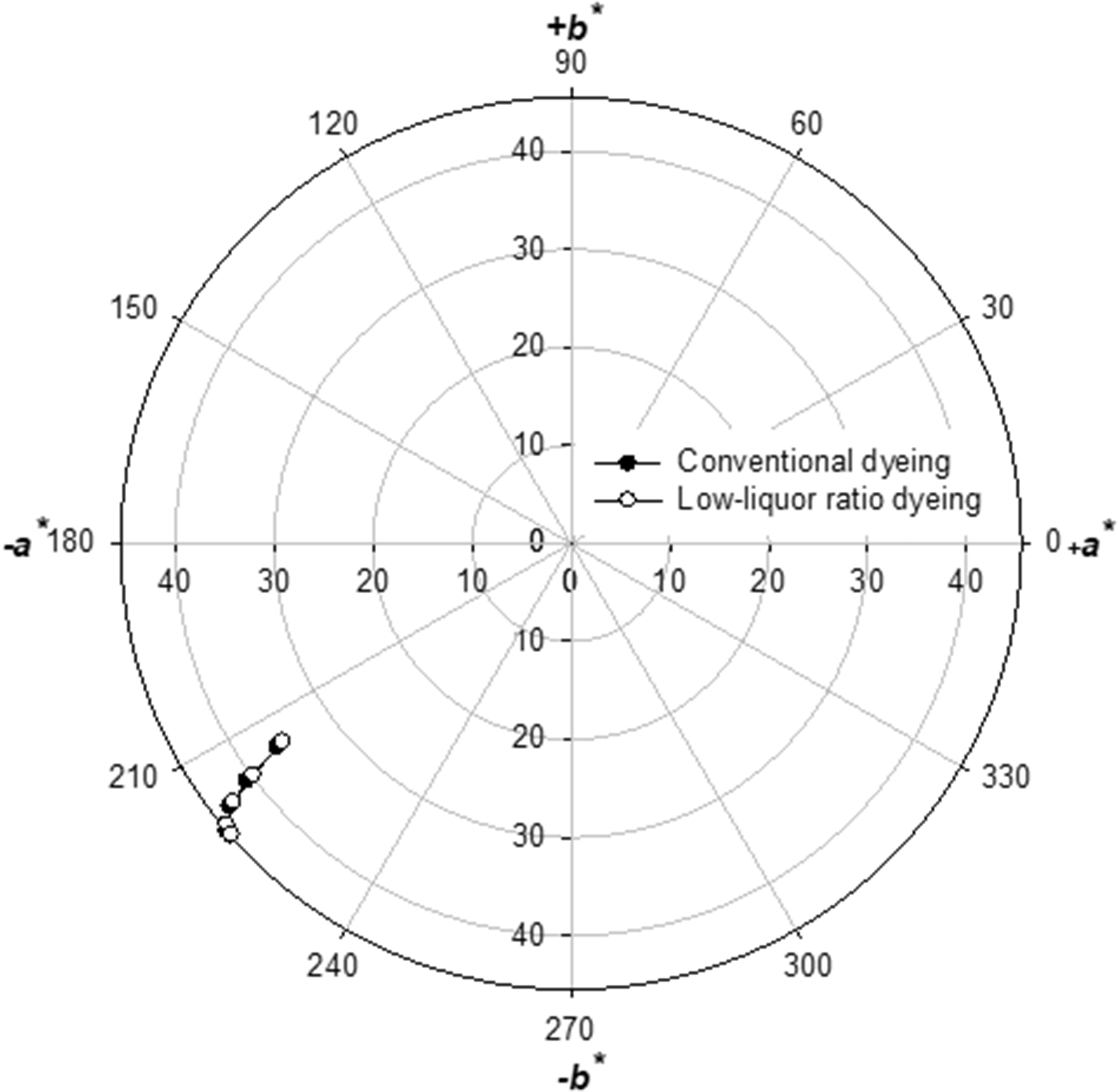
Dyeing properties of conventional dyeing and low liquor ratio dyeing

Evaluation of product quality, sustainability, and cost-effectiveness
Fastness properties of the dyed samples using conventional dyeing and low liquor ratio dyeing methods

SC: staining on cotton; SW: staining on wool.
Sustainability of dyeing effluents for conventional and low liquor dyeing

TDS: total dissolved solids; COD: chemical oxygen demand; BOD: biological oxygen demand; DO: dissolved oxygen; APEOS: alkylphenol ethoxylates.
The effluents from the different dyeing processes were evaluated based on the BOD, COD, TDS, and DO as shown in Table 3. Compared with the low liquor ratio dyeing process, the conventional dyeing process resulted in higher BOD and COD values. The effluent from the low liquor ratio dyeing process had lower TDS (1180 mg/l), COD (395 mg/l), and BOD (125 mg/l) values than those from conventional dyeing (TDS (1910 mg/l), COD (411 mg/l), BOD (214 mg/l)). Furthermore, the DO contents in the effluent from low liquor ratio dyeing and from the conventional dyeing process were 7 and 6 mg/l, respectively. On the other hand, the APEOS contents of the conventional dyed fabric and low liquor ratio dyed fabric were 2.0 and 1.5 mg/kg, respectively, indicating that the samples were free of toxic substances. Moreover, the formaldehyde contents of the conventional dyed fabric and low liquor ratio dyed fabric were 4.5 and 3.0 mg/kg, respectively, indicating that the samples were free of carcinogenic substances. Therefore, the results clearly show that the low liquor ratio dyeing process is more environmentally friendly than the conventional dyeing process.
Consumption and cost analysis (dyeing 1 ton of fabric)

AOT: dioctyl sodium sulfosuccinate.
Conclusion
The purpose of this study was to analyze the low liquor ratio dyeing process for phthalocyanine-based reactive dye on cotton fabric. This study clearly demonstrates that the formation of micelles of the dye with AOT was more effective for dyeing cellulose fabric with C.I. Reactive Blue 21 than the conventional dyeing process. UV-vis spectroscopy also confirms that anti-agglomeration effects were operative in low liquor ratio dyeing compared to conventional dyeing. The conditions for dyeing cotton fabric with phthalocyanine-based reactive dye via the low liquor process, such as the dyeing temperature, pH, treatment time, and chemical concentrations, were optimized to produce higher color strength than in conventional dyeing. For low liquor ratio dyeing, the optimum dyeing conditions are as follows: temperature 80℃, time 60 min, pH 11, and AOT concentration 2 g/l. The dye build-up, exhaustion, fixation, and levelness of the fabric treated with C.I. Reactive Blue 21 using low liquor ratio dyeing were markedly better than those achieved with conventional dyeing. The effects of washing, rubbing, and perspiration on the samples dyed using low liquor ratio dyeing were comparable to those of the samples dyed via the conventional method. Furthermore, the dyeing effluent from low liquor ratio dyeing was found to be less toxic than that from conventional dyeing. Low liquor ratio dyeing with AOT to achieve micelle dyeing could reduce water consumption by 50% and reduced the salt and soda consumption relative to the conventional process.
Footnotes
Declaration of conflicting interests
The authors declared no potential conflicts of interest with respect to the research, authorship, and/or publication of this article.
Funding
The authors disclosed receipt of the following financial support for the research, authorship, and/or publication of this article: This work was supported by a research grant from the Bangladesh University of Textiles, Dhaka, Bangladesh.
