



Abstract
This paper reports a geometrical analysis of auxetic woven fabrics based on foldable geometry. Two fabrics having different geometrical parameters were first designed and fabricated and then subjected to tensile tests in two principal directions. Based on the experimental observations of the geometry of one fabric structural unit cell at different tensile strains, a geometrical model was first proposed and a relationship between the Poisson’s ratio and tensile strain was then established for each principal direction. Two semi-empirical equations are subsequently obtained for both principal directions by fitting the established relationships with experimental results. After validation by the experimental results of the other fabric, the obtained semi-empirical equations were finally used to predict the auxetic behavior of the fabric with a given geometrical parameter. The calculated and experimental results are found to be in excellent agreement with each other. Therefore, the semi-empirical equations obtained in this study could be useful in the design and prediction of the auxetic behavior of auxetic woven fabrics made with the same type of materials and foldable geometry but with different values of geometrical parameters.
Keywords
Unlike conventional materials, auxetic materials laterally expand when stretched or laterally contract when compressed and thus have a negative Poisson’s ratio (NPR).1–3 The known auxetic textile materials to date include auxetic polymers, auxetic fibers, auxetic yarns, semi-auxetic yarns, and auxetic fabrics.4–6 Among these textile materials, auxetic fabrics have gained the particular attention of textile scientists in recent times because of their counter-intuitive properties, such as synclastic behavior for better formability, 7 , 8 improved comfort, increased porosity under stress,9–11 etc. Currently, there are two methods that can be used for producing auxetic fabrics. The first is to directly use auxetic yarns to produce auxetic woven fabrics. Various auxetic woven fabrics were produced with plain, twill, and satin weaves using helix auxetic yarns (HAYs) as the weft yarns. 9 , 10 Among these fabrics, the plain and twill fabrics were found to have more auxeticity and the satin woven fabric was found to be less auxetic. 9 Double-layer narrow woven fabric was also reported by using HAYs as the warp yarns and a plain weave. 12 , 13 Auxetic woven fabrics were also fabricated using S- and Z-twisted plied auxetic yarns and it was reported that the alternative arrangement of these yarns in a woven fabric could produce a higher auxetic effect. 14 However, the auxetic effect of these auxetic yarns could not be fully transferred into woven fabrics due to the constraint of the woven structure. 14
The second method is to produce auxetic fabrics using non-auxetic yarns to realize auxetic geometries in fabric structures. 15 , 16 Both auxetic knitted and woven fabrics were produced by using this method. The knitted fabrics include auxetic warp knitted fabrics made from rotational hexagonal loop geometry, 17 double-arrowhead geometry, 18 re-entrant hexagonal (REH) geometry,19–21 and spacer structure, 22 while the auxetic weft knitted fabrics produced include fabrics based on foldable geometries,23–25 rotating rectangle geometry, 24 REH geometry, double-arrowhead geometry, 26 and tubular fabrics. 27 The above-mentioned fabrics have limitations such as low structural stability, higher thickness, low modulus, and low strength. Using this method, uni-stretch auxetic woven fabrics were also produced based on foldable geometries, rotating rectangle geometry, and REH geometry. 2 However, these fabrics still have some disadvantages, such as extensibility and a smaller auxetic effect only in one direction. Following the development of uni-stretch auxetic woven fabrics, the fabrication of bi-stretch auxetic woven fabrics having extensibility and a larger auxetic effect in both directions was reported based on foldable geometry and an approximation of REH geometry.28–30 The study showed that the developed fabrics have a NPR effect in both principal directions. Such fabrics may have a great potential for clothing application such as highly stretchable sports garments, like a riding kit for bikers that can cast itself to different body shapes, 31 stretchable textile carriers, 32 and a piece of fabric for denim products providing comfort and the ability to mold and move easily under body movements. 33 Although the reported studies have provided systematic information on the design and fabrication of these fabrics as well as the relationships between the Poisson’s ratio and tensile strain for the fabrics based on REH geometry, the relationships between the Poisson’s ratio and tensile strain for the fabrics based on foldable geometry have not yet been investigated.
In this study, a geometrical analysis of auxetic fabric based on foldable geometry is conducted to establish these relationships, since they are very helpful in the design and prediction of the auxetic effect of fabrics for specific applications. In order to simplify the geometrical analysis, the fabrics are first tested under a uniaxial extension in two principal directions. The changes in the geometry of one structural unit cell at different tensile strains are observed. Then, based on the observations, a geometrical model was first proposed and a relationship between the Poisson’s ratio and the tensile strain was then established for each principal direction. Two semi-empirical equations are subsequently obtained for both principal directions by fitting the established relationships with the experimental results. After validation by the experimental results of the other fabric, the obtained semi-empirical equations were finally used to predict the auxetic behavior of the fabric with given geometrical parameters.
Experimental details
Structure and fabrication of the auxetic woven fabrics
Auxetic woven fabrics based on the foldable geometrical structure (FGS) were previously designed and fabricated. 34 In this study, a geometrical model is proposed for the same type of fabrics, followed by the establishment of semi-empirical equations, when they are stretched in the warp direction and weft direction, respectively. As shown in Figure 1(a), the fabric structure was designed based on the FGS, which creates alternate double-directional in-phase parallel zigzag foldable and flat stripes running along the weft direction with a connecting angle of 45°. Upon tensile stretch, this foldable structure can be unfolded, increasing the dimensions of the fabric in the lateral direction and thus producing the NPR effect. The repeating unit of the interlacement pattern is designed based on the combination of alternative tight and loose weave stripes, where the tight weave stripes have a (1/1) plain weave structure and the loose weave stripes have a (3/1) twill weave structure with a floating length of 3, as shown in Figure 1(b). In the relaxed state of the fabric, the plain weave creates tight weave stripes with a lower shrinkage effect, whereas twill weave forms loose weave stripes with a higher shrinkage effect. Therefore, a differential shrinkage effect is created within the repeating unit cell. Moreover, the tight weave stripe with lower shrinkage effect is forced to collapse by the higher shrinkage of the loose weave stripe, and a double-directional fold is created in a parallel in-phase zigzag fashion, which can be unfolded upon stretch in the longitudinal as well as in the transverse direction to achieve the NPR effect.

Foldable geometry and interlacement pattern used to produce auxetic woven fabric: (a) foldable geometry at the relaxed state showing the outlines of unit cells; (b) schematic illustration of the interlacement pattern within the unit cell with plain (1/1) weave and twill weave (3/1).
Two types of auxetic fabrics, named Fabric A and Fabric B, with different geometrical parameters were fabricated by using a rapier weaving machine CCI (Model: SL8900S) based on the dobby shedding mechanism with a second warp beam assembly. The second warp beam is essential to fabricate designed fabrics because the combination of elastic and non-elastic yarns was used in the warp direction of the fabrics. Specifically, one warp beam was used for the elastic yarn and another warp beam was used for the non-elastic yarn. In this way the tension of two warp sheets with different elasticity can be controlled separately and more efficiently. To fabricate both fabrics, a 14.8 tex core-spun cotton spandex yarn was used as the elastic yarn, where the core of the elastic yarn was a 4.44 tex spandex filament. A 14.8 tex cotton spun yarn was used as the non-elastic yarn.
The warp yarns were sized by water-soluble polyvinyl alcohol (PVA). The PVA solution was made in water with a concentration of 60 g/l and cooked at 90–95ºC for 25–30 minutes. The specifications of the PVA used are as follows. Appearance: white to slightly yellowish powder or granule; PH: 5–7; hydrolysis: 85–90; viscosity 20–24 CP; ash content: 0.7%. After washing and removal of the sizing material, the elastic warp yarns regain their elastic nature again. After weaving, the developed fabrics were subjected to relaxation for 48 hours at standard atmospheric conditions (25 ± 2ºC and 65 ± 2 relative humidity (RH)). Then, the fabrics were washed for 45 minutes in a Whirlpool washing machine (model: 3LWTW4840YW) followed by drying and relaxation at room temperature for 24 hours. After relaxation, the differential shrinkage effects were created in the fabric structure and double-directional folds in a pre-designed parallel in-phase zigzag manner were formed, which can be unfolded upon stretch to achieve the NPR effect. It is also important to mention that warp density and weft density during the weaving process were kept 25.20/cm and 23.62/cm, respectively. After washing and relaxation, the weight of the developed Fabric A and Fabric B were measured as 182 and 173 g/m2, respectively. Figure 2(a) shows a real fabric produced. The repeating unit cell is outlined on the fabric using a rectangular box, and plain weave and twill weave are also indicated. It can be seen that the double-directional in-phase parallel zigzag foldable and flat stripes run along the weft direction of the fabric. Figure 2(b) illustrates a rectangle, EBDF, that outlines the repeating unit cell of the fabric. EBDF can further be divided into two smaller rectangles, EACF and BACD. A right-angle triangle ABC can further be obtained from the smaller rectangle BACD. The geometrical parameters of the right-angle triangle ABC include a horizontal line A–B named segment

Auxetic woven fabric based on foldable geometry: (a) arrangement of plain (1/1) and twill (3/1) weave into the repeating unit cell; (b) division of the repeating unit cell.
Testing
The auxetic woven fabric specimens were subjected to the tensile test to measure their NPR effect following the ASTM D5035-95 standard. The tensile test was conducted in two principal directions of the fabric. A photo of the test specimen is shown in Figure 3(a). On the fabric specimen, a square was marked to facilitate the measurement of the size changes in both tensile and transverse directions during the tensile test. The Instron 5566 tensile testing machine was used to conduct the tensile test with the following parameters: pre-tension (0.2 N); gauge length (150 mm); sample size (200 mm × 50 mm); and crosshead speed (50 mm/min). Three specimens were used for testing in each tensile direction with the same parameters until 55% of the tensile strain of the fabric. To measure the size change in tensile and transverse directions of the specimen, the tensile testing process was video-recorded by a high-resolution camera (Canon-EOS 80D), which was placed on a tripod in front of the specimen, as shown in Figure 3(b).

Tensile test: (a) fabric specimen; (b) testing setup.
The specimen photos were extracted from the video with an interval of 15 seconds or at every 5% of tensile strain after testing. A photo was also taken before the start of tensile testing, which was considered as a photo of the specimen in the relaxed state. This photo was used to make a comparison with photos of the specimen extracted from the video at different tensile strains. After that, the engineering strains of the fabric structure were calculated in both the transversal and tensile directions through the following equations



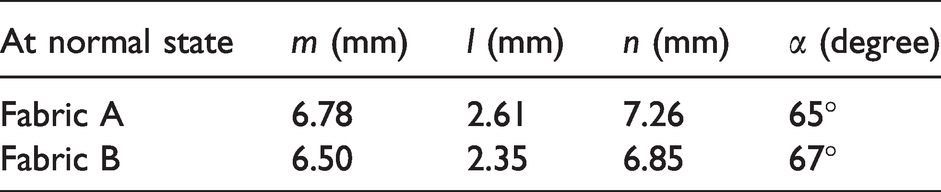
To measure the changes in geometrical parameters precisely, the repeating unit cell was outlined on the fabric specimen and the geometrical parameters (
Geometrical parameters of the auxetic woven fabrics based on the foldable geometrical structure in the relaxed state
Results and discussion
Foldable geometry and NPR effect
From Figure 2(a), it can be observed that because of differential shrinkage effects in both sides of the fabric at loose weave areas, the warp and weft yarns with long floats are prominent, and due to more shrinkage of elastic yarns relative to non-elastic yarns, the yarns in these areas tend to be closer. The fabric in these areas is flat and thicker because of yarn swelling due to the shortening of yarn lengths, which is instigated by shrinkage. At tight weave areas with small floats of warp and weft yarns, the yarns are firmly woven and are not as mobile as in loose weave areas. Therefore, tight weave areas undergo lesser shrinkage as compared to the loose weave areas. Moreover, as the tight weave areas are trapped between two loose weave areas, due to higher shrinkage of loose weave areas on both sides of tight weave areas, the tight weave areas tend to collapse and occupy a folded form in a predesigned parallel in-phase zigzag manner.
It can also be observed that the folded effect along the weft direction is larger than that along the warp direction. This is because the shrinkage percent of fabrics after leaving the weaving machine and undergoing relaxation along the weft direction is higher than that along the warp direction. Therefore, a larger folded effect is achieved along the weft direction. It is also important to mention that in the relaxed state, the warp and weft yarns do not occupy the same path. Due to more shrinkage in the loose weave areas, the warp and weft yarns deviate from the position held by both yarns in the tight weave areas and become closer. Therefore, folds are created between each two consecutive loose weave areas in the predesigned pattern.
The Poisson’s ratio–tensile curves of the two fabrics when stretched along the warp direction and weft direction are shown in Figures 4 and 5, respectively. It can be seen that the NPR effect is produced in both directions. Upon stretching along the warp direction or weft direction, the fabric undergoes tensile deformation, and the folded areas open, making it expand in the transverse direction and producing the NPR. The curves also show that the NPR effect of the fabrics reaches its highest level at low tensile strain and then reduces with increasing tensile strain. Besides, the NPR effect when stretched in the warp direction is higher than that when stretched in the weft direction.

Poisson’s ratio–tensile strain curves of the fabrics produced when stretched along the warp direction.

Poisson’s ratio–tensile strain curves of the fabrics produced when stretched along the weft direction.
Deformation behavior when stretched in the warp direction
Experimental observation
Figure 6 shows eight times magnified repeating unit cell photos taken from Fabric A at the initial state and deformed states after every 5% tensile strain when stretched in the warp direction. The unit cell of the fabric structure is outlined in all photos. When the fabric is stretched in the warp direction according to Figure 6, the higher shrinkage at loose weave stripes transposes and the yarns tend to extend in the tensile direction with the increase of tensile strain. The folded section at segment

Deformation behavior of the repeating unit cell of Fabric A at different tensile strains when stretched in the warp direction.
From Figure 6, it can also be observed that the rectangular-shaped unit cells kept their configuration during extension. Therefore, a rectangular-shaped geometrical model can be adopted for the analysis of the deformation behavior of the fabric when stretched in the warp direction. Moreover, from the photos of the fabric at different tensile strains, when stretched in the warp direction, it can be observed that the deformation of the fabric is likely to be the deformation of the rectangle EBDF, as outlined in the photos. Therefore, a rectangular geometrical model is proposed to estimate the deformation behavior of the fabric structure when stretched in the warp direction. Since the rectangular-shaped repeating unit cell has symmetrical deformation on both sides, the smaller rectangle BACD can be used to calculate the deformation behavior of the fabric when stretched in the warp direction.
Geometrical analysis
In this section, a geometrical analysis is made to establish a relationship between the Poisson’s ratio and tensile strain of the developed auxetic woven fabric, when stretched in the warp direction. The following assumptions are first made to make the geometrical analysis simple and straight forward.
All the repeating unit cells of the fabric have the same size and shape at the relaxed state so that it can be assumed that they exhibit the same deformation when the fabric experiences tensile extension. The deformation behavior of the fabric is likely to be the deformation of the rectangle EBDF, as outlined in the photos. The rectangular-shaped repeating unit cell of the fabric has symmetrical deformation on both sides; therefore, the smaller rectangle (BACD) can be used to calculate the deformation behavior of the fabric when stretched in the warp direction. All the diagonal segments are not kept constant due to the easy deformation of the fabric structure.
Figure 7 shows the proposed geometrical model of the fabric when stretched in the warp direction. Here the solid lines represent the geometrical model in the relaxed state, and dashed lines represent the geometrical model in the extended state. From the right-angled triangle ABC in Figure 7, the following relationship can be obtained



Geometrical model: (a) rectangular-shaped unit cell before stretch; (b) deformation of the unit cell when stretched in the warp direction.
After the tensile extension, the initial geometrical segments 


Variation trend of
Substituting Equation (4) into Equation (7) gives the following equation

As 
Substituting Equations (6) and (8) into Equation (9) gives the following equation

On the other hand, the transverse strain 
Substituting Equations (5) and (10) into Equation (11), the transverse strain can further be expressed as

According to the definition, Poisson’s ratio 
From Equation (13), it can be found that there are two constants 

Fitting with the experimental result of Fabric A when stretched in the warp direction.
Verification
To verify the obtained semi-empirical equation (14), the experimental results of Fabric B with different values of initial parameters

Comparison between the experimental and calculated results of Fabric B when stretched in the warp direction.
Deformation behavior when stretched in the weft direction
Experimental observation
Figure 11 shows eight times magnified repeating unit cell photos taken from Fabric A at the initial state and deformed states after every 5% tensile strain when stretched in the weft direction. The unit cell of the fabric structure is outlined in all photos. When the fabric is stretched in the weft direction according to Figure 11, the higher shrinkage at loose weave stripes transposes and the yarns tend to extend in the tensile direction with the increase of tensile strain. Because segment

Deformation behavior of the repeating unit cell of the fabric at different tensile strains when stretched in the weft direction.
Geometrical analysis
Figure 12 shows the proposed geometrical model of the fabric when stretched in the weft direction, in which solid lines represent the initial state and broken lines represent the stretched state. To make the geometrical analysis simple, similar assumptions were made as above for the geometrical analysis when stretched in the warp direction.

Geometrical model: (a) the geometrical unit cell before stretch; (b) deformation of the geometrical unit cell when stretched in the weft direction.
From the right-angled triangle ABC in Figure 12, the same equations as Equations (4) and (5) for Variation trend of 

In this case, the tensile strain 
Substituting Equation (5) into Equation (16) gives the following equation

As 
Substituting Equations (15) and (17) into Equation (18) gives the following equation

On the other hand, the transverse strain 
Substituting Equations (19) and (4) into Equation (20), the tensile strain is expressed as follows

Therefore, Poisson’s ratio 
From Equation (22), it can be found that there are three constants that need to be determined. By fitting Equation (22) with the experimental results of Fabric A (Figure 14), the constant values were found to be 

Fitting with experimental result of Fabric A when stretched in the weft direction.
Verification
To verify the semi-empirical equation obtained, the testing results of Fabric B are compared with those calculated from Equation (23) using the initial parameters

Comparison between experimental and calculated results of Fabric B when stretched in the weft direction.
Prediction of auxetic behavior when the fabric is stretched in the warp and weft directions
According to Equations (14) and (23), angle

Effect of

Effect of
From the prediction curves, it can be found that the effect of change in angle
Conclusions
In this study, two auxetic woven fabrics with different geometrical parameters but using the same material were designed and fabricated based on FGS geometry. The deformation behaviors of the fabrics, when stretched in either principal direction, were observed experimentally and then analyzed geometrically. Based on the experimental observations, a geometrical model for each stretch direction was proposed and a semi-empirical equation between the Poisson’s ratio and tensile strain was established for each stretch direction. The following conclusions can be drawn from this study.
The diagonal segments of the FGS unit cells are not kept constant under extension due to the easy deformation of the fabric structure. The deformation behaviors of the fabric structure in the warp and weft directions are different; therefore, different geometrical models are required to analyze the deformation behavior in each direction. The constructed semi-empirical equations are simple and fit well with the experimental results. They could be used in the design and prediction of the auxetic behavior of bi-stretch auxetic woven fabrics made with the same type of materials and geometry but with different values of geometrical parameters. The effect of change in angle
Footnotes
Declaration of conflicting interests
The authors declared no potential conflicts of interest with respect to the research, authorship and/or publication of this article.
Funding
The authors disclosed receipt of the following financial support for the research, authorship, and/or publication of this article: This work was supported by the Research Grants Council of Hong Kong Special Administrative Region Government in the form of a GRF project (grant number: 15209616).
