



Abstract
Cornhusk fiber is a kind of biodegradable lignocellulosic fiber. The conditions of enzyme and NaOH retting were optimized on the basis of weight loss rate and the Fried test score to extract the cornhusks fiber. Taking raw cornhusk fiber as a contrast, physicochemical properties of the fiber extracted from cornhusk was researched in detail by chemical analysis (GB5889-86), X-ray diffraction and Fourier-transform infrared spectroscopy (FTIR). The optimal retting condition of cornhusk fiber is the following: Pectinase 9032 0.5% concentration, at 40–55°C, pH 4.2–5.8, and then 5% NaOH treatment for 15 min. The crystallinity index of raw cornhusk fiber, enzyme-treated cornhusk fiber and enzyme-alkali-treated cornhusk fiber are 20.30%, 35.05% and 51.00%, respectively, and the structure of these fibres all correspond to cellulose I. The FTIR spectra showed that higher amounts of lignin and hemicellulose were removed by NaOH treatment compared with enzyme treatment.
Corn is grown on all continents, with North and Central America having the largest area. It is one of the most widely distributed crops in the world, preceded only by wheat and rice. Cornhusk is the outer cladding of corn cobs, and large amounts of cornhusks are produced every year. Cornhusks and stalks are often discarded, burned or left in the field to rot; they are not well used, and contribute to a series of environmental issues. Cellulose is one of the main components of cornhusks, so cornhusks can be used as a source of fiber after processing. 1 Cornhusk fiber together with flax, hemp, jute and sisal fibers all belong to lignocellulosic fibers, which are green ecological fibers; the products made from these natural materials can be biodegradable and recyclable.2,3 Therefore, they are considered as alternatives to traditional man-made fibers and are widely used in many areas including transportation, construction and packaging applications.4,5 Until now, very limited amounts of research efforts have been devoted to investigate extraction or application of cornhusk fiber.6–8
Cornhusk fiber has been combined with epoxy resin, vinyl ester, polypropylene and polylactic acid separately to make composites; fiber can act as a reinforcement in the vinyl ester composite; increased fiber loadings can improve the ultimate tensile strength, tensile modulus and hardness of the composites. 9 Huda and Yang researched the manufacture of cornhusk fiber and polypropylene composites and the application of these composites as structural components in automotive interior, construction and housing sectors. 10
Fiberboard was prepared by polylactic acid and fiber degummed from cornhusk. Cornhusk fiber/polylactic acid sound absorption composites were composed of a slit resonant structure with sound-absorbing function. 11 Due to its biodegradability, cornhusk fiber can be disposed of directly into the soil, so it is of interest as a possible resource for cellulose-based film production. The film is shown to be readily degraded within 7–9 months under controlled soil conditions, indicating a high biodegradability rate. 12 Cellulose from cornhusk was esterified with lauroyl chloride in toluene solvent using pyridine as a catalyst. And then cellulose laurate film was obtained by a casting method in chloroform solvent. The cellulose laurate film was revealed to have potential biodegradation by microorganism consumption after 2 months. 13 The fiber extracted from cornhusk could be applied in the textile field. Corn fiber was blended with cotton or polyester for the preparation of yarn, and yarn breaking strength and elongation were evaluated. Natural cellulose fiber extracted from cornhusk possesses properties similar to cotton and linen and is suitable for various industrial applications; the cornhusk fiber contains about 80–87% cellulose, a relatively higher quantity compared with linen and jute.7,14 The properties of cornhusk fiber extracted by water, alkalization and enzymatic processes were compared. Water-retted fiber gave lower elongation, higher stiffness and a higher amount of lignin and hemicelluloses. 11 Reddy and Yang also found higher yellowness with higher lignin content in cornhusk fiber. 15 Among the various applications of cornhusk fiber, extracting cellulose fiber is a key step. 16
The word “retting” is derived from flax processing, in which the adhesive non-cellulosic gummy materials are removed and fiber is separated from the non-fiber cells. 17 Retting is necessary prior to the industrial utilization of fiber. During fiber extraction, alkali removes the non-cellulose materials of cornhusk fiber; however, using only the alkali to extract fiber resulted either in coarse, low quality fiber or in small hydrolyzed fiber. In this research, the retting effect of acid and alkaline pectinase on cornhusk fiber was compared, and the treatment conditions of Pectinase 9032 combined with alkali were optimized. Pectinase combined with alkali treatment of cornhusk fiber lead to increasing the divisibility and pore volume in fibers. Until now physicochemical and microstructure properties of cornhusk fiber are still not reported deeply in the literature. Here, in this research we have extracted and characterized the cornhusk fibers using multiple methods such as chemical analysis, microscopic analysis, X-ray diffraction (XRD) and Fourier-transform infrared spectroscopy (FTIR). The extracted cornhusk fiber is expected to be used in nanocellulose, dietary fiber, composite material, household and industrial textile, filler and paper.
Experimental
Materials
The naturally desiccated cornhusks (Maize Cob Sheaths) were collected from fully mature corn plants at Hei Long Jiang Province, China. The cornhusks were manually cleaned to remove tassel, leaves and other corn plant parts, followed by air drying. The tip and petiole were cut off, and then the cornhusks were cut into widths of about 3 cm.
Enzymes
Enzyme preparations came from the following sources: Pectinex XXL from Novo Nordisk, Pectinase KDN from Kang Di En Biotechnology Co., Ltd (China) and Pectinase 9032 from Sigma. Pectinex XXL and Pectinase 9032 are acidic and Pectinase KDN is alkaline.
Cornhusk retting
Cornhusk retting was carried out in a sealed plastic bag using 5 g of dried cornhusk and 50 mL of the enzyme solution at five different culture temperature levels, namely 35°C, 40°C, 45°C, 50°C and 55°C, for 72 h. The retted fiber was washed thoroughly in running water to remove the dissolved gummy substances, subsequently neutralized and then dried under ambient conditions. Fiber by pectinase enzyme treatment was further treated with alkali. The alkali treatment was carried out at 100°C, with the material:liquor ratio (g/mL) of 1:10; NaOH concentration and treatment time were varied between 5 and 15 wt% and 5 and 25 min, respectively; concentrations of Na2CO3 and Na5P3O10 were 1.2 wt% and 1.0 wt%, respectively. The fiber was dried under ambient conditions after being rinsed and neutralized.
The cornhusk fiber was also examined by a modified Fried test. 18 Fibers of 5 cm in length (three samples) were placed in test tubes and 10 mL of boiling water was added. The tube was vortex mixed for exactly 10 s at full speed and thereafter shaken manually in the vertical direction four times. The samples were then visually graded on a scale of 0–5 (Table 1). The three values from the duplicate experiments were then averaged.
Standard of Fried test score 40

The average score of each sample was regarded as the degree of fiber separation.
Determination of weight loss rate
Raw cornhusk fiber (RCF), enzyme-treated cornhusk fiber (ECF) and enzyme-alkali-treated cornhusk fiber (EaCF) were dried to constant mass and then weighed.
The percentage weight loss rate (WLR) was calculated using the formula

Analysis of chemical component of cornhusk fiber
Quantitative Analysis of Ramie Chemical Components Method GB5889-86 was used to determine the pectic substance content of cornhusk fiber.
Microscopic morphological analysis
The microscopic morphology of the cornhusk fiber was analyzed using the light microscope, Nikon 50i.
Determination of crystallinity
The fiber was cut in the mill and passed through a mesh sieve so that the mean particle size of the sample was approximately 150 μm. The XRD technique (Bruker-AXS-D8, Germany) was used to determine crystallinity of RCF, ECF and EaCF samples with Cu Kα radiation at 2θ angle ranging from 5° to 40°. The crystallinity index of cornhusk fiber was calculated according to the Segal method
19

FTIR spectra
The FTIR spectra of the cornhusk fiber were recorded with a Spectrum One (PerkinElmer) spectrophotometer using KBr pellet technique to determine the functional groups and chemical structure of cornhusk fiber. A mixture of 5 mg cornhusk fiber powder and 200 mg KBr were pressed into a disk. FTIR was recorded in the range of 500–4000 cm−1.
Results and discussion
Cornhusk fiber retting
Effect of pectinase enzymes
Pectic substances are ubiquitous in plant and form the main components of middle lamella, which is a thin adhesive extracellular substance found between the primary cell walls of adjacent young plant cells. The enzymes hydrolyzing these pectic substances are broadly known as pectinases. Pectinases effectively assist in degumming, maceration and retting of jute, flax, hemp and ramie bast fibers by degrading the pectin which is located in the middle lamella and primary cell wall. Pectinase is the key component in lignocellulosic fiber retting,20,21 and different kinds of pectinase have different retting effects.22–24 The retting effects of three pectinase enzymes are compared in Figure 1. In this experiment, 5% Pectinex XXL, 5% Pectinase KDN and 0.2% Pectinase 9032 were used. No matter the enzyme treatment or alkali treatment, the WLR of cornhusk fiber corresponding to Pectinase 9032 is the highest, with total WLR (TWLR) (i.e. the sum of WLR of enzyme and alkali treatment) reaching 48.38%. Pectinase KDN also shows high retting ability with 43.62%. TWLR of Pectinex XXL is the lowest, only 4.31% higher than control. The average Fried test scores for the three enzyme preparations are as follows: Pectinex XXL 1 (1, 1, 1) < Pectinase KDN 3.3 (3, 3, 4) < Pectinase 9032 4 (4, 4, 4).

Effect of pectinase enzymes on weight loss rate of cornhusk fiber.
Effect of enzyme concentration
In natural fiber extraction, enzymatic retting has advantages over chemical degumming in energy saving and environmental protection, but the cost of the retting enzyme is the key problem. It is important to find a balance between retting efficiency and enzyme concentration for the application of enzyme in cornhusk retting. To study the effect of enzyme concentration, Pectinase 9032 was adjusted to various concentrations (1%, 0.5%, 0.2%, 0.1%). The trends of WLR of enzyme and concentration were accordant (Figure 2). The maximum WLR and TWLR of enzyme all occurred at 1% enzyme concentration, but the difference in value of WLR of enzyme between 1% and 0.2% concentrations is only 4.89%. The average Fried test score is 5 for 1% and 0.5% concentrations and is 4.7 for 0.2% concentration (Table 2).

Effect of enzyme concentration on weight loss rate of cornhusk fiber.
Fried test score of cornhusk fibers

Effect of temperature of enzyme retting
Temperature is a factor that influences diffusion and activity of the enzyme. The retting is carried out for 72 h at different temperatures (35°C, 40°C, 45°C, 50°C, 55°C). As shown in Figure 3, WLR of Pectinase 9032 treatment is increased with the increasing in culture temperature from 35°C to 45°C and kept stable above 45°C. WLR of alkali treatment was maintained at about 30%, not affected by enzyme retting. As shown in Table 2, the results of the Fried test score is consistent with TWLR; completely disperse fiber was obtained at retting temperature 40–55°C.

Effect of temperature on weight loss rate of cornhusk fiber.
Effect of initial pH of enzyme retting
The initial pH also plays a crucial role in enzyme reaction, in turn affecting the degradation of pectin of cornhusk fiber and WLR. The effect of initial pH on cornhusk retting using Pectinase 9032 was determined in this experiment (Figure 4). The initial pH was adjusted from 4.2 to 5.8 by NaAc-HAc buffer. WLRs of enzyme retting are all above 20%, and maximum WLR was obtained at pH 4.6, 2.69% more than the minimum (pH 4.2). As shown in Table 2, the Fried test scores all reached 5, indicating that Pectinase 9032 possesses a wide pH range in cornhusk retting.
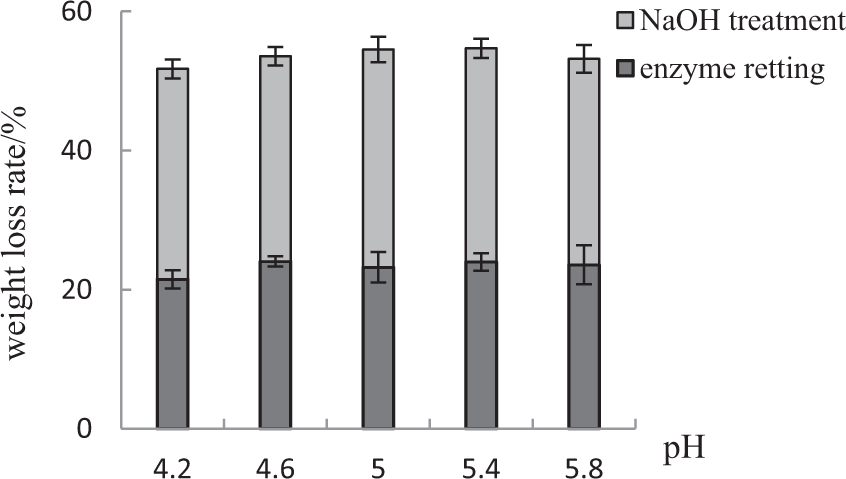
Effect of pH on weight loss rate of cornhusk fiber.
Effect of alkali treatment
WLR of enzyme retting fiber is limited and the fiber could not be sufficiently separated; enzymes by themselves are unable to completely break the outside layer of protective material on the cornhusks. Optimizing the concentration of enzymes, pH and temperature of enzyme retting resulted in the removal of the surface and weak pectin-bonded fiber parts in cornhusks. But the stubborn pectic substance and outer covering substance retained in cornhusk fiber after the enzyme treatment. Therefore, a mild alkali treatment is required to remove the covering substance and a part of the lignin and cellulose. The quality and yield of fiber are dependent on the treatment conditions such as alkali and enzyme concentration, time and temperature. 25
The concentration of NaOH was adjusted to 1%, 5% and 10% (w/w) and conditions of enzyme retting were treated for 5 min, 15 min and 25 min, respectively, at 100°C. WLR of NaOH treatment is shown in Figure 5; WLR increased with the increasing of NaOH concentration. WLRs of fiber treated by 10% NaOH are all above 40%, and the fiber is dissociated into short single fiber once complete decomposition of the pectin has been achieved. The fiber obtained by 5% NaOH, 15 min, possessed moderate dispersion and WLR (32.07%).
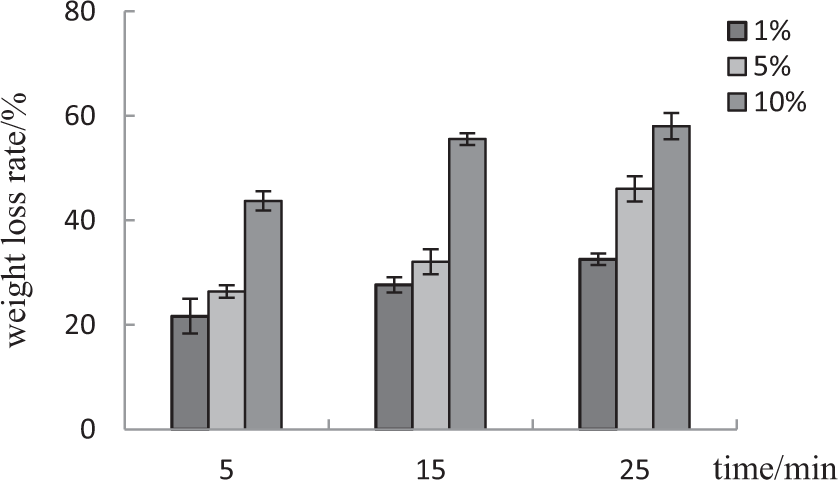
Effect of NaOH treatment on weight loss rate of cornhusk fiber.
Characterization of cornhusk fiber properties
Chemical composition analysis
Chemical composition influences structure, appearance, properties and applications of the cornhusk fiber. 26 The chemical composition of ECF and EaCF are evaluated and compared with RCF (Table 3). RCF contains 84.61% total pectic substances (i.e. contains 15.39% cellulose). Total pectic substances of ECF decrease to 76.48%; the fiber possesses a softer feel and has a pale yellow color. For EaCF, the content of cellulose reached 60.81%, and total pectic substances content decreased to 39.19%. Hemicellulose and lignin content of cornhusk fiber treated by enzyme and alkali were 22.02% and 11.03%, which decreased 57.57% and 53.00%, respectively. The single fibers of cornhusk are very short, and those single fibers are bound together by pectic substances to form fiber bundles. Therefore, the strength of the cornhusk fiber is determined by the binding perfections among the single fibers or fiber bundles. Moreover hemicellulose contributed to water absorption quality and lignin to strength and stiffness.27–29 The retted cornhusk fiber should be retained by the appropriate amount of pectic substances, which is similar to the retting of short fiber such as flax.
Effect of retting on chemical composition of cornhusk fiber

EaCF: enzyme-alkali-treated cornhusk fiber; ECF: enzyme-treated cornhusk fiber; RCF: raw cornhusk fiber.
Microscopic morphological analysis
Light microscopy of fiber by various treatments further confirms the results of chemical composition analysis (Figure 6). RCF shows a rough and irregular appearance and appears as large coarse fragments; this may be due to the presence of non-cellulosic encrusting substances on the fiber surface. ECF is observed with a certain amount of attached shives and epidermal tissue, but the bond between fibers is no longer dense compared with RCF. On the contrary, EaCF presents a cleaner and smoother surface.
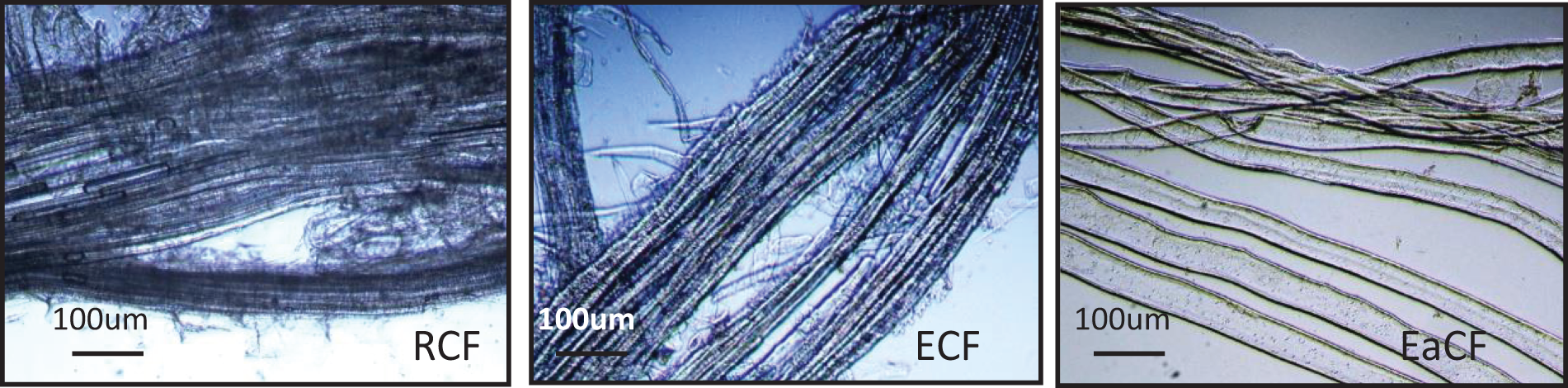
Light micrographs of RCF, ECF and EaCF.
Crystallinity
The crystallinity of the cellulosic fiber is one of the interesting domains as mechanical and thermal properties of fiber depend upon it. 30 The effect of enzyme and enzyme-alkali treatment on cornhusk fiber was investigated by XRD. As shown in Figure 7, peaks around 2θ at 15° and 23°, corresponding to cellulose I structure, indicate that enzyme or enzyme-alkali treatment have not destroyed the crystal chemical structure of the cellulose. The crystallinity indexes of RCF, ECF and EaCF are 20.30%, 35.05% and 51.00% respectively, calculated using equation (1). Compared with RCF, the crystallinity indexes of ECF and EaCF were increased 14.75% and 30.70%, respectively. This might be attributed to the pectin of the middle lamella and primary cell wall being degraded. 31 In cornhusk, cellulose fiber was encircled by an amorphous matrix formed by pectic substance, which was composed of cerolipoid, hydrotrope, pectin, hemicellulose and lignin, amongst others. 32 A part of the amorphous matrix was removed during the enzyme hydrolysis and during the following alkali treatment, leading to most amorphous areas or the defective crystalline regions being removed, resulting in a significant increase in the crystallinity index.
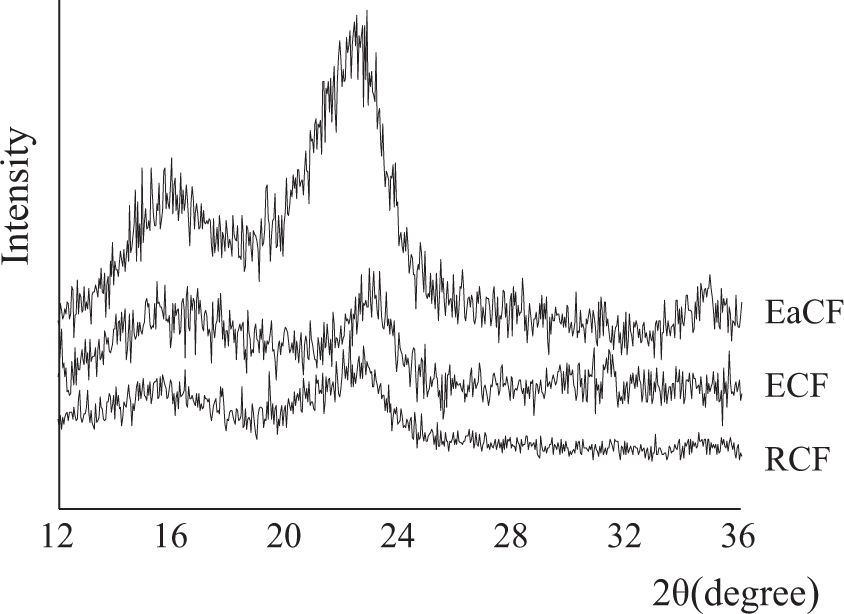
X-ray diffraction pattern of RCF, ECF and EaCF.
FTIR spectra
FTIR spectra of RCF, ECF and EaCF were recorded to understand the transformation of chemical groups present in the fibers (Figure 8). The broadband absorbance peaks around 3400 cm−1 were assigned to the O-H stretching. This broadband commonly appears in plant fibers,11,33 ascribed to intra- and intermacromolecular hydrogen bindings of polysaccharide macromolecules from cell walls. 34 The peaks around 2920 cm−1 corresponded to the C-H stretching in waxes and lignin, this peak have declined slightly in ECF and EaCF. The peaks around 1728 cm−1 were attributed to the C=O stretching of hemicelluloses;35,36 after NaOH treatment the peak disappeared, which suggests there is a lower amount of hemicellulose in EaCF compared with RCF. The 1509 cm−1 peaks were assigned to the aromatic skeletal vibration present in lignin. 37 The peaks around 1250–1239 cm−1 correspond to C-O stretching in the aryl group of lignin; the peak was lost gradually in ECF and EaCF. 11 The peaks at 1159 cm−1 are due to the antisymmetric deformation of the C-O-C band in cellulose and hemicellulose. 38 The strong absorption peaks around 1035 cm−1 are ascribed to C-O and O-H stretching of polysaccharide in cellulose which are found in all the fibers, 39 and the shoulder peaks at 895 cm−1 are interpreted as C-O-C stretching at the β(1-4)glycosidic linkage in cellulose.11,33
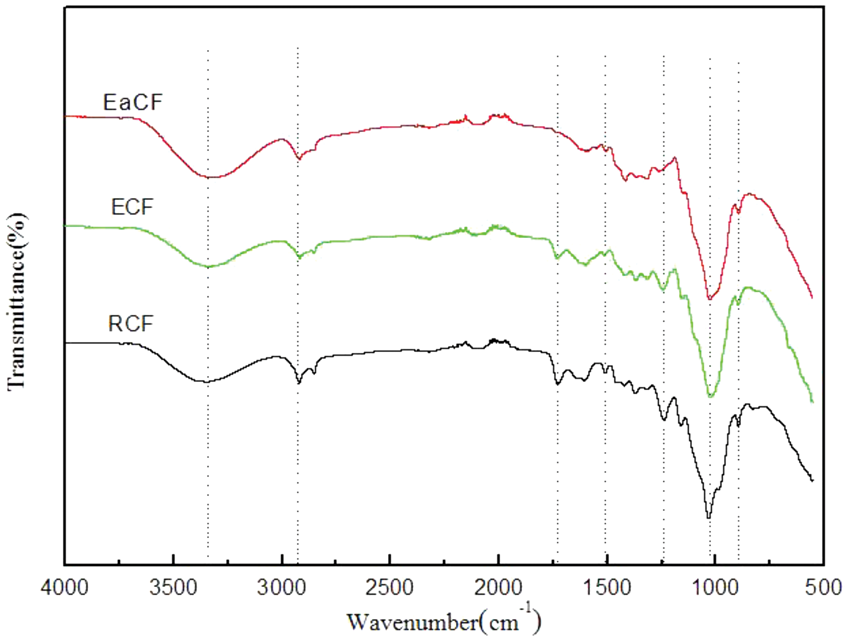
Fourier-transform infrared spectroscopy spectra of RCF, ECF and EaCF.
Conclusion
Extraction of lignocellulosic fiber from agricultural wastes such as cornhusks will bring greater benefits to the farmers. Enzyme retting alone could not disperse the cornhusk fiber well, and WLR of ECF was limited. The non-cellulosic material was removed by the alkali treatment which followed, resulting in increased fiber separability. The crystallinity of EaCF increased 30.7% compared with RCF. The crystal chemical structure of cornhusk fiber was not destroyed and corresponded to cellulose I structure still. Chemical composition and FTIR spectra analysis showed that hemicellulose and lignin were hydrolyzed efficiently and the cellulose content of extracted cornhusk fiber reached 60.81%. Future research may include other enzymes, such as hemicellulase or lignohydrolase, and assess the effects of enzyme and alkali treatment sequence on cornhusk fiber retting.
Footnotes
Acknowledgments
This work was supported by the Foundation for the Characteristic Discipline of Processing Technology of Plant Foods, China, for the financial assistance, item number (YSTSXK201817). We also wish to thank Heilongjiang Provincial Key Laboratory of Corn Deep Processing Theory and Technology.
Declaration of conflicting interests
The authors declared no potential conflicts of interest with respect to the research, authorship, and/or publication of this article.
Funding
The authors received no financial support for the research, authorship, and/or publication of this article.
