



Abstract
There is increasing concern regarding the existing sheep wool processing technology in the textile industry owing to the enormous volume of toxic effluents generated. The application of supercritical carbon dioxide (scCO2) in sheep wool processing is cleaner and increases wool fiber production while avoiding toxic effluent generation. scCO2 is a novel clean technology that can be utilized in sheep processing for sterilization, cleaning, and drying sheep wool at the same time. In the present study, scCO2 was used to treat sheep wool with varying pressure, temperature, and treatment time. These parameters influence the scCO2 treatment of sheep wool fiber through the inactivation of microorganisms and improvement of the whiteness index. The identification of bacteria in sheep wool was carried out based on biochemical analysis by molecular means, using 16s rRNA sequencing. It was found that scCO2 completely inactivated the microorganisms present in sheep wool and potentially enhanced the percentage whiteness index at the highest pressure of 30 MPa, temperature of 80°C, and treatment time of 80 min. Several analytical methods were employed to assess the physicochemical, thermal, and morphological properties of untreated and scCO2 treated sheep wool fibers. The results show that scCO2 effectively removes the impurities and completely inactivates the microorganisms present in sheep wool. The findings of the present study reveal that scCO2 can be utilized as an alternative treatment technology for sheep wool processing in the textile industry.
Wool is a natural protein fiber that is widely used as a high-quality textile material in garments, rugs, socks, carpets, curtains, pillows, blankets, and bedding. The textile industry relies on wool as a key raw material. 1 Wool is an outstanding multifunctional natural animal fiber and is in high demand owing to its excellent strength, high hygroscopic properties, good insulation, and long lifespan. 2 In addition to the material and technical textile usage, wool fiber is applied in the domains of medicine, decoration, aerospace, and automotive engineering. 3 As a renewable resource, wool fiber is gaining attention from researchers and academicians owing to its eco-friendly nature and sustainability. Wool is composed of a single protein called keratin, which contains five main elements, hydrogen 6–7%, carbon 50%, oxygen 21–24%, nitrogen 15–21%, sulfur 2–5%, and other elements. 4 The chemical properties of sheep wool are linked to the structural arrangement of semi-crystalline protein polymers. Sheep wool fibers contain more than 170 different proteins with different structures located in specific regions. The proteins in wool are composed of amino acids that contain a basic amino (-NH) and carboxylic acid (-COOH) groups. These compounds can be regarded as polyamides because each structural unit is joined by an amide group. However, the amide repeating unit (-NHCHRCO-) is called a peptide group. 5 In wool, the individual polypeptide chains are joined together to form proteins by a variety of covalent bonds (chemical), called crosslinks, and non-covalent physical interactions. Disulfide crosslinks are rearranged to impart smooth-drying properties to wool fabrics such that ironing is not required after laundering. 6
Raw wool is a very dirty natural fiber containing large quantities of wool grease, suint, and other impurities on the wool surface. These impurities constitute half the weight of raw wool, which causes a non-white color in wool. 7 The impurities in wool fiber differ depending on factors such as the location, sheep breed, climate, and the environment in which the sheep are reared. Each kilogram of raw, contaminated wool contains approximately 150 g lanolin, 40 g suint, 150 g dirt, and 20 g vegetable matter, and yields only 640 g of wool fiber. 8 The impurities present on the raw wool fiber surface must be eliminated through cleaning procedures before it can be used in textiles. 9 The impurities in wool frequently become contaminated by microbes, beginning when the sheep first grow wool and lasting until the stages at which the wool is processed. 10 Throughout the time that the wool grows on the sheep, it is continually subject to contamination from microorganisms that may be pathogenic organisms responsible for diseases, which might prove hazardous to employees who encounter and process sheep wool. Therefore, the utilization of wool may be seriously affected by the action of microorganisms and must be sterilized to remove pathogenic organisms and non-pathogens that damage it. In addition, the organisms present in sheep wool are spore-forming. Therefore, the water-based treatment process is not effective in eliminating the spore-forming microorganisms present in sheep wool. 11
Existing sheep wool cleaning technology involves the consumption of large quantities of chemicals and water. As a consequence, the toxicity is high, a substantial level of effluent arises due to the standard wet-chemical process, and a large quantity of energy is consumed. 12 The most severe environmental issue caused by the textile industry is intensive water consumption, because impurity removal requires effective treatment before discharge or water recycling. 13 Raw wool scouring effluent is a complex mixture of over 8000 different organic and inorganic compounds and has a chemical oxygen demand (COD) of 30,000–60,000 mg/L. 14 The maximum consumption of water in the wool water-based cleaning process is 659 L/kg, while the minimum consumption is 111 L/kg. 15 Such a process poses significant concerns for the environment and the economy. In recent years, environmentalists have enforced strict regulations on toxic effluent generation during sheep wool scouring. Therefore, the textile industry is searching for waterless sheep wool cleaning technologies to protect against sheep wool fiber damage and minimize toxic effluent generation during sheep wool processing.
Supercritical carbon dioxide (scCO2) technology is widely used in a number of industries to sterilize and clean biomaterials to remove hazardous biological materials, 16 dirt, and various impurities. In addition, scCO2 is an eco-friendly method for dyeing fabrics and wool. 17 It is regarded as an effective technology for sterilizing and cleaning heat-sensitive materials. 18 It can operate at low temperatures and moderate pressures to avoid large levels of effluent discharge and save time and energy.18,19 It is non-toxic, non-flammable, non-corrosive, safe for the environment, cheap, easily recovered, and available on a large scale. 20 The application of scCO2 technology in sheep wool fiber as a cleaning and sterilizing process offers potential advantages including increased fiber production and the avoidance of wastewater effluent. In an earlier study, scCO2 was used for sheep wool skin as a defatting material (for fatty compounds, including waxes and fatty acids). 21 Furthermore, wool treatment with scCO2 has been used for the removal of pesticides, 22 the selective extraction of lanoline and lipids with a co-solvent, 23 wool dyeing, 24 and degreasing. 25 The use of scCO2 has even been mentioned as a quick and efficient standard method to quantify the lanoline and wax content in raw wool. 26 It is a promising technology that can be simultaneously utilized in sheep wool processing for the extraction of lanolin. CO2 behaves like a normal gas under standard temperature and pressure conditions. However, it has modified properties in the supercritical state, appearing neither as a gas nor as a liquid beyond the critical temperature and pressure of 31.1°C and 7.4 MPa, respectively.27,28 Pressure and temperature are the most important factors for the inactivation of bacteria during scCO2 treatment. A certain amount of time is required to achieve the complete inactivation of bacteria. The increase in pressure and/or temperature can shorten the time required to inactivate bacterial cells.
The district advantages of applying scCO2 as a sterilization and cleaning technology over the existing sheep wool fiber processing technologies include minimizing sheep wool fiber damage, minimizing toxic effluent generation, reducing hazardous waste generation, and shortening the sheep wool fiber processing time. Therefore, in the present study, scCO2 was utilized to sterilize and clean sheep wool fibers. The influence of scCO2 pressure, temperature, and time were determined based on the inactivation of microorganisms and the whiteness index of the treated sheep wool. In addition, the physicochemical and morphological properties of scCO2 treated sheep wool were determined. The findings of the present study can help to explore scCO2 as an effective alternative for existing sheep wool fiber processing technologies.
Materials and instrumentation
Materials and chemicals
Raw wool fiber (coarse) was not cleaned after shearing or separating leaves, twigs, and undesirable objects from the fleece. Pure carbon dioxide gas (99.6 vol.%) was used in the supercritical carbon dioxide treatment of samples of woolen fabric. Nutrient agar (NA), a DNA (deoxyribonucleic acid) extraction kit, and 16s rRNA (ribosomal RNA) with the reverse and forward primers 27F (
Instrumentation
In the present study, the equipment and apparatus that were utilized included supercritical carbon dioxide sterilization units (no ETMS2012-100 Japan), a colorimeter (Model: Minolta CM-3500d, Japan), scanning electron microscopy (SEM, FEI quanta FEG 650), attenuated total reflection Fourier transform infrared spectroscopy (ATR-FTIR, NICOLET IR200 FT-IR), X-ray diffraction analysis (Model: D8 Advance; Bruker), thermogravimetric (TG) analysis, differential thermogravimetry (DTG) (METTLER TOLEDO), and light microscopy (the versatile SZX16 microscope, DP72 Ltd, Tokyo, Japan).
Identification of the bacteria in raw sheep wool
The bacterial strains were isolated from raw sheep wool by weighing 1 g of wool and shaking it in a flask with glass beads in 10 mL of sterile water for 1 h. A sterilized metal loop was used to secure samples of bacteria from various areas of the flask to new plates containing NA, and streaking was performed to obtain pure colonies of bacteria. The cultures were then incubated at 37°C. Colonies with different morphological characteristics were selected and used in further studies. DNA extraction was conducted in stages using the nucleic acid extraction kit. DNA was extracted and amplified using the polymerase chain reaction (PCR) with specific primers, viz. 16S rRNA. The cycle was determined based on the primer pairs used, as shown in Table 1. PCR amplification was sequenced and identified in the gene bank using parallel local sequence alignment search tool (PLAST) software.
Polymerase chain reaction cycles steps for identification of microorganisms in sheep wool

F27 and 1492 were the forward and reversed primers, respectively, used for PCR amplification of 16S rRNA. Each primer set, evaluated on genomic DNA from reference strains, showed high specificity and good sensitivity. Each amplification program was initiated by denaturation for 5 min, as shown in Table 1, and ended with a step of 5 min at 72°C as the final extension. Reactions were performed in a PCR Express thermal cycler equipped with a gradient block to optimize the annealing temperature.
Enumeration of viable colonies
The number of viable colonies in the sample was determined before treatment (0 min) and after treatment (t min) using the pour-plate method.
27
One aliquot of contaminated, diluted sample was subjected to eight-fold serial dilution. This procedure was carried out in duplicate to determine the average bacterial colony concentration in the waste. Results were expressed as the logarithm of surviving colony-forming units per gram of wool sample (log CFU g−1)


Treatment of sheep wool using scCO2
A supercritical CO2 sterilization reactor system was used to sterilize and clean raw sheep wool fibers, as shown in Figure 1. The samples were placed in a scCO2 sterilization vessel, which was tightly closed. Tests for the parameters of scCO2, including temperature (°C), pressure (MPa), and time (min), were conducted by combining a range of situations to ascertain the optimal setup for total microbial inactivation (100%). The total inactivation of bacteria was determined based on the absence of colonies on the agar plate surface. 27 When the scCO2 system temperature reached the allotted level, that is, the desired temperatures of 40°C, 50°C, 60°C, 70°C, and 80°C, the connecting valve (V1), and decompression valves (V2 and V3) were opened and shut, respectively. Through a pump and held by a siphoned cylinder, liquid CO2 with a purity of 95% entered the sterilization vessel until the specified pressure (10, 15, 20, 25, and 30 MPa) was attained. The connecting valve (V1) remained open throughout the process. Following the necessary treatment duration, V1 was shut. The vessel pressure was gradually reduced by opening both decompression valves (V2 and V3). 28 The inactivation experiments were conducted in triplicate, and the data were presented as the mean value ± standard deviation.

Supercritical carbon dioxide unit utilized for treating sheep wool fiber.
Samples of wool fibers were treated in batches at different process temperatures (40°C, 50°C, 60°C, 70°C, and 80°C), pressures (10, 15, 20, 25, and 30 MPa), and times (30, 45, 60, 75, and 90 min). To inactivate the bacteria and remove impurities from the samples, treatment began with supercritical fluid circulation using a syringe pump. When the desired treatment time (30, 45, 60, 75, and 90 min) had elapsed, the separation valve (V3) is opened to allow the CO2 to continuously pass through the sterilized wool fiber for 10 min. This process allowed cleaning the sterilized sheep wool by separating the impurities in the separation vessel. The connecting valve (V1) was then closed to depressurize sterilization and the separation vessel by opening the separation valve (V3). Subsequently, the samples were removed and analyzed. The log reduction in the number of viable colonies per gram in scCO2 treated sheep wool was calculated as the number of viable colonies before treatment (No) compared with the number of surviving colonies after sterilization (N), as shown in the equation below

Whiteness index of wool fiber
The degree of whiteness was examined to evaluate the cleanliness of the wool samples. The degree of whiteness was determined based on the measured lightness, redness, and yellowness, according to the Stensby.
30
The wool samples were also analyzed using color measurements and matching instruments (Colorimeter Model Minolta CM-3500d, Japan). The whiteness index was calculated using tristimulus values based on the CIE method D65-10 (Commission on Illumination) standard and expressed in terms of the lightness L*, redness a*, and yellowness b*. According to the Stensby formula
30

Characterization of the physicochemical properties of wool fiber
The treatment of wool fiber is a necessary process for obtaining high-quality final products. In theory, sheep wool has notable qualities and specific properties, which are fundamentally linked to the special chemical and crystal structures of the fibers, their thermal properties, the degree of whiteness, and the surface morphology, all of which need to be investigated.
Morphology analysis
The surface morphology of the wool fiber was analyzed using SEM before and after treatment with scCO2 to study any potential destruction or structural harm. 31 This was conducted with a voltage acceleration of 500 kV and a magnification of 3000×. A light microscope was used to examine the wool fiber (the versatile SZX16 microscope is designed for very demanding applications with the ability to resolve 900 line pairs/mm). The eyepiece was utilized with a total magnification of 1.6× and a total fine focus of 14×–230× to obtain a clear image of impurities attached to the wool fiber. The samples were placed on the platform of the light microscope, and images were captured.
FTIR analysis
The chemical structures of the treated and untreated fibers were characterized by ATR-FTIR (Nicolet IR200 FT-IR). The wool fiber chemical structures (functional groups and various linking bonds) play a vital role in maintaining their physical and service aspects. The infrared spectra in the wool samples ranged from 600.0 to 4000.0 cm−1 at a resolution of 2.0 cm−1. 32
X-ray diffraction analysis
For X-ray diffraction, we employed an analytical X-ray diffractometer with Cu radiation at 1.5406 Å wavelength, 40 kV generator voltage, and 40 mA generator current, with a step size of 0.020 and θ from 5° to 70°. Moreover, for the wavelength ratio of 0.5 and time step of 95 s, the Bragg angle 2θ was between 5° and 70° within a scan step of 0.0234°. An index of crystallinity, introduced by Segal et al.,
33
was formulated as

Analysis of thermal properties
The thermal properties of the treated and untreated sheep wool were determined using TG analysis and DTG analysis. The experiments were performed under a flowing nitrogen atmosphere of 50.0 mL min−1 and a heating rate of 10°C min−1 from 30°C to 800°C. The TG and DTG curves were recorded as the percentage of weight loss and the real weight loss per minute against the programmed temperature, respectively. 34
Results and discussion
Identification of microorganisms in sheep wool
Table 2 presents the bacterial strains found in sheep wool fiber classified into two key types based on their Gram stain reactions: gram-positive (+ve) and gram-negative (–ve). The present study demonstrates the presence of pathogenic bacteria in various types of raw sheep wool fibers. Wool fiber consists of two major morphological components: the cuticle and the cortex. 35 Microbes such as Bacillus cereus produce proteolytic activity enzymes, some of which are not limited to the wool fiber surface but also diffuse inside it, causing unacceptable strength loss.36,37 This causes deterioration of the wool fiber, as it is used as a source of carbon and nitrogen. The enzymes penetrate between the cuticle scales into the interior of the fiber and break down the cell membrane complex, such as pepsin, which is a proteolytic enzyme that hydrolyzes keratin and breaks down the amino acid bonds. 38
Bacterial strains detected from sheep wool fiber

aGenBank accession numbers for 16S rRNA gene.
Enzymes that can degrade sheep wool are abundant in Bacillus spp. 39 Despite this, some experts maintain that once wool is provided as a major nutritional source, wool-degrading enzymes are produced by most microorganisms.40,41 Bacillus and Exiguobacterium strains produce wool-degrading enzymes that demonstrate wool-keratinolytic activities. 42 Prokaryotic microorganisms include the presence of extracellular proteases. These have the capability to cause larger polypeptide substrates to be divided into smaller entities. 43 Bacillus velezensis is listed in the human pathogen hazard group in the approved list of biological agents that were originally isolated from the plant rhizosphere or adjacent soil. 44 Microorganisms can cause damage, skin irritation, and infections from wool products. 45 This supports the need for supercritical sterilization of wool fibers to ensure a safe handling process.
Klebsiella pneumoniae is an opportunistic pathogenic species, is non-motile, and is typically known to grow on textile materials. It is a facultative bacterium that belongs to the family Enterobacteriaceae and shows close genetic relationships with species of the genera Escherichia, Salmonella, Shigella, and Yersinia, which are of clinical importance. 46 Klebsiella pneumoniae has been applied to wool fiber as a microbial test to check the effect of nanosized silver treatment on wool fiber. 47 The test specimens were placed in germs and inoculated with K. pneumoniae. The CFU mL–1 was 1.4 * 105 after 24 applications and increased to 4.3 * 107. It was clear from the results that K. pneumoniae could grow and consume wool fiber. Enterobacter cloacae from the Enterobacteriaceae family are generally not known to be enteric pathogens. They form an opportunistic pathogen in humans.48,49
scCO2 sterilization and cleaning sheep wool fiber
The viable colonies were counted once the sterile samples were collected. The log reduction of microbes was determined by applying Equation (2) after calculating the CFU per gram of wool waste (CFU g−1) based on Equation (1). The log reduction of microbes in the wool samples was calculated before and after scCO2 treatment. This included, in logarithmic terms, the count of the surviving colonies following sterilization (N) compared with the count of these colonies prior to being treated (Nθ). The cleaning efficiency of sheep wool fiber during scCO2 sterilization of sheep wool was determined based on the whiteness index (Stensby), calculated using Equation (3). We adhered to the scCO2 pressure, temperature, and time for the log reduction of the presence of bacteria in wool fiber and the whiteness index (Stensby), as shown in Figures 2–5. It is found that the application of the lowest scCO2 experimental condition (10 MPa. 40°C, and 30 min) reduces the bacterial inactivation in wool fiber to some extent by log 3.39 log CFU g−1, but complete inactivation of the microorganisms is not achieved (zero viable colonies of bacteria on the surface of the agar plate in scCO2 sheep wool fiber).
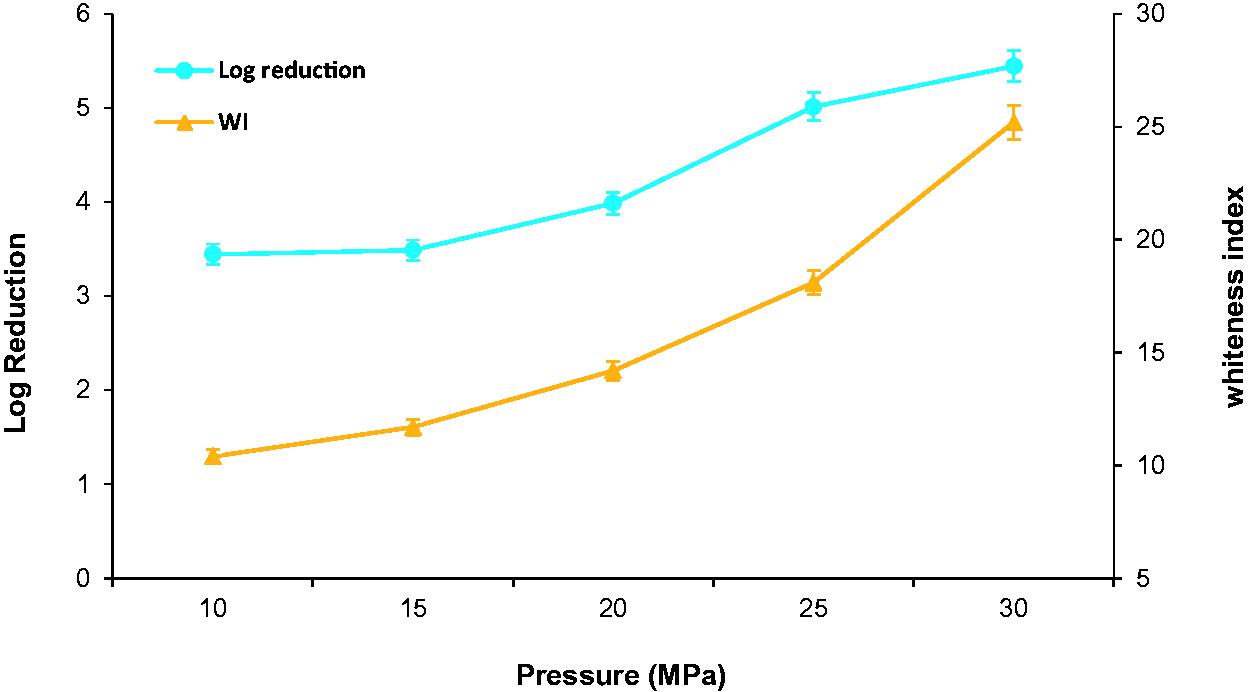
Effect of scCO2 pressure on the sterilization and cleaning the sheep wool fiber. Experimental conditions: temperature of 60°C and treatment time of 60 min.

Effect of scCO2 temperature on the sterilization and cleaning the sheep wool fiber. Experimental conditions: pressure of 20 MPa and treatment time of 60 min.

Effect of scCO2 time on the sterilization and cleaning of sheep wool fiber. Experimental conditions: temperature of 60°C and pressure of 20 MPa.

Effect of scCO2 parameters (time, pressure, and temperature) on the sterilization and cleaning of the sheep wool fiber.
To determine the effect of pressure on the inactivation of bacteria by scCO2, experiments were conducted with varying pressures from 10 to 30 MPa at a constant temperature of 60°C and time of 60 min. The survival ratio of the bacteria significantly decreases with increasing pressure from 10 to 30 MPa, as shown in Figure 2. It is found that the log reduction increases with increasing pressure and reaches 5.44 log CFU g–1 at 30 MPa, 60°C for 60 min of treatment time. However, the whiteness index (Stensby) of the sheep wool fiber also increases with increasing pressure and reaches a maximum of 25.2 Stensby at a pressure of 30 MPa, temperature of 60°C, and treatment time of 60 min.
The effect of temperature on the inactivation of bacteria in wool fiber and the whiteness index (Stensby) of sheep wool fiber using scCO2 was determined by varying the temperature from 40°C to 80°C at a constant time of 60 min and pressure of 20 MPa, as shown in Figure 3. It is observed that the log reduction of the bacteria increases with increasing temperature from 40°C to 80°C. The highest log reduction is obtained as 5.19 log CFU g–1 at 20 MPa and 80°C for a treatment time of 60 min. Similarly, the whiteness index (Stensby) of the sheep wool fiber increases with increasing temperature from 40°C to 80°C. The highest whiteness index is 20.7 Stensby at a pressure of 20 MPa, temperature of 80°C, and treatment time of 60 min.
The effect of time on the inactivation of bacteria in sheep wool fiber and the removal of impurities from sheep wool fiber using scCO2 was determined by varying the time from 30 to 90 min at a temperature of 60°C and a constant pressure of 20 MPa. The results are shown in Figure 4. The log reduction of the bacteria increases with increasing time from 30 to 60 min. Thereafter, the increase in the log reduction of bacteria in the treated sheep is negligible. The cell viability of the bacteria is found to be lower at higher exposure times, suggesting that the inactivation rate of bacteria depends on time. Similarly, the whiteness index (Stensby) of scCO2 treated sheep wool increases with increasing treatment time up to 90 min. The highest log reduction of the bacteria and maximum whiteness index (Stensby) of sheep wool fiber is 5.15 log CFU g–1 and 20.3 Stensby, respectively, at a pressure 20 MPa and temperature of 60°C for the treatment time of 90 min.
The influences of scCO2 pressure (Figure 2), temperature (Figure 3), and treatment time (Figure 3) show the highest log reduction of 5.44 log CFU g–1 at 30 MPa, 60°C, and 60 min. However, it is found that it does not complete the inactivation of bacteria in scCO2 sheep wool, as viable bacterial colonies are obtained on the surface of the agar plate from the treated sheep wool fiber. Therefore, it is necessary to increase the scCO2 pressure, temperature, and treatment time to completely inactivate bacteria in scCO2 sterilized sheep wool. The reason is that the raw wool is contaminated with impurities (grease, suint, sand, etc.) on the surface. These act as a barrier preventing scCO2 from reaching the microbes, because the latter can penetrate the wool layers between the cuticle scales and into the fiber interior. 37 The log reduction of bacteria in scCO2 sterilized sheep wool fiber and the cleaning efficiency of the sterilized sheep wool were determined using 13 sets of scCO2 sterilization experiments with varying combinations of scCO2 pressure, temperature, and time, as shown in Figure 5.
The maximum log reduction is obtained at a pressure of 30 MPa, temperature of 80°C, and time of 80 min (6.235 log reduction). The cell viability of the bacteria is lower at higher pressures, suggesting that the inactivation of bacteria increases as the pressure increases. The viable colony count is zero at a pressure of 30 MPa, as shown in Figure 5. Increasing the parameters leads to increasing the log CFU g–1 reduction. At a pressure of 10 MPa and temperature of 80°C for a duration of 90 min, the log reduction reaches 4.58 ± 0.05. At a pressure of 20 MPa at 70°C for a period of 75 min, the log reduction reaches 4.9248 ± 0.05. In general, the bacterial resistance to pressure exceeds the resistance to temperature when thermally sterilized. According to Ki et al., 45 the temperature parameter is of lower significance than pressure when inactivating bacteria during the scCO2 process. The pressure allows CO2 to penetrate the cell walls of bacteria more easily, increasing the density and hence the extent to which the cellular materials are extracted. 50 In the textile industry, shorn wool undergoes treatment using a lengthy water-based procedure. Other processes ensure that the wool is often washed and scoured, 51 fulled, bleached, carbonized, 52 and even dyed in the final stage. The existing technologies used for sheep wool processing include carbonizing, detergent cleaning, ultrasonic cleaning, cleaning using a solvent, electric and electrohydraulic discharge cleaning, and cleaning using hot steam. 53 Carbonizing is the removal of cellulose impurities (vegetable matter) at high temperatures by strong acids, such as magnesium chloride, aluminum chloride, or gaseous hydrochloric acid, to produce degradable products that can be easily removed from fabric by proper mechanical treatment. However, this process requires neutralization using ammonium or ammonium acetate to remove acids or salts. 54
We compared the obtained data with that from other applications of scCO2 as a cleaning method for the removal of impurities (olive oil, stains, and soil) from cotton and silk at the pressures of 20, 27, and 34 MPa, for times ranging from 30 to 120 min, and at an operational temperature of 40°C. 55 It was found that olive oil is effectively removed from cotton and silk with a maximum cleaning efficiency of 90% at the scCO2 pressures of 20 and 27 MPa. 55 The stained sample is removed from the fiber at a pressure of 34 MPa. In this study, sheep wool fiber was treated at the pressures of 10–30 MPa, temperatures of 40–80°C, and treatment times of 30–80°C. The cleaning time (above the first 60 min) does not seem to have an important impact on the cleaning results, indicating that equilibrium is reached within the first 60 min. Different textile materials have been treated with scCO2 for cleaning and sterilization. In a previous study, cotton and silk were treated with scCO2 to remove organic dyes and soil at a pressure of 34 MPa and temperature of 40°C for 120 min with the additives CaO and H2O. 56 In another study, a polyester fabric was treated with perchloroethylene at 4.5 MPa and 40°C for 30 min to remove sand, carbon black, and clay. 57 Additives may sometimes be required to facilitate treatment and shorten the time. Co-solvents, such as ethanol and xylanase, are used in scCO2 to remove non-cellulosic impurities and residual gum from cotton and flax rove.58,59 As a sterilization method, textile materials such as cellulose membranes, medical fabrics, military suits, and cotton fabric have been sterilized with scCO2 to remove bacteria and fungi, such as lipopolysaccharides endotoxins, E. coli, M. luteus, B. thuringiensis, B. anthracis, Enterococcus faecium, Enterobacter aerogenes, and Candida albicans, and the total inactivation of the microbes was confirmed. The pressures and temperatures ranged from 30 to 35 MPa and from 30°C to 70°C, respectively, for periods of 15–60 min.60,61
The degree of whiteness is an indication of the cleanliness levels of the wool fiber. In a previous study, the whiteness index value reached 70.8 Stensby. 62 Wool color is an important characteristic that influences the value and plays a very important role in obtaining a premium price. The whiteness of wool is a critical selection index. 63 As far as color is concerned, superior wool is generally creamy white. Different formulations for whiteness assessment are currently used by Stensby in accordance with illuminant D65–10. The maximum whiteness index of wool fiber in treated scCO2 increases to the maximum value of 25.2 Stensby, compared to the raw sample, which is 6.2 Stensby. The reason underlying this increase in whiteness is the removal of the number of impurities and contaminants that cause non-white coloring in wool. 11 To obtain a high value of whiteness, scCO2 may require the use of a co-solvent to extract polar organic compounds. The value of the whiteness index in most studies reached high values owing to the use of solvents such as H2O2 or detergents. 64 Due to the presence of potassium organic salts in sheep wool, polar organic solvents need to be added. These range from ethanol and hydrogen peroxide to ether as co-solvents. Chemical additives are required to improve scCO2 solubility. 26
SEM and light microscope analysis
The morphology of wool fiber contains ortho-, para-, and meso-cortices, along with scales covering the fiber surface. 65 The ortho- and para-cortices have a bilateral arrangement within the fiber. The former is on the outer side of the wool curvature, while the latter is on the inner side. The overlying scales have a significant influence on the chemical and physical aspects of the fiber and safeguard it from harm. Cuticle cells (or scales), which overlap like tiles on a roof, make sheep wool unique among textile fibers. 66 The surface morphology of the raw wool fiber under SEM (see Figure 6(a)) clearly shows that the entire surface of the wool fiber is covered with impurities, dirt, and vegetable matter. In contrast, Figure 6(b) shows the treated sample and suggests that compact sets of overlying scales, arranged clearly and in a thick manner, are noted on the treated sample surface, with increased fiber smoothness observed after treatment with scCO2. A light microscope was used for wool samples before and after treatment with a magnification of 1.6×, as shown in Figures 6(c) and (d). The impurities removed from the raw sheep wool were measured in different sizes, as shown in Figure 6(e). The treated wool sample under a light microscope is shown in Figure 6(f).

Morphological observation of untreated and scCO2 treated sheep wool: (a) scanning electron microscopy (SEM) images of the untreated wool sample; (b) SEM images of the treated wool sample; (c) light microscope view of raw wool samples; (d) light microscope view of raw wool samples in light transmission; (e) removed wool impurities under the light microscope; (f) light microscope view of treated wool samples with magnification of 1.6×.
Characterization of physicochemical and thermal properties of wool fiber
FTIR analysis of wool samples
The FTIR spectra of wool fibers before and after scCO2 treatment are shown in Figure 7. The two curves exhibit almost identical absorption bands around 3278.99 cm−1 (N-H and O-H), 2924.09 cm−1 (-CH2), 1635.64 cm−1 amide I, 1533.41 cm−1 amide II, and 1238.3 cm−1 amide III. These are the typical absorption peaks of wool according to previous studies. 67 The infrared spectra of the wool sample used as a control suggest that the highest peak occurs at an absorption band of 3286.7 cm−1 (amide A) in raw wool, and is explained by the conjoined stretching vibration of both N-H and O-H. 68 The absorption bands at 2942.09 and 2855.72 cm−1 are explained by the respective asymmetrical or symmetrical stretching vibrations of C-H in the -CH3 and -CH2- sets. Moreover, the stretch-like vibration of C=O from amide Ι leads to strength with an absorption band at 1635.64 cm−1 in each sample. This peak mainly shows variation and indicates the α-helix structure of the major wool links. 69

Fourier transform infrared spectra of sheep wool fibers prior to and following treatment with scCO2.

Thermogravimetric-differential thermogravimetry curves of wool fibers before and after scCO2 treatment.

X-ray diffraction of raw sheep wool and scCO2 treated sheep wool fibers.
For the peaks of the functional groups, also called the frequency groups, a small group of atoms, such as CH2, OH, and C=O, can be observed after 1500 cm−1. Each mid-range sharp peak with absorption bands at 1548.84 and 1533.41 cm−1 is respectively explained by the bend-like vibration of N-H from amide ΙΙ, along with the stretch-like vibration of C-N from amide ΙΙΙ. Furthermore, the stretch-like vibration of C-N from amide ΙΙΙ is regarded as varying, indicating the β-sheet arrangement in the tissue of the wool. 70 The strong peak at 1031.92 cm−1 is caused by the vibrating cystine set in the wool, which contains sulfur. Usually, in the range of 1000–1300 cm−1, the spectra are characterized by the presence of medium-to-high intensity bands attributed to the different sulfur-containing chemical groups of keratin. A sharper peak at 1238.3 cm−1 indicates some changes in sulfur-containing groups during the treatment process. 71 Compared to the control batch, the collective stretch-like vibrations of both O-H and N-H in scCO2 affected samples are transferred to a reduced wavenumber, starting at 3286.7 cm−1 and ending at 3278.99 cm−1. Clearly, hydrogen interactivity between the groups of -OH and -NH2 within both or either of the wool inter- and intra-macro chains occurs in increasing numbers and with greater strength following the supercritical carbon dioxide fluid process. Moreover, peaks absorbed below 1500 cm−1 have a high molecular weight. Asymmetrical stretch-like vibrations along with symmetrical stretch-like vibrations of C-H in -CH3 and -CH2- sets are reduced to a lower wavenumber, from 2942.09 and 2855.72 cm−1 to 2922.16 and 2841.41 cm−1, respectively.
The increasing number and strength of the hydrogen interactions of CH2 and CH3 also suggests a number of alterations in the sets containing sulfur. It is possible that a division of the disulfide bonding (-CH2-S-S- CH2-) is found in the wool fiber macrochains, particularly in the overlying scales when treated with the supercritical process. Improved levels of absorbency intensity result in a shift from 1031.92 to 1074.35 cm−1 for the sets containing sulfur in cystine, compared to the control and treated samples, respectively. Moreover, it is likely that the polymer chains are recrystallized in the supercritical fluid. Hence, each of these explanations may have led to the shifting of various characteristic bands to lower wavenumbers, along with intensity changes. Other effects might include transformations in polymer chain arrangements or differences in groups containing sulfur in cystine within the woolen material.
TG-DTG analysis of wool samples
TG curves were analyzed to identify the effects of supercritical carbon dioxide on the thermal decomposition behavior of wool fibers. Figure 8 shows the TG and DTG curves resulting from the processed and non-scCO2 processed wool. The TG curve of each sample illustrates that a two-stage weight loss occurs in the program heat range of 30–800°C. The TGA results, such as the onset and offset of the decomposition temperature, inflection point (fastest thermal decomposition temperature, Tp), temperatures at the maximum weight loss rate, and residues at 800°C are shown in supplementary Table 1.
The initial stage of the weight loss is attributed to the loss of regained water (the desorption of water is physically bound to the fiber and the dehydration of wool). 72 The second stage corresponds to the decomposition of the polymer chains of wool, resulting mainly from the micro fibril-matrix structure and disulfide bonds of wool being broken down. 73 With a system heat of 218.25°C, the raw wool fiber loss weight is approximately 77.78 wt.%, in contrast to the system heat of 262.17°C due to which approximately 25.5 wt.% is lost for the treated sample, indicating that the inflection point temperature of the treated sample increases compared to the raw one. The fastest level of thermal decomposition results in a marked improvement after processing with the scCO2 fluid, possibly because wool is a naturally fire-resistant fiber with a relatively high content of sulfur (3–4 wt.%) and nitrogen (15–16 wt.%) and a high limiting oxygen index of 25.2%. 74 The rate of decomposition generally decreases and ultimately becomes very small, up to approximately 500°C. Above 251°C, the loss of various side chains occurs because of the severe breakage of peptide bonds (CONH). Tian et al. 75 reported that weight loss between 250°C and 425°C resulted from the decomposition of cystine and terminal amino groups and from decarboxylation, while the second weight loss between 427°C and 597°C was due to the carbonization of the wool and the oxidation of the charred residue. Furthermore, in our study, solid residues of 21.4% remain after the heating temperature reaches 800°C for the treated sample and 27.92% for the untreated sample. The carbonaceous substance formed from wool after the test is directly correlated to the char-forming ability and fire resistance of wool. 72 As presented in Supplementary Table 1, the onset temperature of raw wool fiber is 218.25°C, while in the sample treated with scCO2, this shifts to 262.17°C. It is evident that the thermal stability of wool fabric considerably improves as the temperature of maximum degradation moves from a lower temperature to a higher temperature. 76 The thermal properties of wool fibers can be improved by treatment with scCO2. This can most likely be explained by the effects of the supercritical fluid on the reconfiguration of the wool polymer chains. 34
X-ray diffraction (XRD) analysis
The crystal structure is an important parameter of the wool fiber structure and has a significant impact on its properties, such as the dyeing behavior and optical properties. 2 Wool fiber is a macromolecular polymer with a structure between the crystal and amorphous regions. 77 Figure 9 shows the XRD graph of raw sheep wool fiber and scCO2 treated sheep wool fibers. The results of this study show that the crystallinity of the treated wool sample is improved compared to that of the untreated sample, where the crystal value shifts from 28.1% to 31.6%. The crystal structures are enhanced by scCO2 treatment, owing to which the crystallinity indexes of the wool fiber are improved, as shown in Table 3. A pattern of diffraction from X-rays is attained with a notable sharp peak at a Bragg angle 2θ of approximately 9.30, and a mid-range sharp peak at 2θ of approximately 18.7 of processed and 20.5 of unprocessed for each separate sample of fiber, which can be explained by the α-helix and β-sheet arrangements of wool peptide links. 2 The diffraction peak at 2θ = 18° is attributed to the amorphous region.
Crystallinity index of wool fibers treated in supercritical carbon dioxide

In theory, as wool fiber is porous, it can easily be penetrated by carbon dioxide, and protein-based macromolecular chains in scCO2 fluid interact and move. 34 In particular, hydrophilic wool fibers usually contain a level of moisture, resulting in naturally acidic fibers and supercritical fluid conditions. Hence, the macromolecular chains of wool possibly lead to the formation of a more rearranged and recrystallized compound, which results in the improvement of the diffraction intensity and/or the calculated crystallinity indexes of the treated wool samples. Furthermore, crystal particles in the wool fiber swell following processing with the supercritical fluid, and this is most likely explained by tightened reconfigurations of wool macro chains, some hydrogen bond alterations, and various other protein chain interactions.
Conclusion
The application of scCO2 technology in sheep wool processing is cleaner than the existing methods as it avoids the generation of toxic effluents. As a waterless technology, scCO2 has been extensively utilized in sterilization, extraction cleaning, and drying technology for processing various solid matrices. Thus, scCO2 technology has considerable potential for use in sheep wool processing. The treatment of wool fiber in scCO2 fluid was performed at various system pressures, temperatures, and times. In the present study, six different bacterial strains were extracted and identified in sheep wool fiber (Bacillus velezensis, Bacillus amyloliquefaciens, Klebsiella pneumonia, Enterobacter cloacae, Exiguobacterium, and Bacillus cereus). The scCO2 treatment of wool fiber was achieved without using any co-solvent to determine the effectiveness of scCO2 for inactivation and impurity removal. We evaluated the results of scCO2 treatment on wool fiber properties (physicochemical and thermal), such as crystallinity, chemical structures, surface morphology, thermal properties, and the whiteness index. Complete inactivation of bacteria is achieved at a pressure of 30 MPa, a temperature of 80°C, and a time of 80 min. The crystal structure of the wool fiber (crystallinity index) improves from 28.1% to 31.6%. FTIR analysis samples shift to a reduced wavenumber, indicating some changes in the sulfur-containing groups, thus revealing more powerful interactions of hydrogen bonds between the macromolecular chains, accompanied by a significant transformation of the α-helix to the β-sheet structure. The TG-DTG analysis shows that the thermal properties of wool fibers are enhanced after treatment with supercritical CO2 fluid. The morphology of wool is observed by SEM analysis, and a compact arrangement of overlying scales is noted on the treated sample surface, which is clear and thick with increased fiber smoothness. A colorimeter analysis shows that the whiteness index improves from 6.2 to 25.2. Therefore, it is an effective and advantageous solution to sterilize and clean wool fiber-based textiles for cleaner industrial production to improve the quilt and protect it from microorganism deterioration.
Supplemental Material
sj-pdf-1-trj-10.1177_00405175211042897 - Supplemental material for Waterless sterilization and cleaning of sheep wool fiber using supercritical carbon dioxide
Supplemental material, sj-pdf-1-trj-10.1177_00405175211042897 for Waterless sterilization and cleaning of sheep wool fiber using supercritical carbon dioxide by Faisal Aboelkasim Allafi, Md Sohrab Hossain, Marwan Shaah, Japarang Lalung, Mohd Omar Ab Kadir and Mardiana Idayu Ahmad in Textile Research Journal
Footnotes
Declaration of conflicting interests
The authors declared no potential conflicts of interest with respect to the research, authorship, and/or publication of this article.
Funding
The authors disclosed receipt of the following financial support for the research, authorship, and/or publication of this article: This work was supported by the Division of Research & Innovation, Universiti Sains Malaysia (Research Universiti Grant 304/PTEKIND/6315313).

Supplemental material
Supplemental material for this article is available online.
References
Supplementary Material
Please find the following supplemental material available below.
For Open Access articles published under a Creative Commons License, all supplemental material carries the same license as the article it is associated with.
For non-Open Access articles published, all supplemental material carries a non-exclusive license, and permission requests for re-use of supplemental material or any part of supplemental material shall be sent directly to the copyright owner as specified in the copyright notice associated with the article.
