



Abstract
The deterioration of water ecology caused by the discharge of oil spill wastewater, industrial sewage, and municipal sewage has attracted wide attention worldwide. Thus, it is significant to design a simple, environmentally friendly approach to separate oil–water mixtures. In this work, three different fabrics with pH-induced wettability transition were prepared by a dip-coating process for oil and water separation. The dip-coating fabrics had the advantages of oil–water separation, photocatalytic degradation, and recycling. Polyethylene terephthalate/polyamide nonwoven fabric was used as the substrate materials of the fabric. The carboxylic acid-modified TiO2 endowed the fabric with hydrophilicity–hydrophobicity and photocatalytic properties. The Fe3O4 nanoparticles obtained by the coprecipitation method provided magnetism for the fabric, facilitating the recycling of the fabric and improving the hydrophobicity of the fabric. The fabrics coated with dipping solutions were superhydrophobic in a neutral environment and hydrophilic in an alkaline environment. Among the three coated fabrics, the fabric coated with stearic acid/TiO2-Fe3O4 (FST) had the most satisfying oil–water separation performance and durability. Under the neutral condition, the contact angle of the FST was 151° and the separation efficiency was 98%. Under the alkaline condition, the underwater oil contact angle of the FST was 150° and the separation efficiency was 95%. After 15 cycles, the oil–water separation rate of the FST was still higher than 90%. Due to the presence of TiO2, the coated fabric had an exceptional performance in the photodegradation of organic pollutants (69.9%). In addition, the fabrics can be quickly recovered due to magnetism.
Oily wastewater, resulting from steel, aluminum, food, textiles, leather, petrochemicals, and metal finishing, has become the most common pollutant worldwide. In addition, frequent oil spill accidents are of great concern since the discharge can lead to severe environmental pollution and a significant energy loss. 1 Furthermore, water in fuel oil has severe implications for the automobile, ship, and airplane industries, since a small amount of water in fuel oil may threaten transportation safety. The oil–water separation membrane has a broad application prospect in the above fields of industrial production due to its advantages of high separation efficiency, low energy consumption, and convenient use.
According to the wettability difference, oil–water separation materials can be divided into three types: superhydrophobic–superoleophilic membranes 2 ; intelligent response oil–water separation materials 3 ; and superhydrophilic–underwater superoleophobic. 4 (1) Low surface energy materials and a microsurface structure endow the separation material with superhydrophobicity. When the oil–water separation material was wetted by water, a dense hydrated layer formed on the surface. 5 When the hydrophobic separation material contacts with oily sewage, the oil will pass through the material and block the water on the surface of the material, to realize oil–water separation. The surface of the hydrophilic fabric forms a dense hydration layer in the water environment, which improves the oil barrier effect and decontamination ability. (2) Intelligent, responsive oil–water separation materials switch wettability by external stimulus. Generally, intelligent response separation materials are divided into pH response, temperature response, ultraviolet (UV) irradiation response, and other types. 6 These materials are suitable for many oil–water pollution treatment applications and have considerable research value and application prospects. (3) Superhydrophobic materials generally need to meet the following conditions: low surface energy and rough microsurface structure. Generally, organic monomers or long carbon chain materials with low surface energy, such as organosiloxane, are used to build low surface energy surfaces. In situ growth, etching, and particle decoration are used to build roughness. Besides, stimuli-responsive underwater wettability has been reported. An external stimulus from the change of pH switches underwater wettability between superhydrophobic and superhydrophilic. Between of them, the intelligent response oil–water separation membrane has been widely used because of its switchable bidirectional wettability.
Textile printing and dyeing wastewater contain a large amount of dye, leading to pollution of the environmental water, air, and soil. 7 , 8 At present, textile printing and dyeing wastewater treatment methods can be divided into physical–chemical methods and biological treatment methods. 9 Physical–chemical treatment methods include chemical coagulation, chemical oxidation, chemical adsorption, membrane separation, and so on. 10 Albadarin et al. 11 investigated the production of activated lignin-chitosan extruded (ALiCE) pellets with controlled particle size distribution for efficient methylene blue (MB) adsorption. Naushad et al. 12 successfully developed 2-amino-5-guanidinopentanoic acid-modified activated carbon (AGDPA@AC) to remove MB dye from an aqueous medium. The biological treatment method mainly uses anaerobic microorganisms to secrete enzymes to decompose pollutants in an anaerobic environment to degrade and transform refractory organic matter. 10 Punzi et al. 13 treated azo fuel wastewater by the anaerobic biofilm method combined with photo-Fenton oxidation. Kee et al. 14 used a variety of dye-degrading bacteria and aseptic sludge as seeding agents to treat textile wastewater. The results revealed that the mixed bacterial cultures are highly promising for efficient textile wastewater treatment.
Traditional fluorine-containing oil–water separation materials have many disadvantages, such as low selectivity, high operation cost, dissatisfactory separation efficiency, severe environmental pollution, and so forth. In this research, a magnetic pH-inducted fabric for oil–water separation with photodegradation of organic pollutants was obtained by a dip-coating process. A polyethylene terephthalate/polyamide (PET/PA) nonwoven fabric was used as a substrate membrane due to its high mechanical strength and large-scale availability. The dip-coating solution was composed of stearic acid (SA)-modified TiO2 and nano-Fe3O4. Between them, TiO2 endowed the fabric photodegradation property and nano-Fe3O4 imparted magnetism to the fabric. To prove that alkyl acids can be used as surfactants to modify inorganic nanoparticles (NPs) to obtain pH-induced wettability of fabrics, decanoic acid (DA) and myristic acid (MA) were substituted for SA to modify TiO2, respectively. The preparation of the superhydrophobic textile is illustrated in Figure 1 (taking SA as an example). The fabric coated with SA/TiO2-Fe3O4 (FST) showed satisfactory superhydrophobicity in the water contact angle (CA) test in a neutral environment but super lipophilicity in a neutral aqueous environment, allowing oil to penetrate through but blocking oil. After being treated with alkaline substances, it became super hydrophilic and oleophobic underwater. It was permeable to water but impermeable to oil and could achieve highly efficient separation of oil–water emulsions without energy consumption. In addition, the FST showed an excellent separation rate, cycling stability, photodegradation property, and magnetic property. The superior property, satisfying cycling stability, fine photodegradation properties, and excellent magnetism of the FST indicated its great potential as an oil−water separation membrane. The finding provided a facile route for fabricating superhydrophobic fabric that might be applied to separate oils and other organic pollutants from water.

Schematic diagram of the pH-responsive nonwoven fabric preparation procedure.
Experimental details
Characterization
The textile fabric morphology was obtained by a scanning electron microscope (SEM) operating at 20 kV (Zeiss Sigma 300). Atomic force microscopy (AFM) height images were obtained with a Bruker MultiModel 8 SPM (Bruker, Dimension Icon). The surface composition of the fabric was analyzed using X-ray photoelectron spectroscopy (XPS, Thermo Scientific K-Alpha); the X-ray source was monochromatized Al Kα radiation (1486.6 eV). The functional group investigation of the textile fabric was executed using Fourier transform infrared spectroscopy (FT-IR; Nicolet-Avatar 360). The CA was tested using a CA measurement system (CAM101, KSV Instruments, Ltd). A multi-function aperture meter ((CFP-1100AX, Porous Materials, Inc.) was used to measure the characteristic value of the fabric aperture. Three samples were evenly selected at a position 2 cm away from the edge of each sample fabric for testing, and the average value was obtained. The friction resistance of nonwoven fabrics (5 cm × 5 cm) was tested by a G238BB electronic friction fastness tester (Standard Group (Hong Kong) Ltd) at the rate of one cycle per second. The static CA of water droplets in the worn area was measured to evaluate wear resistance on the surface of FST. A G228E water washing resistance tester (Shanghai Qianshi Precision Electromechanical Technology Co., Ltd) was used to test the water washing resistance of nonwoven fabrics at 40°C with the speed of 40 r/min. After washing, the static CA of water was measured to evaluate the water washing resistance of FST. The change of absorbance before and after photocatalysis was measured by an UV-visible (UV-Vis) spectrophotometer. UV-Vis Diffuse Reflectance Spectrum (DRs) was used to study the light absorption properties of the coated fabric, and the bandgap of the coated fabric was calculated by the Taucplot method. A vibrating sample magnetometer (VSM; 7404, Lakeshore Company) was used to characterize the magnetic properties of the fabric, and the applied magnetic fields ranged from –20 to 20 kOe. The measuring range of moment was from 5 × 10⁻⁷ to 103 EMU.
The separation efficiency (η) was computed based on Equation (1)

Liquid flux refers to the fluid volume flow (L/(m2 · h)) per unit time per unit area under particular pressure, which is one of the essential indicators to characterize filtration performance. During the test, the nonwoven fabric was pretreated at 40 Pa for 2 min to ensure that all holes were opened, then the volume of the permeate was measured for a certain time at typical atmosphere, and the flux was calculated according to the following equation

The UV-Vis absorption spectrum of the solution was tested by a UV-Vis spectrophotometer (Lambda 35, PerkinElmer, Ltd) to monitor the absorbance change of methyl orange at the maximum absorption wavelength. The coated FST (2 cm × 2 cm) was placed in a 30 mL methyl orange solution (10 mg/L). After stirring in the dark for 30 min, the photocatalytic degradation test of methyl orange was conducted at room temperature and under the irradiation of a xenon lamp for 240 min. The absorbance of methylene orange at 468 nm was recorded every 30 min. The following formula is used to obtain the degradation rate

Results and discussion
Morphological characteristics of coated fabrics
SEM images (Figure 2) showed the surface morphology of the new fabric and coated textile fabrics. As shown in Figure 2(a), the surface of the original fiber was smooth, round, and in a regular cylindrical shape. After the dip-coating process, the fabrics were completely coated with a layer of DA/TiO2-Fe3O4, MA/TiO2-Fe3O4, or SA/TiO2-Fe3O4, as shown in Figures 2(b)–(d), respectively. The surface of the fabrics became rough due to the TiO2 modified by alkyl acid and nano-Fe3O4, which can be seen more clearly in the highly magnified SEM images (Figures 2(b)–(d)). It should be noted that the surface morphology of the fabric did not change before and after the dye removal (as shown in Figure S1). The AFM images of the new fabric and the FST were used to verify further the changes in the roughness of the fabric surface (Figures 2(e) and (f)). The root means square (RMS) roughness of the original nonwoven surface and FST were 5.87 and 98.56 nm, respectively. The increase of surface roughness was due to the accumulation of coating materials and long-chain/Fe3O4-TiO2 structure in the modified coatings. 16 The rough surface morphology provided the possibility to improve the hydrophobicity of the fabric surface.

Scanning electron microscope images of (a) pristine fabric, (b) FDT, (c) FMT, and (d) magnetic pH-inducted (FST). Atomic force microscopy images of (e) pristine fabric and (f) FST.
XPS was carried out to confirm the chemical composition and surface chemical state of the coated fabric. Compared with the pristine fabric in the whole survey spectrum (Figure 3(a)), the signal peaks of Ti 2p and Fe 2p on the surface of the coated fabric can be observed compared with the original fabric, which demonstrated the existence of the TiO2 and Fe3O4. High-resolution XPS spectra of Ti 2p, Fe 2p, and O 1s were recorded to confirm the chemical states further, and the results are shown in Figures 3(b)–(f). There was no change in the XPS spectrum of FSTs before and after dye removal (as shown in Figure S2).

X-ray photoelectron spectra of the FST surface: (a) survey; (b) Ti 2p; (c) O 1s; (d) Fe 2p pH = 13; (e) Ti 2p; (f) pH = 13 O 1s.
In Figure 3(b), the binding energies at 458.6 and 464.2 eV corresponded to the Ti-O bond, that is, TiO2. The binding energy difference of TiO2 was 5.6 eV, which was slightly smaller than the standard value of 5.7 eV. This may be due to the change of electron orbit by the alkanes connected on the TiO2 surface, and thus the orbital splitting energy. It was worth noting that the Ti-O and Ti-OOC- bonds in Ti 2p peak spectrum, which confirmed metal-ligand coordination of long-chain acid-TiO2, occurred and ≡Ti-O-Ti-OOC- formed. 17 Since both the surface charge and oxidation of the coating changed the binding energy, the Ti-OOC- peak shifted toward the direction of low binding energy. Figure 3(c) shows that the binding energy of O 1s at 530.4 eV represented the Ti-O bond (TiO2). The binding energy at 531.0 eV represented the reactive oxygen species, which was chemically adsorbed at the oxygen vacancy in the TiO2 crystal.
The binding energies of Fe 2p3/2 and Fe 2p1/2 obtained from the corresponding high-resolution XPS spectra (Figure 3(d)) were located at 709.8 and 724.6 eV, respectively. The results showed that Fe3O4 was successfully deposited on the FST, and the original fabric pattern was retained during the surface modification. The XPS results further demonstrated the successful coupling of SA, Fe, and TiO2.
In Figure 3(e), the binding energy of the coated fabric treated with pH 13 NaOH solution was 6.1 eV, which was obviously higher than the standard binding energy, indicating that TiO2 was damaged in an alkaline environment. Under the alkaline condition of NaOH, the ionic SA disappears and generates sodium carboxylate ions (–COO-Na+), and the reaction between TiO2 and NaOH solution was as follows

The FT-IR was carried out on the FST to identify the chemical structure of the synthesized products (Figure 4). The band around 3301 cm−1 contributed to the stretching vibration of -OH in PET. The absorption at 2929 cm−1 was ascribed to the C-H stretching of PA. A series of new peaks appeared in the FST while keeping the original fabric unchanged. The peaks at 1720 and 1166 cm−1 corresponded to the C=O and C-N stretching peaks in the fabric, respectively. The characteristic peak assigned to Ti-CH3 was located near 800 cm−1. The bonds at 582 and 600–800 cm−1 corresponded to the asymmetric deformation and stretching vibration of the Fe-O and Ti-O, respectively. The FT-IR results showed that the TiO2 coordination compound was synthesized successfully, and TiO2 NPs were introduced into the pH-responsive fabric. After photocatalytic degradation of dyes, the FT-IR results of the fabric were unchanged, indicating that the fabric can be recycled (Figure S3).

Fourier transform infrared spectra of pristine and magnetic pH-inducted fabric (FST).
Wettability of the coated fabric
To evaluate the wettability of fabric, five static water CA measurements were implemented for each sample in the air (Table S1). As shown in Figure 5(a), a water droplet (5 μL, pH = 7) stood on the FDT with a CA of nearly 144.8 ± 0.97° and stayed in a spherical shape unchanged after 10 min. In Figure 5(b), the water stood on the FMT with a CA of nearly 146.3 ± 1.01° and stayed in a spherical shape unchanged after 17 min. In Figure 5(c), the water stood on the FST with a CA of nearly 149.8 ± 0.96° and stayed in a spherical shape unchanged after 25 min. This indicated that the modified carboxylic acid/TiO2-Fe3O4 fabrics had a stable superhydrophobicity. The hydrophobicity of the coated fabric was related to its surface energy. The longer the length of the acid chain, the lower the surface energy. Therefore, with the increase of the alkane chain, the hydrophobicity of the modified fabric increased, which showed that the CA increased and the water droplets remained unchanged for a longer time (Figure S4). To further prove the lipophilicity of the coated fabric in a neutral environment, the oil CA of the coated fabrics was tested by dichloroethane and liquid paraffin underwater. The coated textile fabric completely absorbed the dichloroethane droplet (5 μL) and the paraffin droplet (5 μL) within a short time. The three types of coated fabrics could completely absorb the dichloromethane droplet within 0.08 s, and the paraffin droplet was entirely absorbed by the three types of coated fabrics within 0.30 s. The result demonstrated that all the coated fabrics were hydrophobic underwater with pH 7.

Water contact angle (CA) at pH 7: (a) FDT; (b) FMT; (c) FST. Paraffin CA at pH 13; (d) FDT; (e) FMT; (f) FST.
In an alkaline environment, the coated fabric became oleophobic and hydrophilic. To characterize the oleophobicity of the coated fabric, the CA of liquid paraffin on the fabric was measured five times for each sample in water (pH 13), as shown in Table S2 and Figures 5(d)–(f). Because of the low surface energy, the liquid paraffin was changed from 5 to 8 μL to drop on the coated fabric. The liquid paraffin CA of the FDT, FMT, and FST were 145.1 ± 1.00°, 147.8 ± 0.98°, and 149.5 ± 1.01°, respectively. At different temperatures, the fabrics were still oleophobic (Table S3). The size of the paraffin drops remained unchanged after 30 min on the coated fabric (Table S4). All of the above results showed that the three coated fabrics had outstanding durability and oil repellency. Water drops were dropped on the three coated fabrics in the air to evaluate the hydrophilicity of the fabrics. All the water droplets were absorbed by the fabric within 0.3 s, indicating the excellent hydrophilic of the coated fabric at pH 13.
In addition, it is worth mentioning that the FST had superior water resistance and friction resistance. After washing for 30 min, the water CA (pH = 7) and CA (pH = 13) could still reach more than 141° (Figure S5). After 500 cycles of friction, the water CA (pH = 7) and CA (pH = 13) could also reach more than 141° (Figure S6). Surface energy and surface roughness were the main factors affecting the hydrophilicity and hydrophobicity of the fabrics. Surface roughness played an essential role in superhydrophobicity. With the increase of surface roughness, the distance between the peak, trough, and single peak in the surface profile curve increased. According to the Wenzel model, hydrophobicity increased geometrically with the increase of surface roughness. TiO2 and Fe3O4 NPs formed a lotus leaf-like structure on the fiber surface, which increased the surface roughness of the fabric and gives the layered fabric excellent hydrophobicity.
The existence of alkali affected the surface chemical structure of the fabric, thereby changing its surface energy.18,19 In other words, the conversion of hydrophilicity and hydrophobicity of coated fabric was determined by the pH value. 20 In a neutral or slightly acidic environment, TiO2 formed a coordination bond with a long-chain carboxylic acid. Due to the presence of alkyl chains in the coating solution, the steric hindrance increased, and the hydrophilicity decreased. The cross alkyl chain was conducive to the formation of a closed structure of the hydrophobic network, forming an air film between the fabric surface and the liquid material so that the liquid phase could not close, thereby improving its hydrophobicity. However, in an alkaline environment, the coordination bond of titanium carboxylic acid was broken, and the carboxylic acid disappeared in the solution in the form of sodium salt, giving the coated fabric hydrophilicity.21–23 Once the bond was broken, due to the attraction between the permanent dipoles of free carboxylic acid and water molecules, carboxylic acid ions migrated from the solid–gas interface to the water–gas interface and even to the water phase. The migration of carboxylic acid ions led to the loss of low free energy molecules from the solid surface, thereby increasing the free energy of the solid surface.24,25 At the same time, when carboxylic acid ions migrated to the water–air interface or water phase, they acted like surfactants and reduced the surface tension of the water. Both the increase in surface free energy and the decrease of water surface tension increased the hydrophilicity of the fabric. 26 Compared with short-chain carboxylic acid, it could more effectively form an air–water film on the surface of the coated fabric. Therefore, the long-chain carboxylic acid had stronger hydrophobicity, which was finally characterized by a large CA and long shear energy retention time. The main reactions of formation and cleavage of coordination bonds were as follows
Formation stage:
≡Ti–O–C4H9 → Ti–OOC– → ≡Ti–OH → Ti–O–
Ti → O–Ti–OOC–
Cleavage stage:
TiO2 + 2OH− → TiO32− + H2O
≡Ti–O–Ti–OOC− + OH−→≡Ti–OH + –Ti–
OOC + H2O
Oil–water separation property
Figure 6(a) shows the adsorption of dichloromethane dyed by red oil O in water by the FST. The FST (0.5 cm × 1 cm) completely absorbed dichloromethane (0.5 mL) in 1.5 s, which proved that the fabric possessed dramatic oil absorption ability. There were still stable absorption properties at different temperatures (Figure S7). To verify the effect of oil–water separation, the FST was installed between the two funnels. A mixture of water (pH 7) and dichloromethane was poured into the upper tube (Figure 6(b) left). Due to the superhydrophobicity at pH 7, the fabric was permeable to dichloromethane but resistant to water. As a result, dichloromethane passed through the fabric while the water remained in the upper tube. Driven by gravity alone, the oil separation flux was as high as 1200 Lm−2 s−1, the retention rate was more than 98%, and the average aperture decreased from 7.0027 to 6.7990 μm.

Water and oil wettability of the coated fabric at pH 7: (a) a coated fabric collected a droplet (colored with oil red O) in pH 7 water; (b) the water/dichloromethane (colored with oil red O) mixture was separated.
The FST fabric displayed super hydrophilicity after soaking in water with pH 13, as shown in Figure 7(a). The FST (0.5 cm × 1 cm) completely absorbed the water (0.5 mL, dyed by acid blue 25) in 1.2 s, which proved that the fabric possessed preeminent hydrophilicity. In the oil–water separation experiment, the mixture of water and liquid paraffin was poured into the upper tube (Figure 7(b)). Because of its hydrophilicity, the fabric was water-permeable at pH 13 but prevented liquid paraffin. Therefore, the water passed through the fabric, while the liquid paraffin remained in the upper pipe to achieve the purpose of oil–water separation. The oil–water wettability of the coated fabric at pH 13 was opposite to that at pH 7, and the results were consistent with the test results of the CA. Under the influence of only gravity, the water separation flux of the FST was as high as 1350 Lm−2 s−1, and the retention rate was more than 95% at pH 13.

(a) Wettability of the coated fabric in a pH 13 aqueous environment. (b) The water (colored with acid blue 25)/dichloromethane mixture was separated.
It can be seen from Table 1 that all of the modified fabrics had high separation efficiency (>91%) for the oil–water mixture. In addition, the oil–water separation performance of the coated fabric after repeated cycles was studied (Table 2). The results showed that after 15 separation cycles, the separation efficiency of the fabric was still higher than 90%. Under the conditions of pH 7 and pH 13, the fabric had stable separation performance, satisfactory durability, and excellent reusability.
Separation efficiency of modified fabric for oil (pH 7 and pH 13)

After 15 cycles, the separation efficiency of modified fabric for oil (pH 7 and pH 13)

Photocatalytic performance
The photocatalytic degradation mechanism is shown in Figure 8. Electrons and holes constantly moved to the surface of the catalyst and reacted with water and oxygen in the environment to generate reactive oxygen free radicals with solid oxidation and reduction ability. Reactive oxygen species had a strong REDOX capacity and could destroy almost all types of organic dyes, eventually degrading them into carbon dioxide and water. Figure 8(b) shows the bandgap of the TiO2 and the SA/TiO2-Fe3O4 by the Taucplot method. As shown in Figure 8(b), the energy bandgap of the SA/TiO2-Fe3O4 was 3.13 eV. The energy of pure TiO2 was 3.2 eV, 0.07 eV higher than that of the SA/TiO2-Fe3O4. This was because the addition of the SA-Fe3O4 system reduced the bandgap and the energy required for the electronic transition of TiO2, improved the utilization rate of light energy, and finally increased the photocatalytic degradation rate.

(a) Photodegradation mechanism. (b) Bandgap energy diagram of TiO2 and SA/TiO2-Fe3O4. (c) Ultraviolet-visible diagram of TiO2 and SA/TiO2-Fe3O4. (d) One cycle and five cycles of degradation of methyl orange by the magnetic pH-inducted fabric (FST).
Figure 8(c) shows the optical absorption characteristics of TiO2 and FST at 200–800 nm. It shows that TiO2 had strong absorption of light in the spectral range of 200–350 nm, which corresponded to the intrinsic absorption of anatase TiO2. For the FST, the absorption edge was redshifted and had a strong absorption at 200–470 nm. Compared with pure TiO2, the light absorption of FST was effectively extended to the visible region, and the absorption intensity of light was improved in the whole band range. The main reason was that the introduction of Fe increased the doping level and formed an electron capture trap, resulting in a smaller bandgap and a redshift in the absorption edge. 27 Due to the increase of the absorbance of FST, the utilization rate of light energy was improved, which was also a means an improvement in the photocatalytic efficiency. Figure 8(d) shows the first and fifth time-varying photocatalytic degradation rates of methyl orange by the FST and modified fabric by TiO2. Under a xenon lamp light source, the FST had specific photocatalytic degradation performance for methyl orange, and the degradation rate was 69.9% after 240 min illumination, which was higher than that of modified fabric by TiO2 (58.2%). After five photocatalytic cycles, the SA/TiO2-Fe3O4 still had preferable photocatalytic performance, and the degradation rate was 56.4%, while that of modified fabric by TiO2 was only 26.1%. This was due to the narrower bandgap and wider light absorption range of SA/TiO2-Fe3O4, which improved the efficiency of light utilization and photocatalytic performance. In addition, the heterojunction structure formed by the contact between TiO2 and Fe3O4 increased the electron transfer, inhibited the recombination of photogenerated electron-hole pairs, improving the photocatalytic degradation performance of the FST. 28 Membrane base materials with superhydrophilic/superoleophobic properties for separating emulsified oil–water mixtures are summarized in Table 3. No work was reported on materials with both good oil–water separation performance and photocatalytic performance.
Comparison with other works
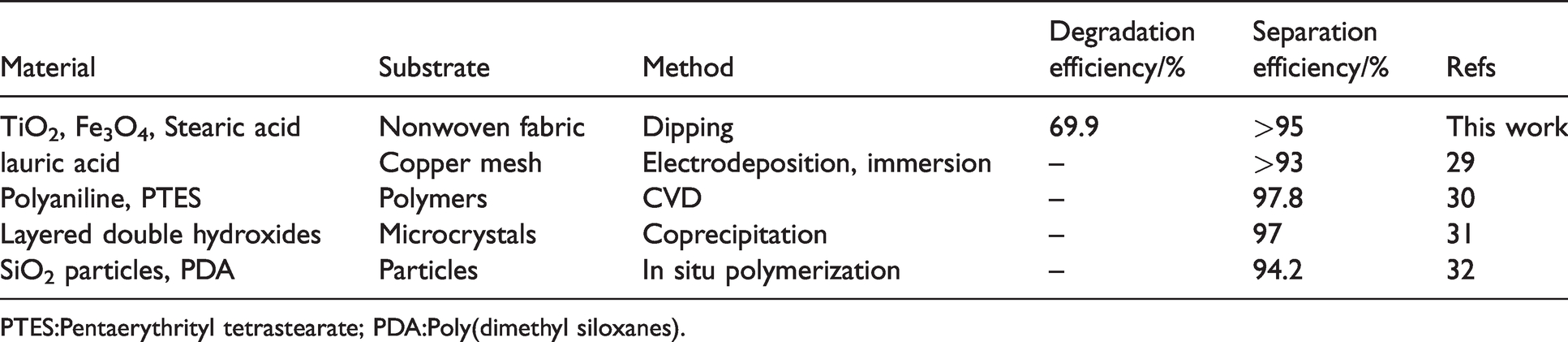
PTES:Pentaerythrityl tetrastearate; PDA:Poly(dimethyl siloxanes).
Magnetic performance
As shown in Figure 9(a), a VSM was used to quantitatively evaluate the magnetic properties of the coated FST. The remanent magnetic strength (Mr) and coercivity of the material (Hc) were 0.3 emu/g and 3.4 Oe, respectively. After dye removal, Mr and Hc hardly changed (Figure S8). In addition, it could be attracted by a magnetic rod (Figure S9). Compared with the FST, the pristine fabric did not possess magnetism. As shown in Figure 9(b), the FST fabric moved with the magnetic rod in both neutral and pH = 13 water (Figure S9), which confirmed that the fabric possessed magnetic properties and was not affected by the pH value. The magnetic properties of the FST fabric provided a guarantee for its recycling.

Vibrating sample magnetometer (VSM) curve of (a) pristine and magnetic pH-inducted fabric (FST). (b) VSM curve of FST at pH 7 and pH 13.
Conclusions
This study has successfully prepared and demonstrated a magnetic nonwoven with controllable wettability and photocatalytic degradation ability by the immersion method. the pH-induced underwater wettability transition and potential in controllable oil–water separation were demonstrated. The surface properties of the coated fabric with pH response could switch between superhydrophobic and superhydrophilic. At pH 7, the fabric was superhydrophobic/lipophilic. Oil could pass through the fabric but not the water, separating oil from water. At pH 13, the surface of the fabric became super hydrophilic. Water could pass through the fabric and the oil was left on the fabric surface, achieving the purpose of oil–water separation. The separation efficiency, flux, and recoverability of these coatings for several oils and organic solvents were investigated. The results showed that the coating had high separation efficiency of 95%, great recyclability and durability, and the hydrophobicity increased with the increase of alkane segments in the coating. Because of the existence of TiO2, the fabric had the property of photocatalytic degradation. Compared with pure TiO2, the energy bandgap of TiO2 decreased from 3.20 to 3.13 eV. This means that different energy states of TiO2 appear in the coated fabric, which made the energy bandgap of TiO2 narrow and the photocatalytic activity was enhanced. The fabric had magnetism, which provides a simple method for recycling the material by an artificial magnetic field. This work indicated that the FST had an excellent performance in the application of water purification, oil spill cleanup, and environmental protection, with more than 95% oil separation efficiency and more than 69.9% photodegradation of organic dye.
Footnotes
Declaration of conflicting interests
The author(s) declared no potential conflicts of interest with respect to the research, authorship, and/or publication of this article.
Funding
The authors disclosed receipt of the following financial support for the research, authorship, and/or publication of this article: This work was supported by the Key Project of Research Development Program of Heibei Province (Project No: 20271202D).
