



Abstract
A filament bundle is a type of yarn, which is composed of nearly parallel and highly oriented polymer monofilaments. Due to its nonlinearity both in material constitutive properties and structure, the filament bundle possesses nonlinear viscoelastic properties. It is important to study the dynamic behavior of the filament bundle accurately during its high-speed movement. Therefore, an accurate expression of the constitutive relation of the filament bundle is an essential prerequisite for its dynamic simulation and analysis. Continued the previous study in Part I: modeling filament bundle method, in this paper, an approach was proposed to identify the equivalent dynamic constitutive parameters of the filament bundle considering frequency-dependent characteristics. Firstly, the identification formulas of the dynamic elastic modulus and viscoelastic coefficients were derived based on the Kelvin model. Then, a testing method of the cross-sectional parameters of the filament bundle under a certain tension was proposed, and the testing device was developed to obtain the area of the filament bundle; The dynamic loading test of the bundle filament was conducted in a DMA Q800 dynamic mechanical tester. Thirdly, the equivalent dynamic elastic modulus and viscoelastic coefficients were obtained through the experimental test. Finally, an analytical method was proposed to verify the correctness of experimental results through simulation. The results show that the excitation frequency has a significant influence on the dynamic elastic modulus and viscoelastic coefficient, and the curves of the equivalent dynamic elastic modulus and viscoelastic coefficient present nonlinear variation characteristics.
Keywords
A filament bundle is a kind of fiber assembly with an ultrahigh aspect ratio. Due to its viscoelastic polymer material and nearly parallel monofilament assembly structures, the mechanical properties of the moving filament bundle not only show the characteristics of viscosity, stress relaxation and strain hysteresis, but also show strong frequency-dependent characteristics.
The filament bundle in high-speed and large overall motions is a common phenomenon during processing, especially in the high-speed movement along the axis, such as the high-speed winding of polyester filament, weft insertion of the loom, and so on. Usually, the moving filament bundle is affected under dynamic load that is a changing force with a definite periodicity and a high frequency. Therefore, the viscosity of the filament bundle is mainly reflected in a form of energy loss under the tension fluctuation. On the other hand, the moving filament bundle is not subjected to the action of long-term constant force, so the creep and relaxation phenomenon of the filament bundle is not obvious in the dynamic behavior of the moving filament bundle.
Obviously, identifying the dynamic constitutive parameters of the moving filament bundle is crucial for accurately investigating its dynamic response, such as in textile processing and prefabricating fiber-reinforced composites. Usually, series-parallel connection combinations of springs and dashpots are used to describe the viscosity, creep and relaxation properties of textile material, such as the Kelvin model and the three-element mechanical model. In this paper, the constitutive equation of the filament bundle is simplified to the constitutive relationship in the axial (length) direction according to the dynamic characteristics of the moving filament bundle. It is worth noting that the effectiveness of the constitutive equation has been verified in the first paper of this series of study.
The dynamic constitutive parameters of the filament bundle include the equivalent elastic modulus and viscoelastic coefficient. Sogabe and Tsuzuki 1 used wave propagation testing to identify the linear viscoelastic properties of polymethyl methacrylate. Shim et al.2–4 investigated the modeling deformation and damage characteristics of woven fabric under a small projectile impact, idealizing the fabric as a network of viscoelastic fiber elements. It was noted that a three-element viscoelastic constitutive model is used to study the yarn and fabric behavior.
Pan 5 has carried out an in-depth study on the constitutive equation of yarn, and Pan and Brookstein 6 discussed the effects of fiber bending and torsion, strain rate and viscoelasticity. Van Langenhove 7 established a theoretical model to predict the stress–strain and torque–tensile strain curves of the yarn. Liu and Hu 8 established a constitutive model that can give accurate compressive stress–strain relationships of warp-knitted spacer fabrics.
Liu et al. 9 proposed a new multiscale approach based on the mechanics of a structural genome to study the viscoelastic behaviors of textile composites. Xu et al. 10 proposed a vibration model of the yarn bundle to study the influence vibration characteristics of the yarn bundle on the vibration and noise of tufted carpet looms. However, these literatures did not consider the effect of the excitation frequency of external loads on the dynamic viscoelasticity of the filament bundle.
Although there is increasing interest in characterizing the dynamic properties of many high-performance fibers, published works of literature on dynamic testing techniques and procedures for fibers and yarns are relatively scarce due to technical difficulties in holding the specimens tightly enough without introducing excessive stress concentration at the ends of the yarns. Laible and Morgan 11 used seven different holding approaches to test isotactic polypropylene fibers. Smith et al.12,13 determined the dynamic modulus, and cautioned that the strengths obtained at various strain rates were not reliable due to complications arising from the clamping technique to hold the fiber bundles. Tan et al. 14 presented the quasi-static and rate-dependent mechanical properties of aramid yarn together with a study on different methods of securing yarn specimens in tensile tests, and also presented a viscoelastic material model to describe the mechanical behavior of the yarn.
The cross-sectional parameters of the filament bundle are one of the important parameters to calculate the elastic modulus and viscoelastic coefficient. The cross-sectional shape and area are not only the description of the filament bundle cross-sectional state, but also the fundamental parameters of the filament bundle to investigate its dynamic characteristics, such as calculating the air resistance force and deformation energy. 15
The cross-sectional shape of the filament bundle is irregular due to its fiber aggregate structure and the influence of external force. The contact measurement method will lead to a change of the cross-sectional area of the filament bundle. Optical methods have several possible advantages, including better resolution and lower sensitivity to humidity or temperature factors. Carvalho et al.16–19 developed an optical signal processing system to measure yarn hairiness. This system can be easily adapted to measure the projection of the yarn diameter along a single direction and, consequently, infer yarn irregularities. However, the system needs to provide a high enough number of samples in a given measurement and assume a random orientation of irregularities over 360º around the yarn axis, and a single projection measurement should be able to adequately sample the variations in the yarn diameter. 20 Ueda et al. 21 proposed an optical method and developed a system for measuring the change in diameter during the production of polyester filaments in a manufacturing plant. These references can throw light upon approaches for developing a testing device to obtain the cross-sectional shape.
Currently, research methods for the cross-sectional parameters mainly include two types. In one, Peirce derived the formulas of the filament bundle density. The other is to use contact or non-contact measurement methods to obtain these parameters through experiments. However, these methods do not consider the tension of the filament bundle. The cross-sectional parameters of the filament bundle measured by the existing methods or instruments are different from the actual cross-sectional parameters. Therefore, a cross-sectional parameter testing method that considers the structural factors and the tension of the filament bundle is required.
In the first paper of the series of study, the research results showed that the dynamic viscoelasticity of the filament bundle has a significant influence on the dynamic characteristics of the moving filament bundle, especially in tension fluctuation. In this paper, a method for identifying the dynamic constitutive parameters of the filament bundle under dynamic loads and different excitation frequencies was proposed. The identification formulas of the elastic modulus and viscoelastic coefficient of the filament bundle were derived based on the Kelvin model. A testing device was designed and developed by a non-contact measuring method to measure the cross-sectional area of the filament bundle. Considering the moving filament bundle is subjected to dynamic loads, a testing method was employed whereby one end of the filament bundle is given an excitation of the harmonic strain of different excitation frequencies through the DAM Q800, and the equivalent dynamic elastic modulus and viscoelastic coefficients under different excitation frequencies were identified through the test data. Finally, based on the single-degree-of-freedom undamped system under the harmonic force, a verifying approach was proposed for the analysis of the experimental results. The main content and flowchart are shown in Figure 1.
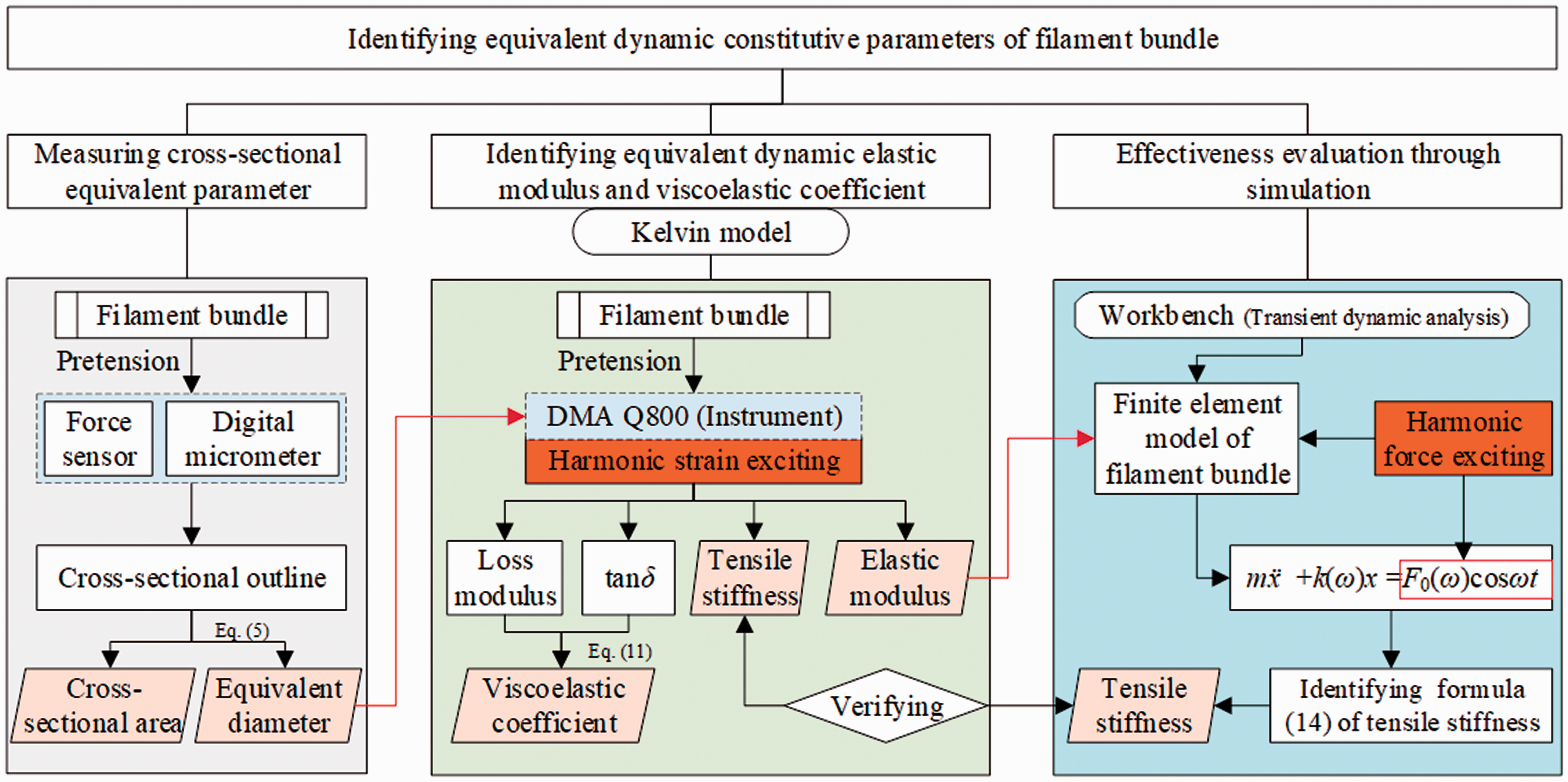
Main content and flowchart.
Constitutive relation
Filament bundle structure
The filament bundle mainly presents as extraordinarily long and thin fiber aggregation, and is composed of several or hundreds of monofilaments, as shown in Figure 2(a).
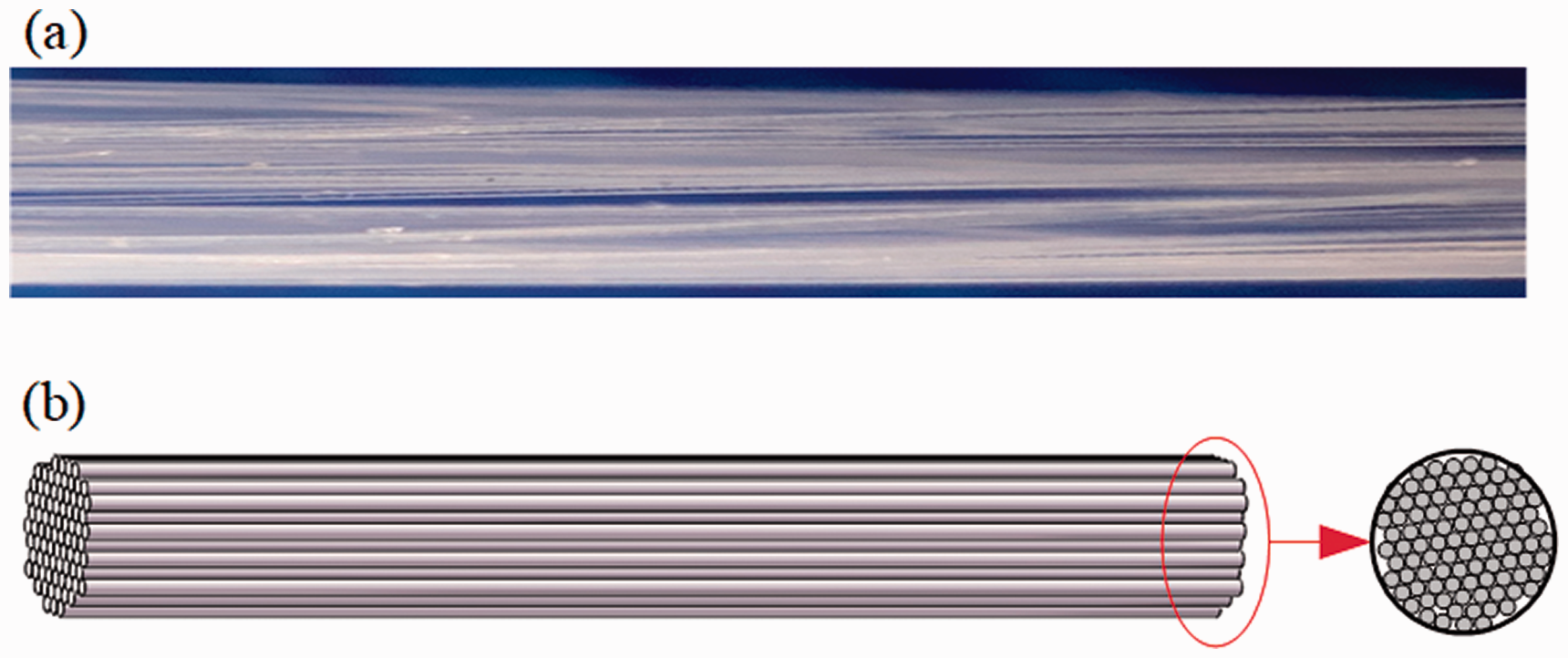
Diagram of the filament bundle structure: (a) the plane shape of the filament bundle under a magnifying glass; (b) the ideal filament bundle and its cross-section.
The monofilaments of the filament bundle are almost parallel to each other, containing oil and water. In the ideal case, all of the filaments in the bundle can be assumed to be arranged parallel to each other, and its cross-section is equivalent to a circular section, as shown in Figure 2(b). The mechanical properties of the filament bundles are not only related to the properties of the fiber itself, but also related to its structural characteristics.
Constitutive equations
The constitutive relation of the filament bundle is the basis for studying the dynamic characteristics of the moving filament bundle through theoretical modeling and simulation, especially in the calculation process of the deformation energy of the filament bundle element. Therefore, how to establish the constitutive relation of the filament bundle is among the most critical steps when using finite element analysis.
Since the filament bundle possesses typical viscoelastic property, this characteristic must be considered when establishing the constitutive relation of the filament bundle. Usually, when establishing the mathematical model, there are two basic elements to describe the viscoelastic properties of textile materials, namely the Hook spring and the Newton dashpot, as shown in Figure 3.
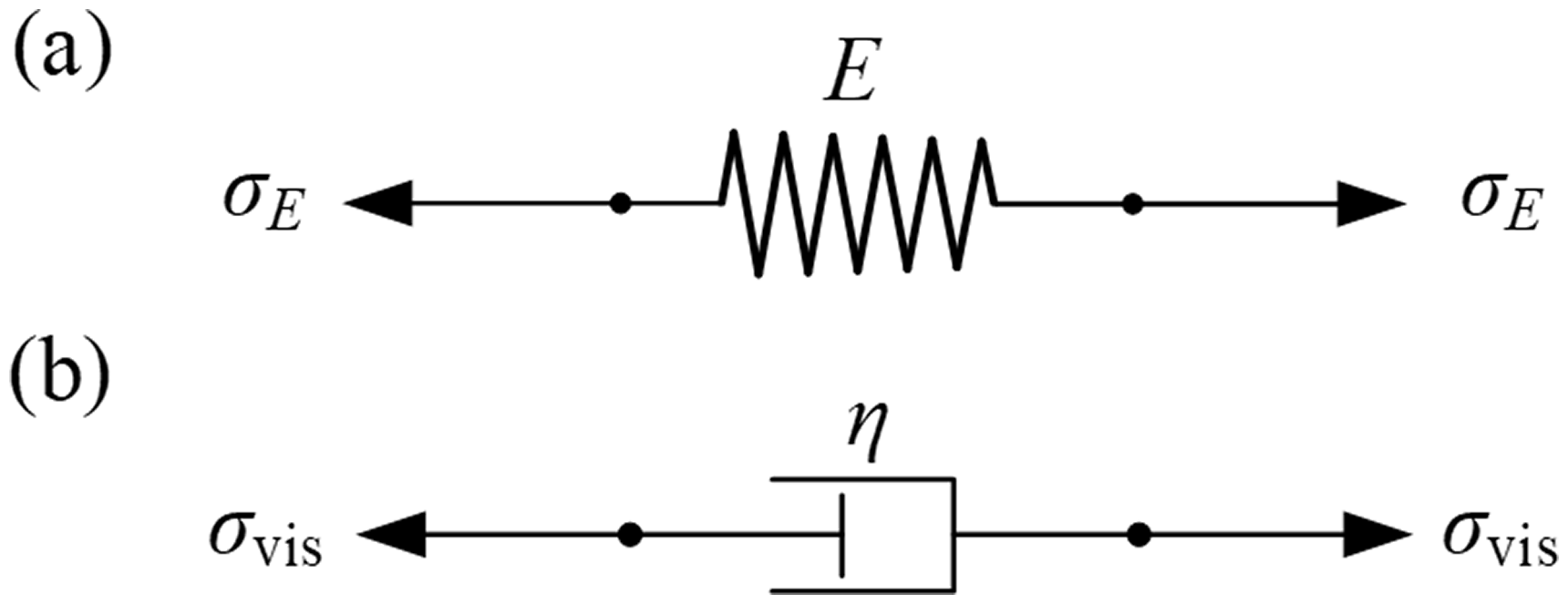
Hook spring and Newton dashpot elements: (a) Hook spring; (b) Newton dashpot.
The Hook spring is used to describe the mechanical behavior of an ideal elastic body, and its stress–strain relationship accords with Hooke's law

The Newton dashpot is used to describe the mechanical behavior of the ideal fluid (Newtonian fluid), and its stress–strain relationship accords with Newton’s law of viscosity

The combination of the two elements forms a variety of constitutive models that can be used to describe the viscoelastic properties of textile materials,
22
such as the Maxwell model, Kelvin model, three-element model, and so on. The constitutive models composed of springs and dashpots give differential expressions describing the mechanical properties of viscoelastic materials, and their general form is expressed as

For the high-speed moving filament bundle, due to its inertia, unbalanced force, etc., the vibration of mechanical equipment may lead to tension variations. This frequency-dependent continuous excitation force has a relatively large impact on the viscoelasticity of the filament bundle. Usually, series-parallel connection combinations of Hook springs and Newton dashpots are utilized to accurately describe the creep and relaxation behavior of the filament bundle with viscoelasticity.
The Kelvin model is composed of two parallel elements of the Hook spring and Newton dashpot, as shown in Figure 4. Although the Kelvin model is relatively simple, it can effectively describe the viscoelasticity of the filament bundle in the dynamic analysis. 22 Therefore, the Kelvin model is used in this paper to describe the constitutive relation of the filament bundle, and then identification formulas of the viscoelastic coefficient of the filament bundle are derived based on the Kelvin model.
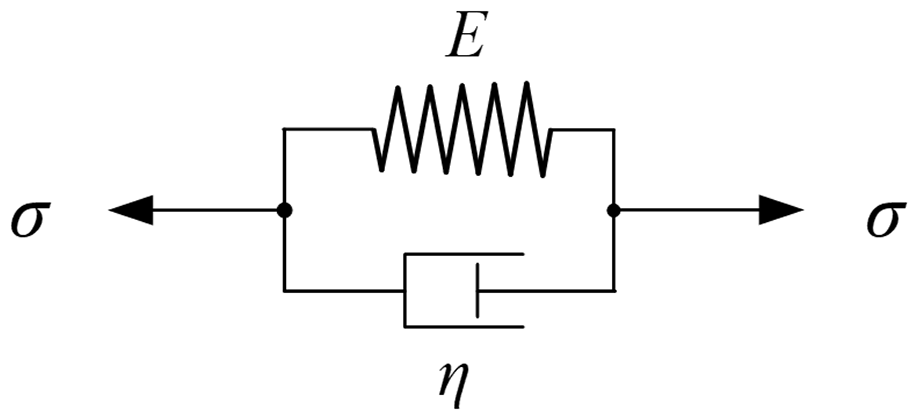
Kelvin model.
The strain

Equation (4) is the constitutive equation for viscoelastic material, and reflects the elastic deformation and viscosity of the moving filament bundle. Furthermore, due to the simple constitutive relation, it has superior calculation efficiency.
Measuring cross-section parameters
Experiment setup
The cross-sectional parameters of the filament bundle, including the cross-sectional shape and the cross-sectional area, are the key parameters for predicting the mechanical properties of the filament bundle, and also provide an important technical reference for designing the woven fabrics and determining the process parameters. Since the cross-sectional area of the filament bundle is an important parameter to obtain the dynamic elastic modulus and viscosity coefficient accurately, a testing device was designed and developed to obtain the cross-sectional shape of the filament bundle in this paper, and the cross-sectional area can be calculated by the shape.
A digital micrometer was used for measuring the cross-sectional area of the filament bundle, The cross-sectional area obtained by the test has the following two requirements: ① since the cross-sectional shape of the filament bundle is irregular, the micrometer can make at least one revolution around the filament bundle’s axis; ② according to the spinning process, the pre-stretch of the filament bundle is between 1% and 3% during processing, and the tension of the filament bundle is 30 cN when the pre-stretch is 1%. Taking all the factors into consideration, the testing device satisfied the requirements of certain tension and the micrometer that revolved around the filament bundle’s axis was developed, as shown in Figure 5.

Experimental setup of measuring the cross-sectional area of the filament bundle.
In the test, a linear motion lead screw slide stage with a servo motor was used to control the tension of the filament bundle. A micrometer was installed on the frame that could revolve around the filament bundle’s axis. The parameters of the experimental instruments used in the test are listed in Table 1.
The equipment parameters used in the experiments

Cross-sectional area
Because the cross-sectional area of the filament bundle remains unchanged under the tension, the measured diameter at the different directions has nothing to do with the revolving speed of the micrometer, but the rotation must be greater than one revolution. The data collected by the micrometer are discrete-time periodic signals in practice 
Continuing the first paper of this series study, a polyester filament bundle was used to obtain the cross-sectional area, and the filament package was provided by the manufacturer of the polyester filament. The filament bundle is pre-oriented yarn (POY), its specifications are 220 dtex/72 f and the filament tension is 30 cN during processing. In this test, the filament bundle unwound from the filament package surface, and specimens with different linear densities and twists were obtained by twisting and doubling. The specimens were used to obtain the cross-sectional area through the experimental test, and are listed in Table 2.
Parameters of filament bundle specimens used for testing

This paper takes the example for the filament bundle that its linear density is 440 dtex, and the twist is 20 T/10 cm to explain the process of the experimental test. The main experimental steps for measuring the cross-sectional outline curve are as follows:
one end of the filament bundle was fixed on the digital force tester and another end was fixed on the slider; the tension of the filament bundle was adjusted by the servo motor of the linear motion lead screw slide stage, and the tension value of the screen on the digital force tester was 30 cN; the micrometer revolved around the filament bundle’s axis, and the data of the cross-sectional diameter of the filament bundle in different directions of rotation were collected by the KEYENCE controller, as shown in Figure 6(a).
Diameters and outline curve of the filament bundle in different directions of rotation: (a) diameter change of the cross-section of the filament bundle (from a screenshot from the LS-Navigator); (b) outline curve of the cross-section area of the filament bundle.
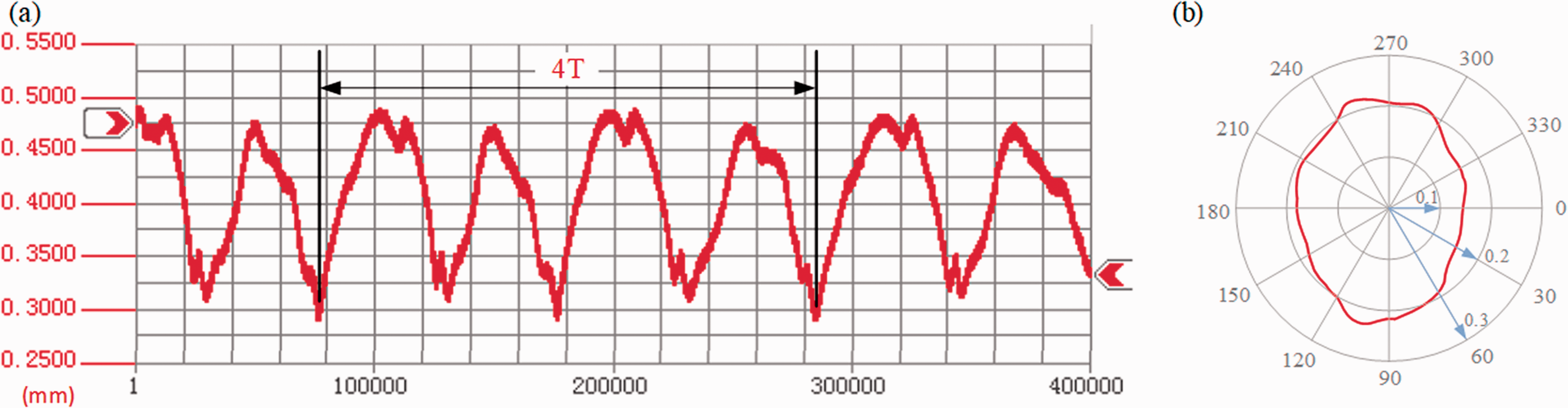
It can be seen from Figure 6(a) that the diameters of the filament bundle in different directions change periodically. To obtain the cross-sectional area of the filament bundle more accurately, the average technique of four periods was applied in the diameters of the filament bundle measurement. Then, the outline curve of the cross-section of the filament bundle was obtained; the outline is an irregular shape, like an ellipse, as shown in Figure 6(b). Finally, the cross-sectional area of the filament bundle was calculated through Equation (5), and the area is 0.1022 mm2.
According to the testing method of the cross-sectional area of the filament bundle, the area of different linear densities and twists was obtained under constant tension, as shown in Figure 7.
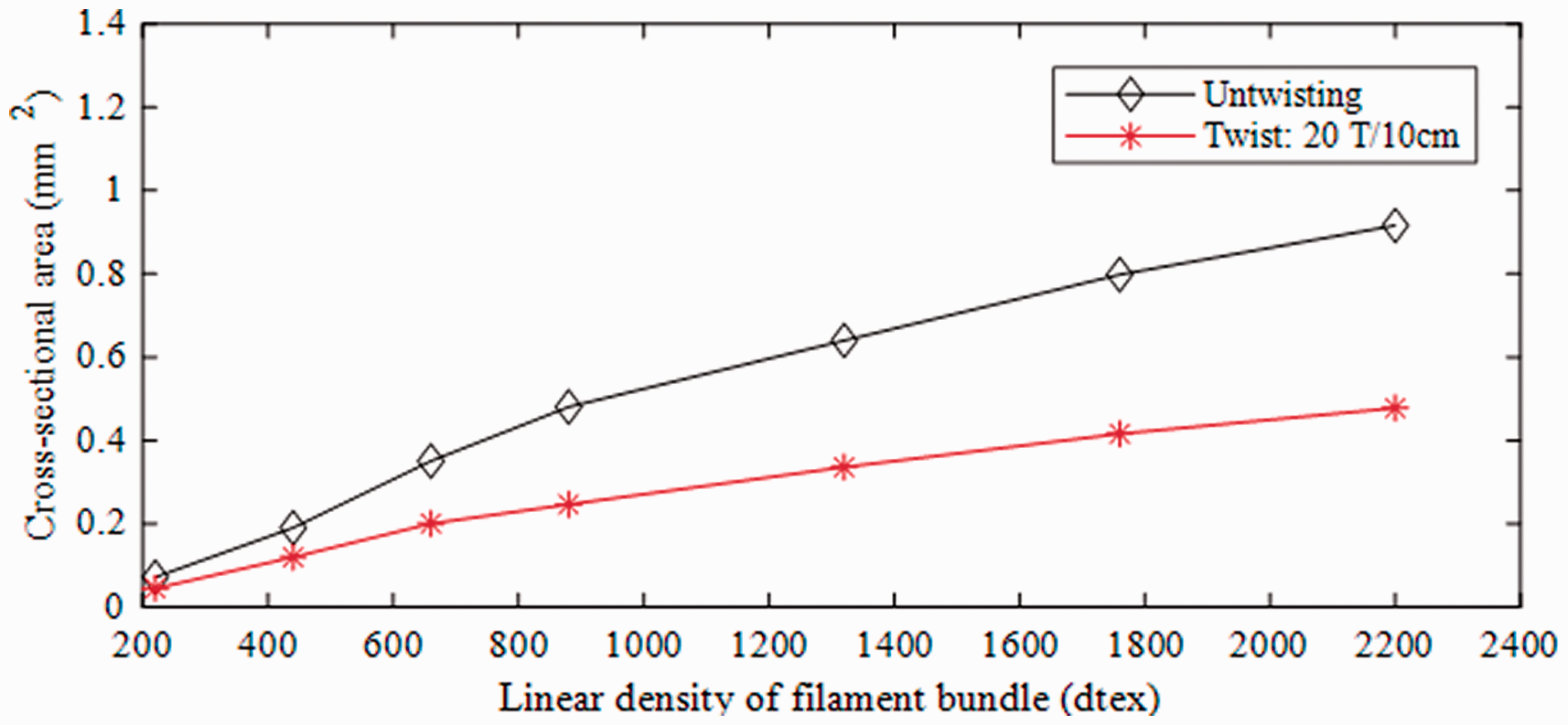
The cross-sectional area of the filament bundle with different linear densities and twists.
The effect of the linear density and the twist on the cross-sectional area of the filament bundle is given in Figure 7. The twist has a pronounced influence on the cross-sectional area. As the linear density of the filament bundle increases, the effect of the twist on the cross-sectional area becomes greater and greater. The cross-sectional area of the filament bundle and its linear density show nonlinear characteristics. In addition, comparing the measured yarn diameter along a single direction,12–16 the method proposed in this paper can quickly and accurately measure the cross-sectional contour of the filament bundle with pretension.
Identifying equivalent dynamic constitutive parameters
Principle of the experiment
Assume an excitation of harmonic strain is given by 
Using the trigonometric relations for Equation (6) yields

From Equation (7), we assume that the stress 
In this paper, the Kelvin model is used to describe the dynamic mechanical properties of the filament bundle. Substituting Equation (7) into Equation (4), one obtains

Equating the coefficients of 
The identification formulas of the dynamic elastic modulus 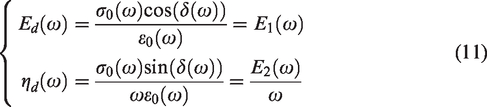
It can be seen that when the Kelvin model is used to describe the dynamic mechanical properties of the filament bundle, the relational expression between the dynamic elastic modulus and the dynamic viscoelastic coefficient can be obtained, namely
Dynamic elastic modulus and viscoelastic coefficient
The experimental instrument (DMA Q800) of the viscoelasticity of the filament bundle is presented, as shown in Figure 8. When one end of the filament bundle undergoes harmonic excitation open the insulating cover of the DMA Q800, make sure that the distance between the two clampers is 22 mm, and then lock the lower clamper; Install the filament bundle on clampers A and B, respectively, and tighten the screws with a torque wrench while ensuring that the filament bundle is straight and tension-free; close the insulating cover, and then set the experiment parameters in the TA Instrument Explorer, including the equivalent diameter of the filament bundle, the length of the filament bundle, test temperature, strain amplitude and excitation frequency range; start the experiment and record the data.
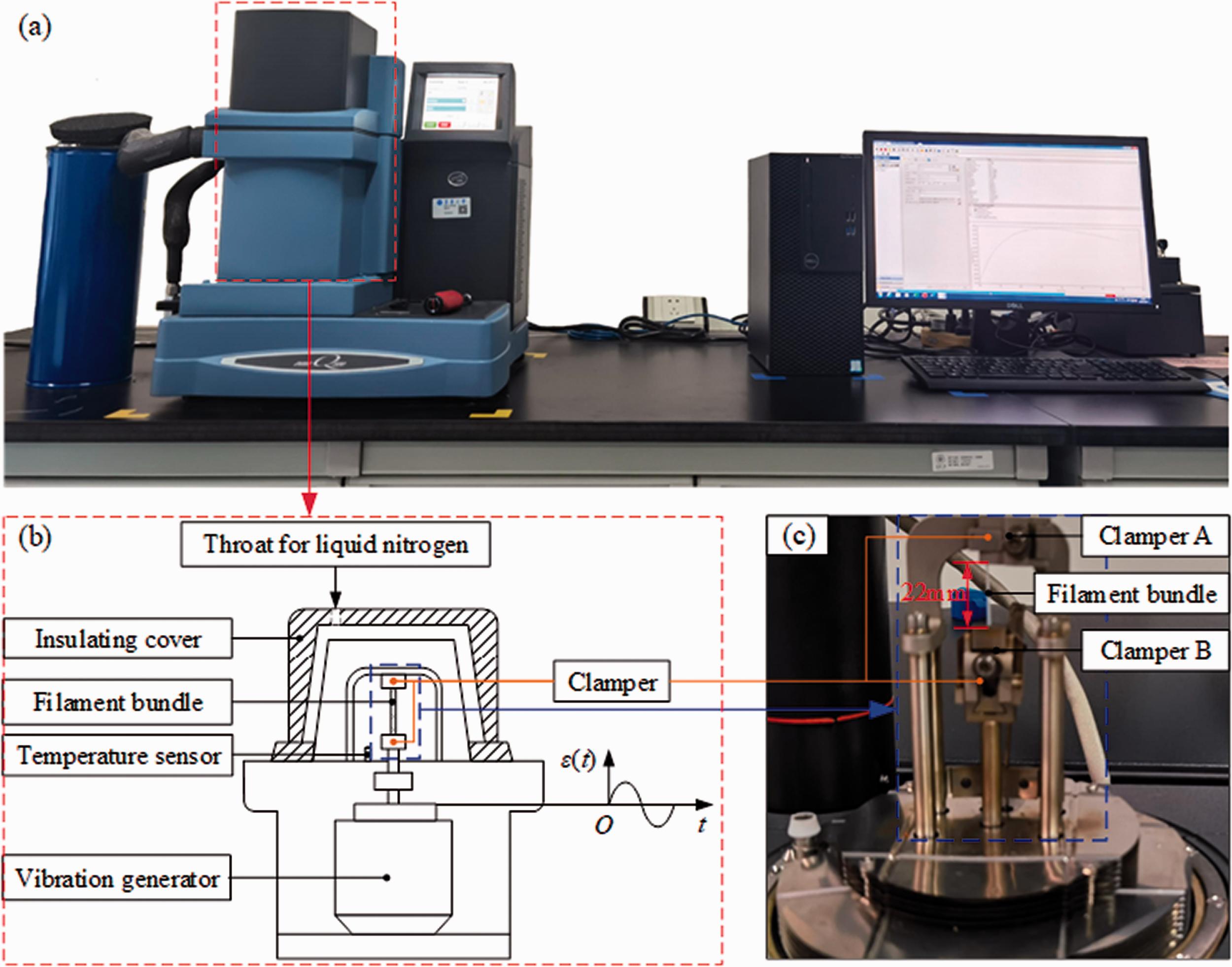
Diagram of the experimental test: (a) DMA Q800 dynamic mechanical analysis; (b) schematic diagram of the Q800 host; (c) clamp assembly.
A dynamic mechanical analysis of the filament bundle was carried out by the DMA Q800, and the setting parameters of the DMA Q800 are listed in Table 3, where the excitation frequency includes a common working frequency range. It should be noted that the cross-sectional areas of the filament bundle with different linear densities and twists were obtained through experiments, as shown in Figure 7, and hence the equivalent diameter of the filament bundle can be calculated. The strain and stress amplitude of the excitation and the response are acquired by the DMA Q800 under different frequencies, respectively.
The setting parameters of the DMA Q800

In the test of the dynamic constitutive parameters, filament bundles with different linear densities and twists were also used to identify the equivalent dynamic elastic modulus coefficient and viscoelastic coefficient through experiments, and the parameters of the filament bundle specimens are the same as described earlier (listed in Table 2).
Analysis of filament bundles with different linear densities and twists was carried out by the DMA Q800, and the storage modulus, loss modulus and
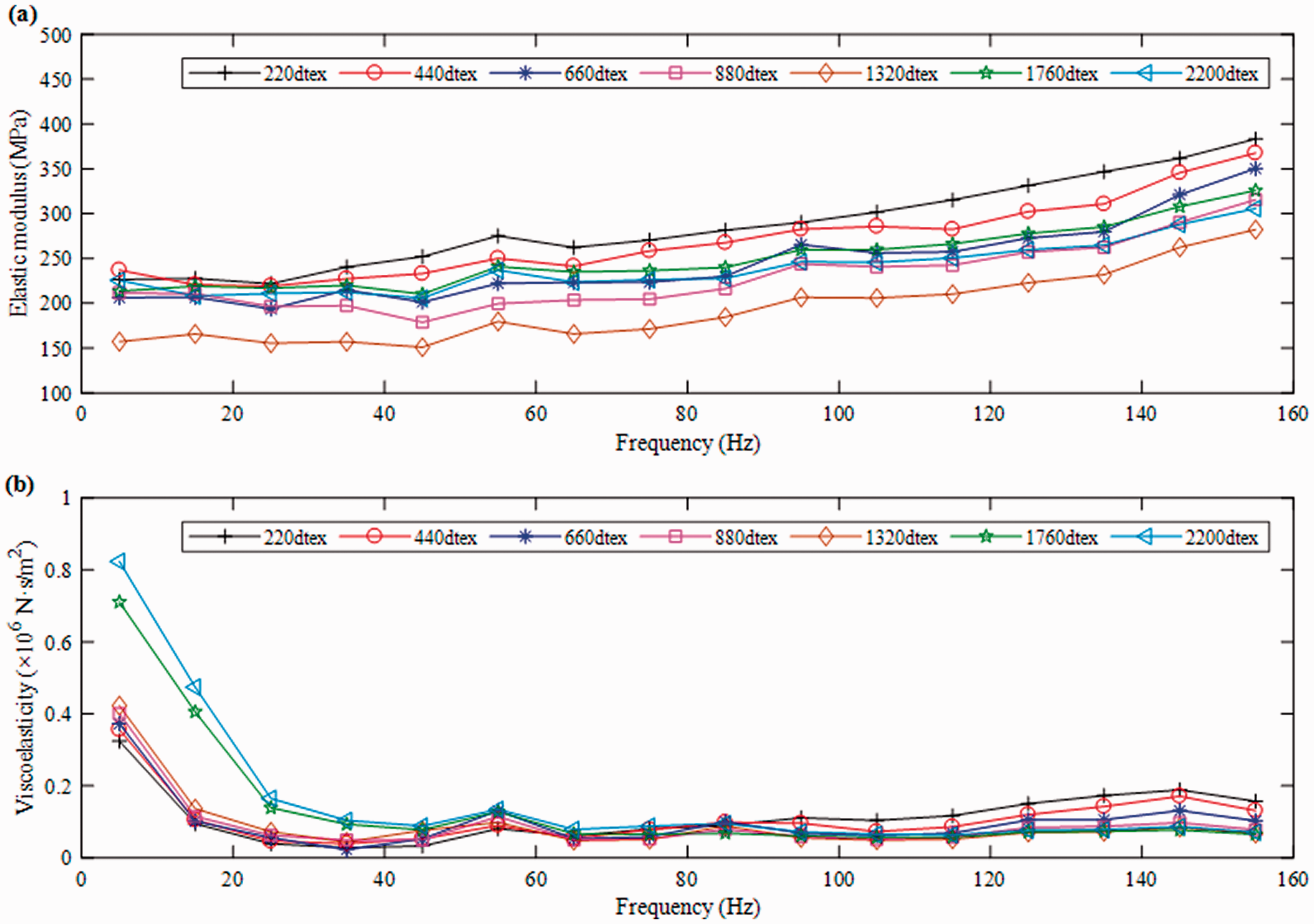
Equivalent dynamic elastic modulus and viscoelastic coefficient under different linear densities (untwisting).
Figure 9(a) shows that the dynamic elastic modulus coefficient of the untwisting filament bundle changes with the excitation frequency, and it increases as the excitation frequency increases and displays a kind of nonlinearity. On the other hand, the dynamic elastic modulus coefficient increases with the increasing linear density. In addition, comparing the experimental results of the dynamic elastic modulus with the values of Wang et al., 15 the tensile modulus of 1.03 × 10⁸ Pa is obtained by the static tensile tests. We found that the elastic modulus of the filament bundle under dynamic conditions is greater than the result of the static test. Therefore, when establishing the mathematical model of the filament bundle to investigate dynamic behavior through numerical simulation, it is necessary to obtain the equivalent elastic modulus coefficient within the excitation frequency range reasonably.
The dynamic viscoelastic coefficient of the untwisting filament bundle was obtained under the different excitation frequencies, as shown in Figure 9(b). Because the filament bundle is nearly a monofilament parallel assembly structure, its viscoelasticity mainly displays the polymeric viscosity of the monofilament. The viscoelastic coefficient decreases as the excitation frequency increases, and tends to be stable at the end. Obviously, the viscoelastic coefficient decreases as the linear density of the filament bundle increases when the excitation frequency range is from 5 to 55 Hz, and the coefficient appears to increase as the linear density of the filament bundle increases when the excitation frequency range is from 95 to 155 Hz. Particularly in lower frequencies, the linear density of the filament bundle has a great influence on the viscoelastic coefficient, and it increases as the linear density increases. According to the first paper of this series, 15 the viscoelastic coefficient of the filament bundle in which the strand number in a bundle is 24 was obtained and its value is 3.708 × 10⁶ Pa; the method of theoretical simulation and experimental testing illustrated the effect of viscoelasticity on yarn dynamics and the correctness of the viscoelastic coefficient.
For the linear density of the untwisting filament bundle of 1320 dtex, the fitting curves of the dynamic elastic modulus and Poisson's ratio are shown in Figure 10, and the R-square values of the fitting curves are 0.964 and 0.963, respectively.
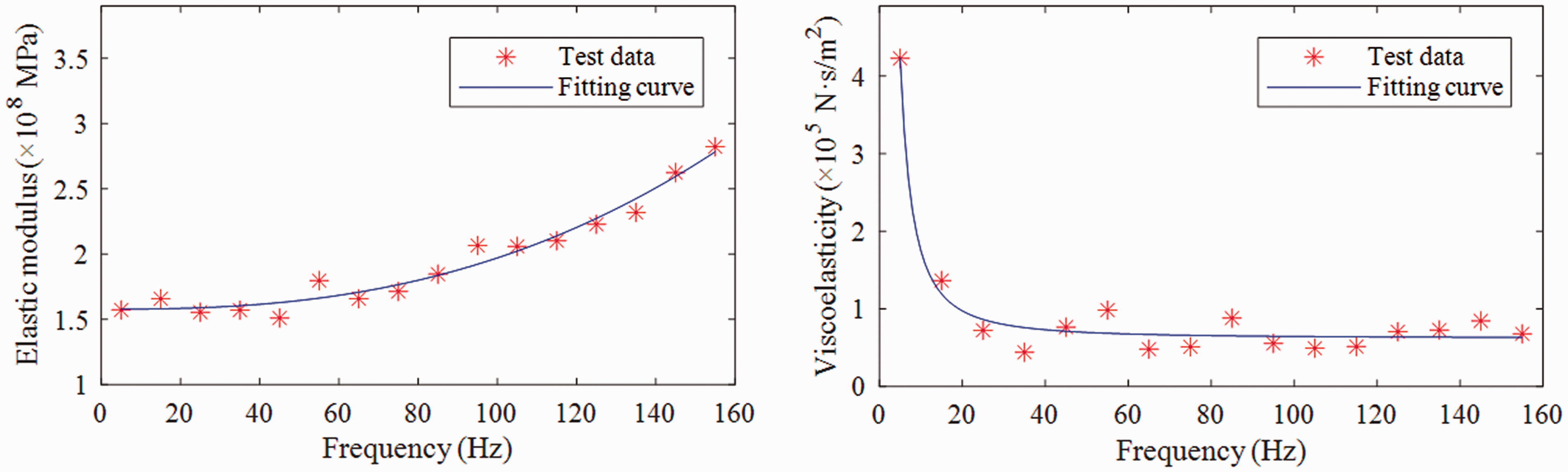
Fitting curve of the equivalent dynamic elastic modulus and viscoelastic coefficient under the linear density of 1320 dtex.
The fitting formulas of the dynamic elastic modulus coefficient and dynamic viscoelastic coefficient can be written as

For other linear densities of the untwisting filament bundle, the fitting formulas for the dynamic elastic modulus and Poisson's ratio can also be obtained from the data in Figure 9.
In order to further investigate the effect of the twist of the filament bundle on the dynamic elastic modulus and viscoelasticity, a similar experiment of the twisting yarn was carried out, and the curves of the equivalent dynamic elastic modulus and viscoelastic coefficient are shown in Figure 11.
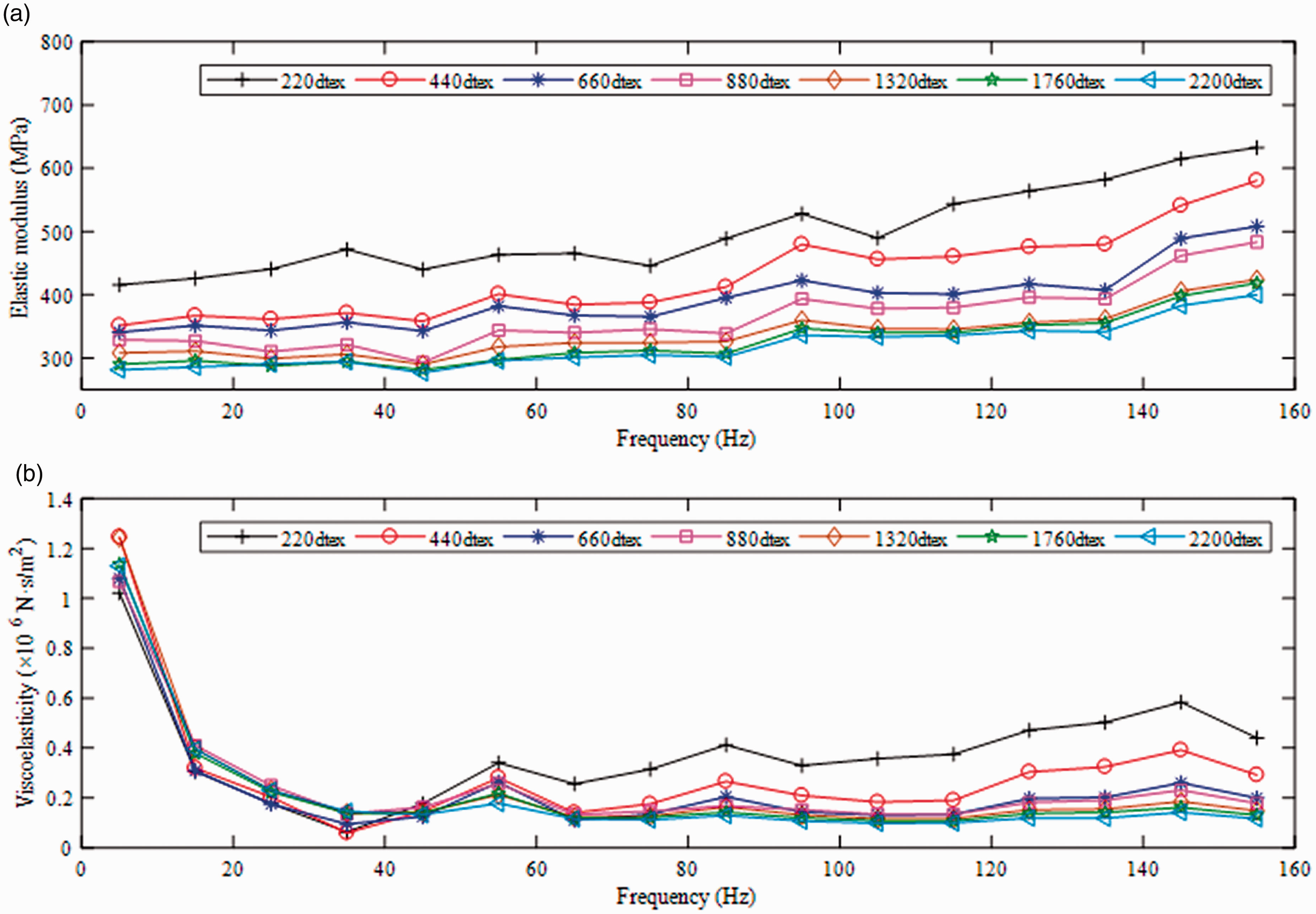
Equivalent dynamic elastic modulus and viscoelastic coefficient under different linear densities (20 T/10 cm).
Figure 11(a) shows that the dynamic elastic modulus coefficient of the twisting filament bundle changes with the excitation frequency, and it increases as the excitation frequency increases and also displays a kind of nonlinearity. On the other hand, the dynamic elastic modulus coefficient decreases regularly with the increasing linear density. The dynamic viscoelastic coefficient of the twisting filament bundle was obtained under the different excitation frequencies, as shown in Figure 11(b). The viscoelastic coefficient decreases as the excitation frequency increases, and tends to be stable at the end.
To illustrate the effect of the twist on the elastic modulus and viscoelastic coefficient, a comparative analysis of data obtained by the experiment was carried out, as shown in Figure 12.
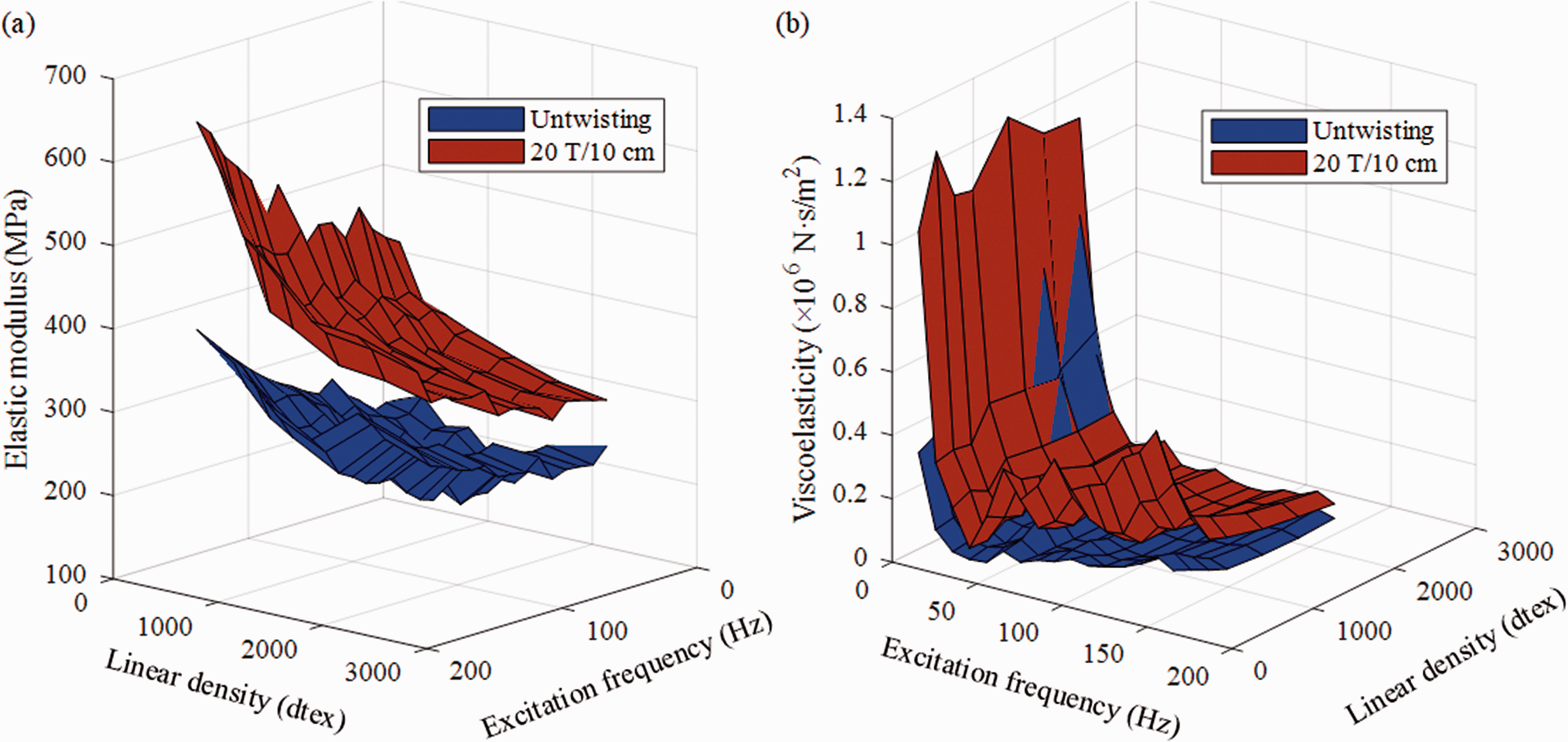
Comparison between untwisting and twisting filament bundles: (a) dynamic elastic modulus; (b) dynamic viscoelastic coefficient.
It can be seen from the figure that the twist has a great effect on the elastic modulus and viscoelastic coefficient, and the elastic modulus value of the twisting filament bundle is larger than the untwisting value, as shown in Figure 12(a). Obviously, the cross-sectional area of the filament bundle decreases as the twist increases, which can lead to larger stress under the harmonic excitation of the constant strain amplitude. Therefore, according to Equation (1), the equivalent elastic modulus of the twisting filament bundle is larger than the untwisting values. Furthermore, the cohesion of the monofilament increases as the twist increases, so the viscoelastic coefficient includes the polymeric viscosity of the monofilament and the damping between the monofilaments, as shown in Figure 12(b).
Analysis and discussion
Tensile stiffness analysis
Analysis of filament bundles with a fixed end (clamper A) and supported end (clamper B) under harmonic loads was carried out by the DMA Q800, as shown in Figure 8. This instrument can not only obtain the storage modulus, loss modulus and tanδ to identify the dynamic elastic modulus and the viscoelastic coefficient based on the Equation (11), but also obtain the tensile stiffness of the filament bundle, as shown in Figure 13.
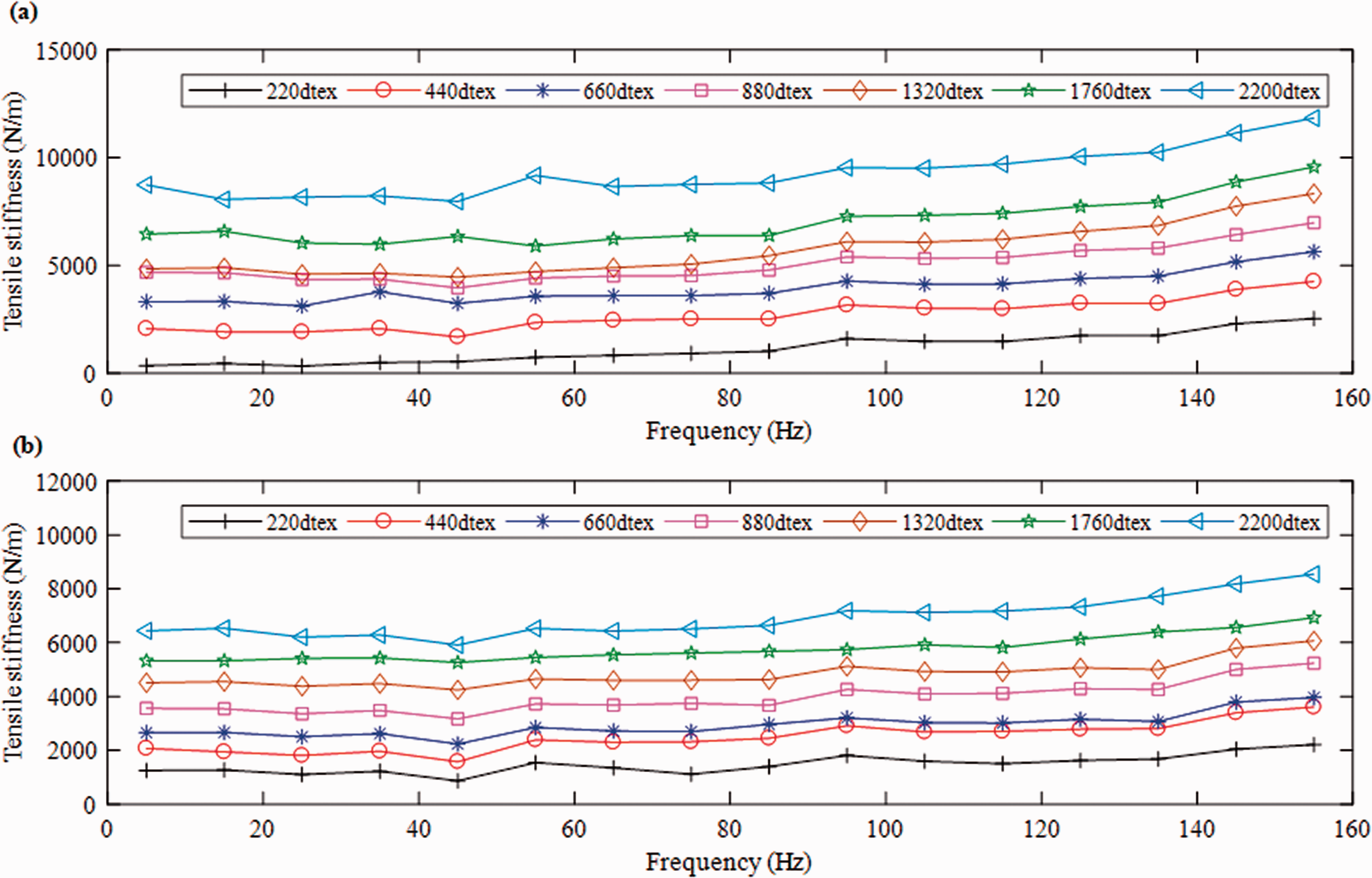
Tensile stiffness of the filament bundle under different linear densities: (a) untwisting filament bundle; (b) twisting filament bundle (20 T/10 cm).
It can be seen from Figure 13 that the linear density and the excitation frequency of the filament bundle have a great influence on the tensile stiffness. The tensile stiffness increases as the linear density and the frequency increase, and the curves present nonlinear frequency variation characteristics. Obviously, the filament bundle is composed of several or hundreds of monofilaments, which are almost parallel to each other, containing oil and water. The tensile stiffness of the monofilament in the filament tow is equals the stiffness springs parallel, which largely affects the tensile stiffness of the filament bundle.
Effectiveness evaluations through simulation
The tensile stiffness is another representation form for material performance in the axial direction. For the filament bundle of circular cross-section, its tensile stiffness can be written as
To verify the correctness of the experimental results, one end of the filament bundle underwent harmonic force to identify the tensile stiffness 
Because the exciting force is harmonic, the stable solution 
To obtain the response of the filament bundle under the harmonic exciting force, the finite element model of the filament bundle was established and simulated by ANSYS Workbench, as shown in Figure 14. The elastic modulus of the filament bundle was obtained through the experiment. Analysis of the filament bundle that underwent harmonic force was carried out through transient dynamic analysis.
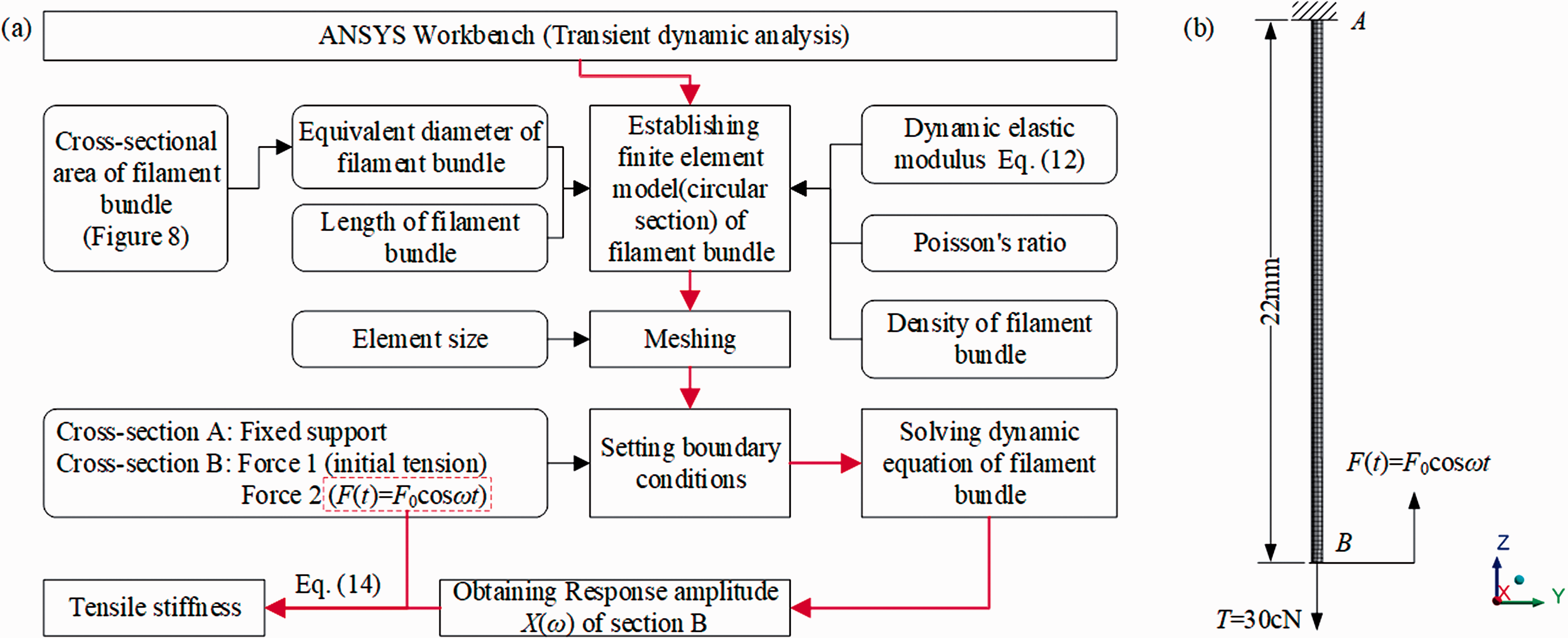
Identifying dynamic tensile stiffness through simulation: (a) flowchart of dynamic simulation; (b) finite element model and boundary condition setting.
This paper takes the example of the linear density of the untwisting filament bundle of 1320 dtex to illustrate the correctness of the experimental results, and the flowchart of dynamic simulation is shown in Figure 14(a). The elastic modulus coefficient of the filament bundle is shown in Figure 9 and its fitting formula is given in Equation (12); a Poisson's ratio of 0.4 is obtained through the test. According to the cross-sectional area measured through the developed device, the equivalent diameter of the filament bundle is obtained. The filament bundle is equivalent to a solid cylinder based on the equivalent diameter and length of the filament bundle. The element size was 0.3 mm. The cross-section A of the filament bundle was fixed, and its cross-section B was applied on a pretension of 30 cN. The exciting force amplitude under harmonic loading
The steady-state response
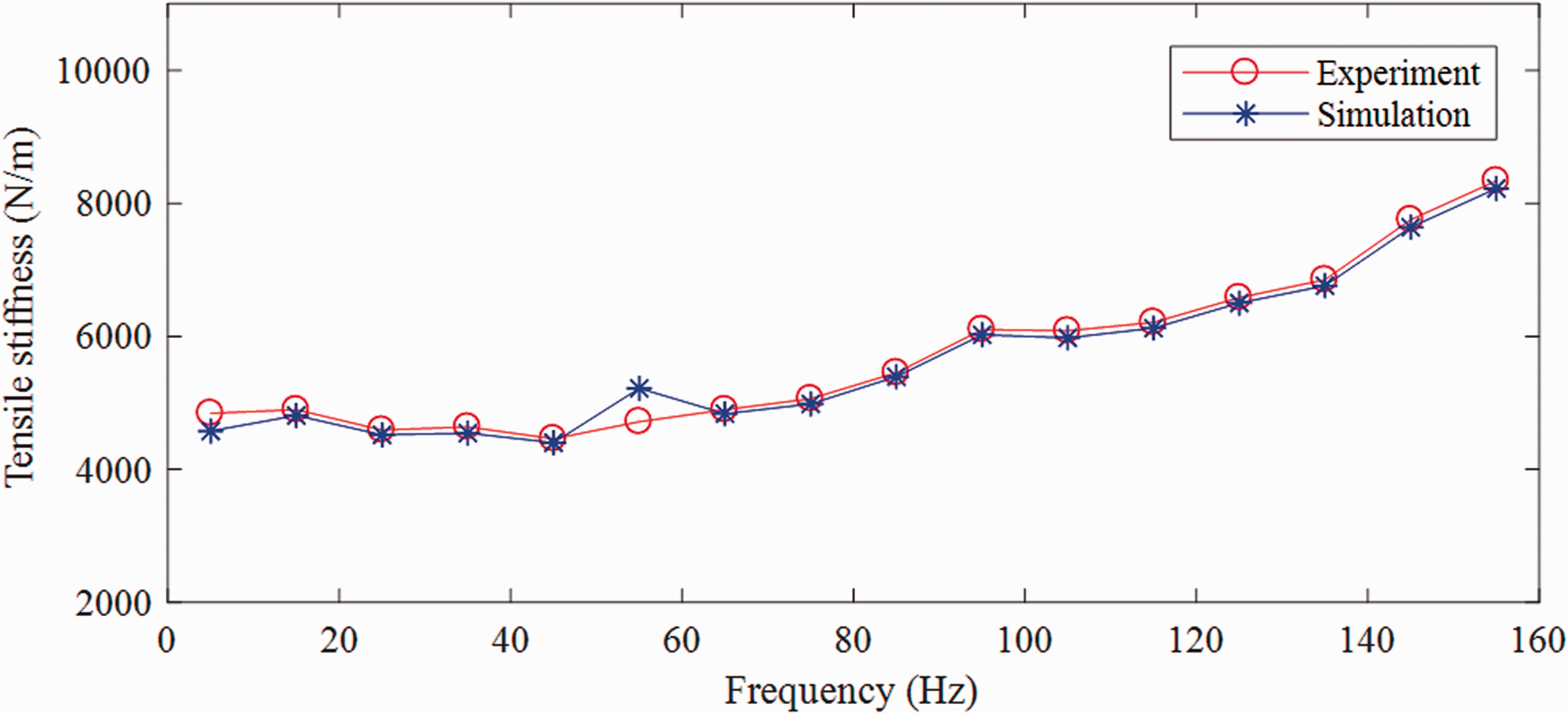
Tensile stiffness analysis of the filament bundle (untwisting and linear density of 1320 dtex).
When the linear density of the untwisting filament bundle is 1320 dtex, Figure 13 shows that the equivalent tensile stiffness increases as the excitation frequency increases. The simulation results of tensile stiffness are basically consistent with the experimental results, as shown in Figure 15. This in turn shows the correctness of the dynamic elastic modulus determined by the experimental test. However, the measured result of tensile stiffness is larger than the value of the theoretical analysis. The major reason for the large value is that the two ends of the filament bundle were held by the clampers, leading to larger tensile stiffness of the test results.
Conclusions
The filament bundle is a typical viscoelastic material with a nonlinear structure, and it has a significant influence on the dynamic characteristics of the moving filament bundle under tension fluctuation. In this paper, the dynamic equivalent elastic modulus, viscoelastic coefficient and tensile stiffness of the filament bundle were obtained through the experimental test, considering the influence of the excitation frequency on the dynamic constitutive parameters.
Because the cross-sectional area of the filament bundle is one of the important parameters for calculating the dynamic elastic modulus coefficient and the dynamic viscoelastic coefficient, a method for measuring the cross-sectional area of the filament bundle considering the filament tension was proposed, and a testing device also was developed. A digital micrometer revolves around the filament bundle’s axis to obtain its outline curve, and the cross-sectional area of the filament bundle was calculated based on Equation (5). The research results showed that the cross-sectional area–linear density curve presents nonlinear characteristics.
The identification formulas of the dynamic elastic modulus and the viscoelastic coefficient of the filament bundle were derived based on the Kelvin model, considering the moving filament bundle subjected to dynamic loads with different excitation frequencies. The dynamic elastic modulus coefficient and the viscoelastic coefficient of the filament bundle were obtained, and these parameters have nonlinear frequency-dependent characteristics. Therefore, the elastic modulus and viscoelastic coefficient of the moving filament bundle under the specific frequency range must be identified when establishing the dynamic model of the filament bundle to accurately investigate its dynamic behavior.
An approach for verifying the effectiveness of the experiment was proposed based on an undamped system under harmonic force. The identification formula of tensile stiffness was derived based on the single-degree-of-freedom system. Using the dynamic elastic modulus of the filament bundle obtained in the experiment, the correctness of the experimental results is verified through software simulation.
Filament bundles in high-speed and large overall motions is a common phenomenon during processing, which leads to the nonlinear and frequency-dependent characteristics of the constitutive parameters. Therefore, it is necessary to investigate the constitutive parameters corresponding to the working frequency range, which provide basic parameters for establishing an accurate model of the yarn and simulation analysis.
Footnotes
Declaration of conflicting interests
The authors declared no potential conflicts of interest with respect to the research, authorship, and/or publication of this article.
Funding
The authors disclosed receipt of the following financial support for the research, authorship and/or publication of this article: This work was supported by the National Key R&D Program of China (2017YFB1304000), the Applied Foundation Research of China National Textile and Apparel Council (grant no. J201504) and the Natural Science Foundation of Shanghai (grant no. 16ZR1401900).
