



Abstract
Duck down, as a natural keratin material, has been widely used as a filling material. The multilevel bifurcation structure of down has been observed and characterized through scanning electron microscopy. The structure is a complex fractal structure composed of four-level self-similar structures including five units, that is, the calamus, main barb, barb, barbule, and node or prong. The differential friction effect of the dynamic friction coefficients of the barb was reduced from 0.4 (dry state) to 0.23 (wet state), namely a decrease of 42.5%. The friction locking effect decreases due to the swelling of the fiber diameter. The down is zero gravity in water, and under the action of vibration and internal stress, down that has been subjected to friction or heat setting treatment can quickly return to its original shape in water. This shape memory mechanism was further confirmed, in which down after heat setting can restore its shape to the natural state by shaking it quickly and vigorously. This research provides inspiration to investigate more complicated functions of natural materials and encourages the creation of very intelligent synthetic polymers.
People can learn skills from very common animal hair in nature, because nature is full of wisdom. 1 Down is a layer of hair on the body surface of fowl, for instance ducks, geese, and swans, which is a top priority for the survival and evolutionary of poultry. 2 It has a lightweight design and excellent thermal insulation performance.3–5 Although down is usually used as a filling material for clothing and bedding, there are some publications about the morphology characteristics and performance of down.6–9 Barbs emanate from the center of down and barbules are distributed on barbs, and as a result down possesses excellent compressibility and compression recovery. The excellent performance of down is inseparable from its structure, and how to accurately describe its structure is meaningful. The concept of fractal geometry was first proposed by Mandelbrot in 1975, 10 which refers to a kind of irregular, fragmented, and complex system with self-similarity. It is suitable for describing the complex structure of down, for example, the morphological structure by local fractal dimensions. 11
The unique structure of down gives it many excellent properties, but its shape memory properties have received less attention. Before the down is processed or used, if the shape memory properties of the down are used to restore its original shape and structure, it is beneficial to give full attention to the use value of the unique structure of the down. Shape memory features of protein materials have been studied by many scholars as a result of the action of water. Hu et al. 12 explored the shrinkage of stretched wool in water, which was considered as a shape memory phenomenon caused by the action of water. Sullivan et al. 13 investigated the shape recovery of a feather shaft due to the swelling of the feather’s matrix material during the hydration process. Huang et al. 14 thought that hydration could promote the recovery performance of bighorn sheep horns. Xiao et al. 15 studied the shape memory mechanism of hair owing to the transition of crosslinking in polymeric networks from the action of water. Breaking and rebuilding of the crosslinking between molecular chains in amorphous region are likely to be reversed under the effect of water.16–18 Therefore, water is the key factor for shape memory and plays an important role in the shape memory process.17,19,20 Down and its products are inevitably subjected to compression during transportation and use, and how to quickly restore their original state is still a challenge.
In this research, the fractal structure of down was studied and the morphological characteristics were summarized. The effect of water on the crystalline structure and friction property of down was investigated by means of wide-angle X-ray diffraction (WAXD) and single fiber friction testing. We further discussed the shape memory properties of down after being subjected to friction and dry-heat and moisture-heat settings, with regard to the effect on restoring its original shape and structure. This study provides inspiration to explore the complex features of natural materials and encourages the investigation of smart synthetic polymers.
Experimental details
Materials
The raw materials used in this study were duck down with an 85% down content provided by Jiangxi province Huayang Down (China) Company. If there is no special description in the text, the word down means duck down. Downs were rinsed with distilled water and dried in a vacuum oven to remove water. The down (1 g) was put into environment at a temperature of 25 ± 2.0°C with relative humidity of 100%. The sample was weighed at the same time intervals to calculate moisture regain. Individual barbs were taken from down and five points were chosen on the barbs for testing the diameter in the dry and wet states. The variety of diameters was calculated as follows


Characterization
The surface morphology of down was observed using scanning electron microscopy (SEM, DXS-10ACKT, Japan) at a voltage of 5 kV with a digital microscope. The crystallinity of down in the dry and wet states was determined by WAXD (D/max-2550, Japan) with Cu Kα radiation (1.54 Å). The test 2θ range was from 5° to 40° and recorded at a scan speed of 10°·min−1 at 40 kV and 150 mA. PeakFit (v4.12) software was used for curve fitting, and the diffractograms were resolved by fitting the six Gaussian curves. 21 The friction coefficient of barbs was conducted using the Fiber Friction Coefficient Test System with a roller speed of 30 rpm. Individual barbs were hung on a metal roller with a pretension of 0.1 cN. The barb friction experiments were divided into positive friction (from root to tip, μbt) and reverse friction (from tip to root, μbr). Dynamic and static friction coefficients of the barb were given automatically and 10 measurements were conducted in the dry and wet states.
The shape memory of barbules on barbs under the action of water was observed by a digital microscope. The barbs were artificially rubbed and we observed the arrangements of barbules on the barbs by digital microscope in ambient temperature and water, respectively. The shape memory ability of down under the role of water was further studied. Downs were manually wrapped on a small metal cylinder and the shapes was fixed by dry-heat and moisture-heat setting, respectively. The wrapped down was maintained for 1 h at 100°C and then taken out to be naturally cooled down to 25°C. The wrapped down was then stripped from the cylinder for observation of the shape. The shape of the down in each process, including the original down, the wrapped circles for shape fixation, and the recovered shape for memory ability, was observed using a digital camera. When the temporary spiral down encountered with water, the shape recovery behaviors were recorded. In addition, we observed the effect of down shape memory by vigorously shaking the heat-set down at room temperature.
Results and discussion
Multilevel bifurcation structure of down
Figure 1 illustrates the multilevel bifurcation structure of down, which is arranged in descending order, including five basic units: the calamus, main barb, barb, barbule, and node and prong. The calamus was located at the center of fan-shaped down with two main barbs (Figure 1(a)), where numerous barbs were symmetrically distributed on the main barbs (Figure 1(b)). The barbules were emitted from the barb (20 μm diameter) and the distance between the two barbules was about 30 μm, as shown in Figure 1(c). The shape of barbules was gradually twisted and flat at the root with 10 μm width and 80 μm length and then round at the tip with 4 μm diameter (Figure 1(d)). As shown in Figure 1(e), the three barbules were a basic unit, in which the barbules were symmetrically distributed at about 120° in the plane. This spatial structure made the barb occupy a great deal of space and volume with a small number of barbules. The spiny prongs grew on the barbule, whose length and width were both about 8.5 μm, and there was a protuberance node that looked like an equilateral triangle with a side length of 12 μm (Figures 1(f) and 1(g), respectively). The widths of the prongs and node were about three and four times the diameter of the nearby barbule, respectively. Figures 1(h)–(j) show that the distance between adjacent nodes and prongs was about 40–80 μm. Therefore, the four-level self-similar structure of down was composed of five units: the calamus (first unit), main barb (second unit), barb (third unit), barbule (fourth unit), and node or prong (fifth unit).
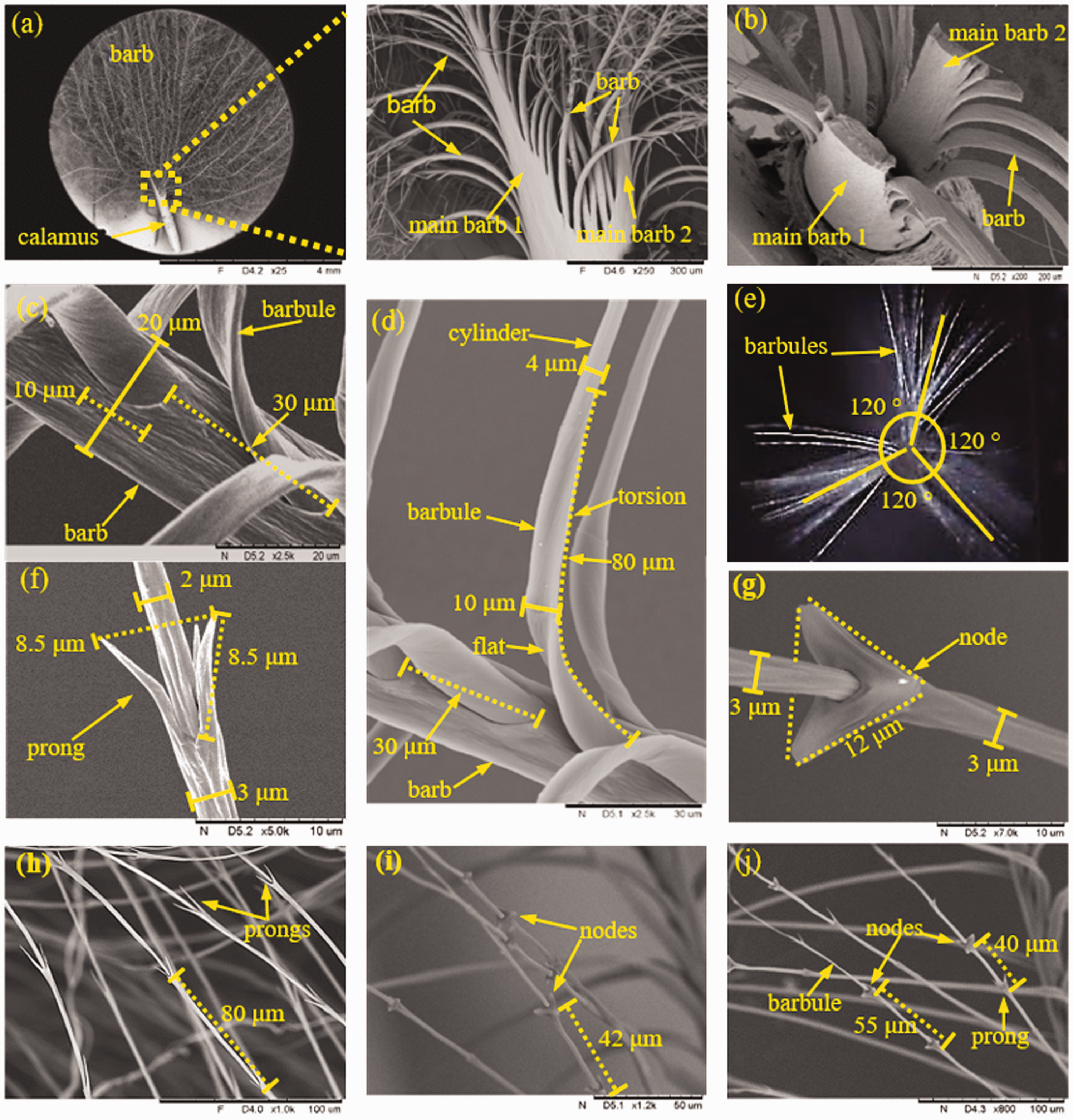
Hierarchical structure of down: (a) scanning electron microscopy (SEM) image of the whole down and enlarged image of the calamus; (b) SEM of the main barb; (c), (d) SEM image of a barb and barbule; (e) digital photograph of the barb and barbule; (f)–(j) SEM micrographs of the prongs and node.
For further understanding the self-similar structure of down, it was simplified as diagramed in Figure 2. We confirmed by many observations that one down had two main barbs. The first level (Figures 2(a) and (b)) shows that the two main barbs were symmetrically distributed on both sides of one end of the calamus, in which the bifurcation form was one split into two. As shown in Figure 2(c), many barbs were symmetrically distributed along the two sides of the main barb, which constituted the secondary structure. Figure 1(c) shows that three barbules were distributed in the range of about 10 μm that accounting for one-third of the 30 μm node spacing, which can be regarded as a basic unit consisted of three barbules. The barb and barbule formed a third-level structure in which the fork form was one split into three, as depicted in Figure 2(d). It can be seen from Figure 2(e) that the fourth-level structure consisted of a barbule and a node or prong. The three branches of the node or prong are distributed along the circumference of the same position of the barbule. Through the characterization of the down structure, it is found that it is similar to goose down structure.7,11 The multilevel bifurcation structure of down has self-similarity, which made it have fractal characteristics. The fractal dimension of goose down was calculated as 1.66 by the box dimension method. 11 It can be deduced from Figures 1 and 2 that the fractal dimension of down was also about 1.66, due to the similar morphology structure characteristics of down and goose down. 7

Schematic diagram of the four-level structure of down: (a), (b) first-level structure; (c) second-level structure; (d) third-level structure; (e) fourth-level structure.
The basic data of different units and structural characteristics of down are summarized in Table 1. The space grid was the smallest in the outer layer and the largest in the inner layer, that is, the number of fibers per unit volume in the outer layer was the most, and the number of fibers in the inner layer was the least. Therefore, the shape of down had a tree-like form. This was the basis for the down aggregates to have good elasticity and thermal insulation properties. According to the fractal structure, the conduction and dissipation probabilities of down tend to 0% and 100%, respectively. As a result, the thermal conductivity of the down assembly was low. 22 The results can be used to estimate the thermal conductivity and structural stability, and proved that the fractal structure was significantly different from the fractal structure that the team thought earlier, 23 and the self-similar structure of down became more complicated.
Structural characteristic data of down
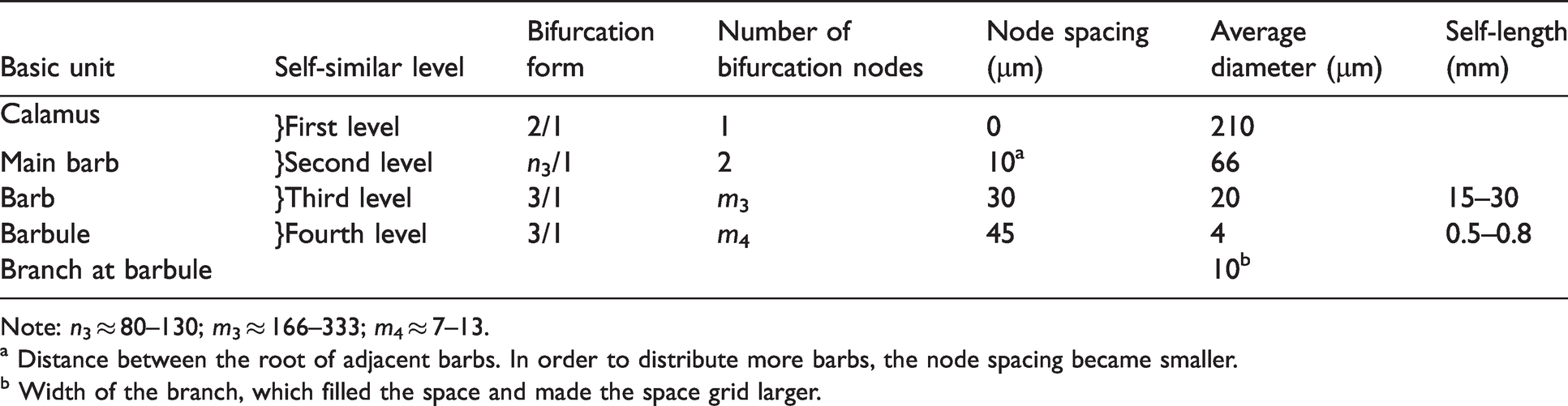
Note: n3 ≈ 80–130; m3 ≈ 166–333; m4 ≈ 7–13.
a Distance between the root of adjacent barbs. In order to distribute more barbs, the node spacing became smaller.
b Width of the branch, which filled the space and made the space grid larger.
Effects of water on the secondary structures
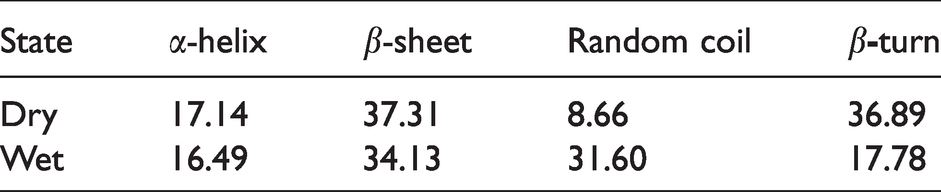
In order to explore the microstructure transformation of down, WAXD was performed to investigate the crystalline structures of down. The quantity of moisture absorption experiment of the dried down was conducted in an environment with a relative humidity of 100%, and the results are shown in Figure 3(a). The moisture regain of down was considered in the dry state to be 0–3% and in the wet state to be 14.7–17.7%. 24 It can be seen from Figure 3(a) that the moisture absorption speed of down changed from fast to slow with the increase of time. All downs for the wet test must be conditioned in the same environment. The WAXD spectra of down in the dry and wet states are shown in Figure 3(b). The diffraction peaks at 9.58° and 19.82° were attributed to the α-helix and the peaks at 19.02° and 21.24° were attributed to the β-sheet structure, while those of the β-turn and random coil domains were 2θ = 24.64° and 28.0°, respectively. 25 Figures 3(c) and (d) show the peak deconvolution results of down with regard to the secondary structures in the dry and wet states. The detailed data are shown in Table 2. The α-helix and β-sheets in the secondary structure are considered to constitute the crystalline regions arranged in the protein structure, and the β-turns and random coils constitute the amorphous regions. 26 The percentages of the sum of the α-helix and β-sheet in the dry and wet states were 54.45% and 50.62%, respectively, since due to the increase of adsorbed water, the disordered area expands and collapses the weakly ordered area. There was little change in the content of the α-helix and a slight decrease in one of the β-sheet structures during the moisture absorption process. The hydration process had little effect on the crystallization zone. 15 This indicated that water molecules entered into the amorphous region that made most of the β-turn structures transform into random coil structures.
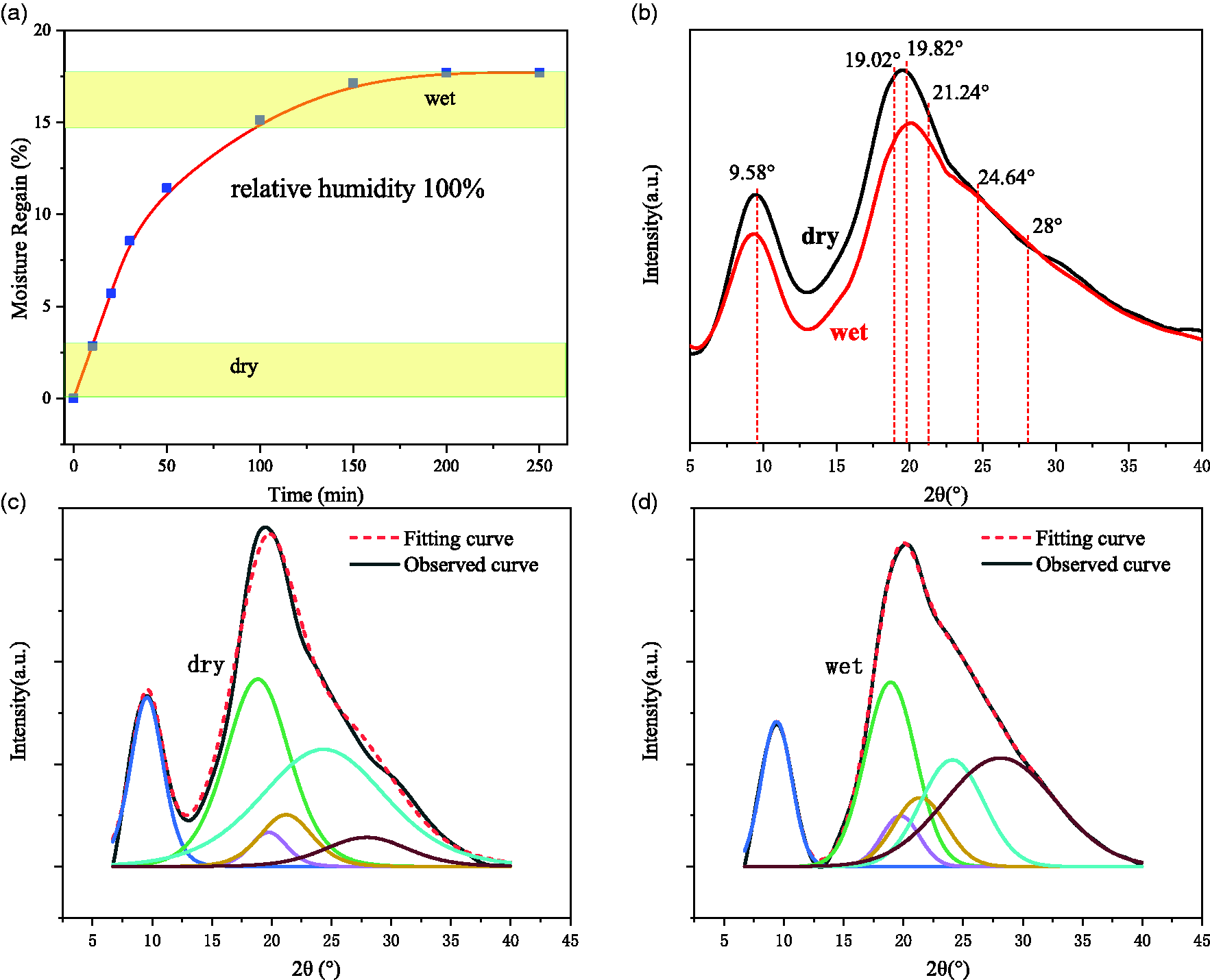
(a) Moisture regain as a function of time in down. (b) Wide-angle X-ray diffraction (WAXD) spectra of down. (c), (d) WAXD deconvolution results of down.
Contents of the secondary structure of down in the dry and wet states
Effects of water on friction properties
In order to explore the influence of barb morphology and water content for the friction properties, a schematic diagram of the friction performance of the barb in the dry and wet state is shown in Figure 4(a). Figure 4(b) shows the relationship between force and time of the barb during the friction test. The friction force of the barb in the dry state was less than that in the wet state. In both states, the friction force of positive friction of the barb is less than the one of reverse friction. Corresponding to the curve of Figure 4(b), when the barb underwent positive friction (μbt) from the dry to wet states, the static and dynamic friction coefficients increased from 0.25 to 0.41 and 0.22 to 0.39, respectively. For the reverse friction (μbr), the static and dynamic friction coefficients were higher than that of positive friction, as shown in Figure 4(c), indicating that down has a differential friction effect. The water entered the amorphous region, which was consistent with the results of WAXD, so that the down fiber swelled and the diameter increased. According to the experimental result, the diameter of the barb in the wet state increased by about 18.35%, as shown in Figure 4(d). Under the same pretension force, the contact area between the fiber and the metal roller became larger in the wet state, so the friction coefficient became larger. Due to the directionality of the distribution of the barbules (Figure 4(e)) and the node or prong (Figure 1(j)), the difference between μbt and μbr of the barb fibers increased. For the wet state, the water molecules entered the amorphous matrix of the down fibers, which weakened the crosslinking between molecular chains27,28 and made the barb thicker; the difference between the reverse friction and positive friction obviously decreased. These results demonstrated that the multilevel bifurcation structure filled the space and made the space grid larger.

Friction properties of the barb of down: (a) illustration of the barb friction test; (b) force–time curves for the dry and wet states, μbrW, μbtW: wet state, μbrD, μbtD: dry state; (c) coefficients of static (μS) and dynamic (μD) friction at the dry and wet states; (d) the average expansion of the barb diameter in the wet state and inset showing a schematic diagram of the measurement position; (e) scanning electron microscopy image of the barb.
The differential friction effect (δμ) of down was calculated by the ratchet action of the barbules of the barb: μbt was smaller than μbr. The expression of δμ
29
is as follows

According to formula (3), the δμ of the static and dynamic friction coefficients between the barb and metal roller were 0.24 and 0.23 in the wet state and 0.46 and 0.40 in the dry state, respectively, as shown in Table 3. The δμ of the static and dynamic friction coefficients of the barb in the wet state were reduced by 47.83% and 42.50%, respectively. When the down fibers became wet, due to the effect of moisture and the increase of diameter, the contact area of the fibers accordingly increased. Therefore, the frictional force of the barb became larger and the difference between the positive and reverse friction coefficients became smaller. For example, the differences (Δ) between the positive and reverse friction coefficients of μS, μD in the wet state were 0.11 and 0.10, respectively. When rubbed in the dry state, the differences (Δ) were 0.15 and 0.11, respectively. The difference (Δ) of positive and reverse friction coefficients and the reduction of the δμ can make the down fibers easier to loosen and unfold in the wet state. The differential friction effect of the barb in the dry state was greater than that in the wet state. The fractal characteristics and directionality of the barbule and the node or prong made the positive friction coefficient of the barb smaller than the reverse friction coefficient.
Differential friction effect and friction analysis

δμW: differential friction effect in the wet state; δμD: differential friction effect in the dry state; SD: standard deviation; Δ = μS – μD.
Effects of water on shape memory properties
For the relationship between water and the shape memory effect of down, we first conducted a study on the shape change of a single barb fiber under water stimulation, as shown in Figure 5. The down with self-similarity characteristics was inevitably compressed and rubbed during packaging and transportation (Figure 5(a)). When immersed in water, the arrangement of the barbules quickly became regular (Figure 5(b)). The barbules also maintained the original orderly arrangement after drying (Figure 5(c)). The results show that due to the synergy effect of hygroscopic expansion, vibration, and zero gravity of the barb in water, the self-similar structure of the barb can quickly return to the best condition. Compared with the rubbed barb (Figure 5(d)), the barbules were still arranged in disorder (Figure 5(e)) at room temperature for a period of time without the stimulus of water, even if the barb experienced slight shaking (Figure 5(f)), indicating the fractal structure, namely the barbule, node, and prong, constituted a self-locking structure and was difficult to unfold. Therefore, the shape of the rubbed barb had no obvious change in the arrangement of the barbule without water.

Shape memory of barbules in water and the dry state, respectively: (a) original state; (b) in water; (c) after drying; (d) original state; (e) in the dry state; (f) after slight shaking.
Further, the correlation between water and shape memory of the single down were investigated, as shown in Figure 6. The single down was wrapped around the metal rod and became a helix shape after the dry-heat or moisture-heat setting process, as shown in Figure 6. The water molecules entered the amorphous area and broke the crosslinking of the molecular chains due to water acting as a plasticizer. 30 When the down was dry, the water molecules overcame the resistance between molecules and created new crosslinking. The hydrogen bond network functions as a locking mechanism to ensure the fixity of the deformed shape. As a result, the helix shape was fixed. However, for the dry-heat setting, the helix shape was not obvious due to the lack of crosslinking reconstruction. Figures 6(c) and (g) show that the spiral down after slight wiggling at room temperature still kept its spiral structure; however, the helix height became large. Even though there was a slight swing, it was difficult for the fibers to expand, straighten, and return to the original state.

Shape memory of down: (a) the original down; (b) down after dry-heat setting (100 °C) and insert plot showing the down was wrapped; (c) down after slight wiggling; (d) down placed in water and dried; (e) the original down; (f) down after moisture-heat setting (100 °C, relative humidity 100%) and insert plot showing the down was wrapped; (g) down after slight wiggling; (h) down placed in water and dried. (ID): wrapped and dry-heat setting; (IW): wrapped and moisture-heat setting; (II) slight wiggle at ambient temperature; (III) down was put into water and dried.
For comparison, the spiral down became fluffy in shape when immersed in water, as shown in Figures 6(d) and (h). The results showed that the water molecules plays an important role in the shape memory process of proteins. 19 The water molecules first entered the amorphous area and broke and rebuilt the transverse crosslinking, which was consistent with the WAXD analysis. Hydrogen bonds in the amorphous region play a key role in the performance of the materials. 12 Under the action of aqueous molecules, hydrogen bonds in polymers could reversibly break and rebuild.31,32 So, there will be a transition phenomenon of temporary shape and permanent shrinkage on the macroscopic scale. 33 Here, water is used as a stimulus to facilitate fiber recovery to the original shape. 34 At the same time, the increase of the diameter was ascribed to the down absorbing the water molecules and swelling. The helical down was almost weightless and had a gravity-free natural state under the repulsion of water. Therefore, the spiral down stretched to the original natural state with the effect of vibration, internal stress, and the swelling stretching of the down fibers in water. The differential friction effect and self-locking structure between the fibers were weakened, so the separation between the fibers could be carried out quickly. Therefore, the shape memory in the dry state was more difficult than that in the water state.
Down was in a weightless state in water, and vibration caused by the water current and stretching effect of internal stress of the down fibers made the down have good shape memory. In order to further verify the shape memory mechanism of down, we conducted a severe shaking experiment by grasping the calamus of the spiral down, as shown in Figure 7. Figure 7(a) shows when the down was subjected to heat setting, the spiral shape of the down disappeared and it returned to a natural fluffy shape (Figure 7(b)) after violent and rapid swinging. When the spiral down fiercely swung in the air, the down was almost weightless, the vibration frequency and the collision probability between the down fibers increased due to airflow, and the internal stress of restoring the original configuration made the spiral down quickly return to its original state. This further verified the importance of weightlessness, vibration, and internal stress of down fiber in shape memory performance.
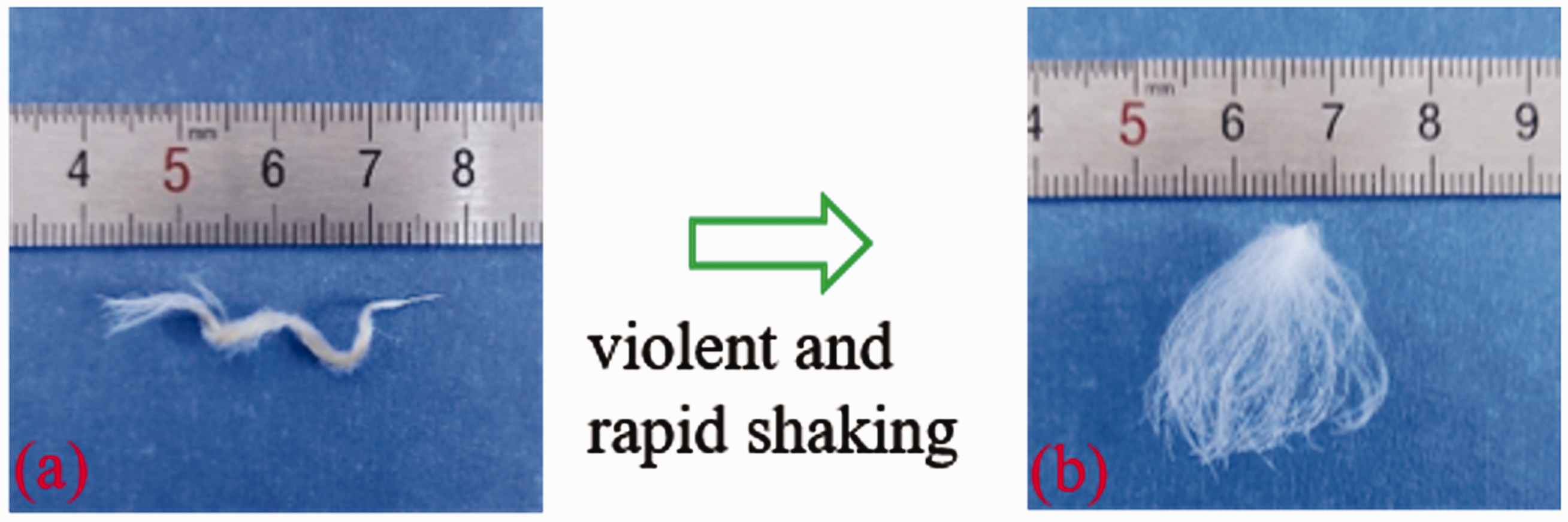
Shape memory property of down after shaking: (a) down after heat setting; (b) down after violent and rapid shaking.
Conclusions
The morphology structure of down was characterized by SEM; down can be considered as a four-level self-similar fractal structure composed of five basic units: the calamus, main barb, barb, barbule, and node or prong. For the first time, we found that there are two main barbs symmetrically distributed on the calamus and we can further understand why there are so many barbs in a limited space. The barbs have a differential friction effect due to the directionality of the barbules and the prong or node. The differential friction effect of the static and dynamic friction coefficients of barbs in the wet state were reduced by 47.83% and 42.50%, respectively. The self-locking between the fiber contact caused by plastic deformation and internal stress made it difficult for down to restore to its original state by itself. The barb and spiral down could more quickly recover its natural state in the wet state. Water entered the amorphous region, which was illustrated by WAXD. The decrease of the differential friction effect and disappearance of the lock-up effect of down fibers made the spiral down rapidly return to the original natural state, due to the increase of diameter and the repulsion of water. Water could accelerate the shape memory due to role of zero gravity, vibration, and internal stress. This mechanism of shape memory was further confirmed by vigorously shaking the spiral down to restore its natural state. How to quickly and effectively restore the bulkiness of down during down processing is very important. Through the study of down fractal structure and shape memory, this study further clarified the microscopic morphology, which provides a basis for the processing technology of down.
Footnotes
Declaration of conflicting interests
The authors declared no potential conflicts of interest with respect to the research, authorship and/or publication of this article.
Funding
The authors disclosed receipt of the following financial support for the research, authorship, and/or publication of this article: This work was supported by the National Key R&D Program of China (2016YFC0802802).
