



Abstract
Durable and formaldehyde-free flame-retardant (FR) modification of wool fabric using phosphorous compounds is of great interest. In this study, Schiff base imine groups were firstly introduced onto wool fiber through aldehyde-amine condensation between p-hydroxybenzaldehyde and wool fiber. Then, an efficient and durable FR wool fabric was fabricated by incorporating diethyl phosphite (DEP) into a Schiff base intermediate via the Pudovik reaction. The potential reaction mechanism among p-hydroxybenzaldehyde, DEP and wool fiber was explored. The thermal stability, smoke generation ability, FR ability and washing durability of the modified wool fabric were studied. The FR modification significantly increased the thermal resistance of wool fabric and suppressed smoke generation by half. The wool fabric modified by 20 g/L DEP was able to self-extinguish during the burning test, suggesting the higher FR efficiency of the DEP-incorporated Schiff base system. The modified wool fabric still self-extinguished after 20 commercial launderings, which is attributed to the covalent grafting of DEP onto wool fiber. Char residue analyses revealed the condensed charring FR mechanism of the DEP-incorporated Schiff base system on wool. This work provides a novel approach to prepare efficient and durable FR functional wool fabric via the Schiff base reaction and Pudovik reaction among p-hydroxybenzaldehyde, DEP and wool fiber.
Wool fiber is a popular and upscale textile material owing to its attractive performance in terms of good wearing comfort, good moisture absorption, good breathability and low hypersensitivity. Wool fibers are widely used in clothing and interior textiles, such as curtains and sofa coverings, airplane carpets and blankets. In addition, wool fibers possess better flame resistance than cellulose fibers due to higher nitrogen, sulfur and moisture content. However, wool fibers still fail to meet strict regulations for flame-retardant (FR) textiles.1,2 Thus, the development of high-performance functional wool textiles is of interest.
Recently, the demand for durable FR wool textiles has been increasing. However, only a limited number of functional methods are available on the market. Many efficient halogenated compounds have been banned by regulations or voluntarily boycotted by manufacturers because of their persistent, bio-accumulative, toxic and transportable properties.3 The zirpro approach (titanium and zirconium complexes) is still the main FR technique for wool textiles thanks to its flexible procedure and good washing resistance.4,5 However, this finishing process has the potential to release heavy metal ions into wastewater systems, and this should be realized and admitted.5
Phosphorus-based FR agents have attracted much interest as efficient FR approaches for textiles and other polymeric materials after the toxicity of some halogen-based FR agents was recognized. There are two main FR mechanisms of phosphorus-based FR agents. One is the gas phase mechanism, that is, trapping radicals propagating the combustion in the flame, and the other is the condensation camera system, that is, stimulating the phosphorylation of textiles and catalyzing the formation of a protective carbon layer.6 Phosphorus (P)/nitrogen (N) synergism also represents a common strategy to further enhance the FR efficiency of phosphorus.7 Commercially developed FR methods, such as Proban/ammonia and Pyrovatex CP for cellulose textiles, also showed high FR efficiency for wool textiles.8,9 However, such applications involve complex deposition of FR compounds at a large amount, causing an adverse influence on the physical performance of textiles; the gradual release of formaldehyde may also occur in service life,6,10 which should be actively avoided.
Despite great efforts, durable FR modification of wool textiles still has great challenges. Under the trend of ecological environment protection, low environmental impacts and green chemistry are growing, guiding the development of FR approaches. However, there are limited reports on biobased FR modifications for wool textiles.11 A promising method to endow wool textiles with durable flame retardancy involves the covalent bonding of phosphorus onto wool fiber. This is beneficial to increase char formation of wool during burning, and thus decreases the amount of combustible gases in the flame zone and reduces heat transfer from the flame zone to the inner substrate. Diethyl phosphite (DEP) is of interest to serve as a phosphorus-containing compound due to its outstanding FR ability and high reactivity. The reactive P-H bond can chemically combine with electron-deficient agents containing imine, phosphazene, triazine or triazine-trione units, and thus produce P/N-containing derivatives as effective FR systems for polymers.12–15
Based on these points, the present study aims to develop efficient and durable FR wool textiles by using phosphorus-containing DEP. For this purpose, Schiff base imine C=N groups were introduced onto the wool macromolecular skeleton via aldehyde-amine condensation between p-hydroxybenzaldehyde and wool fiber. Then, phosphorus group were introduced onto wool fiber through the addition of DEP to a Schiff base intermediate, namely the Pudovik reaction.16,17 On one hand, the introduction of phosphorus groups onto Schiff bases is supposed to take advantage of the P/N synergistic FR effect. It is beneficial to impart enhanced FR to wool by catalyzing carbonization to generate a thermally resistant char. On the other hand, the combination of DEP as the main FR agent, p-hydroxybenzaldehyde as the coupling agent for DEP and wool fiber via stable covalent bonds is of great importance for achieving durable FR functional modification of wool textiles.
In the present study, the possible reaction mechanism between FR agents and wool fiber was explored. The thermal stability, smoke inhibition ability, FR ability and washing durability of the modified wool fabric were investigated. The FR mechanism of the modified wool fabric was studied by analyzing the morphological and chemical structure and elemental content of wool char residues.
Experimental details
Materials
Woven wool fabric (warp and weft count, 156 dtex × 2; warp density, 21 threads/cm, and weft density, 18 threads/cm; weight per unit area, 125 g/m2) was supplied by Shanghai Textile Industry Institute of Technical Supervision, China. p-Hydroxybenzaldehyde and DEP were supplied by Sinopharm Chemical Reagent Co. Ltd, China. Ethanol was supplied by Jiangsu Chinasun Specialty Products Co. Ltd, China. Wool detergent was supplied by Shanghai Zhengzhang Laundering and Dyeing Co. Ltd, China.
Fabrication of functional wool
The functional modification of wool textiles was conducted on a dyeing and finishing machine with a liquid ratio (weight ratio of fabric to finishing solution) of 1:50. p-Hydroxybenzaldehyde and DEP were dissolved in ethanol with a mass ratio of 1:1, and then diluted using distilled water to prepare the finishing solution. The wool fabrics were immersed in the p-hydroxybenzaldehyde solutions, then heated to 90°C for 60 min, and then placed into DEP solutions at the same temperature for 60 min. Finally, the modified wool fabrics were rinsed thoroughly and air-dried. Series concentrations of DEP (0–150 g/L) were applied to wool fabric with a molecular ratio of 1.5:1 to p-hydroxybenzaldehyde. The Schiff base reaction and Pudovik reaction took place among wool fibers, p-hydroxybenzaldehyde and DEP, respectively, as displayed in Figure 1. The weight gain of wool samples was determined according to the weight difference of the samples before and after FR modification. Specifically, the wool samples modified using about 50 and 100 g/L DEP were denoted as Wool-1 and Wool-2, respectively.
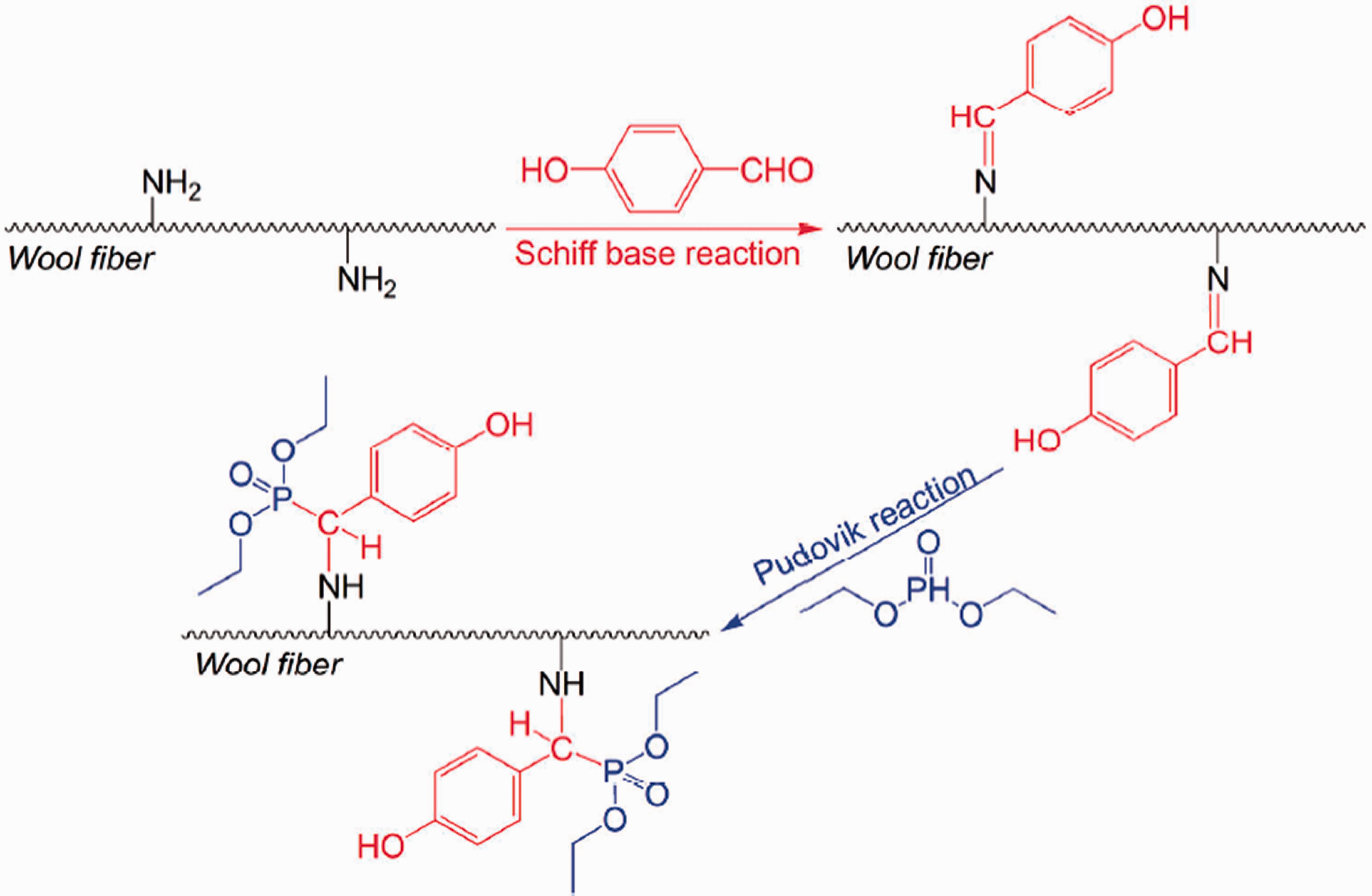
Reaction mechanisms among wool fiber, p-hydroxybenzaldehyde and diethyl phosphite.
Characterizations
An attenuated total reflection Fourier transform infrared spectroscopy (ATR-FTIR) test was performed on a Nicolet iS50 FT-IR spectrophotometer (Thermo Fisher Scientific Inc., USA). The morphology graphics and element content were tested on an Hitachi TM3030 scanning electron microscope (SEM) (Hitachi High-Technologies Co., Japan). The limiting oxygen index (LOI) value was determined according to GB/T 5454-1997 with a specimen of 150 mm × 58 mm, on an FTT0080 oxygen index machine (Fire Testing Technology Ltd, UK). A vertical burning test was performed using a YG815B automatic machine (Ningbo Textile Instrument Factory, China) according to GB/T 5455-2014 by applying a methane flame (the flame height was 40 mm) for 12 s on the lower edge of the wool specimen (300 mm × 89 mm); the combustion performance was classified according to GB/T 17591-2006, as follows. (1) B1 classification: char length ≤15 cm; after-flame time ≤5 s; after-glow time ≤5 s. (2) B2 classification: char length ≤20 cm; after-flame time ≤15 s. after-glow time ≤15 s. A thermogravimetry (TG) test was conducted on a Diamond TG/DTA SII thermal analyzer (Perkin-Elmer, USA) at a heating rate of 10°C/min; each sample was controlled to 4–5 mg in primary weight. The smoke release action was evaluated using an FTT0064 NBS smoke density chamber (Fire Testing Technology Ltd, UK) according to ISO 5659.2; each sample with dimensions of 75 mm × 75 mm (two sample layers) was exposed horizontally to an external heat flux of 25 kW/m2 in the flameless combustion mode. Prior to the flammability tests, the samples were conditioned in a standard atmospheric environment (65 ± 5% relative humidity and 20 ± 1°C) for 24 h. The laundering procedure was carried out according to AATCC-61-2013 in a WashTec-P fastness faster (Roaches International, UK).
Results and discussion
ATR-FTIR and SEM analyses
In the ATR-FTIR spectra of wool fiber (Figure 2), the peaks at 1629 and 1512 cm−1 correspond to the characteristic peaks of amide I (C=O stretching) and amide II (N-H bending and C-N stretching), respectively.18 The modified wool samples displayed the changed spectrum versus the unmodified one. For the spectrum of the wool sample modified by p-hydroxybenzaldehyde (Wool-2 without DEP), the new peak that appeared at around 1600 cm−1 is ascribed to the absorption of Schiff imine (C=N) groups19; the peak at 1283 cm−1 corresponds to the stretching vibration of the aromatic C-O groups;20 and the peaks at 1214 and 1155 cm−1 are assigned to C-CHO stretching vibration.21 For the spectra of Wool-1 and Wool-2, the peak at 1600 cm−1 for C=N groups showed lower absorption intensity due to the conversion into C-N groups after the Pudovik reaction. The new peaks at 1047, 994 and 930 cm−1 are ascribed to the stretching vibration of P-O-C, P-O and P-C groups.22,23 The above results indicate the formation of a Schiff base intermediate between aldehyde groups between p-hydroxybenzaldehyde and amino groups of wool fiber, and the covalent grafting of DEP onto wool fiber via the Pudovik reaction (Figure 1).

Attenuated total reflection Fourier transform infrared spectroscopy spectra of the modified wool fibers. DEP: diethyl phosphite.
SEM and energy-dispersive X-ray spectroscopy (EDS) were used to determine the surface morphology and elemental distribution of the modified wool fibers. As shown in Figure 3, after FR modification, the wool fiber surface displayed moderate and homogeneous deposition of FR compounds, while the original wool fiber had a clean surface. The Wool-2 surface showed increased compound depositions compared with the Wool-1 sample, corresponding to the higher weight gain of Wool-2. Besides, the P element was found to be dispersed on the wool fiber in the corresponding EDS maps (Figure 4). Overall, the FR agents were generally deposited on the fiber surface after washing, and the fiber gaps were well preserved. Correspondingly, the fabric handle underwent a slight change after the FR modification.

Scanning electron microscope images of the modified wool fibers.
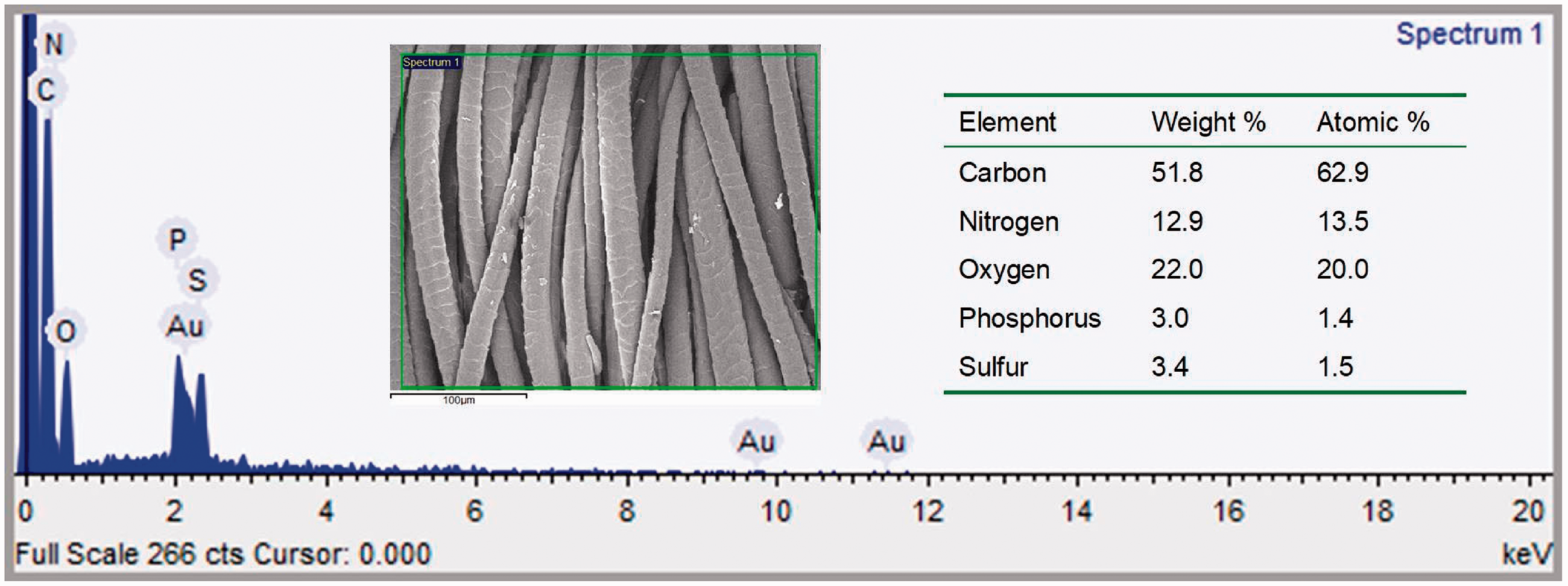
Energy-dispersive X-ray spectroscopy spectra of the modified wool fibers (Wool-2 as an example).
TG analysis
The thermal stabilities of the modified wool fabrics were studied using thermogravimetric analysis (TGA) under nitrogen and air (Figure 5). The high moisture content (10–14%) contributes to a certain level of flame resistance ability of wool fiber, but may exert an unpredictable influence on the analysis of thermal degradation. Thus, the TG curves were normalized based on the residual weight after water removal. The thermal degradation data are collected in Table 1, including the T5%, Tmax1 and Tmax2 values (temperature at 5%, the first and second maximum weight loss, respectively) and char residue at 700°C. One degradation step was observed for wool fiber under nitrogen, and two degradation steps were found under air. The main weight loss mainly comes from the decomposition of the peptide chain and production of combustible gases.24 A second degradation process involving the further oxidation of remaining residues occurred under air atmosphere, and this step was not found under nitrogen atmosphere. After FR modification, the wool samples showed the anticipated degradation during the initial decomposition process, as demonstrated by the lowered T5% value. However, the modified wool samples showed lower weight loss and enhanced thermal resistance in the following decomposition process. As a result, the modified wool samples possessed more char residue than the original one at 700°C. Besides, the Tmax1 and Tmax2 values of the modified wool samples decreased compared with the original wool, indicating that the degradation pathway of wool changed after the FR modification.
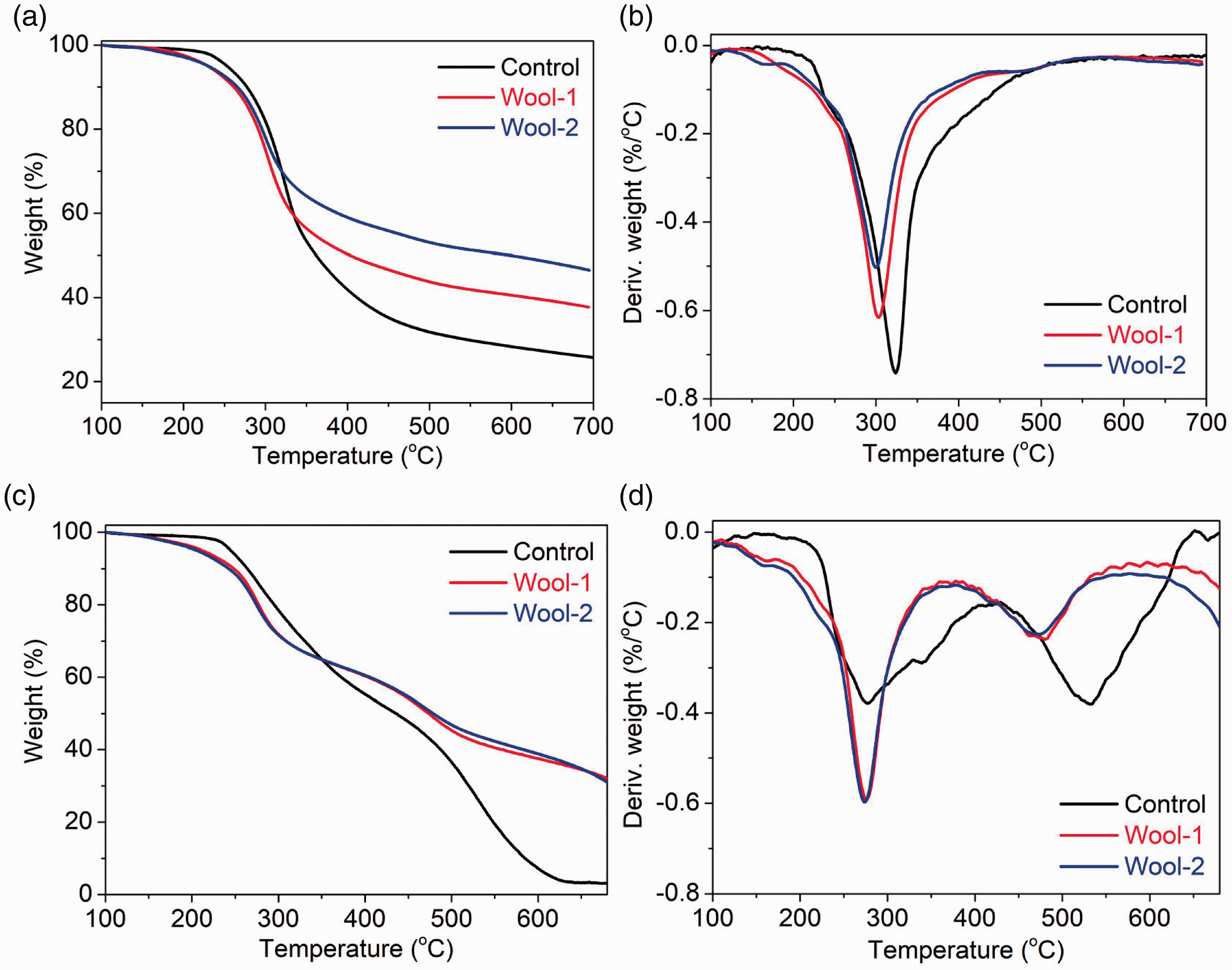
Thermogravimetry curves of the modified wool under nitrogen (a), (b) and air (c), (d).
Thermogravimetry data of the modified wool

Such thermal decomposition behavior could be attributed to the basic chemical reaction in which the earlier decomposition of phosphonate groups leads to the generation of P-rich and thermally stable char, which accumulated on the surface of the wool substrate. This thermally stable char was beneficial to serve as an insulating layer to prevent heat reaching the underlying substrate and imparting enhanced thermal and flame resistance to wool. According to relevant literature studies, the C=N amine structures could also contribute to the improved thermal stability and char yield of materials.15 As confirmed here (Table 1), the increased char residue amount of wool is also conducive to reduce the production of flammable species upon degradation.
Smoke generation analysis
Figure 6 shows the specific optical density (Ds) curves and the related data of wool samples. Smoke formed in fire limits the visibility and can cause hypoxia, while the carbon monoxide in smoke can lead to coma.25 The unmodified wool sample showed the highest smoke release in the test with a high maximum Ds (Dsmax) value of 96.3, suggesting a high potential of fire risk. After FR modification, the Dsmax value of the wool sample showed a significant reduction, suggesting the inhibition of smoke production. More specifically, the Dsmax values of Wool-1 and Wool-2 displayed reductions of 37.9% and 50.4%, respectively, after FR modification. The excellent smoke inhibition capacity of the modified wool was assigned to the introduced DEP, which could promote the formation of thermally resistant carbonaceous species, rather than the formation of smoke particles.
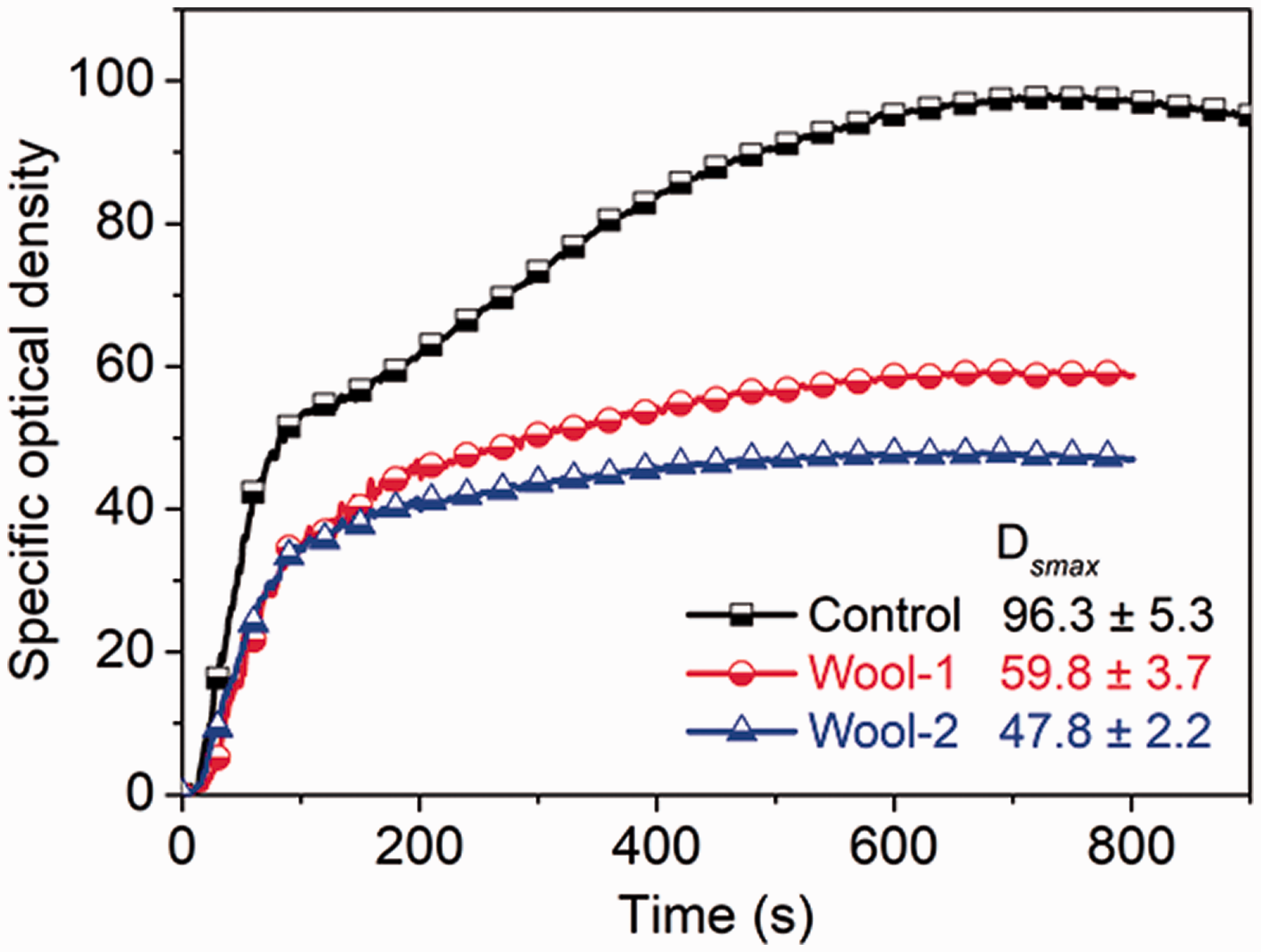
Ds curves of the modified wool samples.
Flammability and washing duraility
The unmodified wool fabric burned vigorously and completely within 12 s without after-flame or after-glow phenomena. At the same time, the corresponding char length reached a maximum value of 30 cm. These experimental phenomena showed the poor flame retardancy of unmodified wool fabric. The burning behavior of modified wool was completely different from that of the original wool (Figure 7(a)). The wool fabric modified by 20 g/L DEP displayed self-extinguishing ability, possessed a low char length of about 10.0 cm and achieved B1 classification. The flame source could not reignite the wool specimen because of the protective action of the formed bubbling char. Compared with the 23.5% LOI of the unmodified wool, the LOI of the modified wool fabric increased to 28.6%.

Photos of the modified wool after the vertical burning test (a), weight gain and FR performance of the modified wool at various diethyl phosphite (DEP) concentrations (b) and char length at various washing cycles (c). LOI: limiting oxygen index.
By further enhancing the DEP concentration, the LOI value of the modified wool fabrics increased accordingly with weight gain, and the char length also showed a decreasing trend (Figure 7(b)), suggesting the enhanced FR ability of the modified wool fabrics. In addition, after 20 commercial washings, the modified wool sample (Wool-2) displayed self-extinguishing ability during the vertical burning test, displayed a low char length of 12.6 cm (Figure 7(c)) and achieved B1 classification. The modified wool showed good laundering resistance, which is ascribed to the Schiff base reaction and Pudovik reaction among the wool fiber, p-hydroxybenzaldehyde and DEP (Figure 1).
Char residue analyses
Figure 8 shows SEM micro-graphs of wool char residues obtained after the vertical burning test. As discussed above, the unmodified wool sample burned vigorously during the burning test and there remained several globular residues with brittle and flimsy characteristics, displaying poor char formation ability. For comparison, the charred area of the modified wool fabrics had severe shrinkage, but the original fiber shape and textile wave structure were still relatively complete, which showed the high flame resistance of the modified wool fabrics. In addition, intumescent fibrous structures and dense char were also found on the wool char residue, which corresponds to the classic burning behavior of the intumescent FR mechanism.
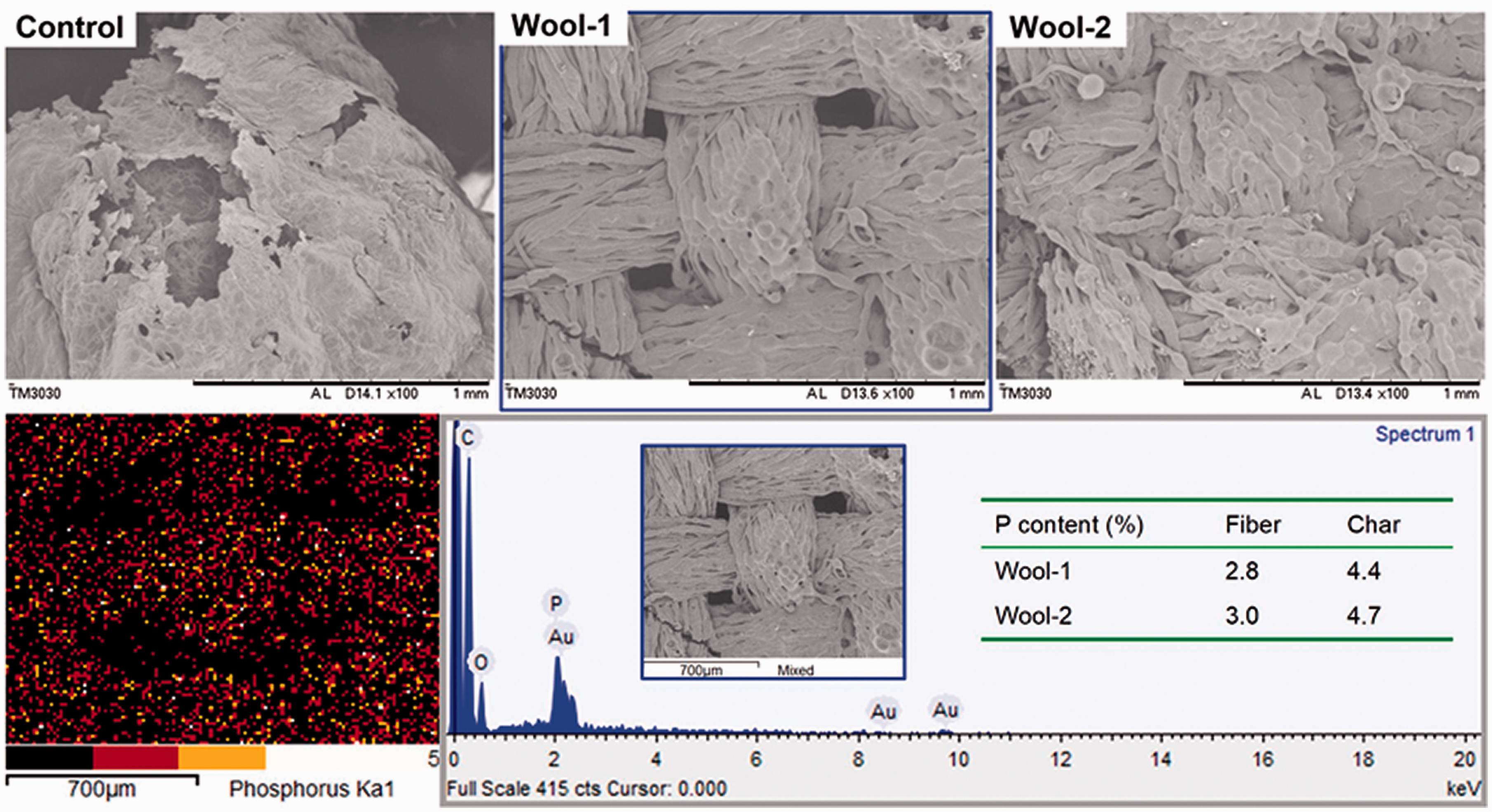
Scanning electron microscope images and energy-dispersive X-ray spectroscopy analysis of wool char residues.
The char residues were also characterized by ATR-FTIR (Figure 9). The burned wool showed a different spectrum than the pristine one. Most of the featured peaks disappeared after combustion due to thermal cracking of the peptide chain and the generation of various volatile species. The spectrum peaks of burned wool at 1578 and 1152 cm−1 are ascribed to the absorption of C=C, C-N and C-O groups, suggesting the formation of polyaromatic species during burning.26,27 In the spectrum of burned Wool-1 and Wool-2, the peak at 1152 cm−1 showed increased intensity, demonstrating the promoted char formation ability; the new peaks at 1077, 973 and 890 cm−1 correspond to the P-O and P-O-C structures.22,23 The elemental analysis by EDS (Figure 8) also confirmed that the char residues had higher P content versus the modified wool fabrics, and the modified wool chars showed the phosphorus-rich characteristic.
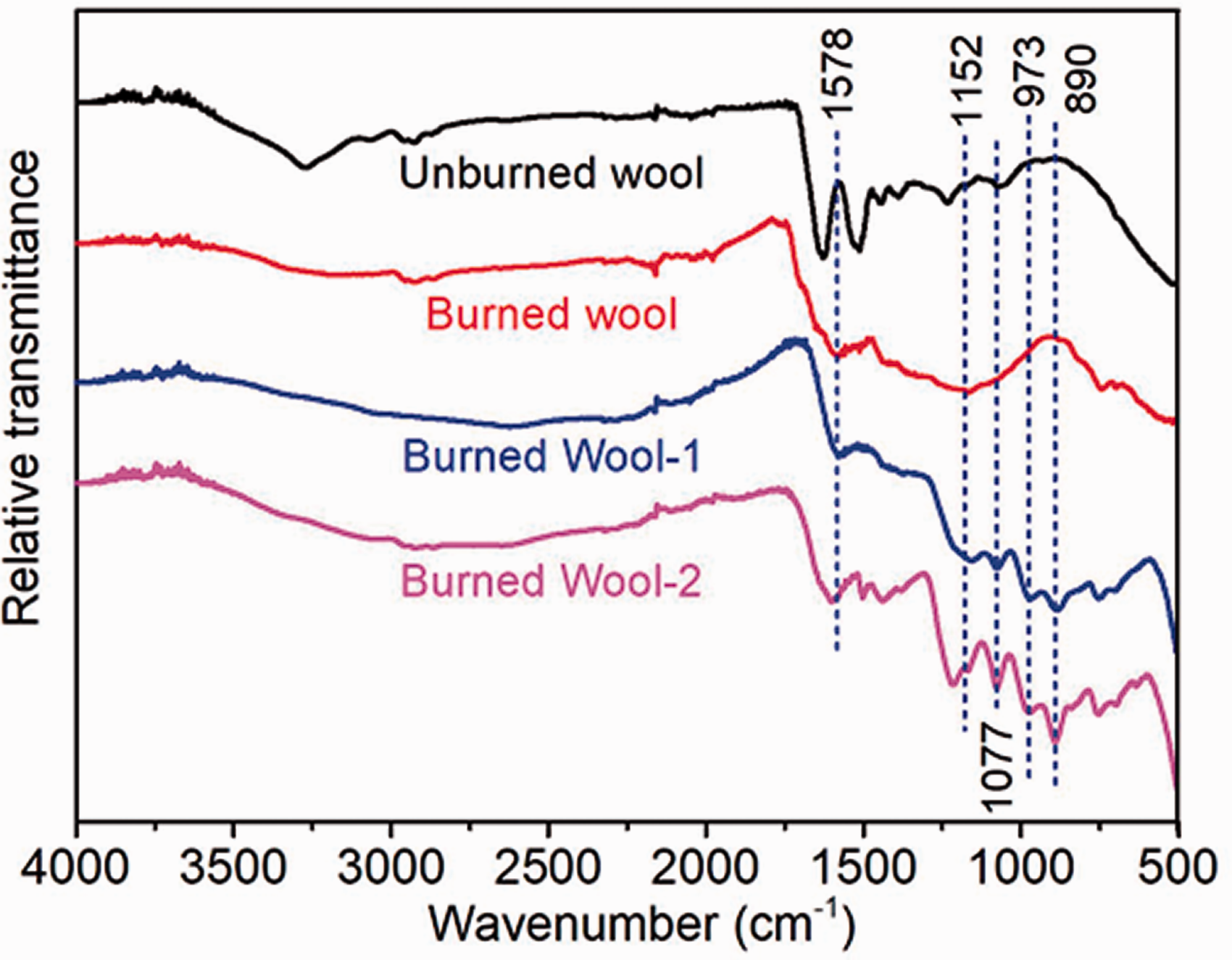
Attenuated total reflection Fourier transform infrared spectroscopy spectra of the modified wool chars.
These above results suggested that Schiff base structures modified by DEP could function via the condensed phase by catalyzing the generation of intumescent and phosphorus-rich char. The formed char served as a protective barrier to retard the transfer of heat, oxygen and combustible volatiles, protecting the underlying substrates from further burning. Thus, the modified wool samples had good flame resistance and a well-reserved textile structure after burning, corresponding to the self-extinguishing ability of the modified wool samples. We conclude that the reported FR system functioned with a condensed charring mechanism.
Conclusions
In this work, a FR wool textile was developed by grafting phosphorus-containing DEP onto wool fiber through the Schiff base and Pudovik reactions with p-hydroxybenzaldehyde as the coupling agent. The DEP jointed Schiff base system showed high FR efficiency on wool fabrics. The modified wool fabrics had an increased LOI of over 28.6% and showed an increasing trend with higher DEP concentration. The modified wool also showed self-extinguishing ability due to the shielding effect of the generated intumescent char. The modified wool samples also had significantly reduced smoke generation. TG analyses suggested the obviously increased thermal resistance and char yield. The modified wool had desirable washing resistance, as indicated by the self-extinguishing effect after 20 washings. This should be ascribed to the covalent bonding of phosphonate groups onto wool fiber through Schiff base and Pudovik reactions. Char residue analyses concerning morphology and chemical structure confirmed the positive impact on the formation of protective and intumescent char by introducing DEP, which is responsible for the improved flame retardancy. The present study offers a novel and promising way to prepare durable FR wool textiles by covalent bonding of phosphonate groups onto wool fiber.
Footnotes
Declaration of conflicting interests
The author(s) declared no potential conflicts of interest with respect to the research, authorship, and/or publication of this article.
Funding
The author(s) disclosed receipt of the following financial support for the research, authorship and/or publication of this article: This work was supported by the Natural Science Foundation of Jiangsu Province (BK20200868) and the Natural Science Fund for Universities and Colleges in Jiangsu Province (20KJB540002).
