



Abstract
The ability of a fabric to wick moisture away from the human body directly determines the moisture management ability of any given textile, and thereby has a great influence on the comfort offered by garments made from that textile. In this paper, the effects of tensile extension and liquid drop height on the transverse wicking behavior of a warp stretch woven fabric were systematically investigated. By virtue of the unique structure of the nylon/spandex air-covered warp yarn, the woven fabric has a denser and tighter surface, which facilitates its warp elastic stretchability beyond 60%. Furthermore, an acceptable cyclic tensile behavior at an extension of 30% was obtained, indicating the superior mechanical robustness of the fabric to a certain extent. The experimental results demonstrated that the transverse wicking performances of the fabric, including the wetting time and liquid spreading area, were dependent on the tensile extensions and the heights between the water droplet and the fabric surface. Specifically, the wetting time increased with an increase of tensile extension or a decrease of liquid drop height. The spreading area of the water droplet increases as a function of the wicking time, and it fits a power relation appropriately. In addition, the water vapor transmission behavior of our fabric during stretch was clarified. Such work is essential to get an in-depth evaluation of the wicking behavior of complex stretchable fabric structures.
Keywords
The wicking behavior of a textile fabric is viewed as an important factor in determining its physiological and ‘wear’ comfort performances, and by dint of this its application.1,2 Elastic fabric structures give excellent elongation and elastic recovery; they are widely used in tight-fitting stretch fabric products but also increasingly in the flexible composites, tissue engineering, protective equipment and smart sensor textile fields.3–6 In particular, the transverse wicking is the transmission of liquid through the thickness of a fabric, and is linked (importantly) to the mechanism of removing liquid perspiration from the skin and into the fabric, where it can be evaporated to provide a cooling effect or held to provide heat. As a result, an insight into the transverse wicking behavior, including elastic fabric structures, is considered important in the design and essential in further application.
The comfort behavior of any clothing largely affects the final performance of the wearer. The fabric characteristics that influence comfort include moisture management, thermal behavior, surface characteristics, etc. Among them, moisture management plays an important role in deciding the final comfort behavior of textiles. The mutual interaction between liquid and a fabric depends on the hydrophilicity or hydrophobicity of the constituent fibers, the surface geometry characteristics of the yarn/fabric assembly, the volume (or droplet size) and character of the liquids and some external factors (e.g., the tension applied to a fabric, environmental conditions).1,2,7–12 Recent advances in work with respect to the transverse wicking behavior of textile fabrics are as follows. For example, a cyclic stress instrument was developed by Raja et al., 12 and the effect of parameters (e.g., extension rate, cyclic extension percentage and liquid flow rate) on the transverse wicking behavior of cotton/Lycra knitted fabric was studied. A simple fabric wicking test system was constructed by Baby et al., 13 retrofitted with an embroidery hoop and two USB video microscopes, and the wicking behavior of drops of porcine blood in various volumes on cotton knit fabrics was investigated. Raja et al. 14 designed a dynamic sweat transfer tester, which can be used to measure the liquid spreading on textile fabrics. It was found that the liquid spreading ratio of bamboo/cotton blended yarn knit fabrics was dependent on the blend ratio and count of their constituent yarns. 15 Fangueiro et al. 16 pointed out that the horizontal wicking of functional knits, prepared with functional fibers and polypropylene or polyester, is closely related to the fabric’s contact angle and the fiber’s cross-sectional shape. Chen et al. 17 developed a setup of the modified water drop test by adding an SK-500II injection pump, and measured the effect of water drop height and volume on the transverse wicking behavior of cotton weft-knitted fabrics in different knit structures (i.e., plain, rib, interlock single pique and double pique). It was found each fabric structure behaved differently and that the two faces of each fabric were capable of asymmetric water absorption performance. Kumar and Das 18 designed an instrument for measuring the horizontal wicking characteristics of fibrous assemblies using a valve attached to a burette to adjust the liquid flow rate, depending on the fabric type and wicking liquid. The rate and amount of liquid spreading on the fabric surface were found to be dependent on fiber materials, with slower wicking rates obtained for hydrophilic fiber. Kim et al. 19 developed a measurement system based on supplying a continuous flow of liquid onto a single yarn at a single point within the fabric substrate at a similar flow rate to a single sweat gland. It was used to clarify how perspiration is transported in fabric based on within-a-yarn and yarn-to-yarn wicking. The blood droplet impact and wicking dynamics on fabrics were studied by Wang et al. 20 The transverse wicking behavior of knitted fabrics under different deformation states was investigated by Priyalatha and Raja, 9 and it was found that the wicking area at the front and back sides of fabrics behaved differently. However, to the best of our knowledge, almost no work has focused on the transverse wickability of elastic woven fabric structures under different events.
To this end, in this work, a warp stretch woven fabric comprising nylon/spandex air-covered warp yarn and cotton weft yarn was prepared. The effects of tensile extension and liquid drop height with respect to the transverse wicking behavior of the as-prepared fabric were systematically investigated experimentally and theoretically. In addition, the water vapor transmission behavior of the fabric at different tensile elongations was also measured. This work is essential in understanding the wicking behavior of complex stretchable fabric structures.
Experimental details
Raw materials
Herein, a warp stretch woven fabric was constructed using a nylon multifilament of 70 denier/24f (i.e., 77 dtex/24f, purchased from Jiangsu WenFeng Chemical Fiber Group Co., Ltd, China) in the warp, a spandex filament of 40 denier (i.e., 44 dtex, purchased from Haining Kaiwei Textile Co., Ltd, China) in the warp and a ring-spun cotton singles yarn of 58.3 tex (prepared by our laboratory), spun using cotton fibers with a mean fineness of 140 mtex and a mean length of 30.8 mm, in the weft.
Preparation of a highly stretchable air-covered yarn
Air covering is a process of combining two or more yarn components (fibers or filaments) to create sophisticated yarns with new characteristics. In this work, the air-covered yarn from nylon multifilament and spandex was prepared on an air covering machine, as illustrated in Figure 1(a). The elastane core and nylon multifilament are fed through a pressurized air-jet that blows the filaments of the covering component apart (the nylon), causing them to partially intermingle around the core (the spandex). The spinning process parameters play a vital role in influencing the yarn structure and, hence, the final properties. Based on preliminary trials, some key process parameters included a yarn delivery speed of 115 m/min, an air pressure setting at 600 kPa, a draw ratio of 2 upon the spandex (by adjusting the winding turns on respective roller) and a feed-tension of 5–8 cN on the nylon multifilament.
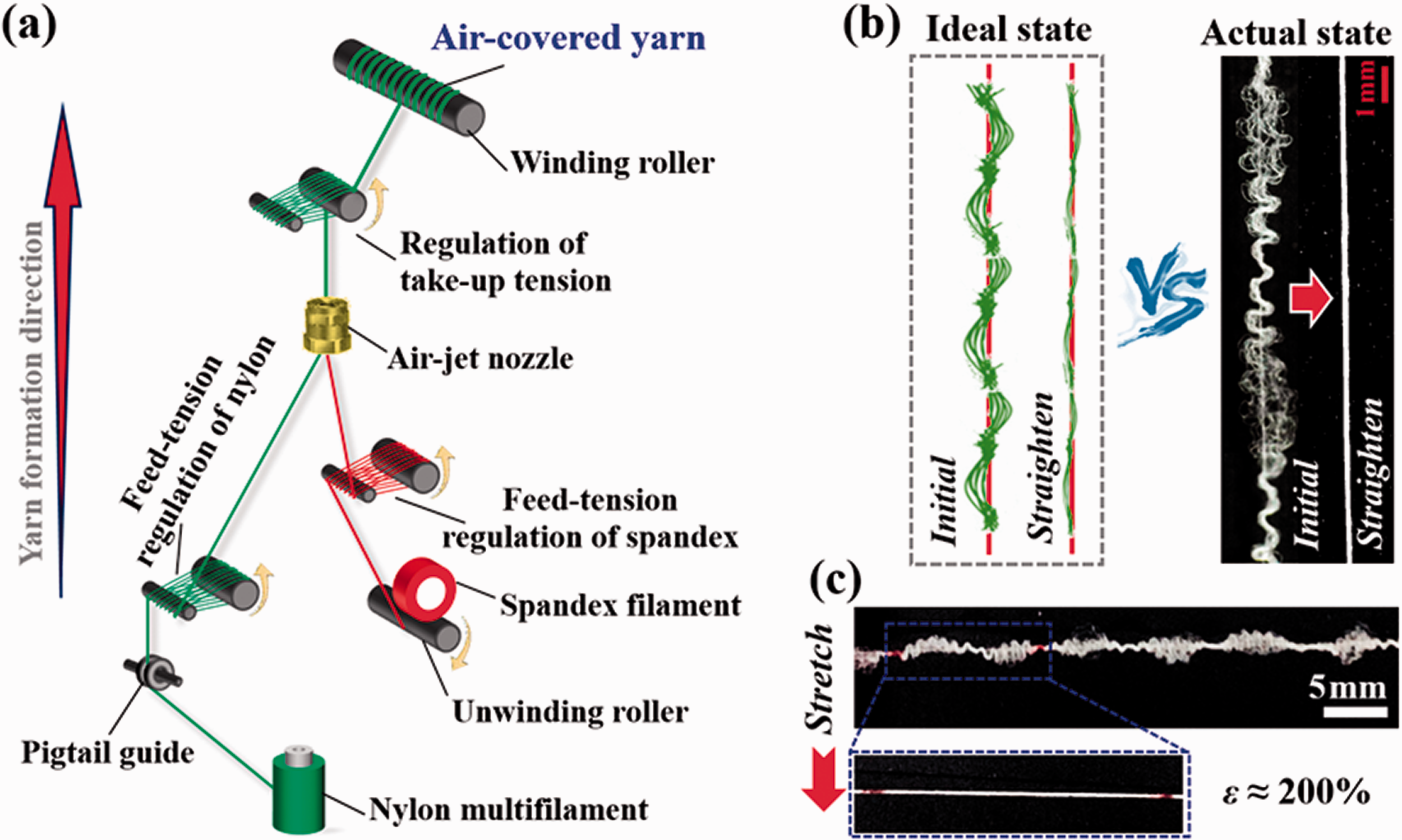
(a) Schematic of nylon/spandex air-covered yarn fabrication. (b) Comparison of ideal and actual yarn structures in the initial and straighten states, respectively. (c) Macroscopic stretchability of as-prepared air-covered yarn.
As presented in Figures 1(b) and (c), the creation of a high stretch, air-covered (warp) yarn uses an air-jet delivered by a nozzle to entangle the constituent filaments, producing intermittent nodes, that is, entangled sections (usually known as nips) at reasonably regular intervals with undisturbed sections between them. The yarn under freeload state, as per Figure 1(c), has regular slack loops of filament on its surface compared with that in an elongated state. The spandex facilitates a stretchability of as-prepared woven fabric up to a macroscopically observable elongation of about 200%.
Preparation of a warp super-elastic woven fabric
To explore the use of the as-prepared nylon/spandex air-covered yarn, a 2/1 left twill elastic woven fabric was prepared on a rapier loom, as shown in Figure 2(a). The warp and weft yarns are nylon/spandex air-covered yarn and cotton singles yarn of 58.3 tex, and the fabric densities are 32 ends/cm × 39 picks/cm, respectively. Note that no further finishing processes were applied to the prepared fabric sample before testing, for example, no dyeing or wet finishing, although a giant panda design was drawn on the fabric surface. As seen in Figure 2(b), the fabric can be reversibly extended in its warp direction to a macroscopic warp strain of about 60%, indicating its excellent elastic stretchability. Also, the void characteristics of the prepared fabric at different tensile elongations were qualitatively evaluated. As seen in Figure 2(c), the micropores clearly presented onto the fabric surface, and the void ratio correspondingly increases with an increase of warp stretch of the fabric.
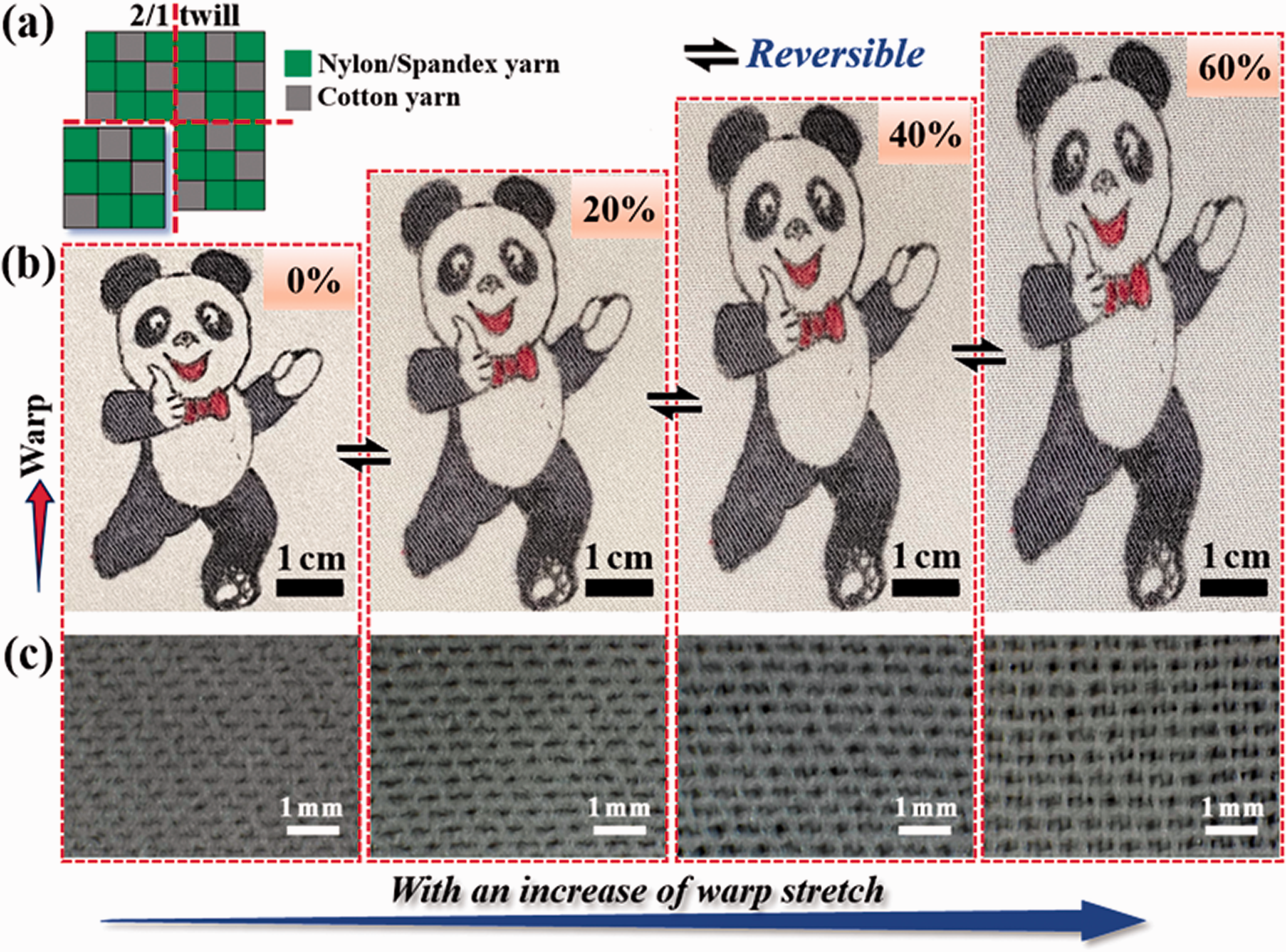
(a), (b) Fabrication and elastic stretchability of our as-prepared warp stretch woven fabric. (c) Microscopic photographs of the fabric during stretch.
Characterization
The warp stretch woven fabric sample was placed under standard laboratory conditions (25 ± 2°C and 65 ± 3% relative humidity) for at least 24 h before testing, and all the tests were performed under the above standard laboratory conditions.
Tensile test
The tensile tests of as-prepared warp stretch woven fabric included the uniaxial failure test and cyclic test, and the respective experimental procedure was as follows.
Uniaxial failure test
A strip fabric sample (50 mm in width × 200 mm in length) is placed into the jaws of an Instron 5567 mechanical device and extended at a speed of 100 mm/min until its complete failure, based on the China Standard GB/T 3923.1-2013. Three replicate specimens were tested.
Cyclic tensile test
As per the China Standard FZ/T 01034-2008, a strip fabric sample of the same size as above is cyclically elongated using an Instron 5567 mechanical device to an extension of 30% at 100 mm/min and held at this elongation for 1 min. Tension was then released at the same speed to its initial position for 3 min. A total of 10 cycles were tested using the same process.
Transverse wicking test
Herein, a system was developed to study the transverse wicking properties of warp stretch fabric samples under various events, such as different fabric extensions and liquid drop heights. As illustrated in Figure 3, the instrument consists of four parts: a liquid reservoir containing a solution of potassium dichromate connected via plastic tubing to a valve and syringe; a fabric extension adjustment; a liquid drop height adjustment; and a camera and image processing unit.12,21 Potassium dichromate is used as a stain to indicate the drop size and shape. The aim of the system is to allow metered drops to fall from a set height onto the fabric surface through the valve and syringe arrangement. Please note that the flow velocity of the liquid was precisely controlled via the valve, and finally a droplet size of 10 μl was obtained. After a drop of liquid had fallen down from the syringe needle, we carefully removed the needle from the top of the fabric. The fabric extension unit consists of a plastic frame and two jaws. The fabric is pre-stretched as required (i.e., 0%, 20%, 40% and 60%) and mounted between the jaws. 22 With the aid of a camera, the liquid spread of fabric in different stretched states is then captured in real time. The captured images of liquid spreading at different time intervals were processed using Adobe Premiere Pro 2020 and ImageJ software to further analyze the contour and area of liquid spread. 22 The time required for a liquid drop to lose any light reflection and change to a dull, wet spot was deemed the ‘wetting time.’ Considering the excellent macroscopic warp elastic stretchability (≈60%) of the prepared fabric, two test sequences (cases) were carried out based on the standards AATCC 79-2010 and GB/T 4745-2012 as follows.
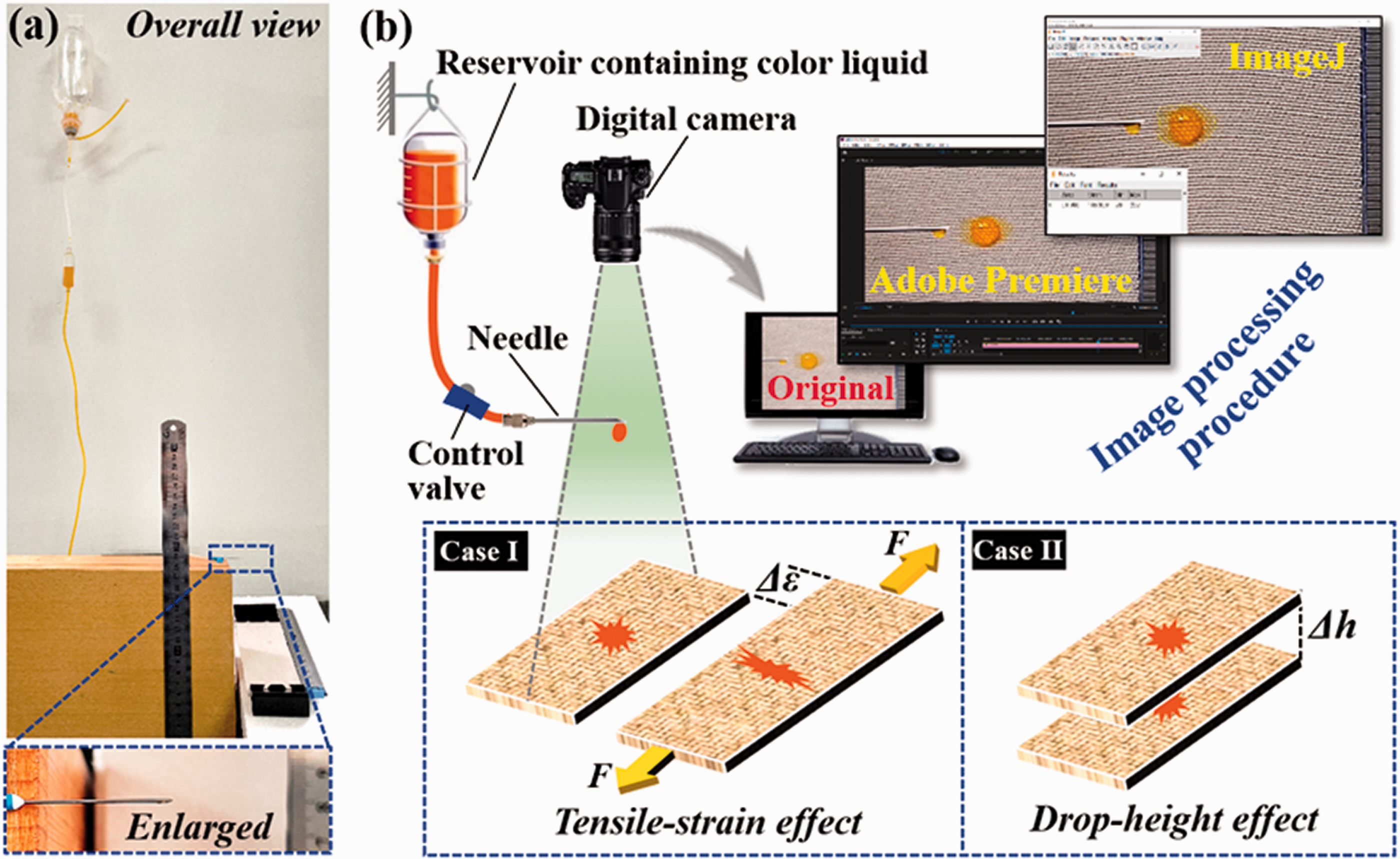
(a) Experimental setup for characterizing the transverse wicking behavior of elastic fabric. (b) Schematic of fabric wicking as a function of strain and drop height, respectively.
Case I: as shown in Figure 3(b), to clarify the strain on fabric wicking, the stretch level was regulated from 0% to 60% in the following increments: 0%, 20%, 40% and 60%, with a constant liquid drop height of 4 cm.
Case II: as shown in Figure 3(b), to clarify the liquid drop height on fabric wicking, the height was regulated from 4 to 12 cm in the following increments: 4, 8 and 12 cm, while keeping the fabric in the freeload state without any strain (i.e., 0%).
Water vapor transfer test
The water vapor transmission behavior of the as-prepared warp stretch fabric at different extensions was also characterized as per the method conducted by Eryuruk. 23 For this test, a beaker was filled with 40 ml of distilled water containing potassium dichromate with the distance between the liquid surface and the beaker lip being about 25 mm. Then, the fabric at two different strains (i.e., 0% and 60%) was attached on the beaker. Note that the liquid was kept at 40°C using a temperature control device and a stirring rotor to ensure the temperature uniformity of the liquid, as shown in Figure 4. The beaker assembly was periodically weighed at 15 minute intervals throughout the 75 minute test. Finally, the weight gain rate of the stretched and unstretched fabric as a function of the water vapor condensed and trapped in the fabric was calculated.
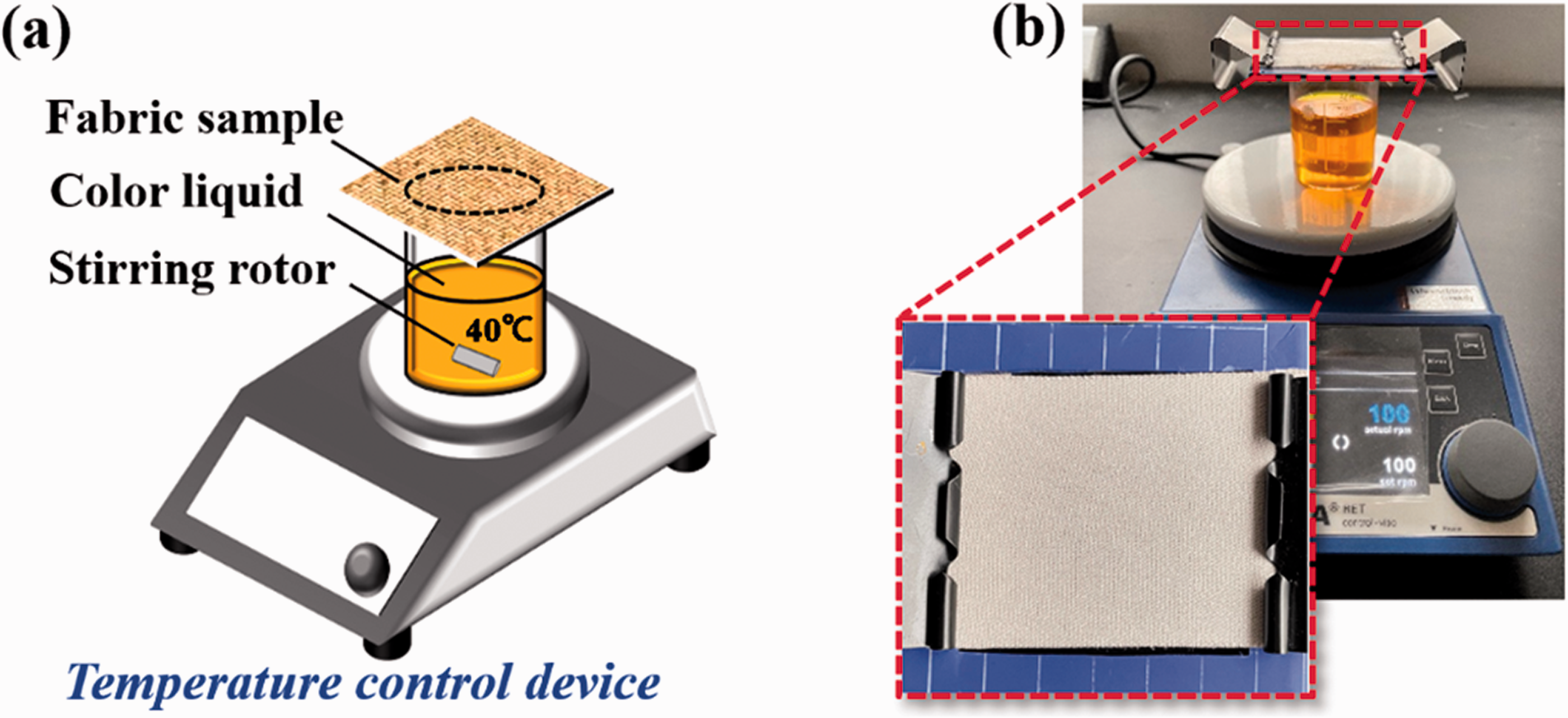
(a) Schematic sketch and (b) experimental setup for characterizing the water vapor transfer behavior of warp super-elastic woven fabric.
Results and discussion
Mechanical robustness of elastic fabric
The tensile behavior of the as-prepared warp stretch fabric in the warp direction is illustrated in Figure 5. The typical stress–strain curve is shown in Figure 5(a). Three distinct regions can be visibly seen: an initial low-stress region, a linear pre-peak region and a linear post-peak region, which is in agreement with the previous work reported by Wang et al. 24 In the initial low-stress region, the warp and weft yarns are orthogonal to each other and the stress increase is lower due to the straightening of undulated air-covered yarn in the loading direction (warp) with limited yarn stretching. At this stage, the relation between the tensile stress and strain is proportional, and the deformation is completely recoverable. As the extension grows, the yarns become extended and the fabric exhibits a linear response with no visible failure. As the loading level reaches the peak, the yarns in the warp direction start to fail, resulting in a dramatic decrease in the load-carrying capacity until the final failure. Note that, as per the work by Wang et al., 24 the inflection point of about 60% in Figure 5(a) represents the elastic extension of the prepared fabric corresponding to the maximum stretch (see Figure 2(b)), and after that the fabric reaches its ultimate elongation (≈130%) before the final breakage.
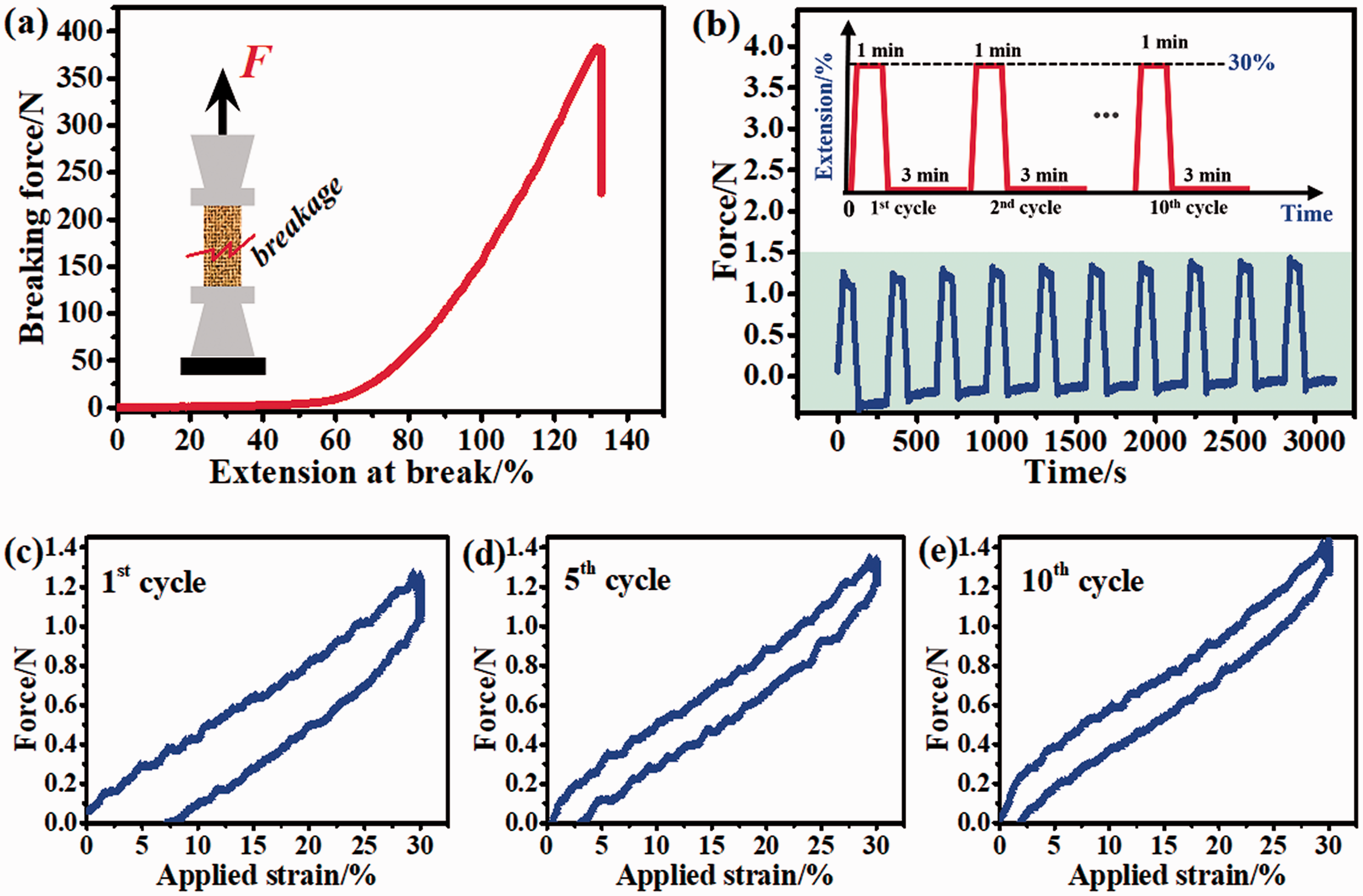
(a) Typical stress–strain tensile curve of elastic fabric in the warp direction. (b) Cyclic tensile curves of fabric at a fixed extension of 30%. (c)–(e) Typical force–strain curves of fabric at a fixed extension of 30% at the first, fifth and 10th cycle, respectively.
The typical force–time behavior of the as-prepared fabric subject to a cyclical extension of 30% is illustrated in Figure 5(b). Here, the predetermined extension of 30% was chosen based on the macroscopically elastic stretchability of the as-prepared fabric (≈60%) and the limiting value of human skin expansion during body movement (10–50%). As seen, the shapes of the force versus time curves following different cycles were almost the same, and the maximum stress achieved in consecutive cycles was well maintained. Further, Figures 5(c)–(e) provide more details of the tensile curves following one, five and 10 cycles. As can be seen, each curve exhibits obvious hysteresis behavior, which is typical for all viscoelastic materials within their elastic recovery limits. The hysteresis loop represents the dissipation of internal energy during the tensile cycle and can be associated with the viscoelastic behavior of constituent fibers and the friction between interfibers within the yarn/fabric structure. Furthermore, as the cyclic number increases, the hysteresis loop becomes smaller. The interlaced structure deformation of the fabric had been changed when stretched at the first cycle, and the status is irreversible, causing a permanent deformation. Consequently, the hysteresis loop in the first cycle is distinctive. However, the permanent deformation mentioned above becomes relatively stable with an increase of the cyclic number, resulting in a smaller but relatively stable hysteresis loop. In a way or to a certain extent, our prepared warp stretch woven fabric has excellent mechanical robustness.
Transverse wicking behavior (liquid water)
Tensile strain effect
The transverse wicking behavior of our warp stretch fabric at different elongations is investigated in Figure 6. As seen in Figure 6(a), an increase in tensile strain on the fabric resulted in a significantly increased wetting time. The wetting time increased from 4.01 s at 0% extension to 6.21, 10.09 and 11.62 s when the extension was increased to 20%, 40% and 60%, respectively. However, the wetting time was not significantly different at higher extensions. For example, the relative difference was about 15.2% between strains of 40% and 60%, whereas the relative difference at lower extensions between 0% and 20% was as much as 55%.
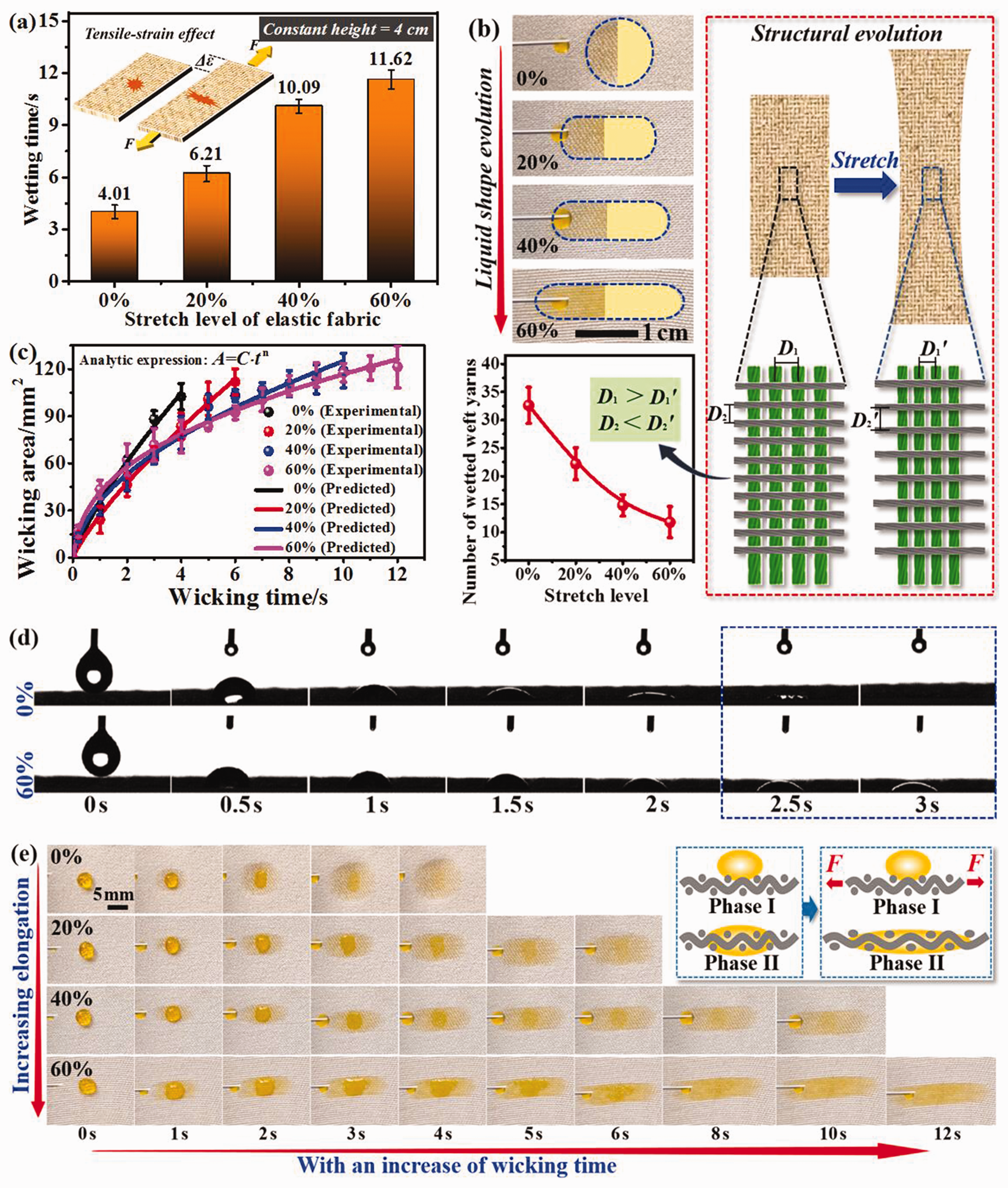
Transverse wicking of liquid water of fabric during stretching: (a) wetting time; (b) liquid shape evolution; (c) wicking areas versus wicking time; (d) contact angles as a function of wicking time at strains of 0% and 60%, respectively; (e) consecutive images as a function of wicking time.
It is evident from these results that tensile strain plays a crucial role in influencing the spreading profile of liquid and, hence, the final comfort of a fabric. As shown in Figure 6(b), when a drop of liquid water was placed onto the fabric surface, it spread transversely, and the profile of the wetting region of the fabric was changed from the circular to the racetrack type during stretching. Physically, fabric wicking is determined mainly by the wicking ability of constituent yarns, which in turn is dependent on the fiber type, the geometric configurations of adjacent yarn spacing and pore structure and the rate of liquid migration between the longitudinal and transverse yarns.16,25 With an increase in strain in the warp direction of our fabric, the distance between the adjacent warp air-covered yarns decreased and the pore space between picks narrowed.7,26 The effect of this was to create a more wick-able micro-channel in the warp direction of the fabric, driven also in part by the excellent hydrophilic nature of the cotton weft yarn. However, transverse spread in the weft direction was reduced by the increase in the distance between weft yarns under elongation.
The transverse liquid spreading area of the prepared fabric at different warp elongations for different time intervals was measured and is summarized in Figure 6(c). As can be seen, the wicking area increased as a function of the wicking time, and the shape of all the wicking curves is essentially nonlinear, with a convexity characteristic. On the whole, for any fabric the rate of spread decreases gradually with time. The spread area strongly fits a power function relationship (A = C·tn, where A is the spreading area at a given wicking time t, C is a constant and n is the nonlinear coefficient (0 < n < 1)). The explanation for nonlinear wicking behavior may be that a relatively higher curve slope in the initial stage represents the effective liquid diffusion along the fabric surface and penetration from the front side to the back side via suitable micropores between adjacent yarns. The formation of direct-water between the liquid and hydrophilic groups within the cotton fiber was also responsible for the quick liquid spreading. The absorption of direct-water was saturated quickly; after that, a relatively lower slope was observed, and the somewhat ineffective liquid transport within the yarns was explained well. In contrast, it takes a longer time to reach the saturating liquid spreading area of about 120 mm2 for the fabric sample at an extension of 60% than in the other three fabric samples at extensions of 0%, 20% and 40%, respectively. Moreover, the saturating wicking area increases gradually with increasing tensile extensions of fabrics. There is a difference in the pore size of fabric samples at different elongations, which is the main reason for the rise in the saturation time. 21 The small pores are easily filled at lower extensions (e.g., 0%), which leads to faster transverse wicking. However, larger voids are formed within the fabric at higher strains (e.g., 60%) and are filled with liquid by replacing the air gaps, which results in slower transverse wicking. The images in Figure 6(d) show this effect. From the consecutive images of the fabric at different strains in Figure 6(e), we can see that the spreading mechanism of a water drop into a fabric starts with initial retention of the liquid on the fabric surface, followed by a gradual spread until it is completely diffused within the fabric. 27
Liquid drop height effect
The transverse wicking behavior of the warp stretch fabric in an initial tension-free state at different liquid drop heights is presented in Figure 7. As shown in Figure 7(a), an increase of liquid drop height of the fabric resulted in decreased wetting time. Wetting time decreased from 4.01 s at 4 cm to 3.12 and 2.97 s when the height was increased to 8 and 12 cm, respectively. However, this downward trend in fabric wetting time was not significant at higher drop heights. For example, the relative difference in wetting time was less than 5% between heights of 8 and 12 cm, whereas the difference was up to 22% between 4 and 8 cm. The spread of moisture in the fabric, irrespective of liquid drop heights, can be considered as a result of the following steps, as illustrated in Figure 7(c): the initial retention of the liquid drop on top of the fabric surface, and then the gradual spread until the liquid water appears as a dull, wetted spot. Moreover, the fabric wetting time is also dependent on the liquid drop height (see Figure 7(d)). It should be noted that the round shape of the moisture drop on the fabric at different liquid drop heights remained constant, which is different from the spreading shape of the fabric at varying elongations.
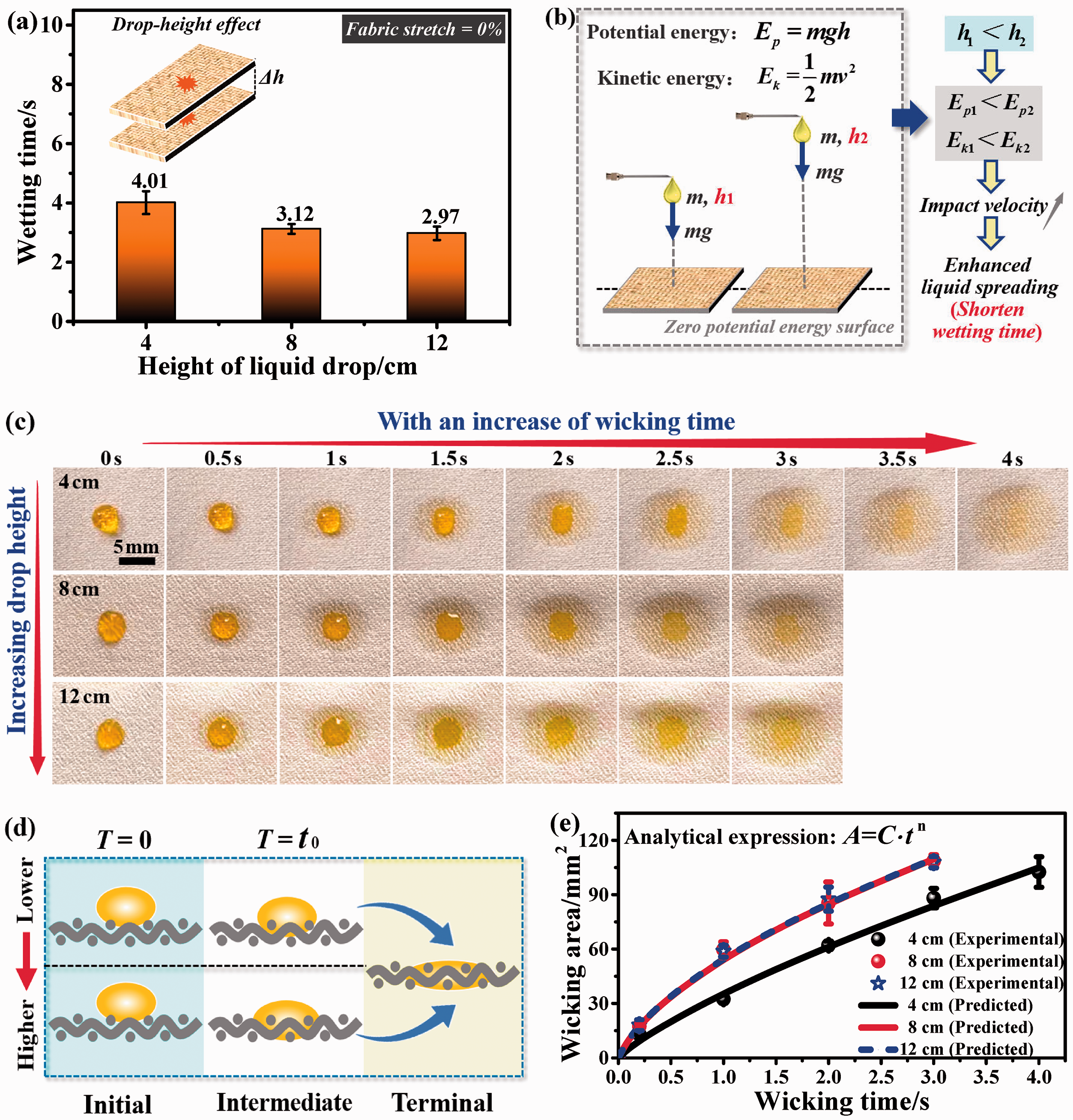
Transverse wicking of fabric with a freeload under different drop heights: (a) wetting time; (b) height-strengthening mechanism; (c), (d) consecutive captured images and a schematic of liquid shape evolution as a function of wicking time; (e) wicking areas versus wicking time.
Why was a shorter wicking time observed with an increase in liquid drop height? The underlying mechanism is unraveled, as illustrated in Figure 7(b): the potential energy Ep and kinetic energy Ek are collectively called the mechanical energy, and the respective expression is as follows: Ek = 1/2 · mv2, where m is the weight of a drop of liquid; v is the instantaneous velocity; Ep = mgh, where m is the weight of a drop of liquid; g is the gravitational acceleration; and h is the vertical height between the liquid and fabric surface. From the perspective of energy conversion (Ek + Ep = Const.), the increase in Ek is equal to the decrease in Ep. When a drop of liquid falls onto the fabric surface at increasingly higher heights, there is at t0 a larger potential energy Ep (i.e., Ep1 < Ep2) that converts to a larger kinetic energy Ek (i.e., Ek1 < Ek2) upon impact, which in turns leads to the liquid spreading further across the fabric via micro-channels of least resistance. Consequently, the wetting time of fabric also becomes shorter with an increase in drop height.
The transverse spread in the area of liquid in the fabric after being dropped from different heights was measured over time and is summarized in Figure 7(e). As can be visibly seen, the wicking area increases as a function of time, with the area strongly dependent on the wicking time. The relationship fits a power function, irrespective of the liquid drop height considered. The initial wicking or wetting area speeds on the fabric surface at 8 and 12 cm drop heights were higher than that of the fabric at 4 cm. The wet area in the case of drops from 4 cm spreads to about 30 mm2 in the first 1 s, while that in the cases of 8 and 12 cm reach up to about 60 mm2. In addition, there is an overlap between the wicking area with the time curve for drops at 8 cm height and those from of 12 cm. The close wetting times (3.12 and 2.97 s) at these heights, as shown in Figure 7(a), suggests the wicking ability, or speed of wicking in the fabric, reaches a limit independent, in these circumstances, on the kinetic energy applied in application of the drop.
Transverse wicking behavior (water vapor)
Herein, water vapor transmitted through a sample of the as-prepared fabric of a given circular area at a specific distance from water surface (in this case 25 mm) was studied. The weight gain rate of the fabric at two different tensile elongations (0% and 60%) over different time intervals was measured. The results are illustrated in Figure 8(a). As can be seen, the weight gain rate of the fabric increases with an increase in the evaporation time, irrespective of the fabric extension considered. By comparison, the weight gain rate of fabric at an extension of 0% is larger than that of fabric at 60% extension, especially over longer periods. In addition, the curves of relative weight gain versus evaporation time can be obtained by taking the first derivative of the weight gain rate with respect to the evaporation time. The relationship is shown in Figure 8(b), which also demonstrates the difference in water vapor transmission behavior of the fabric under elongation.

Vapor water transfer of the fabric at different strains of 0% and 60%: (a) weight gain rate versus evaporation time; (b) relative ratio versus evaporation time; (c) the underlying mechanism.
Why was a remarkable difference of weight gain rate of our fabric found between 0% and 60% stretch? As illustrated in Figure 8(c), the fabric in this test is firmly attached across the top of a beaker at a set distance from the water surface. According to the Arrhenius equation, k = A·exp(–Ea/RT), where k is the rate constant of diffusion, A is the pre-exponential factor, Ea is the activation energy for the reaction (in Joules), R is the universal gas constant and T is the absolute temperature (in kelvin). The diffusion of water molecules across the capillary pores of a fabric increases when water temperature rises from room temperature to 40°C. 8 The transmission of moisture vapor generally occurs through the air pockets within a given fabric, with the rate dependent on the water vapor gradient and the diffusion coefficient of the medium. 28 As noted, there is a significant difference in the pore size of the fabric at different extensions. As the fabric tightness is decreased, the enlarged voids within the fabric result in a decrease in the water vapor drag resistance. Furthermore, the higher available inter-yarn surface area can be used to hold the water vapor during stretching. Consequently, the weight gain rate of the prepared fabric at an extension of 0% is relatively higher than that of fabric at an extension of 60%.
Why does the weight gain rate increase with respect to evaporation time? The water gain will also be dependent on the regain of the fiber type in the fabric: cotton is 8.5%, while spandex is only 1.3%. Firstly, water vapor can be absorbed by the as-prepared fabric due to the number of hydrophilic groups (e.g., -OH) present in cotton fiber within the fabric and their accessibility for contact with water, as shown in Figure 8(c). Secondly, for any textile materials, the water vapor can always be loosely attached onto the fiber surface contours due to the capillary pressure and surface configuration. 28 Since the moisture absorption of textile materials is a process of gradual change, the net weight of the as-prepared fabric increases gradually with respect to evaporation time.
Conclusions
Understanding liquid transport in fibrous substrates is crucial in evaluating the moisture management and the comfort properties of a given textile. Herein, a warp stretch woven fabric, with nylon/spandex air-covered yarn in the warp and pure cotton yarn in the weft, was manufactured. The prepared fabric could be extended up to a high elastic extension of 60% without distortion. A self-designed simple wicking test system was developed, and the effects of tensile extension and the height between the water drop and the fabric surface with respect to transverse wicking were studied. It was found that the transverse wicking indices, including wetting time and spreading area, were strongly dependent on the drop height and tensile strain, and a power function can be used to elucidate the transverse wicking characteristics. In addition, the water vapor transmission behavior of such fabric during stretching was investigated. This work provides an insight into the transverse wicking behavior of complex elastic fabric structures, which has practical meaning in the further development of comfortable, tight-fitting garments.
As a popular fabric used for tight-fitting garments, apart from strain-dependent wicking, the influences of environmental conditions, such as temperature and relative humidity, on the transverse wicking behavior of the warp stretch woven fabric need to be systematically investigated. Furthermore, we aim to investigate the comfort characteristics, such as air permeability and thermal behavior (e.g., thermal resistance and thermal absorptivity) of the fabric, at different tensile elongations, which is also critical to evaluating the overall performance of fabric in a comprehensive manner. Admittedly, there remains a myriad more arrangements of the elastomeric component and yarn and fabric structures that require further refining the design, resulting in finally preparing fabrics with controllably tunable wickability and excellent reversible stretchability.
Footnotes
Declaration of conflicting interests
The author(s) declared no potential conflicts of interest with respect to the research, authorship, and/or publication of this article.
Funding
The authors disclosed the receipt of the following financial support for the research, authorship, and/or publication of this article: This work was financially supported by State Key Laboratory of New Textile Materials and Advanced Processing Technologies (No. FZ2020016), Anhui Provincial Natural Science Foundation (No. 2008085QE211), the Scientific Research Foundation of Anhui Polytechnic University (No. 2020YQQ003), and the Open Project Program of Anhui Engineering and Technology Research Center of Textile, Anhui Province College Key Laboratory of Textile Fabrics (No. 2021AETKL08).
