



Abstract
A novel multiple-reactive-site crosslinking agent, P(TAA‒AA), was developed from transaconitic acid and acrylic acid in this study. Cotton fabrics with durable wrinkle-resistant properties were obtained by crosslinking with P(TAA‒AA), which benefited from the multifunctional carboxyl groups of crosslinking agents and the three-dimensional crosslinking inside cotton fibers. The wrinkle-resistant properties of P(TAA‒AA)-modified fabrics were evaluated and compared with those of other polycarboxylic acid-treated fabrics, and the P(TAA‒AA)-modified fabrics showed a wrinkle recovery angle of 262° as high as the 1,2,3,4-butanetetracarboxylic acid-modified fabrics while maintaining nearly two-fold higher tearing strength retention (62.9%), and they showed a much higher value of whiteness index than the citric acid-modified fabrics. This demonstrated that the obtained P(TAA‒AA) is an ideal polycarboxylic acid already known to date simultaneously to realize the high wrinkle recovery angle and high tearing strength retention for treated cotton fabrics. The Raman depth mapping images and the scanning electron microscope images of P(TAA‒AA)-modified samples indicated that P(TAA‒AA) molecules can diffuse into the amorphous regions of the cellulose fibers and form crosslinking bridges between cellulose chains. The multiple reactive carboxyl groups in P(TAA‒AA) may form three or more ester bonds between the P(TAA‒AA) molecule and different cellulose chains, which were regarded as the main contribution to the high crosslinking effectiveness of the P(TAA‒AA)-modified fabrics.
Keywords
Cotton fiber has been widely used in garments due to its excellent hydrophilicity and air permeability.1,2 However, cotton fabrics tend to wrinkle during wearing and washing due to the slippage of cellulose chains, and the wrinkle-resistant performance is beneficial for the easy care of pure cotton fabrics. 3 Therefore, the wrinkle-resistant treatment of cotton fabrics is usually carried out with various crosslinking agents. The crosslinking bridge formed between different cellulose chains reduces the slippage of cellulose chains, thereby reducing the deformation of fabrics. Dimethyloldihydroxyethyleneurea (DMDHEU) is a popular crosslinking agent for cotton fabrics due to its high crosslinking effectiveness. However, DMDHEU-treated fabrics usually release formaldehyde during the application and storage.4–7 Formaldehyde has been proved to be harmful to the human body;4–7 consequently, various chemicals have been tried as finishing agents for formaldehyde-free treatment of cotton fabrics.
Polycarboxylic acids (PCAs), applied as crosslinking agents for formaldehyde-free modification of cotton fabrics to endow wrinkle-resistant performance, have been widely investigated.8–11 Citric acid (CA) is an eco-friendly, low-cost, and easily available resource in nature. 12 The CA-modified fabrics show a promising wrinkle-resistant performance, and its yellowish appearance is due to the formation of unsaturated acid during the curing process. 13 It was reported that the generation of unsaturated acid during the curing process is easier than the esterification of CA with cellulose chains. 14 Much effort has been made to resolve the yellowish appearance of the CA-modified fabrics, such as adding polyols to the finishing solution to inhibit the formation of unsaturated polycarboxylic acids. 15 However, when the whiteness index (WI) was improved to an acceptable level, the wrinkle recovery angle (WRA) of modified fabrics did not show a significant increase compared with that of the control. The hydrogen peroxide (H2O2) post-bleaching method was an alternative to eliminate the yellowish appearance of the CA-modified fabrics.13,16,17 However, the alkaline condition of the post-bleaching process may accelerate the hydrolysis of the ester bonds formed inside cellulose fibers, which will decrease the WRA of modified fabrics. Unacceptable strength losses of the 1,2,3,4-butanetetracarboxylic acid (BTCA)-modified fabrics and the yellowish appearance of the CA-modified fabrics are the main drawbacks that impede their industrial applications.18–20
Transaconitic acid (TAA) is one of the unsaturated acids formed from CA during the high-temperature curing process, as presented in Figure 1, and the existence of unsaturated double bonds is the main source of the yellowish appearance of the CA-modified fabrics. 14 There are three carboxyl groups in the TAA molecule, and the plane structure of the double bond makes it difficult to rotate. 21 Consequently, after the formation of anhydride and esterification of anhydride with cellulose in the carboxyl group of C3, the formation of the second anhydride is restricted.21–23

Formation of transaconitic acid (TAA) from citric acid (CA) at a high temperature.
In our previous research, we synthesized and investigated two innovative crosslinking agents (Figure 2).24,25 In particular, P(MA‒AA) was prepared from acrylic acid (AA) and maleic acid (MA), 24 and P(IA‒AA) was prepared from AA and itaconic acid (IA). 25 The flexible structures of methylene in P(MA‒AA) or P(IA‒AA) provided a good wrinkle-resistant property, especially a high mechanical strength to the treated fabrics.24,25 However, evidence showed that the WRA value always inversely changed with the tearing strength retention (TSR) value of the modified fabrics.24,25 Improving the TSR of the modified fabrics while maintaining a high WRA value is still a big challenge for researchers. In order to obtain a fabric showing a high TSR and WRA simultaneously, TAA was employed to react with AA to introduce a kind of multifunctional carboxylic acid and eliminate the influence of unsaturated double bonds on the yellowish appearance of the modified fabrics. The selection of TAA and AA to prepare a crosslinking agent was guided by two reasons: (a) TAA contains three adjacent carboxyl groups, which can enhance the crosslinking efficiency with cellulose; (b) one of the carboxyl groups in TAA was connected to methylene, the rotatable characteristic of alkyl may reduce the stress concentration under external force, thereby reducing the strength loss of modified fabrics.
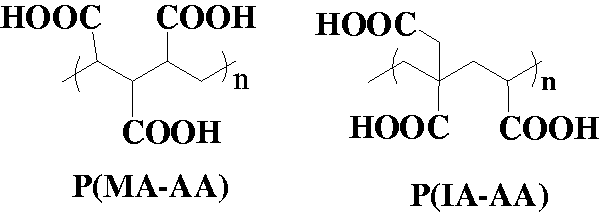
Proposed structures of P(MA–AA) and P(IA‒AA) (n ≤ 3).
This research presents the preparation and application of the multiple-reactive-site and flexible crosslinking agent (P(TAA‒AA)) from TAA and AA. The application of P(TAA‒AA) as a crosslinking agent for the wrinkle-resistant treatment of cotton fabrics has not been reported yet. The focus of the research was to enhance the WRA of cotton fabrics crosslinked with the prepared P(TAA‒AA) while maintaining a desired TSR and WI. The wrinkle-resistant performance of fabrics modified with P(TAA‒AA) was evaluated by comparing it with that of the TAA, CA, BTCA, P(MA–AA), or P(IA‒AA)-modified fabrics processed in similar conditions. To investigate further the proposed crosslinking mechanism of P(TAA‒AA) with cellulose chains, the temperature-dependent Fourier-transform infrared (FTIR) analysis was conducted to monitor the formation of anhydride and ester bonds. Moreover, scanning electron microscopy (SEM) and confocal Raman microscopy were employed to evaluate the distribution of P(TAA‒AA) inside the cellulose fiber. 26 The SEM images, Raman depth mapping images and FTIR analysis provided a detailed explanation on the crosslinking mechanism of P(TAA‒AA) with cellulose chains.
Experimental
Materials and chemicals
Cotton plain-woven fabrics were supplied by Warren Printing and Dyeing Co., Ltd. (Shanghai, China), which were 40 S × 40 S, warp × weft density of 133 × 72, and a weight of 117 g/m2. Before the wrinkle-resistant finishing, the cotton fabrics were desized, scoured, bleached, and mercerized by the manufacturer.
Viscose filaments (loose fibers) were supplied by Dongguan Hengzhisheng Co. Ltd. The cross-sectional diameter of the fibers was 30–35 μm.
TAA (analytical reagent (AR) 99%) and AA (AR 99%) were purchased from TCI Chemical Industry Development Co., Ltd. (Shanghai, China), potassium persulfate (K2S2O8, AR 99%), BTCA (AR 99%), CA (AR 99%), sodium hydroxide (NaOH, AR 99%), and sodium hypophosphite monohydrate (SHP, AR 99%) were supplied by Sinopharm Chemical Reagent Co., Ltd. (Shanghai, China). All chemicals were analytical reagents and were used as received.
Methods
Preparation of P(TAA‒AA)
The preparation of P(TAA‒AA) was carried out in a flask, and the mechanism of polymerization is presented in Figure 4. TAA, SHP, distilled water (M(TAA):M(H2O) = 1:27), and a magnetic stirrer were placed in the flask, then a reflux condenser was equipped for refluxing, and a dropping funnel was equipped for adding AA in dropwise. The mixture was stirred at 90–95°C until TAA and SHP were dissolved completely. AA was then charged in dropwise to the mixture solution via the dropping funnel, and K2S2O8 as a radical initiator was added simultaneously in batch during 30–45 min under a magnetic stirring at 350 r/min.24,25 The M(TAA):M(AA) was 1:1 and the M(TAA):M(K2S2O8) was 9:1, respectively. The mixture solution was stirred and refluxed at 90–95°C, and the reaction was completed after 6 h. Subsequently, the mixture solution was cooled down to room temperature and treated with excess absolute ethanol, and then the precipitation (including the macromolecular products, residual TAA, SHP, and K2S2O8) was removed by filtration. 27 The ethanol was removed by rotary evaporation, a brown viscous liquid of the desired product of P(TAA‒AA) was left (yield: 66%). The obtained P(TAA‒AA) was characterized with liquid chromatography mass spectrometry (LC-MS) and attenuated total reflectance (ATR)-FTIR.
For the preparation of P(MA‒AA), 24 the M(MA):M(AA) was 2.5:1, M(MA):M(K2S2O8) was 6:1, M(MA):M(H2O) was 1:10, and the polymerization time was 5 h. For the preparation of P(IA‒AA), 25 M(IA):M(AA) was 1:1, M(IA):M(K2S2O8) was 16:1, M(IA):M(H2O) was1:10, and the polymerization time was 3 h. The specific synthesis methods and procedures were consistent with the preparation of P(TAA‒AA).
Crosslinking of cotton fabrics with P(TAA‒AA)
As presented in Figure 3, the cotton fabrics with a size of 20 cm × 35 cm (10 g) were immersed in a finishing bath containing 140 g/l P(TAA‒AA) or other polycarboxylic acids (the specific concentration is shown in Figure 8) and SHP acting as a catalyst with the concentration of 44 g/l, and then padded twice via a two-roll padder (P-A1; Rapid Co., Ltd., Xiamen, China) to obtain a 90% pick-up of impregnated samples. The impregnating agents for each sample were presented as follows: TAA was 0.549 g, CA was 0.666 g, BTCA was 0.705 g, P(IA–AA) was 1.242 g, P(TAA–AA) and P(MA–AA) were 1.098 g, respectively. The pre-dried impregnated cotton fabrics were then cured in an oven (Werner Mathis, Switzerland) at 180°C for 2 min. Afterwards, the modified fabrics were rinsed in tap water for 5 min to eliminate the unreacted chemicals, and then dried at 100°C for 2 min. All samples were conditioned in a constant temperature (20 ± 1°C) and humidity (65 ± 2%) condition for 24 h before any characterization. The add-on (%) of modified samples was calculated as follows:

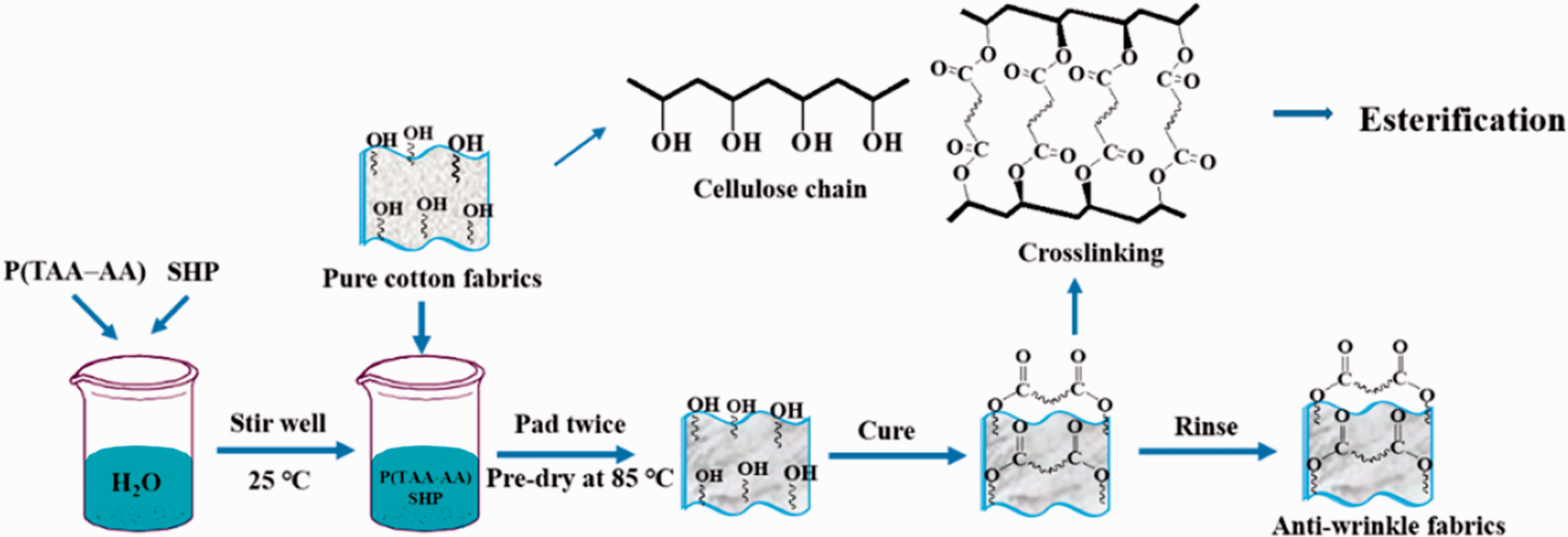
Crosslinking treatment of cotton fabrics with P(TAA‒AA).
For the analysis of Raman depth mapping of cellulose fiber, viscose filaments were immersed in a finishing bath containing 140 g/l P(TAA‒AA) and SHP acting as a catalyst for 5 min, afterwards a filter paper was employed to remove the excess finishing liquid of the impregnated viscose filaments. Then the impregnated viscose filaments were dried at 100°C and cured at 180°C for 2 min. The modified viscose filaments were rinsed with 0.1 mol/l NaOH solution for 5 min and distilled water for 5 min, and then were dried at 100°C for 5 min before measurement.
Characterization
High performance LC-MS analysis
The LC-MS analysis of P(TAA‒AA) was carried out by 1100-MSD LC/MS (Agilent Technologies Inc., California, USA) to determine the molecular weight range of P(TAA‒AA), which was measured by the negative ion mode. In detail, 1.5 ml of distilled water was used to dissolve 0.05 g P(TAA‒AA) for the test, and the injection time and flow rate were 15 min and 0.6 μl/min, respectively. The volume of injection sample was 10.0 μl, and the temperature of the column was 25°C. The results demonstrated that the P(TAA‒AA) presented a molecular weight range of 400∼600.
Attenuated total reflectance FTIR
All the spectra were collected on a FTIR spectrometer (NICOLET iS10, Thermo Fisher Scientific Co., Ltd., Shanghai, China) with 32 scan times, and the range of wave numbers and the resolution were 4000–400 cm−1 and 4 cm−1, respectively. In detail, ATR infrared spectra of P(TAA‒AA), TAA, and AA were compared to study the structural changes of TAA and AA.
For the FTIR analysis of fabrics, the measurement of different samples was conducted according to the FTIR test methods in our previous paper. 25 Briefly, the samples were immersed in a 0.1 mol/l NaOH solution for 4 min to neutralize the unreacted carboxyl groups, and after being rinsed with distilled water and dried, the samples were cut into fine powders carefully. Dried potassium bromide (KBr) of 100.0 mg was mixed with sample powders of 1.0 mg and ground well, and then they were compressed into a transparent pellet.
The ester crosslinking between P(TAA‒AA) and cellulose chains was investigated with the temperature-dependent FTIR analysis.28–30 In order to monitor the formation of anhydride during the crosslinking process of cellulose fibers, viscose filaments (loose fibers) were used. Viscose filaments impregnated in the P(TAA‒AA) finishing bath were pre-dried but without curing, and then they were cut into fine powders. A transparent pellet of sample powders and KBr was made in the afore-mentioned method. The temperature-dependent FTIR spectra were recorded from 30°C to 190°C with a heating rate of 2°C per min, and were recorded every 2.5°C.
Confocal Raman microscopy
A DXR2xi Raman imaging microscope (Thermo Fisher Scientific Co., Ltd., Massachusetts, USA), which was equipped with a semiconductor laser and a charge-coupled device camera, was used to collect the Raman depth mapping images of samples. Each sample was excited at the 532 nm visible laser light for 0.08 s. A microscope (50 × L) focused on the excitation laser spot and the constant laser power was 9.0 mW, avoiding the sample’s physical damage. The size of the objective image was 50 μm × 30 μm. 26
Scanning electron microscope
A S-4800 Field Emission scanning electron microscope (Hitachi Co., Ltd., Japan) was employed to observe the surface morphology of fabrics. The working voltage was adjusted to 5.0 kV.
Evaluation of wrinkle-resistant properties of modified fabrics
The WRA of samples was acquired according to the AATCC 66-2008 (fabric wrinkle recovery, recovery angle method).
The evaluation of the tearing strength of fabrics was according to the ASTM Testing Method D-1424-1996 (tearing strength of fabrics by impact pendulum method). The TSR of fabrics was obtained as follow:

The WI of fabrics was evaluated corresponding to the AATCC 110-2005 method (whiteness determination of textiles) using a D650 Datacolor computer color matching system (Datacolor Inc., Lawrenceville, NJ, USA).
The evaluation of the laundry durability of modified fabrics was measured according to the test method of AATCC 61-2009 (washing color fastness, 2A of the fast method), and the fabric WRA was tested after they were conditioned.
Results and discussion
Mechanism of polymerization of TAA and AA
As shown in Figure 1, TAA is an unsaturated acid containing three carboxyl groups, and the steric hindrance of the carboxyl groups makes it difficult to react with AA. It has been proved that SHP can be induced to form free radicals in the presence of K2S2O8.
31
The mechanism of polymerization of TAA and AA in the presence of SHP and K2S2O8 is presented in Figure 4. During the heating process, K2S2O8 induces free radical KSO4
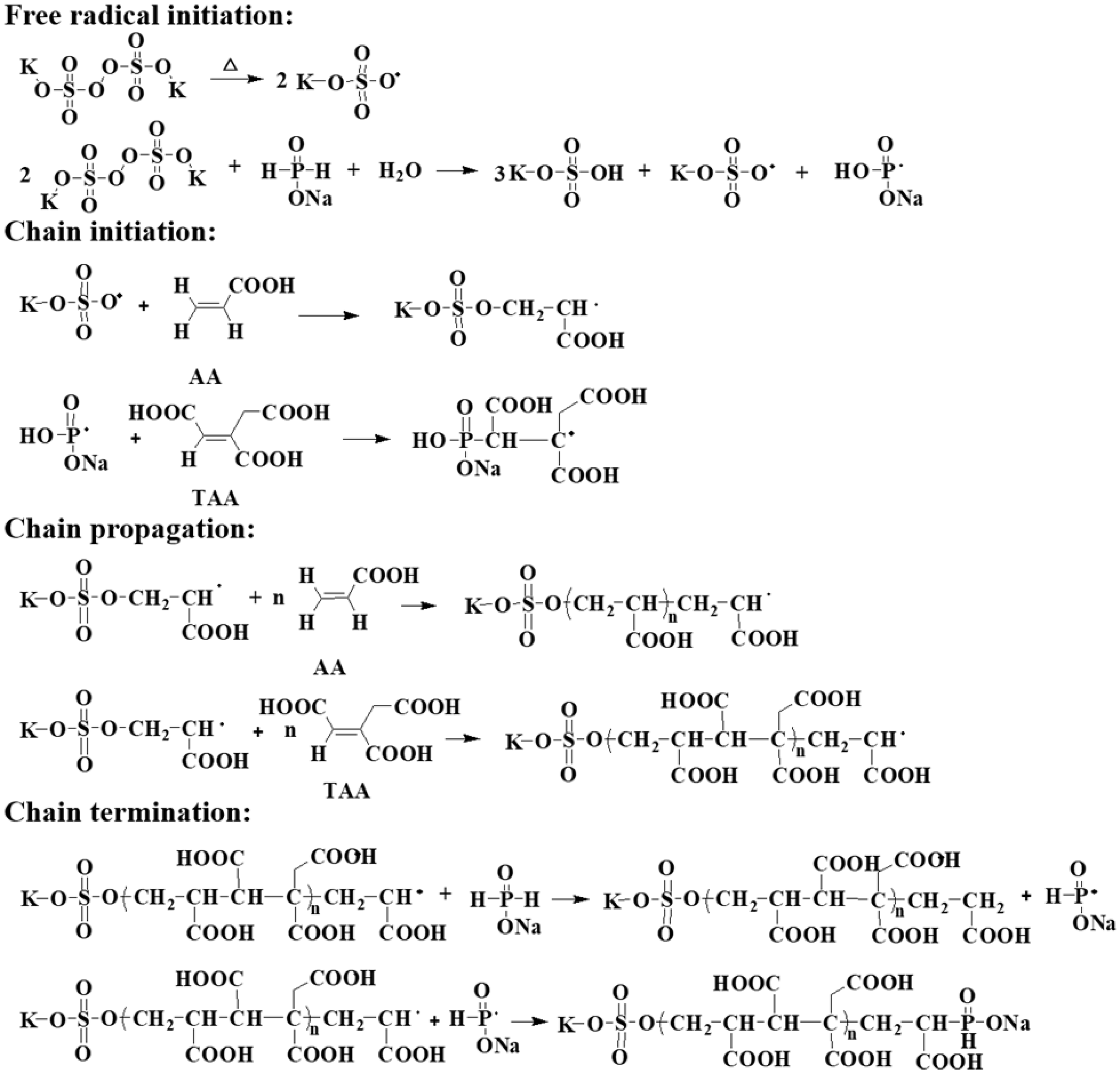
Proposed reaction of transaconitic acid (TAA) and acrylic acid (AA).
Compared with BTCA, the prepared P(TAA–AA) presents excellent solubility in water, which makes it convenient for the application. Besides, P(TAA–AA) shows more reactive groups and a more flexible molecular structure containing more methylene groups. The effect of the molecular differences on the wrinkle-resistant properties of the modified fabrics will be discussed in the following sections.
Characterization of P(TAA‒AA)
The obtained P(TAA‒AA) was produced in a M(TAA):M(AA) of 1:1 and M(TAA):M(K2S2O8) of 9:1 at around 90–95°C for 6 h. Figure 5(a) shows the ATR-FTIR spectra of TAA, AA, and P(TAA‒AA). The spectra of TAA and AA show the strong transmittance peak between 500 cm–1 and 1500 cm–1, and the transmittance peak at 800∼840 cm−1 is attributed to the stretching vibration of C‒H in the group of C=C–H. The transmittance peaks of the stretching vibration of C–O in C–OH groups of TAA and AA are located at 1043 cm–1 and 1210∼1240 cm–1, respectively. Besides, the sharp transmittance peak around 1700 cm–1 is attributed to the stretching vibration of C=O in the carboxyl groups of TAA and AA,4,27 and the spectrum of P(TAA‒AA) shows the similar transmittance peak around 1700 cm–1. However, the transmittance peak around 800∼840 cm–1 (the stretching vibration of C=C–H) disappeared, which confirmed that the reaction of TAA and AA occurred and produced P(TAA‒AA). The new transmittance peak around 1401 cm–1 and 1185 cm–1 corresponding to the stretching vibration of SO4– and HPO3–, indicated that the SO4– and HPO3– were incorporated into P(TAA‒AA). 31

(a) Attenuated total reflectance (ATR) infrared spectrum of different chemicals; (b) liquid chromatography mass spectrometry (LC-MS) spectrum of P(TAA–AA); (c) proposed structure of P(TAA–AA).
For the LC-MS analysis, we performed the measurement with electrospray (ESI), which can be used as a soft ionization technique for low-molecular-weight oligomers. 31 The low-molecular-weight oligomers processed with ESI usually generate little molecular fragment, 31 and the signals detected in the LC-MS spectrum can be regarded as the molecular weight of oligomers. The LC-MS spectrum of P(TAA‒AA) showed homologous series signals at m/z 424, 496, 568, and 640 (Figure 5b), which confirmed the repeat unit of AA (Figure 5c), and the signals can be expressed as [M]– = 135 + 72n. The signal at 452 was expressed as [M]– = 103 + 174 × 2 + 1 (Figure 5b), which was the repeat unit of TAA (Figure5c), and the signal found in 612 was expressed as [M]– = 135 + 174 + 72 × 3 + 87 (Figure 5b), which was attributed to the product of one TAA and three AA molecules (Figure 5c).
Proposed ester-crosslinking reaction mechanism
PCAs crosslink with cellulose in two steps: the two adjacent carboxyl groups in PCAs form a cyclic anhydride intermediate by dehydration, and then the cyclic anhydride further crosslinks with cellulose hydroxyl to form an ester linkage. 21 In order to investigate the crosslinking mechanism between P(TAA‒AA) and cellulose, the temperature-dependent FTIR analysis was carried out to monitor the formation of anhydride and ester bonds.
The temperature-dependent FTIR spectra of the P(TAA‒AA)-modified fibers are displayed in Figure 6. As presented in Figure 6(a), in the presence of the catalyst SHP, when the temperature increased from 30°C to 190°C, a new absorbance peak appeared near 1780 cm–1, which corresponded with the symmetric stretching vibration of the five-membered cyclic anhydride intermediate. 33 Meanwhile, the intensity of the absorbance peak at 1650 cm–1 (Figure 6(a)), which is related to the O–H bending vibration of water molecules, decreased significantly during the curing process. In detail, the peak intensity at 1780 cm–1 of P(TAA‒AA)-modified fibers heated from 30°C to 190°C are presented in Figure 6(c), and as observed the peak intensity of the band at 1780 cm–1 is rarely increased when the temperature increased from 30°C to 75°C. This indicated that the evaporation of water molecules occurred but there is little anhydride formed as the temperature increased from 30°C to 75°C. In the range of 75°C to 190°C (Figure 6(c)), the peak intensity at 1780 cm–1 increased abruptly, and the absorbance peak near 1724 cm–1 shifted to near 1733 cm–1 as the curing temperature increased to 190°C, indicating that the esterification occurred between the P(TAA‒AA) and cellulose chains. Due to the esterification occurring between cellulose and P(TAA‒AA), the intensity of the absorbance peak at 3420 cm–1 (Figure 6(b)), which corresponded with the stretching vibration of hydroxyl groups of cellulose fibers, showed a downtrend during the curing process. The results presented in Figure 6(a) proved that the five-membered cyclic anhydride intermediate was formed in the crosslinking process. Overall, as shown in Figure 7, the temperature-dependent FTIR analyses suggested that the mechanism of P(TAA‒AA) crosslinked with cellulose chains through the formation of a five-membered cyclic anhydride as an intermediate, and thereafter underwent an esterification crosslinking between cellulose chains and P(TAA‒AA) anhydride.

Temperature-dependent Fourier-transform infrared (FTIR) spectra of the P(TAA‒AA)-modified fibers on curing from 30°C to 190°C: (a) in the region of 1900–1550 cm–1, (b) in the region of 3600–2600 cm–1, and (c) the peak intensity of the band at 1780 cm–1.
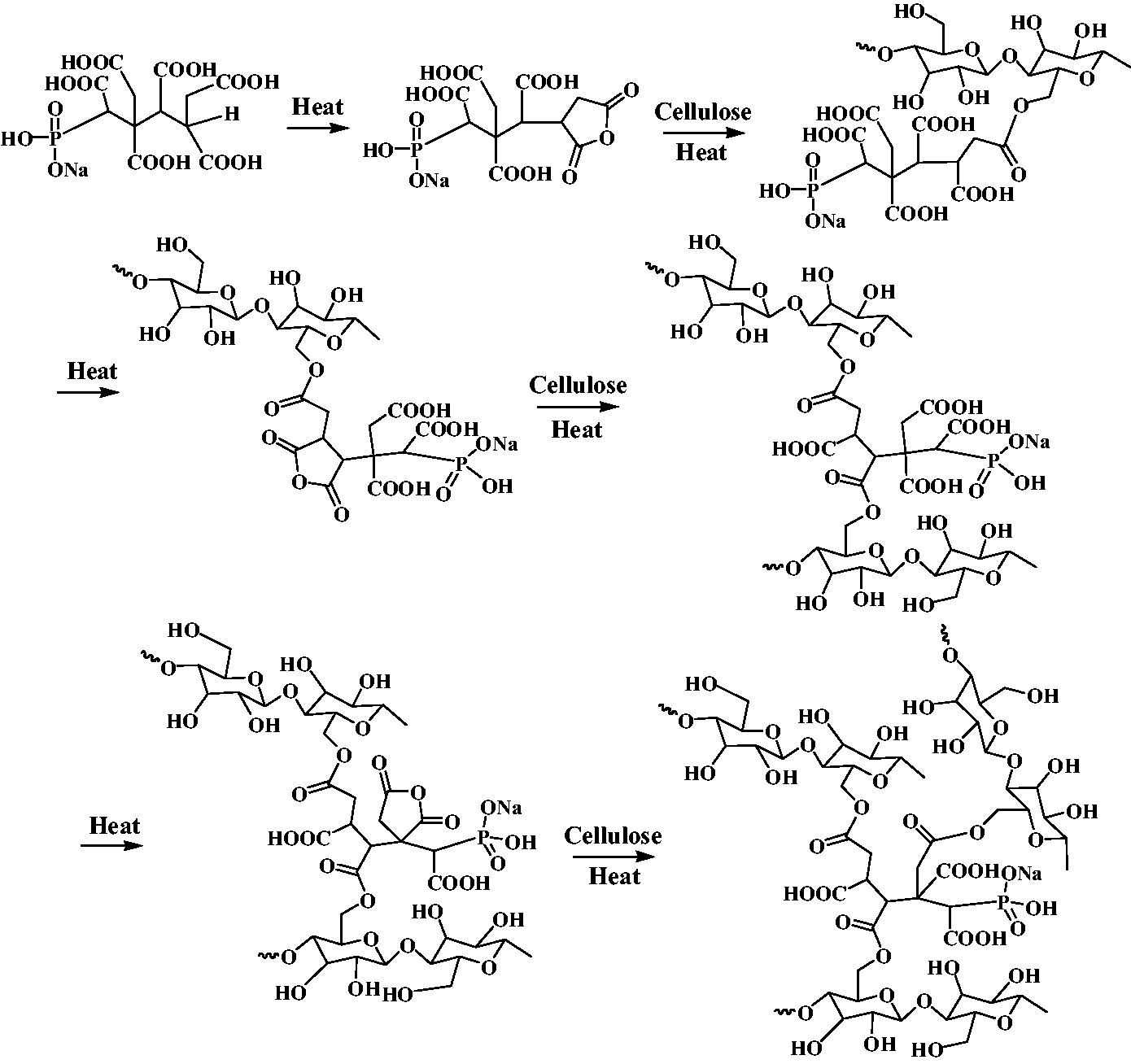
Proposed mechanism of crosslinking with P(TAA–AA).
Performance of P(TAA‒AA) crosslinking
The control sample presents a WRA value of about 130.0°, a WI value of approximately 74.0, and the TSR of control fabrics was 100%. To evaluate the effect of P(TAA–AA) in wrinkle-resistant treatment of cotton fabrics, different polycarboxylic acids (TAA, CA, BTCA, P(MA–AA), P(IA–AA), or P(TAA–AA)) were applied to modify cotton fabrics in the curing condition of 180°C × 2 min. The WRA and TSR of the cotton sample treated at 180°C × 2 min without chemical treatment were 131.5° and 98.4%, respectively, which indicates a little effect of heat treatment on WRA (130°) and TSR (100%) of the pristine fabrics.
Note: Modified conditions: P(TAA–AA) 140 g/l, TAA 65 g/l, CA 80 g/l, BTCA 85 g/l, P(MA–AA) 140 g/l, P(IA–AA) 160 g/l, SHP 44 g/l, cured at 180°C × 2 min. Ester bond absorbance was calculated with the intensity ratio of 1730 cm–1:2900 cm–1 in the FTIR spectroscopy.
The add-on (%) of different polycarboxylic acids on the modified fabrics are displayed as follows: TAA 3.9%, CA 5.16%, BTCA 5.6%, P(MA–AA) 5.4%, P(IA–AA) 5.28%, and P(TAA–AA) 5.8%, and the WRA and ester bond absorbance of modified samples are presented in Figure 8(a). The results in Figure 8(a) demonstrate that the add-on (%) of modified samples was positively correlated with the WRA and ester bond absorbance of modified samples. It should be noted that the carboxyl groups presented on TAA can esterify with the hydroxyl groups on cellulose chains. As reported, 21 it is quite difficult for TAA to form the second anhydride group due to its plane structure. The WRA of the TAA-modified and CA-modified fabrics are 229.2 ± 0.7° and 244.7 ± 4.3°, respectively (Figure 8(a)). The difference in the WRA values of the TAA and the CA-modified fabrics provide the evidence that the plane structure of TAA restricted the formation of the second anhydride groups and further failed to crosslink with cellulose chains. BTCA is currently considered to be the most effective crosslinking agent among polycarboxylic acids, and the WRA of the BTCA-modified fabrics is 268.8 ± 4.7°. The previous research demonstrated that the fabrics modified with P(MA‒AA) showed a comparable WRA of 255.1 ± 3.5° to the BTCA-modified fabrics. In addition, the fabrics modified with P(IA‒AA) showed a lower WRA of 245.1 ± 0.8° compared with the P(MA‒AA)-modified fabrics.24,25 Most importantly, the P(TAA‒AA)-modified samples showed a high WRA of 261.5 ± 0.3°, which was much higher than the WRA of TAA or CA-modified fabrics, as well as P(MA‒AA) or P(IA‒AA)-modified fabrics. As seen in Figure 5(c), the P(TAA‒AA) contains six carboxyl groups, and as a result, P(TAA‒AA) was quite easy to form anhydride groups and continues to react with cellulose chains, forming ester bonds, which ultimately enhanced the WRA. As seen from Figure 8(a), a higher WRA indicated more ester crosslinking formed inside cellulose, which brought an increase of ester bond absorbance.

Properties of cotton samples modified with different polycarboxylic acids: (a) Wrinkle recovery angle (WRA) and ester bond absorbance; (b) Tearing strength retention (TSR) and whiteness index (WI).
Figure 8(b) indicates the TSR and the WI of modified samples. The mechanical strength loss of crosslinking modification fabrics was attributed to the crosslinkage of cellulose chains, which restricted the movement between different cellulose chains. However, a flexible molecular chain of crosslinking agents will reduce the limited movement of cellulose chains, which enhances the mechanical strength of crosslinking modification fabrics. 25 The acidic degradation of cellulose chains is another reason for reducing the mechanical strength of the modified fabrics. 6 The TSR value of TAA, CA, or BTCA-modified fabrics was 53.1%, 45.8%, and 34.9%, respectively, which was always inversely proportional to the WRA value of the modified samples (Figure 8). As mentioned above, a higher WRA indicated more ester crosslinking formed inside cellulose, resulting in a lower mechanical strength. The similar conclusion applies to the P(MA‒AA) and P(IA‒AA)-modified cotton (Figure 8). However, the P(TAA‒AA)-modified samples showed a WRA of 261.5 ± 0.3° and a TSR of 62.9%, which reached the goal of achieving a high TSR and a high WRA value for the modified fabrics simultaneously. Figure 2 indicates that P(IA‒AA) contains more methylene but fewer adjacent carboxyl groups in molecules, as a result, the P(IA‒AA)-modified cotton showed a high TSR of 59.3% but a low WRA of 245.1 ± 0.8°. On the contrary, P(MA‒AA) exhibited more adjacent carboxyl groups but less methylene, therefore, in spite of the WRA value of 255.1 ± 3.5° of P(MA‒AA)-modified cotton fabrics, the TSR of 51.2% was unsatisfactory. Interestingly, P(TAA‒AA) combines the advantages of both methylene and adjacent carboxyl groups (Figure 5(c)). The rotatable methylene in P(TAA‒AA) may reduce the stress concentration under external force, consequently reducing the strength loss of crosslinked fabrics. On the other hand, the P(TAA‒AA) containing multiple and adjacent carboxyl groups presents a high crosslinking efficiency with cellulose and further enhances the WRA of P(TAA‒AA)-modified fabrics.
The WI value of crosslinking modification cotton is one of the most important evaluations, Figure 8(b) presents the WI value of fabrics modified with different polycarboxylic acids. The BTCA, P(MA‒AA) or P(IA‒AA)-modified cotton showed a WI value of 71.5, 76.2, and 77.3, respectively. The TAA or CA-modified fabrics showed a sharp reduction of WI with a value of 46.9 and 51.6, respectively. In addition, the WI value of fabrics after modification with P(TAA‒AA) (66.3) was much higher than that of the TAA (46.9) and CA-modified fabrics (51.6). The yellowish appearance of TAA and CA-modified fabrics was attributed to the existence of unsaturated double bonds.
Overall, the P(TAA‒AA)-modified fabrics displayed the highest TSR value while maintaining a comparable WRA with the BTCA-modified fabrics. The result indicated that the obtained P(TAA‒AA) can be an alternative crosslinking agent to BTCA and CA.
Characterization of P(TAA‒AA)-modified fabrics
Figure 9(a) shows the Raman spectra of the P(TAA‒AA)-modified and control fibers. The absorbance peak around 1095 cm–1 corresponds to the stretching vibration of glycosidic link (C–O–C) in viscose fiber. Obviously, a new absorbance peak appearing at 1733 cm–1, which is attributed to the stretching vibration of C=O in ester bonds, was observed in the Raman spectrum of the P(TAA‒AA)-modified fiber, and this new peak confirmed the esterification between P(TAA‒AA) carboxyl groups and cellulose hydroxyl groups. 4 Figure 9(b) presents the proposed ester crosslinking between P(TAA‒AA) and cellulose chains. Figure 9(c) and (d) displays the true reflection of the surface and the half cross-section of the control fiber, respectively. Figure 9(e) and (f) displays the true reflection of the Raman intensities of control and modified fiber at around 1730 cm–1, respectively. The Raman intensity range in Figure 9(d–f) is from 0 to 450, and in detail the Raman intensity of the blue area is 0 and the Raman intensity of the red area is 450, which represents a strong absorbance of the specific functional group. The distribution of the red region in Figure 9(d) shows that the cross-section inside the fiber was uniform, and the Raman intensity of the control fiber at 1730 cm–1 is weak (Figure 9(e)). However, the Raman intensity of the P(TAA‒AA)-modified fiber at 1730 cm−1 is evenly distributed inside the amorphous region of the fiber (Figure 9(f)), indicating that P(TAA‒AA) can diffuse into the amorphous regions of the cellulose fibers and form crosslinking bridges between cellulose chains (Figure 9(f)). As seen from Figure 5(c), the P(TAA‒AA) shows six carboxyl groups, and the two adjacent carboxyl groups can easily form a five-membered cyclic anhydride, which further reacts with the hydroxyl groups in cellulose. Three or more ester bonds may be formed between each P(TAA‒AA) molecule and different cellulose chains (Figure 9(b)), and as a result, three-dimensional crosslinking networks were formed between cellulose chains to introduce a durable wrinkle-resistant properties to the modified fabrics. Moreover, the flexible molecular chains of methylene in the P(TAA‒AA) results in the flexible movement of cellulose chains under the external force, which is beneficial to reduce the strength loss of the modified fabrics (Figure 9(b)). 24,25,33

(a) Raman spectra of the control and the P(TAA‒AA)-modified fabrics; (b) The proposed crosslinking of cellulose chains with P(TAA‒AA); (c) The surface of viscose fiber; Raman depth mapping images of (d) a control fiber at 1095 cm–1, (e) a control fiber at 1730 cm–1, and (f) the P(TAA‒AA)-modified fiber at 1730 cm−1.
Surface morphology of fibers
To observe further the surface morphology of fibers, the SEM images of control and P(TAA‒AA)-modified fabrics were obtained. Figure 10(a) indicates that the control fibers are naturally distorted, which is the characteristic of cotton fibers, and the magnified images in Figure 10(b) show a smooth surface of control fibers. After modification with P(TAA‒AA), Figure 10(c) displays that the crease and natural distortion of modified fibers are reduced, and the magnified images in Figure 10(b) demonstrate that the P(TAA‒AA)-modified fibers shows the similar smooth surface to the control fibers. Figure 10 explains that there is no damage and no resin coating on the surface of the modified sample, and indirectly confirms that the crosslinking reaction between P(TAA‒AA) and cellulose occurs inside the fiber.
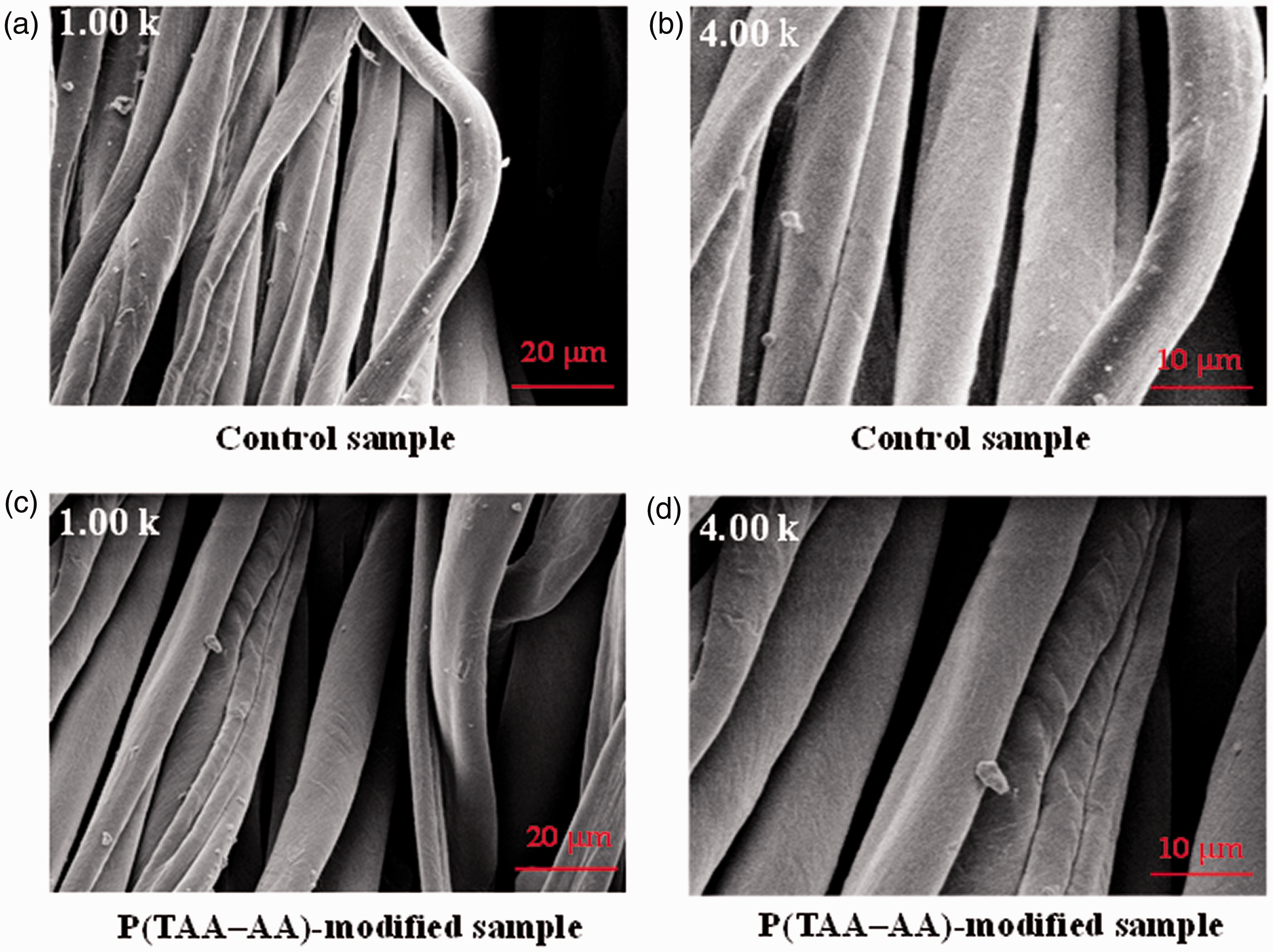
Scanning electron microscopy (SEM) images of (a), (b) control and (c), (d) P(TAA‒AA)-modified samples.
Evaluation of laundering durability
To evaluate the durability of wrinkle-resistant properties, cotton fabrics were modified with 140 g/l P(TAA‒AA) and cured at 180°C × 2 min. Subsequently, the modified samples were washed repeatedly five to twenty times. As washing time increases, a decrease in the WRA value was observed in Figure 11. The ester crosslinking inside the cellulose chains formed between carboxyl groups of P(TAA–AA) and hydroxyl groups of cellulose. 21 The reduction of WRA may be attributed to the hydrolysis of ester bonds formed inside the cellulose fibers during laundering. Overall, the P(TAA–AA)-modified fabrics showed a durable performance.
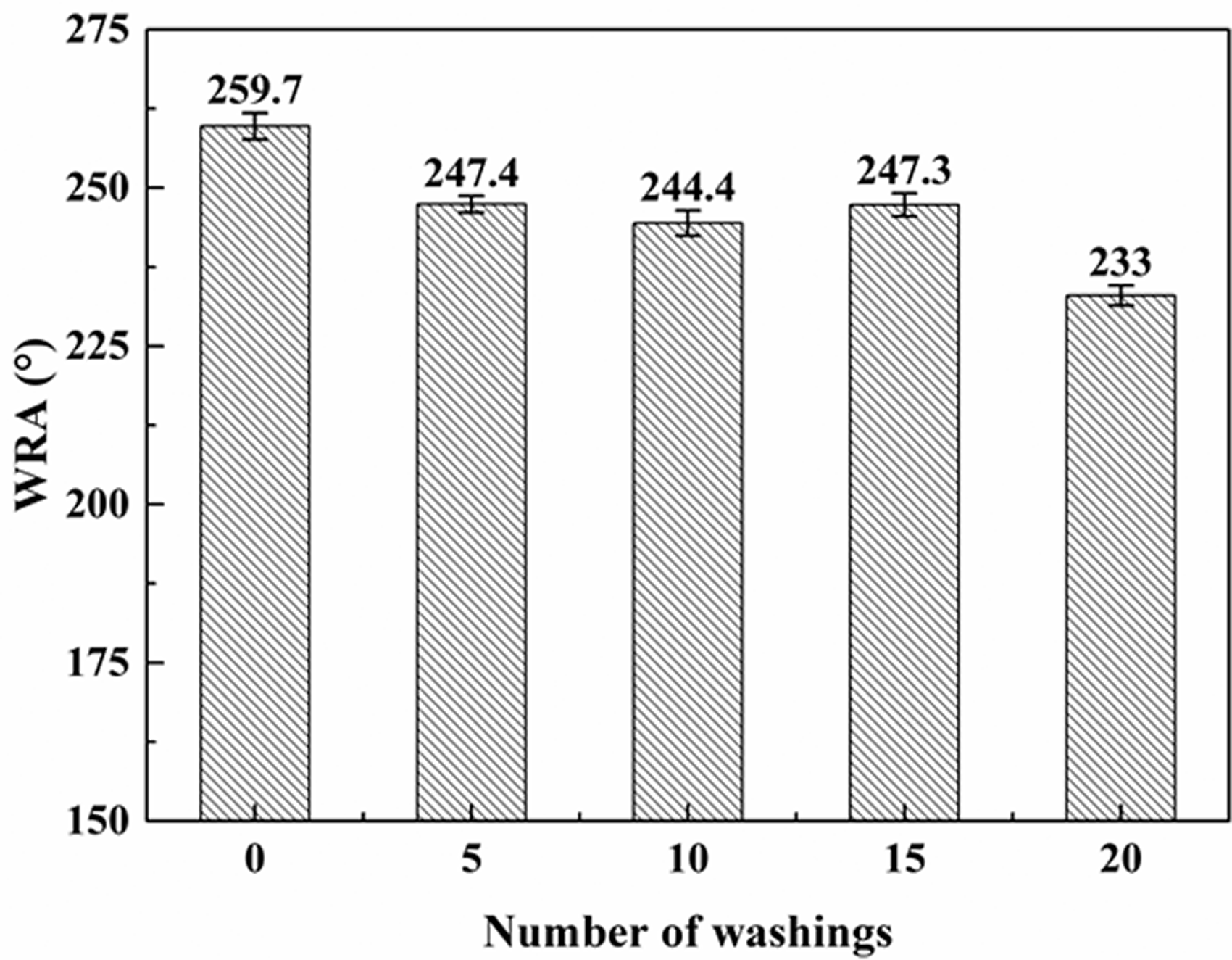
Change of wrinkle recovery angle (WRA) after repeated washing.
Conclusion
A novel crosslinking agent, P(TAA‒AA), with multiple carboxyl groups was prepared in this work. The application of P(TAA‒AA) in the modification of cotton fabrics was investigated in detail. The WRA of 261.5 ± 0.3° of the P(TAA‒AA)-modified fabrics were comparable with that of the BTCA-modified fabrics, while the P(TAA‒AA)-modified fabrics maintained a high TSR of 62.9%, nearly twofold higher than others. Besides this, the WI (66.3) of fabrics treated with P(TAA‒AA) was much higher than that of the CA-modified fabrics. The multiple carboxyl groups in P(TAA‒AA) provided high crosslinking efficiency with cellulose, and the proposed three-dimensional crosslinking bridges with different cellulose chains through P(TAA‒AA) endowed a good durability to the modified fabrics against laundry. The SEM images and the Raman depth mapping images of the modified sample at 1730 cm–1 indicate that the P(TAA‒AA) molecules diffused into and distributed evenly inside the amorphous region of the cellulose fibers, which may be an important reason to bring the high WRA and TSR to the modified fabrics simultaneously. The temperature-dependent FTIR analyses suggested that P(TAA‒AA) crosslinked with cellulose chains through the formation of a five-membered cyclic anhydride as an intermediate, and thereafter underwent an esterification crosslinking between cellulose chains and P(TAA‒AA) anhydride. Overall, the excellent wrinkle-resistant performance indicated that the prepared P(TAA‒AA) can be a good alternative crosslinking agent to BTCA and CA for the wrinkle-resistant treatment of cotton fabrics.
Footnotes
Declaration of conflicting interests
The author(s) declared no potential conflicts of interest with respect to the research, authorship, and/or publication of this article.
Funding
The authors disclosed receipt of the following financial support for the research, authorship, and/or publication of this article: This research was funded by the National Natural Science Foundation of China (51803025), the Fundamental Research Funds for the Central Universities (2232020D-21), the State Key Laboratory of Bio-Fibers and Eco-Textiles (KF2020213), and the State Key Laboratory of New Textile Materials and Advanced Processing Technologies (FZ2020010).
