



Abstract
Highly conductive, flexible, stretchable and lightweight electrode substrates are essential to meet the future demand on supercapacitors for wearable electronics. However, it is difficult to achieve the above characteristics simultaneously. In this study, ultrafine stainless-steel fibers (with a diameter of ≈30 μm) are knitted into stainless-steel meshes (SSMs) with a diamond structure for the fabrication of textile stretchable electrodes and current collectors. The electrodes are fabricated by utilizing an electrodeposited three-dimensional network graphene framework and poly(3,4-ethylenedioxythiophene) (PEDOT) coating on the SSM substrates via a two-step electrodeposition process, which show a specific capacitance of 77.09 F g−1 (0.14 A g−1) and superb cycling stability (91% capacitance retention after 5000 cycles). Furthermore, the assembled flexible stretchable supercapacitor based on the PEDOT/reduced graphene oxide (RGO)@SSM electrodes exhibits an areal capacitance (53 mF cm−2 at 0.1 mA cm−2), a good cycling stability (≈73% capacitance retention after 5000 cycles), rate capability (36 mF cm−2 at 5 mA cm−2), stretchable stability (≈78% capacitance retention at 10% strain for 500 stretching cycles) and outstanding flexibility and stability under various bending deformations. The assembled supercapacitors can illuminate a thermometer and a light-emitting diode, demonstrating their potential application as stretchable supercapacitors. This simple and low-cost method developed for fabricating lightweight, stretchable and stable high-performance supercapacitors offers new opportunities for future stretchable electronic devices.
Flexible stretchable supercapacitors (SCs), which are one of the promising energy storage devices, can be utilized for a variety of high-power supplies for wearable functional integrated electronics due to their peculiarity of miniaturization, light weight, stretchability, high security and comfortable attachment to the human body.1,2 In comparison with photovoltaic cells, Na/Mg-ion batteries, Li-ion batteries and traditional capacitors, SCs provide higher power densities, longer cycle life, faster charge–discharge rates and simpler structures, which are critically required for wearable electronics.3,4 In terms of the SC dimension, SCs represented by one-dimensional (1D) fiber SCs and two-dimensional (2D) planar SCs have been explored extensively. The 2D planar SCs have the merits of light weight, ultra-thin thickness, ease of handling in appearance and integration into clothing.
In general, flexible stretchable SCs are comprised of a flexible stretchable electrode material and solid-state electrolyte. Electrode substrates with high stretchability or good flexibility are the key basic materials for wearable SCs. The current collector should have high electrical conductivity, high mechanical strength/modulus, light weight, high thermal stability, high electrochemical stability and low cost.5,6 In recent years, numerous efforts have been dedicated to fabricate flexible stretchable SCs, and stretchable electrodes can be categorized into two different types depending on the material and structure. The first type includes electrodes with elastomer substrates (polydimethylsiloxane (PDMS),7,8 silicone rubber (Ecoflex) 9 and polyurethane (PU) 10 ) and conductive materials. However, these stretchable SCs have disadvantages such as poor air-tightness, high resistance, low capacitance and poor tensile properties. The second type includes electrodes with stretchable structures (wave structures,11–14 twisted structures,15–17 spring structures,18–20 polygonal structures 21 and stretchable fabric (woven fabric and knitted fabric)) and conductive materials. Among those, stretchable fabrics, especially woven and knitted fabrics, due to their excellent security, flexibility and comfortable attachment to human body, are a good choice for stretchable electrode substrates for wearable SCs. From literature reports, the elongation of the weft knitted fabric can also reach 100% extension 22 and the woven fabric stretches by the slip of the yarn, which can damage the fabric structure and reduce the electrode performance.23–25 In addition, the fabric itself is not conductive, so it also has to be treated for conductivity. However, the reported stretchable fabrics exhibit relatively low tensile recoveries, thus limiting their applicability.
Taking into account the stretchable characteristics of SCs, it found that mass produced stainless-steel mesh (SSM) with a diamond-shaped warp knitting grid structure formed by double comb satin, knitted by ultrafine stainless-steel fibers with a diameter of 30 μm, endows excellent stretchability (elongation can reach 100%) and light weight (with area density of 22 g m−2) characteristics. This excellent stretchability in the fabric with the higher elongation rate is reported in all literatures. In addition, stainless steel is a suitable substrate material for the preparation of SCs due to its conductivity, low cost, rough surface, corrosion resistance and good availability.1,26 The mesh structure of the SSM not only endows the SSM with excellent flexibility, light weight and stretchability over other fabric, but also further strengthens its conductive properties, which act as a flexible stretchable current collector. The SSM could an appropriate material for the fabrication of stretchable electrodes, However, this needs further demonstration.
Herein, we employed a novel SSM with diamond-shaped warp as the conductive substrate to prepare a flexible and stretchable all-solid-state SC. Then, poly(3,4-ethylenedioxythiophene) (PEDOT) coatings covered with a three-dimensional (3D) network-like graphene framework are grown directly on the surface of conductive SSM through a two-step electrodeposition process in a three-electrode cell. The highly exposed surface areas of the 3D graphene network largely enhances the specific surface area of the SSM to further deposit PEDOT coatings. Herein, a symmetric SC was assembled using PEDOT/reduced graphene oxide (RGO)@SSM as the stretchable electrodes and polyvinyl alcohol (PVA)/H3PO4 as the gel electrolyte. This work presents a simple and low-cost strategy to fabricate SCs for wearable electronic devices.
Experimental details
Materials
Fibers of 316 L stainless steel were bought from the Laiwu Longzhi metal yarn company. Single layer graphene oxide powder (GO, diameter 0.5–5 μm, thickness 0.8–1.2 nm) was bought from Nanjing XFNANO Materials Tech Co., Ltd, China. Sodium dodecyl sulfate (SDS, chemically pure), acetone (CH3COCH3, 99.5%), 3,4-ethoxylene dioxy thiophene (EDOT, 99% mass fraction), phosphoric acid (H3PO4, 85%), PVA (Mw ∼ 67,000), LiClO4 (99% mass fraction) and ethanol (C2H5OH, 99.7%) were bought from Sinopharm Chemical Reagent Co., Ltd, China. The water used throughout all experiments was purified through a Millipore system.
Pretreatment of SSM: the mass-produced SSMs was knitted by a modified Raschel warp knitting machine on the basis of 316 L stainless-steel fibers serving as the original material. The diameter of the 316L stainless-steel fibers is 30 μm. The area density of the SSM is 22 g m−2. The SSM was cleaned using acetone, ethanol and deionized water for 30 min under sonication, respectively, and then dried at 60°C for 2 h. Finally, the cleaned SSM was cut into a rectangular shape (1.4 cm × 2.5 cm) for the following preparation of the electrode.
Preparation of PEDOT/RGO@SSM electrode
The PEDOT/RGO@SSM composite electrode was fabricated by a two-step electrodeposition process in a three-electrode cell. RGO was first electrochemically deposited on the rough surface of SSM in an electrolyte comprising GO aqueous suspension (3 mg · mL−1) and LiClO4 (0.1 M) with a constant voltage of –1.2 V for 300 s. After electrodeposition, the obtained RGO@SSM was rinsed with deionized water several times and immersed in deionized water for further electrodeposition. Thereafter, the resultant SSM was further electrodeposited with PEDOT at 1 V for 180 s in an electrolyte containing 0.05 M EDOT, 0.07 M SDS and 0.1 M LiClO4. The as-prepared PEDOT/RGO@SSM was fully washed with deionized water and dried in a vacuum oven at 60°C for 2 h. Platinum (Pt) foils and Ag/AgCl (3 M KCl) served as counter and reference electrodes, respectively. The mass loading of PEDOT/RGO was ≈1 mg. For control experiments, the RGO@SSM and PEDOT@SSM were fabricated by the same method. The PEDOT@SSM was dried at 60°C for 2 h and the RGO@SSM was immersed in deionized water before electrochemical tests.
Fabrication of symmetric stretchable supercapacitors
The PVA/H3PO4 gel electrolyte was fabricated as follows: 2 g PVA were added to 20 mL deionized water and the as-obtained solution was heated to 90°C for 30 min, then 2 g H3PO4 was added into the gel solution under stirring and stirring was continued for 90 min at 90°C. 27 The two pieces of PEDOT/RGO@SSM were dipped in the above PVA/H3PO4 gel electrolyte for 15 min and taken out to vaporize the excess water. After three sets of immersion and drying, a polymer gel electrolyte layer is formed on the electrode surface. Subsequently, the two electrodes were pressed together under a suitable pressure for 5 min so that the polymer gel electrolyte on each electrode merged into a thin membrane, and therefore the two electrodes were closely adhered together.
Material characterization
The morphologies of the samples were obtained by field-emission scanning electron microscopy (FESEM, JSM-7500F). The Raman spectra of the samples were recorded using a Raman spectrometer (InVia-Reflex, excitation wavelength 532 nm). X-ray photoelectron spectroscopy (XPS, ESCALAB 250, Thermo Electron VG Scientific, USA) was carried out to study the chemical states of the elements. The deconvolution analysis of S 2p peaks was performed by XPS-PEAK software. The strain–stress curves of the as-prepared SC were obtained using a microcomputer control electron universal testing machine (MTS Systems Co., Ltd, China). The images of the samples were taken with a camera.
Electrochemical measurements
The electrochemical tests of the PEDOT/RGO@SSM electrode were performed by cyclic voltammetry (CV), galvanostatic charge–discharge (GCD) and electrochemical impedance spectroscopy (EIS) on an IVIUM electrochemical workstation (Tianjin Brillante Technology Limited, Netherlands). All electrochemical measurements were tested utilizing a standard three-electrode cell in a 1 M H3PO4 aqueous electrolyte with Ag/AgCl (3 M KCl) as the reference electrode and platinum (Pt) foils as the counter. The CV and GCD curves were carried out in the range from 0 to 0.8 V. Moreover, EIS measurement was investigated from 0.01 to 100 kHz with an ac perturbation of 10 mV.
Electrochemical characterization of single electrodes: the specific capacitance of the electrodes can be calculated from the GCD curves in a three-electrode cell by using the following equations


Electrochemical characterization of symmetric SCs: the specific mass capacitance (





Results and discussion
Fabrication and characterization of the PEDOT/RGO@SSM textile electrode
As schematically illustrated in Figure 1(a), PEDOT covered with 3D RGO structures was uniformly grown on the SSM surface through a facile two-step electrochemical deposition method. Figure 1(b) illustrates the lapping diagram of the SSM with a diamond-shaped warp knitting grid structure, for which the lapping movements are GB1: 1-0/1-2/2-3/2-1//and GB2: 2-3/2-1/1-0/1-2//. As shown in Figure 1(c), the original stainless-steel fiber with a diameter of about 30 μm was rough, which facilitates the direct growth of 3D RGO structures on the surface. Figure 1(d) shows that the stainless-steel fiber is coated with a sheath of 3D porous network-like graphene framework. 28 The deposited graphene sheets encompass the stainless-steel fiber with the graphene planes almost directional to the stainless-steel fiber surface, which enlarges the specific surface area of the SSM to further deposit pseudocapacitance materials. Figure 1(e) shows that the SSM surrounded by RGO nanosheets is uniformly coated by PEDOT. 29 In addition, the elemental mapping of the single stainless-steel fiber clearly demonstrate the homogeneous distribution of S (green), C (yellow) and O (red) over the whole fiber (Figure 1(f)). Figure 1(g) shows that the PEDOT/RGO@SSM electrode was fabricated by pristine SSM (1.4 cm × 2.5 cm) using a two-step electrodeposition process, which caused the color of the SSM to change from silver to black. In addition, the inset presents a SSM sample with dimensions of 1.4 cm × 2.5 cm, which appears as an approximately hollow tube in the natural condition, indicating the high flexibility and softness of the SSM. More importantly, the SSM exhibited remarkable elasticity and was easily stretchable up to 50% (Figure 1(h)), which is attributed to the prismatic structure of SSM. Moreover, a PEDOT/RGO@SSM sample on a flower indicates its ultralight property (Figure 1(i)).
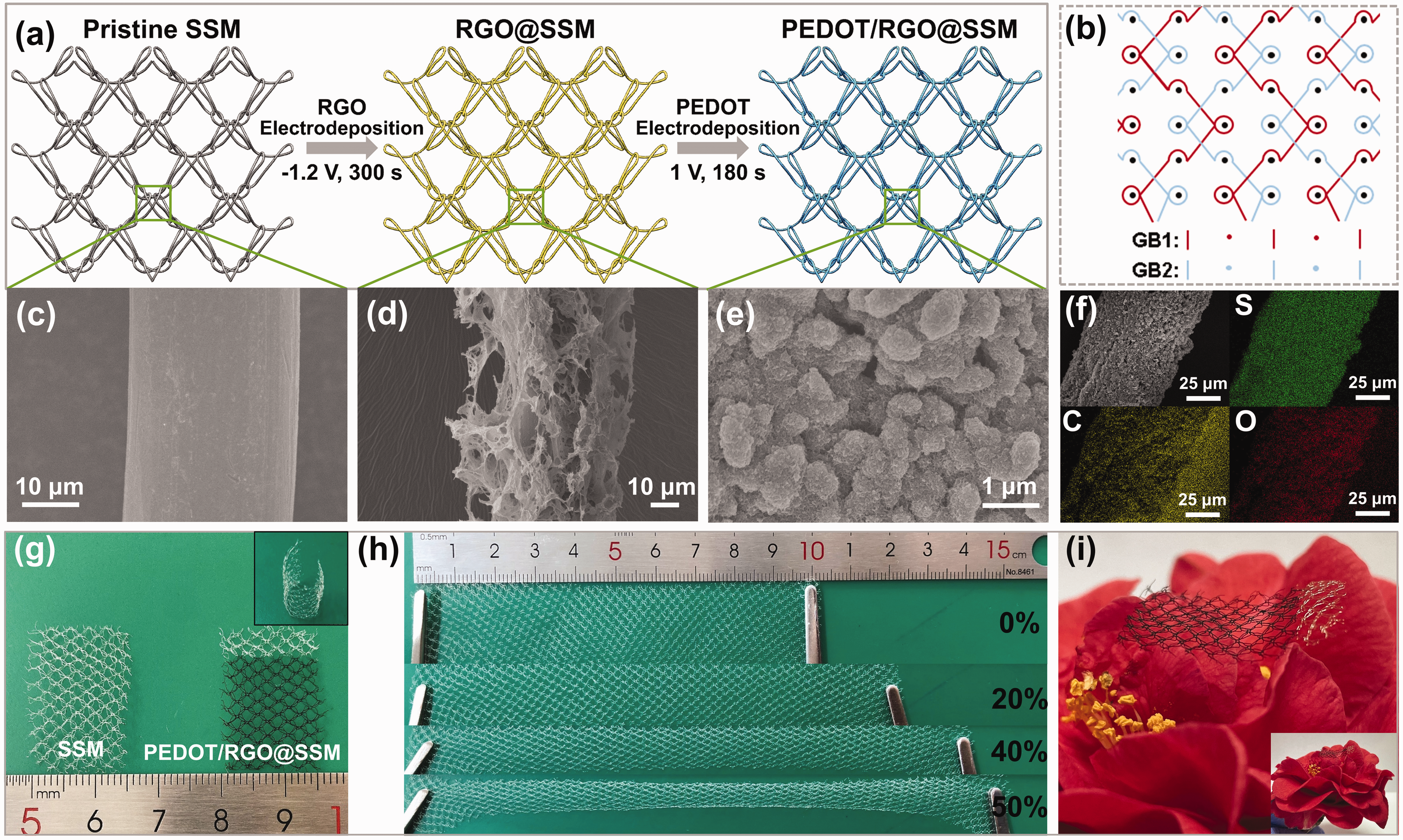
(a) Illustration of the fabrication procedure of the poly(3,4-ethylenedioxythiophene) (PEDOT)/reduced graphene oxide (RGO)@stainless-steel mesh (SSM) electrode. (b) The lapping diagram of the SSM. Field-emission scanning electron microscopy images of (c) pristine stainless-steel fiber, (d) RGO@SSM and (e) PEDOT/RGO@SSM. (f) Elemental mapping of different elements in the PEDOT/RGO@SSM sample. (g) Images of the pristine SSM and PEDOT/RGO@SSM samples. The inset presents the curled SSM with dimension of 1.4 cm × 2.5 cm in the natural state. (h) Image of the SSM treated at various tensile elongations. (i) PEDOT/RGO@SSM sample on a flower. (Color online only.)
Raman spectroscopy and XPS were utilized to study the composition and structural changes of the samples. Figures 2(a) and (b) present the Raman spectra collected for the GO, RGO@SSM, PEDOT@SSM and PEDOT/RGO@SSM. The spectrum of GO and RGO@SSM has two dominant peaks at 1597 and 1343 cm−1, corresponding to its G and D bands, respectively. 30 The D-band is relevant to structural defects or partially disordered structures in the graphite domain and the G-band is associated with graphitic carbon. 31 The intensity ratio (ID/IG) of RGO@SSM increased compared to that of GO,32,33 demonstrating the deposition of RGO on the SSM surface. After coating with PEDOT, the peak intensity of RGO becomes inconspicuous and the peaks of PEDOT emerged. The characteristic Raman peaks of the PEDOT, including 1430 cm−1 (C=C symmetric stretching vibration), 1366 cm−1 (Cα-Cα stretching vibration) and 1510 cm−1 (asymmetric C=C stretching vibration), are observed for the PEDOT/RGO@SSM,34–37 indicating that PEDOT exists in the PEDOT/RGO@SSM sample. XPS measurements was further used to analyze the chemical states of the elements of the as-prepared PEDOT/RGO@SSM sample and the corresponding results are shown in Figure 2(c). The S 2p spectrum shows that the binding energies at 167.6 and 166.5 eV can be assigned to S 2p1/2 and S 2p3/2, 34 respectively (Figure 2(d)). Therefore, the results further demonstrate the successful fabrication of PEDOT coating.

(a), (b) Raman spectrum of the graphene oxide (GO), reduced graphene oxide (RGO)@stainless-steel mesh (SSM), poly(3,4-ethylenedioxythiophene) (PEDOT)@SSM and PEDOT/RGO@SSM. (c) Full X-ray photoelectron spectra and (d) S 2p spectrum of PEDOT/RGO@SSM.
The CV and GCD curves of the RGO@SSM and PEDOT@SSM electrodes can be observed in Figure 3. As shown in Figure 3(a), each similar rectangular shape is accompanied by a pair of redox peaks, which are attributed to the electrochemical double layer capacitance of the 3D graphene sheet layer and the pseudocapacitance caused by the residual oxygen-containing groups on the surface of the RGO. The CV curves of the PEDOT@SSM electrode show an ideal rectangular shape (Figure 3(b)). As can be observed from the Figures 3(c) and (d), the nearly triangular shape of the GCD curves of the RGO@SSM and PEDOT@SSM electrodes suggests good reversibility behavior. Furthermore, the cycling performance of the RGO@SSM and PEDOT@SSM electrodes are presented in Figure 3(e).
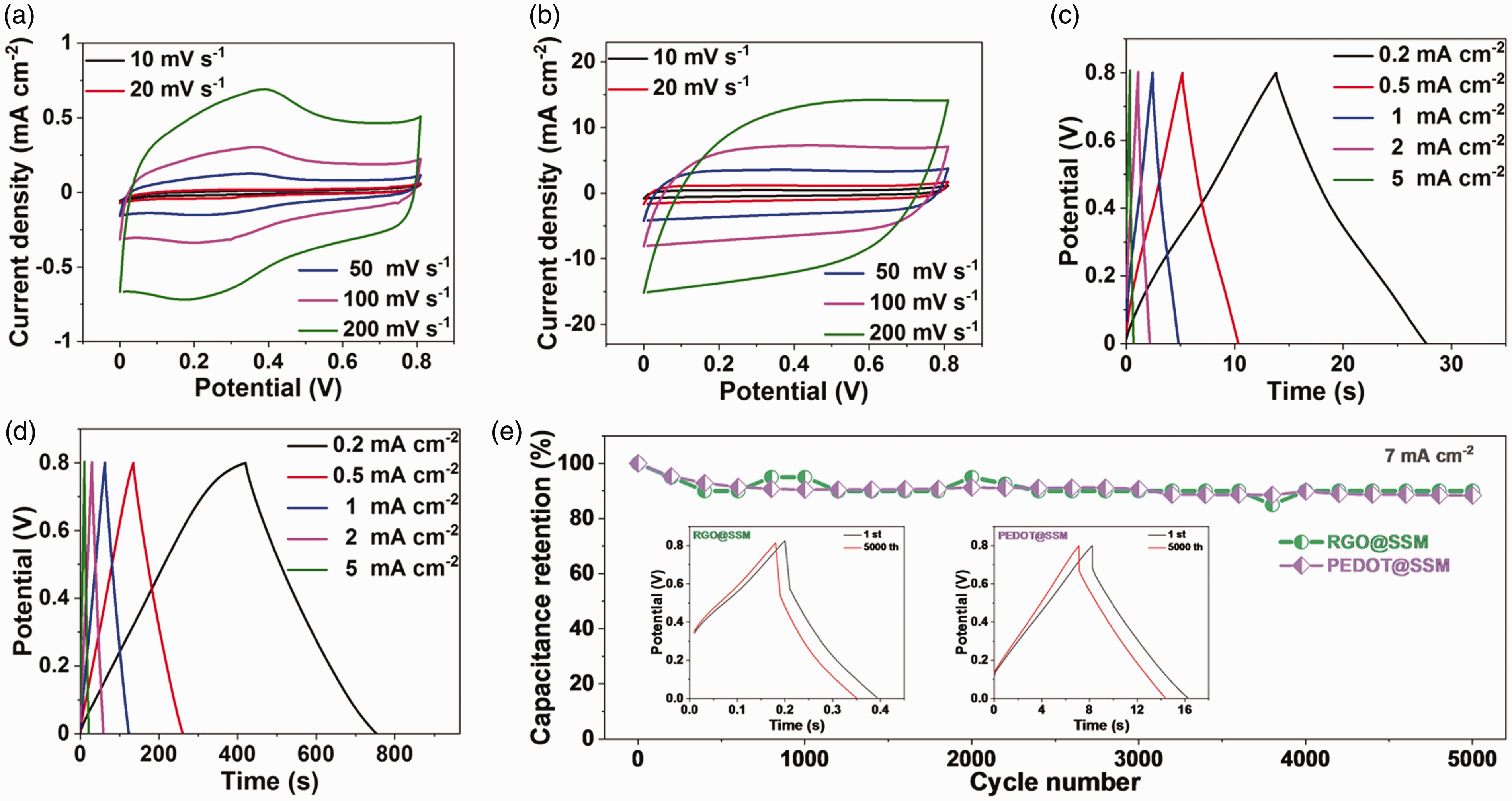
(a), (b) Cyclic voltammetry curves of the reduced graphene oxide (RGO)@ stainless-steel mesh (SSM) and poly(3,4-ethylenedioxythiophene) (PEDOT)@SSM electrodes measured at different scan rates. (c), (d) Galvanostatic charge–discharge (GCD) curves of RGO@SSM and PEDOT@SSM under different constant current densities. (e) Cycling performance of the RGO@SSM and PEDOT@SSM electrodes at 7 mA cm−2. The inset presents GCD curves of the RGO@SSM and PEDOT@SSM electrodes at initial and 5000 cycles, respectively.
Figure 4(a) compares the CV curves of RGO@SSM, PEDOT@SSM and PEDOT/RGO@SSM measured within a potential window of 0–0.8 V at the same scan rate of 50 mV s−1. Among the three types of electrodes, PEDOT/RGO@SSM exhibits the highest current density, indicating a remarkable improvement of the electrochemical capacitance, which is due to the synergistic effect arising from the 3D porous network-like RGO framework and PEDOT nanostructures. In addition, GCD curves of RGO@SSM, PEDOT@SSM and PEDOT/RGO@SSM at a current density of 0.2 mA cm−2 are also collected (Figure 4(b)). In comparison with RGO@SSM and PEDOT@SSM, the PEDOT/RGO@SSM electrode has a better symmetry and longer discharge time. Both CV and GCD measurements indicated that PEDOT/RGO@SSM possesses the best electrochemical performance. Moreover, based on the discharging time, the areal capacitance can be calculated. As can be observed from the Figure 4(c), the PEDOT/RGO@SSM electrode exhibited the highest specific capacitance. EIS was conducted to investigate the properties of the RGO@SSM, PEDOT@SSM and PEDOT/RGO@SSM samples (Figure 4(d)). All plots show a straight line in the low-frequency region and part of a semicircle in the high-frequency region, corresponding to the diffusion process and electron-transfer process, respectively.38,39 By comparison, Faradaic charge-transfer resistance of the RGO@SSM electrode is much larger than that of the PEDOT@SSM and PEDOT/RGO@SSM electrodes, which is attributed to the incorporation of PEDOT coating improving the conductivity of PEDOT/RGO@SSM, so that it shows the most significant charge transport property. Moreover, in the low-frequency region, the PEDOT/RGO@SSM electrode presents a nearly vertical profile, showing an ideal SC behavior.

Comparison between the reduced graphene oxide (RGO)@stainless-steel mesh (SSM), poly(3,4-ethylenedioxythiophene) (PEDOT)@SSM and PEDOT/RGO@SSM electrodes: (a) cyclic voltammetry curves at a scan rate of 50 mV s−1; (b) galvanostatic charge–discharge curves at 0.2 mA cm−2; (c) areal capacitance with respect to discharge current densities; (d) electrochemical impedance spectroscopy curves.
The CV curves of the PEDOT/RGO@SSM electrode were acquired within a potential window of 0–0.8 V at different scan rates (10–200 mV s−1) (Figures 5(a) and (b)). The CV curves exhibit quasi-rectangular shapes, presenting the standard capacitance behavior. The CV curves not only have a similar shape, but also the current density gradually increases with the enhancement of the scan rate, which indicates that the PEDOT/RGO@SSM electrode has good rate capability. Figures 5(c) and (d) present the GCD curves of the PEDOT/RGO@SSM electrode at current densities from 0.2 to 5 A g−1 and 0.1 to 2 mA cm−2, respectively. The GCD curves present a linear and near-symmetrical form, indicating the typical features of an ideal SC. Based on the GCD curves, as seen in Figure 5(e), the specific mass capacitances of PEDOT/RGO@SSM are 77.09, 75.21, 73.85, 71.75 and 67.81 F g−1 at current densities of 0.14, 0.35, 0.7, 1.4 and 3.5 A g−1, respectively, and the corresponding specific areal capacitances are 110.13, 107.44, 105.50, 102.50 and 96.88 mF cm−2 (at the current densities of 0.2, 0.5, 1, 2 and 5 mA cm−2), respectively, which exhibits higher specific capacity than RGO@SSM (3.47 mF cm−2 at the current density of 0.2 mA cm−2), PEDOT@SSM (83.5 mF cm−2 at 0.2 mA cm−2) and other previous reports, such as graphene gel film (33.8 mF cm−2 at 1 mA cm−2) 40 and RGO/Ni-MOF/metallic fabric (64.3 F g−1 at 4 mA cm−2). 41 However, it is noted that SSM substrates are composed of loops, which occupy the area but cannot load the active material, so that the specific areal capacitance of the as-prepared electrode is lower than that in some literature. Remarkably, the specific areal capacitance of PEDOT/RGO@SSM is 36.8 times that of RGO@SSM and 1.4 times that of PEDOT@SSM at the same current density (Figure 4(c)), clearly demonstrating the synergistic effect between RGO and PEDOT in the composite. Moreover, to further evaluate the electrodes as another essential parameter of SCs, Figure 5(f) exhibits the cycling performance of the PEDOT/RGO@SSM electrode at a current density of 5 A g−1. The PEDOT/RGO@SSM electrode presents a remarkably high cyclic stability and ≈91% retention of the original capacitance after 5000 cycles. In order to further confirm that the RGO/PEDOT layer can improve the durability of electrode, FESEM was carried out to show the structural changes of the PEDOT/RGO@SSM electrode after 5000 cycles. Surprisingly, its nanostructured morphology was well maintained before and after 5000 cycles (inset in Figure 5(f)). Hence, these results all indicate that the PEDOT/RGO@SSM electrode has excellent durability, high specific capacitance and rate capability. There are two factors for the excellent electrochemical performance. Firstly, the RGO and PEDOT grow firmly on the conductive substrate surface, which improves effective electron transport between the charge-collecting substrates of the SSM and the pseudocapacitance materials. Secondly, the PEDOT coating is covered with a 3D porous network-like graphene framework, which shortens the ion and electron diffusion paths.

Electrochemical behaviors of the poly(3,4-ethylenedioxythiophene) (PEDOT)/reduced graphene oxide (RGO)@stainless-steel mesh (SSM) electrode: (a), (b) cyclic voltammetry curves at various scan rates; (c), (d) galvanostatic charge–discharge (GCD) curves at different current densities; (e) specific and areal capacitance with respect to discharge current densities; (f) cycling performance at 5 A g−1 (inset shows field-emission scanning electron microscopy images of the PEDOT/RGO nanocomposites before and after 6000 cycles and GCD curves of the PEDOT/RGO@SSM electrode at initial and 5000 cycles).
Preparation and application of symmetric stretchable supercapacitors
In order to evaluate the PEDOT/RGO@SSM electrode for practical applications, a symmetric stretchable SC was assembled with PEDOT/RGO@SSM as the electrodes and PVA/H3PO4 as the gel electrolyte (Figure 6(a)). Figures 6(b) and (c) show that all the CV curves of the as-prepared device maintain a similar rectangular shape, demonstrating their excellent reversibility and the typical characteristics of the carbon-based SC. Moreover, there are no obvious changes in the curve shapes as the scan rate increases, thereby suggesting the excellent fast charge–discharge property of the as-prepared SC. Figures 6(d) and (e) present the GCD curves of the SC at various current densities, which were utilized to further calculate its specific capacitance for evaluating its electrochemical behavior. The stretchable SC achieved mass and areal capacitance of 18.55 F g−1 and 53 mF cm−2 at a current of 0.07 mA and presented rate performance with 68% retention of its original capacitance when the current was enhanced to 3.5 mA (Figure 6(f)). Due to the electrode substrate having diamond-shaped loops, the areal capacitance of the assembled device is lower than some in the literature, including polyaniline (PANI)/graphene composite (72.3 F g−1 at 1 A g−1) 42 and PEDOT:polystyrene sulfonate (PSS)/multi-walled carbon nanotube (MWCNT) film (20.3 F g−1 at 1 mA), 43 but still higher than some SCs, such as graphene hydrogel/Zn foils (33.8 mF cm−2 at 1 mA cm−2), 44 ZnO-MnO2-carbon cloths (26 mF cm−2 at 0.5 mA cm−2), 45 activated carbon cloths (31 mF cm−2 at 10 mV s−1), 46 metal organic framework (MOF)/PANI/carbon cloth (35 mF cm−2 at 0.05 mA cm−2) 47 and RGO-PANI (39.08 mF cm−2 at 1 mA), 48 which is summarized in Table 1. Moreover, the as-prepared device retained ≈73% of its original capacitance after 5000 cycles (Figure 6(g)). Figure 6(h) shows that the as-assembled SC yields a maximum energy density of 4.71 μWh cm−2, while maintaining a power density of 2 mW cm−2.

(a) Schematic of the symmetric supercapacitor based on the poly(3,4-ethylenedioxythiophene) (PEDOT)/reduced graphene oxide (RGO)@stainless-steel mesh (SSM) electrode and polyvinyl alcohol (PVA)/H3PO4 electrolyte. Electrochemical performance of the as-assembled symmetric supercapacitor: (b), (c) cyclic voltammetry curves at various scan rates; (d), (e) galvanostatic charge–discharge curves at different current densities; (f) specific and areal capacitance with respect to discharge current densities; (g) cycling performance of the corresponding supercapacitor at a current density of 5 mA cm−2. (h) Ragone plot related to energy and power densities of the supercapacitor compared with literature results.
The performance of the assembled stretchable supercapacitor compared with other supercapacitors that have been reported

MOF: metal organic framework; PANI: polyaniline; RGO: reduced graphene oxide; PEDOT: poly(3,4-ethylenedioxythiophene); PSS: polystyrene sulfonate; MWCNT: multi-walled carbon nanotube; SSM: stainless-steel mesh.
The various electrochemical stability properties of the stretchable devices are exhibited. To explore their mechanical stability, charge–discharge cycling measurements under a strain of 10% at 5 mA cm−2 were performed on the as-prepared SC (Figure 7(a)). It should be noted that the capacitance of the stretchable SC device decreased by only 22% for strains of 10% in the first 250 cycles and after that the capacitance remained almost unchanged, indicating excellent mechanical stability for the stretchable device under a strain of 10%. To further study the deformation stability for future wearable electronics, the as-prepared product was investigated under different bending states. Figure 7(b) shows that no obvious change can be seen in the CV curves of the flexible SC under different bending deformation conditions. In addition, the capacitance decreased by only 3.2% and 5.3% under the flat state and bending 90° state for 100 cycles sequentially, respectively (Figure 7(c)). By comparison, the capacitance is only reduced by 2.1%. It should be noted that the as-assembled stretchable SC was easily stretched up to 25% (Figure 7(d)). As shown in Figures 7(e) and (f), the as-assembled stretchable SC exhibited remarkable flexibility and light weight. The above results demonstrate the stable capacitive behavior and excellent mechanical flexibility of our device, which meets the requirements of wearable applications.

(a) Capacitance retention after different numbers of stretch/release cycles under 10% strain conditions at a current density of 5 mA cm−2 (the insets present the cyclic voltammetry (CV) curves of the device under normal and 10% drawing conditions at 50 mV s−1 and the images of the supercapacitors during stretching cycles). (b) The CV curves of the device under different bending (0°, 90°, 180°) conditions at 50 mV s−1 (the inset presents an image of the device under the bending 180° state). (c) Bending cycle stability of the symmetric device (the insets present the corresponding images for bent symmetric devices). Images of the symmetric supercapacitor device: (d) normal and 25% drawing; (e) adhered onto a finger with bending and straightening motions; (f) on a flower.
It is clear that two serially connected SCs present an output voltage of 1.6 V, which is twice that of a single SC (Figure 8(a)). The discharge times for single and double devices are essentially the same. (Figure 8(b)). Therefore, the open circuit voltage can be increased through the series connection of SCs to drive the device. Four SCs connected in series can illuminate a thermometer (Figure 8(c)). To further evaluate the applicability of such SCs to wearable electronics, four devices connected in series were encapsulated with PDMS film and then were attached onto cloth to drive an elbow-mounted light-emitting diode (LED) (Figure 8(d)). These results indicate the promising prospects of PEDOT/RGO@SSM stretchable SCs as energy storage devices for wearable electronic devices.
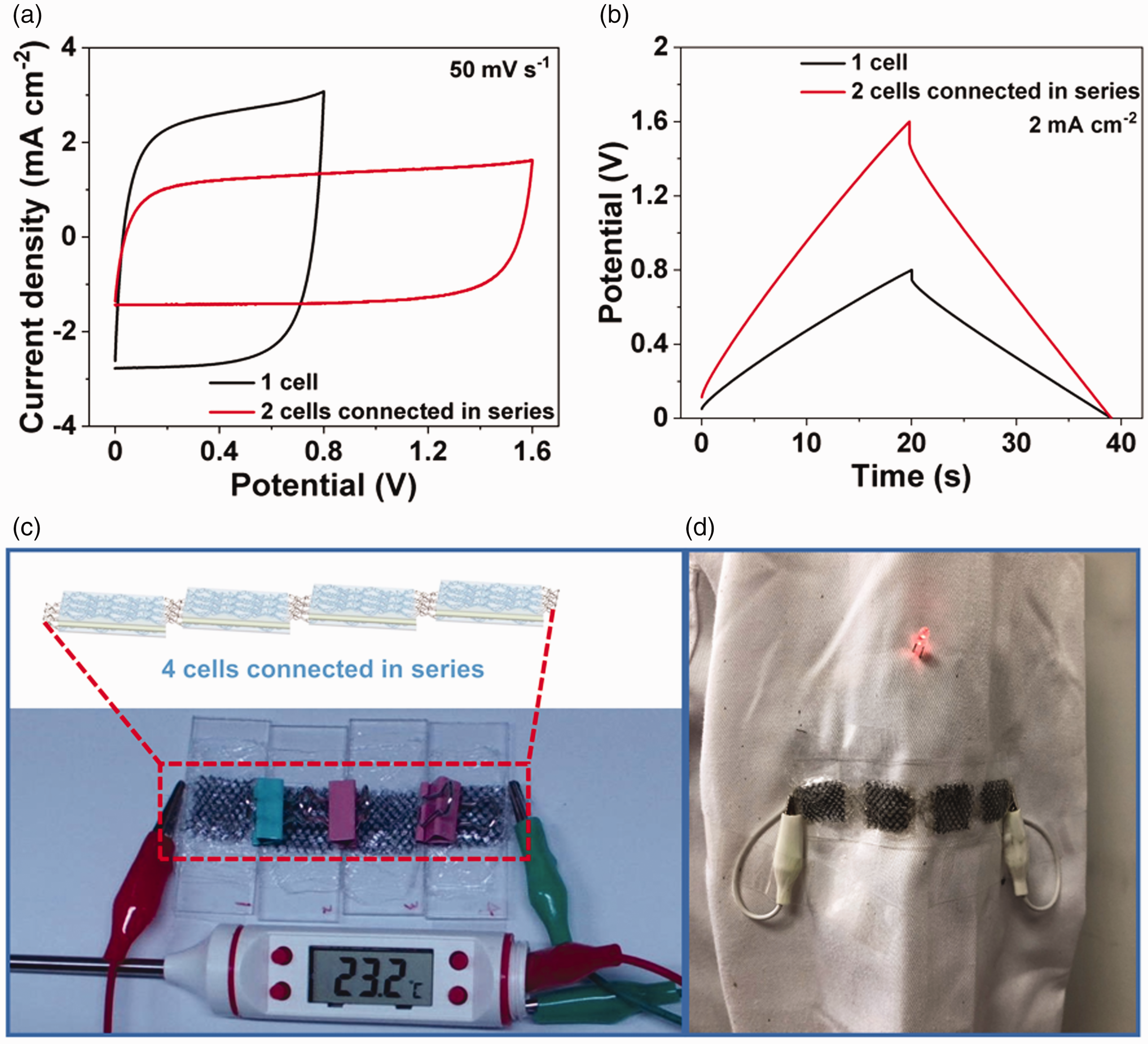
(a) Cyclic voltammetry curves of the single (black) and two serially connected (red) supercapacitors obtained at a scan rate of 50 mV s−1. (b) Galvanostatic charge–discharge curves of the single (black) and two serially connected (red) supercapacitors obtained at a current density of 2 mA cm−2. Four devices connected in series for the illumination of (c) a thermometer and (d) a light-emitting diode. (Color online only.)
Conclusions
In summary, a novel SSM with a diamond structure was used as a conductive stretchable substrate for the fabrication of flexible and stretchable SCs. The SSM, knitted by ultrafine stainless-steel fibers, has excellent properties such as flexibility, stretchability, light weight and conductivity, which is the opposite of the rigidity of metal woven fabrics. Experimental results show that the stretchable SC delivers an areal capacitance of 53 mF cm−2 and an energy density of 4.71 μWh cm−2 at a power density of 40 μW cm−2, and after 5000 cycles at a current density of 5 mA cm−2, the SC also demonstrates good capacitance retention of 73%. In addition, the fabricated all-solid-state stretchable SCs under 10% strains achieve good capacitance retentions of 78% at 5 mA cm−2 after 500 stretching cycles and exhibit outstanding flexibility and stability under various bending deformations. The assembled SC can illuminate a LED and a thermometer, demonstrating its potential application as a stretchable SC. We believe that such an all-solid-state stretchable SC with SSM as the substrate for the electrode and current collector will promote the evolution of highly flexible, stretchable, lightweight and wearable electronics and integrated fabric power devices.
Footnotes
Declaration of conflicting interests
The author(s) declared no potential conflicts of interest with respect to the research, authorship, and/or publication of this article.
Funding
The author(s) disclosed receipt of the following financial support for the research, authorship and/or publication of this article: This work was supported by the Shanghai Natural Science Foundation of the Shanghai Municipal Science and Technology Commission (20ZR1400600), the Fundamental Research Funds for the Central Universities (grant no. 2232021G-06, 2232020A-05) and the Innovation of Doctoral Dissertation of Donghua University (grant no. CUSF-DH-D-2020029).
